Application of a Peptide Nucleic Acid-Based Asymmetric Real-Time
PCR Method for Rapid Detection of Vibrio cholerae
Mingyeong Kang1.2 and Taek-Kyun Lee1,2*
1Ecological Risk Research Division, Korea Institute of Ocean Science and Technology
2Ocean Science, University of Science and Technology
비브리오 콜레라 신속 검출을 위한 펩티드 핵산 기반 비대칭
real-time PCR 방법의 적용
강민경1.2, 이택견1,2*
1한국해양과학기술원 생태위해성 연구부, 2과학기술 연합대학원 대학교 해양과학과
Abstract Vibrio cholerae is a very important pathogenic bacterium that has to be monitored in seafood and ships' ballast water. Various methods have been developed to identify this bacterium, yet these methods are time-consuming and have limitations for their sensitivity to detect contamination. The purpose of the present study was to develop a robust and reliable method for identifying V. cholerae. Peptide nucleic acid (PNA) probes were developed to use for PNA-based asymmetrical real-time PCR techniques. The toxigenic Cholera enterotoxin subunit B (ctxB) gene was selected as a target for detecting V. cholerae and the gene was synthesized as a positive template for conventional and real-time PCR. Real-time PCR primers and PNA probes were designed and standard curves were produced for the quantitative analysis. The selected PNA probes reacted specifically to V. cholerae without any ambiguity, even among closely related species, and the detection limit was 0.1 cfu/100 mL. Taken together, the PNA probes and asymmetrical qPCR methods developed in this present study could contribute to the rapid, accurate monitoring of V. cholerae in marine environments, and as well as in seafood and ships' ballast waters.
요 약 비브리오 콜레라는 수산물과 선박평형수 내에서 모니터링되고 있는 중요 병원성 박테리아이다. 이를 검출하기 위한 여러 방법들이 개발되어 왔으나, 시간 소모가 크고 민감도에서 한계가 있었다. 본 연구는 비브리오 콜레라를 보다 정확하게 검출하기 위한 방법을 개발하는 목적으로 수행하였다. PNA 기반 비대칭 real-time PCR 기술에 적용하기 위 하여 펩티드 핵산(Peptide nucleic acid, PNA) 프로브를 개발하였다. 독성 유전자인 Cholera enterotoxin subunit B (ctxB)를 비브리오 콜레라 검출을 위한 타겟 유전자로 선정하고, conventional PCR과 real-time PCR을 위한 positive template를 합성하였다. Real-time PCR 프라이머와 PNA 프로브를 디자인하여, 정량 분석을 위한 표준곡선 실험을 수행하였다. 선택된 PNA 프로브는 비브리오 콜레라에 특이적으로 반응하였으며, 검출한계는 0.1 cfu/100 mL이 었다. 종합해 보면, 본 연구에서 개발된 PNA 프로브와 비대칭 real-time PCR 방법은 수산물과 선박평형수 뿐만 아니라 해양환경에 있는 비브리오 콜레라를 신속하고 정확하게 모니터링할 수 있는 기술로 판단된다.
Keywords : Vibrio Cholerae, Cholera Enterotoxin Subunit B (ctxB), Peptide Nucleic Acid, Asymmetrical qPCR, Monitoring
This research was supported by the the Bio & Medical Technology Development Program of the National Research Foundation (NRF) funded by the Ministry of Science and ICT (MSIT) (NRF-2017M3A9E4072753).
*Corresponding Author : Taek-Kyun Lee(Korea Institute of Ocean Science & Technology) email: [email protected]
Received August 13, 2019 Revised October 2, 2019 Accepted December 6, 2019 Published December 31, 2019
1. Introduction
Vibrio species belong to Gram-negative facultative bacteria and have a curved rod shape [1]. There are dozens of known species in the genus Vibrio, most of which are known to be pathogenic. In particular, Vibrio cholerae is an infectious bacterium that causes watery diarrhea and leads to rapid dehydration and death.
Coastal waters are an important reservoir for V.
cholerae, and V. cholera is generally transmitted to humans through contaminated seawater or seafood [2, 3]. Due to the rapid infectivity and severe symptoms of V. cholerae, monitoring in marine environments and seafood is very important. It is especially necessary to develop an accurate and rapid method for the detection of toxigenic V. cholerae with a view to predicting microbes according to the ballast water guidance that has recently become effective [4].
In recent decades, nucleic acid amplification- based tests have been introduced and advanced as genetic techniques. Thereafter, various microbial detection methods have been improved. Ideally, methods for the evaluation of microbial contamination should be fast, sensitive, and specific. To meet these needs, microarrays [5, 6], immunoassays [7], loop-mediated isothermal amplification assays (LAMP) [8], and real-time PCR [9, 10] have been applied to the detection of V. cholerae. Despite the technological advances in V. cholerae detection, there remains a need for further development of advanced methods in terms of stability and sensitivity. In this regard, peptide nucleic acid-based research methods have been recently applied to improve the stability and sensitivity of DNA probe-based qPCR [11].
Peptide nucleic acid (PNA) is an artificially synthesized DNA analogue [12] with an uncharged peptide backbone. PNA has chemical, thermodynamic, and biological stability due to the peptide bond-linked backbone [13]. It is
more specific than DNA-DNA hybridization and is not degraded by nucleases or proteases [14].
These characteristics ensure that the melting temperature (Tm) of the PNA probes is high, making them available as robust and reliable diagnostic tools [15, 16]. Therefore, multiplex PCR [17], LAMP [18], and fluorescence in situ hybridization (FISH) [19] technologies based on PNA have been used for the detection of pathogenic bacteria. However, PNA-based real-time PCR has not yet been developed for the detection of V. cholerae. The objective of the present work was to develop highly specific and sensitive molecular methods based on PNA for the rapid identification and monitoring of V.
cholerae in marine products and in ballast water.
Using the synthesized V. cholerae ctxB gene as a template, an experimental method was established to detect < 1 cfu/100 mL within 2 h.
To the best of our knowledge, this is the first study to apply PNA-based asymmetrical qPCR to V. cholerae detection. This method has the potential to be used as a generic method for the prediction of waterborne microorganisms that are important to public health issues.
2. Materials and Methods
2.1 Conventional PCRThe species-specific primers for the V.
cholerae ctxB gene were designed using the Primer-BLAST program at NCBI. As a result of the combination of the forward and reverse primers, the size of the amplified PCR product was designed to be 97−242 base pairs (bp).
Conventional PCR conditions were constructed such that various sizes of PCR product could be synthesized as follows: 1 μL template, 10 μM forward primer, 1 μL reverse primer, 10 μM 10×
PCR buffer, 2 μL dNTP mix, and 0.5 μL Taq polymerase. The reaction conditions were
denaturation at 95°C for 10 min, followed by 30 cycles of amplification at 95°C for 30 sec, 60°C for 30 sec, and 72°C for 30 sec, followed by 35 cycles and a final reaction at 72°C for 10 min.
The PCR product was confirmed by electrophoresis using a 2% agarose gel. The primer combination for the band that was most clearly generated by electrophoresis was selected for detection of the V. cholerae ctxB gene. The nucleotide sequences of the selected primers were: forward 5'-ACCACCACACACAAATACATACG-3' and reverse 5'-GCAATCCTCAGGGTATCCTTC-3', and the PCR product size was 190 bp.
2.2 Real-time PCR
A real-time PCR assay for the detection of V.
cholerae was carried out in a final reaction volume of 20 µL containing 1 µL template, 1 µL 5 pM forward primer, 1 µL 5 pM reverse primer, 10 µL 2× SYBR qPCR mix, and 7 µL distilled water. PCR conditions were optimized as an initial pre-denaturation at 95°C for 5 min, followed by 45 cycles of denaturation at 95°C for 10 sec, and annealing and extension at 60°C for 30 sec. The melting curve analysis was then followed by heating from 60°C to 97°C at 0.1°C per sec.
2.3 PNA-based asymmetrical real-time PCR To ensure accurate amplification of the V.
cholerae ctxB gene, 1 µL template, 1 µL PNA probe, 1 µL 4 pM forward primer, 1 µL 20 pM reverse primer, 9 µL 2.5× PCR buffer, and 1 µL Taq polymerase were mixed, and the reaction volume was adjusted to 25 µL with distilled water.
In the asymmetrical PCR reaction, the ratio of the forward primer to the reverse primer was 1:5.
PNA-based asymmetrical qPCR was performed by denaturation at 95°C for 10 min, followed by 45 cycles of 95°C for 10 sec, 60°C for 30 sec, and 72°C for 15 sec. Melting curve analysis was performed following the asymmetrical PCR
reaction by setting denaturation at 95°C for 5 min and at 37°C for 5 min, and measuring the fluorescence while increasing the temperature from 37°C to 80°C at 0.1°C per sec.
3. Results
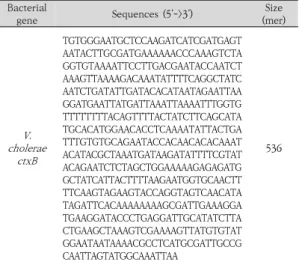
3.1 Synthesis of the ctxB gene as a template Cholera enterotoxin subunit B (ctxB) was selected as a specific gene for the detection of Vibrio cholerae. To select the toxigenic ctxB gene sequences of the O1 and O139 serogroups, the nucleotide sequences of the Vibrio species registered in the National Center for Biotechnology Information (NCBI, USA) database were compared and analyzed. The nucleotide sequence of the ctxB gene was selected as 536 bp, and synthesis by Bioneer, South Korea was requested (Table 1). To confirm whether the synthesized gene was inserted properly into the pBHA vector, the nucleotide sequence obtained from EcoRI restriction enzyme digestion and sequencing was compared with the synthesized nucleotide sequence. The synthesized ctxB gene was used as a template for the design of primers and PNA probes for the detection of V. cholerae.
Table 1. Synthesized V. cholerae ctxB gene fragment.
Bacterial
gene Sequences (5’->3’) Size (mer)
cholerae V.
ctxB
TGTGGGAATGCTCCAAGATCATCGATGAGT AATACTTGCGATGAAAAAACCCAAAGTCTA GGTGTAAAATTCCTTGACGAATACCAATCT AAAGTTAAAAGACAAATATTTTCAGGCTATC AATCTGATATTGATACACATAATAGAATTAA GGATGAATTATGATTAAATTAAAATTTGGTG TTTTTTTTACAGTTTTACTATCTTCAGCATA TGCACATGGAACACCTCAAAATATTACTGA TTTGTGTGCAGAATACCACAACACACAAAT ACATACGCTAAATGATAAGATATTTTCGTAT ACAGAATCTCTAGCTGGAAAAAGAGAGATG GCTATCATTACTTTTAAGAATGGTGCAACTT TTCAAGTAGAAGTACCAGGTAGTCAACATA TAGATTCACAAAAAAAAGCGATTGAAAGGA TGAAGGATACCCTGAGGATTGCATATCTTA CTGAAGCTAAAGTCGAAAAGTTATGTGTAT GGAATAATAAAACGCCTCATGCGATTGCCG CAATTAGTATGGCAAATTAA
536
3.2 Real-time PCR
For the quantitative detection of the V. cholerae ctxB gene, real-time PCR was performed using primers selected by conventional PCR. The ctxB gene was diluted to 1×101−1×10⁸ copies/mL, real-time PCR was performed using SYBR Green, and a standard curve was created (Fig. 1). The detection limit of the ctxB gene obtained from the real-time PCR reaction and standard curves was 1×10² copies/mL. To confirm that the selected primers reacted specifically with toxic V.
cholerae, cross-reactivity analysis with other species (V. xuii, V. sinaloensis, V. litoralis, V.
zureus, and V natriegens) was performed. PCR results show that the primers for the selected ctxB gene did not react with other Vibrio species, only with V. cholerae (Table 2).
Fig. 1. Real-time PCR and standard curve for V.
cholera ctxB gene. (a) real-time PCR reaction curve. (b) standard curve.
Table 2. Cross reactivity with various Vibrio species.
Samples Cq value Reactivity Negative controla 30.224 -
V. cholerae 19.029 +
V. xuii - -
V. sinaloensis 31.389 -
V. litoralis 30.316 -
V. zureus - -
V. natriegens 29.033 -
a is the no template reaction
3.3 PNA probe design
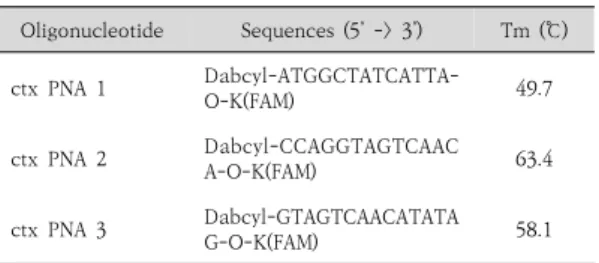
For optimization of the fusion temperature, PNA probes were designed for the detection of the V. cholerae ctxB gene using the complementary sequence to that of the ctxB gene (Table 3). Probes were covalently labelled at the 5ʹ-end with a dabsyl (dimethylamino- azosulphonic acid) quencher dye, and at the 3ʹ -end with a fluorophore (FAM) reporter dye. All the PNA probes used in the present study were synthesized using an HPLC purification method by Panagene, South Korea. The purity of all synthesized probes was confirmed by mass spectrometry.
Table 3. The nucleotide sequences of the PNA probes for the detection of ctxB genes of V.
cholerae.
Oligonucleotide Sequences (5’ -> 3’) Tm (℃) ctx PNA 1 Dabcyl-ATGGCTATCATTA-
O-K(FAM) 49.7
ctx PNA 2 Dabcyl-CCAGGTAGTCAAC
A-O-K(FAM) 63.4
ctx PNA 3 Dabcyl-GTAGTCAACATATA
G-O-K(FAM) 58.1
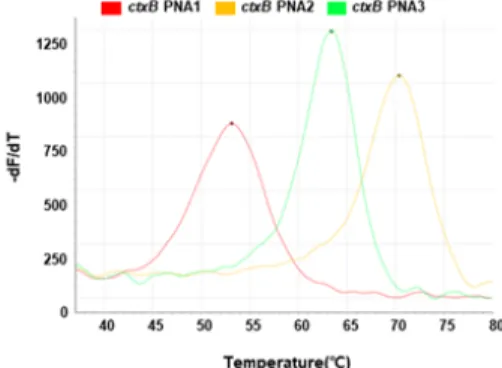
3.4 PNA-based asymmetrical real-time PCR Melting curve analysis using the selected primer sets and PNA probes was performed by MyGo mini real-time PCR (IT-IS Life Science Ltd, Ireland). Asymmetrical PCR was performed using primer sets and PNA probes to generate single-stranded target nucleic acids. Three different PNAs with different Tm values were
used for asymmetrical PCR reactions, and analysis of the melting curve shows that these three PNA probes had a melting peak at each temperature (Fig. 2). The Tm values of PNA1, PNA2, and PNA3 were 53°C, 70.2°C, and 63.2°C, respectively, and subsequent experiments, such as detection limit analysis, were performed using PNA2 with the highest Tm value. Analysis of the melting curve revealed that all three PNA probes for each species could be used to detect V.
cholerae and also in multiplex PCR form.
The detection limit of real-time PCR of the V.
cholerae ctxB gene-specific PNA probes was analyzed. The limit of detection was determined using the ctxB PNA2 probe, which shows the highest Tm value among the selected probes.
Asymmetrical PCR analysis revealed that the detection limit of the V. cholerae toxin gene ctxB was 0.1 cfu/100 mL (Fig. 3).
Fig. 2. Melting peak for Tm values of PNA1, PNA2, and PNA3 at each temperature.
Fig. 3. Standard curve for quantitative analysis of V.
cholerae using PNA probes.
4. Discussion
Peptide nucleic acid (PNA) is a polyamide analogue of DNA that was first proposed in 1991 [20]. PNA has a structure in which the sugar-phosphate backbone of DNA is replaced with a polyamide consisting of repeated N-(2-aminoethyl) glycine units, but it behaves like DNA and promotes binding and selectivity.
PNA has gained attention as a diagnostic tool in several attractive fields [21] and has been successfully applied to the detection of point mutations and single nucleotide polymorphisms (SNPs) in diagnosis, particularly of cancer, by exploiting the high sensitivity of PNA probes to RNA and DNA [22]. PNA probes have been developed and used as sensors and diagnostic kits for the rapid screening of biomedical applications and biological items [23].
In the present study, PNA probes were developed as a diagnostic tool for the monitoring of V. cholerae in seafoods and ship ballast water, and quantitative analysis was performed in conjunction with real-time PCR. We selected the ctxB gene of toxigenic V. cholerae as the target for the development of PNA probes [24, 25]. To obtain the real-time PCR template, a method of synthesizing the ctxB gene was selected instead of culturing V. cholera, which is difficult to perform in the general laboratory (Table 1). We designed various primers for conventional and real-time PCR, selected optimal primer sets by evaluating product size and reaction intensity, and finally designed PNA probes containing a fluorescent reporter dye (Table 3). The optimal reaction conditions for asymmetrical real-time PCR with PNA probes were established and the detection limits were calculated as 0.1 cfu/100 mL when applied to the standard curve, which is consistent with seafoods and the detection criteria for ballast water (Fig. 3). The detection limits for multiplex PCR using the ctxA, chxA, and vopF genes [10] and for the LAMP assay
using the ctxA gene [8] were 10 cfu/PCR tube and 10 cfu/mL, respectively. These results show that the sensitivity in the present study using PNA probes is relatively higher than that using non-PNA probes.
To the best of our knowledge, this study is the first application of the PNA-based asymmetrical real-time PCR method for the detection of V.
cholerae. The PNA-based qPCR method proposed in the present study significantly reduced the detection time as compared with culture-based methods and improved sensitivity as compared with previous gene-based detection methods. The PNA-based asymmetrical real-time PCR method has high specificity and sensitivity for V. cholerae detection and can be used as a simple, fast, and robust detection method. This method will be useful for the detection of V.
cholerae in marine environments as well as in specific samples such as seafood and ship ballast water.
5. Conclusion
Although Vibrio cholerae is a critical pathogenic bacterium, diagnostic techniques are time-consuming and have limitations in sensitivity. In this study, a detection method was developed for the identification of V. cholerae with PNA-based asymmetrical real-time PCR. We selected the ctxB gene as the target for the detection and designed the real-time PCR primers and PNA probes containing a fluorescent reporter dye. Three different PNAs with different Tm values were designed for asymmetrical PCR reactions, and performed using PNA2 with the highest Tm value. The selected PNA probes detected specifically to V. cholerae without any ambiguity, even among closely related species and the detection limit was calculated as 0.1 cfu/100 mL, which is more sensitive than non-PNA probes. This study provided useful
diagnostic method for the detection of V.
Cholerae in seafoods and ship ballast water.
References
[1] Faruque, S.M. and G.B. Nair, "Molecular ecology of toxigenic Vibrio cholerae", Microbiology and immunology, Vol.46, No.2, pp.59-66, 2002.
DOI: https://doi.org/10.1111/j.1348-0421.2002.tb02659.x [2] Farmer III JJ, J.J., Brenner FW, Cameron DN, Birkhead
KM, Bergey's Manual® of Systematic Bacteriology.
p.494–546, Springer US, 2005.
DOI: https://doi.org/10.1007/0-387-28022-7
[3] Messelhausser, U., J. Colditz, D. Tharigen, W. Kleih, C.
Holler, and U. Busch, "Detection and differentiation of Vibrio spp. in seafood and fish samples with cultural and molecular methods", International journal of food microbiology, Vol.142, No.3, pp.360-4, 2010.
DOI: https://doi.org/10.1016/j.ijfoodmicro.2010.07.020 [4] Darling, J.A. and R.M. Frederick, "Nucleic acids-based
tools for ballast water surveillance, monitoring, and research", Journal of sea research, Vol.133, pp.43-52, 2018.
DOI: https://doi.org/10.1016/j.seares.2017.02.005 [5] Kim, I.H., B.S. Kim, K.S. Lee, I.J. Kim, J.S. Son, and K.S.
Kim, "Identification of virulence factors in vibrio vulnificus by comparative transcriptomic analyses between clinical and environmental isolates using cDNA microarray", Journal of microbiology and biotechnology, Vol.21, No.12, pp.1228-35, 2011.
DOI: https://doi.org/10.4014/jmb.1111.11016 [6] Li, S., H. Liu, Y. Deng, L. Lin, and N. He, "Development
of a magnetic nanoparticles microarray for simultaneous and simple detection of foodborne pathogens", Journal of biomedical nanotechnology, Vol.9, No.7, pp.1254-60, 2013.
DOI: https://doi.org/10.1166/jbn.2013.1610
[7] Chen, A., M.N. Tamburri, R.R. Colwell, and A. Huq,
"Potential application of SMART II for Vibrio cholerae O1 and O139 detection in ship's ballast water", Marine pollution bulletin, Vol.136, pp.79-83, 2018.
DOI: https://doi.org/10.1016/j.marpolbul.2018.08.029 [8] Engku Nur Syafirah, E.A.R., A.B. Nurul Najian, P.C.
Foo, M.R. Mohd Ali, M. Mohamed, and C.Y. Yean, "An ambient temperature stable and ready-to-use loop-mediated isothermal amplification assay for detection of toxigenic Vibrio cholerae in outbreak settings", Acta tropica, Vol.182, pp.223-231, 2018.
DOI: https://doi.org/10.1016/j.actatropica.2018.03.004 [9] Greig, D.R., T.J. Hickey, M.D. Boxall, H. Begum, A.
Gentle, C. Jenkins, and M.A. Chattaway, "A real-time multiplex PCR for the identification and typing of Vibrio cholerae", Diagnostic microbiology and
infectious disease, Vol.90, No.3, pp.171-176, 2018.
DOI: https://doi.org/10.1016/j.actatropica.2018.03.004 [10] Awasthi, S.P., N. Chowdhury, S.B. Neogi, A. Hinenoya,
N. Hatanaka, G. Chowdhury, T. Ramamurthy, and S.
Yamasaki, "Development of a multiplex PCR assay for the detection of major virulence genes in Vibrio cholerae including non-O1 and non-O139 serogroups", Journal of microbiological methods, Vol.157, pp.54-58, 2019.
DOI: https://doi.org/10.1016/j.mimet.2018.12.012 [11] Zhang, X., K. Li, S. Wu, J. Shuai, and W. Fang, "Peptide
nucleic acid fluorescence in-situ hybridization for identification of Vibrio spp. in aquatic products and environments", International journal of food microbiology, Vol.206, pp.39-44, 2015.
DOI: https://doi.org/10.1016/j.ijfoodmicro.2015.04.017 [12] Noh, E.S., H.S. Kang, E.M. Kim, J.K. Noh, J.Y. Park,
T.-J. Choi, and J.-H. Kang, "Rapid Differentiation of Seven Species of Anguilla Using PNA Clamping-based Asymmetric PCR with Fluorescence Melting Curve Analysis", BioChip Journal, Vol.12, No.1, pp.46-51, 2018.
DOI: https://doi.org/10.1007/s13206-017-2106-y [13] Choi, Y.J., H.S. Kim, S.H. Lee, J.S. Park, H.S. Nam, H.J.
Kim, C.J. Kim, D.J. Jeong, K.S. Park, and K.A. Baek,
"Evaluation of peptide nucleic acid array for the detection of hepatitis B virus mutations associated with antiviral resistance", Archives of virology, Vol.156, No.9, pp.1517-24, 2011.
DOI: https://doi.org/10.1007/s00705-011-1019-7 [14] Kim, J.W., Y.J. Choi, H.J. Kim, J.S. Park, H.S. Nam, Y.
Hwangbo, D.U. Kim, and K.S. Park, "Comparison of PNA probe-based real-time PCR and Cobas TaqMan MTB for detection of MTBC", BioChip Journal, Vol.7, No.2, pp.85-88, 2013.
DOI: https://doi.org/10.1007/s13206-013-7201-0 [15] Cerqueira, L., N.F. Azevedo, C. Almeida, T. Jardim,
C.W. Keevil, and M.J. Vieira, "DNA mimics for the rapid identification of microorganisms by fluorescence in situ hybridization (FISH)", International journal of molecular sciences, Vol.9, No.10, pp.1944-60, 2008.
DOI: https://doi.org/10.3390/ijms9101944
[16] Peleg, A.Y., Y. Tilahun, M.J. Fiandaca, E.M. D'Agata, L.
Venkataraman, R.C. Moellering, Jr., and G.M.
Eliopoulos, "Utility of peptide nucleic acid fluorescence in situ hybridization for rapid detection of Acinetobacter spp. and Pseudomonas aeruginosa", Journal of clinical microbiology, Vol.47, No.3, pp.830-2, 2009.
DOI: https://doi.org/10.1128/jcm.01724-08
[17] Jeong, S., J.O. Kim, S.H. Jeong, I.K. Bae, and W. Song,
"Evaluation of peptide nucleic acid-mediated multiplex real-time PCR kits for rapid detection of carbapenemase genes in gram-negative clinical isolates", Journal of microbiological methods, Vol.113, pp.4-9, 2015.
DOI: https://doi.org/10.1016/j.mimet.2015.03.019 [18] Sakai, J., T. Maeda, N. Tarumoto, K. Misawa, S.
Tamura, K. Imai, T. Yamaguchi, S. Iwata, T.
Murakami, and S. Maesaki, "A novel detection procedure for mutations in the 23S rRNA gene of Mycoplasma pneumoniae with peptide nucleic acid- mediated loop-mediated isothermal amplification assay", Journal of microbiological methods, Vol.141, pp.90-96, 2017.
DOI: https://doi.org/10.1016/j.mimet.2017.08.009 [19] Patel, N., D. Miller, N. Relhan, and H.W. Flynn, Jr.,
"Peptide Nucleic Acid-Fluorescence In Situ Hybridization for Detection of Staphylococci From Endophthalmitis Isolates: A Proof-of-Concept Study", Investigative ophthalmology & visual science, Vol.58, No.10, pp.4307-4309, 2017.
DOI: https://doi.org/10.1167/iovs.17-21535
[20] Nielsen, P.E., M. Egholm, R.H. Berg, and O. Buchardt,
"Sequence-selective recognition of DNA by strand displacement with a thymine-substituted polyamide", Science (New York, N.Y.), Vol.254, No.5037, pp.1497- 500, 1991.
DOI: https://doi.org/10.1126/science.1962210 [21] Nielsen, P.E., "Peptide nucleic acids (PNA) in chemical
biology and drug discovery", Chemistry & biodiversity, Vol.7, No.4, pp.786-804, 2010.
DOI: https://doi.org/10.1002/cbdv.201000005 [22] D'Agata, R., M.C. Giuffrida, and G. Spoto, "Peptide
Nucleic Acid-Based Biosensors for Cancer Diagnosis", Molecules (Basel, Switzerland), Vol.22, No.11, 2017.
DOI: https://doi.org/10.3390/molecules22111951 [23] Corradini, R., "Special Issue: Molecular Properties and
the Applications of Peptide Nucleic Acids", Molecules (Basel, Switzerland), Vol.23, No.8, 2018.
DOI: https://doi.org/10.3390/molecules23081977 [24] Bhuiyan, N.A., S. Nusrin, M. Alam, M. Morita, H.
Watanabe, T. Ramamurthy, A. Cravioto, and G.B. Nair,
"Changing genotypes of cholera toxin (CT) of Vibrio cholerae O139 in Bangladesh and description of three new CT genotypes", FEMS immunology and medical microbiology, Vol.57, No.2, pp.136-41, 2009.
DOI: https://doi.org/10.1111/j.1574-695X.2009.00590.x [25] Kumar, P. and S. Thomas, "Classical ctxB gene in
Vibrio cholerae O1 and O56 serogroups from Kerala, South India", Journal of medical microbiology, Vol.60, No.Pt 4, pp.559-60, 2011.
DOI: https://doi.org/10.1099/jmm.0.024752-0
Mingyeong Kang [Regular member]
• Feb. 2018 : SungKyunKwan Univ. Genetic Engineering, MS
• Sep. 2018 ~ Current : KIOST, Assistant Researcher
• Sep. 2019 ~ Current : Univ. of Science and Technology, Ocean Science, PhD course
<Research Interests>
Molecular Biology, Marine Biotechnology
Taek-Kyun Lee [Regular member]
• Feb. 1991 : SungKyunKwan Univ. Biology, MS
• Feb. 1998 : SungKyunKwan Univ. Plant Molecular Biology, PhD
• Sep. 1998 ~ Aug. 2000 : KIOST, PostDoc
• Sep. 2000 ~ Current : KIOST, Principal Research Scientist
<Research Interests>
Marine Biotechnology, Marine Pathogens