www.kafm.or.kr
503
서 론최근 고령화가 급격히 진행되면서 노인에 대한 관심이 급증하고 있다. 그러나 이러한 관심에도 불구하고 노인의 안전사고는 해마다 증가하고 있는 실정이다.1)
노인의 안전사고 중 운수사고로 인한 사망률은 2014년 통계청에 서 보고한 사망원인통계 자료 기준으로 국내 전체 사망순위 9위로 10년 전에 비해 순위가 하락하기는 하였으나 노인에서 사망의 외인 에 의한 사망률 2위를 차지하고 있어2) 노인의 안전사고 중에서도 운
수사고로 인한 문제가 사회적으로 심각한 문제임을 알 수 있다.
하지만 우리 주변에서 일어나는 사고의 90% 이상은 예방 가능한 것이므로 사고의 일차예방이 중요하다.3) Lee와 Hwang4)의 연구에서 노인들이 사고를 당하는 이유 중 안전의식 부족이 가장 많은 것으로 조사되었고 실제로 사고의 대부분은 순간적인 방심과 부주의에 의 하여 발생한다고 볼 수 있다.5) 따라서 안전사고를 예방하기 위해서 안전의식을 강화할 필요성이 있다.4)
그러기 위해서는 먼저 노인의 안전의식에 어떤 인자들이 영향을 미치는지 확인하는 일이 중요한데, Cho 등6)의 연구에서 안전벨트를
Association between Stress and Use of Seat Belts in Korean Elders: The Sixth Korean National Health and Nutrition Examination Survey 2014
Hyeon Jin Yang, Han Eol Kang, Youn Seon Choi*, So Yang An, Gyoeng Na Lee, Sang Ah Seok Department of Family Medicine, Korea University Guro Hospital, Seoul, Korea
Background: Stress can have negative effects on safety awareness, but there is insufficient knowledge about the association between stress and use of seat belts in elders. Therefore, this study investigated the associations between stress and use of seat belts in Korean elders.
Methods: This cross-sectional descriptive study used data from the second year of the 6th Korean National Health and Nutrition Examination Survey implemented in 2014, conducted on 1,338 people aged 65 years and over. The chi-square test was used to confirm the relationship between stress perception and use of seat belts. Stress perception and use of seat belts were analyzed by a multiple logistic regression analysis with corrected variables.
Results: This study investigated the relationship between stress perception and use of seat belts in drivers and front-seat passengers aged 65 years and over. There was no significance between stress perception and use of seat belts.
Conclusion: The results of this study show that there is no relationship between stress perception and use of seat belts in people aged 65 years and over.
Keywords: Elder; Stress; Seat Belt; Driver
Received July 8, 2016 Revised September 18, 2016 Accepted September 23, 2016
Corresponding author Youn Seon Choi Tel: +82-2-2626-3276, Fax: +82-2-837-0613 E-mail: [email protected]
Copyright © 2017 The Korean Academy of Family Medicine
This is an open-access article distributed under the terms of the Creative Commons At- tribution Non-Commercial License (http://creativecommons.org/licenses/by-nc/4.0) which permits unrestricted noncommercial use, distribution, and reproduction in any medium, provided the original work is properly cited.
한국 노인의 스트레스와 안전벨트 착용과의 연관성:
2014년 제6기 국민건강영양조사
양현진, 강한얼, 최윤선*, 안소양, 이경나, 석상아
고려대학교 구로병원 가정의학과
Original Article
https://doi.org/10.21215/kjfp.2017.7.4.503 eISSN 2233-9116
Korean J Fam Pract. 2017;7(4):503-506
Korean Journal of Family Practice
KJFP
Hyeon Jin Yang, et al. Association between Stress and Use of Seat Belts in Korean Elders
www.kafm.or.kr
504
Korean J Fam Pract. 2017;7(4):503-506Korean Journal of Family Practice
KJFP
항상 매는 집단에서 스트레스의 정도가 낮아 서로 유의한 관계를 보 이는 것으로 나타났다. 하지만 이 연구에서는 대상 인구가 건강증진 을 목적으로 병원을 방문한 당시 60세 이상의 수진자로서 우리나라 의 노인을 대표할 수 없으므로 이 결과를 전체로 확대하기에는 한계 가 있다는 제한점이 있었다.
그래서 본문에서는 국민건강영양조사 자료를 이용하여 한국 노 인에서 스트레스와 안전벨트 착용과의 연관성에 대해 살펴보고자 한다.
방 법
1. 연구 대상
연구 대상은 2014년 국민건강영양조사 제6기 2차년도차 원시자료 를 이용하였다. 국민건강영양조사는 가용한 가장 최근 시점의 인구 주택총조사 자료를 사용하여 조사구 및 가구를 1, 2차 추출단위로 하는 2단계 층화집락표본추출방법을 통해 표본을 추출하는 방식으 로 진행되었다.7)
제6기 2차년도(2014년)의 조사대상자는 9,701명이었고, 건강설문 조사, 검진조사, 영양조사 중 1개 이상 참여자는 7,550명, 참여율은 77.8%였다.7) 본 연구에서는 2014년 건강설문조사 대상자 총 7,167명 중 나이가 65세 이상인 대상은 1,527명이고 그 중에 스트레스 인지 여부 데이터가 결측인 사람을 제외한 대상은 총 1,338명으로 조사되 어 최종 분석대상군은 1,338명으로 하였다.
2. 자료 수집 방법 및 절차
본 연구에서는 국민건강영양조사 자료 중 건강설문조사를 통해 얻어진 자료 가운데 본 연구에서는 인구사회학적 특성, 건강행태, 스 트레스 인지 여부 및 안전벨트 착용 여부 문항을 이용하였다.7) 인구 사회학적 특성에서는 성별, 학력, 독거 여부, 가구 소득 문항을 분석 에 이용하였고, 건강행태에서는 현재 흡연 여부, 월간 음주 여부, 걷 기 실천 여부를 분석에 이용하였다.7)
학력은 고등학교 졸업 미만과 고등학교 졸업 이상으로 구분하였 으며, 가구소득은 ‘상’, ‘중상’, ‘중하’, ‘하’로 구분한 것을 이용하였다.7) 현재 흡연은 ‘현재 담배를 피우고 있는 경우’로 하였고, 월간 음주는
‘한 달에 1회 이상 음주하는 경우’로 정의하였으며, 걷기 실천은 걷기 를 1회 10분 이상, 1일 총 30분 이상 주 5일 이상 실천한 사람으로 정 의하였다.7)
스트레스 인지 여부는 평소 일상생활 중에 스트레스를 ‘대단히 많 이 느낀다’ 또는 ‘많이 느끼는 편이다’라고 응답한 경우로 하였다.7)
운전자 안전벨트 착용은 운전자 중 운전 시 안전벨트를 ‘대체로
매는 편이다’, ‘항상 맨다’고 응답한 경우로 하였고, 동승차량 앞좌석 안전벨트 착용은 다른 사람이 운전하는 자동차(택시 포함)의 앞좌 석 탑승 경험자 중 안전벨트를 ‘대체로 매는 편이다’, ‘항상 맨다’고 응 답한 경우로 하였다.7)
3. 자료분석 방법
본 연구에서 자료의 분석은 SAS ver. 9.4 program (SAS Institute, Cary, NC, USA)을 사용하였으며 통계적 유의수준은 0.05로 하였다.
스트레스 인지와 안전벨트 착용과의 관계를 확인하는 데에는 chi- square test를 이용하였고 스트레스와 안전벨트 착용에 대하여 보정 변수(성별, 가구원수, 개인소득, 학력, 현재 흡연 여부, 월간 음주 여 부, 걷기 실천 여부)와 함께 다중 로지스틱 회귀분석을 진행하였다.
결 과
1. 연구대상자의 일반적 특성
본 연구의 대상자는 65세 이상의 노인으로 총 1,338명이 참여하였 다.
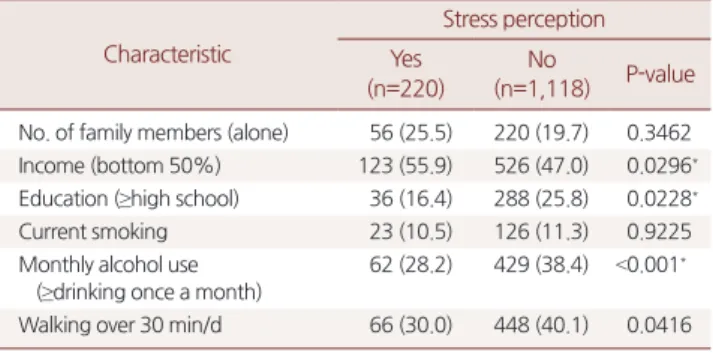
이 연구에 참여한 65세 이상의 노인을 스트레스 인지 여부에 따라 평소 일상생활 중에 스트레스를 ‘대단히 많이 느낀다’ 또는 ‘많이 느 끼는 편이다’라고 응답한 집단(n=220)과 그 외의 집단(n=1,118)으로 나누었고 두 집단의 일반적 특성은 Table 1과 같다. 스트레스 인지 여 부에 따른 일반적 특성 및 건강행태의 분포를 살펴보면, 가구원수 (P=0.3462), 가구소득(P=0.0296), 학력(P=0.0228), 월간 음주(P<0.001) 에서 스트레스를 많이 느끼는 집단과 그렇지 않은 집단 간의 유의한 차이가 있었다.
2. 스트레스와 안전벨트 착용과의 관계
우리나라 65세 이상의 노인에서 운전자의 안전벨트 착용 여부는
Table 1. Baseline characteristics of study subjects Characteristic
Stress perception Yes
(n=220)
No
(n=1,118) P-value No. of family members (alone) 56 (25.5) 220 (19.7) 0.3462 Income (bottom 50%) 123 (55.9) 526 (47.0) 0.0296* Education (≥high school) 36 (16.4) 288 (25.8) 0.0228*
Current smoking 23 (10.5) 126 (11.3) 0.9225
Monthly alcohol use (≥drinking once a month)
62 (28.2) 429 (38.4) <0.001*
Walking over 30 min/d 66 (30.0) 448 (40.1) 0.0416 Values are presented as number (%).
*Asterisks indicate statistically significant associations (P<0.05).
www.kafm.or.kr 양현진 외. 한국 노인의 스트레스와 안전벨트 착용과의 연관성
Korean J Fam Pract. 2017;7(4):503-506
505
Korean Journal of Family Practice
KJFP
스트레스를 많이 받는 집단과 그렇지 않은 집단에서 각각 87.5%, 91.2%로 차이를 보였으나 통계적으로 유의하지 않았고 (P=0.2008) (Table 2), 동승차량 앞좌석 안전벨트 착용 여부는 스트레스를 많이 받는 집단과 그렇지 않은 집단에서 각각 84.8%, 87.1%로 차이를 보였 으나 역시 통계적으로 유의하지 않았다(P=0.4046) (Table 2).
스트레스와 안전벨트 착용과의 관계를 검정하기 위해 성별, 가구 원수, 개인소득, 학력, 현재 흡연 여부, 월간 음주 여부, 걷기 실천 여 부의 변수를 보정하여 다중 로지스틱 회귀분석을 실시하였다.
운전자의 안전벨트 착용 여부에 영향을 미치는 요인에 대한 다중 로지스틱 회귀분석을 실시한 결과 스트레스 인지 여부(P=0.213), 성 별(P=0.1621), 가구원수(P=0.5256), 개인소득(P=0.5129), 학력 (P=0.3838), 현재 흡연 여부(P=0.7024), 월간 음주 여부(P=0.5034), 걷 기 실천 여부(P=0.9115) 모두 운전자의 안전벨트 착용 여부에 대해 통 계적으로 유의한 결과를 나타내지 못했다(Table 3).
반면, 동승차량 앞좌석 안전벨트 착용 여부에 영향을 미치는 요인 에 대한 다중 로지스틱 회귀분석을 실시한 결과 스트레스 인지 여부 (P=0.6598), 성별(P=0.0699), 가구원수(P=0.1194), 개인소득(P=0.4019), 현재 흡연 여부(P=0.5439), 월간 음주 여부(P=0.1674), 걷기 실천 여부 (P=0.4711)는 동승차량 앞좌석 안전벨트 착용 여부에 대해 통계적으 로 유의한 결과를 나타내지 못했지만 학력(P=0.0067)은 유의한 결과 를 나타냈다(Table 3).
고 찰
최근 스트레스에 관련된 많은 연구들이 진행되었고, 스트레스가 노인으로 하여금 신체적, 정신적 건강에 부정적인 영향을 미친다는 사실은 이미 여러 연구들에서 확인되었다. 85세 이상의 노인들을 대 상으로 한 Jeon과 Dunkle8)의 연구에서는 더 많은 일상적 스트레스 를 경험하는 노인들에서 우울증이 증가하는 것으로 나타났고, Glass 등9)의 연구에 의하면 생활 스트레스를 더 많이 경험한 65세 이상 노 인들에서 우울증이 증가한 것으로 나타났다. 또한 스트레스는 제2형 당뇨병,10) 과민성대장증후군,11) 소화성 궤양,12) 비궤양성 소화불량13) 등과 연관성이 있는 것으로 보고되었다.
또한 현대에 들어서 안전의식에 대한 연구들도 활발히 이루어졌 는데, Lee 등1)은 노인의 안전의식에 영향을 미치는 요인을 분석하였 고 그 결과 연령과 건강상태, 그리고 고혈압이 통계적으로 유의하게 나타났다는 연구결과를 제시하였다. Oh와 Lee14)의 연구에서 일반적 특성에 따른 교통안전의식의 차이를 보면 성별, 거주지역, 과거직업 에서 통계적인 유의미한 차이가 있었다. 이처럼 노인의 안전의식에 영향을 미치는 요인에 대한 몇몇 연구가 이루어졌지만 스트레스와 안전의식과의 연관성에 대해서는 많은 연구가 이루어지지 않았다.
Cho 등6)의 연구에서 안전벨트를 항상 매는 집단에서 스트레스의 정도가 낮아 유의한 관계를 보였지만 대상 인구가 건강증진을 목적 으로 병원을 방문한 당시 60세 이상의 수진자로서 우리나라의 노인 Table 2. Association between stress perception and use of seat belts for drivers and front-seat passengers
Stress perception Use of seat belts for driver Use of seat belts for front-seat passenger
Yes No P-value Yes No P-value
Yes 35 (87.5) 5 (12.5) 0.2008 162 (84.8) 29 (15.2) 0.4046
No 323 (91.2) 31 (8.8) 847 (87.1) 126 (12.9)
Values are presented as number (%).
P-values are obtained by chi-square test.
Table 3. Multiple logistic regression analysis for use of seat belts for drivers and front-seat passengers of stress perception
Variable Use of seat belts for driver Use of seat belts for front-seat passenger
OR 95% CI P-value OR 95% CI P-value
Stress perception (no) 1.962 0.677–5.691 0.213 1.113 0.689–1.799 0.6598
Sex (female) 4.23 0.557–32.14 0.1621 1.59 0.962–2.628 0.0699
No. of family members (≥2) 1.424 0.475–4.263 0.5256 1.534 0.894–2.63 0.1194
Income (top 50%) 1.373 0.529–3.566 0.5129 0.837 0.55–1.272 0.4019
Education (≥high school) 1.496 0.602–3.718 0.3838 2.039 1.222–3.403 0.0067*
Current smoking (no) 1.228 0.425–3.546 0.7024 1.19 0.676–2.094 0.5439
Monthly alcohol use (no) 1.366 0.545–3.42 0.5034 0.736 0.475–1.139 0.1674
Walking over 30 min/d (no) 0.958 0.446–2.055 0.9115 1.159 0.774–1.736 0.4711
OR, odds ratio; CI, confidence interval.
*Asterisk indicates statistically significant associations (P<0.05). P-values are calculated by the analysis of logistic regression model for use of seat belts for drivers and front-seat passengers of stress perception, after adjustment for sex, number of family members, income, education, smoking, alcohol consumption and walking.
Hyeon Jin Yang, et al. Association between Stress and Use of Seat Belts in Korean Elders
www.kafm.or.kr
506
Korean J Fam Pract. 2017;7(4):503-506Korean Journal of Family Practice
KJFP
을 대표할 수 없으므로 이 결과를 전체로 확대하기에는 한계가 있다 는 제한점이 있었다.
이러한 대표성의 한계점을 해소하기 위해 본 연구에서는 전국에 서 추출된 표본을 조사함으로써 우리나라 국민을 대표할 수 있는 자료로 볼 수 있는 국민건강영양조사 자료를 이용하여 조사된 65세 이상 노인을 대상으로 하여 스트레스와 안전벨트 착용과의 연관성 을 파악하기 위해 분석을 진행하였다. 그러나 본 연구의 결과를 살펴 보면 스트레스 인지 여부와 안전벨트 착용 여부의 유의한 연관성은 확인되지 않았다. 다만 동승차량 앞좌석 안전벨트 착용 여부와 관련 하여 학력과의 유의한 연관성이 확인되었고 이는 65세 이상 노인에 서 고졸 이상의 학력을 가진 집단이 그렇지 않은 집단에 비해 동승 차량 앞좌석 안전벨트 착용을 더 잘 준수하고 있는 것으로 보여진 다.
본 연구에 대해서 몇 가지 한계점을 들 수 있다.
첫째, 스트레스 인지 여부에 대한 문항이 평소 일상생활 중에 스 트레스를 ‘대단히 많이 느낀다’ 또는 ‘많이 느끼는 편이다’라고 응답 한 사람을 기준으로 하고 있는데 이는 표준화된 스트레스 척도를 사용한 것이 아닌 개인의 주관적인 기준에 따라 조사되어 객관성이 떨어질 수 있다는 점이다. 둘째, 설문을 통해 조사가 이루어졌기 때 문에 설문 대상자의 불성실한 답변에 의한 오류가 존재할 수 있다는 점이다.
후속 연구에서는 표준화된 스트레스 척도를 사용하여 본 연구의 한계점을 보완하는 것이 중요하겠으며, 본 연구에서는 스트레스 인 지 여부와 안전벨트 착용 여부와의 연관성을 조사하는 데 그쳤으나 향후 추가적인 연구를 통하여 안전벨트 착용 외의 자전거 헬멧 착 용, 오토바이 헬멧 착용 등 다른 안전의식 요인들과의 연관성을 확인 함으로써 안전사고 예방에 활용할 필요가 있을 것으로 판단된다.
요 약
연구배경:
노인에서 스트레스는 안전 의식에 해가 될 수 있지만 스 트레스와 안전벨트 착용과의 연관성에 대한 연구는 아직까지는 적 다. 그러므로 이 연구는 한국 노인의 스트레스와 안전벨트 착용과의 연관성을 알아보고자 한다.방법:
본 연구는 2014년에 시행된 제6기 2차년도 국민 건강영양 조 사 결과를 이용한 횡단적 기술연구로 65세 이상의 노인 1,338명을 대 상으로 하였다. 스트레스 인지와 안전벨트 착용과의 관계를 확인하 는 데에는 카이제곱 검정을 이용하였고 스트레스 인지 여부와 안전 벨트 착용에 대하여 변수를 보정한 상태에서 다중 로지스틱 회귀분석을 시행하여 분석하였다.
결과:
65세 이상의 노인에서 스트레스 인지 여부와 운전자 안전벨트 착용여부, 동승차량 앞좌석 안전벨트 착용 여부와의 유의성을 조사 한 결과, 스트레스 인지 여부와 안전벨트 착용은 유의성이 없는 것 으로 조사되었다.결론:
본 연구 결과 65세 이상의 노인에서 스트레스와 안전벨트 착 용과의 연관성이 없는 것으로 나타났다.중심단어:
노인; 스트레스; 안전벨트; 운전자REFERENCES
1. Lee KJ, Lee MR, Cho YH. A study on safety awareness and accidents in el- ders. J Korean Gerontol Nurs 2008; 10: 48-57.
2. Statistics Korea. Cause of death statistics. Daejeon: Statistics Korea; 2014.
3. Lee KJ, Lee CY, Kang KS, Han JS. A study on the occurrences and policy de- velopment for accident prevention. J Nurs Acad Soc 1995; 25: 362-71.
4. Lee YM, Hwang SW. Prevalence and risk factors for atopic dermatitis in pre- school and school aged children. J Korean Acad Child Health Nurs 2008;
14: 285-94.
5. Jeon BJ, Yun KM. Safety consciousness according to school bus driver’s type at child care centers. J Korea Contents Assoc 2014; 11: 249-59.
6. Cho B, Ou S, Lee E, Seo S, Yoo T, Huh BY. Factors related with amount of stress in the elderly. J Korean Geriatr Soc 1998; 2: 72-81.
7. Ministry of Health and Welfare, Korea Center for Disease Control and Pre- vention. Guidelines for using raw data of Korean National Health and Nu- trition Examination Survey, the second survey of the sixth phase.
(KNHANES VI-2). Cheongju: Korea Center for Disease Control and Pre- vention; 2014.
8. Jeon HS, Dunkle RE. Stress and depression among the oldest-old: a longitu- dinal analysis. Res Aging 2009; 31: 661-87.
9. Glass TA, Kasl SV, Berkman LF. Stressful life events and depressive symp- toms among the elderly. Evidence from a prospective community study. J Aging Health 1997; 9: 70-89.
10. Surwit RS, Schneider MS, Feinglos MN. Stress and diabetes mellitus. Diabe- tes Care 1992; 15: 1413-22.
11. Choi JH. Clinical manifestations of irritable bowel syndrome and relation- ship between stress, family function and irritable bowel syndrome in high school students. Korean J Fam Med 1996; 17: 11-21.
12. Cho WS, Kang JH, Kim IH, Chung JS, Yoon SW. Analysis of stress by Korean social rcadjustment rating scale in peptic ulcer patients. Korean J Fam Med 1993; 14: 637-46.
13. Lee JY, Cho BS, Lee GY, Park TJ, Choi BH. Comparison of depression, anxi- ety and stress levels between non ulcer dyspepsia group and control group.
Korean J Fam Med 1997; 18: 411-23.
14. Oh SI, Lee WT. Life safety consciousness of the elderly and related factors. J Korean Acad Health Welf Elder 2010; 1: 1-18.