PGHN
Original Article
Foreign Body Ingestion in Children: Should Button Batteries in the Stomach Be Urgently Removed?
Jun Hee Lee, Jee Hoo Lee, Jung Ok Shim, Jung Hwa Lee, Baik-Lin Eun, and Kee Hwan Yoo
Department of Pediatrics, Korea University Guro Hospital, Korea University College of Medicine, Seoul, Korea
Purpose: Foreign body (FB) ingestion is common in children, and button battery (BB) ingestion has been increasing in recent years. This study was to identify factors related to outcomes of FB ingestion, particularly BBs in the stomach.
We evaluated whether the current recommendations are appropriate and aimed to suggest indications for endo- scopic removal of BB in the stomach in young children.
Methods: We investigated patient age, shape, size, location of FBs, spontaneous passage time and resulting compli- cations among 76 children. We observed types, size, location of BB and outcomes, and analyzed their associations with complications.
Results: Coins and BB were the two most common FBs. Their shapes and sizes were not associated with the sponta- neous passage time. Size, spontaneous passage time, and age were also not associated with any specific complications. For BB ingestion, all 5 cases with lithium batteries (≥1.5 cm, 3 V) presented moderate to major compli- cations in the esophagus and stomach without any symptoms, even when the batteries were in the stomach and beyond the duodenum, while no complications were noted in 7 cases with alkaline batteries (<1.5 cm, 1.5 V) (p=0.001). All endoscopies were conducted within 24 hours after ingestion.
Conclusion: The type and voltage of the battery should be considered when determining whether endoscopy is re- quired to remove a BB in the stomach. For lithium battery ingestion in young children, urgent endoscopic removal might be important in order to prevent complications, even if the child is asymptomatic and the battery is smaller than 2 cm.
Key Words: Foreign bodies, Endoscopy, Ingestion, Button battery
Received:September 2, 2015, Revised:September 23, 2015, Accepted:October 4, 2015
Corresponding author: Jung Ok Shim, Department of Pediatrics, Korea University Guro Hospital, 148 Gurodong-ro, Guro-gu, Seoul 08308, Korea.
Tel: +82-2-2626-3157, Fax: +82-2-2626-1249, E-mail: [email protected] Copyright ⓒ 2016 by The Korean Society of Pediatric Gastroenterology, Hepatology and Nutrition
This is an openaccess article distributed under the terms of the Creative Commons Attribution NonCommercial License (http://creativecommons.org/licenses/by-nc/4.0/) which permits unrestricted noncommercial use, distribution, and reproduction in any medium, provided the original work is properly cited.
INTRODUCTION
Foreign body (FB) ingestion is common in child- ren. It has been reported that the ages of children in-
gesting FBs and the types of ingested objects vary greatly. Children often swallow coins, toy parts, jew- elry, or batteries [1]. Most FB ingestions occur in children between 6 months and 3 years of age [2].
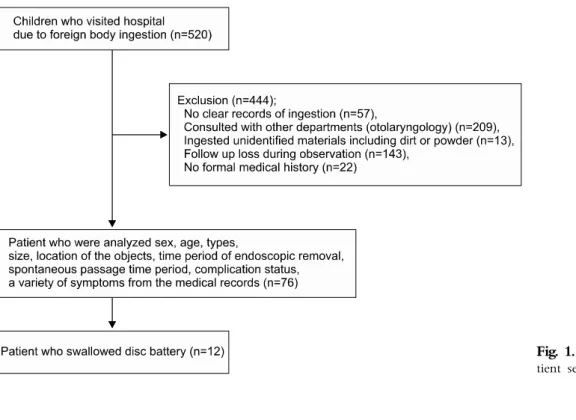
Fig. 1. Flow diagram of pa- tient selection.
These patients may have no symptoms or could present with severe complications that require emer- gent medical attention [3]. Ingested FBs may pass spontaneously with time, or patients could experi- ence complications, such as erosions, ulcers, and per- forations [4,5]. We particularly focused on how some factors correlated with the patient’s progress be- cause of the several different possible outcomes.
Battery ingestion in particular is potentially life threatening; when it is lodged in the esophagus, this is a medical emergency that requires immediate removal. Despite prompt removal, severe complica- tions and sequelae have been reported [6,7]. On the other hand, when it located in the stomach, it has been thought to be at low risk. 24-48 or more hours of observation are recommended. Recently, studies have reported complications caused by a button bat- tery located in the stomach [8]; since then, revised guidelines have been suggested [9,10].
In this study, we identified a variety of factors as- sociated with the ingestion of the FB, such as the type, size, and location of the objects ingested as well as the age of the children. We also investigated fac- tors associated with complications especially con-
cerning a button battery in the stomach. We aimed to evaluate if the current recommendations are appro- priate and to suggest indications for endoscopic re- moval of a button battery in the stomach in young children.
MATERIALS AND METHODS
We analyzed the medical records of 520 children under 18 years of age who visited Korea University Guro Hospital (Seoul, Korea) with complaints of FB ingestion from March 2012 through February 2015.
We excluded subjects with no clear histories of in- gestion, those who had the objects removed from their oral cavity or pharynx by otolaryngologists, children who ingested unidentified materials in- cluding dirt or powder, and subjects without com- plete follow-up medical records.
We assessed the patients’ demographic character- istics, including sex and age; the shape, size, and lo- cation of the objects confirmed by endoscopy or ra- diography; whether upper endoscopy was conducted and the time period of any endoscopic procedure af- ter FB ingestion; the time period in case of sponta-
Fig. 2. Age distribution (mean age, 3.13±3.07 years) of the 76 patients (44 boys [57.3%] and 32 girls [42.7%]) with foreign body ingestion.
Table 1. Nature and Frequency of Ingested Foreign Bodies Foreign body Numbers Frequency (%)
Coin 17 22.4
100 KRW coin 9 11.8
10 KRW coin* 4 5.3
500 KRW coin 2 2.6
50 KRW coin 2 2.6
Button battery 12 15.8
Earring 5 6.6
Go-stone 4 5.3
Fish bones 4 5.3
Ring (gold) 2 2.6
Hair pin 2 2.6
Iron beads 2 2.6
Magnet 2 2.6
Sticker 2 2.6
Glass pieces 2 2.6
Chicken bone 1 1.3
Metal objects† 13 17.1
Plastic objects‡ 8 10.5
Total 76 100
KRW: Korean Republic Won.
*2.29 cm, issued before December 2006, †clip, wire, spring, screw, needle, and so on, ‡button, brace, and so on.
neous passage; symptoms; and complications, in- cluding endoscopic findings when available.
In children who ingested a button battery, we also investigated the types, models, currents, and vol- tages of the batteries. Endoscopic findings were ana- lyzed with relations to these factors to determine which are associated to complications (Fig. 1). Medi- cal outcomes, including endoscopic findings, were defined modifying those of National Poison Data System of America as follow: (1) no complications:
no signs or symptoms, (2) minor complication: mini- mal signs or symptoms that resolved rapidly, (3) moderate complication: more pronounced, pro- longed, or multiple signs or symptoms, such as bloody stool or emesis, erosions, shallow ulcers or mucosal burns without sequelae, (4) major compli- cation: significant residual disability, such as deep ulcers or mucosal burns with protracted healing or long-term sequelae, systemic effects, perforation, or fistula [10].
Data analyses were performed using IBM SPSS Statistics ver. 20.0 (IBM Co., Armonk, NY, USA).
Categorical variables were assessed using the chi- square test and Fisher’s exact test, and continuous variables were assessed using the Mann- Whitney U test and Kruskal-Wallis test. p<0.05 was considered to be significant for the statistical tests. The study was conducted in accordance with the Declaration of
Helsinki and approved by the institutional review board of Korea University Guro Hospital (KUGH15123-001).
RESULTS
Patient descriptions and outcomes of children who ingested foreign bodies
Of total 520 children, 76 children were enrolled. Of them, 44 were male (57.9%) and 32 were female (42.1%). The mean age was 3.13±3.07 years. Eleven children were younger than 12 months (14.5%), 18 (23.7%) were 12-23 months, and 11 (14.5%) were 24-35 months. Patients under 36 months of age made up 52.6% of the total patients (Fig. 2).
Seven patients (9.2%) showed symptoms of chest discomfort, abdominal pain, bloody stool, or blood- tinged saliva. Coins were the most common FB in 17 cases (22.4%): 9 cases (11.8%) of 100 Korean Republic Won (KRW) coin (diameter 2.4 cm), 4 cases (5.3%) of 10 KRW coin (2.29 cm, issued before December 2006). The second most common FB was a button
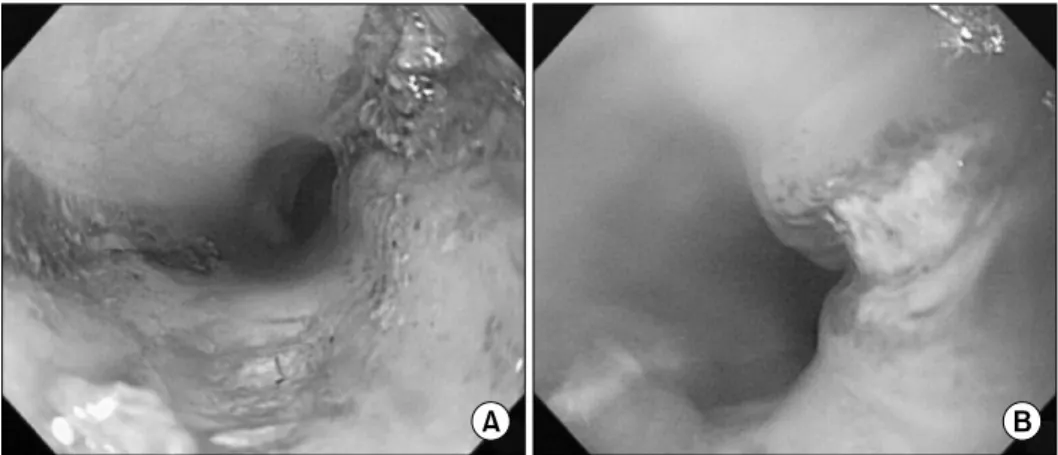
Fig. 3. Endoscopic fingings of children with lithiuim battery (2.0 cm, 3 V) lodged in the upper esophageal sphincter (UES). The lithium battery was removed from the UES within two hours after ingestion. (A) Mucosal burns and two linear ulcerations with dirty exudate and bleeding were noted in the UES. (B) After five days, a linear deep ulceration with basal whitish exudate and peripheral mucosal edema was remained. A shallow linear ulceration was noted in the opposite side of the esophagus.
Table 2. Location of the Foreign Body and How It Was Removed
Location Passed Spontaneously
Removed by
endoscopy Surgery Total
UES 0 5 0 5 (6.6)
UES-LES 0 3 0 3 (3.9)
Stomach 10 20 0 30 (39.5)
Duodenum 0 3 1 4 (5.3)
Distal to the duodenum
13 - 0 13 (17.1)
Unknown 21 - 0 21 (27.6)
Total 44 (57.9) 31 (40.8) 1 (1.3) 76 (100) Values are presented as number only or number (%).
UES: upper esophageal sphincter, LES: lower esophageal sphincter.
battery in 12 cases (15.8%), followed by earrings in 5 cases (6.6%), a Go-stone in 4 cases (5.3%), and fish bones in 4 cases (5.3%) (Table 1). The mean size of the foreign bodies was 2.00±0.98 (range, 0.5-6 cm) except for the unidentified sizes of 4 fish bones.
Objects sized ≥2 cm accounted for 50.0% (38 items).
Radiography and upper endoscopy were used to identify the location of the FB. Five objects (6.6%) were detected in the upper esophageal sphincter (UES), 3 (3.9%) in the mid- to lower esophageal sphincter (LES) and, most commonly, 30 (39.5%) in the stomach. Four objects (5.3%) were located in the
duodenum, while 13 (17.1%) were distal to the duo- denum, small bowel, and colon. Twenty-one objects (27.6%) were not observed with either radiography or upper endoscopy (Table 2).
Fifty-three of 76 children underwent upper endos- copy. The mean period of time from ingestion to the endoscopic procedure was 17.8±24.8 hours (range, 2-96 hours). Endoscopic removal succeeded in 31 cases; 1 underwent surgery due to perforation of the duodenum with a sharp object (a steel wire). In the remaining children, the FBs already moved past the duodenum, and spontaneously passed in the stool.
The mean passage time was 36.9±29.7 hours (range, 10-124 hours).
The sharp pointed objects in 3 children took 26.7±15.3 hours (range, 10-40 hours) for sponta- neous passage, while non-sharp objects took 40.0±
32.9 hours (range, 11-124 hours) (p=0.573). Children with objects shorter than 2 cm took 39.1±32.0 hours (range, 10-124 hours) for spontaneous passage, and children with objects ≥2 cm took 25.0±7.1 hours (range, 20-30 hours) (p=0.553).
Nine of 76 (11.8%) children developed ulcers, ero- sions, and erythema on the endoscopy. Children with mucosal complications were 2.33±2.35 years of age, while those without complications were 3.14±
3.29 years old (p=0.615). Of 18 children who swal-
Fig. 4. Endoscopic fingings of children with lithiuim battery (1.6 cm, 3 V) lodged in the stomach. The lithium battery was removed from the stomach within five hours. (A) Linear ulcerations with blood clots and diffuse mucosal edema were noted in the body.
(B) Ulcerations with dirty exudates and diffuse mucosal edema were noted in the antrum. (C) After three days, there was sign of mucosal traction accompanying surrounding edema along the two linear ulceration bases in opposing directions in the antrum.
lowed objects <2 cm, 3 (16.7%) had mucosal com- plications. Out of the 29 children who ingested ob- jects ≥2 cm, 6 (20.7%) showed mucosal complica- tions (p=1.000). There was no statistical correlation between the spontaneous passage time and mucosal complications (p=1.000).
Children with button battery ingestion and their outcomes
Of the 12 children who ingested button batteries, 8 were male (66.7%) and 4 were female (33.3%). The median age was 17 months (interquartile range [IQR], 12-31 months). Ten children were younger than 36 months, and 2 were ≥36 months. All were younger than 5 years, and none showed any symp- toms after the ingestion.
The types of ingested batteries were alkaline man- ganese dioxide chemistry LR57 (diameter, 0.95 cm;
1.5 V, 40 mAh) in 2 children, LR44 (diameter, 1.16 cm; 1.5 V, 140 mAh) in 5 children, lithium man- ganese dioxide chemistry CR1616 and CR1620 (dia- meter, 1.6 cm; 3 V, 50-68 mAh) in 3 children, and CR2032 (diameter, 2.0 cm; 3 V, 210 mAh) in 2 children.
A button battery was detected in the UES in 1 child, in the stomach in 5, and distal to the duode- num in 6. Nine of 12 children underwent endoscopy.
All 9 endoscopies were performed within 24 hours after ingestion. Upper endoscopy successfully re-
moved the batteries with retrieval nets in 5 cases (1 was in the UES, and 4 were in the stomach). Seven objects passed spontaneously in the stool.
Complications were present in 5 (41.7%) of the to- tal 12 children who ingested batteries. In one case, the button battery was located in the UES and was removed within 2 hours, but caused mucosal burns and deep ulcers with bleeding and exudate (Fig. 3).
These sequelae remained when the patient was fol- lowed up (major complication). Complications were detected in 4 cases in the stomach, including 1 with a major complication and 3 with moderate complica- tions (Fig. 4). Of them, in 1 case, the battery was lodged in the small bowel immediately before the upper endoscopy, but ulcers and erosions were iden- tified in the stomach (moderate complication). The median age of 5 children with complications was 13 months (IQR, 11-35 months), while that of the 7 children without complications was 18 months (IQR, 14-31 months) (p=0.570).
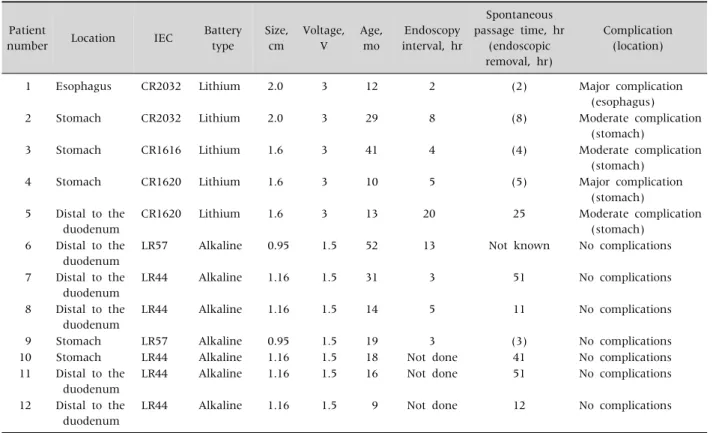
All 7 children who ingested button batteries small- er than 1.5 cm did not show any symptoms or signs of complications, while all 5 children who swallowed batteries larger than 1.5 cm showed moderate (n=3) to major (n=2) complications. The 7 batteries that had no effect were alkaline batteries (LR57 and LR44), and all 5 that produced complications were lithium batteries (CR1616, CR1620, and CR2032).
There was a significant statistical difference between
Table 3.Button Battery Ingestion in Twelve Children
Patient
number Location IEC Battery type
Size, cm
Voltage, V
Age, mo
Endoscopy interval, hr
Spontaneous passage time, hr
(endoscopic removal, hr)
Complication (location)
1 Esophagus CR2032 Lithium 2.0 3 12 2 (2) Major complication
(esophagus)
2 Stomach CR2032 Lithium 2.0 3 29 8 (8) Moderate complication
(stomach)
3 Stomach CR1616 Lithium 1.6 3 41 4 (4) Moderate complication
(stomach)
4 Stomach CR1620 Lithium 1.6 3 10 5 (5) Major complication
(stomach) 5 Distal to the
duodenum
CR1620 Lithium 1.6 3 13 20 25 Moderate complication
(stomach) 6 Distal to the
duodenum
LR57 Alkaline 0.95 1.5 52 13 Not known No complications
7 Distal to the duodenum
LR44 Alkaline 1.16 1.5 31 3 51 No complications
8 Distal to the duodenum
LR44 Alkaline 1.16 1.5 14 5 11 No complications
9 Stomach LR57 Alkaline 0.95 1.5 19 3 (3) No complications
10 Stomach LR44 Alkaline 1.16 1.5 18 Not done 41 No complications
11 Distal to the duodenum
LR44 Alkaline 1.16 1.5 16 Not done 51 No complications
12 Distal to the duodenum
LR44 Alkaline 1.16 1.5 9 Not done 12 No complications
IEC: International Electrotechnical Commission.
the type of battery ingested (p=0.001) (Table 3). All of the 3 patients who did not go through endoscopy had no signs or symptoms and thus they were cate- gorized as no complications according to National Poison Data System of America. Even if one case in esophagus and three cases without endoscopy are excluded, the analysis had statistically significant re- sults as well (p=0.001).
The endoscopy time interval after ingestion was a median of 5.0 hours (IQR, 3-14 hours) in children with complications and a median of 4.5 hours (IQR, 3-11 hours) in those without complications who un- derwent endoscopy (p=0.806).
DISCUSSION
Whether upper endoscopy is performed in order to remove a FB depends on the time since the ingestion;
the location, size, and shape of the FB; and the pa-
tient’s age, symptoms, or complications. The guide- lines have been revised by various committees through the years. In 2007, guidelines described by Seo recommended immediate endoscopic removal particularly for button batteries and sharp objects lodged in the esophagus [11]. If sharp or pointed ob- jects, long objects (>4-5 cm for infants and young children, >6-10 cm for older children), or large and wide objects (>2 cm in diameter for infants and young children, >2.5 cm in diameter for older chil- dren) are located in the stomach, endoscopic re- moval is also recommended. In the case of a button battery ≥2 cm or that has remained for over 24-48 hours in the stomach, multiple magnets, or gastric retention of any objects for more than 3-4 weeks, en- doscopic removal is recommended.
Recently, the North American Society for Pediatric Gastroenterology, Hepatology, and Nutrition (NASPGHAN) Endoscopy Committee revised the
recommendations for the timing of endoscopic inter- vention [9]. If the FB lodged in the esophagus is a button battery, it should be removed within 2 hours.
If the patient does not show any symptoms, 24 hours are allowed to observe them. In case long objects are ingested, they should be eliminated within 24 hours regardless of the presence of symptoms.
The frequency of button battery ingestion has been increasing due to widespread use of such bat- teries as power supplies in electronic devices [10]. It has been frequently reported that severe complica- tions, including aortoesophageal fistula and vocal cord paralysis, are present in cases of a button battery in the esophagus [12-15]. Patients with a button bat- tery in their esophagus should be managed with im- mediate endoscopic removal [9,16,17].
However, most button batteries with a diameter
<2 cm in the stomach pass spontaneously with no complications. If a battery with a diameter ≥2 cm stays in the pylorus or duodenum for a long time, it is recommended that it be removed out of concern for the increasing risk of perforation [11].
Recently, complications caused by a button bat- tery located in the stomach seem to be increasing. In a case of a 3-month-old infant, the battery was firmly lodged in the antrum with its surface almost exposed on the serosa and was surrounded by necrotic debris located near the pylorus. After endoscopic removal failed, laparotomy and gastrotomy were conducted to remove the battery [8].
Litovitz et al. [10] reported worse outcomes for large diameter lithium batteries (≥2 cm) and in children who are younger than 4 years of age. They did not separate button batteries in esophagus and stomach. They suggested that endoscopic removal should be considered even if symptoms appear minor. If a child younger than 6 years is asympto- matic and the ingested battery is 1.5 cm in diameter or more, they recommended obtaining an X-ray within 4 days after ingestion. On the other hand, if the patient is older than 6 years or if the ingested bat- tery is smaller than 1.5 cm, it can be managed at home and later confirmed that the battery has passed by inspecting the stool.
The NASPGHAN Endoscopy Committee sug- gested in 2015 that if children younger than 5 years of age have a button battery ≥2 cm in their stomach, an assessment for esophageal injury and endoscopic removal should be considered if possible within 24-48 hours. If the patient is 5 years or older or the battery diameter is <2 cm, outpatient observation may be an option to consider. For those children 5 years of age or older who have ingested a battery ≥2 cm in diameter, a repeat radiography in 48 hours is recommended. Clinicians should also consider re- peating an X-ray if patients 5 years of age or younger have swallowed a battery <2 cm and fail to pass it in their stool within 10-14 days after ingestion. Endos- copic removal is required if gastrointestinal symp- toms develop or the battery does not pass the stom- ach by the time the X-ray is repeated [9].
In our study, all cases associated with batteries
>1.5 cm experienced complications (major compli- cation, 2 cases; moderate complication, 3 cases).
None of them showed any symptoms. We have a pol- icy to remove button batteries in the stomach if the child’s fasting time permits, especially when the size and type of the battery is not defined. We observed that in terms of endoscopic removal time, less than 2 hours should have elapsed since the button battery ingestion to remove it from the esophagus and 8 hours to remove it from the stomach, with the ex- ception of 1 case where a button battery was re- moved after 20 hours. In our study, the button bat- tery was properly removed, but complications were present. One child in particular who ingested a 1.6-cm lithium battery also presented with a major complication, even though the battery was removed within 5 hours. The two opposite rims of the battery were lodged in the antrum near the pylorus. Its sur- face was almost exposed on the serosa and was sur- rounded by necrotic debris and markedly thickened and inflamed peripheral mucosa. According to the recent recommendations of NASPGHAN [9] or Litcovitz et al. [10], we should have only conducted outpatient observation for 24 hours in 3 cases with complications related to a 1.6-cm battery, which could have led to more severe complications. There-
fore, it might be reasonable to set 1.5 cm rather than 2 cm as the minimum size requirement for endos- copy in young children. Nelson Textbook of Pedia- trics [18], the latest edition recommends that bat- teries larger than 1.5 cm are not likely to pass sponta- neously and should be removed endoscopically in children younger than 6 years of age. In our study, complications were shown though button batteries were removed within 24 hours after ingestion. This is not the matter of spontaneous passage, so more ur- gent removal is needed to avoid complications by lithium batteries.
As all the children in this study were younger than 5 years, and most of them were younger than 3 years except for 2 children, we could not find a correlation between age and the complication rate.
There were 5 types of button batteries ingested by patients in our study. The battery diameters were 0.95 cm (LR57), 1.16 cm (LR44),1.6 cm (CR1616, CR1620), and 2.0 cm (CR2032). The product names complied with the required categorization by the International Electrotechnical Commission; “LR”
represents the alkaline manganese dioxide chem- istry, and “CR” represents the lithium manganese dioxide chemistry [19]. Lithium batteries are larger than alkaline batteries in general; however, the sizes of commercially available lithium batteries vary from 0.95 cm to 2.45 cm. The sizes of alkaline batteries range from 0.68 cm to 1.16 cm. The voltage of alka- line batteries ranged from 1.5 V to 1.55 V, while lith- ium batteries had a voltage of 3 V. According to Korea Consumer Agency, lithium battery smaller than 1.5 cm in diameter is rarely distributed in Korea.
In our study, the only batteries (1.6 cm and 2 cm) that produced complications were lithium batteries, while the other batteries (0.95 cm and 1.16 cm) that had no complications were alkaline batteries. Though the study sample was small, it can be considered that complications are related to higher voltages and spe- cific types of batteries (lithium) rather than merely the size of the ingested battery. Since the percentage of lithium battery ingestion has increased from 1.3%
in 1993 to 24% in 2008 [10], we suggest that battery
types and voltages should be considered when mak- ing the decision to proceed with endoscopy.
Conventionally, the mechanisms of battery-in- duced injury have been explained: a leakage of the alkaline electrolyte, the generation of electrical cur- rent that hydrolyzes tissue fluids and produces hy- droxide when it comes in contact with physiologic solutions, and physical pressure necrosis on adjacent tissues [20]. No severe complications were reported such as renal toxicity or hepatotoxicity even when heavy metal was systemically absorbed [21,22].
New batteries also show a greater risk of injury than spent batteries. The higher incidence of severe injuries from lithium batteries, even those smaller than 2 cm in diameter, could indicate that the injury is related to the higher voltage rather than leakage of the alkaline electrolyte or the electrical current.
In summary, this study identified the types, sizes, and locations of FBs in children and analyzed their associated complications and spontaneous passage time. After FB passed through stomach, shapes and sizes were not associated with the spontaneous pas- sage time and size, spontaneous passage time, and age were also not associated with any specific com- plications.
To our knowledge, this is the first cross-sectional study that showed mucosal complications in stom- ach caused by lithium batteries sized <2 cm. As the use of lithium batteries with higher voltages is in- creasing, factors such as the types and voltages of the battery should be considered when determining whether urgent endoscopy is required to remove a battery lodged in the stomach. In cases of young chil- dren with a lithium battery in the stomach, urgent removal could be important in order to prevent com- plications, even if the child is asymptomatic, even within 24 hours. Further study in multicenter is needed to revise the guidelines for removal of button battery, especially for the proper time of endoscopy.
REFERENCES
1. Arana A, Hauser B, Hachimi-Idrissi S, Vandenplas Y.
Management of ingested foreign bodies in childhood
and review of the literature. Eur J Pediatr 2001;160:
468-72.
2. Webb WA. Management of foreign bodies of the upper gastrointestinal tract. Gastroenterology 1988;94:204- 16.
3. Kirkham EN, Kane M, Paul SP. Foreign body ingestion in children. Community Pract 2015;88:45-8.
4. Lee JH, Nam SH, Lee JH, Lee HJ, Choe YH. Spontaneous passage of gastrointestinal foreign bodies in children.
Korean J Pediatr Gastroenterol Nutr 2007;10:157-65.
5. Litovitz T, Schmitz BF. Ingestion of cylindrical and but- ton batteries: an analysis of 2382 cases. Pediatrics 1992;89:747-57.
6. Litovitz TL. Button battery ingestions. A review of 56 cases. JAMA 1983;249:2495-500.
7. Maves MD, Carithers JS, Birck HG. Esophageal burns secondary to disc battery ingestion. Ann Otol Rhinol Laryngol 1984;93:364-9.
8. Honda S, Shinkai M, Usui Y, Hirata Y, Kitagawa N, Take H, et al. Severe gastric damage caused by button battery ingestion in a 3-month-old infant. J Pediatr Surg 2010;45:e23-6.
9. Kramer RE, Lerner DG, Lin T, Manfredi M, Shah M, Stephen TC, et al. Management of ingested foreign bod- ies in children: a clinical report of the NASPGHAN Endoscopy Committee. J Pediatr Gastroenterol Nutr 2015;60:562-74.
10. Litovitz T, Whitaker N, Clark L, White NC, Marsolek M. Emerging battery-ingestion hazard: clinical im- plications. Pediatrics 2010;125:1168-77.
11. Seo JK. Endoscopic management of gastrointestinal foreign bodies in children: a clinical practice guideline.
Korean J Pediatr Gastroenterol Nutr 2007;10(Suppl 1):64-9.
12. Hamilton JM, Schraff SA, Notrica DM. Severe injuries from coin cell battery ingestions: 2 case reports. J Pediatr Surg 2009;44:644-7.
13. Mortensen A, Hansen NF, Schiødt OM. Fatal aortoeso- phageal fistula caused by button battery ingestion in a 1-year-old child. Am J Emerg Med 2010;28:984. e5-6.
14. Virgilis D, Weinberger JM, Fisher D, Goldberg S, Picard E, Kerem E. Vocal cord paralysis secondary to impacted esophageal foreign bodies in young children. Pediatrics 2001;107:E101.
15. Soerdjbalie-Maikoe V, van Rijn RR. A case of fatal coin battery ingestion in a 2-year-old child. Forensic Sci Int 2010;198:e19-22.
16. Sung SH, Jeon SW, Son HS, Kim SK, Jung MK, Cho CM, et al. Factors predictive of risk for complications in pa- tients with oesophageal foreign bodies. Dig Liver Dis 2011;43:632-5.
17. Hung CW, Hung SC, Lee CJ, Lee WH, Wu KH. Risk fac- tors for complications after a foreign body is retained in the esophagus. J Emerg Med 2012;43:423-7.
18. Judith RK, Chris AL. Foreign bodies and bezoars. In:
Kliegman R, Stanton B, St Geme J, Schor NF, eds.
Nelson textbook of pediatrics. 20th ed. Elsevier Saunder, 2015:1814-6.
19. Galligan C, Morose G. An investigation of alternatives to miniature batteries containing mercury [Internet].
Lowell: Maine Department of Environmental Protec- tion; 2003 [cited 2015 Aug 27]. Available from:
http://www.sustainableproduction.org/downloads/
MaineDEPButtonBatteryReportFinal12-17-04.pdf.
20. Gryboski J. Traumatic injury. In: Walker WA, Durie PR, eds. Pediatric gastrointestinal disease. 3rd ed.
Hamilton (ON): BC Decker, 2000:351-77.
21. Mallon PT, White JS, Thompson RL. Systemic absorp- tion of lithium following ingestion of a lithium button battery. Hum Exp Toxicol 2004;23:193-5.
22. Yardeni D, Yardeni H, Coran AG, Golladay ES. Severe esophageal damage due to button battery ingestion: can it be prevented? Pediatr Surg Int 2004;20:496-501.
![Fig. 2. Age distribution (mean age, 3.13±3.07 years) of the 76 patients (44 boys [57.3%] and 32 girls [42.7%]) with foreign body ingestion.](https://thumb-ap.123doks.com/thumbv2/123dokinfo/5411411.222314/3.892.462.800.700.1042/fig-age-distribution-years-patients-girls-foreign-ingestion.webp)