• 검색 결과가 없습니다.

Does Breastfeeding Protect Infants from Simple Urinary Tract Infection?

N/A
N/A
Protected

Academic year: 2021

Share "Does Breastfeeding Protect Infants from Simple Urinary Tract Infection?"

Copied!
4
0
0

로드 중.... (전체 텍스트 보기)

전체 글

(1)

Korean Journal of Pediatric Urology Vol. 2, No. 1: 25-28, 2010

25

ORIGINAL ARTICLE Does Breastfeeding Protect Infants from Simple Urinary Tract Infection?

Minki Baek, Seong Jin Jeong

1

, Tae Beom Kim

2

, Kwanjin Park

3

, Hwang Choi

3

From the D epartm ent of U rology, Sam sung M edical Center, Sungkyunkw an U niversity School of M edicine, Seoul,

1

Seoul N ational U niversity Bundang H ospital, Seoul N ational U niversity College of M edicine, Seongnam ,

2

Gachon U niversity Gil H ospital, Incheon,

3

Seoul N ational U niversity H ospital, Seoul N ational U niversity College of M edicine, Seoul, Korea 백민기ㆍ정성진

1

ㆍ김태범

2

박관진

3

ㆍ최 황

3

성균관대학교 의과대학 삼성서울병원

비뇨기과학교실,

1

서울대학교 의과대학 분당서울대학교병원 비뇨기과학교실,

2

가천의과대학교 길병원 비뇨기과학교실,

3

서울대학교 의과대학 서울대학교병원 비뇨기과학교실

Purpose: We evaluated whether breastfeeding has a protective effect against simple urinary tract infection (UTI) in infants.

Materials and Methods: Sixty-seven cases presenting with simple UTI were matched with 68 age- and sex-matched controls who had an acute illness that was not an infectious disease. We performed a retrospective review of all infant medical records and administered a parental tele- phone questionnaire regarding whether the infant was breastfed, the du- ration of breastfeeding, and the extent of breastfeeding. Extent was clas- sified as exclusively breastfed, mostly breastfed (less than one bottle of formula per day), and mostly formula-fed (with some breast milk supple- mentation).

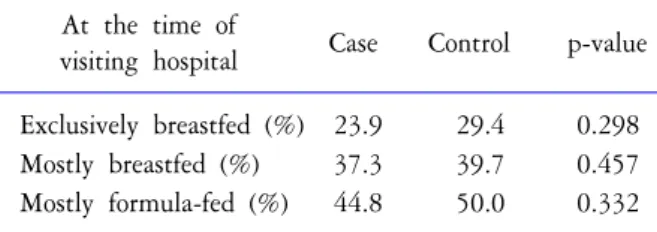
Results: Breastfed infants comprised 86.6% and 85.3% of cases and con- trols, respectively. Breastfeeding duration was not significantly different between groups. When the data were analyzed according to the extent of breastfeeding at the time of the hospital visit, the proportions of ex- clusively breastfed, mostly breastfed, and mostly formula-fed infants were 23.9%, 37.3% and 44.8% of cases and 29.4%, 39.7% and 50.0% of controls (p=0.30, 0.46, and 0.33, respectively).

Conclusions: Although there was a trend toward a lower rate of simple UTI in breastfed infants, our study did not support a direct protective effect of breastfeeding against UTI.

Key Words: Breastfeeding, Urinary tract infection, Infant (Received: June 1, 2010, Accepted: June 8, 2010)

교신저자 최 황

서울대학교 의과대학 서울대학교병원 비뇨기과학교실

서울시 종로구 연건동 28, 110-744

Tel: 02-2072-3644 Fax: 02-742-4665 E-mail: [email protected]
INTRODUCTION

Breastfeeding is known to protect infants against a variety of infections. It has been reported that increasing the proportion of exclusively breastfed infants reduces illness at the community level.

1

A number of studies have indicated that breastfeeding protects against urinary tract infection (UTI) in infants.

2-6

A possible mechanism of this effect is the presence of certain

factors in human breast milk, although this has not been clearly demonstrated. One criticism of such studies is that confounding factors persist even after appropriate statistical adjustment.

7

This is the first study to evaluate the effects of

breastfeeding on infant UTI in Korea. We sought to

evaluate whether breastfeeding has a protective effect

against simple UTI in infants.

(2)

26 Korean Journal of Pediatric Urology Vol. 2, 25-28, 2010

Table 1. Distribution of demographic information by cases and controls

Case Control p-value

Number (n) 67 68

Male infants (%) 76.1 63.2 0.134

Mean age (months) 5.8 6.0 0.810

C/S delivery (%) 44.8 25.0 0.096

Phimosis rate (%) 100 95.6 0.451

Table 2. Breastfeeding before the hospital visit

Before visiting hospital Case Control p-value History of breastfeeding (%) 86.6 85.3 1.00 Duration of breastfeeding 5.6 5.1 0.425 (months)

Table 3. Breastfeeding at the time of the hospital visit At the time of

Case Control p-value visiting hospital

Exclusively breastfed (%) 23.9 29.4 0.298 Mostly breastfed (%) 37.3 39.7 0.457 Mostly formula-fed (%) 44.8 50.0 0.332 PATIENTS AND METHODS

This case-control study recruited 136 infants who visited Seoul National University Children’s Hospital from January 2005 to April 2006. Sixty-seven cases presenting with simple UTI were matched with 68 age- and sex-matched controls with an acute illness other than an infectious disease. Simple UTI was defined as a documented urine culture with 100,000 colony-forming units (CFUs) or more per milliliter in an afebrile infant. Urine was collected using a urine collection bag, with catheterization performed only if necessary. Imaging studies such as ultrasound or voiding cystourethrogram were not routinely performed. Infants with known urologic anomalies, such as vesicoureteral reflux, ureteropelvic junction obstruction, ureteral dupli- cation, ureterocele, cystic kidney disease, or neurogenic bladder, were excluded from the study group.

We evaluated breastfeeding history, duration, and pattern in each infant at the time of visit to the hospital using medical record review or telephone interview. We classified breastfeeding patterns as exclusively breastfed, mostly breastfed (less than one bottle of formula per day), and mostly formula-fed (with some breastfeeding).

The primary endpoint of this study was comparison of the proportion of breastfed infants and duration of breastfeeding. The secondary endpoint was comparison of breastfeeding patterns between the two groups. Statistical analysis was performed using SPSS 17.0 for Windows (SPSS for Windows, SPSS Inc, Chicago, IL, USA). We used the chi-square test for analysis. p-values less than 0.05 were considered statistically significant.

RESULTS

The median age of infants in our study was 5.9 months.

Subject characteristics are summarized in Table 1. There were no significant differences between the study and control groups in the percentage of male infants, mean age, delivery type, or phimosis rate among male subjects.

The proportion of breasted infants was 86.6% of cases and 85.3% of controls. The median breastfeeding durations were 5.6 months and 5.1 months, respectively (p=0.425) (Table 2). When classified according to the extent of breastfeeding at the time of hospital visit, exclusively breastfed infants comprised 23.9% of cases and 29.4% of controls (p=0.298). Infants fed less than one bottle of formula per day comprised 37.3% of cases and 39.7% of controls (p=0.332). Mostly formula-fed infants comprised 44.8% of cases and 50.0% of controls (p=0.457).

DISCUSSION

Breastfeeding is associated with lower rates of several childhood infectious diseases, including upper and lower respiratory tract infections,

8,9

otitis media,

10,11

gastroen- teritis,

9,12

and meningitis

13

in a number of studies. However, other studies report little or no effect.

7,14

In particular, several studies have suggested that

breastfeeding protects against UTI in infants. Levy et al

(3)

Minki Baek, et al: Does Breastfeeding Protect Infants from Simple Urinary Tract Infection? 27

found that provision of breast milk was associated with a lower risk of UTI in preterm infants in a tertiary-care neonatal intensive care unit.

2

Mårild et al reported that ongoing exclusive breastfeeding significantly lowers the risk of UTI, and that a longer duration of breastfeeding lowers infection risk even after weaning, which suggests a long- term protective mechanism.

3

One proposed mechanism is that certain factors in breast milk prevent bacterial coloni- zation of mucous membranes. Most commonly, the causal organism of UTI in infants are their own intestinal microbes. A newborn’s intestines are initially colonized by the mother, as delivery occurs adjacent to the mother’s anus. Breast milk contains several antibodies to the mother’s own intestinal flora including secretory immunoglobulin A (IgA), which may coat certain microbes in her infant’s intestinal tract.

15

Another proposed mechanism is that neutral oligosaccharides present in breast milk and the urine of breastfed infants inhibit bacterial adhesion.

16

Criticisms of these studies include the persistence of confounding factors despite statistical adjustment. For example, women who breastfeed may differ from mothers who use formula in other ways that alter their infant’s risk of illness.

In our study, there was no significant difference between study and control groups in the proportion of breastfed infants, breastfeeding duration, or the extent of breast- feeding. These results differ from those of previous studies that demonstrated a protective effect of breastfeeding against UTI in infants.

2-6

Although our study had a structured case-control design, it was not planned in a prospective manner, and thus suffers from the weaknesses of retrospective data collection. One critical problem of our study is information bias: although all mothers remembered whether they breastfed or not, some had difficulties in remembering the amount. Moreover, the designations of exclusively breastfed, mostly breastfed (less than one bottle of formula per day) and mostly formula-fed, while not objective, were used because it is impossible to measure actual breast milk intake. Another problem of our study was the way UTI was diagnosed: we collected urine with a urine collection bag in most cases, with catheterization only if needed. This method leaves the possibility of false-positive UTIs in study subjects. Also, we excluded only infants with known urinary tract anomalies, rather than using imaging

studies in all subjects, as these are not routinely performed at our institution for simple UTI.

In recent years, many mothers have re-dedicated them- selves to breastfeeding despite their increased social responsibilities out of concern for infant health. As physi- cians, we have a responsibility to research any putative protective effects of breastfeeding. The evidence provided by previous studies for breastfeeding’s protective effect against UTI has been less than adequate. However, because it is unethical to randomly assign infants to breastfed and formula-fed groups, future studies will continue to suffer from methodological concerns.

CONCLUSIONS

Although fewer infants were breastfed in the simple UTI group as compared to the control group, the difference was not statistically significant. This study does not support the hypothesis that breastfeeding protects infants from simple UTI.

REFERENCES

1. Wright AL, Bauer M, Naylor A, Sutcliffe E, Clark L.

Increasing breastfeeding rates to reduce infant illness at the community level. Pediatrics 1998;101:837-44

2. Levy I, Comarsca J, Davidovits M, Klinger G, Sirota L, Linder N. Urinary tract infection in preterm infants: the protective role of breastfeeding. Pediatr Nephrol 2009;24:

527-31

3. Mårild S, Hansson S, Jodal U, Odén A, Svedberg K.

Protective effect of breastfeeding against urinary tract infection. Acta Paediatr 2004;93:164-8

4. Riccabona M. Urinary tract infections in children. Curr Opin Urol 2003;13:59-62

5. Mansour L, Mansour A. Breast feeding protects infants against urinary tract infection. New Egypt J Med 1993;8:

463-4

6. Pisacane A, Graziano L, Mazzarella G, Scarpellino B, Zona G. Breast-feeding and urinary tract infection. J Pediatr 1992;120:87-9

7. Bauchner H, Leventhal JM, Shapiro ED. Studies of breast-feeding and infections: how good is the evidence?

JAMA 1986;256:887-92

8. Wright AL, Holberg CJ, Martinez FD, Morgan WJ,

Taussig LM, Group Health Medical Associates. Breast-

feeding and lower respiratory tract illness in the first year

(4)

28 Korean Journal of Pediatric Urology Vol. 2, 25-28, 2010

of life. Br Med J 1989;299:946-9

9. Howie PW, Forsyth JS, Ogston SA, Clark A, Florey CD.

Protective effect of breast feeding against infection. Br Med J 1990;300: 11-6

10. Duncan B, Ey J, Holberg CJ, Wright AL, Martinez FD, Taussig LM. Exclusive breastfeeding for four months pro- tests against otitis media. Pediatrics 1993;91:867-72 11. Aniansson G, Alm B, Andersson B, Håkansson A, Larsson

P, Nylén O, et al. A prospective cohort study on breast- feeding and otitis media in Swedish infants. Pediatr Infect Dis J 1994;13:183-8

12. Dewey KG, Heinig MJ, Nommsen-Rivers LA. Differences in morbidity between breast-fed and formula-fed infants.

J Pediatr 1995;126:696-702

13. Arnold C, Makintube S, Istre GR. Day care attendance and other risk factors for invasive Haemophilus influenzae type b disease. Am J Epidemiol 1993;138:333-40

14. Leventhal JM, Shapiro ED, Aten CB, Berg AT, Egerter SA.

Does breastfeeding protect against infections in infants less than 3 months of age? Pediatrics 1986;78:896-903 15. van der Waaij LA, Limburg PC, Mesander G, van der

Waaij D. In vivo IgA coating of anaerobic bacteria in human faeces. Gut 1996;38:348-54

16. Coppa GV, Gabrielli O, Giorgi P, Catassi C, Montanari

MP, Varaldo PE, et al. Preliminary study of breastfeeding

and bacterial adhesion to uroepithelial cells. Lancet

1990;335:569-71

수치

Table  3.  Breastfeeding  at  the  time  of  the  hospital  visit At  the  time  of

참조

관련 문서

Third, there was no significant difference in the frequency of second hospital evacuation after moving to the medical room due to experience and

Difference of microhardness values(M±SD) between control and experimental side in various groups ···

The change in active oxygen was decreased after exercise in the exercise group than in the control group, and there was a statistically significant

In the control group, lifestyle-related factors were significantly different only in blood glucose (p <.01) and there was no significant difference in

Results: The results demonstrated a significant positive correlation between the muscle atrophy and the tendon tear.(p<0.05) And there was statistically

Third, there was no statistically significant difference in their conspicuous consumption according to their and their parents' consumer life education, the places of the

Second, there was no statistically significant difference in the sub-factors of participation satisfaction according to age, career, occupation,

First, there was no significant difference in all the lower factors of leisure satisfaction by age among the personal characteristics of football club