1. INTRODUCTION
In recent years, positively charged pyrylium salts have been attracting attention from chemists. A pyrylium cation and its derivative are conjugated 6-membered carbon ring systems with one carbon atom replaced with a positively charged oxygen atom(i.e., an oxonium ion). Unlike in other compounds, the oxonium ion in a pyrylium compound is much less reactive due to aromatic stabilization. However, if a pyrylium containing salt is present in water at a neutral pH, it becomes unstable like ordinary oxonium salts. The high electronegativity of the oxygen results in the strongest single perturbation of the one heteroatom in a six-membered ring[1, 2], and pyrylium ions have the highest conductivity among the compounds with benzene rings. The high conductivity of pyrylium ions can form different derivatives that can be utilized in a variety of products such as functional pigments, nonlinear optical glasses, phototherapeutic agents and anticancer medicine[3-6].
The reactivity of pyrylium salts towards nucleophiles allows them to easily obtain electrons from any compound with aromatic rings, as such, they react with nucleophiles in the 2, 4 and 6 positions, which may result in ring- opening. In fact, the reactivity of pyrylium makes it useful in many different fields.
First, pyrylium salt is a main source of two-photon absorption, which can be applied in two-photon microscopy, optical power limiting, single molecule detection, micro-fabrication and 3-dimensional data storage[7, 8]. Since some pyrylium salts even have high photoluminescence so they are excellent candidates for laser technology[6].
Second, due to their complex heterocyclic skeletons and physical properties, pyrylium salts are utilized in pharmaceutical material synthesis as a versatile synthetic intermediate. For example, a novel 3-arylisoquinoline can be synthesized by electrophilically cyclizing pyrylium compounds. 3-arylisoquinoline derivatives are valuable intermediates in the synthesis of morphinan derivatives, especially dextromethorphan[9].
Third, pyrylium salts are a kind of ionic liquid crystal that can be used in displays[10,11].
Fourth, materials with photoelectric characteristic are
1Department of Energy and Environmental System Engineering, University of Seoul
2Department of Chemical Engineering, University of Seoul
+Corresponding author: [email protected]
(Received : Nov. 29, 2011, Revised : Dec. 20, 2011, Accepted : Jan. 4, 2012) http://dx.doi.org/10.5369/JSST.2012.21.1.13
pISSN 1225-5475/eISSN 2093-7563
Synthesis and Characterization of 2, 6-Di-(4'-Methyl Phenyl) Pyrylium Fluoroborate and Perchlorate
in Single Step Salts Using 4'-Methyl Acetophenone
Jinhyeong Wie1, Young Min Hong1, Hyunook Kim1, Kyung-Hoon Kim2, and Sung-Il Cho2,+
Abstract
Due to its high conductivity, pyrylium has been frequently used in electron transfer reactions or in the synthesis of various organic materials. It has also been used as a sensor material. Traditionally, the compounds have been synthesized using various methods; mostly in a multiple steps. In this study, two pyrylium salts, 2, 6-di-(4'-methylphenyl) pyrylium fluoroborate and perchlorate were synthesized.
The synthesis of these products was confirmed by 1H-NMR, LC/TOF-MS and FT-IR analyses while their photo-properties were analyzed using UV/VIS spectrophotometry. In addition, the electron transfer capacities of the salts were analyzed with a conductivity meter, it was found that their electron conductivities were high. When the synthesized compounds were dissolved in acetone, a green fluorescent material was observed to form. The fluorescent material can be used as a sensitizer in the electrical industry.
Keywords : Pyrylium Salts, Synthesis, Sensitizer, LC/TOF-MS, UV-vis
useful as a sensor material. In fact, pyrylium salts have been used in biochemical optical sensors and ion detectors[12-14].
Finally, it is known that the absorption spectrum bands of the unsubstituted pyrylium cation, at λmaxof 219 and 269 nm, correspond to the transition from πto π*. Any material with a high UV absorption capacity can be used as a sensing membrane or a sensitizer, as such, pyrlium salts have been utilized in designing sensors for anions, amines, amino acids and proteins[15].
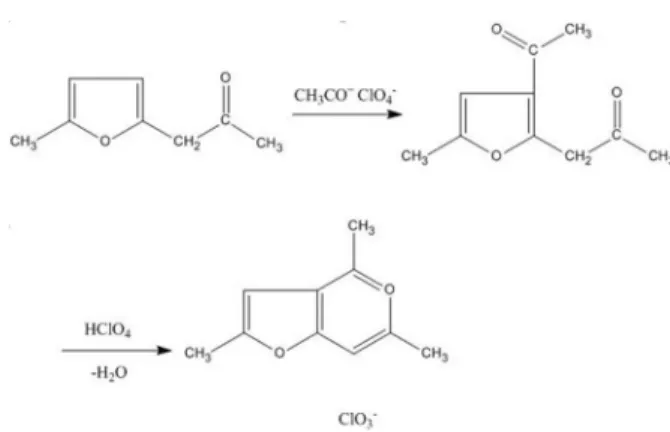
Traditionally, pyrylium salts have been synthesized in multiple steps; the synthesis reactions precede one after the other[16]. The followings are examples of these multi-step pyrylium synthesis processes. 2, 4, 6-trimethylfurano[3, 2- c]pyrylium perchlorate as shown in Fig. 1 is synthesized by acetylating 2-methyl-5-acetonylfuran, which is obtained by a reduction of the product from alkaline condensation of furfural with nitroethane[17].
2, 4, 6-tris(dialkylamino)pyrylium salts and 2, 6- bis(dialkyl-amino)pyran-4-pyrylium as well as their thio- analogues, are prepared by a multi-step route starting with 1, 1, 5, 5-tetrachloro-penta-1, 4-dien-3-one. The tris(dialkylamino)-subs-tituted undergoes electrophilic substitution [18]. The above-mentioned methods, however, take considerable time and their yields are low; the yield of the first method is only 17 %[1, 17], for example.
In this study, we synthesized 2, 6-di-(4'-methyl) pyrylium fluoroborate and perchlorate in one step[16]. The syntheses of 2, 6-di-(4'-methyl) pyrylium salt was confirmed by analyzing the products with 1H-NMR, LC/TOF-MS and FT-IR. A UV-VIS spectrophotometer
was used to characterize the UV absorption capacity of the products[19]. Finally, the conductivity of the produced salts was also analyzed.
2. DESIGN 2.1 Materials
Analytical-grade chemicals including acetic- anhydride(96 %, Daejung, Korea), fluoroboric acid(50 wt%, Alfa Aesar, USA), perchloric acid(60 %, hayashi purechemical, Japan), 4'-methyl acetophenone(95 %, Aldrich, USA), triethyl orthoformate(98 %, Acros organics, USA) and diethyl ether(99 %, Daejung, Korea) were purchased and used in this study. These materials were not further refined before use.
1H-NMR(Inova AS400, Varian, USA), LC/IT-TOF- MS(Shimadzu, Japan) and an FT-IR(Spectrum RX, Perkin-Elmer, USA) instruments were used to analyze the structure of the synthesized 2, 6-di-(4'-methyl phenyl) pyrylium.
The UV absorption capacity of the salt was analyzed by a UV/VIS spectrometer(S-4100, SCINCO, Korea). The conductivity and melting point were measured by an electrical conductivity meter(EcoMet, Woongki, Korea), and a J-293(JISICO, Korea), respectively.
2.2 Experiment 2.2.1 Synthesis step
The theoretical synthetic reaction of the salt is illustrated in Fig. 2. The synthesis is initiated with an exothermic reaction between 4'-methyl acetophenone and triethethyl orthoformate.
This reaction spontaneously proceeds through step (a) and (b) (Fig. 2). In this reaction, acetic-anhydride along with fluoroboric acid or perchloric acid can be used as an accelerator; the hydro ion in the mixture attacks one of the oxonium ion of the compound shown in Fig. 2(b). Finally, the oxonium ion is removed to synthesize 2,6-di-(4'-methyl phenyl) pyrylium fluoroborate (or perchlorate) salt, which is substituted with a tetrafluoroborate (or perchlorate) anion via anion-bonding.
Fig. 1. Example of pyrylium salt synthesis.
2.2.2 Experiment procedure
In our study, 2, 6-di-(4'-methyl) pyrylium salt was synthesized in a single step by mixing two previously prepared solutions, i.e., solutions A and B that are shown in Fig. 3. First, solution A was prepared by slowly adding fluoroboric acid(5.9 g) or perchloric acid(6.7 g) into acetic- anhydride(20 mL) for 30 min at 5 ℃~10 ℃. To release the heat from the resulting exothermic reaction, the solution was placed in an ice bath filled with acetone.
Solution B was prepared by slowly adding 4'-methyl acetophenone(10 g) into 20 mL of triethyl orthoformate for two hours. After solution (B) was cooled, it was added to solution (A). Then the mixture was stirred for 24 h to precipitate the pyrylium salt. Finally, the synthesized pyrylium salt was harvested from the solution by applying a vacuum for 30 min.
The structure of the harvested product was analyzed by
high resolution LC/IT-TOF-MS and 1H-NMR spectroscopy.
Samples for analysis were prepared by dissolving 80 mg of the product in 100 mL of acetone. Samples for FT-IR analysis were prepared by mixing 2 mg of this with 100 mg of KBr. For UV-VIS analysis, samples were prepared by dissolving 0.8 g of salt in 100 mL of acetonitrile. By analyzing the UV/VIS light absorbed by the product, its optical properties were confirmed. Finally, the conductivity of the product was analyzed by measuring the conductance of 0.001 to 0.01 M sample solutions prepared by adding the product salts to acetone at 7 ℃. Once the product was dissolved in acetone, it produced brown or green fluorescent light.
3. RESULTS AND DISCUSSIONS
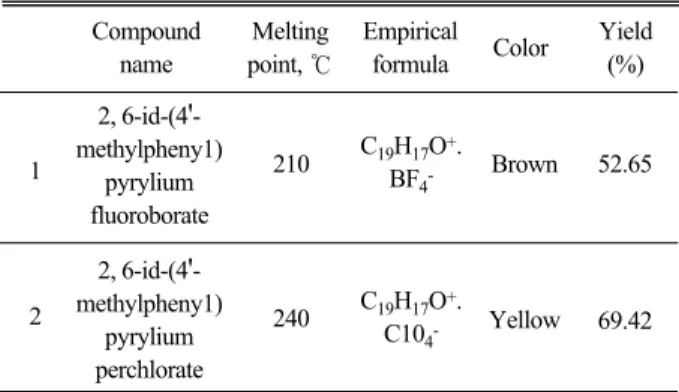
In this study, two pyrylium salts were synthesized(Table 1), i.e., 2, 6-di-(4'-methyl phenyl) pyrylium perchlorate (yellow colored), and 2, 6-di-(4'-methyl phenyl)pyrylium fluoroborate(brown colored). The yield of 2, 6-di-(4'- methyl phenyl) pyrylium perchlorate was higher than that of fluoroborate salt; the yield of former was 69 %, while that of latter was 53 %. Compared to pyrylium yields reported in other literature[1, 16], ours are slightly or considerable higher.
After each salt product was harvested, its structure was analyzed with 1H-NMR to confirm the synthesis of 2, 6-di- (4'-methyl phenyl) pyrylium salts. The peaks from 1H- NMR analysis of the salts were compared to those with other reference compounds with a similar chemical
Fig. 3. Experiment procedure to synthesize pyrylium salts in a single step.
Fig. 2. Mechanism of synthesis of 2, 6-di-(4'-methyl phenyl) pyrylium salts.
Table 1. The physical properties of the pyrylium salts produced in this study
1
2
Compound name 2, 6-id-(4'- methylpheny1)
pyrylium fluoroborate
210 C19H17O+.
BF4- Brown 52.65
69.42 Yellow C19H17O+.
C104- 240
2, 6-id-(4'- methylpheny1)
pyrylium perchlorate
Melting point, ℃
Empirical
formula Color Yield (%)
Fig. 6. FT-IR spectra of 2, 6-di-(4'-methyl phenyl) pyrylium fluoroborate (a), and 2, 6-di-(4'-methyl phenyl) pyrylium perchlorate (b).
structure(Fig. 4(a)). Fig. 4(a) shows the respective peaks of the synthesized products at 2.5, 7.6, 8.4, 8.8, and 9.2 ppm.
The ratio of proton atoms was 6:4:4:2:1 in the 2, 6-di-(4'- methyl phenyl) pyrylium fluoroborate. Similarly, 2, 6-di- (4'-methyl phenyl) pyrylium perchlorate had an almost equivalent area and location to pyrylium fluoroborate salt (Fig. 4(b))[20, 21].
Analysis of the product with a mass spectrometer(in this study, LC/IT-TOF-MS was used) also confirmed the existence of [C19 H17O]+ fragment ions with m/z = 261.1(Figs. 5(a) and (b)). Considering the accuracy of our test setup the error in the m/z of 261.1 is estimated to be only 0.00012 %.
The two synthesized salts were also analyzed by FT-IR (Figs. 6(a) and (b)). The peaks in the FT-IR analysis were observed at around 1,600 cm-1and 2,900 cm-1. The peaks had similar areas, so we can say the analyzed salts are very similar to each other in their structures[4, 17]. In short, the
FT-IR analysis identified the product as 2, 6-di-(4'-methyl phenyl) pyrylium salt[11].
(a)
(b)
Fig. 4. 1H-NMR spectra of 2, 6-di-(4'-methyl phenyl) pyrylium fluoroborate (a), and 2, 6-di-(4'-methyl phenyl) pyrylium perchlorate (b).
(a)
(b)
Fig. 5. LC/TOF-MS spectra of 2, 6-di-(4'-methyl phenyl) pyrylium fluoroborate (a), and 2, 6-di-(4'-methyl phenyl) pyrylium perchlorate (b).
(a)
(b)
Fig. 8. Conductivity of 2, 6-di-(4'-methyl phenyl) pyrylium fluoroborate pyrylium fluoroborate (a), and 2, 6-di-(4'-methyl phenyl) pyrylium perchlorate (b).
After the structure of the synthesized pyrylium salts was confirmed their physical properties, such as melting point, optical absorption, and electron transferring capacities, were analyzed. The melting point of the synthesized pyrylium perchlorate salt was higher than that of the pyrylium fluoroborate. It is advantageous for the pyrylium salt to have a high melting point because LCDs are heated by other components[22]. The former’s melting point was found to be 240 ℃, while the latter’s was 210 ℃.
To analyze optical properties of the 2, 6-di-(4'-methyl phenyl) pyrylium salts, UV-VIS spectra were analyzed.
The UV-VIS spectra of the two salts confirmed that there was conjugated πbonding. Theoretically, three aromatic rings commonly have a λmax at 350 nm~450 nm. The 2, 6- di-(4'-methyl phenyl) pyrylium salts synthesized in our study showed a λmax at 439 nm(Fig. 7), indicating the presence of aromatic rings.
Finally, the electron transfer capacities of the synthesized 2, 6-di-(4'-methyl phenyl) pyrylium salts were measured with a conductivity meter(Fig. 8(a) and (b)). These pyrylium salts had higher conductivity than others in organic compounds such as sodium hydroxide, sodium chloride, potassium chloride and so on, but a little lower than those found in electrolytes such as polymers with lithium perchlorate and trifluoromethane sulfonate(Table 2).
(a)
(b)
Fig. 7. UV-VIS spectra of 2, 6-di-(4'-methyl phenyl) pyrylium of 2, 6-di-(4'-methyl phenyl) pyrylium fluoroborate (a), and 2, 6-di- (4'-methyl phenyl) pyrylium perchlorate (b).
(a)
(b)
Table 2. Conductivity of selected compounds(0.05 M)[23, 24]
Reference (Experimental)
Measurement
value Compound name EC(μS/cm)
2, 6-id-(4'-methylpheny1) pyrylium perchlorate(in Acetone)
2, 6-id-(4'-methylpheny1) pyrylium perchlorate(in Acetone)
Nacl( in water) KCL (in water) NaOH (in water) LiC104(in EtOH) NaCF3SO3 (in water)
221 129 107 6.0*106 8.2*106
3.10*103
3.38*103
4. CONCLUSIONS
In this study, we synthesized 2,6-di-(4'-methyl phenyl) pyrylium fluoroborate and 2,6-di-(4'-methyl phenyl) pyrylium perchlorate in single step. In addition, their physical and optical properties were characterized. The λmax
identified from UV absorption spectra of the pyrylium salts was 439 nm. Since the synthesized pyrylium salts have higher electron transferring capacity than traditional electrolytes, they can be used as a good sensitizer to detect ionic chemicals.
ACKNOWLEDGMENT
This research was supported by the 2009 Research Funds Program of the University of Seoul
REFERENCES
[1] A. T. Balaban, G. W. Fischer, A. Dinulescu, A. V.
Koblik, G. N. Dorofeenko, V. V. Mezheritski, and W.
Schroth, Editors, Pyrylium salts: Synthesis, Reaction and Physical Properties, Advanced in Heterocyclic Chemistry, Suppl. II, Academic Press, New York, 1982.
[2] T. H. Steinberg, L. J. Jones, R. P. Haugland, and V. L.
Singer, “SYPRO orange and SYPRO, red protein gel stains: one-step fluorescent staining of denaturing gels for detection of nanogram levels of protein”, Anal.
Biochem., vol. 239, no. 2, pp. 223-237, 1996.
[3] G. Purvinis, P. S. Priambodo, M. Pomerantz, M. Zhou, T. A. Mal-donado, and R. Magnusson, “Second- harmonic generation in resonant waveguide gratings incorporating ionic self-assembled monolayer polymer Films”, Opt. Lett., vol. 29, no. 10, pp. 1108-1110, 2004.
[4] I. Polyzos, G. Tsigaridas, M. Fakis, V. Giannetas, P.
Persephonis, and J. Mikroyannidis, “Substituent effect on the photobleaching of pyrylium salts under ultra- short pulsed illumination”, J. Phys. Chem., vol. B 110, pp. 2593-2597, 2006.
[5] K. Binnemans, “Ionic liquid crystals”, Chem. Rev., vol.
105, pp. 4148-4204, 2005.
[6] M. Fakis, J. Polyzos, G. Tsigaridas, J. Parthenios, A.
Fragos, V. Giannetas, P. Persephonis, and J.
Mikroyannidis, “Novel class of pyrylium dyes with
high efficiency in lasing and two photon absorption fluorescence”, Chem. Phys. Lett., vol. 323, no. 1, pp.
111-116, 2000.
[7] D. Egan, M. Salmain, P. McArdle, G. Jaouen, and B.
Caro, “FT-IR observation of covalent labelling of lysozyme crystals by organometallic complexes of transition metals”, Spectrochim. Acta., vol. Part A 58, pp. 941-951, 2003.
[8] A. Diaspro and M. Robell, “Two-photon excitation of fluorescence for three-dimensional optical imaging of biological structures”, J. Photochem Photobiol., vol B:
Biol. 55, pp. 1-8, 2000.
[9] J. D. Tovar and T. M. Swager, “Pyrylium salts via electrophilic cyclization: applications for novel 3- arylisoquinoline syntheses”, J. Org. Chem., vol. 64, pp.
6499-6504, 1999.
[10] F. A. Scaramuzzo, A. Gonzalez-Campo, C. C. Wu, A.
H. Velders, V. Subramaniam, G. Doddi, P.
Mencarelli, M. Barteri, P. Jonkheijm, and J. Huskens,
“Pyrylium monolayers as amino-reactive platform”, Chem. Commun., vol. 46, no. 23, pp. 4193-4195, 2010.
[11] A. R. Katritzky, G. P. Savage, M. Pilarska, and Z. D.
Szafran, “The synthesis and response to vapor challenges of new microsensor coatings pyridinium and pyrylim salts”, Chem. Scr., vol. 29, pp. 235-239, 1989.
[12] M. R. Ganjali, M. Ghorbani, A. Daftari, P. Norouzi, H. Pirelahi, and H. D. Dargahani, “Highly selective liquid membrane sensor based on 1,3,5- triphenylpyrylium perchlorate for quick monitoring of sulfate ions”, Bull. Korean Chem Soc., vol. 25, no. 2, pp.172-176, 2004.
[13] B. G. Acosta, M. Comes, J. L. Bricks, M. A.
Kudinova, V. V. Kurdyukov, A. I. Tolmachev, A. B.
Descalzo, M. D. Marcos, R. M. Manez, A. Moreno, F.
Sancenon, J. Soto, L. A. Villaescusa, K. Rurack, J. M.
Barat, I. Escriche, and P. Amoros, “Sensory hybrid host materials for the selective chromo-fluorogenic detection of biogenic amines”, Chem. Commun., vol.
21, pp. 2239-2241, 2006.
[14] G. J. Mohr, “Covalent bond formation as an analytical tool to optically detect neutral and anionic analytes”, J.
snb., vol. 107, pp. 2-13, 2005.
[15] N. Manoj, G. Ajayakumar, K. R. Gopidas, and C. H.
Suresh, “Structure-absorption spectra correlation in a series of 2,6-dimethyl-4-arylpyrylium salts”, J. Phys.
Chem., vol. A 110, no. 39, pp. 11338-11345, 2006.
[16] C. H. Chen, J. J. Doney, and G. A. Reynolds,
“Synthesis and reactions of 2,6-diphenyl 4- (trimethylsilyl)-4H-thiopyran”, J. Org. Chem., vol. 47, no. 4, pp. 680-684, 1982.
[17] G. N. Dorofeenko and L. V. Dulenko, “A new method for the construction of pyrylium and pyridine rings fused to derivatives of furan and indole”, Chem.
Heterocycl. Compd., vol. 5, no. 3, pp. 417-421, 1969.
[18] W. Schroth, R. Spitzner, and E. Kleinpeter, “2,4,6 -tris (dialkylamino) pyrylium salts and related systems, synthesis and reaction behavior”, Tetrahedron Lett., vol. 29, pp.4695-4698, 1988.
[19] S. V. Krivun, A. I. Buryak, and S. N. Baranov,
“Pyrylium salts from pyrones and some organometallic compounds”, Chem. Heterocycl.
Compd., vol. 9, no. 10, pp.1191-1194, 1973.
[20] T. S. Balaban and A. T. Balaban, Science of Synthesis;
Houben-Weyl Methods of Molecular Transformations,
Georg Thieme Verlag, Stuttgart, 2003.
[21] C. Mahler, U. Muller, W. Muller, V. Enkelmann, C.
Moon, G. Brunklaus, H. Zimmermann, and S. Hoger,
“Synthesis of highly phenylene substituted p- phenylene oligomers from pyrylium salts”, Chem.
Commun., vol. 39, pp. 4816-4818, 2008.
[22] I. A. Levitsky, K. Kishikawa, S. H. Eichhorn, and T.
M. Swager, “Exciton coupling and dipolar correlations in a columnar liquid crystal: photophysics of a bent- rod hexacatenar mesogen”, J. Am. Chem. Soc., vol.
122, no. 11, pp. 2474-2479, 2000.
[23] S. E. Okan, D. C. Champenev, and J. Solut, “Molar conductance of aqueous solutions of sodium, potassium, and nickel trifluoro-methane sulfonate at 25 ℃”, Chem., vol. 26, pp. 405-414, 1997.
[24] R. E. Johnson, Solute and Cathode Investigations in Propylene Glycol Sulfite, Lewis Research Center, Langley, 1967.
Jinhyeong Wie received his B.S.
degree in environmental engineering from Daejin University, Korea, in 2004.
He is currently working toward a M.S.
degree inEnergy and Environmental System Engineering, University of Seoul, Korea. His research filed is Biological wastewater treatment and process control.
Young-Min Hong received his B.S.
and M.Sc. degrees in environmental science from Kangwon National University, Korea, in 1999 and 2002, respectively. He finished the doctorate course in environmental engineering from University of Seoul, Korea, in 2009. He is currently working in the technology research institute in the Dong-Il SHIMADZU corporation. His research filed is environmental chemistry and instrumental analysis.
Hyunook Kim received his B.S. degree in environmental engineering from Yonsei University, Korea, in 1994 and his M.S. degree in Geography Environmental Engineering from the Johns Hopkins University, in USA, in 1997. In 2000, he received his Ph.D.
degree in civil environmental engineering from University of Maryland, the USA. Now, he is on working in the University of Seoul with the professor. Presently, he takes on the Research Journal of Chemistry and Environment chief editor.
Kyung-Hoon Kim received his B.S.
degree in chemical engineering from University of Seoul, Korea, in 2010.
His research filed is Organic Light Emitting Diodesandsensitizer of electrical organic materials.
Sung-Il Cho received his B.S. degree in chemical engineering from Dongguk University, Korea, in 1974 and his M.Sc. degree in chemistry from Seoul National University, Korea, in 1976. In 1981, he received his Ph.D. degree in chemistry from Seoul National University, Korea.
His field of specialization is the crystallography, CVD semi-conductor, and inorganic chemistry. He is a lifetime member of the KCS, since 1975.