Causes of Death and Risk Factors for Mortality among HIV- Infected Patients Receiving Antiretroviral Therapy in Korea
A retrospective study was conducted to determine the mortality, causes and risk factors for death among HIV-infected patients receiving antiretroviral therapy (ART) in Korea. The outcomes were determined by time periods, during the first year of ART and during 1-5 yr after ART initiation, respectively. Patients lost to follow-up were traced to ascertain survival status. Among 327 patients initiating ART during 1998-2006, 68 patients (20.8%) died during 5-yr follow-up periods. Mortality rate per 100 person-years was 8.69 (95%
confidence interval, 5.68-12.73) during the first year of ART, which was higher than 4.13 (95% confidence interval, 2.98-5.59) during 1-5 yr after ART. Tuberculosis was the most common cause of death in both periods (30.8% within the first year of ART and 16.7%
during 1-5 yr after ART). During the first year of ART, clinical category B and C at ART initiation, and underlying malignancy were significant risk factors for mortality. Between 1 and 5 yr after ART initiation, CD4 cell count ≤ 50 cells/μL at ART initiation, hepatitis B virus co-infection, and visit constancy ≤ 50% were significant risk factors for death. This suggests that different strategies to reduce mortality according to the time period after ART initiation are needed.
Key Words: HIV; Antiretroviral Therapy; Mortality; Cause of Death; Risk Factors; Loss to Follow-up; Retention in Care; Visit Constancy
Sun Hee Lee,1 Kye-Hyung Kim,1 Seung Geun Lee,1 Heerim Cho,1 Dong Hwan Chen,2 Joo Seop Chung,1 Ihm Soo Kwak,1 and Goon Jae Cho1
1Deparment of Internal Medicine, Pusan National University School of Medicine, Medical Research Institute, Pusan National University Hospital, Busan;
2Namgu Public Health Center, Busan, Korea Received: 22 December 2012
Accepted: 22 May 2013 Address for Correspondence:
Sun Hee Lee, MD
Division of Infectious Diseases, Department of Internal Medicine, Pusan National University Hospital, 179 Gudeok-ro, Seo-gu, Busan 602-739, Korea
Tel: +82.51-240-7673, Fax: +82.51-247-3213 E-mail: [email protected]
This work was supported by a 2-Year Research Grant of Pusan National University.
http://dx.doi.org/10.3346/jkms.2013.28.7.990 • J Korean Med Sci 2013; 28: 990-997 Infectious Diseases, Microbiology & Parasitology
INTRODUCTION
The introduction of antiretroviral therapy (ART) has led to pro- found reduction in morbidity and mortality among people liv- ing with HIV (1, 2). Despite of availability of ART, a substantial portion of human immunodeficiency virus (HIV) infected pa- tients has continued to die from both AIDS-related and non- AIDS-related causes (3). A number of factors may contribute to these deaths, but the mortality rate, cause of death, and risk fac- tors for death are variable between countries, depending on several factors such as socio-economic, cultural, and health- care factors (4-7). In low- and middle-income countries, dis- proportionately high mortality has been observed in the first few months after ART initiation, especially among profoundly immunosuppressed patients (7-10). In addition, advanced age, anemia, low body mass index, and malnutrition were indepen- dent risk factors for early mortality (7, 8). In high-income coun- tries, along with increased survival, the causes of death among HIV-infected patients have gradually changed. Although a sub- stantial proportion of deaths continue to be AIDS-related, par- ticularly among those with lower CD4 cell counts and those pre- senting late to care, the proportion of non-AIDS-related death has increased in ART era (3, 11, 12).
As of December 2010, a total of 7,656 individuals were diag- nosed with HIV infection in Korea (13). Despite improved sur- vival in ART era in Korea, there was still a high risk of death at early time points after diagnosis of HIV infection amongst pa- tients with HIV diagnosed late or patients presenting for care with advanced immunodeficiency in ART era (14, 15). In a re- cent study, we compared the causes of death between pre-ART era and ART era among HIV infected patients in Korea (16).
AIDS-related death still remained the leading cause of death in ART era. Overall, tuberculosis and Pneumocystis pneumonia (PCP) were the most common causes of death in pre-ART era and ART era, respectively. There was a trend toward increasing number of PCP and decreasing frequency of tuberculosis as cause of death over time (16). These findings also seem to be the result of the increase of the proportion of late presenter to care in ART era. Nevertheless, there are few descriptions of ei- ther the causes of death or the associated risk factors for death among HIV infected patients receiving ART in Korea. The ob- jective of this study was to assess mortality rate, specific causes of death, and risk factors associated with death in adults receiv- ing ART in Korea. We also investigated whether cause of death and the determinants for death differ between during the first year of ART and during 1-5 yr after ART initiation.
MATERIALS AND METHODS Study Design
A retrospective study was conducted to assess the causes of death and the factors associated with mortality among HIV-in- fected patients receiving ART. Pusan National University Hospi- tal is a 1,220 bed, university-affiliated teaching hospital and pro- vides HIV care for HIV infected patients in southeastern region of Korea, in close collaboration with the local Public Health Cen- ters (PHCs) in this area. An observational, longitudinal database including epidemiological data, clinical courses, laboratory re- sults and treatment records of all patients had been maintained.
It was regularly updated on each visit including inpatient and outpatients care.
The study included HIV infected patients aged 18 yr and older who started ART at the study hospital between 1998 and 2006.
Patients who had been started ART in other hospitals before they referred to the study hospital were excluded. Patients who had undergone zidovudine mono-therapy or dual-therapy with two nucleoside reverse transcriptase inhibitors before starting ART were included. After ART initiation, patients visited HIV care clinic every 2-4 weeks until their HIV-RNA load became undetectable, and then they were followed up every 1-3 months with CD4 cell count and HIV-RNA load measurement every 3-6 months. All medical cost for HIV care including antiretroviral drugs was provided free of charge by the Republic of Korea Gov- ernment through medical aid or National Health Insurance pro- gram, in which local PHCs reimbursed medical expenses for which receipts were provided. Based on the follow-up status of patients to the study hospital as of 60 months after ART initiation, each patient was initially classified as remained in care, dead at the study hospital, transfer-out to other hospitals, or lost. The sur- vival of patients initially categorized as lost was traced in collab- oration with local PHCs. We ascertained survival status and, if
alive, whether or not the subject was on ART from different hos- pitals. After tracing, each patient was reclassified as alive or dead.
For the purpose of assessing the difference in mortality rate, cause of death and risk factors associated mortality over time after ART initiation, we divided the 60 month observation time into two time periods, first 12 months after ART initiation and a later 13-60 month period. Mortality rates, causes of death and the determinants for death were analyzed respectively and com- pared between two time periods. The indications for initiation of ART and choice of the initial regimen for ART-naive patients were based on the U.S. Department of Health and Human Ser- vices guidelines (17).
Definitions
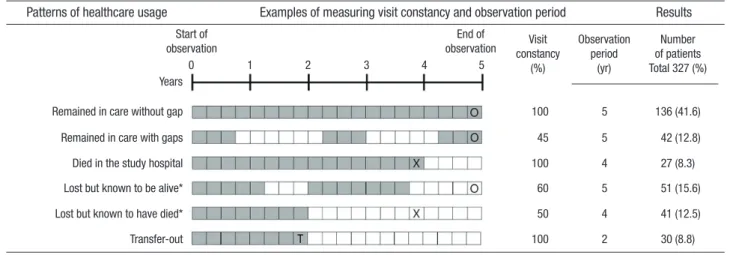
Based on the survival and follow-up status of patients after trac- ing, the observation periods were measured from the date of ART initiation to the earliest of the following dates: the date of death, the date of the last follow-up visit if the patients were transfer-out, or 12 months after ART initiation for the analysis of the first 12 months (or 60 months after ART initiation for the analysis of a later 13-60 month period) if the patients were alive at that point in time (Fig. 1).
Retention in care was measured by hospital visit constancy during the observation period after initiating ART (18-21). The observation period after starting ART was divided into 3-month time intervals, and the number of 3-month time interval in which patients had at least 1 hospital visit for HIV care was ex- amined. Hospital visit constancy was expressed by percentage, by dividing the numbers of 3-month time interval with at least 1 completed hospital visit for HIV care by the total numbers of 3-month time interval during observation period of interest (Fig. 1). Medical subspecialty appointment except HIV care visit was excluded, but urgent care visit for HIV care was included.
Cause of death was defined as the main condition that initi-
Fig. 1. Examples of measuring visit constancy and observation period, and 5 yr follow-up status of 327 patients included in analyses, according to the patterns of healthcare usage. Quarterly tracing of attendance (shaded boxes) and missed appointment (white boxes) with tracing results: alive (circles), dead (X), and transfer-out (T). *with or without gaps in care.
Patterns of healthcare usage Results
Start of observation
0 1 2 3 4 5
Years Remained in care without gap Remained in care with gaps Died in the study hospital Lost but known to be alive*
Lost but known to have died*
Transfer-out
100 5 136 (41.6)
45 5 42 (12.8)
100 4 27 (8.3)
60 5 51 (15.6)
50 4 41 (12.5)
100 2 30 (8.8)
End of
observation Visit constancy
(%)
Observation period
(yr)
Number of patients Total 327 (%) Examples of measuring visit constancy and observation period
ated the sequence of events resulting in death. Details of the methodology have been previously described (16).
Statistical analysis
Categorical variables were compared using Pearson’s chi-square test or Fisher’s exact test, whereas non-categorical variables were tested with the Mann-Whitney U-test. The mortality rate for each time period was calculated as the number of deaths per 100 person-years (PY) of observation. Cox proportional haz- ard regression analyses were used to determine the risk factors associated with mortality for both the first year after ART and a period of 1-5 yr. All variables associated mortality (P < 0.25) in univariate Cox models were assessed in multivariate models using stepwise forward selection. All tests were considered sta- tistically significant at P < 0.05. The statistical analyses were con- ducted using PASW Statistics 18 (SPSS Inc., Chicago, IL, USA) and STATA 11.1 (StataCorp LP., College Station, TX, USA).
Ethics statement
This study protocol was approved by the institutional review board of Pusan National University Hospital (IRB No. E-2012074).
Informed consent was waived by the board.
RESULTS Subjects
Between 1998 and 2006, a total of 341 patients received ART in the study hospital. Of these, 14 patients who had taken ART be- fore visiting study hospital were excluded, leaving 327 patients for analyses. The baseline characteristics of the study popula- tion are presented in Table 1. As of 60 months after ART initia- tion, 178 patients (54.4%) remained in care in the study hospi- tal, 30 patients (8.8%) were transferred out to other hospitals, 27 patients (8.3%) died in the study hospital, and 92 patients (28.1%) was lost. Of the 92 patients initially categorized as lost, after tracing, 41 patients (44.6%) were known to have died and 51 patients (55.4%) were alive (Fig. 1).
Mortality and cause of death
A total of 68 patients (20.8%) died during the 5-yr observation period; 26 (38.2%) during the first year of ART, and 42 (61.8%) between 1 and 5 yr after start of ART. Overall 5-yr mortality rate was 5.19 per 100 PY (95% confidence interval [CI], 4.03-6.58) and median time from ART initiation to death was 21.1 months (interquartile range [IQR], 4.85-38.83). Mortality rate per 100 PY was higher during the first year of ART (8.69; 95% CI, 5.68-12.73) than the period between 1 and 5 yr after start of ART (4.13; 95%
CI, 2.98-5.59). Among 26 deaths occurred during the first year of ART, 15 (57.7%) were AIDS-related death, and tuberculosis (n = 8, 30.8%) was the most common clinical condition associ- ated with death (Table 2). Ten patients (38.5%) died of non-AIDS-
related death, and non-AIDS infection (n = 3, 11.5%) was the most frequent cause of death. Of the 42 deaths occurred be- tween 1 and 5 yr after ART initiation, 23 deaths (54.8%) were AIDS-related and 15 deaths (35.7%) were non-AIDS- related (Table 2). Tuberculosis (n = 7, 14.3%) was the most frequent cause of AIDS-related death. Of the non-AIDS-related deaths, liver disease (n = 4, 9.5%) was the most common condition as- Table 1. Baseline characteristics of 327 patients included in analyses at the start of ART
Characteristics No. (%) of patients
Sex, male/female 281 (85.9)/46 (14.1)
Age at presentation, median (IQR), yr ≤ 50
> 50
42 (35-49) 260 (79.5) 67 (20.5) Route of transmission
Heterosexual Homo/bisexual IDU/transfusion
204 (62.4) 114 (34.9) 9 (2.8) Marriage
Unmarried Married
Divorced/separated by death
126 (38.5) 157 (48.0) 44 (13.5) Site of HIV acquisition
Domestic
Foreign country 210 (64.2)
117 (35.8) Comorbidity
Diabetes Hypertension Malignancy*
HBV coinfection HCV coinfection
11 (3.4) 10 (3.1) 13 (4) 24/273 (8.8) 18/273 (6.6) History of mono/dual therapy 51 (15.6) CD4 cell counts on ART initiation, median (IQR), cells/µL
> 200 101-200 51-100 ≤ 50
145 (44-277) 132 (40.4) 60 (18.3) 49 (15.0) 86 (26.3) Clinical category at ART start
A B C
182 (55.7) 49 (15.0) 96 (29.4) Year of ART initiation (yr)
2002-2006
1998-2001 210 (64.2)
117 (35.8) Duration from HIV diagnosis to ART start, median (IQR),
months < 1 1-5 5-10 > 10
7.6 (2.3-47.5) 178 (54.4) 83 (25.4) 50 (15.3) 16 (4.9) Class of ART
PI-based NNRTI-based Mixed
219 (67.0) 36 (11.0) 72 (22.0) Visit constancy for 5 yr after ART initiation
100%
51-99%
0-50%
190 (58.1) 57 (17.4) 80 (24.5) Data are number (%) of patients, unless otherwise indicated. *including both AIDS and non-AIDS malignancy. HIV, human immunodeficiency virus; IQR, interquartile range;
ART, anti-retroviral therapy; IDU, injection drug user; PI, protease inhibitor; NNRTI, non- nucleotide reverse transcriptase inhibitor; HBV, hepatitis B virus; HCV, hepatitis C virus.
sociated with death.
Factors associated with mortality within the first year after starting ART
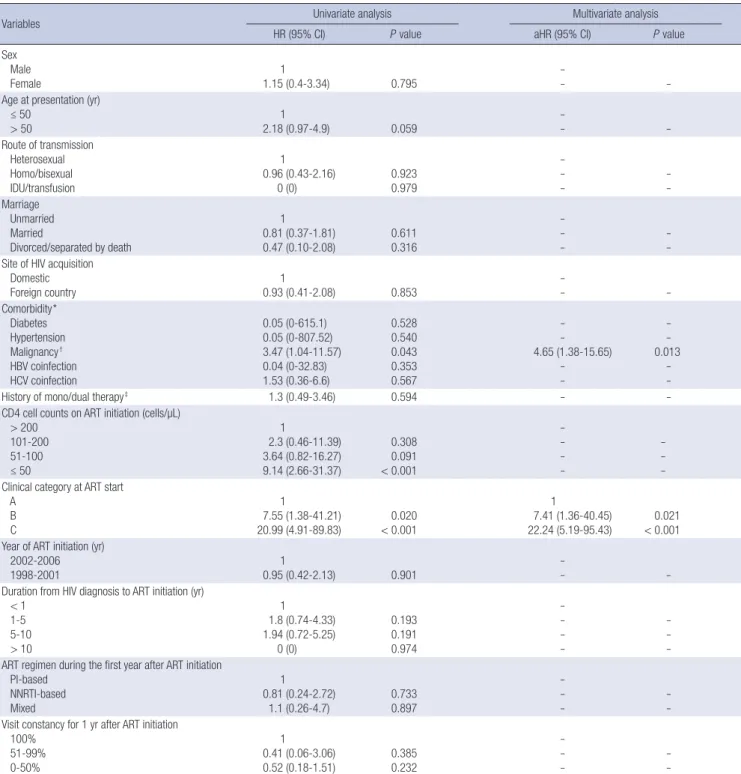
In univariate analysis, CD4 cell count ≤ 50 cells/μL at ART ini- tiation (hazard ratio [HR], 9.14; 95% CI, 2.66-31.37, P < 0.001), clinical category B (HR, 7.55; 95% CI, 1.38-41.21, P = 0.020) and C (HR, 20.99; 95% CI, 4.91-89.83, P < 0.001) at ART initiation, and underlying malignancy (HR, 3.47; 95% CI, 1.04-11.57, P = 0.043) were significant risk factors associated with mortality within the first year after ART initiation (Table 3). Multivariate analysis showed that clinical category B (adjusted hazard ratio [AHR], 7.41; 95% CI, 1.36-40.45, P = 0.021) and C (AHR, 22.24;
95% CI, 5.19-95.43, P < 0.001) at ART initiation, and underlying malignancy (AHR, 4.65; 95% CI, 1.38-15.65, P = 0.013) were sig- nificant risk factors associated with mortality during the first year of ART.
Factors associated with mortality between 1 and 5 yr after starting ART
Univariate analysis showed that site of HIV acquisition (HR, 2.61; 95% CI, 1.42-4.81, P = 0.002), underlying malignancy (HR, 4.76; 95% CI, 1.87-12.15, P = 0.001), hepatitis B virus (HBV) co- infection (HR, 6.51; 95% CI, 3.0-14.16, P < 0.001), ART initiation in 1998-2001 (HR, 3.35; 95% CI, 1.78-6.3, P < 0.001), duration from HIV diagnosis to ART initiation 5-10 yr (HR, 2.41; 95% CI,
1.06-5.45, P = 0.035) and > 10 yr (HR, 5.38; 95% CI, 2.21-13.08, P < 0.001), and visit constancy 51-99% (HR, 4.21; 95% CI, 1.5- 11.83, P = 0.006) and ≤ 50% (HR, 10.16; 95% CI, 4.19-24.62, P <
0.001) were significant risk factors associated with mortality be- tween 1 and 5 yr after ART initiation (Table 4). Multivariate anal- ysis revealed that HBV co-infection (AHR, 4.39; 95% CI, 1.81- 10.62, P = 0.001), CD4 cell count at ART initiation ≤ 50 cells/μL (AHR, 6.68; 95% CI, 2.4-18.6, P < 0.001), and visit constancy
≤ 50% (AHR, 12.54; 95% CI, 4.3-36.61, P < 0.001) were signifi- cant risk factors associated with mortality between 1 and 5 yr after ART initiation (Table 4).
DISCUSSION
Following HIV diagnosis, timely linkage to care, prompt initia- tion of ART when indicated, and maintaining good adherence to ART are critical for successful HIV treatment. Delayed link- age and poor retention in care have been associated with dele- terious clinical outcomes including delayed ART initiation, high rate of ART failure, and worse survival (19, 22, 23). The present analysis showed that the mortality rate and the risk factors for death were different over time after ART initiation. The first year mortality after ART initiation was about 2-fold higher than that of a period of 1-5 yr after ART initiation. During the first year af- ter ART initiation, CDC clinical categories B or C on ART initia- tion and underlying malignancy were significant risk factors for Table 2. Frequencies of specific cause of death in the 68 patients who died stratified by the time periods after ART initiation
Causes of death Within 1 yr after
ART initiation Between 1 and 5 yr after
ART initiation Total (%) P value*
Total death 26 42 68 -
AIDS death
Pneumocystis pneumonia Definite
Probable Tuberculosis Definite Probable Possible Cryptococcosis Cytomegalovirus disease HIV wasting syndrome
Progressive multifocal leukoencephalitis HIV encephalopathy
Non-Hodgkin’s lymphoma
15 (57.7) 2 (7.7) 1 (3.8) 1 (3.8) 8 (30.8) 4 (15.4) 3 (11.5) 1 (3.8) 0 (0) 1 (3.8) 2 (7.7) 0 (0) 0 (0) 2 (7.7)
23 (54.8) 5 (11.9) 3 (7.1) 2 (4.8) 7 (16.7) 2 (4.8) 0 (0) 5 (11.9) 1 (2.4) 0 (0) 5 (11.9) 1 (2.4) 2 (4.8) 2 (4.8)
38 (55.9) 7 (10.3) 4 (5.9) 3 (4.4) 15 (22.1)
6 (8.8) 3 (4.4) 6 (8.8) 1 (1.5) 1 (1.5) 7 (10.3) 1 (1.5) 2 (2.9) 4 (5.9)
0.813 0.700 - - 0.173
- - - 1.000 0.382 0.700 1.000 0.521 0.633 Non AIDS death
Bacterial infection/sepsis Non-AIDS malignancy Liver disease including HCC Cardiovascular disease Gastrointestinal disease Accident (trauma, injury) Suicide
10 (38.5) 3 (11.5) 1 (3.8) 1 (3.8) 2 (7.7) 1 (3.8) 0 (0) 2 (7.7)
15 (35.7) 1 (2.4) 2 (4.8) 4 (9.5) 3 (7.1) 1 (2.4) 1 (2.4) 3 (7.1)
25 (36.8) 4 (5.9) 3 (4.4) 5 (7.4) 5 (7.4) 2 (2.9) 1 (1.5) 5 (7.4)
0.819 0.152 1.000 0.642 1.000 1.000 1.000 1.000 Indeterminate
Unspecified pneumonia 0 (0)
0 (0) 3 (7.1)
3 (7.1) 3 (4.4)
3 (4.4) 0.281
0.281
Unknown 1 (3.8) 1 (2.4) 2 (2.9) 1.000
Data are number (%) of patients, unless otherwise indicated. *Calculated using χ2 test, Fisher’s exact test, or the Mann-Whitney U-test. HIV, human immunodeficiency virus; AIDS, acquired immunodeficiency syndrome; ART, anti-retroviral therapy; HCC, hepatocellular carcinoma.
death. The patients with clinical category C were about 22 times more likely to die than those with clinical category A. These find- ings are consistent with other studies that have shown that early mortality after ART initiation is related to the delayed treatment initiation due to late presentation to care (4, 24-26). Baseline CD4 cell counts ≤ 50 cells/μL was associated with early mortal- ity in univariate analyses, however, it was not associated in mul-
tivariate models, probably because clinical staging was a better indicator of early death (26). In addition, visit constancy to hos- pital was not associated with early mortality, suggesting that the patients with high risk opportunistic infections (OIs) for death remained increased risk for early death after ART initiation, even though they remained in good retention in care, before the full effect of therapy had not yet been obtained (9, 10, 27).
Table 3. Cox proportional hazards modeling of baseline and time-dependent variables associated with mortality within the first year of ART initiation
Variables Univariate analysis Multivariate analysis
HR (95% CI) P value aHR (95% CI) P value
Sex Male
Female 1
1.15 (0.4-3.34) 0.795 -
-
- Age at presentation (yr)
≤ 50
> 50 1
2.18 (0.97-4.9)
0.059 -
- -
Route of transmission Heterosexual Homo/bisexual IDU/transfusion
1 0.96 (0.43-2.16)
0 (0)
0.923 0.979
- - -
- - Marriage
Unmarried Married
Divorced/separated by death
1 0.81 (0.37-1.81)
0.47 (0.10-2.08) 0.611
0.316
- -
- -
- Site of HIV acquisition
Domestic
Foreign country 1
0.93 (0.41-2.08) 0.853 -
- -
Comorbidity*
Diabetes Hypertension Malignancy† HBV coinfection HCV coinfection
0.05 (0-615.1) 0.05 (0-807.52) 3.47 (1.04-11.57) 0.04 (0-32.83) 1.53 (0.36-6.6)
0.528 0.540 0.043 0.353 0.567
- - 4.65 (1.38-15.65)
- -
- - 0.013
- -
History of mono/dual therapy‡ 1.3 (0.49-3.46) 0.594 - -
CD4 cell counts on ART initiation (cells/µL) > 200
101-200 51-100 ≤ 50
1
2.3 (0.46-11.39) 3.64 (0.82-16.27) 9.14 (2.66-31.37)
0.308 0.091
< 0.001
- - - -
- - - Clinical category at ART start
A B C
1
7.55 (1.38-41.21)
20.99 (4.91-89.83) 0.020
< 0.001
1
7.41 (1.36-40.45)
22.24 (5.19-95.43) 0.021
< 0.001 Year of ART initiation (yr)
2002-2006
1998-2001 1
0.95 (0.42-2.13) 0.901 -
- -
Duration from HIV diagnosis to ART initiation (yr) < 1
1-5 5-10 > 10
1 1.8 (0.74-4.33) 1.94 (0.72-5.25)
0 (0)
0.193 0.191 0.974
- - - -
- - - ART regimen during the first year after ART initiation
PI-based NNRTI-based Mixed
1 0.81 (0.24-2.72)
1.1 (0.26-4.7) 0.733
0.897
- -
- -
- Visit constancy for 1 yr after ART initiation
100%
51-99%
0-50%
1 0.41 (0.06-3.06) 0.52 (0.18-1.51)
0.385 0.232
- - -
- -
*Compared with patients who had no comorbidity (reference); †including both AIDS and non-AIDS malignancy; ‡Compared with patients who had no history of mono/dual thera- py (reference). HR, hazard ratio; aHR, adjusted hazard ratio; CI, confidence interval; HIV, human immunodeficiency virus; ART, anti-retroviral therapy; IDU, injection drug user; PI, protease inhibitor; NNRTI, non-nucleotide reverse transcriptase inhibitor; HBV, hepatitis B virus; HCV, hepatitis C virus.
Between 1 and 5 yr after ART initiation, poor retention in care, baseline CD4 cell counts ≤ 50 cells/μL on ART initiation, and HBV co-infection were significant risk factors for death. How- ever, clinical category B or C on ART initiation which were risk factors for early mortality were not associated with mortality in 1-5 yr on ART, suggesting that patients with high risk OIs for death initially do not have persistently increased risk for death
if they survive the first 12 months of ART (24). In contrast, base- line CD4 cell counts ≤ 50 cells/μL on ART initiation was associ- ated with mortality in 1-5 yr on ART, suggesting that severely im- munosuppressed patients still have increased risk for death, even though they survive the first 12 month of ART (28).
In the present study, we traced the patients initially catego- rized as lost in collaboration with local PHCs. Previous studies Table 4. Cox proportional hazards modeling of baseline and time-dependent variables associated with mortality between 1 and 5 yr after ART initiation
Variables Univariate analysis Multivariate analysis
HR (95% CI) P value aHR (95% CI) P value
Sex Male
Female 1
1.18 (0.5-2.79) 0.714 -
- -
Age at presentation (yr) ≤ 50
> 50 1
1.32 (0.65-2.69) 0.441 -
- -
Route of transmission Heterosexual Homo/bisexual IDU/transfusion
1 0.56 (0.28-1.15)
0.8 (0.11-5.84)
0.114 0.824
- - -
- - Marriage
Unmarried Married
Divorced/separated by death
1 0.76 (0.38-1.52)
1.82 (0.83-4.01) 0.437 0.138
- -
- -
- Site of HIV acquisition
Domestic
Foreign country 1
2.61 (1.42-4.81) 0.002 -
- -
Comorbidity*
Diabetes Hypertension Malignancy† HBV coinfection HCV coinfection
1.46 (0.35-6.03) 0.47 (0-76.23) 4.76 (1.87-12.15) 6.51 (3.0-14.16)
2.1 (0.63-6.96)
0.603 0.418 0.001
< 0.001 0.225
- - 3.27 (0.99-10.72) 4.39 (1.81-10.62)
-
- - 0.051 0.001 -
History of mono/dual therapy‡ 1.85 (0.91-3.77) 0.090 - -
CD4 cell counts on ART initiation (cells/µL) > 200
101-200 51-100 ≤ 50
1 1.66 (0.72-3.84) 1.41 (0.57-3.49) 1.67 (0.77-3.61)
0.234 0.460 0.193
1 0.94 (0.26-3.35) 2.88 (0.84-9.95) 6.68 (2.4-18.6)
0.921 0.094
< 0.001 Clinical category on ART initiation
A B C
1 1.84 (0.87-3.89)
1.11 (0.53-2.35) 0.110 0.782
- -
- -
- Year of ART initiation (yr)
2002-2006
1998-2001 1
3.35 (1.78-6.3) < 0.001 -
- -
Duration from HIV diagnosis to ART initiation (yr) < 1
1-5 5-10 > 10
1 1.45 (0.66-3.19) 2.41 (1.06-5.45) 5.38 (2.21-13.08)
0.360 0.035
< 0.001
- - - -
- - - ART regimen during 5 yr after ART initiation
PI-based NNRTI-based Mixed
1 0 (0)
0.81 (0.4-1.64) 0.965
0.550
- -
- -
- Visit constancy for 5 yr after ART initiation
100%
51-99%
0-50%
1 4.21 (1.5-11.83) 10.16 (4.19-24.62)
0.006
< 0.001
1 2.46 (0.79-7.7) 12.54 (4.3-36.61)
0.122
< 0.001
*Compared with patients who had no comorbidity (reference); †including both AIDS and non-AIDS malignancy; ‡Compared with patients who had no history of mono/dual thera- py (reference). HR, hazard ratio; aHR, adjusted hazard ratio; CI, confidence interval; HIV, human immunodeficiency virus; ART, anti-retroviral therapy; IDU, injection drug user; PI, protease inhibitor; NNRTI, non-nucleotide reverse transcriptase inhibitor; HBV, hepatitis B virus; HCV, hepatitis C virus.
conducted in sub-Saharan Africa showed that survival rates may be inaccurate and important risk factors for death may be missed if patients are not actively traced, due to high rates of death among patients lost to follow-up after ART (24, 29). In our study, of 92 patients initially categorized lost, 44.6% were con- firmed dead after tracing, resulting in 12.5% increase of number of death after tracing.
In our study, we measured retention in care by hospital visit constancy during the observation period after ART initiation (19-21, 30). This measure is less detail to assess retention in care than appointment adherence, and is computationally more challenging (21). The missed visit within an interval of interest cannot be measured and retention can be overestimated or un- derestimated by the timing of visit (18, 21). However, this mea- sure is known to be preferable for research for longer observa- tion periods, particularly relevant for patient starting ART, and is better accounts for loss to follow-up (LTFU) than other mea- sures such as missed visit or adherence measure (21). Previous studies have typically included only scheduled outpatient med- ical appointment for HIV care (19, 22, 23, 31). In this study, how- ever, we included urgent care visit for HIV care to measure the retention because patients who returned to care after LTFU were frequently hospitalized via urgent care, and thereafter success- fully retained in care if they survived.
In our study, suboptimal retention in care was common dur- ing 5-yr observation period. Among patients who survived more than 12 months after starting ART, 53.5% was regular clinic atten- dance, whereas 46.5% had various durations of LTFU. Our data showed that patients with ≤ 50% visit constancy were about 13 times more likely to die than those who attended hospital regu- larly during 5-yr observation period. The patterns of healthcare usage and the duration of LTFU among patients with LTFU were also considerably variable, and 49% of the patients with LTFU demonstrated a cyclical pattern of being in and out of care (32, 33), leading to measuring retention in care more complex in our study.
In addition, HBV co-infection was also independent risk fac- tor for death between 1 and 5 yr after start of ART. HIV infection is associated with more rapid progression to cirrhosis or hepa- tocellular carcinoma (34, 35). HBV is the most common cause of cirrhosis and hepatocellular carcinoma in Korea, and the prevalence rate in twenties and over showed 7.6% in men and 3.4% in women (36). In our study, the prevalence rate of HBV was 9% in men and 7.5% in women, and slightly higher than that of general population. Because tenofovir has not been avail- able and other anti-HBV drugs, such as entecavir and adefovir have not been covered by public health insurance until end of 2011 in Korea, many HBV/HIV co-infected patients have been treated with lamivudine as monotherapy against HBV in their ART regimen. At present, there are few published data regard- ing the clinical outcomes of HBV/HIV co-infected patients treat-
ed with ART in Korea, and further studies are needed.
Although the mortality rate and the risk factors associated with mortality after initiating ART were different in these two time periods, the causes of death were similar over time on ART.
AIDS-related death was more common and tuberculosis re- mained the most frequent OI associated with death in both time periods.
This study has some limitations. First, this study is an obser- vational study, so we cannot rule out the presence of unmea- sured confounding. Second, our study was conducted at a sin- gle center in the southeastern region of Korea, and the numbers of death are relatively small, therefore our findings may not be generalized to other region of the country. Third, there was the lack of detailed information about the reason that tuberculosis is the most frequent cause of death, reasons for LTFU after ART initiation, and some missing data on serology for hepatitis due to its retrospective design.
In summary, the mortality rate, cause of death, and risk fac- tors associated with death in adults receiving ART in Korea were different over time after ART initiation. Late presentation to care with AIDS-defining OIs is an important risk factor for early death in the first year of ART, whereas poor retention in care, CD4 cell counts ≤ 50 cells/μL on ART initiation, and HBV co-infection are significant risk factors of late mortality. Different strategies to reduce mortality according to the time period after ART initi- ation are needed.
DISCLOSURE
The authors have no conflicts of interest to disclose.
REFERENCES
1. Mocroft A, Ledergerber B, Katlama C, Kirk O, Reiss P, d’Arminio Mon- forte A, Knysz B, Dietrich M, Phillips AN, Lundgren JD. Decline in the AIDS and death rates in the EuroSIDA Study: an observational study.
Lancet 2003; 362: 22-9.
2. Palella FJ Jr, Delaney KM, Moorman AC, Loveless MO, Fuhrer J, Satten GA, Aschman DJ, Holmberg SD. Declining morbidity and mortality among patients with advanced human immunodeficiency virus infec- tion: HIV Outpatient Study Investigators. N Engl J Med 1998; 338: 853-60.
3. Smith C, Sabin CA, Lundgren JD, Thiebaut R, Weber R, Law M, Mon- forte Ad, Kirk O, Friis-Moller N, Phillips A, et al. Factors associated with specific causes of death amongst HIV-positive individuals in the D:A:D Study. AIDS 2010; 24: 1537-48.
4. Grinsztejn B, Veloso VG, Friedman RK, Moreira RI, Luz PM, Campos DP, Pilotto JH, Cardoso SW, Keruly JC, Moore RD. Early mortality and cause of deaths in patients using HAART in Brazil and the United States.
AIDS 2009; 23: 2107-14.
5. Handford CD, Rackal JM, Tynan AM, Rzeznikiewiz D, Glazier RH. The association of hospital, clinic and provider volume with HIV/AIDS care and mortality: systematic review and meta-analysis. AIDS Care 2012;
24: 267-82.
6. Palella FJ Jr, Baker RK, Buchacz K, Chmiel JS, Tedaldi EM, Novak RM, Durham MD, Brooks JT; HOPS Investigators. Increased mortality among publicly insured participants in the HIV Outpatient Study despite HAART treatment. AIDS 2011; 25: 1865-76.
7. Braitstein P, Brinkhof MW, Dabis F, Schechter M, Boulle A, Miotti P, Wood R, Laurent C, Sprinz E, Seyler C, et al. Mortality of HIV-1-infected patients in the first year of antiretroviral therapy: comparison between low-income and high-income countries. Lancet 2006; 367: 817-24.
8. Gupta A, Nadkarni G, Yang WT, Chandrasekhar A, Gupte N, Bisson GP, Hosseinipour M, Gummadi N. Early mortality in adults initiating anti- retroviral therapy (ART) in low- and middle-income countries (LMIC):
a systematic review and meta-analysis. PLoS One 2011; 6: e28691.
9. Stringer JS, Zulu I, Levy J, Stringer EM, Mwango A, Chi BH, Mtonga V, Reid S, Cantrell RA, Bulterys M, et al. Rapid scale-up of antiretroviral therapy at primary care sites in Zambia: feasibility and early outcomes.
JAMA 2006; 296: 782-93.
10. Lawn SD, Harries AD, Anglaret X, Myer L, Wood R. Early mortality among adults accessing antiretroviral treatment programmes in sub- Saharan Africa. AIDS 2008; 22: 1897-908.
11. Marin B, Thiébaut R, Bucher HC, Rondeau V, Costagliola D, Dorrucci M, Hamouda O, Prins M, Walker S, Porter K, et al. Non-AIDS-defining deaths and immunodeficiency in the era of combination antiretroviral therapy. AIDS 2009; 23: 1743-53.
12. Sackoff JE, Hanna DB, Pfeiffer MR, Torian LV. Causes of death among persons with AIDS in the era of highly active antiretroviral therapy: New York City. Ann Intern Med 2006; 145: 397-406.
13. Korea Centers for Disease Control and Prevention. Annual report on the notified HIV/AIDS in Korea. Available at http://stat.mw.go.kr [accessed on 1 December 2012].
14. Kee MK, Lee JH, Kim EJ, Lee J, Nam JG, Yoo BH, Kim SS. Improvement in survival among HIV-infected individuals in the Republic of Korea:
need for an early HIV diagnosis. BMC Infect Dis 2009; 9: 128.
15. Choe PG, Park WB, Song JS, Kim NH, Park JY, Song KH, Park SW, Kim HB, Kim NJ, Oh MD. Late presentation of HIV disease and its associated factors among newly diagnosed patients before and after abolition of a government policy of mass mandatory screening. J Infect 2011; 63: 60-5.
16. Lee SH, Kim KH, Lee SG, Chen DH, Jung DS, Moon CS, Park JY, Chung JS, Kwak IS, Cho GJ. Trends of mortality and cause of death among HIV- infected patients in Korea, 1990-2011. J Korean Med Sci 2013; 28: 67-73.
17. Department of Health and Human Services. Archived adult and ado- lescent guidelines. Available at http://www.aidsinfo.hih.gov/guidelines/
archive/adult-and-adolescent-gudilinens [accessed on 1 December 2012].
18. Giordano TP. Retention in HIV care: what the clinician needs to know.
Top Antivir Med 2011; 19: 12-6.
19. Giordano TP, Gifford AL, White AC Jr, Suarez-Almazor ME, Rabeneck L, Hartman C, Backus LI, Mole LA, Morgan RO. Retention in care: a chal- lenge to survival with HIV infection. Clin Infect Dis 2007; 44: 1493-9.
20. Mugavero MJ. Improving engagement in HIV care: what can we do? Top HIV Med 2008; 16: 156-61.
21. Mugavero MJ, Davila JA, Nevin CR, Giordano TP. From access to engage- ment: measuring retention in outpatient HIV clinical care. AIDS Patient Care STDS 2010; 24: 607-13.
22. Berg MB, Safren SA, Mimiaga MJ, Grasso C, Boswell S, Mayer KH. Non- adherence to medical appointments is associated with increased plasma
HIV RNA and decreased CD4 cell counts in a community-based HIV primary care clinic. AIDS Care 2005; 17: 902-7.
23. Mugavero MJ, Lin HY, Willig JH, Westfall AO, Ulett KB, Routman JS, Abroms S, Raper JL, Saag MS, Allison JJ. Missed visits and mortality among patients establishing initial outpatient HIV treatment. Clin Infect Dis 2009; 48: 248-56.
24. Hoffmann CJ, Fielding KL, Johnston V, Charalambous S, Innes C, Moore RD, Chaisson RE, Grant AD, Churchyard GJ. Changing predictors of mor- tality over time from cART start: implications for care. J Acquir Immune Defic Syndr 2011; 58: 269-76.
25. Falster K, Choi JY, Donovan B, Duncombe C, Mulhall B, Sowden D, Zhou J, Law MG; Australian HIV Observational Database; TREAT Asia HIV Observational Database. AIDS-related and non-AIDS-related mor- tality in the Asia-Pacific region in the era of combination antiretroviral treatment. AIDS 2009; 23: 2323-36.
26. Moore DM, Yiannoutsos CT, Musick BS, Tappero J, Degerman R, Camp- bell J, Were W, Kaharuza F, Alexander LN, Downing R, et al. Determi- nants of early and late mortality among HIV-infected individuals receiv- ing home-based antiretroviral therapy in rural Uganda. J Acquir Immune Defic Syndr 2011; 58: 289-96.
27. Steele KT, Steenhoff AP, Newcomb CW, Rantleru T, Nthobatsang R, Lesetedi G, Bellamy SL, Nachega JB, Gross R, Bisson GP. Early mortality and AIDS progression despite high initial antiretroviral therapy adher- ence and virologic suppression in Botswana. PLoS One 2011; 6: e20010.
28. Antiretroviral Therapy Cohort Collaboration. Importance of baseline prognostic factors with increasing time since initiation of highly active antiretroviral therapy: collaborative analysis of cohorts of HIV-1-infected patients. J Acquir Immune Defic Syndr 2007; 46: 607-15.
29. Bisson GP, Gaolathe T, Gross R, Rollins C, Bellamy S, Mogorosi M, Avalos A, Friedman H, Dickinson D, Frank I, et al. Overestimates of survival after HAART: implications for global scale-up efforts. PLoS One 2008; 3: e1725.
30. Horstmann E, Brown J, Islam F, Buck J, Agins BD. Retaining HIV-infect- ed patients in care: where are we? where do we go from here? Clin Infect Dis 2010; 50: 752-61.
31. Park WB, Choe PG, Kim SH, Jo JH, Bang JH, Kim HB, Kim NJ, Oh M, Choe KW. One-year adherence to clinic visits after highly active antiret- roviral therapy: a predictor of clinical progress in HIV patients. J Intern Med 2007; 261: 268-75.
32. Cheever LW. Engaging HIV-infected patients in care: their lives depend on it. Clin Infect Dis 2007; 44: 1500-2.
33. Rajabiun S, Mallinson RK, McCoy K, Coleman S, Drainoni ML, Rebholz C, Holbert T. “Getting me back on track”: the role of outreach interven- tions in engaging and retaining people living with HIV/AIDS in medical care. AIDS Patient Care STDS 2007; 21: S20-9.
34. Konopnicki D, Mocroft A, de Wit S, Antunes F, Ledergerber B, Katlama C, Zilmer K, Vella S, Kirk O, Lundgren JD. Hepatitis B and HIV: preva- lence, AIDS progression, response to highly active antiretroviral therapy and increased mortality in the EuroSIDA cohort. AIDS 2005; 19: 593-601.
35. Thio CL, Seaberg EC, Skolasky R Jr, Phair J, Visscher B, Muñoz A, Thomas DL; Multicenter AIDS Cohort Study. HIV-1, hepatitis B virus, and risk of liver-related mortality in the Multicenter Cohort Study (MACS). Lancet 2002; 360: 1921-6.
36. Kwon SY, Lee CH. Epidemiology and prevention of hepatitis B virus in- fection. Korean J Hepatol 2011; 17: 87-95.