the difficulty of the intraoperative visualization of the medial epicondyle. However, external rotation of the femoral component may increase the risk of notching on the anterolateral femoral cortex and result in excessive shear forces and stresses on the patella during ≥90o flexion3). To overcome these disadvantages, a new type of femoral component with a varying thickness of the posterior condyle was designed to produce the same effect of external rotation. The incorporation of external rotation into the femoral component can be effective in improving patella tracking and patellofemoral joint stability3), but this has yet to be estab- lished with more follow-up research.
In this study, we compared the outcomes of TKAs using the Genesis II (Smith & Nephew Inc., Memphis, TN, USA) pros- thesis in which 3o of external rotation was incorporated into the femoral component and the Nexgen LPS (Zimmer Inc., Warsaw, IN, USA) prosthesis in which the amount of external rotation was determined based on the extent of intraoperative bone cut- ting.
Early Results of Total Knee Arthroplasty Using a Built- in 3-Degree External Rotation Prosthesis
Young-Joon Choi, MD, Ki-Won Lee, MD, and Jun-Seok Park, MD
Department of Orthopaedic Surgery, Gangneung Asan Hospital, University of Ulsan College of Medicine, Gangneung, Korea pISSN 2234-0726 · eISSN 2234-2451
Knee Surgery & Related Research
Purpose: We compared the outcomes of total knee arthroplasty (TKA) using the Genesis II prosthesis in which 3o of external rotation was incorporated into the femoral component and Nexgen LPS prosthesis in which the degree of external rotation was determined by the extent of intraoperative bone cutting.
Materials and Methods: Of the patients who underwent TKA for osteoarthritis between November 2006 and December 2009, 326 patients (572 knees) were included in this study. The prosthesis of choice was Genesis II in 199 knees and Nexgen LPS in 373 knees. The mean follow-up was 27 months (range, 24 to 51 months). The American Knee Society score (KSS) and function score (FS) were used for clinical assessments. The maximum flexion angle and patellar tilt were compared between the groups.
Results: At the final follow-up, no significant intergroup difference was observed regarding the KSS (p=0.217), FS (p=0.238), maximum flexion angle (p=0.124), and patellar tilt (p=0.156).
Conclusions: There was no significant difference in the clinical outcomes and patellar tilt between the prosthesis in which 3o of external rotation was incorporated into the femoral component and the prosthesis in which external rotation was determined based on bone cutting.
Keywords: Knee, Osteoarthritis, Arthroplasty, Femoral rotation, Patellofemoral complication
Received April 26, 2012; Revised (1st) September 28, 2012;
(2nd) February 7, 2013; Accepted May 13, 2013 Correspondence to: Ki-Won Lee, MD
Department of Orthopaedic Surgery, Gangneung Asan Hospital, 38 Bangdong-gil, Gangneung 210-711, Korea
Tel: +82-33-610-3239, Fax: +82-33-641-8050 E-mail: [email protected]
Introduction
Obtaining correct rotational alignment of the femoral compo- nent in total knee arthroplasty (TKA) is crucial to proper patellar tracking and varus-valgus balance in flexion. Since external rota- tion of the femoral component has been known to produce the closest to the normal varus-valgus stability1), it has been generally recommended to externally rotate the femoral component paral- lel to the transepicondylar axis during implant placement2). In spite of this, the femoral component is commonly placed 3o−5o externally rotated relative to the posterior condylar axis due to
112
This is an Open Access article distributed under the terms of the Creative Commons Attribution Non-Commercial License (http://creativecommons.org/licenses/by-nc/3.0/) which permits unrestricted non-commercial use, distribution, and reproduction in any medium, provided the original work is properly cited.
Copyright © 2013 KOREAN KNEE SOCIETY www.jksrr.org
Materials and Methods
1. Patients
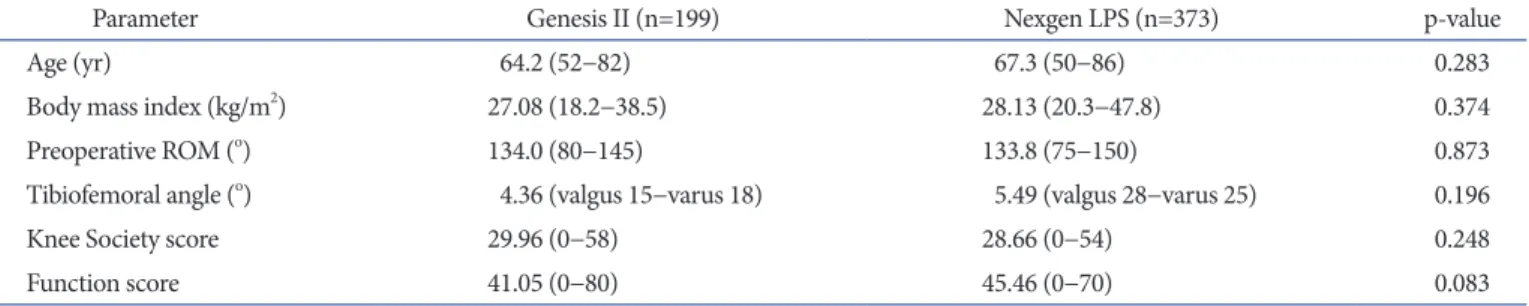
Of the patients who underwent TKA for osteoarthritis by the same surgeon from November 2006 to December 2009, 326 pa- tients (572 knees) who were available for ≥2 years of follow-up without any evidence of complications, such as infections or frac- tures were included in this study. The prosthesis of choice was Genesis II in 110 patients (199 knees) and Nexgen LPS in 216 patients (373 knees). The mean follow-up period was 27 months (range, 24 to 51 months). In the Genesis II group, there were 98 females and 12 males with a mean age of 64.2 years (range, 52 to 82 years). The mean body mass index (BMI) was 27.08 (range, 18.2 to 38.5), the mean preoperative range of motion (ROM) was 134.0o (range, 80o to 145o), the mean preoperative degree of deformity was 4.36o varus (range, 15o valgus to 18o varus). In the Nexgen LPS group, there were 208 females and 8 males with a mean age of 67.3 years (range, 50 to 86 years). The mean BMI was 28.13 (range, 20.3 to 47.8), the mean ROM was 133.8o (range, 75o to 150o), and the mean degree of deformity was 5.49o varus (range, 28o valgus to 25o vagus) (Table 1). The results of TKAs performed by the same surgeon during the same period were compared retrospectively between the two groups classified ac- cording to the prosthesis type. The patients randomly received a
Genesis II prosthesis or a Nexgen LPS prosthesis.
2. Surgical Technique
All the operations were performed by the same surgeon using the medial parapatellar approach. Posterior cruciate ligament- sacrificing implants were secured with bone cement fixation in all patients. The patella was resurfaced in all patients, taking care not to increase the thickness of the patella. More than 2 mm gain in the thickness was avoided even in knees with a preoperative thickness of <20 mm. Thus, a ≥2 mm increase in the thickness was observed in none of the patients postoperatively. Lateral reti- nacular release was carried out if the towel clip test that was per- formed during surgery in knees with poor patellar tracking even after tourniquet release revealed the presence of patellar tilt.
Regarding the extent of femoral resection, a femoral cut made was parallel to the posterior condylar axis in order to equalize the thickness of the resected bones from the posterolateral and pos- teromedial condyles in the Genesis II group. In the Nexgen LPS group, femoral resection was performed at the 3o externally rotat- ed position with respect to the posterior condylar axis in order to make the thickness of the resected bone from the posteromedial condyle greater than that from the posterolateral condyle (Fig. 1).
The radiographic assessments and clinical and functional evalu- ations were performed 6 weeks, 3 months, and 6 months postop-
Fig. 1. Application of a cutting zig for exter- nal rotation of the femoral component. (A) The thickness of the resected bone from the posteromedial condyle is equal to that from the posterolateral condyle in Genesis II prosthesis. (B) The thickness of the resected bone from the posteromedial condyle is thicker than that from the posterolateral condyle in Nexgen LPS prosthesis.
Table 1. Demographics, Radiographic Data and Preoperative Knee Score
Parameter Genesis II (n=199) Nexgen LPS (n=373) p-value
Age (yr) 64.2 (52−82) 67.3 (50−86) 0.283
Body mass index (kg/m2) 27.08 (18.2−38.5) 28.13 (20.3−47.8) 0.374
Preoperative ROM (o) 134.0 (80−145) 133.8 (75−150) 0.873
Tibiofemoral angle (o) 4.36 (valgus 15−varus 18) 5.49 (valgus 28−varus 25) 0.196
Knee Society score 29.96 (0−58) 28.66 (0−54) 0.248
Function score 41.05 (0−80) 45.46 (0−70) 0.083
Values are presented as mean (range).
ROM: range of motion.
eratively, and yearly thereafter on an outpatient basis.
3. Assessments
The patient characteristics, such as age at the time of surgery, BMI, preoperative ROM, and preoperative deformity were com- pared between the groups. The Knee Society score (KSS) and function score (FS) at the last follow-up were used to assess clini- cal outcome in both groups. Maximal flexion that was defined as the angle created by lines drawn from each midpoint of the soft tissue of the thigh and calf was measured on the lateral radio- graph taken with the knee in maximum active flexion (Fig. 2).
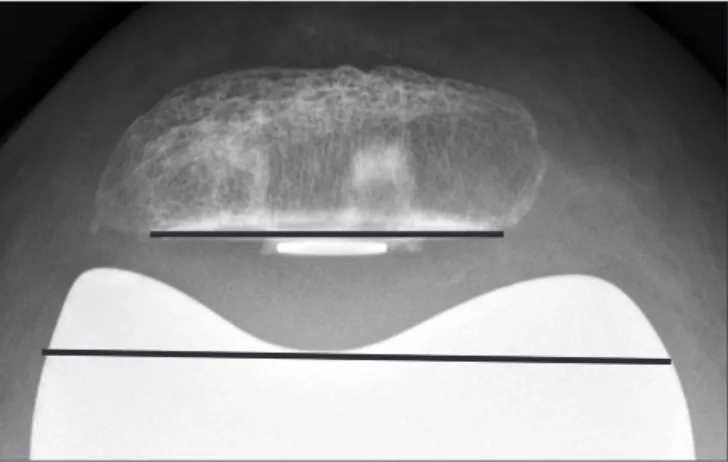
Patellar tilt was measured as the angle created by two lines tan- gential to the floor of the trochlear groove and to the patellar re- section surface on the Merchant view taken with the knee in 45o flexion as suggested by Bindelglass et al.4) (Fig. 3). Radiographic measurements were performed on plain radiographs acquired with a computed radiography system and picture archiving and communication system (Petavision for Clinics version 2.0 [Asan Medical Center, Seoul, Korea]). The mean values of the measure- ments performed twice each by two surgeons (an orthopedic knee surgeon and a chief resident) were used for radiographic evaluation. Statistical analysis was done using the Student’s t-test with SPSS ver. 14.0 (SPSS Inc., Chicago, IL, USA) and p<0.05 was considered significant. The intraobserver reproducibility and interobserver reliability were assessed using the intraclass cor- relation coefficients described by Shrout and Fleiss5): grade 0 was defined as no correlation, 0.00−0.39 as poor, 0.40−0.74 as moder- ate, ≥0.75 as excellent, and 1 as complete correlation.
Results
There was no significant difference between the groups regard- ing the age, BMI, preoperative varus deformity, KSS, FS, and ROM (Table 1). The mean KSS and FS at the last follow-up were 92.3±17.0 and 93.6±28.2, respectively, in the Genesis II group and 93.7±18.0 and 92.6±28.9, respectively, in the Nexgen LPS group, showing no notable intergroup difference (p=0.217, p=0.238).
There was no significant difference between the Genesis II group and the Nexgen LPS group in maximal flexion angle (116.3o±27.8o vs. 118.9o±29.4o; p=0.124) and patellar tilt angle (8.7o±11.0o vs.
9.6o±14.8o; p=0.156). The intraobserver reproducibility and in- terobserver reliability for patellar tilt angle measurement were relatively high, 0.901 and 0.792, respectively. Patellofemoral in- congruence was observed after tourniquet release during surgery in 17 knees (8.6%) in the Genesis II group and in 37 knees (9.9%) in the Nexgen LPS group. A lateral retinacular release was per- formed in 5 (2.5%) of the former 17 cases and in 8 (2.2%) of the latter 37 cases and component loosening was not observed dur- ing the follow-up period (Table 2).
Fig. 2. Maximal flexion is the angle between lines drawn through mid- points of soft tissue of the thigh and calf on the lateral radiograph of the actively flexed knee.
Fig. 3. Patellar tilt is the angle between a line tangential to the floor of the trochlear groove and a line drawn through the margin of the patellar prosthesis.
Table 2. Comparison of Postoperative Clinical Outcomes
Parameter Genesis II
(n=199) Nexgen LPS
(n=373) p-value Knee Society score 92.3±17.0 93.7±18.0 0.217
Function score 93.6±28.2 92.6±28.9 0.238
Maximal flexion angle (o) 116.3±27.8 118.9±29.4 0.124 Patellar tilt angle (o) 8.7±11.0 9.6±14.8 0.156
Lateral release (%) 5 (2.5) 8 (2.2)
Values are presented as mean±standard deviation or number (%).
Discussion
Obtaining correct rotational alignment of the femoral compo- nent in TKA is crucial to patellofemoral joint stability and varus- valgus balance in flexion. One of the most important character- istics of Genesis II prosthesis is built-in external rotation, which enables bone resection to be performed with 0o of external rota- tion of the femoral component. In contrast, most of the conven- tional prostheses require bone resection to be done with 3o of ex- ternal rotation relative to the posterior condylar axis. As a result, the thickness of the resected bone from the posterolateral con- dyle is greater than that from the posteromedial condyle on the anterior view, which increases the risk of notching of the lateral femoral condyle3) or component instability in the medial con- dyle due to insufficient bone resection. Notching was observed in 3 knees in the Genesis II group and in 5 knees in the Nexgen LPS group, none of which was clinically significant (<1 mm) or resulted in complications. The occurrence of an anterior femoral notch is considered to be more dependent on the experience of the surgeon and surgical technique than the type of prosthesis.
However, we believe that anterior placement of the femoral com- ponent with built-in external rotation for the purpose of avoiding notching could result in insufficient resection of the medial con- dyle and increase patellofemoral compression.
The rotational alignment of the femoral and tibial components could affect the postoperative clinical outcome. Nicoll and Row- ley6) reported that internal rotation or rotational incongruity of the femoral and tibial components was the major cause of postoperative pain. A biomechanical study by Thompson et al.7) showed that internal rotation of the femoral component could limit the ability to perform daily living activities, such as kneeling and getting up from a chair, due to quadriceps weakness. Thus, it has been recommended to externally rotate the femoral and tibial components in most cases. On the other hand, Ries et al.8) suggested that a relatively constant angle of rotational congru- ity could be maintained with use of a neutrally rotated femoral component based on their observation that external rotation of the femoral component resulted in 3.53o of rotational incongru- ity in extension when the tibial component was not externally rotated, and 3.23o of rotational incongruity in flexion when the tibial component was externally rotated. Liau et al.9) reported that Genesis II prostheses were useful for obtaining correct rotational alignment because the contact area was relatively well maintained regardless of the changes in the rotational position. The use of a downsized tibial component for the purpose of preventing an- teromeidal overhang in external rotation could result in reduced
coverage of the resected surface of the tibia. There was no case of anteromiedal overhang of the tibia in our patients. However, the number of posterolateral overhang was higher in the Nexgen LPS group. Although the difference was not clinically significant, we thought that the asymmetrical shape of the Genesis II prosthesis (medial condyle of the tibial component is bigger than the lateral condyle) partly contributed to the relatively low occurrence of overhang10). In the absence of objective standards to assess clini- cal differences caused by alignment incongruity of the femoral and tibial components, the incidence and type of polyethylene insert wear should be monitored for a long-term period.
Normal trochlear groove is situated 4−5 mm lateral to the mid- line of the femur, and thus it is located relatively laterally when a symmetrical femoral component is placed. On the other hand, external rotation of a femoral component results in a lateral shift of the proximal portion of the trochlear groove, which leads to normal patellar tracking in extension, whereas medialization of the patella in flexion. High flexion may increase shear force on the patellofemoral joint, which eventually leads to patellar com- ponent wear or patellar fracture3). The Genesis II prosthesis is designed to have a more lateralized trochlear groove to replace the lateral shift of the trochlear groove that occurs when a pros- thesis is inserted laterally rotated. In a study by Kaper et al.3), the prosthesis reduced the need for lateral retinacular release and improved patellar tracking, whereas we could not find a signifi- cant difference between the Genesis II group and the Nexgen LPS group (2.5% vs. 2.2%). No notable intergroup difference was observed in the patellar tilt as well. However, it is difficult to as- sign significance to this result, considering that patellar tilt can be affected by the measurement method or the extent of flexion during assessment as well as postoperative muscle strength or rehabilitation program even in knees treated with an appropri- ate surgical procedure for proper patellar tracking. The patellar grind test for anterior knee pain was positive in 10 knees (5.0%) in the Genesis II group and in 16 knees (4.3%) in the Nexgen LPS group, showing no significant intergroup difference. Thus, no correlation could be found between the patella tilt and anterior knee pain.
The extent of knee flexion affects joint function for daily living activities and patient satisfaction especially in Asians. According to the meta-analysis of Bhandari et al.11), the Genesis II prosthesis allows for high flexion and exhibits encouraging survival rates.
Accordingly, we expected that the high-flexion polyethylene insert we used in our patients would enable greater flexion than do conventional prostheses, but we could not observe significant difference between the prostheses. McCalden et al.12) reported
that there was no difference in the range of flexion between knees with a standard insert and those with a high-flex polyethylene insert. We also believe that the postoperative range of flexion is more influenced by the patient’s characteristics and surgical technique than the prosthesis design. In our opinion, the stabil- ity of the prosthesis for high flexion positions and polyethylene wear rate need to be assessed for a longer-term follow-up period.
The flexion angles among our patients were smaller than those reported in recent studies and the preoperative values. This can be primarily attributable to the use of lateral views taken with the knee in maximum active flexion position instead of the passive flexion position to improve the measurement reliability in the ra- diographic assessment. Partly, the results may reflect the fact that TKA could result in a decrease in active ROM. The limitations of this study include that other knee functions, such as squatting, sitting cross-legged on the floor, and stair climbing were not in- cluded in the clinical assessment that was solely based on the KSS and FS.
Conclusions
The Genesis II prosthesis with built-in 3-degree external ro- tation of the femoral component did not exhibit significant improvement in terms of the clinical outcome and patellar tilt during the short-term follow-up period compared to the Nexgen LPS prosthesis in which the level of external rotation is deter- mined intraoperatively according to the extent of bone cutting.
Conflict of Interest
No potential conflict of interest relevant to this article was re- ported.
References
1. Anouchi YS, Whiteside LA, Kaiser AD, Milliano MT. The effects of axial rotational alignment of the femoral compo- nent on knee stability and patellar tracking in total knee ar- throplasty demonstrated on autopsy specimens. Clin Orthop
Relat Res. 1993;(287):170-7.
2. Poilvache PL, Insall JN, Scuderi GR, Font-Rodriguez DE.
Rotational landmarks and sizing of the distal femur in total knee arthroplasty. Clin Orthop Relat Res. 1996;(331):35-46.
3. Kaper BP, Woolfrey M, Bourne RB. The effect of built- in external femoral rotation on patellofemoral tracking in the genesis II total knee arthroplasty. J Arthroplasty.
2000;15:964-9.
4. Bindelglass DF, Cohen JL, Dorr LD. Patellar tilt and sublux- ation in total knee arthroplasty: relationship to pain, fixation, and design. Clin Orthop Relat Res. 1993;(286):103-9.
5. Shrout PE, Fleiss JL. Intraclass correlations: uses in assessing rater reliability. Psychol Bull. 1979;86:420-8.
6. Nicoll D, Rowley DI. Internal rotational error of the tibial component is a major cause of pain after total knee replace- ment. J Bone Joint Surg Br. 2010;92:1238-44.
7. Thompson JA, Hast MW, Granger JF, Piazza SJ, Siston RA.
Biomechanical effects of total knee arthroplasty component malrotation: a computational simulation. J Orthop Res.
2011;29:969-75.
8. Ries MD, Salehi A, Laskin RS, Bourne RB, Rand JA, Gustilo RB. Can rotational congruity be achieved in both flexion and extension when the femoral component is externally rotated in total knee arthroplasty? Knee. 1998;5:37-41.
9. Liau JJ, Cheng CK, Huang CH, Lee YM, Chueh SC, Lo WH.
The influence of contact alignment of the tibiofemoral joint of the prostheses in in vitro biomechanical testing. Clin Bio- mech (Bristol, Avon). 1999;14:717-21.
10. Bourne RB, Laskin RS, Guerin JS. Ten-year results of the first 100 Genesis II total knee replacement procedures. Or- thopedics. 2007;30(8 Suppl):83-5.
11. Bhandari M, Pascale W, Sprague S, Pascale V. The Genesis II in primary total knee replacement: a systematic literature review of clinical outcomes. Knee. 2012;19:8-13.
12. McCalden RW, MacDonald SJ, Bourne RB, Marr JT. A randomized controlled trial comparing “high-flex” vs “stan- dard” posterior cruciate substituting polyethylene tibial inserts in total knee arthroplasty. J Arthroplasty. 2009;24(6 Suppl):33-8.