Development of a Pneumatic Tensioning Device for Gap Measurement during
Total Knee Arthroplasty
Dai-Soon Kwak, PhD, Chae-Gwan Kong, MD*, Seung-Ho Han, MD, Dong-Hyun Kim, MD*, Yong In, MD*
Department of Anatomy, Catholic Institute for Applied Anatomy,
*Department of Orthopaedic Surgery, The Catholic University of Korea School of Medicine, Seoul, Korea
Received November 9, 2011; Accepted December 20, 2011 Correspondence to: Yong In, MD
Department of Orthopaedic Surgery, Seoul St. Mary’s Hospital, The Catholic University of Korea School of Medicine, 222 Banpo-daero, Seocho-gu, Seoul 137-701, Korea
Tel: +82-2-2258-2838, Fax: +82-2-535-9834 E-mail: [email protected]
The goal of total knee arthroplasty (TKA) is to achieve a well-aligned tibiofemoral and patellofemoral joint sur- rounded by a well-balanced soft-tissue envelope.1-3) Soft tissue balancing in TKA should create a symmetric medial and lateral joint gap throughout the range of motion.4) Tight gaps may lead to limited motion, a less than satisfac- tory result, or adverse wear of the polyethylene compo- nent.5) Knee instability has been documented as a cause of pain and poor results after cruciate-retaining or posterior-
Background: Despite the importance of soft tissue balancing during total knee arthroplasty (TKA), all estimating techniques are dependent on a surgeon’s manual distraction force or subjective feeling based on experience. We developed a new device for dynamic gap balancing, which can offer constant load to the gap between the femur and tibia, using pneumatic pressure during range of motion.
Methods: To determine the amount of distraction force for the new device, 3 experienced surgeons’ manual distraction force was measured using a conventional spreader. A new device called the consistent load pneumatic tensor was developed on the basis of the biomechanical tests. Reliability testing for the new device was performed using 5 cadaveric knees by the same surgeons.
Intraclass correlation coefficients (ICCs) were calculated.
Results: The distraction force applied to the new pneumatic tensioning device was determined to be 150 N. The interobserver reliability was very good for the newly tested spreader device with ICCs between 0.828 and 0.881.
Conclusions: The new pneumatic tensioning device can enable us to properly evaluate the soft tissue balance throughout the range of motion during TKA with acceptable reproducibility.
Keywords: Total knee arthroplasty, Soft tissue balancing, Gap measurement, Pneumatic tensor
stabilized TKA.6,7) Estimating the soft tissue balancing dur- ing TKA is usually achieved with the use of spacer blocks, laminar spreaders, and tensioning devices, as well as by placement of trial components. An accurate gap measure- ment technique is as important as gap balancing.
The spacer blocks technique involves inserting a series of fixed thickness spacers with the knee in full ex- tension and in 90o flexion to measure gaps, whereas in the tensor technique the flexion and extension gaps are assessed with the tensioning of the medial and lateral compartments.3,8,9) Trial components technique involves checking the knee range of motion and stability with the trial components in place.10) Some surgeons11,12) reported that navigation assisted soft tissue balancing during TKA was an effective means. However, the navigation system is not a gap evaluation device, rather, it is a positioning sys- tem. The navigation system represents an additional health
Copyright © 2012 by The Korean Orthopaedic Association
This is an Open Access article distributed under the terms of the Creative Commons Attribution Non-Commercial License (http://creativecommons.org/licenses/by-nc/3.0) which permits unrestricted non-commercial use, distribution, and reproduction in any medium, provided the original work is properly cited.
Clinics in Orthopedic Surgery • pISSN 2005-291X eISSN 2005-4408
care cost and its efficacy has not yet demonstrated in TKA.
Despite the importance of soft tissue balancing during TKA, all of the estimation techniques are dependent on a surgeon’s manual distraction force or subjective feeling ac- cording to experience.
The purpose of this study was to develop a new tensioning device that offers consistent tension by way of using pneumatic pressure during range of motion. The ob- jectives of this study were to determine the force applied to the device and to evaluate the feasibility of using the new device.
METHODS
Determination of Distraction Force
To test and quantify the usual amount of a surgeon’s man- ual distraction force applied to the spreader device for gap estimation during TKA procedure, a conventional spread- er (Aesculap, Tuttlingen, Germany) was set on the Instron universal tester (model 5567; Instron, Norwood, MA, USA). A specific holder for the spreader was constructed.
Three skilled orthopedic surgeons distracted the spreader manually, 5 times each, using the same power applied to the device as during TKA surgery (Fig. 1). The Instron universal tester developed a force curve and the maximal force was recorded.
Development of a New Device
Pneumatic pressure was considered as a new source of force applied to the tensioning device. Nitrous oxide (N2O) gas is easily accessible in operation room circumstances
and so was utilized as a source of pneumatic pressure that can offer consistent tension to the new device in this study.
Pneumatic cylinders were applied to separately measure the medial and lateral gaps. It consisted of a main frame that had 2 cylinders and thickness scales, air tube connec- tors, one tibial plate, and 2 femoral plates (Fig. 2). N2O gas is delivered through the tube to the cylinders. Pneumatic pressure supplied to the cylinder distracts the femoral plates and the power of the gas can be easily controlled us- ing a valve of the gas supplier. The size of gap is measured using the scales on the spreader from 6 to 30 mm. If a trial femoral component is inserted into the femur, then the flexion and extension gaps can be continuously measured throughout the range of motion.
Validation
Five fresh-frozen human cadaveric knees were prepared after having thawed overnight. No knee had signs of pre- vious trauma, surgery or deformity. All the procedures were performed by one surgeon. A medial parapatellar approach was performed through a midline skin incision.
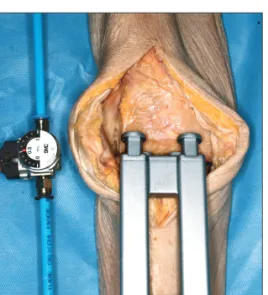
The distal femoral cut was made 9 mm in thickness us- ing an intramedullary 6o valgus guide. After determining the anterior-posterior (AP) dimension using an AP sizing instrument, the AP and chamfer cutting was performed at the 3o externally rotated position to the posterior condylar axis. The proximal tibial cut was done using an extramed- ullary guide and the cut was 10 mm in thickness from the lateral tibial plateau. Three different orthopedic surgeons placed the new tensioning device into the gap space of the knee joint. The pneumatic force was applied through an air tube and cylinder to the plates. The surgeons read the gap shown on the scales. Feasibility testing was performed in the full extension and 90o flexion positions. Each surgeon
Fig. 1. A conventional spreader was set on the Instron universal tester to quantify the usual amount of a surgeon’s manual distraction force.
Fig. 2. The new pneumatic tensioning device consists of air connectors, air cylinders, and femoral and tibial plates.
controlled the position of the tibia to be neutral to the fe- mur to prevent rotation and AP displacement and the gap was measured 3 times per cadaveric knee (Fig. 3).
Statistics
To determine the interobserver reliability of the measure- ments, intraclass correlation coefficients (ICCs) were calculated using the method of absolute agreement and with a single measurement as the unit of analysis. Results below 0.60 represented poor reliability, those from 0.60 to 0.75 represented moderate reliability and values above 0.75 represented good reliability.13) The calculations were per- formed using the SPSS ver. 13.0 (SPSS Inc., Chicago, IL, USA).
RESULTS
Determination of the Distraction Force
The mean surgeons’ manual distraction force using a con-
ventional spreader set on the Instron universal tester was 148 ± 9.1 N (range, 127 to 159 N). The distraction force applied to the new pneumatic tensioning device was deter- mined to be 150 N.
Reproducibility of the Device
The feasibility of the new tensioning device was tested with 150 N of pneumatic pressure. The new device provided independent gap measurements of the medial and lateral compartments. The mean extension medial and lateral gap measurements ranged from 18.6 to 18.8 mm, and from 20.0 to 20.4 mm, respectively. The mean flexion medial and lateral gap measurements ranged from 17.2 to 17.6 mm, and from 18.1 to 18.4 mm, respectively. The interobserver reliability was very good for the newly tested spreader de- vice, with ICCs between 0.828 and 0.881 (Table 1).
DISCUSSION
The results of the current study suggest that the new pneu- matic tensioning device is reliable and precise for gap measurement testing during TKA. Our design concept for a new gap estimation device was based on excluding the manual force from the manipulation of the device. This study shows that the new device can fulfill the require- ments that have been proposed for an ideal tensioning device: consistent force, dynamic measurement and ease of use.
Estimation of soft tissue balancing during TKA is usually achieved with the use of spacer blocks, spreader/
tensor devices and trial components. Some authors14,15) have introduced spreader/tensor devices with a torque meter, which indicate the angular deviation, as well as the distraction distance. Muratsu et al.16) developed a new tensor using a rack and pinion mechanism that permits reduction of the patellofemoral joint while performing measurement. However, measurements with these devices were performed only at a certain position on the medial and lateral femorotibial joint, such as full extension or 90o Fig. 3. Feasibility testing was performed by placing the new tensioning
device into the gap space of the knee joint. The pneumatic force was applied through the air tube and cylinder to the plates.
Table 1. Interobserver Agreement of Gap Measurement by 3 Surgeons
Knee position Surgeon 1 Surgeon 2 Surgeon 3 ICC (95% confidence interval)
Extension medial (o) 18.7 (17-20) 18.6 (16-20) 18.8 (16-21) 0.881 (0.749-0.954)
Extension lateral (o) 20.0 (17-24) 20.1 (17-24) 20.4 (18-25) 0.879 (0.745-0.953)
Flexion medial (o) 17.2 (16-19) 17.6 (17-19) 17.4 (16-20) 0.849 (0.649-0.944)
Flexion lateral (o) 18.1 (17-20) 18.2 (16-21) 18.4 (17-22) 0.828 (0.651-0.932)
ICC: intraclass correlation coefficient.
of flexion. Even though these devices are generally con- sidered to supply consistent tension, the torque driver is operated by the surgeon’s hand.
Initially, we developed a primitive model using com- pression springs. Employment of a spring-loaded tension- ing device to measure the soft tissue balancing is not a new development. Several authors17-19) have developed their own tensor devices that consist of spring housing with 2 separate springs. A spring force of 100 to 200 N was ap- plied to assess the soft tissue tension in their studies. How- ever, two problems were identified with our spring tensor device during feasibility testing. The first was that it could not offer consistent tension. Because compression springs store energy when compressed, the distraction force of the device was increased by compressing the springs. The second problem was that there was an offset on the point of application of the force between the springs and plates.
Although the basic designs of the conventional spreader/
tensor devices also have this offset, the medial and lateral plates of these devices were directly spread by distraction clamps with manual maximal tension till the ligaments were taut.
In this current study, the mean surgeons’ manual distraction force, using a conventional spreader, was 148 N.
Our data was considered to be similar with that of other studies that applied force of 100 to 200 N for the distrac- tion of a balancer/tensor.14,17,18,20) Computerized sensing devices have been developed and incorporated into the conventional balancers and trial components.20,21) These devices allow quantitative, intraoperative assessment of compartment pressures. Viskontas et al.20) added load cells to the balancer that was adapted with a computer. They reported that there was no difference in the knee load bal- ance between a conventional balancing technique and a new technique using computer assistance. Wasielewski et al.21) incorporated a pressure sensing device into a polyethylene tibial trial. They reported that abnormal compartment pressures and distributions, as recorded by the intraoperative pressure sensor, were correlated with inappropriate or paradoxical postoperative kinematics.
The sensor system is highly sensitive and it can detect even subtle imbalance. Anyhow, these sensor systems are based on the traditional balancer or on the trial component tech- nique.
Marmignon et al.22) developed an automated hy- draulic tensor. They reported that the hydraulic tensor was powerful enough to measure the gaps. However, they mentioned that the height control accuracy is dependent on the compressibility of the contained liquid and the stiffness of the bladders. In our study, the tension of the pneumatic tensioning device was consistent and it could be easily controlled by adjusting the power of the N2O gas in an operation room environment. However, during the study, we found that the leakage problem could happen at connection parts. This problem might lead to inaccurate measurements. Air proof sealing should be confirmed in manufacturing process.
There are some limitations in the current study.
First, even though this study performed feasibility testing, while working with cadavers, the sample size was rela- tively small. Second, the cadavers were tested 3 times on the same day by 3 surgeons and only a short time interval separated the test-retest sessions; thus there was the po- tential to interfere with learning the effect of fatigue after the first measurement. Third, even though the device was developed for gap measurement during range of motion, the feasibility testing was performed in the full extension and 90o flexion positions for the convenience of the study.
Finally, there was no control group to compare the mea- surements data to the new device.
The results of this study demonstrate that interob- server reliability was very good for the measurements us- ing the new pneumatic tensioning device. In conclusion, our study suggests that this pneumatic tensioning device can enable us to properly evaluate the soft tissue balance throughout the range of motion during TKA with accept- able reproducibility.
CONFLICT OF INTEREST
No potential conflict of interest relevant to this article was reported.
ACKNOWLEDGEMENTS
The authors wish to acknowledge the financial support of the Catholic Medical Center Research Foundation in the program year of 2009.
REFERENCES
1. Mihalko WM, Saleh KJ, Krackow KA, Whiteside LA. Soft- tissue balancing during total knee arthroplasty in the varus knee. J Am Acad Orthop Surg. 2009;17(12):766-74.
2. Peters CL. Soft-tissue balancing in primary total knee ar- throplasty. Instr Course Lect. 2006;55:413-7.
3. Winemaker MJ. Perfect balance in total knee arthroplasty:
the elusive compromise. J Arthroplasty. 2002;17(1):2-10.
4. D'Lima DD, Patil S, Steklov N, Colwell CW Jr. An ABJS best paper: dynamic intraoperative ligament balancing for total knee arthroplasty. Clin Orthop Relat Res. 2007;463:208-12.
5. Swany MR, Scott RD. Posterior polyethylene wear in pos- terior cruciate ligament-retaining total knee arthroplasty: a case study. J Arthroplasty. 1993;8(4):439-46.
6. Pagnano MW, Hanssen AD, Lewallen DG, Stuart MJ. Flex- ion instability after primary posterior cruciate retaining total knee arthroplasty. Clin Orthop Relat Res. 1998;356:39- 46.
7. Schwab JH, Haidukewych GJ, Hanssen AD, Jacofsky DJ, Pagnano MW. Flexion instability without dislocation after posterior stabilized total knees. Clin Orthop Relat Res.
2005;440:96-100.
8. Tanzer M, Smith K, Burnett S. Posterior-stabilized versus cruciate-retaining total knee arthroplasty: balancing the gap.
J Arthroplasty. 2002;17(7):813-9.
9. Griffin FM, Insall JN, Scuderi GR. Accuracy of soft tis- sue balancing in total knee arthroplasty. J Arthroplasty.
2000;15(8):970-3.
10. In Y, Kim SJ, Kim JM, Woo YK, Choi NY, Kang JW. Agree- ments between different methods of gap balance estimation in cruciate-retaining total knee arthroplasty. Knee Surg Sports Traumatol Arthrosc. 2009;17(1):60-4.
11. Lee DH, Park JH, Song DI, Padhy D, Jeong WK, Han SB.
Accuracy of soft tissue balancing in TKA: comparison be- tween navigation-assisted gap balancing and conventional measured resection. Knee Surg Sports Traumatol Arthrosc.
2010;18(3):381-7.
12. Song EK, Seon JK, Park SJ. Flexion-extension gaps bal- anced using navigation assistance in TKA. Orthopedics.
2009;32(10 Suppl):26-30.
13. Portney LG, Watkins MP. Foundations of clinical research:
applications to practice. Upper Saddle River, NJ: Prentice Hall; 2000.
14. Asano H, Muneta T, Sekiya I. Soft tissue tension in exten- sion in total knee arthroplasty affects postoperative knee ex- tension and stability. Knee Surg Sports Traumatol Arthrosc.
2008;16(11):999-1003.
15. Yagishita K, Muneta T, Ikeda H. Step-by-step measurements of soft tissue balancing during total knee arthroplasty for patients with varus knees. J Arthroplasty. 2003;18(3):313-20.
16. Muratsu H, Matsumoto T, Kubo S, et al. Femoral compo- nent placement changes soft tissue balance in posterior- stabilized total knee arthroplasty. Clin Biomech (Bristol, Avon). 2010;25(9):926-30.
17. Bathis H, Perlick L, Tingart M, Luring C, Perlick C, Grifka J.
Flexion gap configuration in total knee arthroplasty follow- ing high tibial osteotomy. Int Orthop. 2004;28(6):366-9.
18. Nowakowski AM, Majewski M, Muller-Gerbl M, Valder- rabano V. Development of a force-determining tensor to measure "physiologic knee ligament gaps" without bone resection using a total knee arthroplasty approach. J Orthop Sci. 2011;16(1):56-63.
19. Swank M, Romanowski JR, Korbee LL, Bignozzi S. Liga- ment balancing in computer-assisted total knee arthroplas- ty: improved clinical results with a spring-loaded tensioning device. Proc Inst Mech Eng H. 2007;221(7):755-61.
20. Viskontas DG, Skrinskas TV, Johnson JA, King GJ, Wine- maker MJ, Chess DG. Computer-assisted gap equalization in total knee arthroplasty. J Arthroplasty. 2007;22(3):334-42.
21. Wasielewski RC, Galat DD, Komistek RD. Correlation of compartment pressure data from an intraoperative sensing device with postoperative fluoroscopic kinematic results in TKA patients. J Biomech. 2005;38(2):333-9.
22. Marmignon C, Leimnei A, Lavallee S, Cinquin P. Auto- mated hydraulic tensor for total knee arthroplasty. Int J Med Robot. 2005;1(4):51-7.