• 검색 결과가 없습니다.

Gastric type mucinous endocervical adenocarcinoma of the uterine cervix: very rare and interesting case

N/A
N/A
Protected

Academic year: 2022

Share "Gastric type mucinous endocervical adenocarcinoma of the uterine cervix: very rare and interesting case"

Copied!
5
0
0

로드 중.... (전체 텍스트 보기)

전체 글

(1)

https://doi.org/10.5468/ogs.2018.61.1.165 pISSN 2287-8572 · eISSN 2287-8580

Gastric type mucinous endocervical adenocarcinoma of the uterine cervix: very rare and interesting case

Chul Min Park

1

, Hyun Min Koh

2

, Soyun Park

1

, Hye Sim Kang

1

, Soon Sup Shim

1

, Sung Yob Kim

1

Departments of

1

Obstetrics and Gynecology,

2

Pathology, Jeju National University Hospital, Jeju, Korea

Gastric type mucinous endocervical adenocarcinomas of the uterine cervix (GAC) are a newly classified mucinous subtype with morphologically in 2014, WHO. They have a much more aggressiveness and show unusual metastatic patterns compared to usual type endocervical adenocarcinoma. They tend to present at higher stage and even in stage I, they have worse survival. Therefore, differential diagnosis of GAC from the usual type of endocervical adenocarcinoma is very important because they are related to a significant risk of recurrence and decreased 5-year disease-specific survival. Besides, GACs are mostly not associated with human papillomavirus (HPV) infection and p16 immunohistochemistry is also typically negative in GAC that is HPV-unassociated tumor. We report a very rare and interesting case of stage IB1 GAC with negative HPV DNA and p16.

Keywords: Adenocarcinoma; Mucinous; Gastric type; Human papillomavirus

Introduction

Endocervical adenocarcinoma represents approximately 20%–

25% of cervical cancers, with increasing incidence in recent years [1-5]. The 2014 World Health Organization (WHO) clas- sification of endocervical adenocarcinoma lists the following types: usual type adenocarcinoma, mucinous carcinoma (gas- tric, intestinal, signet-ring cell type), villoglandular carcinoma, endometrioid carcinoma, clear cell carcinoma, and others (Table 1). Above all gastric type, as a subtype of mucinous adenocarcinoma shows distinct morphologic features, gastric phenotype and an aggressive clinical course [6,7]. Most mu- cinous adenocarcinomas are considered to be human papil- lomavirus (HPV)-associated tumor, but studies have shown that gastric type mucinous endocervical adenocarcinomas of the uterine cervix (GAC) is mostly not related to HPV infection [8,9]. And p16 immunohistochemistry is a very useful marker of HPV-associated cervical carcinomas, but it is also typically negative in GAC that is HPV-unassociated tumors [9]. GAC has been reported to have an aggressive clinical course. The 5-year disease-free survival (DFS) rate of patients with GAC (38%) is substantially lower than that of patients with the usual type adenocarcinoma (74%) [7].

We report a rare and interesting case of stage IB1 GAC with negative HPV DNA and p16. In spite of preoperative evalu-

ations that there were negative local invasion and distant metastasis except cervical mass on pelvis magnetic resonance imaging (MRI) and positron emission tomography-computed tomography (PET-CT), after operation we confirmed parame- trial, vaginal, and corpus involvement with pelvic lymph node (LN) metastasis by pathology.

Case report

A 53-year-old nullipara menopaused woman was referred to our hospital with abnormal Papanicolaou (Pap) smears show- ing atypical glandular cells in April 2017. She was healthy and had no medical complication but complained of 3 kg

Articles published in Obstet Gynecol Sci are open-access, distributed under the terms of the Creative Commons Attribution Non-Commercial License (http://creativecommons.

org/licenses/by-nc/3.0/) which permits unrestricted non-commercial use, distribution, and reproduction in any medium, provided the original work is properly cited.

Copyright © 2018 Korean Society of Obstetrics and Gynecology

Received: 2017.08.21. Revised: 2017.10.13. Accepted: 2017.10.13.

Corresponding author: Chul Min Park

Department of Obstetrics and Gynecology, Jeju National University Hospital, 15, Aran 13-gil, Jeju 63241, Korea

E-mail: [email protected]

http://orcid.org/0000-0001-9338-9972

(2)

weight loss for 2 months. She underwent colposcopic exam and followed by punch biopsy and endocervical curettage.

Colposcopic finding showed erosive cervix with easy bleeding, but there was no definite acetowhite lesion and vaginal ex- tension. Histological analysis of punch biopsy and endocervi- cal curettage revealed invasive endocervical adenocarcinoma.

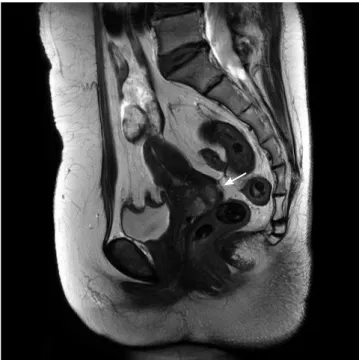
But, HPV DNA test was negative. Subsequent bimanual rectovaginal examination showed about 2×3×4 cm cervical mass and no parametrial invasion. MRI of the pelvis revealed a longest diameter 3.9 cm sized cervical mass without para- metrial and vaginal extension. And there is no evidence of sig- nificant LN metastasis and other local invasion in pelvic cavity (Fig. 1). The PET-CT scan showed a heterogenous, moderate fluorodeoxyglucose (FDG) uptake in uterus area which was suspected of malignancy, but there is no significant abnormal FDG uptake to suggest metastatic LN and distant metastasis (Fig. 2). Carbohydrate antigen-125 (CA-125) and carcinoem- bryonic antigen (CEA) were within normal range, 9.00 U/mL and 1.78 ng/mL, respectively. The results of other examina- tion including sigmoidoscopy, gastroscopy and cystoscopy were unremarkable. In conclusion, the preoperative clinical stage was IB1 according to the International Federation of Gynecology and Obstetrics (FIGO). Therefore, nerve sparing radical hysterectomy (type C1), both salpingo-oophorectomy, bilateral pelvic lymphadenectomy (level 1) and appendectomy were performed at our hospital. After surgery, the pathology revealed that 4×3 cm sized, gastric type mucinous endocervi- cal adenocarcinoma encircling of uterine cervix with 1.4 cm

involvement of 1.5 cm total thickness. And bilateral parame- trium, upper two-third of vagina and corpus involvement was present, but surgical margin was all free from everywhere.

Metastasis in 3 of 18 regional pelvic LNs and lymphatic in- vasion were present also. Microscopic examination shows atypical glands extended below the normal level expected for benign endocervical glands. The glands are irregular and Table 1. 2014 World Health Organization (WHO) classification of

glandular tumors of the uterine cervix Glandular tumors and precursors Endocervical adenocarcinoma, usual type Mucinous carcinoma, NOS

Gastric type Intestinal type Signet-ring cell type Villoglandular carcinoma Endometrioid carcinoma Clear cell carcinoma Serous carcinoma Mesonephric carcinoma

Adenocarcinoma admixed with neuroendocrine carcinoma NOS, not otherwise specified.

Fig. 1. Pelvis magnetic resonance imaging (MRI) revealed a 3.9 cm sized cervical mass without parametrial and vaginal extension.

Fig. 2. The positron emission tomography-computed tomography

(PET-CT) scan showed a heterogenous, moderate fluorodeoxyglu-

cose (FDG) uptake in uterus area which was suspected of malig-

nancy, but there is no significant abnormal FDG uptake to suggest

metastatic lymph node (LN) and distant metastasis.

(3)

dilated with gastric differentiation. The tumor shows gastric type differentiation with abundant clear or pale, eosinophilic cytoplasm with atypical nucleus. Immunohistochemical stains are negative for p16, positive for CK7 (Fig. 3). Because of many high-risk factors such as 4 cm size, almost full thickness involvement of the cervix and parametrial, vaginal and corpus involvement with pelvic LN metastasis, she underwent concur- rent chemoradiation. She received 6 cycles of weekly cisplatin (40 mg/m

2

) with a total dose of 50.4 Gy pelvic irradiation for 6 weeks.

Discussion

Endocervical adenocarcinoma shows increasing incidence in recent years [1-5]. By far the most common type of adeno- carcinoma is usual type endocervical adenocarcinoma. This is associated with high-risk HPV infection, most commonly HPV types 16 and 18. However, unlike cervical squamous cell carcinoma which nearly all cases are etiologically associ- ated with HPV infection, approximately 10% of endocervical

adenocarcinomas in western countries are unrelated to HPV [10,11]. Therefore, endocervical adenocarcinoma could be classified into HPV-associated and HPV-unassociated groups.

The HPV-unassociated group includes gastric, clear cell and mesonephric type [8,9]. Above all, GAC is a rare variant of mucinous adenocarcinoma not associated with HPV infection.

And p16 immunohistochemistry is also a very useful marker to distinguish endocervical adenocarcinoma from the benign diseases, but it is typically negative or focal in GAC that is HPV-unassociated group [7]. Not only HPV DNA but also p16 protein are usually positive in the usual type, but are almost negative in GAC with only rare exception [7,8,12]. Our GAC case also shows negative HPV DNA and p16 immunohis- tochemical stain. In challenging cases, CEA may be a good marker to differentiate these tumors because CEA is usually negative in clear cell carcinoma but increase in GAC [8]. But in our case, CEA was within normal range.

GAC is a clinically aggressive neoplasm with a distinctive histologic appearance. Histologic criteria for GAC were first defined by Kojima et al. to include cells showing clear and/or pale eosinophilic and voluminous cytoplasm with distinct cell

A B C

D E F

Fig. 3. Histologic (A-D; Hematoxylin and Eosin stain) and immunohistochemical (E; p16 stain, F; CK7 stain) findings. (A) Microscopic ex-

amination shows atypical glands extended below the normal level expected for benign endocervical glands. The glands are irregular and

dilated with gastric differentiation. (B) The tumor shows gastric type differentiation with abundant clear or pale, eosinophilic cytoplasm

with atypical nucleus. (C) The tumor invades the myometrium. (D) Tumor cells metastasize to the regional lymph nodes. (E, F) Immunohis-

tochemical stains are negative for p16 (E), positive for CK7 (F).

(4)

borders comprising the majority of the tumor [7]. GAC rep- resents a distinct, biologically aggressive type of endocervical adenocarcinoma. GAC typically present at a higher stage than HPV-associated group of the usual type. The majority of GAC patients present at advanced stage and pelvic, abdominal, and distant metastases are common. GAC frequently metas- tasize to ovaries, the abdomen, the omentum, and distant sites. Retrospective reviews of Karamurzin et al. [13] showed that the majority of patients with GAC presented at advanced stage (59% stage II–IV), with only 41% presenting at stage I.

In comparison, usual type patients mostly presented at stage I (89%), with only 11% presenting at high stage. GAC had sig- nificantly worse disease-specific survival (DSS) than usual type.

The 5-year DSS for stage I usual type was excellent at 96%, compared to 62% for stage I GAC [13]. Our case shows bi- lateral parametrium, upper two-third of vagina and corpus in- volvement, regional pelvic LNs and lymphatic invasion in spite of preoperative clinical stage IB1.

In conclusion, GAC is more likely to have extracervical in- volvement and significant decreased 5-year DFS, compared with the usual type [9] Because GAC has significantly worse prognosis and poorer clinical outcomes, the accurate differ- ential diagnosis of GAC from the usual type is very important.

And HPV DNA test and p16 immunohistochemical stain are very helpful for differential diagnosis in the cervical adenocarci- noma. When they are negative in the cervical adenocarcinoma, clinicians must consider HPV-unassociated group especially GAC. And we also must keep in mind that both negative HPV DNA test and p16 protein could be a potential pitfall in screen- ing and diagnosis of endocervical adenocarcinoma. Therefore, we must consider more whether the only HPV DNA test is appropriate or not as a screening test for cervical cancer since HPV-unassociated endocervical carcinomas like gastric type are not associated with high-risk HPV infection.

Conflict of interest

No potential conflict of interest relevant to this article was re- ported.

References

1. Bergström R, Sparén P, Adami HO. Trends in cancer of the

cervix uteri in Sweden following cytological screening. Br J Cancer 1999;81:159-66.

2. Smith HO, Tiffany MF, Qualls CR, Key CR. The rising inci- dence of adenocarcinoma relative to squamous cell carci- noma of the uterine cervix in the United States--a 24-year population-based study. Gynecol Oncol 2000;78:97-105.

3. Arraiz GA, Wigle DT, Mao Y. Is cervical cancer increasing among young women in Canada? Can J Public Health 1990;81:396-7.

4. Chilvers C, Mant D, Pike MC. Cervical adenocarci- noma and oral contraceptives. Br Med J (Clin Res Ed) 1987;295:1446-7.

5. Eide TJ. Cancer of the uterine cervix in Norway by histo- logic type, 1970–84. J Natl Cancer Inst 1987;79:199-205.

6. Wilbur DC, Mikami Y, Colgan TJ, Park KJ, Ferenczy AS, Ronnett BM, et al. Glandular tumors and precursors. In:

Kurman RJ, Carcangiu ML, Herrington CS, Young RH, edi- tors. WHO classification of tumours of female reproduc- tive organs. Lyon: International Agency for Research on Cancer; 2014. p.183-9.

7. Kojima A, Mikami Y, Sudo T, Yamaguchi S, Kusanagi Y, Ito M, et al. Gastric morphology and immunophenotype predict poor outcome in mucinous adenocarcinoma of the uterine cervix. Am J Surg Pathol 2007;31:664-72.

8. Park KJ, Kiyokawa T, Soslow RA, Lamb CA, Oliva E, Ziva- novic O, et al. Unusual endocervical adenocarcinomas: an immunohistochemical analysis with molecular detection of human papillomavirus. Am J Surg Pathol 2011;35:633- 46.

9. Houghton O, Jamison J, Wilson R, Carson J, McCluggage WG. p16 Immunoreactivity in unusual types of cervical adenocarcinoma does not reflect human papillomavirus infection. Histopathology 2010;57:342-50.

10. Andersson S, Rylander E, Larsson B, Strand A, Silfvers- värd C, Wilander E. The role of human papillomavirus in cervical adenocarcinoma carcinogenesis. Eur J Cancer 2001;37:246-50.

11. Quint KD, de Koning MN, Geraets DT, Quint WG, Pirog EC. Comprehensive analysis of Human Papillomavirus and Chlamydia trachomatis in in-situ and invasive cervical ad- enocarcinoma. Gynecol Oncol 2009;114:390-4.

12. Chou YY, Lin MC, Huang LW. Human papillomavirus- unrelated gastric type of cervical adenocarcinoma pre- senting with a metastatic ovarian tumor: report of a case.

J Low Genit Tract Dis 2013;17:218-22.

(5)

13. Karamurzin YS, Kiyokawa T, Parkash V, Jotwani AR, Patel P, Pike MC, et al. Gastric-type endocervical adenocarcinoma:

an aggressive tumor with unusual metastatic patterns

and poor prognosis. Am J Surg Pathol 2015;39:1449-57.

수치

Fig. 1. Pelvis magnetic resonance imaging (MRI) revealed a 3.9  cm sized cervical mass without parametrial and vaginal extension.
Fig. 3. Histologic (A-D; Hematoxylin and Eosin stain) and immunohistochemical (E; p16 stain, F; CK7 stain) findings

참조

관련 문서