https://doi.org/10.5468/ogs.2017.60.6.602 pISSN 2287-8572 · eISSN 2287-8580
Introduction
Carcinoid tumors are a slow-growing type of neuroendocrine tumors. Neuroendocrine tumors originate mainly from gas- troenteric tissue, pancreatic islet cells, neuroendocrine cells within the respiratory epithelium, and parafollicular cells dis- tributed within the thyroid. They occasionally have secretory characteristics, and the patients present with a rather unusual and complex disease spectrum with various conditions, such as flushing, diarrhea, hirsutism, or constipation [1,2].
Primary carcinoid tumors of the ovary account for <0.1%
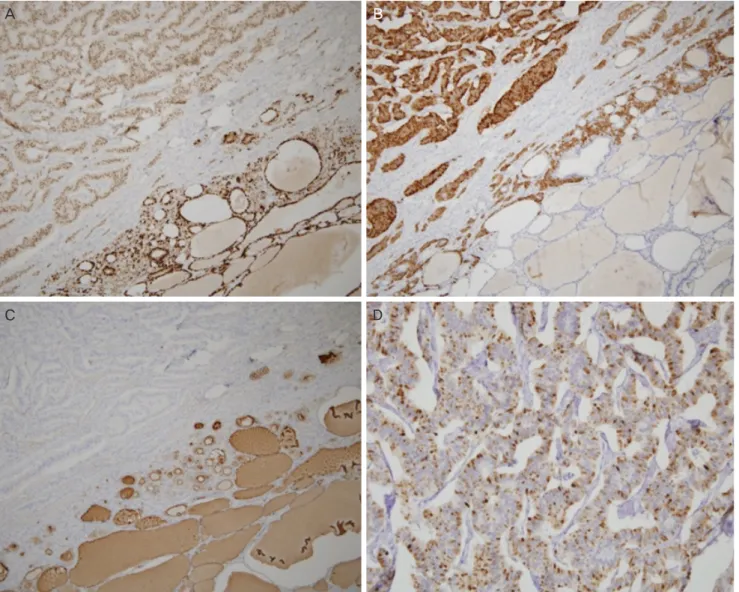
of all ovarian malignancies and only 5% of carcinoid tumors are of the ovarian origin [2]. There are 4 subtypes in primary ovarian carcinoid tumors: insular, trabecular, mucinous, and strumal. The insular type is the most common and is associ- ated with the typical carcinoid syndrome caused by serotonin and its precursors. The trabecular carcinoid is a rare, slow- growing tumor that has not been associated with carcinoid syndromes. Mucinous carcinoids are typically more aggressive manner than other types. In contrast, the strumal type is the least common and is characterized by a mixture of thyroid
and carcinoid tissues [1]. Most tumors are either seen in peri- menopausal or postmenopausal women with nonspecific symptoms like enlarging mass, or are found incidentally on
Peptide YY producing strumal carcinoid tumor of the ovary in a postmenopausal woman: a rare cause of chronic constipation
Hye Kyung Noh 1 , Byung Su Kwon 1 , Yoon Hwa Kim 1 , Nam Kyung Lee 2 , Kyung Un Choi 3 , Dong Soo Suh 1 , Dong Hyung Lee 1 , Ki Hyung Kim 1
1
![Fig. 1. (A) Contrast-enhanced computed tomography shows a well-defined hypervascular solid mass (arrow) in the right adnexa (uterus [U])](https://thumb-ap.123doks.com/thumbv2/123dokinfo/5462181.657386/2.892.82.821.425.1017/contrast-enhanced-computed-tomography-defined-hypervascular-adnexa-uterus.webp)