증 례
Korean Circulation J 2003;33(2):150-154
SCN5A 유전자의 Missense 돌연변이를 가진 1가계
원광대학교 의과대학 생화학교실,
1내과학교실
2신창호
1·김남호
2·김경희
1·유수성
1·최용복
1오석규
2·홍경만
1·정진원
2·백문기
1A Family with A Missense Mutation in the SCN5A Gene
Chang Ho Shin, PhD
1, Nam-Ho Kim, MD
2, Kyung-Hee Kim, BS
1, Su-Sung Yoo, BS
1, Yong-Bock Choi, MS
1, Seok Kyu Oh, MD
2,
Kyeong-Man Hong, MD
1, Jin-won Jeong, MD
2and Moon-Kee Paik, MD
11
Departments of Biochemistry and
2Internal Medicine, Wonkwang University School of Medicine, Iksan, Korea
ABSTRACT
Brugada syndrome, an autosomal dominantly inherited form of ventricular fibrillation, is characterized by ST- segment elevation in leads V1-3 and right bundle-branch block on surface electrocardiogram. It is caused by mutations in the cardiac sodium channel gene, SCN5A, and to the best of our knowledge, there has been no report of this mutation in Korea. Three members of a family were heterozygous for a G to T substitution at the nucleotide position 5851 in exon 28 of the SCN5A gene. This nucleotide alteration makes a missense mutation, leading to a valine to leucine substitution (V1951L), in the carboxy terminal region of the sodium channel a subunit. We report here a missense mutation in a Korean family with Brugada-type electrocar-diogram.
(
Korean Circulation J 2003;33(2):150-154)KEY WORDS:Brugada syndrome;Ventricular fibrillation;Sodium channels;Mutation.
서 론
심전도 소견상 특징적인 우각차단 양상과 우흉부 유 도상(V
1-3) ST절의 상승 소견을 보이면서 심실세동에 의한 심인성 급사의 특징적인 임상경과를 보이는 환자 들을 Brugada 증후군이라 한다.
1)2)이들 환자의 경우, 심근 세포막에 존재하는 소디움 이온 통로(sodium ch -
annel)의 alpha subunit를 부호화(encoding)하는 SC- N5A, 3p21 유전자에 돌연변이가 있음이 확인되었다.
3-11)
국내에서도 Brugada 증후군이 2례가 보고된 적이 있으나,
12)소디움 이온 통로 유전자의 돌연변이에 대한 보고는 없다. 본 저자들은 한 가족에서 나타난 SCN5A 유전자의 돌연변이를 발견하였기에 보고하는 바이다.
증 례
환 자:이○진, 남자 41세.
주 소:12유도 심전도상 우각차단과 우흉부 유도 (V
1-3)에서 ST절 상승.
논문접수일:2002년 09월 04일 심사완료일:2002년 10월 24일
교신저자:김남호, 501-757 전북 익산시 신용동 344-2 원광대학교 의과대학 내과학교실
전화:(063) 850-1068·전송:(063) 852-8480 E-mail:[email protected]
과거력 및 가족력:실신 및 돌연사 등의 특이한 병 력은 없었다.
현병력:평소 건강하게 지내던 환자는 내원 3일 전 부터 발생한 고열과 기침으로 폐렴 진단하에 치료하던 중 우연히 발견한 심전도상의 이상으로 본원에 내원하 였다.
진찰소견 및 경과:이학적 검사 및 혈액 검사에서 특 이 소견 없었으며, 심전도상 전형적인 Brugada 형태의 심전도를 보였다(Fig. 1). 환자의 부모, 아들, 그리고 딸에게서 심전도 검사를 실시하였으나 특이한 심전도 양상은 없었으며, 소디움 차단제를 이용한 유발검사는 시행하지 못하였다. 모든 대상자는 심초음파 검사, 신 호 평균화 심전도에서 특이소견 없었다. 환자는 심실 빈맥 유발 유무를 확인하기 위하여 심전기 생리검사를 권유하였으나 거부한 상태에서 특별한 약물치료 없이 1년째 추적 관찰 중이다.
DNA 분리:환자의 가족 5명을 대상으로 유전체 연 구에 대한 동의서를 획득후 혈액을 채취하였다. EDTA 관에 채혈한 혈액은 원심 분리하여 buffy coat 층을 분 리하고, 같은 양의 phosphate buffered saline를 첨가 하여 혼합한 뒤 원심 분리하여 적혈구를 함유한 상층액 을 제거하였다. 분리된 Buffy coat에 STE 500 μL, proteinase K 40 μL, 20% SDS 40 μL를 가해 침전 시킨 후 phenol 및 chloroform를 가해 정제 후 cold 100% ethanol을 넣어 DNA를 침전시켰다. 다시 원심 분리하여 상층액을 버리고 70% ethanol로 washing 한 뒤 DNA를 추출하였다.
중합효소연쇄반응(PCR) :자동 온도조절기(Gene-
Amp PCR system 2400, Perkin Elmer, USA)를 사 용하여 95℃에서 3분간 DNA를 처리시킨 후 94℃에 서 30초간 변성(denaturation), 61℃에서 30초간 보 합(annealing), 72℃에서 30초간 확장(extension)과 정을 35회 반복하였고, 마지막 과정에서는 72℃에서 7 분간 유지시킨 후 정지시켰고, 3 primer set을 이용하 여 SCN5A 유전자의 exon 28번을 증폭하였다. 이때 사용된 primer는 1F:GCACTGTGCTCTCGGACA - TC, 1R:CACGCTGAAGTTCTCCAGGA, 2F:A GC-CGTGGGCATCCTCTTCT, 2R : GACACC - TCTT-CGTGCTTGCG, 3F :ATGGACGCCCTG - AAGA-TCCA, 3R:TCACACGATGGACTCACG - GT이었다. 증폭된 PCR산물을 1.0% agarose gel에서 전기영동 후 증폭된 DNA band를 절제하여 Gel ext - raction kit(Necleogen Biotechnoloy, Korea)을 이용 하여 세척 분리하였다.
돌연변이 확인:약 30 ng template DNA을 이용하
였다. ABI PRISM BigDye
TMterminator cycle se -
quencing ready reaction kit(Applied Biosystems,
Foster City, Calif. USA)을 이용하여 ABI PRISM
BigDye
TM3100 genetic analyzer(Applied Biosyst -
ems)로 DNA 염기순서 분석을 실시하였다. 3번 염색
체의 소디움 이온 통로의 유전자인 SCN5A에서 mis-
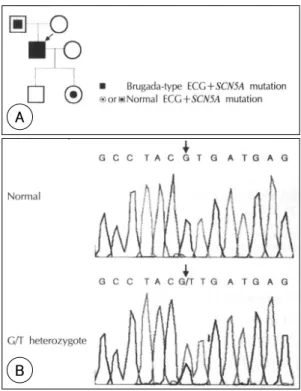
sense 돌연변이가 아버지, 계보발단자, 그리고 딸에게
서 확인되었다. 이 3명은 SCN5A 유전자의 exon 28의
nucleotide position 5851에서 G/T 치환이 일어난 이
형 접합(heterozygote)이었다. 이러한 nucleotide의
변형은 c-terminus에서 valine을 leucine으로 치환하는
Fig. 1. The 12-lead electrocardiogram of the proband shows J point elevation and incomplete right bundle bra- nch block in V1-3 .missense 돌연변이를 일으켰다(V1951L)(Fig. 2, 3).
고 찰
Brugada 증후군은 심전도상 특징적인 우각차단과 우흉부유도에서 ST절의 상승소견을 갖으면서 돌연사 를 일으키는 질환이다.
1)2)최근에 알려지기 시작한 질 환으로 그 유병율과 발생 빈도는 아직 정확하지 않다.
일반적으로 남자에서, 특히 동양인과 백인에서 그 발생
빈도가 높은 것으로 알려져있다. 25%의 경우에는 유전 적 경향의 확인이 어려우며, 약 15%정도에서는 가족 력을 확인할 수 없는 것으로 알려져있다. 돌연사의 4~
12%, 특히 구조적으로 심장이 정상인 경우에는 50%
이상이 Brugada 증후군이 돌연사의 원인일 것으로 생 각한다. 현재까지 알려진 바에 의하면 Brugada 증후군 의 25% 가계에서 상염색체 우성 형태의 유전양상이 확인되고 있으며, 따라서 이론적으로 환자의 자손 중 약 50%에서 Brugada 증후군이 나타날 확률을 지닌 다.
1)2)11)13)14)Brugada 증후군에서 SCN5A의 돌연변이는 splice- donor, frame-shift, 그리고 missense의 3가지 형태 가 보고되고 있다.
3-11)T1620M 돌연변이는 소디움 통로의 DⅣS3와 DⅣS4사이의 extracelluar loop에서 threonine이 methionine에 의해 치환되어 steady- state inactivation curve를 우측으로 이동시킴으로써 소디움 통로를 정상 통로보다 빨리 불활성화시킨다.
3)R1512W 돌연변이는 소디움 통로의 불활성화 관문으 로 알려져있는 DⅢ-Ⅳ linker에서 불활성화의 회복과 불활성화을 더욱 느리게 한다.
4)R1432G는 소디움 통 로의 발현을 폐지함으로써 소디움 통로의 기능을 소실 시킨다.
15)또한 1795insD 돌연변이는 소디움 통로의 전류를 감소시킨다.
16)이와 같이 SCN5A 유전자의 돌 연변이로 인해 정상적 기능의 소디움 통로의 수적 감소 혹은 그 기능 자체의 이상을 통해 심근세포 단위에서 재분극 과정의 이상을 초래함으로써 Brugada 증후군 을 유발할 것으로 생각한다.
3)17-20)하지만, 이러한 유 전자의 돌연변이가 Brugada 증후군을 유발하는 직접적 인 기전에 대해서는 아직 명확하지 않다.
21)22)본 저자들은 심전도상 우각차단과 우흉부유도에서 ST절 상승이 있는 환자의 가계에서 1개의 돌연변이를 발견하였다. 아버지, 계보발단자, 딸에게서 소디움 통로 의 α subunit carboxy terminal 부위에서 모두 동일 한 missense 돌연변이(V1951L)가 관찰되었다. 아버 지와 딸에게서는 특징적인 심전도의 발현이 안되었는 데 이는 소디움 차단제를 사용하여 유발검사가 필요할 것으로 생각된다. 본 연구에서는 이러한 소디움 통로 유전자의 돌연변이가 소디움 채널의 기능에 영향을 주 어 심전도상 변화를 나타내는 기전에 대해서는 직접적 인 확인은 하지 못하였으나, Priori 등
11)이 Brugada 증 후군에서 같은 부위의 돌연변이 V1951L을 보고한 적
Fig. 3. SCN5A mutation identified. The location of theV1951L mutation is indicated.
Fig. 2. Mutation detection in a family. A:pedigree of a family. B:DNA sequence analysis of genomic DNA identifies a G-to-T base substitution (arrow) in exon 28 of SCN5A, leading to an amino acid substitution of valine by leucine at codon 1951 (V1951L).
A
B
이 있다. 향후에는 이러한 SCN5A의 돌연변이가 기능 적으로 소디움 이온 통로에 어떠한 영향을 미치는지에 대해서 추후 연구가 되어야 할 것이다. 이러한 제한점 에도 불구하고 국내에서는 처음으로 Brugada 형태의 심전도를 갖는 환자의 가계에서 소디움 이온 통로의 유 전자 돌연변이를 발견하여 보고하는 바이다.
요 약
Brugada 증후군은 심전도상 우각차단과 우흉부 유 도상 ST절 상승 소견이 관찰되고 돌연사를 일으키는 질환이다. 상염색체 우성으로 유전되고 심장 소디움 통 로의 SCN5A 유전자에 돌연변이를 일으키는 것으로 알 려져 있다. 그러나 국내에서는 소디움 이온 통로 유전 자의 돌연변이가 아직 보고된 바 없다. 계보발단자는 우연히 발견된 Brugada 형태의 심전도를 주소로 내원 하여 부모, 두 자녀들을 포함하여 혈액검사로 DNA se - quencing을 실시하였다. 아버지, 계보발단자, 딸에게서 공통적으로 SCN5A 유전자의 exon 28의 nucle-otide position 5851에서 염기 치환(G/T)에 의해 C-termi - nus에서 valine을 leucine으로 치환하는 misse -nse 돌 연변이(V1951L)가 관찰되었다. 저자들은 한국인 1가 계에서 소디움 통로의 SCN5A 유전자에서 missense 돌연변이를 관찰하였기에 문헌고찰과 함께 보고한다.
중심 단어 :Brugada 증후군;심실세동;소디움 통로;
돌연변이.
이 논문은 2001년도 원광대학교 교내연구비의 지원에 의해 서 수행됨.
REFERENCES
1) Brugada P, Brugada J. Right bundle branch block, persi- stent ST segment elevation and sudden cardiac death: a dis- tinct clinical and electrocardiographic syndrome. J Am Coll Cardiol 1992;20:1391-6.
2) Brugada P, Brugada R, Brugada J. The Brugada syndrome.
Curr Cardiol Rep 2000;2:507-14.
3) Chen Q, Kirsch GE, Zhang D, Brugada R, Brugada J, Brugada P, Potenza D, Moya A, Borggrefe M, Breithardt G, Ortiz-Lopez R, Wang Z, Antzelevitch C, O'Brien RE, Schulze-Bahr E, Keating MT, Towbin JA, Wang Q. Genetic basis and molecular mechanism for idiopathic ventricular fibrillation. Nature 1998;392:293-6.
4) Deschenes I, Baroudi G, Berthet M, Barde I, Chalvidan T, Denjoy I, Guicheney P, Chahine M. Electrophysiological
characterization of SCN5A mutations causing long QT (E1784K) and Brugada (R1512W and R1432G) syndromes.
Cardiovasc Res 2000;46:55-65.
5) Valdivia CR, Ackerman MJ, Tester DJ, Wada T, McCor- mack J, Ye B, Makielski JC. A novel SCN5A arrhythmia mutation, M1766L, with expression defect rescued by mexi- letine. Cardiovasc Res 2002;55:279-89.
6) Vatta M, Dumaine R, Antzelevitch C, Brugada R, Li H, Bowles NE, Nademanee K, Brugada J, Brugada P, Towbin JA. Novel mutations in domain I of SCN5A cause Brugada syndrome. Mol Genet Metab 2002;75:317-24.
7) Baroudi G, Acharfi S, Larouche C, Chahine M. Expression and intracellular localization of an SCN5A double mutant R1232W/T1620M implicated in Brugada syndrome. Circ Res 2002;90:E11-6.
8) Kyndt F, Probst V, Potet F, Demolombe S, Chevallier JC, Baro I, Moisan JP, Boisseau P, Schott JJ, Escande D, le Marec H. Novel SCN5A mutation leading either to isolated cardiac conduction defect or Brugada syndrome in a large French family. Circulation 2001;104:3081-6.
9) Levy-Nissenbaum E, Eldar M, Wang Q, Lahat H, Belhas- sen B, Ries L, Friedman E, Pras E. Genetic analysis of Bru- gada syndrome in Israel: two novel mutations and possible genetic heterogeneity. Genet Test 2001;5:331-4.
10) Weiss R, Barmada MM, Nguyen T, Seibel JS, Cavlovich D, Kornblit CA, Angelilli A, Villanueva F, McNamara DM, London B. Clinical and molecular heterogeneity in the Bru- gada syndrome: a novel gene locus on chromosome 3. Cir- culation 2002;105:707-13.
11) Priori SG, Napolitano C, Gasparini M, Pappone C, Della Bella P, Giordano U, Bloise R, Giustetto C, De Nardis R, Grillo M, Ronchetti E, Faggiano G, Nastoli J. Natural his- tory of Brugada syndrome: insights for risk stratification and management. Circulation 2002;105:1342-7.
12) Park SS, Nam GB, Choi KJ, Song JK, Kim JJ, Park SJ, Park JH, Kim YH. Two cases of sudden cardiac death synd- rome associated with right bundle branch block and ST se- gment elevation. Korean Circ J 2000;30:611-6.
13) Belhassen B, Viskin S, Fish R, Glick A, Setbon I, Eldar M.
Effects of electrophysiologic-guided therapy with Class IA antiarrhythmic drugs on the long-term outcome of patients with idiopathic ventricular fibrillation with or without the Brugada syndrome. J Cardiovasc Electrophysiol 1999;10:
1301-12.
14) Priori SG, Napolitano C, Gasparini M, Pappone C, Della Bella P, Brignole M, Giordano U, Giovannini T, Menozzi C, Bloise R, Crotti L, Terreni L, Schwartz PJ. Clinical and genetic heterogeneity of right bundle branch block and ST- segment elevation syndrome: a prospective evaluation of 52 families. Circulation 2000;102:2509-15.
15) Baroudi G, Pouliot V, Denjoy I, Guicheney P, Shrier A, Chahine M. Novel mechanism for Brugada syndrome: defe- ctive surface localization of an SCN5A mutant (R1432G).
Circ Res 2001;88:E78-83.
16) Baroudi G, Chahine M. Biophysical phenotypes of SCN5A mutations causing long QT and Brugada syndromes. FEBS Lett 2000;487:224-8.
17) Rook MB, Bezzina Alshinawi C, Groenewegen WA, van Gelder IC, van Ginneken AC, Jongsma HJ, Mannens MM, Wilde AA. Human SCN5A gene mutations alter cardiac so- dium channel kinetics and are associated with the Brugada
syndrome. Cardiovasc Res 1999;44:507-17.
18) Antzelevitch C, Yan GX, Shimizu W. Transmural dispersi- on of repolarization and arrhythmogenicity: the Brugada syndrome versus the long QT syndrome. J Electrocardiol 1999;32(Suppl):158-65.
19) Yan GX, Antzelevitch C. Cellular basis for the Brugada syndrome and other mechanisms of arrhythmogenesis asso- ciated with ST-segment elevation. Circulation 1999;100:
1660-6.
20) Antzelevitch C, Yan GX. Cellular and ionic mechanisms
responsible for the Brugada syndrome. J Electrocardiol 2000;33(Suppl):33-9.
21) Grant AO. Molecular biology of sodium channels and their role in cardiac arrhythmias. Am J Med 2001;110:296-305.
22) Smits JP, Eckardt L, Probst V, Bezzina CR, Schott JJ, Rem- me CA, Haverkamp W, Breithardt G, Escande D, Schulze- Bahr E, LeMarec H, Wilde AA. Genotype-phenotype relationship in Brugada syndrome: electrocardiographic features differentiate SCN5A-related patients from non- SCN5A-related patients. J Am Coll Cardiol 2002;40:350-6.