Veterinary Science
DOI: 10.4142/jvs.2010.11.2.133
*Corresponding author
Tel: +1-631-323-3223; Fax: +1-631-323-3006 E-mail: [email protected]
Evaluation of infectivity and transmission of different Asian foot-and-mouth disease viruses in swine
Juan M. Pacheco
1,*, P. W. Mason
21
Plum Island Animal Disease Center, North Atlantic Area, Agricultural Research Service, United States Department of Agriculture, PO Box 848, Greenport, NY 11944-0848, USA
2
Microbial Molecular Biology, Novartis Vaccines and Diagnostics, 350 Massachusetts Avenue, Cambridge, MA 02139, USA
Most isolates of foot-and-mouth disease virus (FMDV) display a broad host range. Since the late 1990s, the genetic lineage of PanAsia topotype FMDV serotype O has caused epidemics in the Far East, Africa, the United Kingdom, France, the Netherlands, and numerous other countries throughout Europe and Asia. In contrast, there are several FMDV isolates that exhibit a more restricted host range. A Cathay topotype isolate of FMDV serotype O from the 1997 epizootic in Taiwan (O/TAW/97) demonstrated restricted host specificity, only infecting swine. Methods used to evaluate infectivity and pathogenicity of FMDV isolates in cattle are well-documented, but there has been less progress studying transmission and pathogenicity of FMDV isolates in pigs. In previous studies designed to examine pathogenicity, various chimeric viruses derived from O/TAW/97 were intradermally inoculated in the heel bulb of pigs. Subsequent quantitative scoring of disease and evaluation of virus released into nasal secretions and blood was assessed. Here we prove the usefulness of this method in direct and contact inoculated pigs to evaluate infectivity, pathogenicity and transmission of different Asian FMDV isolates. Virus strains within the Cathay topotype were highly virulent in swine producing a synchronous disease in inoculated animals and were efficiently spread to in-contact naïve pigs, while virus strains from the PanAsia topotype displayed more heterogeneous properties.
Keywords: Cathay topotype, FMDV, infectivity, PanAsia topotype, pathogenicity, pigs
Introduction
Foot-and-mouth disease (FMD) is one of the most dreaded ailments of livestock due to its broad host range
and high rate of contagious spread. Efforts to control FMD outbreaks have resulted in regional and international quarantine laws and regulations. Recent outbreaks in historically FMD-free countries (e.g., reintroductions into Argentina, Brazil, Uruguay [25,27] and Western Europe in the 2000s, in Japan in 2000 after 90 years [36], and in Korea in 2000 and 2002 after 66 years [30,31]) suggest a need for more information about how FMD spreads. Among the seven serotypes of FMD virus (FMDV), serotype O has the broadest distribution, occurring worldwide [22]. FMDV can infect all even-toed ungulates, although some FMDV isolates exhibit a restricted host range. One of these, the virus responsible for the devastating epizootic in Taiwan in 1997 (O/TAW/97), affects swine but does not cause disease in cattle [10]. We have previously reported that O/TAW/97 has a shortened form of the non-structural viral protein 3A, which is associated with the inability of this virus to replicate or grow in bovine cells in culture [5,21,29]. We have also reported that this deletion is associated with attenuation in cattle but not in pigs [5,33]. This shortened form of 3A is characteristic of one topotype of Asian viruses [21], designated the Cathay topotype [37].
Interestingly, the earliest available member of the Cathay topotype examined, a 1970 virus recovered from a pig in Hong Kong (O/HKN/21/70), grows well in bovine cells, despite expressing a truncated form of 3A [21]. Other members of this topotype were recently isolated in Hong Kong in the years 2001 and 2002, named O/HKN/2001 and O/HKN/2002, respectively [7,11,28]. Following the multibillion-dollar outbreak in Taiwan caused by O/TAW/
97 [39] a second FMDV strain was isolated in 1999 in the
Kinmen Island prefecture of Taiwan, several kilometers
from the coast of mainland China. The Kinmen Island virus
is a member of the PanAsia topotype of FMDV [22,24] and
contains a full-length 3A-coding region [21]. Interestingly,
the 1999 Kinmen Island isolate (represented in this study
by O/TAW/2/99) did not cause disease in cattle (the presence
of virus was only detected serologically and in probang
Table 1. Origin and passage history of foot-and-mouth disease virus (FMDV) strains used in this study
Virus* Topotype Species of origin
†Source/previous passage history
‡Plum Island passage history
§O/TAW/97
O/HKN/21/70 O/TAW/2/99 O/SKR/00 O/SAR/19/00 O/UKG/35/2001
Cathay Cathay PanAsia PanAsia PanAsia PanAsia
Porcine Porcine Bovine
¶Bovine Bovine Porcine
FADDL/APHIS PIGp1 WRL/BTYp4, RSp1 WRL/BHKp3, BTYp1 FADDL/field
OVI/ PK2, RS1 FADDL/field
PIGp2
||BHKp2 BHKp2 BHKp1 BHKp2 PIGp2**
*Nomenclature for all viruses is as follows: serotype/three-letter location code for country or place of origin/accession number (if applicable)/
year of isolation. TAW: Taiwan, HKN: Hong Kong, SKR: South Korean Republic, SAR: South African Republic, UKG: United Kingdom.
†Livestock species of origin. ‡Institute of origin (FADDL: Foreign Animal Disease Diagnostic Laboratory, APHIS, VS, Plum Island, NY, USA;
WRL: World Reference Laboratory for FMD, Pirbright, Woking, Surrey, UK; OVI: Onderstepoort Veterinary Institute, Onderstepoort, SAR).
Passages (p) were performed in pigs (PIG), bovine thyroid cells (BTY), IBRS2 porcine kidney cell line (RS), baby hamster kidney cell line 21 clone 13 (BHK), or porcine kidney cells (PK) prior to receipt. §Amplifications made in our lab for inoculation studies. ||The sample received was vesicular fluid that was inoculated in a pig and vesicular fluid from this pig was harvested and aliquoted for inoculations in vivo and in vitro. ¶The virus was isolated from an esophageal/pharyngeal sample obtained from an animal exhibiting a subclinical infection. **Original sample from the outbreak was directly inoculated in one pig, and vesicular fluid was harvested from another pig placed in direct contact with the inoculated one. Aliquots from this vesicular fluid were used for all inoculations in vivo and in vitro.
samples collected from disease-free animals [21]). FMDV was subsequently discovered on the main part of Taiwan, where it caused clinically apparent disease in cattle and goats, but not pigs (although some isolates could induce disease in experimentally infected pigs) [20]. In 2000, PanAsia topotype FMD viruses closely related to O/TAW/
2/99 were detected in Japan, South Korea, Far Eastern Russia, and Mongolia, where they affected various species of even-toed ungulates [12,23]. PanAsia topotype viruses eventually spread out of Asia, and were responsible for an outbreak in the South African Republic in 2000 and the catastrophic European epidemic in 2001 [23]. In 2002, a PanAsian virus was isolated again in South Korea, designated as O/SKR/02 [30]. More recently, outbreaks in Turkey caused by this topotype were associated with myocarditis in lambs [15].
The efficiency and speed of dissemination of FMD depends on the FMDV strain involved, the quantities of virus shed, the rate of contact and the susceptibility of the recipient animals. As mentioned by Alexandersen et al. [3], there is an urgent need for additional quantitative information on excretion and transmission of FMDV and on disease parameters. This information will help to improve models used to predict the spread of the disease, especially if such predictions are to be used in FMD control (i.e., vaccination or treatment with biotherapeuthics). This report illustrates findings of FMDV excretion and transmission in pigs infected by direct or contact inoculation with isolates representative of the two topotypes described above (Cathay and PanAsia). When studied in cattle, FMDV infectivity can be readily accomplished by inoculating graded dilutions of virus intradermally into sites in the tongue, with scoring of lesions forming 24 to 72 h later [16,17]. However, the epidermis of the porcine tongue is thinner and more fragile than the bovine tongue, preventing
application of this method to pigs [6]. Here we describe the adaptation of an intradermal heel-bulb inoculation method described by Burrows in 1966 [6] for the determination of porcine infectious dose of several FMDV isolates. This method was previously successfully applied for the comparison of swine infectivity with different chimeric viruses derived from O/TAW/97 [33]. Because the primary route of infection in pigs is by direct contact [1,2], we decided to evaluate transmission from directly inoculated pigs to pigs in direct contact for a limited period of 4 h.
Preliminary application of these methods to the same strains evaluated in vitro demonstrates their utility in comparison of virulence, and suggests that the PanAsian viruses are more heterogeneous than the Cathay topotype viruses in terms of their ability to cause disease in pigs.
Materials and Methods Virus strains and cell cultures
Table 1 describes the sources of viruses as well as the precise passage history of the viruses at the time of receipt and further passages made in our lab. Viruses prepared as described in this table were stored frozen at 70
oC until needed. Baby hamster kidney cell monolayers (BHK, strain 21, clone 13, ATCC CL10, passage 62 to 66) were used to determine virus titers in terms of plaque forming units (PFU) [18]. The ability of these viruses to replicate in BHK, primary fetal bovine kidney cells (FBK) and primary fetal porcine kidney cells (FPK) [13,14] was determined as described previously [33]. All samples were run simultaneously to avoid inter-assay variability.
Evaluation of the disease after pig inoculation, and determination of porcine infectivity and pathogenicity
All animal manipulations were performed following
Fig. 1. (A) Intradermal inoculation in the heel bulb. The space between the two arrows marks the portion of the needle that lays within the dermis, approximately 1.2 cm. Inoculums were released while slowly removing the needle. (B and C) Replication of O/UKG/35/01 at the inoculation site 24 h after intradermal inoculation with 700 PFU/5 μL (1 and 2) and 70,000 PFU/5 μL (3 and 4). The presence of a vesicle (POS) indicates a positive result.
The absence of a vesicle (NEG) indicates a negative result.
Fig. 2. Species specificity in primary bovine and porcine kidney cells (FBK and FPK, respectively) compared with BHK cells.
TCID
50/mL was estimated for each virus starting with 10
7PFU/mL, as previously determined in BHK cells. The vertical bar and the extended bar illustrate the results from two independent experiments. The name of each virus and species of origin are described in Table 1. vCRM8 (a chimeric virus experimentally shown to be infectious in cattle and swine) was added as an internal positive control.
protocols approved by the Plum Island Animal Disease Center (PIADC) Animal Care and Use Committee.
Determination of virus infectious dose in pigs was performed as previously described [33]. Briefly, four co-housed 20∼
40 kg out-bred white pigs were sedated and inoculated intradermally in the heel bulb of each major digit of each foot with 10
2, 10
3, 10
4or 10
5PFU of virus/5 μ L (estimated volume retained in the inoculation site as described by Burrows [6]) achieved by inserting a 23G needle 1 cm along the superficial layer of the epidermis (Fig. 1A).
Immediately following injection, the titer of the virus stock was confirmed by plaque assay in BHK cells. Formation of vesicles at the inoculation sites was scored 24 h after inoculation (Figs. 1B and C), and data from all four
animals was used to determine the number of PFUs of virus
capable of producing a 50% pig heel infectious dose
(PHID
50) [34]. To demonstrate ability of transmission by
direct contact between pigs, two days after inoculation the
four directly inoculated pigs were combined with four
similar-sized naïve pigs in a fenced 4 m
2area within an
animal isolation room, with water but without food during
the exposure time. Four h later, the exposed pigs were
placed into four rooms with separate HEPA-filtered
ventilation systems containing hermetically sealed doors
facing clean hallways. Heparinized blood and nasal swabs
were collected and processed for virus isolation or IgM
detection as previously described [33]. Records of the sites
containing vesicles were prepared each day as previously
described [33]. A maximum lesion score of 12 was
possible in directly inoculated pigs (the eight injected
digits were not counted in the former determinations) and
a score of 20 was possible for direct contact pigs. The same
team of investigators visited the 8 pigs for the indicated
number of days, showering and changing clothing between
each animal room. In all cases directly inoculated animals
were examined after the direct contact animals. Pigs were
humanely euthanized 5∼7 days after they produced
lesions or, in absence of lesions, when virus-specific IgM
could be detected by ELISA or on day 20 after exposure. In
some cases, once secondary vesicles appeared, animals
were sedated and euthanized to collect samples that were
used for other experiments (animals # 48, 97, 103, 292, 293
and 296). No animals died as a result of FMDV infection.
Table 2. Results obtained after direct inoculation with FMDV O/
SKR/00 in porcine heel bulb for determination of concentration of the inoculum as 50% pig heel infectious doses per mL (PHID
50/ mL)
No.* 47,500 PFU
†4,750 PFU 475 PFU 47 PFU 783
781 794 799
+ +
‡+ + + + + +
+ + + + + +
*Animal number. †Amount of virus in each inoculation site. ‡Each sign represents one main digit. “+” indicates a macroscopic lesion was formed at the site of inoculation. “” indicates that no lesion was visible.
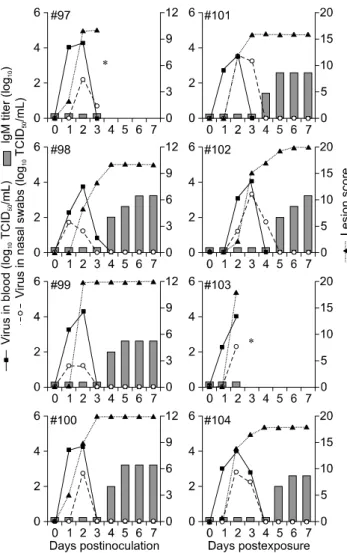
Fig. 3. Viremia, virus in nasal secretions, vesicular lesions and IgM titers in pigs directly inoculated with O/TAW/97 (left panels) or exposed to O/TAW/97 (right panels). *Indicates the day animals were euthanized to obtain samples for other studies.
Results
Different topotypes show different species specificity when analyzed in vitro
To determine species specificity in vitro, an assay was developed to measure the minimum infectious dose of virus able to propagate an infection on various cell types (Fig. 2).
For these experiments, multi-well plates with BHK, FBK, and FPK cells were infected with 10-fold dilutions of virus [starting with 10
7PFU/mL (as measured previously on BHK cells)] and examined to determine the lowest dose of virus able to cause complete cytopathic effect (CPE) at 48 h. These results were expressed as TCID
50/mL. All six strains and a positive control virus (vCRM8, a genetically engineered virus which is highly virulent in bovine and swine [4,35]) showed similar ability to cause CPE in hamster- and swine-derived cells (values close to 10
7TCID
50/mL). In bovine-derived cells, all viral isolates except O/TAW/97 were able to replicate at similar titers.
Different topotypes demonstrate different infectivity when inoculated in swine
To study differences of infectivity (PFU/PHID
50), each one of the six strains were inoculated intradermally in the heel bulb of four pigs as described above. At 24 h post- inoculation the inoculation sites were scored as negative or positive (Fig. 1) to determine the PHID
50/mL present in the inoculums. Table 2 shows an example with the results obtained for O/SKR/00. Table 3 shows the PHID
50/mL and the infectivity obtained for each strain. Although we started the experiment with all viruses at similar PFU/mL values (ranging from 9.5 × 10
6to 2.8 × 10
7), the PHID
50/mL values were broadly different. With O/TAW/97 we obtained a value of 10
5PHID
50/mL; with O/HKN/21/70, O/SKR/00 and O/
UKG/35/01 we obtained values of 10
3; and with O/TAW/2/
99 and O/SAR/19/00 we obtained values less than 10
2. The five strains also showed different relative infectivities when
compared to O/TAW/97. Twenty to 62 times more virus would be needed to produce a vesicle at the inoculation site with O/HKN/21/70, O/SKR/00 and O/UKG/35/01 while greater than 5,000 times more virus would be needed for the remaining two strains, O/TAW/2/99 and O/SAR/19/00.
Cathay topotype FMDVs are highly infectious and produce severe disease in pigs
When we studied the various parameters of infection of
O/TAW/97 (Fig. 3), the direct inoculation of 10
5PFU (10
3PHID
50, Table 3) produced an acute and synchronous disease
in the inoculated animals. In the O/TAW/97- inoculated
animals, virus in blood was detected as early as 1 day
post-inoculation (dpi) and virus was isolated from nasal
swabs at 1 to 3 dpi. At 2 dpi, all the animals expressed peak
amounts of virus in blood, nasal swabs and vesicles at
secondary sites of replication. The highest value of lesion
Table 3. Infectivity results obtained with different Asian FMDV strains in comparison with O/TAW/97
Virus PFU
/mL*
PHID
50/mL
†PFU
/PHID
50‡PFU
/animal
§PHID
50/animal
||Relative infectivity
¶O/TAW/97
O/HKN/21/70 O/TAW/2/99 O/SKR/00 O/SAR/19/00 O/UKG/35/01
9.75 × 10
62.0 × 10
72.0 × 10
79.5 × 10
62.8 × 10
71.4 × 10
71.0 × 10
53.4 × 10
3≤ 45 4.3 × 10
3≤ 25 7.3 × 10
39.4 × 10
15.8 × 10
3≥ 4.4 × 10
52.2 × 10
3≥ 1.1 × 10
61.9 × 10
31.0 × 10
52.2 × 10
52.2 × 10
51.0 × 10
53.1 × 10
51.5 × 10
51.150 38
≤ 0.5 47
≤ 0.27 82
1 62
≥ 4.680 23
≥ 11.702 20
*Viral concentration of inoculums expressed as plaque forming units per mL (PFU/mL) obtained in BHK cells. †Determination of 50% pig heel infectious doses (PHID50/mL) in inoculums after intradermal inoculation in the heel bulb. ‡PFU of virus calculated to be one PHID50. §Each pig received values of 105 PFU of virus, projected by multiplying the value of PFU/mL by 11.11 μL the estimated volume of inoculums (5 μL
× 2 of first dilution plus three more dilutions of a volume of 1/10 of the immediate previous dilution). ||Determination of PHID50 that each animal received, based on volume estimated above. ¶Relative infectivity of each virus compared with porcine infectivity of O/TAW/97. This number indicates how many more viral particles than O/TAW/97 are needed to obtain 1 PHID50.