ASYMPTOTIC BEHAVIOR OF LEBESGUE MEASURES OF CANTOR SETS ARISING IN THE DYNAMICS OF TANGENT FAMILY Ta(9) = o:tan(9/2)
HONG OH KIM, JUN Kyo KIM AND JONG WAN KIM
1. Introduction
Let 0 < 0: < 2 and let Ta(9) = 0: tan( 9/2). Ta has an attractive fixed point at 9=o. We denote by C( 0:) the set of points in I = [-7r, 7r]
which are not attracted to 9= 0 by the succesive iterations ofTa. That is, C( 0:) is the set of points in I where the dynamics ofTa is chaotic.
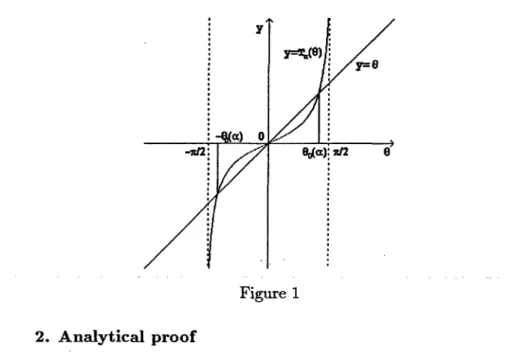
It is also related to the Julia set of the family of point-mass singular inner functions exp(0:~+~) and is shown to be a Cantor set, a closed, totally disconnected, perfect subset ofI in [KKl,KK2]. Since Ta has a slope 0:/2 at 9 = 0 which is less than one, it has two more fixed points in I other than the attractive fixed point at 9 = o. They are symmetrically located at -90(0:) and 90(0:). See Figure 1. We denote the interval ( -90 (0: ), 9(0:»by Eo (0: ). From the graphical analysis, the points on the interval Eo(0:) are shown to be attracted to the attrac- tive fixed point at 9= 0 under Ta. Therefore, C(o:) C I\Eo(o:). Since the Lebesgue measure IEo(o:)1 of Eo(o:) tends to 27r as 0: -+ 0, the Lebesgue measure IC(o:)1 of C(o:) tends to 0 as 0: -+
o.
We can saymore precisely on the asymptotic behavior of IC(o:)1 as 0: -+ 0 in the following theorem.
THEOREM.
(a) IC(o:)1 =0(0:5) as 0: -+ 0, analytically.
(b) IC(o:)1 =0(0:7) as 0:-+ 0, by use of MATHEMATICA.
Itis a reasonable conjecture that IC(0:)1is of infinite order as0: -+
o.
Received September 17, 1994.
1991 AMS Subject Classification: 26A18.
Key words: Dynamics, Julia set, Cantor set.
The author was partly supported by TGRC(KOSEF).
Figure 1 2. Analytical proof
Let E1(a)be the set of points 8 inI\Eo(a) such thatTa(8) E Eo(a) (mod 271"). Then E1(a) =U{E?d: k1 =±1,±2,···}, where
E~kl) = {B El: Ta(B) E Eo(a)+2kl71"}.
Let Ez(a) be the set of points 8 inI\(Eo(a)UE1(a» such thatT~(8) E Eo(a) (mod 271"). ThenEz(a) is given as
where
E~kl,k2) = {B El: Ta(8) E E~kl)(a)+2kz71"}.
Inductively, we let En (a) be the set of points () in1\Uj~;Ej(a) such that T:;(B) E Eo(a) (mod 271"). Then
En(a)
=
U{E~kllk2,... ,kn) :k1=
±1,±2, ... ;kz ..., , n-,k - 0 ±1 ±2 ... }, , ,
where
E~kl,k2,···,kn)= {8 El: To(8) EE~~c,kn-d +2kn
1r}.
Then clearly C(a) is given by
00
C(a) = 1\
U
En(a).n=O
For an n-tuple (k), kz,'" ,kn ) of nonzero integer k1 and intege rs kz, ... ,kn , we set
(0) ( (0) ( )
81 = - 80 a) ,82 = 80 a ,
( 0») (0»)
8~1) = 2tan 2k1
1r:
81 . ,e~l) = 2 tan 2k11r:
8z ,and, inductively,
O\n)
= 2 tan-1ekn?r: 0~n-1») ,O\n)
= 2 tan-1(2kn?r:0\n-1}
~ 1 2 T h E(k1 ," ,kn ) (ll(n) ll(n») Of ll(n) , J.or n = , , . . . . en n = 171 ,l7z. course,17i s depend on the choice of k}, kz, ... ,kn but we suppressed its dependence for a notational simplicity.
Now, we estimate IEn(a)1 up to order 4 in its Taylor expansion at
a = O. The following identities are easy to obtain.
2.1 LEMMA.
(i)
L
1 -1k#O(2k)2 - 1 -
(iii) '"" ( 1 )3 _ 1 _ 311"2
~ (2k)2 - 1 - 32
k#O
k2 11"2
(v)
L
«2k)2 _ 1)3 =128k#O
00 1 11"4
(vii) '""~ - - (2k+ 1)4 - 48
- 0 0
To begin with, the leading terms ofIEn(a)1 is generally given by
IEn(a)1 =
~ (~)
n +O(an+1).Proof. For an integer k1 =1=0
IEj',)1= 2tan-1
ekl~: 8\0)) _
2 tan-1ekl?r:8\0»)
_ 2tan-1 ( 2a9o(a) ) - (2k11r)2 - 95(a)+a2
2a 2
= 21r· 1r2((2k
1)2 _ 1) +O(a ).
2a n+l)
1r2(2kn+1)2 +O(a .
2.3. LEM.MA.
(i) IEo(a)1 =211"-~a-~a2+(~-~)a3+(~-~)a4+0(a5), (ii) lE1(a)1 = .i11'a - (1. _11' 1r1l"8 )a2 _ (1631r1l" _ 32)a311'5 + (-l. -611' ~311'5 +
~)a4+Oe(5),
(iii) IE2(a)1 = ~a2 - (-!r - -!a)a3 - (6~+~ - ~)a4 +O(a5), (iv) IE3(a)1 = -!ra3 - (2~ - ~)a4+0(a5),
(v) IE4(a)1 = 2~a4 +0(a5).
Proof. From the relation Oo(a) = atan(00(a)/2) and lima_oOo(a)
=11", we have the following Taylor expansion ofOo(a) near0: =o.
( 2 4
2(2 16)
3(16 80)
4 500 a)=1I"--a--a + - - - a + - - - a +O(a).
11" 11"3 311"3 11"5 311"5 11"7 Therefore,
I ()IEo a = 211"--a--a4 8 2+( 4- - -32) a3+(32- - -
160)
0: +0(0: .4 5) 11" 11"3 311"3 1r5 311"5 11"7For a nonzero integer k1 , we have the following expansion by a routine calculation:
where the sum runs over all nonzero integers k1 .
Next, for an integer k2 , we have
IE~kl,k2)1
0(2) 0(2) -1 (2k211"+0~1)) -1 (2k211"+OP))
=
2 - 1=
2 tan a - 2 tan a(
0'(0(1) - 0(1» )
_ 2tan-1 2 1
- .. (2k 211"+oP)(2k21r+8~1) +0'2 0'(0(1) _ 0(1)
=2 2 1 +0(0'5)
(2k211"+0~1»(2k211"+0~1) +0'2
80'2 3 { 64kl
=
r«
2kl)2 - 1)(2k2+1)2 +a 1I"5«2kt}2 -1)2(2k2+1)316 3 2 }
- 1I"5«2kt} - 1)(2k2+1)2 - 1I"5«2kt}2 - 1)2(2k2+1)2
4{ 1 2 8 k 1 256k 1
+a - 1I"7«2kt}2 _ 1)2(2k2+1)3 - 1I"7«2k1)2 - 1)3(2k2+1)3
( 16 4 ) 8 8
+ 11"4 - 311"2 1I"3«2kt}2 - 1)3(2k2+1)2 + 1I"3«2k1)2 - 1)2(2k2+1)2
( 4 1)
321
512k~11"4 - 11"2 - 11"7 «2k1)2 - 1)(2k2+1)2 +1I"7«2k1)2 -1)3(2k2+1)4
8 32
1I"5«2kt}2 - 1)(2k2+1)4 1I"7«2kt}2 - 1)2(2k2+1)4
32 3 2 }
+ 1I"7«2kt}2 - 1)(2k1+1)2(2k2+1)3 - 1I"7«2kt}2 - 1)(2k1 - 1)2(2k2+1)3 +0(0'5).
Therefore, we haveby use of Lemma 2.1
where the sum runs overall nonzero integers k1 and all integers k2 • Next, for integers k2 and k3 , we compute
IE~kl,k2,k3)1= 9~3)_ 9~3)= 2tan-1 .( 0'(9~2)- 9~2» )
(2k271"+8~2»(2k271"+9~2» +0'2 (9(2) 9(2»
= 2 ~2)2 - 1 (1) +0(0'5)
(2k271"+91 )(2k271"+92 )+0'2
16 1 ( 1 ) 2 ( 1 ) 2
= 71"5 (2kl)2 - 1 2k2+1 2k3+1 0'3
+ :;
{«2kl~~1_1)2
(2k21+lr
(2k31+I f1 ( 1 ) 2 ( 1 )2
(2kt}2 - 1 2k2+1 2k3+1
2 ( 1 ) 2 ( 1 )2
«2kt}2 - 1)2 2k2+1 2k3+1
+ (2k
1:2 _ 1
(2k2~ J
3 (2k3 1+
lr}
0'4+0(0'5).Therefore, we have by the use of Lemma 2.1
IE3(a)1 =
L
IE~kl,k2,k3)1= 2:..7ra3 _
(--!- _
27r ~)7r3 a4 +O(a5),where the sum runs over all nonzero integers k1 and all integers k2 ,k3 •
Finally by Lemma 2.2, we have
IE4(a)1 = _a1 4 +O(a5).
27r
2.4 Proof of Theorem (aJ. By Lemma 2.3, we have
4 4
I
U
En(a)1 =L
IEn(a)1 =27r+O(a5)n=O n=O
Since IEn(a)1 = ~ (~r+O(an+1) by Lemma 2.2, we have
00 00
I
U
En(a)/ =L
IEn(a)1 =O(a5).n=5 n=5
ex> 4 ex>
I
U
En(a)1 =L
IEn(a)1 +L
IEn(a)1 =271"+O(a5),n=O n=O n=5
and hence we have our main result,
3. Proofby mathematica
We used the MATHEMATICA to obtain the Taylor expansion of IEn(a)1 up to order 6. They are given as follows:
(i) IEo(a)1 =27l" _ i a _ '!'a,.2+
(-±- _
32)0'3+ (32 _ 160)0'47l" ~ 37l"3 7l"5 37l"5 7l"7
4 ... stt·c·S96- 5 184···l11n--5376 .. 6 7 . - ( - - - + - ) 0 ' - ( - - - + - ) 0 ' +0(0'),
57l"5 7l"7 7l"9 157l"7 7l"9 7l"11 (ii) IEl(a)l=ia-(~_.!.)a2-(~-32)0'3
7l" 7l" ~ 37l"3 7l"5
( 1 SO 160) 4 ( 1 32 160 896) 5
+ 67l" - 37l"5 + -;7 a + 3~ + 157l"5 - -;7+ 7 a
_ (_1 1_ _
-±- _
424 + 3136 _ 5376)0'6 + 0(0'7),607l" 67l"3 37l"5 157l"7 37l"9 7l"11 (Hi) IE2(a)1= ~a2_ (.!- _~)0'3 _ (2-+.!. _16)0'4
11" 11" ~ 611" 11"3 11"5
+(_1 1_ _ 28 + 80)0'5 +(_1_ _...!... _56 + 448)0'6 +0(0'7),
127l" 37l"3 37l"5 7l"7 607l" 37l"5 7l"7 7l"9
(iv) lE ()I 1 3 (1 2 ) 4 (1 + 1 8) 5
3 a =;0' - 27l" - 7l"3 a - 127l" 7l"3 - 7l"5 a +(_1 1_ _ ~+ ~)a6 +0(0'7),
247l" 67l"3 37l"5 7l"7
(v) IE4(a)1 = 2-0'4 _ (..!... _..!...)0'5 _ (_1_+_1__ ~)0'6+0«(1'7),
27l" 411" ~ 247l" 2~ 7l"5
(vi) IE5(a)1= 41
7l" 0'5 - (81
7l" - 2:3)0'6 + 0(0'7), (vii) IE6(a)1 = -0'6 +0(0'7),
87l"
Since IEn(a)1 = !(~)n +O(an+1) by Lemma 2.2, we have
ex> ex>
I
U
En(a)1 =L
IEn(a)1 = O(a7).n=7 n=7
Therefore, we have
00 6 00
I
U
En(a)1 =L
IEn(a)1+L
IEn(a)1 =271"+O(a7).n=O n=O n=7
and hence,
4. Concluding remarks
The Cantor set C(a) is atypical as compared with the classical Can- tor set. When we encountered with the Cantor set C(a), we wondered whether the Lebesgue measure of C(a) is positive for all 0<a <2 or not. We could only prove that IC(a)1 =O(a5) and conjecture that it is of infinite order as a --+ O. Also it would be an interesting question to know the Hausdorff dimension of the set C(a).
References
[D] R. L. Devaney,An introduction to Chaotic Dynamical Systems, Addison-We sley, Menlo Park, 1989.
[KK1] H. O. Kim and H. S. Kim, Iteration,Denjoy- Wolff point andergodic prop- erties of point-mass singular inner functions, J. of Math. Anal. and Appl.
174 (1993), 105-117.
[KK2] H. O. Kim and H. S. Kim, Dynamics of two parameter of point-mass singular inner junctions,J. Korean Math. Soc. 33 (1996), 39-46.
Department of Mathematics KAIST
Taejon 305-701, Korea