• 검색 결과가 없습니다.

Preparation of poly(methyl methacrylate)/clay nanocomposites by microwaveassisted in-situ radical polymerization

N/A
N/A
Protected

Academic year: 2021

Share "Preparation of poly(methyl methacrylate)/clay nanocomposites by microwaveassisted in-situ radical polymerization"

Copied!
5
0
0

로드 중.... (전체 텍스트 보기)

전체 글

(1)

https://doi.org/10.6111/JKCGCT.2019.29.1.019

Preparation of poly(methyl methacrylate)/clay nanocomposites by microwave- assisted in-situ radical polymerization

Ji-Won Jeong*

,

**, Dong-Hyun Kim**, Jae-Ho Jang**, Jung-Taek Lee**, Kyung-Hyeon Yoo* and Seog-Young Yoon*

,†

*School of Materials Science and Engineering, Pusan National University, Busan 46241, Korea

**R&D Center, HEBEDENT Co., Ltd., Busan 46241, Korea (Received December 28, 2018)

(Revised January 10, 2019) (Accepted January 23, 2019)

Abstract The PMMA (polymethyl methacrylate)/clay nanocomposites were synthesized by in situ radical polymerizations with different clay contents (3 and 7 wt%) using microwave heating. The nanostructure, optical, and thermal properties of the synthesized PMMA/clay nanocomposites were measured by XRD, TEM, AFM, UV-vis, and TGA. It was found that the intercalated- or exfoliated structure of PMMA/clay nanocomposites was strongly dependent on the content of clay.

Thus, the imposition of microwave-assisted polymerization facilitated a delamination process of layered silicates to achieve exfoliation state of interlayer distance. The PMMA/3 wt% C10A nanocomposite with well-dispersed and exfoliated clay nano-layers showed the good optical transparency similar to pure PMMA in this study. The thermal decomposition rates of the PMMA/clay nanocomposites become to be lower compared to that of the pure PMMA, indicating the intercalated- or exfoliated inorganic silicate has high thermal stability. A possible reason is that the thermally segmental motion of PMMA polymer into inorganic silicate interlayer spacing has increased the thermal stability of the PMMA/clay nanocomposites.

Key words PMMA/Clay nanocomposites, Microwave, Intercalation, Exfoliation

1. Introduction

Polymer/clay nanocomposites (PCN) have been widely investigated because they usually exhibit remarkably improved functional properties such as excellent mechan- ical, thermal stability, bio-functional properties, etc., compared with pure polymeric materials [1-6].

Poly(methyl methacrylate) (PMMA), one of the ther- moplastic materials, is widely used in an application of polymer processing operations in electronics, optics, and medicine. This is a transparent, hard, and stiff material with good ultraviolet stability and low water absorption [7]. However, thermoplastic PMMA has low impact strength and heat distortion temperature. In order to solve this problem, PMMA/clay nanocomposites have been developed using polymer melt intercalation and in- situ intercalative polymerization with organo-modified clay. The partial exfoliated- or intercalated structures of nanocomposites have been showed advanced thermal and mechanical properties, and similar optical clarity compared with pure PMMA [8-13].

Microwave irradiation has been developed into a highly

useful technique and has become an effective alterna- tive energy source for polymer synthesis and process- ing [14-17]. Recently, microwave irradiation processes have been used to prepare polymer/clay nanocompos- ites with exfoliated or intercalated nanostructure [18-21].

For polycarbonate (PC) and poly( ε-caprolactone) (PCL) of nanocomposites, the microwave heating method showed unique advantages over the conventional meth- ods [19, 21]. However, there have been few works on polymeric type of nanocomposites besides its intensive applications in polymerizations.

In this work, we successfully synthesized the interca- lated- and exfoliated PMMA/clay nanocomposites using the microwave-assisted in situ radical polymerization (MRP). The effects of the clay on the nanostructure, thermal and optical properties of the nanocomposites were characterized.

2. Experimental Methods

The organophilic clay modified by quaternary ammo- nium cations containing hydroxyl groups (Cloisite 10A, C10A) has been supplied by Southern Clay Products (USA). In order to prepare the PMMA/clay nanocom-

Corresponding author

E-mail: [email protected]

(2)

posites with two different clay contents, the desired amount of the clay (3 and 7 wt%) was dispersed in MMA (Methymethacrylate) (Junsei Chemicals, Japan) with 0.1 wt% azobisisobutyronitrile (AIBN) as an initia- tor. The polymerization of MMA was carried out with a preset microwave power, and then stopped at desired time by cooling. The reaction was fully maintained for 1 h with irradiation power of 200 W.

The phase analysis and microstructure of the synthe- sized PMMA/clay nanocomposites was carried out using an X-ray diffraction (XRD, D/max-IIA, Rigaku) and a transmission electron microscopy (TEM, Philips CM200).

The XRD patterns were obtained with Ni filtered Cu K

α

radiation at a step size of 0.02

o

, scan rate of 2

o

/min, voltage/current of 30 kV/25 mA. TEM specimens of nanocomposites were obtained the thin-sectioned sam- ples using an ultramicrotome equipment. The transpar- ency of nanocomposites and homogeneity of the disorderly exfoliated clay in PMMA matrix were exam- ined by a UV-visible Spectrophotometer (UV-vis, Agi- lent 8453) in wavelength range from 200 to 800 nm and an atomic force microscopy (AFM, Park Systems XE- 100) in non-contact mode. To analyze the thermal prop- erty of the synthesized PMMA/clay nanocomposites with different clay contents, thermal gravimetric analy- sis (TGA) is carried out with TA Instruments Q600 at a heating rate of 10

o

C/min from 5

o

C to 550

o

C under a nitrogen atmosphere.

3. Results and Discussion

XRD patterns for C10A, and PMMA/clay nanocom- posites are shown in Fig. 1. The interlayer distance (d

001

, i.e., basal spacing) of composites changed with two dif- ferent clay contents (3 and 7 wt%). As shown in Fig.

1(b), the d (001) value of PMMA/clay nanocomposite

containing 7 wt% of C10A increased the interlayer spac- ing compared to C10A, leading to a shift in the X-ray diffraction peak toward a lower angle in which the peak centered at 1.87 nm corresponding to organophilic clay (Fig. 1(a)) was shifted to a new peak at 3.32 nm for the PMMA/clay nanocomposites. In the case of PMMA/

clay nanocomposite containing 3 wt% of C10A (Fig.

1(c)), diffraction peak did not observe in the low angle range. These results mean that PMMA are intercalated between the organophilic clay interlayer by free radical polymerization of monomer [8]. Thus, PMMA/clay nanocomposite containing 3 wt% of organophilic clay showed that the organophilic clay sheets could be exfo- liated and randomly dispersed in the PMMA matrix through the polymerization with the microwave energy [19, 21].

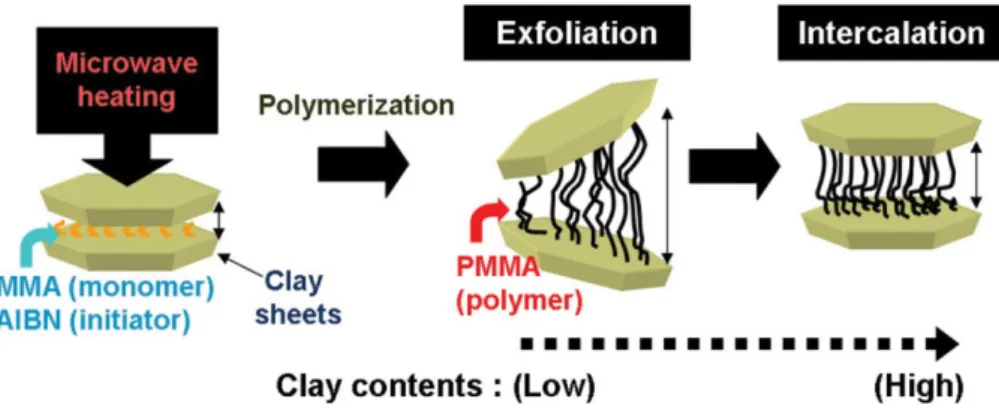
Fig. 2 shows the proposed process of PMMA/clay nanocomposites in the applied microwave-assisted polymerization. In the presence of organophilic clay and MMA, the formation of PMMA chains is able to exfoli- ate the clay through radical polymerization of MMA

Fig. 2. Schematic illustration of microwave assisted polymerization of PMMA in clay gallery resulting in PMMA/clay nanocomposites.

Fig. 1. XRD patterns of (a) C10A, (b) PMMA/C10A (7 wt%),

and (c) PMMA/C10A (3 wt%) nanocomposites.

(3)

and AIBN with microwave volume heating. This inter- pretation can be evidenced by XRD and TEM results.

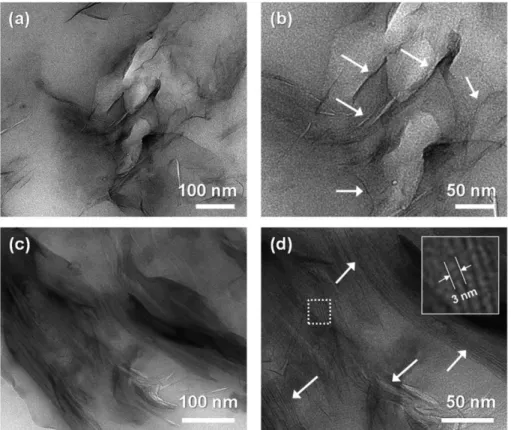
Fig. 3 shows the TEM images of the PMMA/clay nanocomposites prepared by microwave assisted polym- erization with two different C10A contents of 3 wt%

and 7 wt%. The white light area is the PMMA matrix and the black line is made of the silicate layers. PMMA/

clay nanocomposite containing 3 wt% of C10A shows that the nano-layer of clay (dark lines) was well dis- persed in the PMMA (white part) matrix, indicating the exfoliation state as shown in Fig. 2(a and b). This result could be due to microwave energy assisted the delami- nating process of layered silicate to achieve exfoliation [19]. On the other hand, in the presence of organophilic clay in liquid MMA, the hydroxyl groups existing in the chemical structure of the quaternary ammonium cation could be served as initiators such AIBN for radical polymerization of MMA in layered silicate gallery [21].

However, PMMA/clay nanocomposite containing 7 wt%

of C10A exhibits the intercalated state, which is the well-ordered layer of the clay. Although this nanocom- posite does not show the full exfoliation of clay, we believe that the microwave heating has been effective for preparation of PMMA/clay nanocomposites.

The dispersion of clay particles in the nanocompos-

Fig. 3. TEM images of (a and b) PMMA/C10A (3 wt%), and (c and d) PMMA/C10A (7 wt%) nanocomposites (White allows indicate silicate layers and inset image is magnified from dotted line of Fig. 2(d)).

Fig. 4. AFM height images (a and b) and UV-vis transmit-

tance spectra (c) of PMMA/C10A nanocomposites (White

allows indicate aggregated clay particles).

(4)

ites of dip-coated thin films was determined by AFM measurements. Fig. 4(a and b) shows the AFM height images of the PMMA/clay nanocomposites with two different organoclay contents of 3 wt% and 7 wt%. All samples showed homogeneously dispersing regions of clay. However, PMMA/clay nanocomposite containing 7 wt% of C10A showed morphology of clay particles agglomerated. Fig. 4(c) shows the UV-visible transmis- sion spectra of the PMMA/clay nanocomposite disks with a thickness of 5 mm. PMMA/clay nanocomposite containing 3 wt% of C10A showed result similar to high transparency of pure PMMA in the visible light region.

In contrast, PMMA/clay nanocomposite containing 7 wt%

of C10A has very low transmittance, indicated the aggre- gation of clay particle in PMMA matrix. These spectra confirm that the transparency of these nanocomposites decreased with increasing content of clay. Generally, the high optical clarity of PMMA/clay nanocomposite can be related from the disorderly exfoliated morphology.

Therefore, aggregation of intercalated clay in the PMMA matrix is relatively smaller than the wavelength of visi- ble light [12]. This result is amended with the XRD and TEM results.

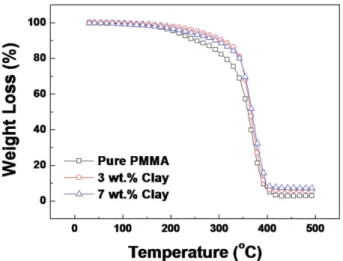
Fig. 5 presents the TGA thermograms of the pure PMMA and PMMA/clay nanocomposites prepared by microwave assisted polymerization with two different C10A contents of 3 wt% and 7 wt%. As could be expected from results XRD, TEM, AFM, and UV-vis, the decomposition rates of the PMMA/clay nanocom- posites become to be lower compared to that of the pure PMMA, indicating the inorganic silicate has a high ther- mal stability. A possible reason is that inorganic materi- als with high thermal stability and the great barrier

properties of the nano-layers dispersed in the nanocom- posites. Moreover, thermal decomposition behaviors of PMMA between clay sheets due to the segmental motion of into silicate interlayer spacing [2].

4. Conclusions

PMMA/clay nanocomposities were successfully syn- thesized by microwave assisted in situ radical polymer- ization. The intercalated or exfoliated nanostructure of PMMA/clay nanocomposites was strongly dependent of the content of organophilic clay (C10A). With micro- wave energy, at lower C10A content of 3 wt%, the nano-layer of clay was well-dispersed in the PMMA matrix, indicating the exfoliation state. Nanocomposite with homogeneously dispersed and exfoliated clay in PMMA matrix showed the high optical transparency similar to result of pure PMMA. The thermal decompo- sition rate of the PMMA/clay nanocomposites become to be lower compared to that of the pure PMMA, indi- cating the inorganic silicate has a high thermally stabil- ity. The improvement of thermal properties is attributed to that the PMMA chains are fixed inside of the sheets of the clay, and layers of the clay can effectively sup- press quick transmit of the heat and segmental motions of the polymer chains.

Acknowledgement

This work was supported by a 2-Year Research Grant of Pusan National University.

References

[ 1 ] E.P. Giannelis, “Polymer layered silicate nanocompos- ites”, Adv. Mater. 8 (1996) 29.

[ 2 ] M. Alexandre and P. Dubois, “Polymer-layered silicate nanocomposites: preparation, properties and uses of a new class of materials”, Mater. Sci. Eng., R: Reports 28 (2000) 1.

[ 3 ] M. Biswas and S.S. Ray, “Recent progress in synthesis and evaluation of polymer-montmorillonite nanocom- posites”, Adv. Polym. Sci. 155 (2001) 167.

[ 4 ] J.J. Luo and I.M. Daniel, “Characterization and model- ing of mechanical behavior of polymer/clay nanocom- posites”, Compos. Sci. Technol. 63 (2003) 1607.

[ 5 ] D.R. Paul and L.M. Robeson, “Polymer nanotechnol- ogy: nanocomposites”, Polymer 49 (2008) 3187.

[ 6 ] F. Chivrac, E. Pollet and L. Avérous, “Progress in nano- biocomposites based on polysaccharides and nano- Fig. 5. TGA thermograms of PMMA and PMMA/C10A

nanocomposites.

(5)

clays”, Mater. Sci. Eng., R: Reports 67 (2009) 1.

[ 7 ] G. Palm, R.B. Dupaix and J. Castro, “Large strain mechanical behavior of poly (methyl methacrylate) (PMMA) near the glass transition temperature”, J. Eng.

Mater. Tech. 128 (2006) 559.

[ 8 ] D.C. Lee and L.W. Jang, “Preparation and characteriza- tion of PMMA-clay hybrid composite by emulsion polymerization”, J. Appl. Ploym. Sci. 61 (1996) 1117.

[ 9 ] S. Kumar, J.P. Jog and U. Natarajan, “Preparation and characterization of poly (methyl methacrylate)-clay nanocomposites via melt intercalation: the effect of organoclay on the structure and thermal properties”, J.

Appl. Ploym. Sci. 89 (2003) 1186.

[10] Z. Shen, G.P. Simon and Y.B. Cheng, “Nanocomposites of poly (methyl methacrylate) and organically modified layered silicates by melt intercalation”, J. Appl. Ploym.

Sci. 92 (2004) 2101.

[11] Y. Xu, W.J. Brittain, C. Xue and R.K. Eby, “Effect of clay type on morphology and thermal stability of PMMA-clay nanocomposites prepared by heterocoagu- lation method”, Polymer 45 (2004) 3735.

[12] G.A. Wang, C.C. Wang and C.Y. Chen, “Characteriza- tions of a new flame-retardant polymer”, Polym. Degrad.

Stab. 91 (2006) 3344.

[13] L. Cui, N.H. Tarte and S.I. Woo, “Effects of modified clay on the morphology and properties of PMMA/clay nanocomposites synthesized by in situ polymerization”, Macromolecules. 42 (2008) 4268.

[14] D. Bogdal, P. Penczek, J. Pielichowski and A. Prociak,

“Microwave-assisted degradation of acid orange using a

conjugated polymer polyaniline, as catalyst”, Adv.

Polym. Sci. 163 (2003) 193.

[15] L. Zong, S. Zhou, N. Sgriccia, M.C. Hawley and L.C.

Kempel, “A Review of Microwave-Assist Polymer Chemistry (MAPC)”, J. Micro Power Electric Energy 38 (2003) 49.

[16] F. Wiesbrock, R. Hoogenboom and U.S. Schubert,

“Microwave-assisted polymer synthesis: state-of-the-art and future perspectives”, Macromol. Rapid Commun. 25 (2004) 1739.

[17] C. Zhang, L. Liao and S.S. Gong, “Recent developments in microwave-assisted polymerization with a focus on ring-opening polymerization”, Green Chem. 9 (2007) 303.

[18] P. Aranda, Y. Mosqueda, E. Perez-Cappe and E. Ruiz- Hitzky, “Electrical characterization of poly(ethylene oxide)-clay nanocomposites prepared by microwave irradiation”, J. Polym. Sci. Part B: Polym Phys. 41 (2003) 3249.

[19] Y. Yoo, K.Y. Choi and J.H. Lee, “Polycarbonate/mont- morillonite nanocomposites prepared by microwave- aided solid state polymerization”, Macromol. Chem.

Phys. 205 (2004) 1863.

[20] N. Uyanik, A.R. Erdem, M.F. Can and M.S. Celik,

“Epoxy nanocomposites curing by microwaves”, Polym.

Eng. Sci. 46 (2006) 1104.

[21] L. Liao, C. Zhang and S.S. Gong, “Recent develop- ments in microwave-assisted polymerization with a focus on ring-opening polymerization”, Macromol.

Rapid Commun. 9 (2007) 303.

수치

Fig. 2. Schematic illustration of microwave assisted polymerization of PMMA in clay gallery resulting in PMMA/clay nanocomposites.
Fig. 3 shows the TEM images of the PMMA/clay nanocomposites prepared by microwave assisted  polym-erization with two different C10A contents of 3 wt%
Fig. 5 presents the TGA thermograms of the pure PMMA and PMMA/clay nanocomposites prepared by microwave assisted polymerization with two different C10A contents of 3 wt% and 7 wt%

참조

관련 문서