• 검색 결과가 없습니다.

Fabrication of Porous Alumina Ceramics Using Hollow Microspheres as the Pore-forming Agent

N/A
N/A
Protected

Academic year: 2021

Share "Fabrication of Porous Alumina Ceramics Using Hollow Microspheres as the Pore-forming Agent"

Copied!
6
0
0

로드 중.... (전체 텍스트 보기)

전체 글

(1)

* Corresponding author. Tel.: +1-573-239-6981 Fax: +1-573-884-5090

E-mail address: [email protected] ( Zhengwei Nie ).

Fabrication of Porous Alumina Ceramics Using Hollow Microspheres as the Pore-forming Agent

Zhengwei Nie

a*

, Yuyi Lin

a

a

Department of Mechanical & Aerospace Engineering, University of Missouri, Columbia, MO 65211, USA

ARTICLE INFO ABSTRACT

Article history: Porous alumina ceramics with two different pore sizes were fabricated using hollow microspheres as the pore-forming agent. The relative density, total porosity, and microstructure of the obtained alumina ceramics were studied. It was found that the total porosity of sintered samples with different amounts of hollow microsphere content, from 2.0 to 4.0 wt%, was 69.3-75.6%. The interconnected and spherical cell morphology was obtained with 3.0 wt% hollow microsphere content. The resulting ceramics consist of a hierarchical structure with large-sized cells, and small-sized pores in the cell walls. Moreover, the compressive strength of the sintered samples varied from 8.3-11.5 MPa, corresponding to hollow microsphere contents of 2.0-4.0 wt%.

Received 22 June 2015 Revised 11 August 2015 Accepted 11 August 2015

Keywords:

Porous ceramics Al

2

O

3

Pore-forming agent Sintering

Microstructure

1. Introduction

Porous ceramics is one of the frequently used materials for a variety of applications, including catalyst supports, filters, preforms for pressure filtration processes, membranes, hot gases media, and lightweight structural materials

[1-5]

. Many different preparation methods for porous ceramics have been studied over the past decade. Yao et al. prepared the reticulated porous silicon carbide ceramics using polymeric foam and a recoating technique

[6-8]

. Gregorová et al. presented that the porous alumina ceramics between 25 and 50%

porosity were produced by starch consolidation casting (SCC) and the limits of pore size and porosity were discussed

[9-11]

. Sepulveda et al. made open-cell hydroxyapatite (HA) foams with relative porosities from 72 to 90%

[12]

. Colombo et al.

obtained the macro cellular and micro cellular silicon carbide

open cell ceramics using sacrificial template technique. Macro cellular structures with cell sizes ranging from 100-600 μm were synthesized by a foaming approach. Microcellular struc- tures with a cell size of around 8 um were fabricated using polymer microbeads as sacrificial templates

[13]

. Each of these routes has its own disadvantages, e.g. the mechanical properties of the ceramics prepared by the polymeric foam replication are poor because of the drawbacks of the pyrolysis process and its pore sizes are limited to macro scale and millimeter scale. In order to fabricate porous ceramics without drawbacks mentioned above, some studies developed procedures combining these techniques to produce ceramics with improved properties that could not be obtained by single technique. Ramsay et al.

reported that the macro porous hydroxyapatite scaffolds,

which possessed an open, uniform, and interconnected porous

structure with a pore size of 200-400 μm and a compressive

(2)

Journal of the Korean Society of Manufacturing Technology Engineers 24:4 (2015) 368~373

Fig. 1 Expansion of Expancel microspheres when heated

[16]

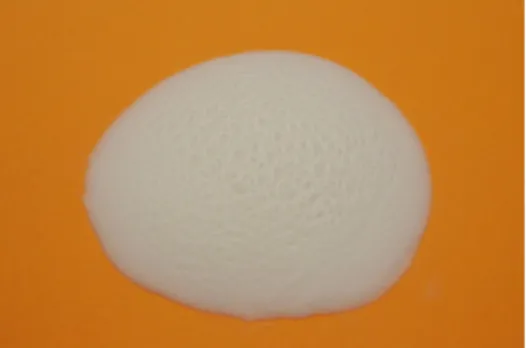
Fig. 2 Microspheres of Expancel product: 920DE80d30 yield strength of 5 MPa, by combining the replication method

with the gel-casting method

[14]

. Mao et al. developed a new technique to make ceramics with hierarchical pore structure using starch consolidation casting and foaming methods

[15]

.

In this work, porous alumina ceramics with different porosity were fabricated using hollow microspheres as pore-forming agent. The relative density, total porosity, and microstructure of the obtained alumina ceramics were studied. The cell morphology of resulting materials has a hierarchical structure with pores of two different sizes. The advantage of using hollow microspheres as pore-forming agent is that hollow microsphere has lower amounts of gaseous by-products when it is pyrolyzed during sintering process than other microbeads such as PMMA-PEG and is less expensive than other bulk microbeads. The compressive strength of the sintered samples also was measured.

2. Experimental procedure

2.1 Materials

As ceramics’ raw materials, alumina powder (main size less than 0.5 μm, A16SG, Alcoa Inc., New York City, USA) was chosen as received in this study. Nano alumina powder (40-80 nm, gamma-phase >99%, Alfa Aesar Co., Haverhill, USA) was used as sintering additive. 5 wt% polyvinyl alcohol (PVA) solution was added as a binder. Commercially available microspheres (Expancel 920DE80d30, particle sizes = 55-85 μm, true density = 30 kg/m

3

, Akzo Nobel Coating Inc., Amsterdam, Netherlands) was selected as the pore-foaming agent. Expancel microspheres are small spherical plastic particles. The microspheres consist of a polymer shell encapsulating a gas.

When heated, the internal pressure from the gas increases and the thermoplastic shell softens, resulting in a dramatic increase of the volume of the microspheres as shown in Fig.

1. The commercial Expancel product used in this work is shown in Fig. 2. No pre-processing to prepare the micro- spheres in this study.

2.2 Preparation process

The micro scale alumina powder and nano scale alumina powder were weighed with the weight ratio of 95%/5%, and then mixed using ball mill with beads (2-3 mm in diameter) for 8 h. Both jar and milling beads are made of agate while

milling medium is deionized water. 5 wt% polyvinyl alcohol (PVA) solution was added to the alumina suspension.

Amounts of 2.0-4.0% hollow microspheres mixed with the suspension were then measured by the weight fraction of ceramics powders. 0.5 wt% commercial dispersant for Al

2

O

3

(Dolapix CE64, Zschimmer & Schwarz Inc., USA) also added with the hollow microspheres. The resulting mixtures were agitated using electromagnetic stirrer at room temperature for 24 hours. After that the suspension was then stirred and dried in an oven at 60°C for a couple of days. The dried powders were compacted into samples of 16 mm-diameter and 5 mm- thickness. The compacted samples were then sintered in argon environment at atmospheric pressure. The sintering process was performed in an electric heating furnace. The block diagram of preparation process is shown in Fig. 3.

In this study, the PVA and hollow microspheres must be

burnt out during sintering process in order to get the desired

porous ceramics. According to the thermogravimetry analysis

and Fourier transform infrared spectroscopy of the compacted

ceramics body

[13]

, the crucial temperatures for burning hollow

microspheres out before the ceramics sintering is from 300 to

500°C. Therefore, the samples in this study were heated from

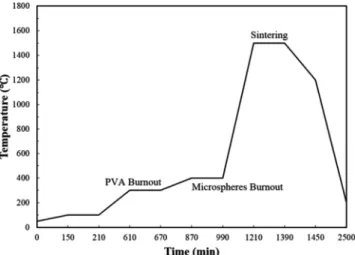
room temperature up to 300°C at a heating rate of 0.5°C/min,

and stayed at this temperature for 1 h to eliminate PVA com-

pletely. Then the samples were heated from 300°C to 400°C

(3)

Fig. 3 Flow chart of preparation process for porous alumina ceramics in this study

Fig. 4 Heating schedule for the sintering process

Fig. 5 Relative density of alumina ceramics varies with micro- sphere content

at a rate of 0.5°C/min, and assisted by dwelling at 400°C for 2 h to burn out the hollow microspheres. Thereafter, the heating rate was changed to 5°C/min and then the sintering was accomplished at 1,500°C for 3 h. The sintering processes aforementioned were performed in a tube furnace (GSL- 1700X-80VT-UL, MTI Corp., Richmond, USA). The heating schedule is shown in Fig. 4.

2.3 Characterization

The relative density of sintered ceramics was calculated by the weight-to-volume ratio of the samples. The total porosity of ceramics was determined through the ratio of bulk density to true density of samples. The grain and cell morphology of

obtained ceramics was observed by scanning electron micro- scopy (SEM, FEI Sirion 200, Hillsboro, USA). The com- pressive strength was measured at a crosshead speed of 1.0 mm/min. The diameter of the test samples was 13 mm and the thicknesses were from 3.5 mm to 6.5 mm.

3. Results and Discussion

The relative densities of alumina ceramics added different amounts of hollow microsphere is profiled in Fig. 5. The bulk densities were measured by Archimedes technique. This figure shows that the density decreases linearly with increasing amount of hollow microsphere. The alumina ceramics with approximate 26% theoretical density (theoretical density of alumina ceramics=3.95 g/cm

3

) was attained when the micro- sphere content was 2.0 wt%. The density reduced to the mini- mum value 0.82 g/cm

3

at 4.0 wt% microsphere content. This result indicates that the burnout of hollow microspheres during sintering process does not influence the sintering of ceramics and the forming of porous structure.

The total porosity obtained in this study as a function of hollow microsphere content is shown in Fig. 6. As shown in Fig. 6, the linearly increasing trend was observed when the hollow microsphere content increased from 2.0 wt% to 4.0 wt%. The total porosity of 69.3% was obtained at 2.0 wt%

microsphere content while it increased to 75.6% at 4.0 wt%

microsphere content. This result suggests that the microsphere expansion during the sintering process increased the total porosity of sintered ceramics.

Figure 7 shows that the SEM micrographs of the typical

(4)

Journal of the Korean Society of Manufacturing Technology Engineers 24:4 (2015) 368~373

Fig. 6 Total porosity of sintered alumina ceramics as a function of microsphere content

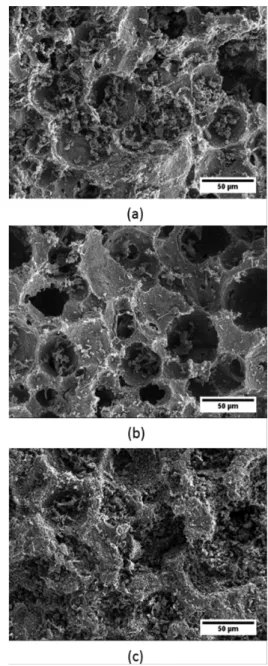
Fig. 7 SEM micrographs of porous alumina ceramics at 1,500°C with different hollow microsphere contents: (a) 2.0 wt%, (b) 3.0 wt%, (c) 4.0 wt%

surfaces of the sintered alumina ceramics with different hollow microsphere contents (2.0-4.0 wt%) after sintering at 1,500°C for 3 hours. The pores and grain growth can be observed for the samples sintered at this temperature. As illustrated in Fig. 7, the cell structure changed from spherical to irregular as the hollow microsphere content was increased in the sintered alumina ceramics. The open and well-distributed cell structure with struts was observed in Fig.

7(b) when the content of hollow microsphere was 3.0 wt%.

Such morphology was almost spherical, stating that the shape of hollow microsphere was retained in the sample compacting, in the expansion, and in the pyrolysis of sintering process. The diameter of cell was from 20 to 60 μm, and there were no large voids in the ceramics with 3.0 wt% microsphere content sintered at this temperature. However, the cell structure was collapsed when the microsphere content was up to 4.0 wt%

as shown in Fig. 7(c). A lot of small voids can be observed in this case, which illustrates that the shape of hollow micro- sphere is destroyed during ceramic sintering process. From Fig. 7(a), although the spherical shape of microsphere was retained to some extent, there was a small number of interc- onnections between cells when the microsphere content was 2.0 wt%.

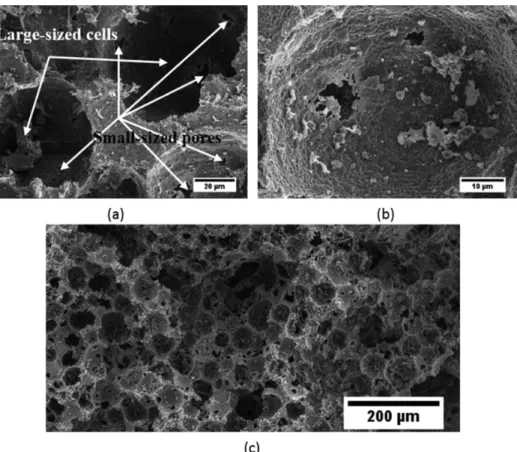
The microstructure feature of porous ceramics with 3.0 wt%

hollow microsphere content is shown in Fig. 8. A hierarchical structure consists of large-sized cells with diameter of 20-60 μm, small-sized pores in cell walls averaging about 10 μm as shown in Fig. 8(a). It can be inferred that the large-sized cells and small-sized pores are formed from elimination of microspheres, bubbles produced by microsphere pyrolysis,

respectively. The large-sized cells mainly attributed to the

porosity of ceramics. The small-sized pores acted as cell

windows connecting several cells. These cell windows are

critically important in the catalyst supports and biomaterials

since they sieve mass transfer between contiguous cells. Since

the ceramics is fabricated through a direct foaming process,

that is form the nucleation gas bubbles within a liquid which

then tend to grow and coalesce

[17]

, a large dispersion in pore

size is observed. Similar results were also attained by other

work by other methods for fabrication of porous alumina

ceramics

[18-21]

. From Fig. 8(c), it can be observed that the

alumina samples with 3.0 wt% hollow microsphere possesses

(5)

Fig. 8 Microstructure feature of porous ceramics with 3.0 wt% microsphere content

Fig. 9 Compressive strength of sintered ceramics with different hollow microsphere content

an uniform cells. As shown in Figs. 7 and 8, a variety of structures can be obtained using hollow microsphere as pore-forming agent or so-called structure foam agent for the fabrication of porous ceramics. The microstructure of obtained porous ceramics can actually be designed to be open-celled contain small-sized pores in cell walls, or to be open cells without cell windows, or to contain a lot of pores and voids.

The compressive strength of porous alumina ceramics as a

function of microsphere contents is shown in Fig. 9. As can be seen, the compressive strength decreased slightly when the microsphere contents increased from 2.0 to 4.0 wt% corres- ponding with a compressive strength of 8.3-11.5 MPa. The decreasing trend of compressive strength with increasing of microsphere content is an indication of the fact that size changes of crucial loading area occurs in the samples when sintering with different amounts of pore-forming agent. This tendency has been found in many other porous ceramics

[22-24]

. The increasing hollow microsphere content resulted in the higher porosity and more porous structure that could lead to the weak struts among pores within the ceramics.

4. Conclusions

Porous alumina ceramics with two different pore sizes were fabricated using hollow microspheres as pore-forming agent.

The relative density, total porosity, and microstructure of the

obtained alumina ceramics were studied. It was found that the

total porosity range of sintered samples with different amount

of hollow microsphere contents from 2.0 wt% to 4.0 wt% was

69.3-75.6% and the total porosity increased with the increase

(6)

Journal of the Korean Society of Manufacturing Technology Engineers 24:4 (2015) 368~373

of hollow microsphere contents. The interconnected and spherical cell morphology was obtained with 3.0 wt% hollow microsphere content. The resulting ceramics consists of a hierarchical structure. The hierarchical structure consists of large-sized cells with diameter of 20-60 μm, small-sized pores in cell walls averaging about 10 μm Moreover, the compressive strength of the sintered samples varied within the range of 8.3-11.5 MPa, corresponding to hollow microsphere contents of 2.0-4.0 wt%.

Acknowledgements

The authors wish to thank Master Dynamic of Hong Kong for funding a research project that is related to this study.

References

[1] Carn, F., Colin, A., Achard, M. F., Deleuze, H., Saadi, Z., Backov, R., 2004, Rational Design of Macro Cellular Silica Scaffolds Obtained by a Tunable Sol-Gel Foaming Process, Adv. Mater, 16:2 140-144.

[2] Stuart, A. R., Gonzenbach, U. T., Tervoort, E., Gauckler, L. J., 2006, Processing Routes to Macro Porous Ceramics: A Review, Journal of the American Ceramic Society, 89 1771-1789.

[3] Sepulveda, P., 1993, Gel Casting Foams for Porous Ceramics, Am.

Ceram. Soc. Bull., 76:10 61-65.

[4] Scheffler, M., Colombo, P., 2005, Cellular Ceramics: Structure, Manufacturing, Properties and Applications, Wiley- VCH., London.

[5] Liu, D., 1998, Preparation and Characterization of Porous Hydroxy- apatite Bio-ceramic Via a Slip-casting Route, Ceram. Int., 24:6 441-446.

[6] Yao, X., Tan, S., Huang, Z., Jiang, D., 2006, Effect of Recoating Slurry Viscosity on the Properties of Reticulated Porous Silicon Carbide Ceramics, Ceramics International, 32 137-142.

[7] Yao, X., Tan, S., Huang, Z., 2005, Influence of Polymeric Sponge Pre-treatment on Properties of Reticulated Porous Ceramics, Journal of the Chinese Ceramics Society, 33:10 1215-1219.

[8] Yao, X., Huang, Z., Tan, S., 2005, Preparation of Silicon Carbide Reticulated Porous Ceramics Sintered at Low Temperature with PCS as Sintering Additive, Journal of Inorganic Materials, 25:10 168-172.

[9] Gregorová, E., Pabst, W., 2007, Porosity and Pore Size Control in Starch Consolidation Casting of Oxide Ceramics- Achievements and Problems, Journal of the European Ceramic Society, 27:2-3 669-672.

[10] Gregorová, E., Pabst, W., 2011, Process Control and Optimized Preparation of Porous Alumina Ceramics by Starch Consolidation

Casting, Journal of the European Ceramic Society, 31:12 2073-2081.

[11] Pabst, W., Gregorová, E., Sedlárová, I., Cerny, M., 2011, Preparation and Characterization of Porous Alumina-zirconia Composite Ceramics, Journal of the European Ceramic Society, 31:14 2721-2731.

[12] Sepulveda, P., Ortega, F. S., Innocentini, D. M., Pandolfelli, V. C., 2000, Properties of Highly Porous Hydroxyapatite Obtained by the Gel Casting of Foams, J. Am. Ceram. Soc., 83:12 3021-3024.

[13] Colombo, P., Bernardo, E., 2003, Macro- and Micro-cellular Porous Ceramics from Preceramic Polymers, Composites Science and Technology, 63:16 2353-2359.

[14] Ramsay, H. R., Zhang, M. Q., 2003, Preparation of Porous Hydroxy- apatite Scaffolds by Combination of the Gel-casting and Polymer Sponge Methods, Biomaterials, 24:19 3293-3302.

[15] Mao, X., Wang, S., Shimai, S., 2008, Porous ceramics with tri-modal pores prepared by foaming and starch consolidation’, Ceramics International, 34:1 107-112.

[16] Akzo Nobel, N. V., viewed 6 July 2015, <https://www.akzonobel.

com/expancel/>

[17] Gibson, L. J., Ashby, M. F., 1999, Cellular Solids, Structure and Properties, 2nd ed. Cambridge: Cambridge University Press, England.

[18] Li, S., Wang, C., Zhou, J., 2013, Effect of Starch Addition on Microstructure and Properties of Highly Porous Alumina Ceramics, Ceramics International, 39:8 8833-8839.

[19] Lyckfeldt, O.,Ferreirab, J. M. F., 1998, Processing of Porous Ceramics by Starch Consolidation, Journal of the European Ceramic Society, 18 131-140.

[20] Gregorová, E., Pabst, W., Bohačenko, I., 2006, Characterization of Different Starch Types for Their Application in Ceramic Processing, Journal of the European Ceramic Society, 26:8 1301-1309.

[21] Khattab, R. M., Walsh, M. M. S., Khalil, N. M., 2012, Preparation and Characterization of Porous Alumina Ceramics Through Starch Consolidation Casting Technique, Ceramics International, 38:6 4723-4728.

[22] Zhu, X., Jiang, D., Tan, S.,2002, Preparation of Silicon Carbide Reticulated Porous Ceramics, Materials Science and Engineering, 323:1-2 232-238.

[23] Chun, Y., Kim, Y., 2005, Processing and Mechanical Properties Of Porous Silica-bonded Silicon Carbide Ceramics, Metals and materials International, 11:5 351-355.

[24] Eom, J., Kim, Y.,Song, I., Kim, H., 2007, Microstructure and

Properties of Porous Silicon Carbide Ceramics Fabricated by

Carbothermal Reduction and Subsequent Sintering Process, Materials

Science and Engineering, 464:1-2 129-134.

수치

Fig. 2 Microspheres of Expancel product: 920DE80d30yield strength of 5 MPa, by combining the replication method
Fig. 5 Relative density of alumina ceramics varies with micro-  sphere content
Fig. 6 Total porosity of sintered alumina ceramics as a function of microsphere content
Fig. 8 Microstructure feature of porous ceramics with 3.0 wt% microsphere content

참조

관련 문서