Print ISSN: 2288-4637 / Online ISSN 2288-4645 doi:10.13106/jafeb.2020.vol7.no5.167
1
First Author and Corresponding Author. General Manager, AQ Marketing Team, Hanwha Hotels & Resorts, Korea.
[Postal Address: 50, 63-ro, Yeongdeungpo-gu, Seoul, 07345, Korea] Email: [email protected]
© Copyright: The Author(s)
This is an Open Access article distributed under the terms of the Creative Commons Attribution Non-Commercial License (http://Creativecommons.org/licenses/by-nc/4.0/) which permits unrestricted noncommercial use, distribution, and reproduction in any medium, provided the original work is properly cited.
The Effects of Personality Traits on Subjective Well-being and Behavioral Intention Associated with Serious Leisure Experiences
Jang Heon HAN
1Received: February 10, 2020 Revised: March 15, 2020 Accepted: March 31, 2020
Abstract
The study examined how the personality traits, manifested during serious leisure experience, i.e., experiences that involve the acquisition of special knowledge or techniques and the participation required to achieve the expertise necessary to express them. This study also investigated how such subjective well-being affected behavioral intention, specifically, the intention to use the same leisure facilities again and to spread this information to acquaintances by positive word of mouth. A survey was administered to 727 research subjects selected from pre-registered panels enrolled by an online research organization. The main constructs examined in this study were measured on 5-point Likert scales using multiple items. A structural equation model was employed to verify the proposed conceptual model and the relationships among variables. The results revealed that, of the personality traits, participants high in extraversion, openness to experience, and agreeableness felt high levels of life satisfaction and positive affect, i.e. a sense of subjective well-being. Second, users who felt a high level of subjective well-being, specifically, high life satisfaction and positive affect, also indicated a high level of behavioral intention.
Finally, the academic and practical implications and limitations of the study, as well as future research plans involving the personality traits underlying serious leisure experiences are discussed.
Keywords : Personality Traits, Subjective Well-being, Behavioral Intention, Serious Leisure Experience JEL Classification Code : L83, M31, N35
1. Introduction
The leisure industry has undergone rapid growth since World War II and is forecast to continue growing based on social and industrial development (Unger & Kernan, 1983).
The South Korean tourism and leisure industry, including hotels, ski resorts, golf courses, and theme parks, has grown significantly, by about 25% in five years, from a scale of w20 trillion in 2011 to w25 trillion in 2016 (Tourism &
Leisure Industry Skill Council, 2018). People want to create more meaningful and happier memories rather than simply functional services. Positive feelings such as excitement and joy are the goal of consumer behavior, and customers who
experience positive affect by means of a positive experiences will continue to pursue the same positive experiences in the future (Richins, 2007).
People’s interest in subjective well-being, as reflected in overall life satisfaction and happiness, continues to increase (Ryan & Deci, 2001). The relationship between experience and subjective well-being, specifically happiness, can be explained by a temporal stage model (Diener, Scollon, &
Lucas, 2009). Pleasant and highly immersive experiences have an immediate effect and are stored in affective memory.
People experience happiness by frequently drawing on this affective memory. By sensitively accepting pleasant stimuli, extroverted people easily experience positive affect (Larsen
& Ketelaar, 1989; Rusting & Larsen, 1997; Uziel, 2006).
Thus, people are predicted to achieve optimal experiences
through serious leisure experiences such as skiing, and
to reveal their happiness by experiencing a high level of
flow (Csikszentmihalyi, 1990). In addition, each person
experiences happiness differently, and these differences
are affected by internal qualities such as personality and
self-esteem. In particular, happiness is closely related to
personality traits (Deneve & Cooper, 1998). Personality traits
have been classified into five factors, namely agreeableness, conscientiousness, openness to experience, neuroticism, and extraversion, referred to as the personality traits (McCrae &
Costa, 1991).
Studies establishing causal relationships between personality traits and subjective well-being by applying personality traits as antecedents have taken a variety of forms (Anglim & Grant, 2016; Gutiérrez, Jiménez, Hernández, &
Pcn, 2005; Hayes & Joseph, 2003; Henning, Hansson, Berg, Lindwall, & Johansson, 2017; Meléndez, Satorres, Cujiño,
& Reyes, 2019; Zhai, Willis, O’Shea, Zhai, & Yang, 2014).
However, most of these studies have selected a particular age range or subject group, such as retired adults, workers, or elderly people. Studies that identify the mechanism underlying personality traits’ roles in the formation of subjective well-being among people engaging in serious leisure activities have been absent. Studies that have disclosed the effects of personality traits on subjective well- being in situations involving serious leisure experiences are important because, unlike existing studies on general situations, situations involving serious leisure experiences involve different personality traits that have different effects on subjective well-being. Dispositional traits, such as extraversion, which helps in maintaining warm-heartedness and good interpersonal relationships, or neuroticism, seen in high levels of compulsion or inferiority, affect hedonic balance, which forms the basis for subjective well-being (Schimmack, Radhakrishnan, Oishi, Dzokoto, & Ahadi, 2002). Furthermore, previous research has shown a causal relationship between subjective well-being and behavioral intention for a variety of experiences, and a similar effect is predicted for the relationship between subjective well- being and behavioral intention related to serious leisure experiences.
In summary, the purpose of the present study was to determine how the personality traits affect the subjective well-being of skiers during serious leisure activities at ski resorts. Second, the study examined how skiers’ subjective well-being affects behavioral intention. The results will have implications for the field of tourism and leisure studies and practical implications for relevant work in the field.
2. Review of Literature and Hypothesis 2.1. Personality Traits and Subjective Well-being
The present study attempted to reveal which of the personality traits directly affect subjective well-being during serious leisure experiences and to identify the underlying causal mechanism so as to understand why such a consumer behavior occurs. Serious leisure experiences are those that involve the acquisition of special knowledge or skills and the participation required to achieve the expertise to express
them (Stebbins, 1992). These are the activities systematically performed by hobbyists, amateurs, and volunteers who pursue them with the aim of achieving sufficient expertise (Stebbins, 1982, 1992). Comprehensive research is underway in the field of leisure sports and tourism, with research undergoing further segmentation as the field expands to incorporate adventure tourism, including paragliding, hang gliding, surfing, and other outdoor recreation activities that place importance on building expertise.
Furthermore, personality has been defined by scholars in different ways depending on their perspectives. Hodgetts and Fountain (1987) referred to personality as the stable characteristics or tendencies used to distinguish similarities and differences among people. Judge and Bono (2000) referred to personality as the characteristics distinguishing one person from another in various situations, as well as patterns of behavior, including emotions. Dirks and Ferrin (2002) refer to personality as a fixed part of an individual that allows them to behave in a consistent pattern. Personality is said to be affected by genetic factors, such as DNA, as well as by cultural customs. The model of personality traits, one of the theories that most clearly defines personality traits, was developed by joint factor analysis (Costa &
McCrae, 1991). Agreeableness is expressed through of trust, straightforwardness, and altruism, among other traits.
Extraversion comprises warmth, sociability, activity, and related traits. Openness to experience is manifested in imagination, aesthetics, openness to feelings, and openness to actions, among other qualities. Conscientiousness entails competence, order, dutifulness, achievement striving, and deliberation, along with related qualities. Neuroticism is reflected in anxiety, hostility, depression, vulnerability, and related traits (John, 1990). According to instrumental theory, personality traits have direct effects on actions or circumstances, which in turn affect subjective well-being (Heller, Watson, & Ilies, 2004). In addition, according to temperament theory, personality traits affect subjective well- being as a result of emotional reactivity and the effect of cognitive processing over emotional information (Diener, Oishi, & Lucas, 2003).
Kahneman and Krueger (2006) argued that leisure
activities have great effects on subjective well-being and
that daily life activities, such as shopping, fail to affect
subjective well-being. Costa and McCrae (1992) introduced
the personality traits and examined their correlation with
affective variables. Extraversion is positively correlated
with positive affect, whereas neuroticism is correlated with
negative affect. DeNeve and Cooper (1998) showed that
extraversion was positively correlated and neuroticism was
negatively correlated with life satisfaction. In their study on
workers in five Chinese cities, Zhai et al. (2014) reported
that extraversion and conscientiousness had a positive
effect on subjective well-being, whereas neuroticism had a
negative effect. Meléndez et al. (2019) suggested in their research on elderly people in Columbia that extraversion, openness to experience, and conscientiousness had positive effects on subjective well-being, while extraversion and conscientiousness had positive effects on life satisfaction. In contrast, neuroticism appears to have a negative effect on life satisfaction. Based on this prior work, the present study predicted that the personality traits would affect subjective well-being during serious leisure experiences. The specific hypotheses of this study were:
H1: Personality traits have a significant effect on subjective well-being.
H1-1: Extraversion has a positive effect on life satisfaction
H1-2: Openness to experience has a positive effect on life satisfaction
H1-3: Conscientiousness has a positive effect on life satisfaction
H1-4: Agreeableness has a positive effect on life satisfaction
H1-5: Neuroticism has a negative effect on life satisfaction
H1-6: Extraversion has a positive effect on positive affect H1-7: Openness to experience has a positive effect on positive affect
H1-8: Conscientiousness has a positive effect on positive affect
H1-9: Agreeableness has a positive effect on positive affect
H1-10: Neuroticism has a negative effect on positive affect
2.2. Subjective Well-being and Behavioral Intention Subjective well-being is the subjective sense of happiness experienced by an individual (An & Zhang, 2019). Such happiness is remembered and experienced differently depending on how people accept the things that have happened to them during their lifetime (Lyubomirsky
& Ross, 1997; Lyubomirsky & Tucker, 1998). For instance, happy people accept and recall their experiences in a more positive was than do unhappy people. Thus, happiness is said to be closely related to optimism (Lyubomirsky, Tkach, &
DiMatteo, 2006). Happy people expect more positive results from life than do unhappy people, and such expectations are said to have an overall positive effect on life. Diener (1984) suggested that happiness and unhappiness are based on inherently different underlying mechanisms, with different moderating effects. Diener (1984) replaced the notion of happiness with a new concept, subjective well-being, and differentiated between its cognitive components and affective components. Cognitive components refer to the degree of life satisfaction experienced, while affective components
include positive affect among others. Such subjective well- being is closely related to behavioral intention. Chiu, Cheng, Huang, and Chen (2013) showed that satisfaction achieved via online social media use has positive effects on subjective well-being, on the intention to reuse the media platform, and on loyalty to it. Jamaludin, Sam, Sandal, and Adam (2016) reported that the perceived universalism of Norwegian international students had a positive effect on subjective well- being and that subjective well-being had a positive effect on the destination loyalty of international students. This finding shows that international students who are relatively stable and happy respond positively toward maintaining destination loyalty. Wang, Lin, and Liao (2010) stated that extraversion, agreeableness, and conscientiousness had positive effects on users’ perceived pleasure with weblogs and that such perceived pleasure ultimately had a positive effect on behavioral intention. Based on these theoretical grounds, the present study predicted that subjective well- being evoked by serious leisure experiences would affect behavioral intention. The specific hypotheses of this study were:
H2: Subjective well-being has a significant effect on behavioral intention.
H2-1: Life satisfaction has a positive effect on behavioral intention
H2-2: Positive affect has a positive effect on behavioral intention
3. Research Method
3.1. Participants and Procedure
The present study employed the online research organization Macromill Embrain located in South Korea to conduct a survey. This study extracted samples from online panels by targeting users who had experience skiing at ski resorts. The online survey asked subjects whether they had skied during the previous ski season to extract an adequate number of responses. Only respondents who responded ‘yes’
were surveyed; those responding ‘no’ were excluded from the
survey. These respondents underwent a scenario technique to
arouse their memories of skiing. Respondents received a ski
lesson at the ski area in the morning. Then, in the afternoon,
they read a scenario instructing them to ski freely on the
slopes. Next, they projected a shadow of themselves into
a past skiing situation for one minute before participating
in the survey. A final panel of 727 subjects participated in
the survey. Respondents took the online survey, which
covered the respondents’ personality traits, subjective well-
being, behavioral intentions, and demographic variables
such as gender, age, and the frequency of skiing during a
season. Respondents received a small financial reward in
return for participating in the survey. The gender makeup
of the respondents was 425 males (58.5%) and 302 females (41.5%). The ages included people in their 20s (n = 213;
29.3%), 30s (289; 39.8%), 40s (155; 21.3%), and 50s (70;
9.6%). With regard to the frequency of skiing in a season, 480 (66.0%) respondents reported skiing 1–2 times, 173 (23.8%) skied 3–4 times, 42 (5.8%) skied 5–6 times, and 32 (4.4%) respondents skied 7 or more times per season.
3.2. Measures
The main constructs examined in this study were measured on 5-point Likert scales using multiple items (except respondents’ sex, age, and skiing frequency).
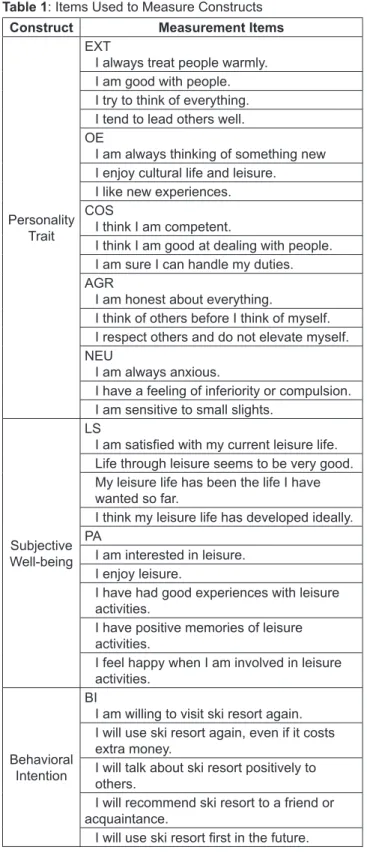
Measures for all constructs are shown in Table 1.
Personality Traits: We measured personality traits by adopting a scale consisting of 17 items from Yoo and Gretzel (2011). Participants were asked to rate themselves in terms of the constructs of extraversion, openness to experience, conscientiousness, agreeableness, and neuroticism.
Subjective Well-being: This study developed and measured a scale of subjective well-being by modifying and supplementing scales used in previous studies (Diener, 1984). The scale involved assessing life satisfaction and positive affect in relation to leisure activities.
Behavioral Intention: This study used five items to assess behavioral intention (Kim & Shim, 2017; Kim & Shim, 2019;
Chiu et al., 2013; Cho, 2019; Jamaludin et al., 2016; Wang et al., 2010): the extent to which the participant felt loyal to this ski resort, the intention to use this resort again, intention to offer positive word-of-mouth support for this resort, and intention to spend additional money to ski at this resort.
3.3. Data Analysis
We evaluated descriptive features and tested the reliability of the measurements using IBM SPSS statistic 23.0 software (IBM Corp., Armonk, NY, USA) and tested hypotheses using Amos 23.0. As a first analysis, we estimated the measurement validity of the model by conducting a confirmatory factor analysis. In the second analysis, we utilized structural equation modeling to test the hypothesized relationships.
4. Results
Table 2 shows descriptive statistics such as mean, standard deviation, and correlations among the variables. According to the analysis, we conducted confirmatory procedures to investigate the discriminant validity of measures. The reliability of the variables was investigated using Cronbach’s alpha, and discriminant and convergent validity were tested based on average variance (AVE), composite reliability (CR), and correlation coefficients among the variables (Tables 2 and 3). The analysis of the relationship between positive
Table 1: Items Used to Measure Constructs
Construct Measurement Items
Personality Trait
EXT I always treat people warmly.
I am good with people.
I try to think of everything.
I tend to lead others well.
OE I am always thinking of something new I enjoy cultural life and leisure.
I like new experiences.
COS I think I am competent.
I think I am good at dealing with people.
I am sure I can handle my duties.
AGR I am honest about everything.
I think of others before I think of myself.
I respect others and do not elevate myself.
NEU I am always anxious.
I have a feeling of inferiority or compulsion.
I am sensitive to small slights.
Subjective Well-being
LS I am satisfied with my current leisure life.
Life through leisure seems to be very good.
My leisure life has been the life I have wanted so far.
I think my leisure life has developed ideally.
PA
I am interested in leisure.
I enjoy leisure.
I have had good experiences with leisure activities.
I have positive memories of leisure activities.
I feel happy when I am involved in leisure activities.
Behavioral Intention
BI I am willing to visit ski resort again.
I will use ski resort again, even if it costs extra money.
I will talk about ski resort positively to others.
I will recommend ski resort to a friend or acquaintance.
I will use ski resort first in the future.
Note. EXT = extraversion, OE = openness to experience, COS = conscientiousness, AGR = agreeableness, NEU = neuroticism. LS
= life satisfaction, PA = positive affect, BI = behavioral intention
Table 4: Hypothesis Testing Results
NO Hypothesis Estimate SE CR P
1-1 EXT → LS .416 .116 3.588 <.001
1-2 OE → LS .319 .078 4.070 <.001
1-3 COS → LS -.197 .122 -1.610 .107
1-4 AGR → LS .308 .085 3.643 <.001
1-5 NEU → LS .077 .052 1.469 .142
1-6 EXT → PA .565 .130 4.338 <.001
1-7 OE → PA .401 .084 4.758 <.001
1-8 COS → PA -.259 .133 -1.944 .052
1-9 AGR → PA .333 .091 3.678 <.001
1-10 NEU → PA .159 .056 2.845 .004
2-1 LS → BI .397 .045 8.747 <.001
2-2 PA → BI .543 .041 13.138 <.001
Note. EXT = extraversion, OE = openness to experience, COS = conscientiousness, AGR = agreeableness, NEU = neuroticism. LS = life satisfaction, PA = positive affect, BI = behavioral intention
Table 2: Scale Means, Standard Deviations, and Correlations among Variables
Variables Correlations
1 2 3 4 5 6 7 8
1 =EXT 1
2 = OE .67 1
3 =COS .74 .69 1
4 = AGR .46 .27 .39 1
5 = NEU −.50 −.41 −.49 −.39 .1
6 = LS .30 .28 .22 .25 −.14 1
7 = PA .33 .31 .22 .23 −.10 .75 .1
8 = BI .35 .33 .26 .30 −.15 .72 .77 1
M 3.5 3.6 3.5 3.5 2.9 3.5 3.8 3.6
SD .60 .65 .59 .62 .68 .71 .64 .69
Note. EXT = extraversion, OE = openness to experience, COS = conscientiousness, AGR = agreeableness, NEU = neuroticism. LS = life satisfaction, PA = positive affect, BI = behavioral intention
Table 3: Results of the Confirmatory Factor and Reliability Analyses
Variable Factor loading SE Critical
ratio CR AVE α
EXT 1 EXT 2 EXT 3 EXT 4
.910 1 1.046
.748
.071 .068 .064
12.88 15.39 11.73
.824 .542 .741
OE 1 OE 2 OE 3
.866 1 .966
.070
.074 12.67
13.10 .768 .524 .693 COS 1
COS 2 COS 3
1 1.918
1.607 .178
.151 10.80
10.65 .799 .580 .675 AGR 1
AGR 2 AGR 3
1 1.498
1.178 .139
.119 10.76
9.92 .756 .512 .624 NEU 1
NEU 2 NEU 3
1 1,093
1.011 .072
.074 15.11
13.63 .802 .576 .739 LS 1 LS 2
LS 3 LS 4
1.126 1 1.080 1.123
.051 .049 .047
.22.01 21.90 24.07
.915 .730 .880
PA 1 PA 2 PA 3 PA 4 PA 5
.978 1 .992 .992 1.016
.039 .038 .039 .043
25.29 25.85 25.43 23.71
.943 .768 .905
BI 1 BI 2 BI 3 BI 4 BI 5
1.085 1 1.102 1.095 1.041
.040 .040 .043 .016
27.39 27.27 25.55 22.58
.940 .760 .910
Note. EXT = extraversion, OE = openness to experience, COS = conscientiousness, AGR = agreeableness, NEU = neuroticism. LS = life satisfaction, PA = positive affect, BI = behavioral intention
affect and behavioral intention variables is not shown, as
there was no clear correlation between the two variables. A
χ2 difference analysis was performed using constrained and
non-constrained models between the latent variables. The
results of the analysis were statistically significant, ensuring
discriminant validity. As shown in Table 3, the fit of the
measurement model was satisfactory (χ2 = 1307.64, df =
377, p < .001, χ2/df = 3.469, CFI = .916, TLI = .903, RMR
= .030, and RMSEA = .058). The Cronbach’s alpha values were >.60 for all constructs, which exceeded the threshold criterion of .60 for general acceptance of internal consistency reliability. A confirmatory factor analysis was carried out;
the item factor loadings ranged from .70 to 2.0, and CR and AVE were above the threshold values of .70 and .50.
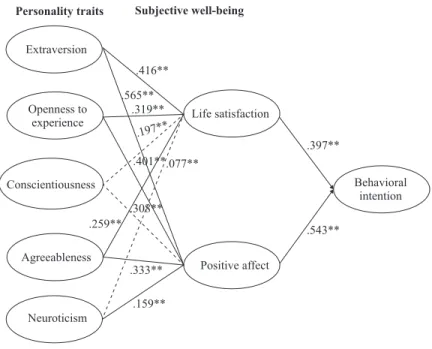
The goodness of fit of the analytical model was close to the standard value ( = 2,132.00, df = 388, p < .001, /df = 5.495, CFI = .842, TLI = .823, RMR = .104, and RMSEA
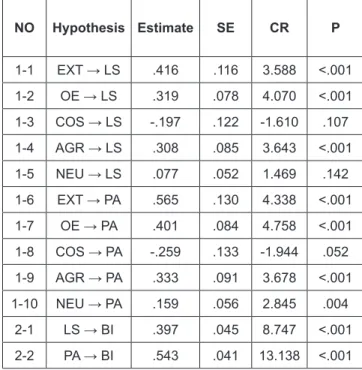
= .079; see Figure 1 and Table 4). A robust maximum likelihood estimation approach was utilized to generate this model. The hypothesis test results were as follows. First, extraversion positively influenced life satisfaction (βEXT
→ LI = .416, p < .001), openness to experience positively influenced life satisfaction (βOE → LI = .319, p < .001), and agreeableness positively influenced life satisfaction (βAGR
→ LI = .308, p < .001). Thus, H1-1, H1-2, and H1-4 were supported. Extraversion positively influenced positive affect (βEXT → PA = .565, p < .001), openness to experience positively influenced positive affect (βOE → PA = .401, p <
.001), and agreeableness positively influenced positive affect (βAGR → PA = .333, p < .001). Thus, H1-6, H1-7, and H1-9 were supported. In contrast to the established hypothesis, neuroticism enhanced positive affect (βNEU → PA = .159, p < .05). However, H1-3 (COS → LS), H1-5 (NEU → LS), and H1-8 (COS → PA) were not supported. Furthermore, life satisfaction positively influenced behavioral intention (βLI → BI = .397, p < .001) and positive affect positively
influenced behavioral intention (βPA → BI = .543, p < .001).
Thus, H2-1 and H2-2 were supported.
5. Discussion
The present study examined how the personality traits were related to serious leisure experiences and how they affected subjective well-being, specifically overall life satisfaction and positive affect. In addition, the study investigated how subjective well-being affected the behavioral intention to use the same leisure facilities again and the will to spread this information to acquaintances by positive word of mouth.
The results of the study were as follows. First, the personality traits had significant effects on subjective well- being during serious leisure experiences. The personality traits, specifically, extraversion, openness to experience, and agreeableness, had significantly positive effects on life satisfaction. In addition, extraversion, openness to experience, agreeableness, and neuroticism had significantly positive effects on affect. These results support those of DeNeve and Cooper (1998), Zhai et al. (2014), and Meléndez et al. (2019). Interestingly, neuroticism appeared to have a significant positive effect on positive affect. This result suggests that people who are high in neuroticism experience greater fun, pleasure, and happiness than do those who are low in neuroticism. In the past, blogging studies in online environments have shown that neuroticism has a positive
Personality traits Subjective well-being
.416**
.397**
.543**
.159**
.333**
.259** .308**
.077**
.401**
.197**