*Corresponding author: Jin Hwan Lee Phone: +82-42-605-7079; Fax: +82-42-605-7095;
E-mail: [email protected]
Korean J Environ Agric. 2015;34(4):294-302. English Online ISSN: 2233-4173
Published online 2015 October 7. http://dx.doi.org/10.5338/KJEA.2015.34.4.36 Print ISSN: 1225-3537
Performance Evaluation of Hazardous Substances using
Measurement Vehicle of Field Mode through Emergency Response of Chemical Incidents
Yeon-Hee Lee
1,4, Seung-Ryul Hwang
1, Jae-Young Kim
1,5, Kyun Kim
1, Ji Hyun Kwak
1, Min Sun Kim
1, Joong Don Park
1, Junho Jeon
2, Ki Joon Kim
3and Jin Hwan Lee
1*1
Division of Research Development and Education, National Institute of Chemical Safety, Ministry of Environment, Daejeon 34111, Korea
2
Department of Environmental Engineering, College of Engineering, Changwon National University, Changwon 51140, Korea
3
Yeongsan River Basin Environmental Office, Ministry of Environment, Gwangju 61945, Korea
4
Department of Environmental Engineering, University of Seoul, Seoul 02504, Korea
5
Department of Agricultural Chemistry, Chungbuk National University, Cheongju 28644, Korea
Received: 6 March 2015 / Revised: 8 September 2015 / Accepted: 30 September 2015 Copyright ⓒ 2015 The Korean Society of Environmental Agriculture
This is an Open-Access article distributed under the terms of the Creative Commons Attribution Non-Commercial License (http://creativecommons.org/licenses/by-nc/3.0) which permits unrestricted non-commercial use, distribution, and reproduction in any medium, provided the original work is properly cited.
294
Abstract
BACKGROUND: Chemical accidents have increased owing to chemical usage, human error and technical failures during the last decades. Many countries have organized supervisory authorities in charge of enforcing related rules and regulations to prevent chemical accidents.
A very important part in chemical accidents has been coping with comprehensive first aid tool. Therefore, the present research has provided information with the initial applications concern to the rapid analysis of hazardous material using instruments in vehicle of field mode after chemical accidents.
METHODS AND RESULTS: Mobile measurement vehicle was manufactured to obtain information regarding field assessments of chemical accidents. This vehicle was equipped with four instruments including gas
chromatography with mass spectrometry (GC/MS), Fourier Transform Infrared Spectroscopy (FT-IR), Ion Chromatography (IC), and UV/Vis spectrometer (UV) to analyses of accident preparedness substances, volatile compounds, and organic gases. Moreover, this work was the first examined the evaluation of applicability for analysis instruments using 20 chemicals in various accident preparedness substances (GC/MS; 6 chemicals, FT-IR; 2 chemicals, IC; 11 chemicals, and UV; 1 chemical) and their calibration curves were obtained with high linearity (r
2> 0.991). Our results were observed the advantage of the high chromatographic peak capacity, fast analysis, and good sensitivity as well as resolution.
CONCLUSION: When chemical accidents are occurred, the posted measurement vehicle may be utilized as tool an effective for qualitative and quantitative information in the scene of an accident owing to the rapid analysis of hazardous material.
Key words: Accident preparedness substances, Chemical, Chemical accident, Mobile measurement vehicle
Research Article Open Access
Introduction
With the remarkable development of Korea’s economy, chemicals have essential materials for agriculture, industry, national productivity and people’s daily life (Chung and Kim, 2009). Specifically, the chemical industry has become one of the important industries concern to the rapid growth of Korean economy life (Chung and Kim, 2009). However, recent surveys have emphasized that chemical materials bring great risks to human health, environment, and safety through chemical accidents or incidents (Fanelli et al ., 1980; US-EPA, 1993; Bertazzi et al ., 1998; Broughton, 2005). Especially, these substances may cause infection to various diseases, if people are exposed for a long time, even at very low concentrations (Gupta and Verma, 2002). Several countries focused on the chemical safety to strengthen national capabilities through the process of storage, transportation, production, usage, and disposal due to potential hazards during many years (Regulation (EC), 2006; Shi et al ., 2014).
Moreover, they have established supervisory authorities in charge of enforcing related rules and regulations to prevent chemical accidents (Rosenthal et al ., 2006;
Wood et al ., 2008). Nevertheless, chemical accidents and incidents have increased owing to human error and technical failures during the last decades (Krausmann et al ., 2011; Krausmann and Cruz, 2013;
Zio and Aven, 2013). For instance, major accidents including Bhopal (India, 1984), Seveso (Italy, 1976), Schweizerhalle (Switzerland, 1986), Toulouse (France, 2001), and Guangxi (China, 2008) were well known due to serious human health and environmental impacts. The chemical accident of Korea (Sep. 27, 2012), spillage of highly toxic hydrofluoric acid was also widely known because of various problems concern to health of local citizens and contamination of crops as well as other plants (Lim and Lee, 2012;
Na et al ., 2013; An et al ., 2015). In other words, this accident was released about 8 tons for transfer from a transporting vehicle to a storage tank through worker’s carelessness (Na et al ., 2013; An et al ., 2015).
The gaseous hydrogen fluoride was proliferated into the atmosphere instantly after the accident and five workers died as well as many local citizens suffered from respiratory irritation problems (Park, 2013; An et al ., 2015). Furthermore, Korean government declared the area ‘special disaster zone’ and discarded approximately 9,000 tons of crops and plants (Park, 2013; An et al ., 2015). Up to data, under the
increasing the use of chemicals, chemical accidents have increased in Korea (2009 : 16, 2010 : 15, 2011 : 12, 2012 : 9, 2013 : 87, and 2014 : 104 cases). On the basis of the above considerations, Korean government suggested safety measures in relation to chemical accident (Chung and Kim, 2009; Shin, 2013). Among numerous measures, the National Institute of Chemical Safety was distributed to mobile measurement vehicle at the six Local Environment Offices with the supports of the Ministry of Environment to field assessments of chemical accidents. This vehicle was designed to obtain information about human health and environmental contamination as the determination of concentration levels of chemicals (focusing on accident preparedness substances having high probability of chemical accident) through on-site analysis.
In the current research, we were the first to organize mobile measurement vehicle together with technical facilities including analysis instrument and sampling as well as preprocessing equipment. Moreover, we evaluated the various accident preparedness substances using analysis instruments as gas chromatography with mass spectrometry (GC/MS), Fourier Transform Infrared Spectroscopy (FT-IR), Ion Chromatography (IC), and UV-Vis spectroscopy in this vehicle.
Materials and methods
Materials and chemicals
Vehicle manufacture was performed from Shin Kwang Technology, Gyeonggi, Korea during 2014.
Analytical grade benzene, toluene, ethylbenzene, tert -butyl methyl ether, and m,p,o -xylenes were purchased from RESTEK (Bellefonte, PA, USA).
Moreover, analytical grade benzyl chloride, m -cresol, p -nitrotoluene, and phenol were obtained from AccuStandard (New Haven, CT, USA). Multi-component Anion Mix 4* and Cation Mix 2* ion chromatography standards were purchased from AccuStandard (New Haven, CT, USA). The NH
4OH were obtained from Sigma Chemical Co. (St. Louis, MO, USA). Other chemicals and solvents used in the present research were of analytical grade.
Instrument
Mobile measurement vehicle was equipped with
four instruments including GC/MS, FT-IR, IC, and
UV. The GC/MS analysis was measured by a Griffin
460 (Griffin Analytical Technologies, LLC, USA) with
a cylindrical ion trap (CIT) source. Secondly, the
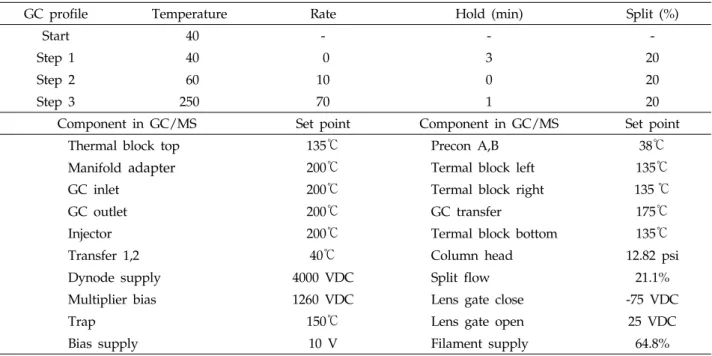
Table 1. Conditions of GC/MS for six chemical materials.
GC profile Temperature Rate Hold (min) Split (%)
Start 40 - - -
Step 1 40 0 3 20
Step 2 60 10 0 20
Step 3 250 70 1 20
Component in GC/MS Set point Component in GC/MS Set point
Thermal block top 135℃ Precon A,B 38℃
Manifold
adapter
200℃ Termal block left 135℃GC inlet 200℃ Termal block right 135°℃
GC outlet 200℃ GC transfer 175℃
Injector 200℃ Termal block bottom 135℃
Transfer 1,2 40℃ Column head 12.82 psi
Dynode supply 4000 VDC Split flow 21.1%
Multiplier bias 1260 VDC Lens gate close -75 VDC
Trap 150℃ Lens gate open 25 VDC
Bias supply 10 V Filament supply 64.8%
gas-phase FT-IR instrument (MIDAC Corporation, Westfield, USA) was recorded in MIDAC spectrometer in the range of 4500-800 cm
-1. Ion chromatography was accomplished by Thermo Scientific Dionex ICS-2100 (Sunnyvale, CA, USA) configured with a conventional analytical IC system. UV-Vis absorption was measured on a PerkinElmer UV WinLab spectrophotometer (PerkinElmer, Lambda, Germany).
Analysis conditions of four instruments
The six chemical materials were analyzed with a Griffin 460 GC/MS with coupled to a cylindrical ion trap, equipped with a 15 m × 0.18 mm × 0.18 μm DM-5MS capillary column. The flow rate of the helium (99.999%) carrier gas was 1.0 ml/min. The injector and detector temperature were 200℃. The column oven temperature was programmed at 40℃
for 3 min, and then increased to 60℃ at 10℃/min and then increased to 250℃ at 70℃/min and held for 1 min. The remaining GC and mass conditions are shown in Table 1.
The two chemical materials using gas-phase FT-IR was analyzed in the 4500-800 cm
-1range using a Hg source, Ge bolometer detector at 4.2 K and add windows. The gas atmosphere in the cell was nitrogen at a pressure of 15 psi at room temperature. The maximum temperature during the measurements was around 1200 K, reached at the end of the run. The spectrum was recorded at a resolution of 1 cm
-1using 120 scans and a 10 L/min gas sample was injected to
analyze using diaphragm pump. The separation of IC instrument was achieved using AS18 (250 × 4 mm) and CS12 (250 × 4 mm) to anion and cation materials with 25 μl sample injection volume. The flow rate was 1 ml/min and the column temperature was maintained at 30℃. The mobile phase was composed of 30 mM KOH (anion) and 20 mM MSA (cation) in water. The remaining conditions were programmed as follows : Detector cell heater 35℃, suppressor type SRS, Current 75 mA (anion) 59 mA (cation), CR-TC On. The absorbance of UV-VIS spectroscopy in each cell was measured at 640 nm.
Results and discussion
Vehicle manufacture
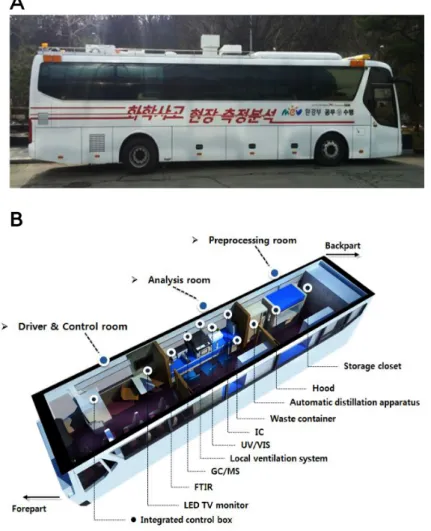
The mobile measurement vehicle for field assessments regarding chemical accidents was supported by the Ministry of Environment. This vehicle is designed to obtain information about environmental concentration and human health impact from the exposure of chemical substances in chemical accidents (Posthuma et al ., 2014). Thus, the National Institute of Chemical Safety has organized mobile measurement vehicle by Shin Kwang Technology. As seen for Fig.
1, mobile vehicle was composed of three rooms such as drive & control site, analysis site, and preprocessing site.
Among them, analysis site comprised of four
instruments including GC/MS, FT-IR, IC, and UV-Vis
Fig. 1. (A) Appearance of the mobile measurement vehicle. (B) The internal structure of the mobile measurement vehicle.
spectroscopy. In the present study, we evaluated 20 accident preparedness substances having high probability of chemical accidents using analysis equipment. Moreover, this work reported for the first time that development of mobile measurement vehicle regarding chemical accidents from the Ministry of Environment in Korea.
Preparation of calibration curve
To analysis of six chemical materials using GC/MS, calibration curves were prepared by trap time (0.05, 0.2, and 0.5 min) control with three concentrations (17.5, 70, and 175 μg) (Yun and Minyan, 2014). The gas-phase FT-IR was performed with qualitative analysis using two chemicals (Harrison and Clark, 1992). For ion chromatography analysis, the standard stock solutions were prepared using Multi-component Anion Mix 4* and Cation Mix 2* Ion Chromatography standard solutions (each 100 ppm). Calibration curves of anion materials were
made by diluting the stock solution with water to five concentrations (1, 5, 10, 15, and 20 μg/mL) (Siriraks and Stillian, 1993). Cation materials were constructed using diluting the stock solution with water to four different concentrations including 1, 3, 5, and 7 μ g/mL, respectively (Siriraks and Stillian, 1993).
Calibration curve using UV-VIS spectroscopy was made by four concentrations (0.2, 0.4, 0.8, and 1.6 μ g/mL) (Mérian et al ., 2010).
Applicability of analysis instrument
The GC/MS analysis provided to be reliable for
rapid separation and identification of volatile organic
compounds one of the harmful chemicals (Dumont
and Delmas, 2003; Kim et al ., 2013). Thus, to
investigate the applicability for chemical materials of
GC/MS, we examined six different chemicals, including
benzene, toluene, ethylbenzene, tert -butyl methyl ether,
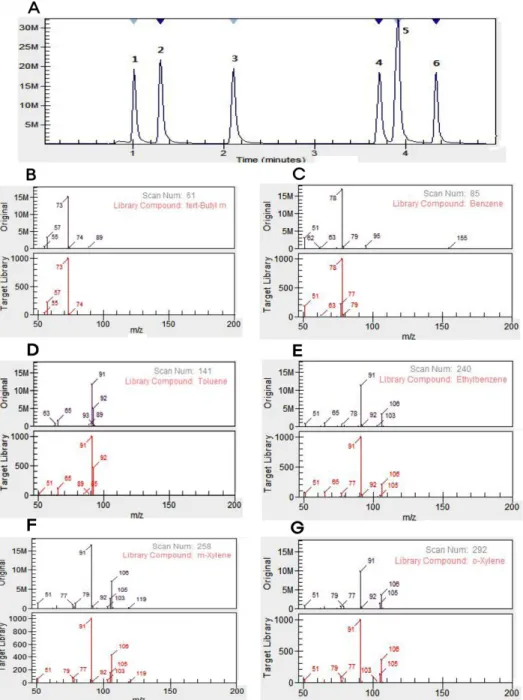
m,p -xylene and o -xylene. As presented in Fig. 2A, six
peaks were separated within 5 min by GC/MS
Fig. 2. (A) Representative GC/MS chromatogram of six chemical materials. (B-G) Mass fragmentation patterns of six chemical materials, (B)
tert
-butyl methyl ether, (C) benzene, (D) toluene, (E) ethylbenzene, (F)m,p
-xylene, (G)o
-xylene.analysis and their retention times were as follows : peak 1, t
R= 1.0 min; peak 2, t
R= 1.3 min; peak 3, t
R= 2.1 min; peak 4, t
R= 3.7 min; peak 5, t
R= 3.9 min;
peak 6, t
R= 4.3 min.
Peak 1 was detected three ion peaks at m/z 55, m/z 57, and m/z 73. The major fragmentation showed at m/z 73 and the minor ions were observed at m/z 55 and m/z 57 (Fig. 2B). On the basis of the described fragmentation patterns and mass spectral library, peak 1 was identified as tert -butyl methyl ether.
However, this peak was not detected exactly
molecular weight [M]
+in analysis values of the full mass scan chromatogram and chemical library values.
This phenomenon suggests that the structural
characteristic of tert -butyl methyl ether may be
responsible for the ion fragmentation patterns of
GC/MS analysis. The MS spectrum of peak 2
presented the fragment ions at m/z 78, m/z 51. As
can be seen in Fig. 2C, one major ion peak ( m/z 78)
and one minor ion peak ( m/z 51) showed in the
chromatogram. Based on the mass spectral chemical
library, the structure of peak 2 was tentatively
Fig. 3. FT-IR spectrums concern to NH3 and CO chemical materials. (A) FT-IR spectrum of NH3, (B) The magnified spectrum of NH3 (1200-800 cm-1), (C) FT-IR spectrum of CO, (D) The magnified spectrum of CO (2220-2060 cm-1).
determined as benzene. The GC/MS profile of peak 3 exhibited an identical molecular ion at m/z 92 with three fragmentation ions at m/z 91, m/z 65, and m/z 63 (Fig. 2D). Peak 3 was confirmed be toluene by comparing the mass spectral library. Subsequently, the major fragmentation ions of full mass scan analysis of peaks 4-6 were detected at m/z 106 (Fig.
2E), m/z 106 (Fig. 2F), and m/z 106 (Fig. 2G), respectively. According to the various fragmentation ions and mass spectral library, peaks 4-6 were assigned as ethylbenzene, m,p -xylene and o -xylene.
For calibration curves, the trap time was operated with 0.05, 0.2, and 0.5 min to obtain at three
concentration sequences (17.5, 70, and 175 μg).
Furthermore, the correlation coefficient ( r
2) of each curve was higher than 0.991. In other words, their values showed 0.998 ( tert -butyl methyl ether), 0.994 (benzene), 0.993 (toluene), 0.992 (ethylbenzene), 0.991 ( m,p -xylene), and 0.996 ( o -xylene), respectively.
In general, it is well established that gas-phase
FT-IR technique has been unprecedented attention
due to the analyses of hazardous air pollutants,
greenhouse gases, and ozone-destroying chemicals
(Sharpe et al ., 2004). Therefore, for determining of
applicability concern to the analysis of gas-phase
FT-IR, we investigated peak ranges using the exactly
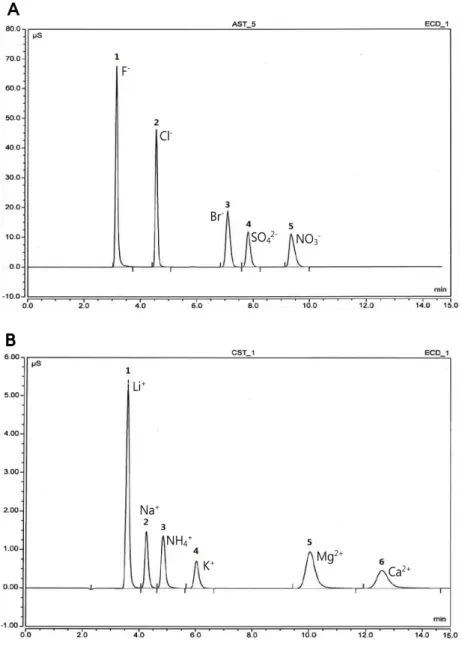
Fig. 4. IC chromatograms of anion and cation materials. (A) IC chromatogram of five anion materials, (B) IC chromatogram of six cation materials.