Ⅰ. 서 론
방사선 진단이 사용되는 구강 검진은 국민의 건강증진과 삶의 질 향상에 있어 필요하며1,2), 국민건강보험 공단에 의한 구강 검진 대상자는 18,269,720명으로3), 건강보험 미적용 대상
까지 포함하면 더 많을 것으로 추정된다. 구강 보건을 위한 질병의 진단, 치료의 목적으로 방사선이 사용되고 있으며4), 식품의약품안전처에 의한 치과 방사선촬영 (Cone beam CT, 입 속 촬영, 파노라마, 세팔로) 건수는 24,321,030건으로, 최근 임플란트 치과학에서 Cone beam CT사용 증가로 인해 방사선촬
Journal of Radiological Science and Technology, 38(4), 411-420 eISSN 2384-1168 ISSN 2288-3509 http://dx.doi.org/10.17946/JRST.2015.38.4.11
<원저>
치위생(학)과 학생의 방사선안전관리에 대한 지식, 태도 및 행위
*- The Knowledge, Attitude and Behavior on the Radiation Safety Management for Dental Hygiene Major Students -
대구가톨릭대학교 방사선학과・1)한국원자력안전아카데미・2)수성대학교 방사선과
3)대구보건대학교 방사선안전관리위원회
전여령・조평곤・한은옥
1)
・장현철2)
・고종경3)
・김용민― 국문초록 ―
목적: 국내 치위생학을 전공하는 학생들의 방사선 안전행위 수준 확인을 위해 방사선 안전관리 지식, 태도, 행 위 수준을 분석하여 교육학적 근거를 도출하고자 하였다.
대상 및 방법: 한국대학교육협의회 대학정보공시센터(대학알리미)에 등록된 전국 83개교 치위생(학)과에 재학중 인 3,4학년을 대상으로 하였으며 연구도구는 설문지이다. 설문조사는 대학별 각 20부(총 1,660부)를 방문, 우편, e-mail의 방법으로 배포하여 수거된 응답지 중 신뢰도를 확보하고 있는 총 723부를 SPSS/WIN 15.0를 사용하여 빈 도, 백분율, 평균과 표준편차, Pearson’s correlation으로 분석하였다.
결과: 방사선 안전관리에 대한 치위생(학)과의 지식, 태도, 행위는 모두 상관관계가 있는 것으로 나타났다. 즉, 방사선 안전관리에 대한 행위수준을 높이기 위해서는 지식, 태도 수준을 높일 수 있는 교육이 적용되어야 한다. 또한 개인의 행위에 가장 상관성이 높은 변수는 물리적 환경에 대한 변수로, 이는 물리적 환경이 갖추어져 있지 않으면 방사선 안전행위 수준을 높이는데 한계가 있음을 의미한다. 따라서 치위생(학)과의 방사선 안전행위 수준을 높이기 위해 물리적 환경을 보완해야 하며 개인의 방사선 안전관리 태도 수준 또한 물리적 환경에 대한 태도 변수와 가장 상관성이 높으므로 방사선 안전관리에 대한 개인의 태도 수준을 높이기 위해 물리적 환경에 대한 변수를 보완해야 한다.
결론: 방사선 안전관리에 대한 태도보다 지식이 상대적으로 낮고, 행위 수준이 가장 낮으므로 안전 행위에 대한 강화된 교육정책이 도입되어야 할 것이며 국내의 경우 치위생(학)과를 졸업한 치위생사들이 치과병원에서 전국민 의 구강 방사선 촬영 시 방사선 피폭을 감소시킬 수 있는 주체이므로 현재의 교육 시스템에서 방사선 안전관리 행 위 수준을 향상시킬 교육적 개입이 필요하다.
중심 단어 : 방사선 안전관리, 치위생, 지식, 태도, 행위
* 본 연구는 원자력안전위원회와 한국방사선안전재단의 지원을 받아 수행한 원자력안전연구사업의 연구결과입니다(No.1403014).
교신저자: 김용민 (38430) 경북 경산시 하양읍 하양로 13-13
대구가톨릭대학교 방사선학과 Tel: 053-850-2522 / E-mail: [email protected] 접수일(2015년 10월 19일), 심사일(2015년 11월 10일), 확정일(2015년 12월 10일)
영 건수는 지속적으로 증가할 것이다5,6). 각 검사항목별 방사선 피폭량은 Cone Beam CT의 경우 약 0.078 mSv, 구내 촬영의 경우 약 0.005 mSv, 파노라마의 경우 약 0.019 mSv, 세팔로의 경우 0.004 mSv 정도이다5). 구강 검진 빈도의 증가가 방사선 검사의 빈도도 함께 증가시키고 이에 따라 방사선 피폭량도 함께 증가하고 있는 실정이므로 전 국민의 건강 증진 일환으로 구강 방사선 촬영에 대한 방사선 안전관리가 필요하다.
국내의 경우 대형병원, 치과전문 병원 일부를 제외하고 대부 분의 개인 치과의원에서는 치과위생사가 구강 방사선촬영 업무 를 하는 것이 현실이며7), 환자 및 보호자의 방사선 안전관리가 치과위생사에 의해 수행되는 실정이다. 대한치과의사협회에 따르면 매년 약 4,000명 이상 치위생(학)과 졸업생을 배출하여
8),9) 이들이 치과에서 방사선촬영 업무를 수행하는 경우가 많다.
현재 국내 치위생(학)과의 경우 방사선 관련 전공자가 아닌 단시간 방사선 안전교육을 받은 치과위생 전공 교수가 방사선 촬영 실습교육을 수행하고 있다. 또한 치위생(학)과의 교과과 정 중 방사선원을 사용하고 안전관리에 대한 내용이 포함된 교과목은 한두 과목 정도인데10-12), 대부분은 구강 악안면 방사 선 촬영방법에 대한 내용이다12). 또한 보건계열학과에서 설치 및 운용중인 방사선원 사용의 경우 원자력 안전법에 의해 규제 대상이 되고 있으나 방사선 안전관리자가 안전관리규정, 안전 보고서에 제시된 사항대로 안전관리가 행해지고 있으며, 사용 방사선원의 특성과 행위대상자를 고려한 표준화된 안전,정도 관리 지침은 부재한 실정이다. 이와 같은 상황에서 치위생(학) 과의 방사선안전관리에 대한 지식, 태도, 및 행위수준은 구강보 건 향상의 이면에 방사선피폭으로 인한 건강증진 문제에 직접 관계될 것이며 예비 치위생사가 될 졸업학년인 치위생(학)과 학생의 방사선안전관리에 대한 지식, 태도 및 행위수준의 점검 은 국민건강증진 측면과 선원을 취급할 잠재적 역량을 생각했을 때 매우 중요할 것이다.
따라서 본 연구에서는 국내 치위생학 전공학생 중 졸업학년 을 대상으로 구강 방사선촬영과 관계된 방사선안전관리의 지 식, 태도, 및 행위 수준을 파악하여 이를 보완할 수 있는 교육학 적 근거를 도출하고자 하였다.
Ⅱ. 연구방법
1. 연구대상 및 자료수집
연구대상은 한국대학교육협의회 대학정보공시센터13)에 등록된 전국 83개교 치위생(학)과에 재학중인 3,4학년이다.
설문조사는 대학별 각 20부(총 1,660부)의 설문지를 방문, 우편, e-mail의 방법으로 수행하였다. 수거된 응답지 중 신 뢰도를 확보하고 있는 총 723부를 분석하였다. 분석대상은 여학생 97.9%(708명), 남학생 2.1%(15명)이고, 3년제 69.8%(505명), 4년제(대학원 포함) 30.2%(218곳)이다. 방 사선안전관리 교육형태는 학교교육 69.9%(539명), 자체교 육 24.3%(187명), 법정교육 1.4%(11명), 심포지엄 0.3%(2 명), 기타 4.2%(32명) 순이다. 지역별로는 수도권 소재 대 학 29.7%(215명), 충청권 15.1%(109명), 영남권 39.6%(286 명), 호남권 15.6%113명(113명)이다.
2. 연구도구 및 내용
연구도구는 설문지를 이용하였으며, 방사선안전관리에 대한 지식(27문항), 태도(27문항), 행위(27문항)를 포함하 였고, 인간행위에 영향을 미치는 주요변수인 자기효능감(4 문항), 방사선안전관리 행위기대(4문항)를 포함하였다. 지 식, 태도, 행위의 측정항목은 안전사고 예방 대책을 수립하 는 전략으로 유용하게 사용되어 온 Haddon matrix14)-17)에 의한 개인요인(10문항), 위험물(방사선 발생장치)요인(5문 항), 환경 요인(물리적;10문항, 조직적; 4문항)을 총 3회의 전문가 자문과 선행 연구(Han, 2013)에 따라 구성하였다.
설문도구의 크론바 α는 방사선원관련 지식 0.908, 개인행 위관련 지식 0.864, 조직적 환경관련 지식 0.890, 물리적 환경 관련 지식 0.849, 방사선원관련 태도 0.953, 인간태도 0.950, 조직적 환경관련 태도 0.954, 물리적 환경 관련 태 도 0.957, 방사선원관련 행위 0.920, 인간행위 0.892, 조직 적 환경관련 행위 0.889, 물리적 환경 관련 행위 0.886, 자 기효능감 0.894, 기대 0.629로 비교적 높게 나타났다. 분석 방법은 SPSS/WIN 15.0를 사용하여 빈도와 백분율, 평균과 표준편차, Pearson’s correlation으로 분석하였다.
Ⅲ. 연구결과
1. 방사선 안전관리 지식수준
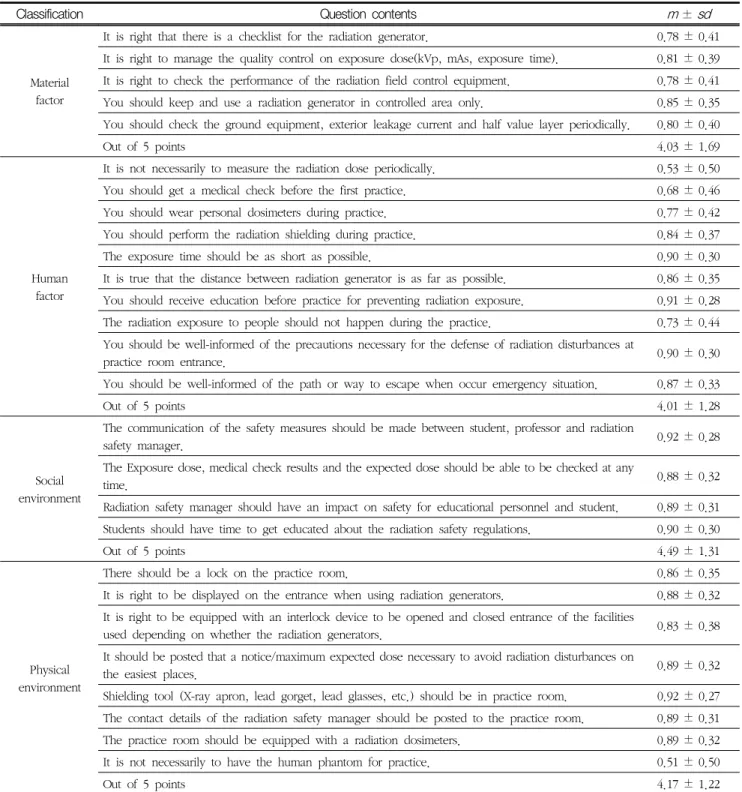
<Table 1>에서 보여지는 것과 같이 방사선 안전관리에 대한 지식수준은 5점 만점을 기준으로 평균 4.18±1.38점이 다. 본 연구에서의 태도(4.25 ± 0.63점)보다 낮고 행위 (3.28 ± 0.84점)보다는 높다. 그 중 개인요인과 관련된 것 은 4.01 ± 1.28점, 위험물 요인 4.03 ± 1.69점, 조직적 환 경 4.49 ± 1.31점, 물리적 환경 4.16 ± 1.22점으로 개인 요
인이 낮다. 방사선 촬영 실습 시 인체를 대상으로 방사선 촬 영이 이루어지는 것은 원자력 안전법에서 규정하는 방사선 안전관리 등의 기술기준에 관한 규칙 제50조 1항에서 의료 피폭의 관리 대상에 포함되지 않으므로 인체 팬텀을 사용해
야 한다. 그러나, 실제 인체팬텀을 구비해야 한다는 사실 (0.51 ± 0.50점)에서 가장 낮은 지식 수준을 보였고, 방사 선량을 주기적으로 측정해야 한다(0.53 ± 0.50점)는 사실 에 대한 지식 수준도 낮게 나타났다.
Classification Question contents m ± sd
Material factor
It is right that there is a checklist for the radiation generator. 0.78 ± 0.41 It is right to manage the quality control on exposure dose(kVp, mAs, exposure time). 0.81 ± 0.39 It is right to check the performance of the radiation field control equipment. 0.78 ± 0.41 You should keep and use a radiation generator in controlled area only. 0.85 ± 0.35 You should check the ground equipment, exterior leakage current and half value layer periodically. 0.80 ± 0.40
Out of 5 p oints 4.03 ± 1.69
Human factor
It is not necessarily to measure the radiation dose periodically. 0.53 ± 0.50 You should get a medical check before the first practice. 0.68 ± 0.46
You should wear personal dosimeters during practice. 0.77 ± 0.42
You should perform the radiation shielding during practice. 0.84 ± 0.37
The exposure time should be as short as possible. 0.90 ± 0.30
It is true that the distance between radiation generator is as far as possible. 0.86 ± 0.35 You should receive education before practice for preventing radiation exposure. 0.91 ± 0.28 The radiation exposure to people should not happen during the practice. 0.73 ± 0.44 You should be well-informed of the precautions necessary for the defense of radiation disturbances at
practice room entrance. 0.90 ± 0.30
You should be well-informed of the path or way to escape when occur emergency situation. 0.87 ± 0.33
Out of 5 p oints 4.01 ± 1.28
Social environment
The communication of the safety measures should be made between student, professor and radiation
safety manager. 0.92 ± 0.28
The Exposure dose, medical check results and the expected dose should be able to be checked at any
time. 0.88 ± 0.32
Radiation safety manager should have an impact on safety for educational personnel and student. 0.89 ± 0.31 Students should have time to get educated about the radiation safety regulations. 0.90 ± 0.30
Out of 5 p oints 4.49 ± 1.31
Physical environment
There should be a lock on the practice room. 0.86 ± 0.35
It is right to be displayed on the entrance when using radiation generators. 0.88 ± 0.32 It is right to be equipped with an interlock device to be opened and closed entrance of the facilities
used depending on whether the radiation generators. 0.83 ± 0.38
It should be posted that a notice/maximum expected dose necessary to avoid radiation disturbances on
the easiest places. 0.89 ± 0.32
Shielding tool (X-ray apron, lead gorget, lead glasses, etc.) should be in practice room. 0.92 ± 0.27 The contact details of the radiation safety manager should be posted to the practice room. 0.89 ± 0.31 The practice room should be equipped with a radiation dosimeters. 0.89 ± 0.32 It is not necessarily to have the human phantom for practice. 0.51 ± 0.50
Out of 5 p oints 4.17 ± 1.22
* In the knowledge questionnair, the correct answer for each question was scored 1, the wrong answer or the answer what they do not know was scored 0.
* The average score was 22.35±6.23 points (out of 27 points) in a total of 27 questions.
Table 1 Knowledge on the radiation safety management
2. 방사선 안전관리 태도수준
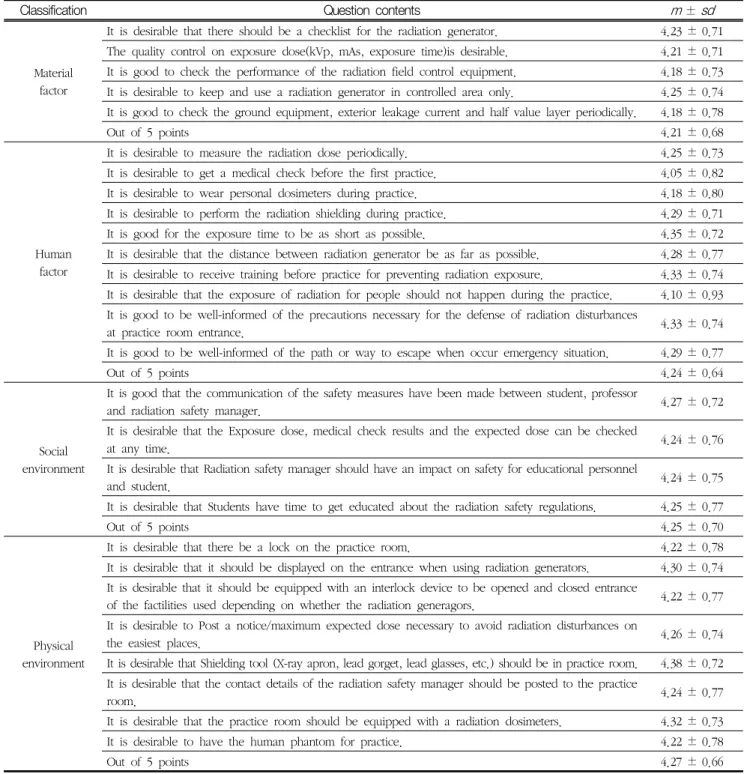
<Table 2>에서 보여지는 것과 같이 방사선 안전관리에 대한 태도수준은 5점 만점을 기준으로 평균 4.25±0.63점이다. 개인 요인과 관련된 것이 4.24 ± 0.64, 위험물 요인 4.21±0.68,
조직적 환경 4.25 ± 0.70, 물리적 환경 4.27 ± 0.66으로 모든 영역이 유사한 수준을 나타냈다. 방사선 촬영 실습시 인체를 대상으로 방사선이 노출되지 않아야 하지만, 이에 대한 태도 수준이 매우 낮다(4.10 ± 0.93). 이는 국민건강증진 측면 에서 실습 시 인체 피폭이 가능하다고 생각하는 것은 안전불감
Classification Question contents m ± sd
Material factor
It is desirable that there should be a checklist for the radiation generator. 4.23 ± 0.71 The quality control on exposure dose(kVp, mAs, exposure time)is desirable. 4.21 ± 0.71 It is good to check the performance of the radiation field control equipment. 4.18 ± 0.73 It is desirable to keep and use a radiation generator in controlled area only. 4.25 ± 0.74 It is good to check the ground equipment, exterior leakage current and half value layer periodically. 4.18 ± 0.78
Out of 5 p oints 4.21 ± 0.68
Human factor
It is desirable to measure the radiation dose periodically. 4.25 ± 0.73 It is desirable to get a medical check before the first practice. 4.05 ± 0.82 It is desirable to wear personal dosimeters during practice. 4.18 ± 0.80 It is desirable to perform the radiation shielding during practice. 4.29 ± 0.71 It is good for the exposure time to be as short as possible. 4.35 ± 0.72 It is desirable that the distance between radiation generator be as far as possible. 4.28 ± 0.77 It is desirable to receive training before practice for preventing radiation exposure. 4.33 ± 0.74 It is desirable that the exp osure of radiation for p eop le should not hap p en during the p ractice. 4.10 ± 0.93 It is good to be well-informed of the precautions necessary for the defense of radiation disturbances
at practice room entrance. 4.33 ± 0.74
It is good to be well-informed of the path or way to escape when occur emergency situation. 4.29 ± 0.77
Out of 5 p oints 4.24 ± 0.64
Social environment
It is good that the communication of the safety measures have been made between student, professor
and radiation safety manager. 4.27 ± 0.72
It is desirable that the Exposure dose, medical check results and the expected dose can be checked
at any time. 4.24 ± 0.76
It is desirable that Radiation safety manager should have an impact on safety for educational personnel
and student. 4.24 ± 0.75
It is desirable that Students have time to get educated about the radiation safety regulations. 4.25 ± 0.77
Out of 5 p oints 4.25 ± 0.70
Physical environment
It is desirable that there be a lock on the practice room. 4.22 ± 0.78 It is desirable that it should be displayed on the entrance when using radiation generators. 4.30 ± 0.74 It is desirable that it should be equip p ed with an interlock device to be op ened and closed entrance
of the factilities used depending on whether the radiation generagors. 4.22 ± 0.77 It is desirable to Post a notice/maximum expected dose necessary to avoid radiation disturbances on
the easiest places. 4.26 ± 0.74
It is desirable that Shielding tool (X-ray apron, lead gorget, lead glasses, etc.) should be in practice room. 4.38 ± 0.72 It is desirable that the contact details of the radiation safety manager should be posted to the practice
room. 4.24 ± 0.77
It is desirable that the practice room should be equipped with a radiation dosimeters. 4.32 ± 0.73
It is desirable to have the human phantom for practice. 4.22 ± 0.78
Out of 5 p oints 4.27 ± 0.66
* In the attitude part, the minimum score is 1 point and the maximum score is 5 points.
A higher score means the higher attitude level of radiation safety management.
* The average score was 4.25±0.63 points (out of 5 points) in a total of 27 questions.
Table 2 Attitude on the radiation safety management
증의 한 실태이다. 따라서 인체 피폭은 의료진단, 치료목적 이 외에는 불가능 하다는 것을 인지시켜야 한다.
3. 방사선 안전관리 행위수준
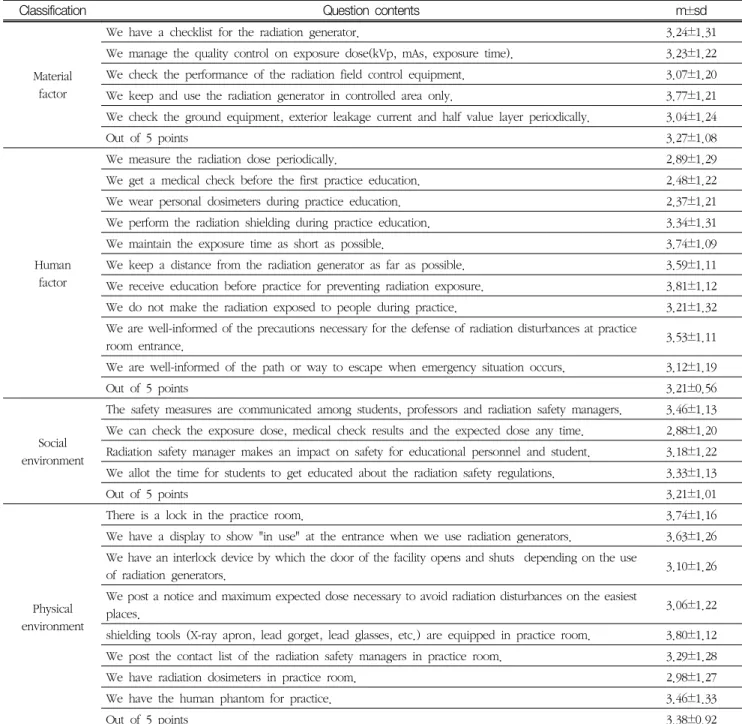
<Table 3>에서 보여지는 것과 같이 방사선 안전관리에 대한 행위 수준은 5점 만점을 기준으로 평균 3.28±0.84점
으로 또, 본 연구에서의 지식(4.18 ± 1.38점), 태도(4.25 ± 0.63점)에 비교했을 때 매우 낮은 수준이다. 국민건강증진 의 일환으로 치위생(학)과 학생의 방사선 안전관리 행위는 중요하다. 그러나 학교 교육에서부터 행위수준이 낮다는 것 은 치위생(학)과 학생들이 졸업하여 치과위생사로 의료기관 에 근무를 하게 될 경우, 환자와 환자보호자의 방사선 피폭 으로부터 국민건강증진을 담보할 수 없다고 사료된다. 실습
Classification Question contents m±sd
Material factor
We have a checklist for the radiation generator. 3.24±1.31
We manage the quality control on exposure dose(kVp, mAs, exposure time). 3.23±1.22 We check the performance of the radiation field control equipment. 3.07±1.20 We keep and use the radiation generator in controlled area only. 3.77±1.21 We check the ground equipment, exterior leakage current and half value layer periodically. 3.04±1.24
Out of 5 p oints 3.27±1.08
Human factor
We measure the radiation dose periodically. 2.89±1.29
We get a medical check before the first practice education. 2.48±1.22
We wear personal dosimeters during practice education. 2.37±1.21
We perform the radiation shielding during practice education. 3.34±1.31
We maintain the exposure time as short as possible. 3.74±1.09
We keep a distance from the radiation generator as far as possible. 3.59±1.11 We receive education before practice for preventing radiation exposure. 3.81±1.12 We do not make the radiation exposed to people during practice. 3.21±1.32 We are well-informed of the precautions necessary for the defense of radiation disturbances at practice
room entrance. 3.53±1.11
We are well-informed of the path or way to escape when emergency situation occurs. 3.12±1.19
Out of 5 p oints 3.21±0.56
Social environment
The safety measures are communicated among students, professors and radiation safety managers. 3.46±1.13 We can check the exposure dose, medical check results and the expected dose any time. 2.88±1.20 Radiation safety manager makes an impact on safety for educational personnel and student. 3.18±1.22 We allot the time for students to get educated about the radiation safety regulations. 3.33±1.13
Out of 5 p oints 3.21±1.01
Physical environment
There is a lock in the practice room. 3.74±1.16
We have a display to show "in use" at the entrance when we use radiation generators. 3.63±1.26 We have an interlock device by which the door of the facility opens and shuts depending on the use
of radiation generators. 3.10±1.26
We post a notice and maximum expected dose necessary to avoid radiation disturbances on the easiest
places. 3.06±1.22
shielding tools (X-ray apron, lead gorget, lead glasses, etc.) are equipped in practice room. 3.80±1.12 We post the contact list of the radiation safety managers in practice room. 3.29±1.28
We have radiation dosimeters in practice room. 2.98±1.27
We have the human phantom for practice. 3.46±1.33
Out of 5 p oints 3.38±0.92
* In the behavior p art, the minimum score is 1 p oint and the maximum score is 5 p oints.
A higher score means that the attitude is more positive.
* The average score was 3.28±0.84 points (out of 5 points) in a total of 27 questions.
Table 3 Behavior on the radiation safety management
시 개인선량계를 착용해야 한다(2.37 ± 1.21점)는 것과 건 강검진을 받아야 한다(2.48 ± 1.22점)는 것에 대해 행위수 준이 낮게 나타났다. 이는 원자력 안전법에서 규정하는 내 용이다. 하지만 교육기관에서 방사선 작업종사자로 관리 받 지 않는 학생들이 이러한 내용을 수행하는데 필요한 것들을 확보하기에 다소 어려움이 있을 것으로 사료된다. 따라서 이에 대한 보완이 필요할 것이다.
4. 방사선 안전관리에 대한 지식, 태도, 행위의 상관관계
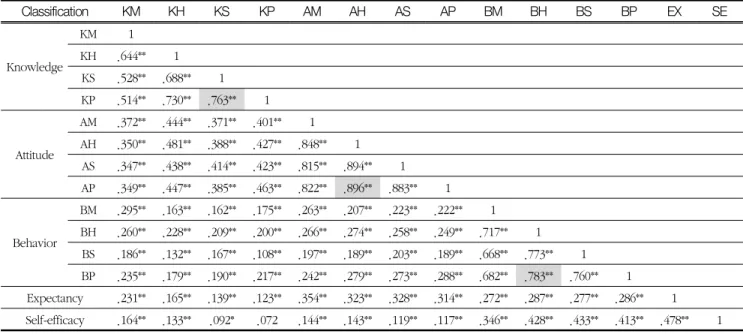
<Table 4>에 드러난 바와 같이 방사선 안전관리에 대한 치위생(학)과의 지식, 태도, 행위는 모두 상관관계가 있는 것으로 나타났다. 즉, 방사선 안전관리에 대한 행위수준을 높이기 위해서는 지식, 태도 수준을 높일 수 있는 교육이 적 용되어야 한다. 또한 개인의 행위에 가장 상관성이 높은 변 수는 물리적 환경(0.783)에 다한 변수이다. 이는 물리적 환 경이 갖추어져 있지 않으면 방사선 안전행위 수준을 높이는 데 한계가 있음을 의미한다. 따라서 치위생(학)과의 방사선 안전행위 수준을 높이기 위해 물리적 환경을 보완해야 할 것이다. 더불어 개인의 방사선 안전관리 태도 수준 또한 물 리적 환경에 대한 태도(0.896) 변수와 가장 상관성이 높다.
이에 방사선 안전관리에 대한 개인의 태도 수준을 높이기 위해 물리적 환경에 대한 변수를 보완해야 한다.
Ⅳ. 고 찰
우리나라에서는 방사선 전공자가 아닌 비전공자인 치위 생(학)과 교수들이 수업을 진행하고 있는 실태이며 방사선 안전관리에 대한 숙지가 미흡한 경우가 많다. 본 연구와 관 련하여 선행으로 이루어진 연구에서 “전공자와 비전공자 모 두 방사선이용 분야 중 의료분야의 필요성 인식수준이 가장 높았고, 비전공자는 정보가 부족한 상태에서 방사선 이용의 필요성을 선택한다.”18) 고 하였다. 또한 본 연구의 결과에서 선행연구에서 언급된 것과 같이 방사선 관리구역으로 분류 되는 실습실에서 개인선량계를 착용하지 않거나, 출입 전에 건강검진을 받아야 한다는 사실의 경우 지식수준이 다소 낮 은 수준을 보였다. 이는 우리나라 원자력 안전법 시행규칙 제 121조와 122조19)에서 방사선으로 인한 장해의 방지를 위 하여 앞서 언급한 사항에 대해 규정하고 있다는 사실에 대 한 정보 습득의 부족에서 온 것으로 보인다. 또한 구내 방사 선 촬영에 의한 위험도는 운전, 흡연, 음주 등 우리가 매일 생활하면서 닥칠 수 있는 여러 위험도에 비해 적기는 하지 만 많은 수의 사람들이 구내 방사선사진 촬영을 하고 있으 므로 치과의사나 관련 종사자인 치위생사는 환자의 이익에 관계 없는 불필요한 방사선 피폭을 최소화 할 의무와 책임 이 있으며 모든 방사선 검사는 환자에게 해를 줄 수 있으므 로 방사선 방어의 기본개념인 방사선 피폭을 수반하는 행위 에서 얻는 이득이 피폭의 위험보다 클 때 이루어져야 한다
Classification KM KH KS KP AM AH AS AP BM BH BS BP EX SE
Knowledge
KM 1
KH .644** 1
KS .528** .688** 1
KP .514** .730** .763** 1
Attitude
AM .372** .444** .371** .401** 1 AH .350** .481** .388** .427** .848** 1
AS .347** .438** .414** .423** .815** .894** 1 AP .349** .447** .385** .463** .822** .896** .883** 1
Behavior
BM .295** .163** .162** .175** .263** .207** .223** .222** 1 BH .260** .228** .209** .200** .266** .274** .258** .249** .717** 1
BS .186** .132** .167** .108** .197** .189** .203** .189** .668** .773** 1 BP .235** .179** .190** .217** .242** .279** .273** .288** .682** .783** .760** 1 Expectancy .231** .165** .139** .123** .354** .323** .328** .314** .272** .287** .277** .286** 1 Self-efficacy .164** .133** .092* .072 .144** .143** .119** .117** .346** .428** .433** .413** .478** 1
* KM=knowledge of matrial factor, KH=knowledge of human factor, KS=knowledge of social factor, KP=knowledge of physical factor, AM=attitude of matrial factor, AH=attitude of human factor, AS=attitude of social factor, AP=attitude of physical factor, BM=behavior of matrial factor, BH=behavior of human factor, BS=behavior of social factor, BP=behavior of physical factor, EX=expectancy, SE=self-efficacy.
Table 4 Correlation of knowledge, attitude and behavior related to radiation safety management for students major in dental hygiene
는 것을 잊지 않아야 할 것이라고 하였다20-22). 또 미량의 방 사선 피폭이라도 장기적인 노출에 의해 유전적 결함이나 암 등의 방사선 확률적 영향에 의한 질병이 발생할 수 있으므 로 국민의 건강증진 측면에서 의료분야에서의 방사선 피폭 관리가 매우 중요하고, 치과병원에서의 방사선 촬영 빈도가 많아지는 실태에 치위생(학)과 학생들에게 개인의 방사선 피폭 관리에 대한 인식을 심어주어야 할 것이라 하였다.23,24) 하지만 방사선 인체 피폭에 대한 안전불감과 이 때까지 사 고 없이 방사선 발생장치를 잘 사용해 왔다는 본인의 방사 선 안전행위를 과신하는 것과 관리를 받을 만큼의 피폭을 받지 않는다는 과소평가식 사고가 팽배하여 비전공자인 치 위생(학)과 학생들이 방사선 피폭에 대한 위화감 없이 실습 에 임하고 있는 것으로 사료되어25) 이에 대한 경각심을 일깨 우는 것이 필요할 것이다.
또, “방사선 안전교육 경험 유무와 관련한 안전관리 지식 수준에 대해 평가 했을 때 교육을 많이 받을 수록 지식수준 이 높을 것이라는 일반적인 결과와 달리 교육 경험이 없는 치과위생사의 방사선 안전관리 지식수준이 높게 나타났으 며 이는 학습자의 준비상태, 빠르게 변화하는 의료 현장 상 황에 대한 교육 내용의 비대응, 교육 동기유발 실패, 교육경 험 유무에 대한 조사대상의 심한 편중일 것으로 유추된 다.”26)고 하였다. 방사선 안전관리에 대한 지식 향상을 위한 교육 프로그램을 기획할 때 학습자가 비전공자 임을 고려하 여 방사선 안전행위를 의료 현장에서 효율적으로 행할 수 있는 현실적인 교육 내용을 구성하는 것이 필요할 것이다.
한편, 치과위생사의 직무 스트레스와 관련해서 안전행위 수준이 높을 수록 직무 스트레스는 감소하며 방사선 피폭 위험이 있는 직무 환경은 치과위생사에게 직무 스트레스의 한 원인으로 여겨질 수 있다는 선행 연구 결과가 있다27). 미 래에 치과위생사로 일하게 될 치위생(학)과 학생들의 건강 증진을 위해 현장에서 안전행위를 성실히 수행할 수 있도록 사전에 안전 행위 수준 향상을 위한 교육은 학생들의 미래 를 생각했을 때 반드시 필요할 것이다.
앞서 언급된 것을 토대로 전국의 치위생(학)과 학생들의 방사선 안전관리에 대한 교육학적 접근으로 지식, 행위, 태 도 행위 수준을 분석하여 장차 현장에서 진단용 방사선 발 생장치를 주도적으로 취급할 것이라는 잠재적인 역량을 가 진 학생들에게 방사선 발생장치를 사용하는 치위생(학)과 학생들의 건강증진과 관련하여 안전하고 올바른 방사선 안 전관리에 대한 안전문화를 전파시키는 것은 매우 중요할 것 이라 생각된다. 또한 사용 방사선원별로 피폭선량이나 사용 및 정도관리 방법에 있어 차이가 있을 것이고 안전관리 행 위 대상인 학생과 교수에 따라 실천 행위방법이 다를 것이
므로 이에 따라 치위생(학)과의 실정에 적합하게 적용할 수 있는 표준화된 안전관리 모델을 개발하여 사용할 수 있으면 좋을 것으로 사료된다. 이는 안전문화를 유연성 있게 전파 시킬 수 있을 것이며 이런 환경 속에서 교육된 학생들이 사 회인이 되었을 때 의료 방사선을 이용하는 전 국민적 차원 에서 방사선 이용의 최적화가 달성되는데 그 파급효과가 클 것이다.
Ⅴ. 결 론
본 연구에서는 치위생(학)과 3,4학년(최고학년)의 방사선 안전관리에 대한 지식, 태도 및 행위와 변수 간의 관련성을 분석하여 안전수준을 파악하였다. 방사선 안전관리에 대한 지식이 4.18 ± 1.38점, 태도가 4.25 ± 0.63점, 행위가 3.28 ± 0.84점으로 지식, 태도에 비해 상대적으로 낮다. 선 행 연구에서 “치과병원의 경우 치과위생사 자신에 대한 방 사선안전관리 행위 수준이 낮게 나타나 치과병원을 대상으 로 이에 대한 구체적인 원인을 분석하여 보완이 이루어져야 할 필요가 있다고 보며, 치과위생사 경력 및 방사선 촬영 경 력이 짧을 수록 행위수준이 낮으므로 임상에 투입되기 전부 터 방사선안전관리에 대한 의무교육을 받도록 정책화 할 필 요가 있다.”28)고 하였다. 즉, 방사선 안전관리에 대한 태도 보다 지식이 상대적으로 낮고, 행위 수준이 가장 낮으므로 안전 행위에 대한 강화된 교육정책이 도입되어야 할 것이 다. 본 연구의 결과에서처럼 방사선 안전관리 행위 수준을 높이기 위해 상관성이 높은 치위생(학)과의 물리적 방호 환 경을 충분히 갖출 수 있도록 정책 제안이 필요하다고 사료 된다. 또한 방사선 안전관리 태도 수준에도 행위 변수와 유 사하게 물리적 환경에 대한 변수가 가장 높은 상관성이 있 으므로 물리적 환경에 대한 보완이 필요할 것이다. 물리적 환경은 방사선원을 안전하게 사용하는데 있어 매우 중요하 다. 납으로 된 보호구를 착용하였을 경우 방사선 조사량의 97%를 차단할 수 있다는 연구 결과가 있다29). 하지만 실제 치과병원에서 방사선 촬영시 보호구를 착용하는 행위수준 은 낮은 실태이며27) 이는 치과에서 진료받는 환자들의 건강 증진 저해요인이 될 수 있기 때문에 교육단계에서부터 실습 시 방호구 착용에 대한 안전행위 수준을 높이는 것이 중요 할 것이다. 이 뿐만 아니라 본 연구에서 물리적 환경 행위수 준을 측정하기 위해 설문문항에서 제시한 실습실 시건(잠 금)장치 및 방사선 발생장치의 사용여부에 따른 출입구 개 폐 연동장치와 차폐도구, 방사선측정기 및 실습을 위한 인 체팬텀 구비, 방사선 장해방지에 필요한 주의사항 및 최대
예상 피폭선량 게시, 방사선 발생 중임을 표시하는 경광등 설치, 방사선 안전관리자의 연락처 게시와 같은 물리적 환 경을 갖추는 것은 방사선 안전행위 수준을 향상 시키는 데 필요할 것이다.
치위생(학)과 학생들은 방사선 발생장치를 취급하게 될 잠재적 역량이 크며 의료 현장에 나가기 전 적절한 안전행 위 교육을 받지 못한다면 국민들의 피폭에 문제를 초래할 수 있으므로 이를 예방하기 위한 적절한 프로그램 및 지침 등을 개발하여 방사선 안전행위 지식향상을 추구하는 것이 매우 중요하다. 선행연구에서 “방사선(학)과에 재학중인 학 생들에게 국제 방사선 방호 위원회에서 정한 계획된 방사선 피폭 상황에서의 일반인 한도인 1 mSv30)를 똑같이 적용한 다면 실용적인 실습교육이 이루어 질 수 없으며, 교육의 실 효성을 극대화 하기 위해 참가자들이 자원하여 환자역할을 하게 되는데 이 때 재학생들이 받는 방사선 피폭이 실습 및 교육과정에 따라 매우 큰 차이를 보인다.”31)고 하였다. 이는 치위생(학)과의 상황과 크게 다르지 않을 것이라 사료되며 따라서 최적화된 교과목 배치 및 실습운영 방법에 대한 연 구가 필요할 것이다. 또 다른 선행연구에 따르면 방사선 안 전관리 교육을 통해 치위생(학)과 학생들의 방사선 안전관 리 지식과 태도 수준이 향상되었고 따라서 교육의 효과가 있다고 하였다32). 학교 교육과정에 방사선 안전관리 교육을 포함시키는 것은 학생들의 방사선 안전관리에 대한 지식과 태도 수준을 향상시키는데 중요할 것이며 이는 방사선 안전 관리 행위 수준을 향상시킬 수 있는 방법이 될 것이다. 국내 의 경우 치위생(학)과 졸업생이 치과위생사로써 치과병원에 서 전국민의 구강 방사선 촬영 시 방사선 피폭을 저감화 할 수 있는 주체인 실태이므로 현재의 교육 시스템에서 방사선 안전관리 행위 수준을 향상시킬 교육적 개입이 필요하다.
참고문헌
1. MiRa Lee, GyeongSoon Han, SuJin Han, JunSeon Choi: Impact of Subjectively Reported Oral Health Status on the Quality of Life among Adults: Appying the RRECEDE Model. Korean Journal of Health Education and Promotion, 28(1), 23-35, 2011 2. HongSa Lee, Chunmi Kim: Effects of Oral Health
Impact Profile (OHIP) on Depression and Quality of Life among Community-dwelling Korean Elderly Persons. J Korean Acad Community Health Nurs, 23(3), 338-346, 2012
3. National Health Insurance Corporation: National Health Screening Statistics. 2013
4. Korean Association for Radiation Application.: 2012 Statics on the radiation practices in Korea. 2013 5. KwangPyo Kim, JunYoung Lee: Ministry of Food and
Drug safety Report. Radiation Exposure of Korean Population from Medical Diagnostic Examinations.
2013
6. EunJu Kang, KyungHee Lee, OnJu Ju: A study on the Environmental Condition and Safety in Dental Radiographic Room. Journal of Dental Hygiene Science, 5(2), 83-88, 2005
7. YoungSuk Choi, JinKyoung Kim, JongHwa Jang, YongDuk Park: A literature review on expansion of dental hygienists' radiography operations. J Korean Acad Dental Hygiene Education, 9(2), 1-14, 2009 8. Korean Dental association, Health Policy Institute.:
YearBook of Korean Dentistry. 2013 9. http://www.kuksiwon.or.kr/
10. YoungSik Cho: Comparison of Curriculums of Dental Hygiene Education Programs for B. S Degree.
Journal of Dental Hygiene Science, 5(4), 251-258, 2005
11. HyungSuk Lee: Analysis of dental hygiene curricu- lum of dental hygiene programs in Korea. J Korean Acad Dental Hygiene Education, 9(4), 808-823, 2009 12. SoonChul Choi: Education of Oral and Maxillofacial Radiology in South Korea. Imaging Science in Dentistry, 39(1), 1-5, 2009
13. http://www.academyinfo.go.kr/
14. Willian, H, Jr.: Advances in the Epidemiology of Injuries as a Basis for Public Policy. Public Health Reports, 95(5), 411-421, 1980
15. Runyan, C. W.: Using the Haddon matrix: introduc- ing the third dimension. Injury Prevention, 4(4), 302-307, 1998
16. David E. M., Hope R. H.: The Business of Medical Practice. 163-178, 2011
17. Conroy, C., Fowler J.: The Haddon matrix: applying an epidemiologic research tool as a framework for death investigation. American Journal of Forensic Medicine & Pathology, 21(4), 339-342, 2000 18. EunOk Han: Difference in Understanding of the
Need for Using Radiation in Various Fields between Students Majoring in Radiation and Non-Radiation Related Studies. Journal of radiation protection, 36(4), 230-236, 2011
19. http://www.law.go.kr/
20. SoonChul Choi: Risk Assessment During Oral Radiography. The journal of Korean Dental Association, 299(4), 265-270, 1994
21. AeJi Kim, BongHae Cho, KyungSoo Nah: Organ dose, Effective dose and Risk Assessment From Computed Tomography to Head and Neck Region.
Korean Jounal of Oral and Maxillofacial Radiology, 25(1), 27-38, 1995
22. SamSun Lee: Radiation protection in dental clinic.
Korean J Oral Maxillofac Radiol, 37(3), 117-126, 2007
23. HoYoung Ha: A study for Reduction of Radiation Dose in the Field of Diagnostic Radiology. - A Point of Tube Voltage and Filtration -. Journal of radio- logical science and technology, 15(1), 89-97, 1992 24. InSeog Kang, SungMin Ahn: Evaluation of Usability
and Radiation Dose Measurement Using Personal Radiation Exposure Dosimeter. Journal of the Korea contents association, 14(11), 864-870, 2014 25. JungAe Yoon, YoungSook Yoon: Comparing with
self-efficacy and knowledge, attitude about radia- tion safety management of dental hygienists and students at department of dental hygiene. Journal of Korean Society of Dental Hygiene, 11(5), 729-739, 2011
26. EunJu Kang, KyungHee Lee, YoungIm Kim: A study on Radiation Safety Management by Dental
Hygienist. Journal of Dental Hygiene Science, 5(3), 105~112, 2005
27. JongHwa Jang, SuLyun Hwang, HongRyang Jung:
The Relationship between Behavior of Radiographic Safety Control and Job Stress in Dental Hygienist.
Journal of Dental Hygiene Science, 10(4), 265-271, 2010
28. Sung-Hee Jun, EunOk Han: Analysis of the behav- ior on the radiation safety management for dental hygienists. J Korean Acad Dent Health, 32(3), 363-375, 2008
29. Niklason, N. T, Marx, M. V, Chan, H. P.:
Interventional radiologist: occupational radiation doses and risks. Radiology, 187(3), 729-733, 1993 30. ICRP Report 60: 1990 Recommendations of the
International Commission on Radiological Protection, 1991
31. JongWon Kil, JungHo Park, YongGwon Kim: Study on The Planning and Operation of Training Education in Radiologic Science for Reduced x-ray Exposure. Journal of Institute of Electronics and Information Engineers, 51(12), 174-179, 2014 32. SungAe Kim, JiYoung Lee, SeHyun Hwang, et al.:
Knowledge and attitude change towards radiation protection after radiation safety management edu- cation in dental hygiene students. Journal of Korean Society of Dental Hygiene, 15(1), 101-109, 2015
∙Abstract
The Knowledge, Attitude and Behavior on the Radiation Safety Management for Dental Hygiene Major Students
Yeo Ryeong Jeon・Pyong Kon Cho・Eun Ok Han1)・Hyon Chul Jang2)・ Jong Kyung Ko3)・Yong Min Kim
Department of Radiological Science, Daegu Catholic University
1)Korea Academy of Nuclear Safety
2)Department of Radiological Technology, Suseong College
3)Radiation Safety Management Commission, Daegu Health College
Objectives : This study tries to find the educational basis based on the radiation safety knowledge, atti- tudes and behaviors to check the level of radiation safety behavior in domestic students who study dental hygiene.
Methods : The students of 3rd and 4th grades in 83 universities which have registered on the Korean University Education Council were involved, and they were given a questionnaire for this study. The ques- tionnaire was provided via visit with 20 copies to each university (total 1660 copies), mail by post and e-mail. Among them, we analyzed only 723 copies that we can trust. The data were analyzed with fre- quency, percentage, mean, standard deviation and Pearson’s correlation using the SPSS/WIN 15.0.
Results : As a result, there are correlations in the students’ knowledge, attitudes and behaviors regarding the radiation safety management. It means that the education which can improve the knowledge and atti- tudes should be applied to increase the action level of the radiation safety. In addition, the physical envi- ronment is the most closely correlated with the individual behavior, so it will be limited to improve the behavioral levels of the radiation safety if the physical environment is not prepared. Therefore, the phys- ical environment should be supported to enhance the level of the radiation safety activity, and to increase the individual attitude level of radiation safety.
Conclusions : The knowledge level of the radiation safety management is relatively lower than the atti- tudes level, and the behavior level is the lowest. Therefore, the education policy of the safety behavior must be enhanced. For domestic students, the educational intervention is necessary to improve their be- havioral level of radiation safety management because they will be able to reduce the amount of radiation exposure of their patients in dental care after getting a job.
Key Words : Radiation Safety Management, Dental Hygiene, Knowledge, Attitude, Behavior