Original Article
Dosimetric Analysis on the Effect of Target Motion in the Delivery of Conventional IMRT, RapidArc and Tomotherapy
Ju-Young Song
Department of Radiation Oncology, Chonnam National University Medical School, Gwangju, Korea
Received 13 November 2017 Revised 11 December 2017 Accepted 11 December 2017
Corresponding author Ju-Young Song ([email protected]) Tel: 82-61-379-7225 Fax: 82-61-379-7249
One of the methods to consider the effect of respiratory motion of a tumor target in radiotherapy is to establish a treatment plan with the internal target volume (ITV) created based on an accurate analysis of the target motion displacement. When this method is applied to intensity modulated radiotherapy (IMRT), it is expected to yield a different treatment dose distribution under the motion condition according to the IMRT method. In this study, we prepared ITV-based IMRT plans with conventional IMRT using fixed gantry angle beams, RapidArc using volumetric modulated arc therapy, and tomotherapy using helical therapy. Then, the variation in dose distribution caused by the target motion was analyzed by the dose measurement in the actual motion condition. A delivery quality assurance plan was prepared for the established IMRT plan and the dose distribution in the actual motion condition was measured and analyzed using a two-dimensional diode detector placed on a moving phantom capable of simulating breathing movements. The dose measurement was performed considering only a uniform target shape and motion in the superior-inferior (SI) direction. In this condition, it was confirmed that the error of the dose distribution due to the target motion is minimum in tomotherapy. This is thought to be due to the characteristic of tomotherapy that treats the target sequentially by dividing it into several slices. When the target shape is uniform and the main target motion direction is SI, it is considered that tomotherapy for the ITV- based IMRT method has a characteristic which can reduce the dose difference compared with the plan dose under the target motion condition.
Keywords: Internal target volume (ITV), RapidArc, TomoTherapy, Tumor motion, MapCHECK2
Copyright © 2017 Korean Society of Medical Physics
CCThis is an Open-Access article distributed under the terms of the Creative Commons Attribution Non-Commercial License (http://creativecommons.org/licenses/by- nc/4.0) which permits unrestricted non-commercial use, distribution, and reproduction in any medium, provided the original work is properly cited.
Introduction
Many methods have been researched and developed to reduce the effect of respiratory motion of tumor targets during radiotherapy. These can be categorized into two main methods in the clinical practice. One is the gating and active breathing control (ABC) method, which allows irradiation only of a stable part of the tumor motion range.
1-4)The other is to construct a treatment field based
on the internal target volume (ITV) setting using four- dimensional computed tomography to accurately cover the whole area of the motion of the tumor target.
5,6)A gating method can theoretically be considered as the optimal method to minimize the side effects on the surrounding normal tissue, because it can reduce the size of the treatment field. However, it has a limitation that it requires regular and stable respiration of the treated patients and it cannot be applied to all treatment machines. Therefore, it
Progress in Medical Physics 28(4), December 2017 https://doi.org/10.14316/pmp.2017.28.4.164 pISSN 2508-4445, eISSN 2508-4453
is more commonly used to set the treatment field based on the accurate ITV setting that can be applied to all treatment devices.
In the case of ITV-based radiotherapy, the dose dis- tribution of the general 3-dimensional conformal radio- therapy (3D CRT) is considered to be the same as the calculated dose distribution in the treatment area.
However, when the dose distribution changes dynamically according to the motion of the multi-leaf collimator (MLC) as in the intensity-modulated radiotherapy (IMRT), the change in the actual dose distribution due to tumor movement is expected to be significant.
7-11)The purpose of this study was to analyze the dose variation in the ITV-based IMRT treatment due to the respiratory motion, compared with the calculated dose distribution in the plan according to the IMRT performance technique. The ITV for the virtual tumor target for the phantom was set and the organ at risk volume (OAR) was delineated around it; three different IMRT plans, a fixed-gantry IMRT, a volumetric modulated arc therapy (VMAT), and tomotherapy (Accuray, Sunnyvale, CA, USA) using helical therapy were prepared separately. Delivery quality assurance (DQA) plans were established for these treatment plans, and dose distributions were measured under actual motion conditions. The dose variations were compared and analyzed for each treatment method in order to evaluate the effect of a target motion on the IMRT dosimetric error.
Materials and Methods
1. IMRT plan preparation
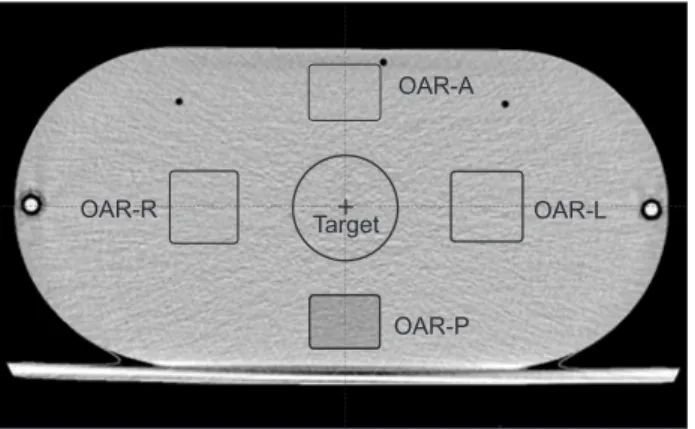
I'mRT Phantom (IBA, Schwarzenbruck, Germany) CT images were acquired and IMRT treatment plans were prepared by creating a virtual tumor target and peripheral OARs, as shown in Fig. 1.
The shapes of the tumors were cylindrical, with a diameter of 6 cm and lengths of 2, 4, and 6 cm. The su- rrounding major organs were placed on a square column of side length 4 cm with height equal to that of the tumor and placed 3 cm away from the tumor in the up-down direction and 2 cm in the left-right direction.
The tumor movement related to the ITV setting was considered only in the superior-inferior (SI) direction, owing to the limited direction of movement of the moving phantom, and the motion condition was applied to two motion ranges of 4 cm and 2 cm and two motion periods of 7 s and 4 s. Table 1 shows the five ITV setting conditions used in this study.
The IMRT treatment plan was based on the Novalis TX (Varian, PaloAlto, CA, USA) linear accelerator. A RapidArc (Varian, PaloAlto, CA, USA) plan with one arc and an IMRT plan consisting of seven fixed gantry angular beams (FB- IMRT) was established using the Eclipse (Varian, PaloAlto, CA, USA) treatment planning system (TPS). A tomotherapy plan was established in addition and a total of three
Table 1. The length of internal target volume (ITV) according to the motion range of clinical target volume (CTV) considered in this study.
CTV length Motion range
2 cm 4 cm
2 cm 4 cm 6 cm
4 cm 6 cm 8 cm
6 cm 8 cm
Table 2. Dose constraints in the optimization process of the IMRT planning.
ITV V4,750cGy> 98%
OAR_L Dmax <2,500 cGy, Dmean <1,200 cGy OAR_R Dmax <2,800 cGy, Dmean <1,000 cGy OAR_S Dmax<2,500 cGy
OAR_I Dmax <2,000 cGy OAR-A
OAR-R OAR-L
OAR-P Target
Fig. 1.Virtual tumor target and peripheral organs at risk for the preparation of IMRT plan.
separate IMRT treatment techniques were prepared. The total prescription dose was 5,000 cCy for the ITV in 25 fractions and was optimized according to the constraints in Table 2. All the plans were made to meet the constraint conditions.
2. Measurement of IMRT dose distribution under the motion condition
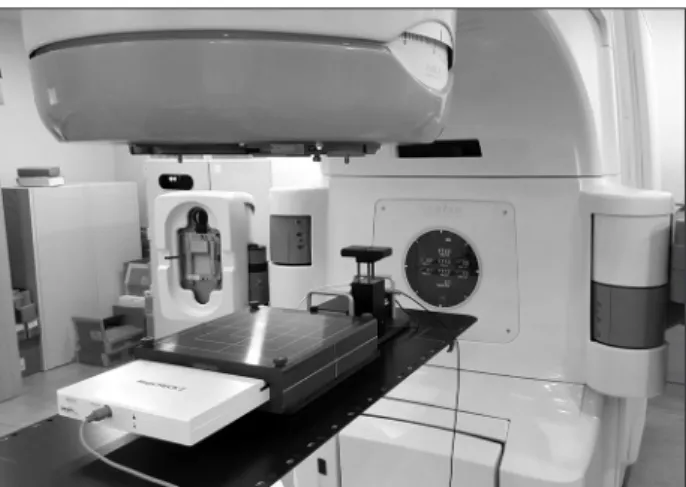
A DQA plan for each treatment plan was created and applied to the dose measurement in order to analyze the changes in dose distribution during beam irradiation of each of the three IMRT methods under the motion conditions. The DQA plan was based on a CT image of MapCHECK2 (SunNuclear, Melbourne, FL, USA), a 2D diode detector array, inserted into MapPHAN (Sun- Nuclear, Melbourne, FL, USA), a solid water phantom, and a Dynamic Platform Model 008PL (CIRS, Norfolk, VA, USA) moving phantom was used to simulate the motion conditions. Phantom setup images for the dose measurements using the NovalisTx and tomotherapy instruments are shown in Fig. 2 and Fig. 3.
The dose measurements were performed for various combinations of motion ranges, 2 cm and 4 cm, and mo- tion periods, 7 s and 4 s. The errors from the dose distri- bution in the original plan were compared and analyzed by gamma evaluation with a 3% dose difference and 3-mm distance-to-agreement criterion.
Results
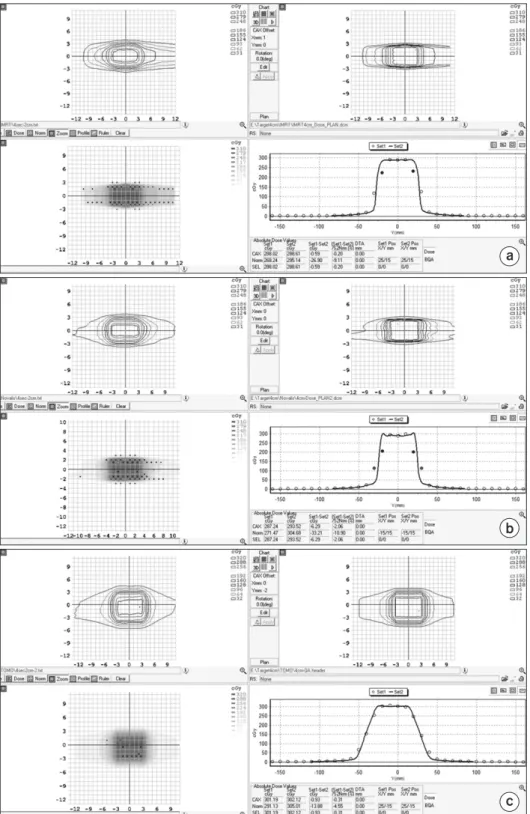
The dose distribution measured with MapCHECK2 under various motion conditions was slightly different for each treatment method, and Fig. 4 shows an example of these different results.
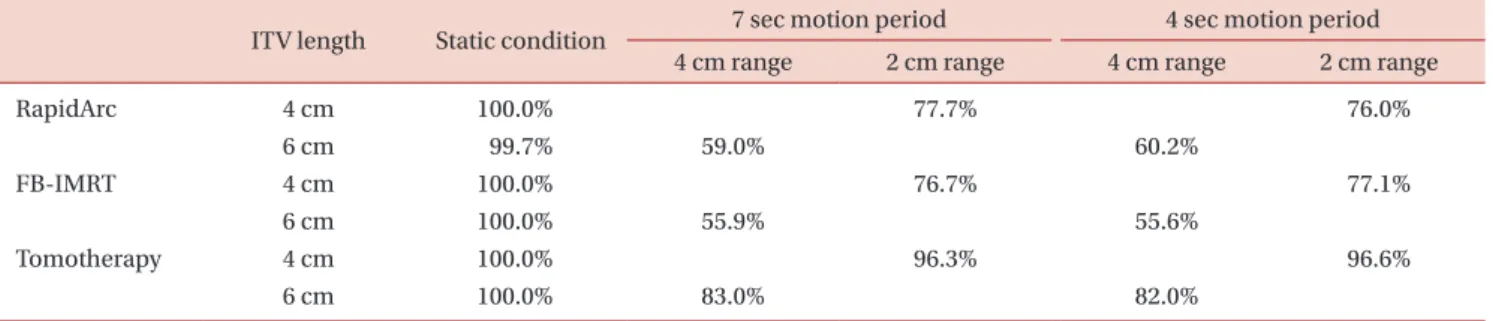
The calculated pass rates by the gamma evaluation for each clinical target volume (CTV) tumor size in the condition of motion are shown in Tables 3, 4, and 5.
As shown in the pass rates of the tables, the average difference in pass rate between the 4 s and 7 s period was 0.18±0.73% in the case of tomotherapy, 1.44±2.16% in the case of RapidArc, and
−0.52±0.97% in the case of FB-IMRT.
For RapidArc, the pass rate difference at 4 s was slightly higher than those for tomotherapy and FB-IMRT, but the mean of the overall difference was 0.29±1.73%, indicating that the change in motion period had little effect on dose accuracy.
The factors that have the greatest influence on the dose distribution in the motion condition are the magnitude of motion range, which can be confirmed in the table results. It was confirmed that the dose error was further increased with increasing motion range because the pass rate was lower at the 4-cm motion range than at the 2-cm motion range.
The degree to which the error increased with increasing motion range showed different tendencies according to the treatment method. In the case of tomotherapy, the mean pass rate was 83.08±0.78% at the 4-cm motion range and 95.80±0.72% at the 2-cm motion range. In the
Fig. 3. Phantom setup image for the dose measurement in the Tomotherapy.
Fig. 2. Phantom setup image for the dose measurement in the Novalis Tx.
case of RapidArc, the mean pass rate was 63.68±5.08%
at the 4-cm motion range and 81.43±3.81% at the 2-cm motion range. For FB-IMRT, the average pass rate was 61.38±6.49% for 4 cm motion range and 82.05±4.67% for 2 cm motion range. As shown by the above results, the
tendency of the dose error increase with the increase in the motion displacement from 2 cm to 4 cm was different according to the treatment technique. The mean decrease in pass rate was
−12.50±1.19% in the case of tomotherapy,
−
18.88±8.27% in the case of RapidArc, and
−21.95±8.96% in
a
b
c
Fig. 4. Example of the measured dose distribution and error analysis in the moving condition. (a) RapidArc, (b) FB-IMRT, (c) Tomotherapy.
the case of FB-IMRT. These results show that the dose error due to the increase in the motion range was relatively small in tomotherapy compared to those in RapidArc and FB-
IMRT.
The effect of target motion according to the CTV increase due to CTV length increase is shown in Fig. 5. In the case
Table 3. The calculated pass rates by the gamma evaluation for the CTV with 2 cm length in the condition of motion.ITV length Static condition 7 sec motion period 4 sec motion period 4 cm range 2 cm range 4 cm range 2 cm range
RapidArc 4 cm 100.0% 77.7% 76.0%
6 cm 99.7% 59.0% 60.2%
FB-IMRT 4 cm 100.0% 76.7% 77.1%
6 cm 100.0% 55.9% 55.6%
Tomotherapy 4 cm 100.0% 96.3% 96.6%
6 cm 100.0% 83.0% 82.0%
Table 4. The calculated pass rates by the gamma evaluation for the CTV with 4 cm length in the condition of motion.
ITV length Static condition 7 sec motion period 4 sec motion period 4 cm range 2 cm range 4 cm range 2 cm range
RapidArc 6 cm 99.7% 83.3% 82.4%
8 cm 99.5% 65.5% 70.0%
FB-IMRT 6 cm 100.0% 82.2% 81.9%
8 cm 100.0% 67.0% 67.0%
Tomotherapy 6 cm 100.0% 95.7% 95.9%
8 cm 100.0% 83.6% 83.7%
Table 5. The calculated pass rates by the gamma evaluation for the CTV with 6 cm length in the condition of motion.
ITV length Static condition 7 sec motion period 4 sec motion period
2 cm range 2 cm range
RapidArc 8 cm 99.5% 83.1% 86.1%
FB-IMRT 8 cm 100.0% 88.4% 86.0%
Tomotherapy 8 cm 100.0% 94.5% 95.8%
%
a b
CTV-2 cm length 100.0
90.0 80.0 70.0 60.0
Pass rate in 2 cm moving condition
50.0
RapidArc TomoTherapy 7F-IMRT
CTV-4 cm length CTV-6 cm length 76.9
96.5
76.9
82.9 95.8
82.1 84.6
95.7 87.2
59.6 83.5
55.8
67.8 83.7
67.0
%
CTV-2 cm length 100.0
90.0 80.0 70.0 60.0
Pass rate in 4 cm moving condition
50.0
RapidArc TomoTherapy 7F-IMRT
CTV-4 cm length 95.0
85.0 75.0 65.0 55.0
Fig. 5. Graphs showing the effect of target motion according to the CTV increase due to CTV length increase. (a) Pass rate in 2 cm moving condition. (b) Pass rate in 4 cm moving condition.