• 검색 결과가 없습니다.

First Principles Computational Study of Surface Reactions Toward Design Concepts of High Functional Electrocatalysts for Oxygen Reduction Reaction in a Fuel Cell System

N/A
N/A
Protected

Academic year: 2021

Share "First Principles Computational Study of Surface Reactions Toward Design Concepts of High Functional Electrocatalysts for Oxygen Reduction Reaction in a Fuel Cell System"

Copied!
9
0
0

로드 중.... (전체 텍스트 보기)

전체 글

(1)

한국표면공학회지 J. Korean Inst. Surf. Eng.

Vol. 50, No. 1, 2017.

https://doi.org/10.5695/JKISE.2017.50.1.1

<해설논문>

ISSN 1225-8024(Print) ISSN 2288-8403(Online)

First Principles Computational Study of Surface Reactions Toward Design Concepts of High Functional Electrocatalysts

for Oxygen Reduction Reaction in a Fuel Cell System

Jeemin Hwang, Seunghyo Noh, Joonhee Kang, Byungchan Han

*

Department of Chemical and Biomolecular Engineering, Yonsei University, Seoul 03722, Korea (Received February 9, 2017 ; revised February 27, 2017 ; accepted February 27, 2017)

Abstract

Design of novel materials in renewable energy systems plays a key role in powering transportation vehicles and portable electronics. This review introduces the research work of first principles-based computational design for the materials over the last decade to accomplish the goal with less financial and temporal cost beyond the conventional approach, especially, focusing on electrocatalyst toward a proton exchange membrane fuel cell (PEMFC). It is proposed that the new method combined with experimental validation, can provide fundamental descriptors and mechanical understanding for optimal efficiency control of a whole system.

Advancing these methods can even realize a computational platform of the materials genome, which can substantially reduce the time period from discovery to commercialization into markets of new materials.

Keywords : Renewable energy, First principles, Surface reactions, Materials genome, Electrocatalysts

1. Introduction

There is no doubt that fossil fuels have significantly contributed to realizing modern technologies through supplying powers for various systems. In spite of serious environmental issue, it still occupies more than 75% of all global energy sources consumed in used for commercialized applications [1-2]. It is, however, also true that the conventional energy framework will be shifted in near future due to the environmental degradation and concern with worries for exhausting the energy reservoir.

Over the last several decades there have been extensive efforts in research and development to establish renewable energy sources, such as earth- abundant biomass [3], hydrogen [4-5], solar power [6]

and so on. Various systems have been proposed to efficiently utilize the energies via electro- or chemical

reactions [7].

The high operational efficiency being free from the limitation by thermodynamic law for combustion engines, however, turns out much lower than what is expected. It originates largely from the inherent irreversible reactions. Especially, the activation barriers for oxygen reduction or evolution reaction (ORR or OER) is notoriously known as very high, and its reduction is the most challenging. It is due to missing of proper catalysts with highly stable, selective and active. The difficulty is at the oper - ational conditions, where, the catalysts are exposed to: strong acidic medium or high electro -chemical potential.

Thus, commercialized catalysts are mostly based on expensive noble elements, Pt and its alloys. These issues are the bottleneck that delays the replacement of conventional fossil fuels by the renewable energies, also the strong driving force for further concerted research work.

Using electrocatalysts toward ORR in proton exchange membrane (PEM) fuel cells this review introduces the frontiers of the first principles-based

* Corresponding Author: Byungchan Han

Department of Chemical and Biomolecular Engineering, Yonsei University

Tel: +82-2-2123-5759; Fax: +82-2-312-6401

E-mail: [email protected]

(2)

computational materials science [8], which can open new ways in developing high functional materials and discovering new design concept beyond the conventional wisdom. It firmly stands on the quantum mechanical laws to predict materials properties from the levels of electrons, atoms and molecules. If rigorously combined with statistical mechanics or electrochemical formalism, it is even utilized for multiscale materials properties spanning a wide range of reaction time scales and sizes of interest. This paper consists of several sections. First, it explain show to capture the underlying principles for key catalytic properties of electrochemical stability and catalytic activity. The next session describes how to identify optimal alloy catalysts beyond Pt and estimate its performance. Finally, it guides completely new design concepts for superior catalysts by controlling hybrid complex of material interfaces.

2. Computational Details and Model System

As an archetype of a catalyst model, we used Pt nanoparticles and its alloys with different sizes and morphologies, which are exposed to adsorptions of various chemical species: O, OH, H

2

O, etc. To calculate its catalytic properties, we extensively utilized the first principles density functional theory (DFT) [9] calculations. To describe interaction potential

between ion/electron cores and valence electrons, PAW [10] method were employed and the generalized- gradient approximation(GGA) [11] captured the exchange-correlational energy of electrons. These formalisms were implemented in VASP [12] the program we used in this paper. For a cluster, we used gamma point only to get total energy by DFT calculations and zero-point energy and entropic change were estimated in calculated internal energy to obtain the Gibbs free energy.

3. Results and Discussion

3.1 Prediction of ground state structures:

Grand canonical potential

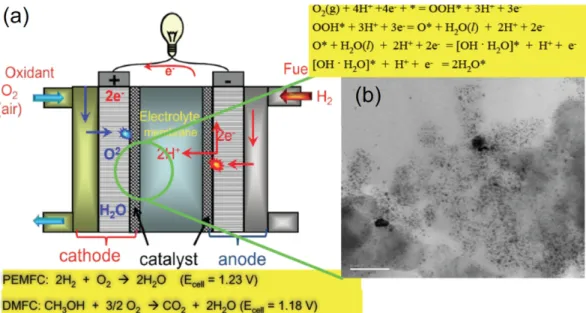
PEM fuel cells generate electric power through water formation with hydrogen and oxygen gas. As illustrated in Fig. 1, H

2

(g) and O

2

(g) are injected into gas diffusion channels to reach Pt catalyst of 2-3 nm sizes in anode and cathode, respectively. Then, H

2

(g) is oxidized to H

+

(aq) + e

-

and O

2

(g) is reduced into O

2-

at each of the electrodes. The H

+

(aq) diffuses to the cathode through a membrane (typically Nafion®) and form water by reacting with O

2-

ion. The spontaneous electrochemical reaction involves four electrons which are utilized for electric work with a potential of 1.23 V at room temperature. If liquid methanol is used as a fuel in anode (direct methanol fuel cell, DMFC), a slightly smaller electric potential of 1.18 V is created due to dissipation of energy for

Fig. 1. A PEM fuel cell system. (a) Pt catalyst oxidizes H

2

(g) into a proton at anode and reduces O

2

(g) into O

2-

in

cathode. The proton diffuses into cathode to react with O

2-

and forms water. The electron produced in the anode go

around the external circuit for electric work. Overall, it is four electron electrochemical reaction in a Pt catalyst[7]. (b)

Pt nanoparticle on carbon support.

(3)

breaking C-H bonds.

It is well known [13] that exchange current density for the proton oxidation reaction in Pt is very high compared to any transition metal leading to very small overpotential in the PEM fuel cell operation.

The oxygen reduction reaction is, however, very sluggish even in Pt limiting overall performance of the system [14-15]. It is because the breaking of the double bond O=O consumes substantial energy.

Furthermore, various intermediates are produced in the ORR, which degrades the performance of Pt catalyst. Thus, critical issues in the catalysts for the PEM fuel cells are focused on how to improve the ORR catalytic activity, either by pure Pt or by developing other alloys. Even though several alloys such as Pt-Ni, Pt-Co and Pt-Fe have been proposed as superior activity to Pt, the electrochemical instability hinders their appearances into markets.

Since catalysis is essentially surface reactions it is of importance to accurately characterize the structure of a catalyst, which is open to adsorption of chemical species in the ORR. It is a formidable task in experiments since synthesis of well-defined Pt nanocatalyst is difficult and observation on the adsorption of various intermediates requires accurate control of thermodynamic (temperature, pressure, etc.) and electrochemical conditions (potential, current density, etc.). On the other hand, the first principles DFT calculations are free from the difficulties when rigorous statistical thermodynamic formalism is combined with the accurately obtained internal energy. It is well known in modern thermodynamics [16] that an internal energy of a system can be transformed into various other state

functions without losing any information of the system. Using Legendre transform, we expand the internal energy of any Pt-adsorbate system into equivalent grand canonical potential as eq. (1-1),

(1-1) where, Ψ is the grand canonical potential of Pt nanoparticle adsorbed with O of the coverage x, and μ

O

is chemical potential of O. E is the internal energy the system obtained by DFT calculations.

For adsorption by intermediates other than O, the grand canonical potential can be calculated as the same method. For example, adsorption of OH,

(1-2) In eq. (1-2) the coverage of OH should be twice of O because of the charge balance. Both eq. (1-1) and (1-2) indicate that we can calculate grand canonical potential of Pt nanoparticle adsorbed with any oxygen contained chemical species as a function of µ

O

. They are linearly dependent on µ

O

and thus, the ground state structures will be identified by the convex hull of the grand canonical potentials as illustrated in Fig. 2(a) for 1 nm sized Pt consisting of 55 Pt atoms. It implies that at extremely low μ

O

, pure Pt metal nanoparticle is stable and as the oxygen partial pressure increases, OH group adsorb faster on the Pt surface instead of oxygen. At extremely high potentials, adsorbed oxygen atoms penetrate into the subsurface and form an oxide Pt nanoparticle.

Once the ground state structures are identified, we can even calculate a cyclic voltammogram (CV) for

Ψ PtO (

x

) E PtO = (

x

) x –

O

μ

O

Ψ PtOH (

2x

) E PtOH = (

2x

) 2 x – (

O

μ

O

+ x

H

μ

H

)

Fig. 2. (a) Ground state structures of Pt nanoparticles open to chemical adsorption with O and OH predicted by DFT

caluclations and grand canonical potentials and (b) surface structure of Pt nanoparticle by an applied potential in

solution[19].

(4)

the ORR catalysis by the Pt nanoparticle as shown in Fig. 2(b). For example, the 1 nm Pt is considered in the reaction

(2) Here, the reaction potential (V) depends on activity of a proton, i.e., pH (= -log [H

+

]) and total 2/55 of electronic charge was involved to form 2/55 water molecule. DFT calculations give us the energy of Pt(OH)

2/55

and a water molecule. Then, with the Nernst equation V is expressed as V = 0.518 - 0.059pH, where 0.518 was obtained by the DFT calculated energies. In this way, it is possible to formulate stepwise functions between the charge Q and V of the reactions of other ground state structures. Eventually, the relations allow us to calculate differential charge dQ/dV, which consists of delta functions centered at the reaction potentials. By convoluting them with Gaussian-type functions we can calculate the CV as shown in Fig. 2(b).

3.2 Prediction of electrochemical stability:

Pourbaix diagram

As stated in the introduction, the electrochemical stability is the central issue in nano-scale catalysts for ORR of PEM fuel cells due to the highly acidic medium. Even though bulk Pt is the most noble transition metal, its nanoscale counterpart has completely different characteristics. Previous experiments [17]

observed that Pt catalyst in acidic aqueous solution become electrochemically dissolvable after the repeated potential cyclings under the PEM fuel cell operation condition.

To understand its underlying mechanism a pourbaix diagram [18] was calculated for a Pt

nanoparticle as a function of size in aqueous solution. The diagram maps the phase stability of chemical species with varying pH and electrode potential with respect to standard hydrogen electrode.

The governing equations determining phase boundaries depend on types of reactions: chemical or electrochemical as shown in eq. (3-1) and eq. (3-2), respectively. For a general reaction of OX + xH

+

+ ze

-

= Red + 0.5xH

2

O,

(3-1)

(3-2)

Here, OX and Red represent chemical species of higher and lower oxidation states of a catalyst, respectively. [OX] and [Red] are their molar concentrations, K means an equilibrium constant for given T and P. ΔG

o

(E

o

) is the standard reaction Gibbs free energy (reduction potential).

Fig. 3(a) illustrates that the dissolution potential of 1 nm Pt (~0.7 V) is substantially lower than that of the bulk counterpart (~1 V). Furthermore, the stability region of Pt

2+

ion is much bigger as well, widely spread out into pHs and electrode potentials.

Fig. 3(b) shows experiments to measure the dissolution potentials of Pt nanoparticles with varying sizes using in-situ STM. Pt nanoparticles of different sizes were distributed on the Au support in acidic solution until certain particles disappear to define electrochemical dissolution potential. The DFT Pt OH ( )

2 55

2

55 ---H

+

2 55 ---e

+ + Pt 2

55 ---H

2

O +

=

For a chemical reaction z ( = 0 ) ; logK log [ Red ]

H

+

[ ]

x

[ OX ] ---

⎝ ⎠

⎛ ⎞ – Δ G

o

2.303RT ---

= =

For electrochemical reation z 0 ( ≠ ) ; E – Δ G

o

--- z ( = E

o

) 0.05916

---log z [ Red ] H

+

[ ]

x

[ OX ] ---

⎝ ⎠

⎛ ⎞

=

⎩ ⎪

⎪ ⎪

⎪ ⎨

⎪ ⎪

⎪ ⎪

Fig. 3. The Pourbaix diagram predicted by DFT calculations for Pt nanoparticle of 1 nm size in (a) and in (b) the in-

situ STM measurement of electrochemical dissolution potentials of Pt with varying sizes[19].

(5)

calculations and the experimental measurements agreed well [19]. Underlying mechanism for such different materials properties were ascribed to a dramatic change of the cohesive energy of a Pt particle as a function of the particle size. Nanoparticles have much large excessive surface areas, which reduces bond strengths between atoms leading to easier dissolution than bulk counterpart.

The results indicate that the figure of merit of a nanocatalyst (larger surface areas for the catalysis than bulk) may not results as good as expected since the electrochemical instability degrades the durability in the PEM fuel cell operation. Unfortunately, even Pt, the most noble metal has such low dissolution potential when sizes are reduced to about 1 - 2 nm. It implies that it is of difficulty to develop more durable nanocatalysts better than Pt.

3.3 Prediction of catalytic performance: Gibbs free energy diagram

The catalytic performance of ORR is thermodyna- mically evaluated by its onset potential. DFT calculations can predict it by estimating Gibbs free energies of intermediates and the final product water over the ORR catalysis as shown in eq. (4)[20-21].

(4) Where, ΔG and ΔE are changes of Gibbs free energy of the reaction and internal energy for a given reaction, respectively. The term ΔZPE and ΔS mean zero-point energy correction and entropy change, by the reaction, respectively. The internal energy can be obtained by DFT computing but the ΔZPE and ΔS are estimated by statistical mechanics.

Fig. 4 illustrates the Gibbs free energy diagrams

for Pt(111) and (100) surfaces toward ORR catalysis.

It was calculated by considering ORR mechanism as eq. (5),

(5-1)

(5-2)

(5-3) (5-4) Here, * indicate adsorption site in the Pt surface and adsorbate was described by superscript * in the chemical species. It was assumed that activation energy in each reaction is at least the reaction energy, and details of microkinetic model were not applied to the free energy map, that is, it is thermodynamic approach. The Fig. 4 indicates that thermodynamic onset potentials of ORR for (111) and (100) surfaces are very different, about 0.78 V versus 0.54 V, respectively. Such inferior performance in Pt(100) surface originated from the last step of the electrochemical reduction of OH into H

2

O, which will be a rate determining step in overall ORR catalysis in the Pt nanoparticle. In summary, for only performance aspect Pt(111) single crystal is better than the multifaceted Pt nanoparticle[14].

3.4 Toward alloy catalysts

As stated in the previous sections, a pure Pt nanoparticle is not expected to meet the requirements for high functional ORR catalyst: electrochemical Δ G = Δ E + Δ ZPE – T S Δ

O

2

( ) 4 H g + [

+

( ) e aq +

] * + OOH* + 3 H [

+

( ) e aq +

]

=

OOH* + 3 H [

+

( ) e aq +

]

O* + H

2

O l ( ) 2 H + [

+

( ) e aq +

]

=

O* + H

2

O l ( ) 2 H + [

+

( ) e aq +

] OH* + H

2

O l ( ) + [ H

+

( ) e aq +

]

=

OH* + H

2

O l ( ) + [ H

+

( ) e aq +

] = 2H

2

O l ( )

Fig. 4. Gibbs free energy diagrams of ORR in Pt(111) surface in (a)[20] and in (b) Pt(100) surface[21].

(6)

stability and performance. Over the last decade concerted research work has been pursued to overcome the challenging issues. Naturally, one of the main stream was to develop Pt-alloy catalysts to tune the activity and durability [22-23].

Previous experimental measurements and computational predictions proposed that early transition metals Fe, Ni Co, Cr, etc. can be good candidates for the alloying elements, showing even better activity than a pure Pt. Nørskov [23] identified that experimentally measured exchange current density and chemical adsorption energy of O in the catalyst surface have a linear relation, so called the volcano plot manifesting the Sabatier rule. Based on the results they argued that Pt adsorb O too strongly to be highly active for ORR catalysis and thus, it

should be optimized by alloying with elements to reduce the binding strength. Fig. 5 illustrates the volcano plot, showing that Pt alloys with the early transition metals indeed reduce the adsorption energy, leading to higher exchange current density than bulk Pt(111) surface.

In spite of the computational and experimental studies for the Pt-M alloys, none of them were commercialized. It is because the electrochemical stability was not secured for a long time enough for PEM fuel cells. To understand the mechanism, ab- initio thermodynamics was applied. As shown in Fig.

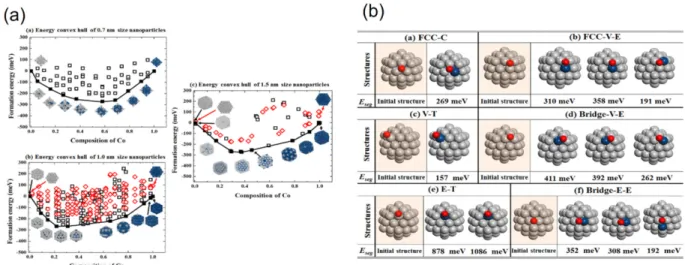
6 thermodynamically the most stable structures as a function of alloy composition can be identified using so called energy convexhull concept. Internal energy of a Pt-M alloys with the same certain alloy composition but with different configurations are obtained by DFT calculations. Then, the convexhull sorts out the most stable structures for a given composition and particle size. Since the two variables create formidable numbers of alloy candidates to calculate we need smart statistical formalism to only consider symmetrically independent particles. The cluster expansion theory [24] can handle with the issue with a cheap computational cost. It also enables to capture interatomic interaction potentials as a function of atomic distance and cluster size, of which information can be utilized in Monte Carlo simulations to explore thermodynamically stable structures with varying experimental conditions, such as the alloy composition and oxygen partial pressure [25].

Fig. 6 denotes that Pt-Co alloys are stable against each of their pure states and form various stable Fig. 5. Volcano plot showing clear relation between

experimentally measured exchange current density and adsorption energy of O in various catalysts[23].

Fig. 6. Energy convex hull capturing thermodynamically the most stable structures of Pt-Co alloys as function of the

alloy composition and size in (a), and in (b) surface segregation energies of Co calculated by DFT method with varying

O coverages. Negative energy value means the surface segregaion is thermodynamically plausible and vice versa[22].

(7)

configurations [22] depending on the alloy composition. In compositional ranges of x < 0.333 in the Pt

1-x

Co

x

so called Pt(shell)-Co(core) structures are thermodynamically the most stable, which well agrees with experimental observation. It is noteworthy, however, that the early 3d-transition metals in Pt-M alloys have strong affinity toward oxygen, which may induce surface segregation of the core metals to the outermost shell occupying Pt lattice followed by their dissolutions. Indeed, Fig.

6(b) shows that Co can come out to the surface to form an oxide when oxygen coverage reach a certain level. The interplay of the selective surface segregation and dissolution of the core metal seriously degrades the integrity of Pt-Co alloy structure.

In summary, the enhancement of catalytic activity toward ORR by alloying early 3d-transition metals led serious deterioration of the stability unless the surface segregation is hindered [26-27].

3.5 New design concept of high functional catalyst To remove the two issues (electrochemical stability, activity) in ORR catalyst for PEM fuel cells new design concept should be necessary other than making the alloys. While adsorption energy with O is necessarily reduced by the alloying the serious surface segregation needs to be blocked.

It is interesting that encapsulating of the Pt-M or even non-precious catalyst with N-doped carbon shells was proposed as the promising solution [28- 30]. The carbon shells not only tune the interaction

strength between oxygen and the core metal but also close the path for surface segregation.

In the new approach, the key step is how to control or optimize the carbon shell thickness toward the best ORR performance. DFT calculations propose that the carbons layers should be less than five, otherwise the encapsulation effect is nullified. Noh and associates [28] controlled the thickness by oxidizing the shells using CO

2

at high temperature T = 1000

o

C. As shown in Fig. 7 they identified that Fe-Co nanoparticle alloy encapsulated by N-doped carbons shells as a promising ORR catalyst with high activity in acidic solution as much as Pt and with exceptional stability for a 10,000 cycling tests.

This new design concept is a good example how to utilize systematic applications of computational prediction and experimental validation to realize new material discovery for a desired function.

Accurate and fast DFT calculations identify good candidates for experimental synthesis and validation with an innovative design concept. This synergic aspect from such tight collaborations are already undergoing in many research areas and industrial sectors. In fact, the material genome project targets a dramatic saving in temporal and monetary costs from discovery to commercialization of new functional materials [31-33].

4. Conclusion

This paper reviewed recent computational

framework applied to develop highly functional

Fig. 7. Design of Fe-Co catalyst for ORR encapsulated N-doped carbon shells. (a) TEM, EDS, XPS analysis of Fe-

Co encapsulation structure and theoretical model (b) Computational prediction and experimental measurements agree

that the catalyst have high ORR activity and durability in acidic solution[28].

(8)

materials with an example of nanoscale catalysts toward ORR. It was mentioned that conventional Pt- based catalysts have crucial issues for serving in the PEM fuel cells: electrochemical instability and low catalytic activity for oxygen reduction reaction. It was stressed that a systematic interplay between first principles-based computational prediction and experimental validation can substantially useful to overcome the challenges and discover highly functional new materials. This new methodology is beyond the conventional wisdom depending on our repetitive experiences and already successfully applied to several research areas and industrial sectors, for instance, materials genome project for a new drug discovery.

Acknowledgement

This review is supported by Global Frontier Program through the Global Frontier Hybrid Interface Materials (GFHIM) (2013-M3A6B1078882) and Technology Development Program (NRF-2015M1A2 A2056833) to Solve Climate Changes of the National Research Foundation of Korea (NRF) funded by the Ministry of Science, ICT and Future Planning.

References

[1] John Conti, International Energy Outlook 2016.

DOE, Ed. Washington, DC, (2016) 1-18.

[2] Gregorio Marbán, Teresa Valdés-Solís, Towards the hydrogen economy, Int. J. Hydrogen Energy 32 (2007) 1625-1637.

[3] S Dasappa, PJ Paul, HS Mukunda, NKS Rajan, G Sridhar, HV Sridhar, Biomass gasification technology–a route to meet energy needs. Curr.

Sci. 87 (2004) 908-916.

[4] A Boudghene Stambouli, E Traversa, Fuel cells, an alternative to standard sources of energy.

Renewable Sustainable Energy Rev. 6 (2002) 295- 304.

[5] C Retna Raj, Arpan Samanta, Seung Hyo Noh, Siniya Mondal, Takeyoshi Okajima, Takeo Ohsaka, Emerging new generation electrocatalysts for the oxygen reduction reaction. J. Mater. Chem. A 4 (2016) 11156-11178.

[6] D Yogi Goswami, Sanjay Vijayaraghavan, Shaoguang Lu, Gunnar Tamm, New and emerging developments in solar energy. Sol. Energy 76 (2004) 33-43.

[7] Byungchan Han, First Principles Study of Effect of Surface Structure on Chemical Activity of Pt

Electrocatalysts in Fuel Cells. Massachusetts Institute of Technology (2007) 15-153.

[8] Ying Shirley Meng, M Elena Arroyo-de Dompablo, First principles computational materials design for energy storage materials in lithium ion batteries.

Energy Environ. Sci. 2 (2009) 589-609.

[9] Pierre Hohenberg, Walter Kohn, Inhomogeneous electron gas. Physical review 136 (1964) B864.

[10] Peter E Blöchl, Projector augmented-wave method.

Phys. Rev. B 50 (1994) 17953.

[11] John P Perdew, Kieron Burke, Matthias Ernzerhof, Generalized gradient approximation made simple.

Phys. Rev. Lett. 77 (1996) 3865.

[12] Georg Kresse, Jürgen Furthmüller, Efficient iterative schemes for ab initio total-energy calculations using a plane-wave basis set. Phys. Rev. B 54 (1996) 11169.

[13] Hubert A Gasteiger, Shyam S Kocha, Bhaskar Sompalli, Frederick T Wagner, Activity benchmarks and requirements for Pt, Pt-alloy, and non-Pt oxygen reduction catalysts for PEMFCs. Appl. Catal., B 56 (2005) 9-35.

[14] Mark K Debe, Electrocatalyst approaches and challenges for automotive fuel cells. Nature 486 (2012) 43-51.

[15] Wolf Vielstich, Harumi Yokokawa, Hubert Andreas Gasteiger, Handbook of fuel cells: fundamentals technology and applications. John Wiley & Sons (2009) 1-17.

[16] H. B. Callen, Thermodynamics and an Introduction to Thermostatistics. 2nd ed., AAPT (1998) 1-50.

[17] Edward F Holby, Wenchao Sheng, Yang Shao-Horn, Dane Morgan, Pt nanoparticle stability in PEM fuel cells: influence of particle size distribution and crossover hydrogen. Energy Environ. Sci. 2 (2009) 865-871.

[18] MJN Pourbaix, J Van Muylder, N De Zoubov, Electrochemical properties of the platinum metals.

Platinum Met. Rev. 3 (1959) 47-53.

[19] Lei Tang, Byungchan Han, Kristin Persson, Cody Friesen, Ting He, Karl Sieradzki, Gerbrand Ceder, Electrochemical stability of nanometer-scale Pt particles in acidic environments. J. Am. Chem.

Soc. 132 (2009) 596-600.

[20] Jens Kehlet Nørskov, Jan Rossmeisl, Ashildur Logadottir, LRKJ Lindqvist, John R Kitchin, Thomas Bligaard, Hannes Jonsson, Origin of the overpotential for oxygen reduction at a fuel-cell cathode. J. Phys. Chem. B 108 (2004) 17886- 17892.

[21] Byungchan Han, Venkatasubramanian Viswanathan,

Heinz Pitsch, First-principles based analysis of the

electrocatalytic activity of the unreconstructed pt

(9)

(100) surface for oxygen reduction reaction. J.

Phys. Chem. C 116 (2012) 6174-6183.

[22] Seung Hyo Noh, Min Ho Seo, Joon Kyo Seo, Peter Fischer, Byungchan Han, First principles computational study on the electrochemical stability of Pt–Co nanocatalysts. Nanoscale 5 (2013) 8625- 8633.

[23] J Greeley, IEL Stephens, AS Bondarenko, Tobias Peter Johansson, Heine Anton Hansen, TF Jaramillo, Jan Rossmeisl, INJK Chorkendorff, Jens Kehlet Nørskov, Alloys of platinum and early transition metals as oxygen reduction electrocatalysts. Nat.

Chem. 1 (2009) 552-556.

[24] Axel van de Walle, Gerbrand Ceder, Automating first-principles phase diagram calculations. J. Phase Equilib. 23 (2002) 348.

[25] Byungchan Han, Anton Van der Ven, Gerbrand Ceder, Bing-Joe Hwang, Surface segregation and ordering of alloy surfaces in the presence of adsorbates. Physical Review B 72 (2005) 205409.

[26] Seung Hyo Noh, Byungchan Han, Takeo Ohsaka, First-principles computational study of highly stable and active ternary PtCuNi nanocatalyst for oxygen reduction reaction. Nano Res. 8 (2015) 3394-3403.

[27] Hyon Chol Kang, Hanfei Yan, Yong S Chu, Su Yong Lee, Jungdae Kim, Evgeny Nazaretski, Chan Kim, Okkyun Seo, Albert T Macrander, G Brian Stephenson, Oxidation of PtNi nanoparticles studied by a scanning X-ray fluorescence microscope with multi-layer Laue lenses. Nanoscale 5 (2013) 7184- 7187.

[28] Seung Hyo Noh, Min Ho Seo, Joonhee Kang, Takeyoshi Okajima, Byungchan Han, Takeo Ohsaka, Towards a comprehensive understanding of FeCo coated with N-doped carbon as a stable bi-functional catalyst in acidic media. NPG Asia Mater. 8 (2016) e312.

[29] Xiaoju Cui, Pengju Ren, Dehui Deng, Jiao Deng, Xinhe Bao, Single layer graphene encapsulating non-precious metals as high-performance electrocatalysts for water oxidation. Energy Environ. Sci. 9 (2016) 123-129.

[30] Gyutae Nam, Joohyuk Park, Min Choi, Pilgun Oh, Suhyeon Park, Min Gyu Kim, Noejung Park, Jaephil Cho, Jang-Soo Lee, Carbon-Coated Core–

Shell Fe–Cu Nanoparticles as Highly Active and Durable Electrocatalysts for a Zn–Air Battery. ACS Nano 9 (2015) 6493-6501.

[31] Anubhav Jain, Shyue Ping Ong, Geoffroy Hautier, Wei Chen, William Davidson Richards, Stephen Dacek, Shreyas Cholia, Dan Gunter, David Skinner, Gerbrand Ceder, Commentary: The Materials Project: A materials genome approach to accelerating materials innovation. APL Mater. 1 (2013) 011002.

[32] MI Jordan, TM Mitchell, Machine learning: Trends, perspectives, and prospects. Science 349 (2015) 255-260.

[33] Arun Mannodi-Kanakkithodi, Ghanshyam Pilania, Tran Doan Huan, Turab Lookman, Rampi Ramprasad, Machine learning strategy for accelerated design of polymer dielectrics. Sci. Rep.

6 (2016) 20952.

수치

Fig. 1. A PEM fuel cell system. (a) Pt catalyst oxidizes H 2 (g) into a proton at anode and reduces O 2 (g) into O 2-  in cathode
Fig. 3. The Pourbaix diagram predicted by DFT calculations for Pt nanoparticle of 1 nm size in (a) and in (b) the in- in-situ STM measurement of electrochemical dissolution potentials of Pt with varying sizes[19].
Fig. 4 illustrates the Gibbs free energy diagrams
Fig. 6. Energy convex hull capturing thermodynamically the most stable structures of Pt-Co alloys as function of the alloy composition and size in (a), and in (b) surface segregation energies of Co calculated by DFT method with varying O coverages

참조

관련 문서