1. Introduction and Theoretical background 1.1. Introduction
We live in a society in which considerable importance is attached to an attractive, healthy appearance(Rumsy, 2018).
* 1st Author. Chief researcher, Corporation Reve Korea, Korea.
Tel: +82-33-645-2643. Email: [email protected] ** 2nd Author. Department of Sports Management, Catholic
Kwandong University, Korea.
Tel: +82-33-649-7249. Email: [email protected]
*** 3rd Author. Postgraduate Student, Graduate School of Public Health, YonSei Univ. Korea.
Tel: +82-2-714-5090. Email: [email protected]
**** Corresponding Author. Professor, Department of Health Care Management, Catholic Kwandong University, Korea.
Tel: +82-33-649-7274. Email: [email protected]
© Copyright: Korean Distribution Science Association (KODISA)
This is an Open Access article distributed under the terms of the Creative Commons Attribution Non-Commercial License (https://creativecommons.org/licenses/by-nc/4.0/) which permits unrestricted non-commercial use, distribution, and reproduction in any medium, provided the original work is properly cited.
Beauty is a feature which is feeling a perceptual pleasure about a human, concrete object or abstract object(Caki &
Solmaz, 2013).
The beauty salon industry further expanded in the 1990s (Lin, Lee, Lean, & Lan, 2018). The expansion and segmentation of cosmetics-related industries radically expanded due to an increase in income, diversification and differentiation of female consumers' needs, expansion of target groups for gender and age, increase in function and role of cosmetics, and population aging(Choi, Kwon, Kwon,
& So, 2018).
The cosmetic industry is an important and valuable global industry(Ramli, 2015). Beauty is a feature which is feeling a perceptual pleasure about a human, concrete object or abstract object(Caki & Solmaz, 2013).
Thus, women's social progress has had a large impact on the beauty industry, either directly or indirectly, and has had a ripple effect. Beauty-skin and beauty-fashion are now strong assets in the industrial and information society. In addition to traditional functions such as personal satisfaction, Print ISSN: 2233-4165 / Online ISSN: 2233-5382
doi:http://dx.doi.org/10.13106/ijidb.2019.vol10.no8.25.
Women's Skin Care Factors Affecting Korean Women's Skin and Beauty Industry Market
Jong-Won CHOI
*, Ho-Gil YOO
**, Young-Eun KWON
***, Lee-Seung KWON
****Received: May 06, 2019. Revised: July 16, 2019. Accepted: August 05, 2019.
Abstract
Purpose – This study aims to explore women's beauty industry market and growth development by identifying the main factors of women's perception of skin health care.
Research design, data, and methodology – The survey was conducted on women aged 20 to 60 living in Seoul. For the statistical analysis, frequency analysis, t-test and one-way ANOVA were conducted, and significant differences in p<0.05 were tested through the multiple range test of the Scheffe. The factor analysis was conducted to verify the validity of questions, and the reliability was determined by the coefficient of Cronbach's α.
Results – The lower the age, the higher the perception of the skin, and women pay a higher price for skin health as a provisional customer. 'Acne care' was the most common skin condition (32.8%), 'life style' (79.8%) was the most important part of skin care. Final education was the highest level of skin care for women with a professional background (M=3.41) (F=4.028, p<.05).
Conclusions – The differences in the recognition of health knowledge by age, marital status, and household monthly income were significant, but there was no difference between jobs and final education. Customers who use less skin care than customers who frequently use the skin care center were more aware of skin health, and women who have a high awareness of skin are more interested in aging and regenerating due to the skin care.
Keywords: Beauty Industry, Skin Care, Recognition and Perception, Health Care, Skin Cognitive Factors, Attitude and Behavior.
JEL Classifications: A1, H8, I1.
tools for meeting the opposite sex, and are regarded as capabilities and have value as an industrialized commodity.
Women's industrial value is linked to the Korean wave movement worldwide, and has even had cultural, industrial and health-medical effects such as medical tourism to Korea. Along with progress in information and communication technology, globalization has led to an active exchange in the political, economic, and cultural sectors.
The expansion and segmentation of cosmetics-related industries radically expanded due to an increase in income, diversification and differentiation of female consumers' needs, expansion of target groups for gender and age, increase in function and role of cosmetics, and population aging(Choi et al., 2018).
The skin care global markets consist of Africa and Middle East, Americans, Europe and Asia–Pacific (Khan & Khan, 2013). Beauty industry mainly refers to the hair market, the nail market, the make-up market and the skinny care market. A typical part of the body that affects the women's beauty industry is skin care, particularly around women's looks(Clarke & Griffin, 2008). Even women's appearance and skin care has recently tended to seek digital beauty by accepting beauty information from the Internet Web(Sur, 2017).
Women's perception and thinking about beauty-skin are thought to have important influence on skin care and skin practice. According to Korea Statistics (2017), regarding the perception of beauty, women(53%) are more aware of beauty than men (46%), and by age, women under 29 are most interested. This shows that women are more emotionally sensitive than men, seeking satisfaction, fun or happiness. In this regard, businesses are utilizing experiential marketing using the feelings of consumers because they prefer pursuit of happiness, fun and excitement.
However, almost all of the research on skin involves skin recognition, practice and behavior, and few studies have analyzed the specific relationship between skin recognition and skin health care in women. Therefore, the following research aims to contribute to women's beauty industry market and growth development by identifying the main factors of adult women's perception of skin health care and analyzing the general characteristics and the combined effect on the recognition of skin health care.
1. What is the difference in the perception of skin care according to the general characteristics of the subject?
2. What is the difference in skin care behavior according to the general characteristics of the person surveyed?
3. What is the difference between the skin care behaviors of the survey subjects based on their perception of skin care?
Through the above detailed purposes, it is thought that the difference of skin health management according to the skin health awareness of women can be found out, and it is
considered that the marketing according to this result can be established.
1.2. Theoretical background
The beauty product industry is estimated at $400 billion globally(Gyan, 2014). In general, one of the most representative body parts for appearance care is skin care market. Skin care has emerged as a growing interest in beauty in modern women, and it has been regarded as the most representative part of appearance management, which has been shown externally by investing time and money(Park, Kim, & Lee, 2006). Krutmann, Bouloc, Sore, Bernard, and Passeron (2017) classified skin aging exposome according to personal lifestyle into following factors: 'smoking', 'nutrition', 'stress' and 'sleep deprivation'.
The body parts of skin care currently receiving in the purpose and practice of using skin care programs account for nearly 80% of the body parts of skin care. Hodges and Walker's study (2011) showed skin care is the most prevalent between the ages of 30 and 39, a period of economic stability and active social activity. The main purpose of skin care is body type control, self-satisfaction, self-expression and aesthetic orientation, but self-satisfaction was seen as the biggest factor.
Skin care is a method of maintaining skin health care by analyzing and managing skin types. Therefore, skin care is very closely related to skin health care, and there is a growing trend in the number of people who visit the care center for skin health care. On the contrary, it also proves that awareness for skin health care is increasing. When the beauty satisfaction is increasing, daily stability, psychological and social stability, and self-efficacy which are sub-variables of perception of successful ageing are increasing(Jung &
Moon, 2018).
Dermal health care awareness indicates that people are aware of factors that are important to skin health care.
Although there are mainly harmful factors, life style habits, and health knowledge, adult women thought that lifestyle and health knowledge affect skin health care(Tylka &
Iannantuono, 2016).
Also, in the actual behavior of buying, women who are highly interested in skin have a strong tendency to purchase on impulse and to purchase on a planned basis. Women skin care users are conscious about the product quality of the skin care products(Khan & Khan, 2013).
Although men are not as good in appearance or skin care and awareness as women, Tylka and Iannantuono (2016) thought the aesthetic consciousness of the male college students affected their own appearance management behaviors in a positive manner. And well-educated, professional and full-fledged personnels should be fostered in the beauty industry to address the diverse needs of male college students. The personal self-consciousness was found that the best important to skin care behavior.
2. Research method
2.1. Subject and period of study
In order to analyze the perception and practice of skin health care in women living in Seoul, the research subjects were adult women aged between 20 and 60 who reside in Seoul area. The survey period was 2 months from May 02, 2017 to July 30, 2017.
2.2. Research tool
The purpose of the study was to analyze the results of a study on the recognition factors of women's skin care in Seoul.
2.2.1. Survey
A total of 400 questionnaires were distributed to adult women in Seoul. Among them, 351 copies were used as final analysis data except 49 copies, which were either unsatisfactory or missing data, and a total of 39 questions were used to measure the five-point limit.
2.2.1.1. General point
For an investigation into the awareness of skin beauty health care, the scales cited in the study of Tylka and Iannantuono(2016) were modified and supplemented accordingly to the study, and measured in paragraph 16 as a five-point Likert's scale.
2.2.1.2. Skin health care recognition
① Harmful factor
The scale cited in Tylka and Iannantuono's study (2016) was modified and supplemented in accordance with this study to determine the presence of any adverse effects of skin health care awareness, and measured in paragraph 7 as a five-point scale of the Likert. One point is that "not at all" and five point is "always so," meaning the higher the number, the higher the risk of skin care.
② Life cycle
To identify life cyle among the cognition of skin health care, the research was modified and secured based on Tylka and Iannantuono's Study (2016) to measure the five-point mark in nine paragraphs. One point is that "not at all" and five point is "always so," meaning the higher the number, the higher the awareness of life cyle for skin health care.
③ Health knowledge
Based on prior research by Tylka and Iannantuono's study (2016) to identify health knowledge among skin health care cognition, the research was modified and secured in
conformity with this study, and the modified five-point scale was measured in paragraph 7. One point is that "not at all"
and five point is "always so," meaning the higher the number, the higher the awareness of health care for skin health care.
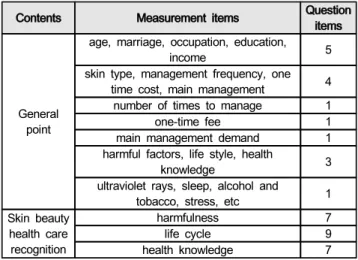
Table 1: Contents of Questionnaire
Contents Measurement items Question
items
General point
age, marriage, occupation, education,
income 5
skin type, management frequency, one time cost, main management 4
number of times to manage 1
one-time fee 1
main management demand 1
harmful factors, life style, health
knowledge 3
ultraviolet rays, sleep, alcohol and
tobacco, stress, etc 1
Skin beauty health care
recognition
harmfulness 7
life cycle 9
health knowledge 7
2.3. Data processing and analysis method
In carrying out this study, the following statistical processes have been carried out:
1. Frequency analysis was conducted to identify the general and skin care characteristics of the subjects.
2. To identify differences in the perception of skin care according to the general characteristics of the subjects and the skin care characteristics, t-test and one-way ANOVA were conducted, and significant differences in p<0.05 were tested through the multiple range test of the Scheffe.
3. The factor analysis was conducted to verify the validity of questions about the recognition factors of skin health care, and the reliability was determined by the coefficient of Cronbach's α.
The empirical analysis of this study was all verified at a significant level of 5%, and statistical processing was analyzed using the SPSS IBM 21.0 program.
3. Research results
3.1. General characteristics of the subject
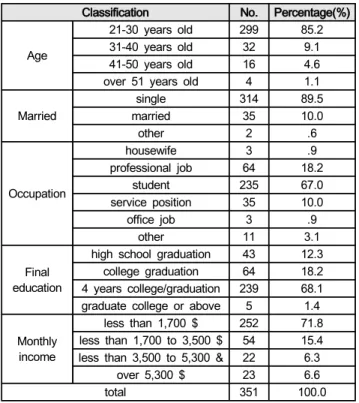
3.1.1. General characteristics of the person surveyed The general characteristics of the subjects are shown in Table 2. The age of the survey subjects was '21-30 years old'(85.2%). 89.5% of the respondents were married. 67.0%
of the students were students, and 68.1% of them graduated from college or university.
Table 2: General characteristics of the subject
Classification No. Percentage(%)
Age
21-30 years old 299 85.2
31-40 years old 32 9.1
41-50 years old 16 4.6
over 51 years old 4 1.1
Married
single 314 89.5
married 35 10.0
other 2 .6
Occupation
housewife 3 .9
professional job 64 18.2
student 235 67.0
service position 35 10.0
office job 3 .9
other 11 3.1
Final education
high school graduation 43 12.3
college graduation 64 18.2
4 years college/graduation 239 68.1 graduate college or above 5 1.4 Monthly
income
less than 1,700 $ 252 71.8 less than 1,700 to 3,500 $ 54 15.4 less than 3,500 to 5,300 & 22 6.3
over 5,300 $ 23 6.6
total 351 100.0
3.1.2. Dermal Care Characteristics
The results of looking at skin care characteristics are shown in Table 3. In particular, for the purpose of skin care, 'acne management' was 32.8% and 'lifestyle' was the most important part in skin care, with 79.8%. The most frequent cause of skin's harmful factor was 'stress' (42.7%).
Table 3: Skin care characteristic
Classification No. Percentage(%)
Skin type
neutrality 17 4.8
dry 96 27.4
oily 46 13.1
complexity 167 47.6
irritability 25 7.1
Number of proper skin
care
once a week 106 30.2
twice a week 114 32.5
once or twice a month 74 21.1 two or three times a
month 34 9.7
other 23 6.6
Appropriate once skin care
costs
less than 9 $ 35 10.0
less than 26 $ 139 39.6 less than 44 $ 149 42.5
less than 88 $ 28 8.0
Purpose of skin care
wrinkle management 65 18.5
whitening management 47 13.4
acne management 115 32.8
regeneration management 86 24.5
other 38 10.8
Skin care recognition
harmful factor 42 12.0
life cycle 280 79.8
health knowledge 29 8.3
Skin care hazards
ultraviolet rays 50 14.2
sleep 82 23.4
liquor and tobacco 51 14.5
stress 150 42.7
other 18 5.1
total 351 100.0
3.2. Verification of the validity and reliability of measurement tools
In this study, the following verification was performed to ensure the validity and reliability of the measuring tools.
3.2.1. Results of the feasibility and reliability analysis of questionnaire
Reliability, a measurement tool used in this study, was analyzed using the Cronbach's α coefficient, and the specific results of the study are as follows in Table 4. The internal consistency of the questionnaire was 0.917, indicating a reliable level.
Table 4: Verification of the perception of skin health care and reliability of skin health care practices
Classification Sub factor No. Cronbach's α Skin health care
recognition
harmful factor 9 .825
life cycle 8 .873
health knowledge 6 .830
Skin health care recognition 23 .907
3.3. Analysis of factors and technical statistics on dermal health care awareness and reliability verification measures of skin health care behavior
3.3.1. Factor analysis
3.3.1.1. Analysis of skin health care perception factors The results of a factorial analysis of dermal health care awareness are shown in Table 5.
To verify the validity of the recognition of skin health care, factor analysis was performed using the principal component analysis method and the orthogonal rotation method varimax. In this study, the kmo value is very good at 0.908, so it is possible to determine that the correlation
of pairs of variables is well explained by other variables. In addition, Bartlett's test of sphericity, which indicates the suitability of the factorial analysis, shows that the approximate chi-square test value is 3999.525 with a significant level of .000, indicating that the use of the factorial analysis is appropriate. As a method of extracting factors, three factors were determined using eigen-value, which indicates how much information each factor described in an existing variable is described, based on factors with a unique value of 1.0 or higher and on items with a factor load of 0.4 or higher. As a result, factor 1 illustrates the health knowledge factor by showing a unique value of 4.537, an explanatory ratio of 19.72%, and factor 2 explains the health knowledge factor by showing a unique value of
4.241 and an explanation fee of 18.43%, and factor 3 illustrates the factors that are beneficial by showing 3.549 and 15.43%.
3.3.2. Technical statistics
3.3.2.1. Technical statistics of dermal health care recognition
The results of looking at the technical statistics of dermal health care awareness are shown in Table 7.
The overall average of skin health care awareness was 3.80, followed by 'significant factors' (M=3.96), 'health knowledge' (M=3.86), and 'life habits' (M=3.57).
Table 5: Analysis of skin health care perception factors
Classification factor
1 2 3
life cycle
To reduce food containing fat or sugar .801
Avoid stimulating food for skin care .796
Reduce instant food .773
Exercise regularly for skin care .768
I quit smoking this week for skin care. .661
I usually take vitamins for skin care. .611
When going out to block ultraviolet rays, wearing a hat, sunglasses, and long arms. .539 Excessive irritation during massage makes the skin sensitive .509
skin and health knowledge
Normal skin is oily and hydrated. .755
Dry skin lacks oil and moisture to form wrinkles .718
Vitamin E (tocopherol) is a component that prevents skin aging .684
Normal skin is pH4.5-6 or a weak acid condition. .681
The factors determining the type of skin (dry, oily, complex, etc.) are divided according to
the amount of sebum. .679
For acne skin, choose cosmetics for care for skin cleanliness .559
harmful factor
Stress is a harmful factor in skin care management. .661
Getting a sauna often causes skin aging .634
Drinking and smoking are harmful factors in skin health care and cause skin aging .621
Lack of moisture in the skin makes the skin dry .585
Soap wash is good for skin health care. .582
Constipation is a factor in skin care management. .563
Skin health care requires six to eight hours of sleep. .559
The act of pushing the dirt helps to keep your skin healthy .537
Ultraviolet rays dry the skin .481
eigen value 4.537 4.241 3.549
dispersion rate 19.728 18.437 15.431
cumulative dispersion rate 19.728 38.165 53.597
KMO = .908, Bartlett's test result χ²=3999.525 (df=253, p=.000)
Table 7: Technical Statistics of Dermal Health Care Recognition
Classification No. Min. Max. Average S.D.
Skin health care recognition
harmful factor 351 2.33 5.00 3.96 .56
life cycle 351 1.00 5.00 3.57 .77
health knowledge 351 2.50 5.00 3.86 .64
Skin health care recognition 351 2.52 5.00 3.80 .54
Figure 1: Skin health care recognition
5. Discussion
This study is about women's skin care and skin awareness, and it is to find out how and how much women have a perception of skin health care. Beauty and social advantage is relation to the fairer skin and skin health care.
In the skin health care, personal hygiene not only prevents several infections from spreading but also improves individuals’ self-esteem and contributes to mental well-being (AlGhamdi, AlHomoudi, & Khurram, 2014).
The industry offers a vast armamentarium of skin care products to clean, soothe, restore, reinforce, protect and to treat our skin and hence to keep it in “good condition”(Surber & Kottner, 2017). Overall, 85.2 percent of those surveyed were aged between 21 and 30, 89.5 percent of those who were married, 67.0 percent of those who were
"unmarried," 68.1 percent of those who were "college students" and 71.8 percent of households' monthly income.
Since most of those surveyed were 20-30 years old, the majority of those subject to skin care were 47.6 percent complexities, while acne management was the highest among those affected by skin at 42.7 percent. This is similar to the results of lifestyle and stress affecting skin care in the study of Tylka and Iannantuono(2016).
Differences in dermal health recognition according to the general characteristics of the person surveyed were significant in age, marital status and household monthly income, but differences in occupational and final education were not significant at a significant level of 5%. Among the people who have occupations over 20-30 college students related to the harmful factors, life cycle and health knowledge of the subjects, the higher the household income,
the higher the awareness of the skin health care(Almuqati, Alamri, & Almuqati, 2019). Women in their 20s and 30s are interested in skin health care, and they constantly change their dietary life(Whitehead, Ozakinci, & Perrett, 2012). A woman is considered to be at the peak of beauty in her mid-thirties just before early signs of facial aging begin to appear (Ehlinger-Martin, Cohen-Letessier, Taïeb, Azoulay, &
Crest, 2016). The higher the household income, the higher the perception of lifestyle habits, and the more important is the eating habits(Kuipers, 2015).
If you look at the differences in skin health care behavior, you can see that there are differences in skin health care behavior depending on the final education. This is similar to the results of a thesis(Almuqati, Alamri, & Almuqati, 2019) in that more than one college graduate has a high interest in skin health care practices, and thus practices them. Among the activities on skin health care, the use of cosmetics was found to be used by anyone regardless of age, occupation or income. As women become more interested in skin care, they become more interested in professional management and also make steady efforts for nutrition and exercise (Lipowska, 2016), The dietary habits of women in their 20s have a great impact on skin health (Im, Chee, Lim, Liu, &
Kim, 2008). This is similar to the result that young women with good eating habits are similar to those who exercise hard(AlGhamdi, AlHomoudi, & Khurram, 2014).
Among the differences in perception of skin health according to skin care characteristics, the adverse factors were the highest perception of stress. Similar to the research results of Im et al.(2008), women who are at high risk for stress are more aware of their skin health.
The subjects of this study were mostly in their 20s and
30s, and skin type was intelligent, complex, and other sensitive. Among the subjects, those who visited the skin care room more than once a week and those who received the management fee of less than 1130$ showed a high awareness of skin health care. The correlation between skin health awareness and skin health care behavior indicates that skin health care practices are the life cycle of skin health awareness (r=.551, p<).001, health knowledge (r=.298, p<.001), the harmful factor (r=.136, p<.05). It was shown that there was a high definition correlation in order. In detail, cosmetic products were all related to definition of skin health awareness, life cycle and health knowledge, and the specialties of skin care were related only to living habits, and nutrition and exercise had a significant relationship to life cycle and health knowledge. As in the paper (Díaz-Méndez & Gómez-Benito, 2010), the higher the awareness of skin health, the higher the use of cosmetics, which is similar to the results of the high impact on the reaction, use, and response of cosmetics. According to Peltzer and Pengpid (2017), among women, older age, coming from a poorer family, residing in an upper middle income country, awareness of active skin lightening ingredients, and poor mental health were associated with skin lightening products.
The effect of skin health awareness on skin health care behavior is that of the life cycle of skin health awareness (=.587, p<.001), followed by the following significant effects (=-.186, p<.01) on dermal health care behavior were found to have significant effects. Thus, the higher the awareness of living habits, the higher the skin health care activity is.
This is similar to the results of a paper in the Koblenzer 's study(1996) that shows that life cycle habits affect skin health, and good lifestyle habits are similar to the results of increased satisfaction with skin health. Also, according to the study of Koblenzer (1996), the higher the appearance directivity and appearance evaluation, the higher the attitude of skin health care.
Based on these results, the researcher considers the importance of education in skin health awareness and the need for guidance for clarifying and popularizing education programs. Also, awareness of skin health should be the basis for promoting skin health behaviors to live on.
6. Conclusion and Summary
The results derived from this study are as follows.
Research Issue 1. Recognize the differences in the perception of skin health according to the general characteristics of the subject.
Differences in skin health recognition with age, marital status and household monthly income were significant, but differences with occupation and final education were not significant at a significant level of 5%. People in their 20s
and 30s are very interested in skin health care, and they constantly change their diet.
The differences in age, occupation and household monthly income were significant, but there was no difference between marriage status and final education.
There was a significant difference in the perception of life style based on age, marital status, and household monthly income, but there was no difference between career and final education.
The differences in the recognition of health knowledge by age, marital status and household monthly income were significant, but there was no difference between jobs and final education.
Research question 2. Recognize the difference in skin health care behavior according to the general characteristics of the person surveyed.
Differences in dermal health care behaviour over final education were significant, but differences in age, marital status, occupation and household monthly income were not significant at a significant level of 5%. Final education was the highest level of skin care for women with a professional background (M=3.41) (F=4.028, p<.05).
Research issue 3. Recognize the differences in skin health awareness according to skin care characteristics.
The differences in dermal health recognition due to dermal hazards were significant, but there were no differences in skin type, proper number of skin care, proper once-in-a-time cost of skin care, skin care objectives, and important perceptions of skin care. Other (M=3.91), stress (M=3.86), and skin health awareness (F=2.861, p<.05). (Jang et al., 2014)' paper is similar to the result that women with high stress risk factors are more aware of skin health.
The proper number of skin care treatments per week (M=3.92) was the lowest in recognition of health knowledge (F=2.872, p<.05), skin care objectives are regenerative care (M=3.98), which shows a high awareness of health knowledge (F=2.613, p<.05).
Customers who use less skin care than customers who frequently use the skin care center were more aware of skin health, and women who have a high awareness of skin health are more interested in aging and regenerating due to the skin care that they usually receive.
References
AlGhamdi, K. M., AlHomoudi, F. A., & Khurram, H.
(2014). Skin care: Historical and contemporary views.
Saudi Pharmaceutical Journal, 22(3), 171-178.
Almuqati, R. R., Alamri, A. S., & Almuqati, N. R. (2019).
Knowledge, attitude, and practices toward sun exposure
and use of sun protection among non-medical, female, university students in Saudi Arabia: A cross-sectional study. International Journal of Women's Dermatology, 5(2), 105-109.
Caki, N., & Solmaz, B. (2013). The effects of facial beauty in personnel selection: A field work in retail sector. Procedia - Social and Behavioral Sciences, 84(9), 1203-1206.
Caballero-Navas, C. (2008). The care of women's health and beauty: an experience shared by medieval Jewish and Christian women. Journal of Medieval History, 34(2), 146-163.
Choi, E. M., Kwon, L. S., Kwon, N. H., & So, Y. J.
(2018). Selection Factors for Distribution Partners for the Market Entry in Southeast Asia. Journal of Distribution Science, 16(5), 17-29.
Clarke, L. H., & Griffin, M. (2008). Visible and invisible ageing: Beauty work as a response to ageism. Ageing and Society, 28(5), 653-674.
Díaz-Méndez, C., & Gómez-Benito, C. (2010). Nutrition and the Mediterranean diet. A historical and sociological analysis of the concept of a “healthy diet”
in Spanish society. Food Policy, 35(5), 437-447.
Ehlinger-Martin, A., Cohen-Letessier, A., Taïeb, M., Azoulay, E., & Crest, D. (2016). Women's attitudes to beauty, aging, and the place of cosmetic procedures:
insights from the QUEST Observatory. J Cosmet Dermatol, 15(1), 89-94.
Gyan R. (2014). Analytics. Global Beauty Care Market (2014-2018) -Research and Markets. 2014. Retrieved from https://www.marketresearch.com/product/sample- 8483698.pdf.
Hodges, A. L., & Walker, D. K. (2017). Skin Care for Women. Nursing for Women's Health, 20(6), 609-613.
Im, E. O., Chee, W., Lim, H. J., Liu, Y., & Kim, H. K.
(2008). Midlife Women’s Attitudes Toward Physical Activity. Journal of Obstetric, Gynecologic & Neonatal Nursing, 37(2), 203-213.
Jung, M. H., & Moon, J. S. (2018). A Study on the Effect of Beauty Service of the Elderly on Successful Ageing: Focused on Mediated Effect of Self-esteem.
Journal of Asian Finance, Economics and Business, 5(4), 213-223.
Khan, A. F., & Khan, M. F. (2013). A Study on the Awareness of Product Ingredients among Women Skincare Users in State Of Madhya Pradesh. Journal of Business and Management, 14(4), 65-72.
Koblenzer, C. S. (1996). Psychologic aspects of aging and the skin. Clinics in Dermatology, 14(2), 171-177.
Korean Statistical Information Service. (2017). Service industry survey report as of 2014, National business survey as of 2014 - Industry classification by city area.
Retrieved March 5, 2017, from http://kosis.kr
Krutmann, J., Bouloc, A., Sore, G., Bernard, B., &
Passeron, T. (2017). The skin aging exposome. Journal of Dermatological Science, 85, 152–161.
Kuipers, G. (2015). Beauty and distinction? The evaluation of appearance and cultural capital in five European countries. Poetics, 53(December), 38-51.
Lin, Y. Y., Lee, T. R., Lean, H. H., & Lan, H. Y. (2018).
Will My Customers Come Back? A Study of Beauty Salons in Taiwan. Journal of Distribution Science, 16(1), 73-85.
Lipowska, M., Lipowski, M., Olszewski, H., & Dykalska- Bieck, D. (2016). Gender differences in body-esteem among seniors: Beauty and health considerations.
Archives of Gerontology and Geriatrics, 67(November– December), 160-170.
Park, Y. K., Kim, P. J., & Lee, B. C. (2006). The Decision Factor of Franchisee Performance in Esthetic Store. Journal of Distribution Science, 4(1), 141-160.
Peltzer, K., & Pengpid, S. (2017). Knowledge about, attitude toward, and practice of skin lightening products use and its social correlates among university students in five Association of Southeast Asian Nations (ASEAN) countries. Int J Dermatol., 6(3), 277-283.
Ramlia, N. S. (2015). Immigrant Entrepreneurs on the World’s Successful Global Brands in the Cosmetic Industry. Procedia - Social and Behavioral Sciences, 195, 113–122.
Rumsey, N. (2018). Psychosocial adjustment to skin conditions resulting in visible difference (disfigurement):
What do we know? Why don’t we know more? How shall we move forward?. International Journal of Women's Dermatology, 4(1), 2-7.
Sur, P. (2017). Beauty and the Internet: Old Wine in a New Bottle. Journal of International Women's Studies, 18(4), 278-291.
Surber, C., & Kottner, J. (2017). Skin care products:
What do they promise, what do they deliver. Journal of Tissue Viability, 26, 29-36.
Tylka, T. L., & Iannantuono, A. C. (2016). Perceiving beauty in all women: Psychometric evaluation of the Broad Conceptualization of Beauty Scale. Body Image, 17(June), 67-81.
Whitehead, R. D., Ozakinci, G., & Perrett, D. I. (2012).
Attractive skin coloration: harnessing sexual selection to improve diet and health. Evol Psychol, 10(5), 842-854.