Tree-based Multi-channel Communication with Interference Avoidance using Dynamic Channel
Switching in Wireless Sensor Network
Mohd. Noor Islam* Associate Member
Sunwoong Choi,* Yeong Min Jang* Lifelong Members
ABSTRACT
In centralized control sensor network, tree-based multi-channel communication overcomes the recurrent channel switching and makes possible to transfer data simultaneously from different sources. In our paper, we propose a greedy algorithm named as NIT (Non-Intersecting Tree) that the trees can avoid inter-tree interference. We also propose channel switching technique by which trees can avoid link failure or area blocking due to external interference locally without rerunningthe algorithm and without interrupting the whole network. At first we applied our algorithm for a random topology and then we evaluate the performance of the network using NS-2 simulator.
The results show that with the increasing of channel the throughputand delivery ratio are increased significantly.
We got better performance than a using a recent proposed Tree-based Multi-Channel Protocol (TMCP).
Key Words : Multi-channel Comm, Sensor Network, 간섭회피, 채널 할당, NS-2 Simulation
※ This research was supported by the MKE (Ministry of Knowledge and Economy), Korea, under the ITRC (Information Technology Research Center) support program supervised by the IITA (Institute of Information Technology Assessment) (IITA-2009-C1090-0801-0019).
※ 2009년도 국민대학교 교내연구비를 지원받아 수행된 연구 * Kookmin University, Korea, ((schoi, yjang)@kookmin.ac.kr)
논문번호:KICS2009-10-506, 접수일자:2009년 10월 30일, 최종논문접수일자: 2009년 12월 17일
Ⅰ. Introduction
In case of centralized control system the synchronization among the large number of nodes, data collection from different sources simul- taneously becomes difficult using single channel because of collision and congestion. As a result, the throughput decreases for the network. Since data size of the sensor network is small and IEEE 802.15.4 specifies 16 non-overlapping channels within the 2.4 GHz, it is wise to divide the network into different small parts or making different paths for different sources to transmit data using various channels among 16 without using a single channel. Therefore, multi-channel communication is the key solution to get higher throughput with lower collision and simultaneous
data transfer. For multi-channel communication in wireless sensor network different node-based, component based
[8]and tree-based
[10]protocols have been proposed but there still needs more research to use all 16 channels efficiently. By this time, different MAC protocols MMSN [1], TMMAC
[2]and MCMAC
[3]have been proposed for wireless sensor network to use multi-channel.
In those node-based protocols, necessity of recurrent channel switching and scheduling schemes to coordinate channel switching introduces difficulties to use multi-channel. So, tree-based channel assignment comes as a solution where the network can be divided into some trees and each tree is assigned with different channel among 16 channels.
Tree-based communication satisfies the reliable,
timely data transfer and increase the overall throughput of the network. However in tree-based solution some problems arise like inter-tree interference between two trees, intra-tree interference. Our experiment
[10]shows thatadjacent channels has interference though all 16 channels specified by IEEE 802.15.4, but non-overlapping and two channels away channels don’t show interference.Intra-tree interference can be overcome using CSMA. These days external interference due to IEEE 802.11b/g is also a great challenge for channel assignment in wireless sensor network because the number of networks overlapping geographically increases and IEEE802.11b/g and wireless sensor network are using the same bandwidth. The main contributions of this paper are:
1. We propose a NIT algorithm by which we can divide the network into non-overlapped trees and each tree can be handled separately without interrupting the whole network.
2. We propose a way of channel assignment for the trees and a dynamic channel switching scheme to overcome external interference caused by IEEE 802.11 b/g locally.
The rest of this paper is organized as follows.
In Section II, we explain related works. We propose the NIT based channel assignment and switching in Section III. We evaluate the performance of WSN after applying our algorithm as well as we compared the performance with TMCP in Section IV. Finally, Section V concludes the paper.
Ⅱ. Related Works
A significant number of multi-channel MAC protocols
[4]-[7]have been proposed for WSNs.
These protocols either require multiple radio transceivers at each node, or need certain kinds of control messages for channel negotiation.
However, each sensor device is usually equipped
with a single radio transceiver, which cannot function on different frequencies simultaneously and the network bandwidth in WSNs is very limited and the data packet size is very small.
Therefore, channel negotiation packets cannotbe ignored as small overhead. Recently, MMSN
[1], TMMAC
[2]and MCMAC
[3]are three new multi-channel MAC protocols designed especially for WSNs. They all try to assign different channels to nodes in a two-hop neighborhood to avoid potential interferences. Node-based protocols may not be suitable for WSNs in practice due to recurrent channel switching and scheduling schemes to coordinate channel switching introduces difficulties to use multi-channel. More recently, a component-based protocol in [8] is presented where it assigns channels to connect components in wireless ad hoc networks and, in [9], nodes dynamically select channels based on a control theory approach to achieve load balance among channels.
With similar favor but considering low interference and optimized throughput, a tree-based multi-channel assignment TMCP is proposed in [10], where inter-tree and intra-tree interference is also optimized. Their case was static and they only considered orthogonal channels to avoidinterference which limits to use up to 8 channels without considering the interference of all the bands of IEEE 802.11b/g. In our paper we also propose a tree-based channel assignment similar to them but we also considered dynamic channel changing due to avoid external interference caused by 802.11b/g and to use all 16 channels efficiently.
Ⅲ. NIT based Channel Assignment and Switching
3.1 Node-based and Tree-based Channel Assignment
Tree-based multi-channel communication shows
better performance thannode-based multi-channel
communication. With node-based channel
assignment schemes, a node typically has a
(a) (b)
Fig. 1. (a) First level node division and inclusion in trees (b) Including of second level nodes into trees
different channel from its downstream and upstream nodes. Within a multi-hop flow, nodes have to switch channels to receive and forward packets which can cause very frequent channel switching and potential packet losses. In order to avoid such packet losses, node-based protocols use some negotiation or scheduling schemes to coordinate channel switching and transmissions among nodes with different channels. They in [10] confirm that node-based protocols can improve communication performance, but have large performance degradation with time errors and it also shows that node-based protocols cannot provide reliable and stable communication services forhigh data rate traffic. One possible solution is to perform the time synchronization operation periodically. However, time synchronization protocols in WSNs can be costly, consuming extra bandwidth and power, which makes frequently re-synchronizing impractical, especially for high data rate applications or for dense and larger networks.
Tree based channel assignment can avoid complex coordination schemes by reducing channel switching and communication among nodes with different channels a coarse-grained channel assignment strategy. Tree divides network into different parts for getting data in sink node from different node at a time.However, with a single channel, transmission collisions within the tree and flow congestion at nodes greatly decrease the network performance. There may have intra-tree interference which can be overcome using CSMA.
3.2 NIT based Channel Assignment
We propose a new tree formation and channel assignment algorithm. We considered 1) flexibility of changing channel when link failure and area blocking due to external interference 2) Inter-tree interference and 3) efficient use of all 16 channels. The tree formation according to our algorithm and our proposal for channel assignment is explained below:
3.2.1 Non-intersecting tree formation
According to NIT algorithm non-intersecting and non-overlapped trees are formed. This algorithm is for centralized control WSN communication. In any network the base station (BS) or sink will be at the center of the network.
We assume that the BS is equipped with multi transceiver and the base station knows the position of each first hop nodes. We assume that the first hop neighbors are GPS facilitated sensors (i.e. GPS MTS420/400). Using a reference point BS will calculate the angle of each node position and then it will sort the nodes ascending order by angles. If the user wants to use k channel then the BS will divide the nodes into k parts. It will then make knumber of trees rooted from the BS and will include those nodes into it. Each tree will communicate with different transceiver in the BS through different channel.
In Figure 1(a), 6 channels are used so the first hop nodes are divided into 6 parts. Nodes of each tree has neighbor set and the combined neighbor set is shown in the Figure 1(a) as neighbor of each tree. Each tree will then include non-shared neighbor nodes with other trees and the shared nodes between this tree and next tree.
In Figure 1(b), T
1to T
6included neighbor nodes which are not shared with other trees. T
1includes shared nodes between T
1and T
2and so on. By this way the non-overlapped tree will be formed.
The purpose of our algorithm is shown in
Figure 2. Let assume one random topology is
taken with a rooted at ‘A’. The main intention of
the algorithm is to divide the network into
non-overlapped parts and to assign different
A A
(a) (b)
Fig. 2. (a) A simple Graph rooted at A before applying our algorithm (b) Output after applying our algorithm
channel for different pars as well as to control the contention in a node. In the Figure 2, three channels are used, so the graph is divided into three trees. The trees are separated using different kinds of lines.
Whenever the neighbor nodes will make link with the parent node that time each node will select that parent among all parents which will have the least number of neighbors after connecting that node. By this way the contention in each node in a tree is considered and decrease in this algorithm.
In our algorithm, we assume a graph G = (V,
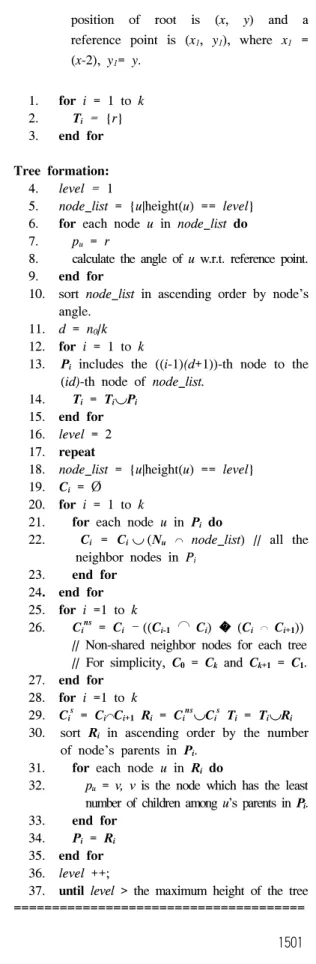
E), a root r. This algorithm first applies aBreadth-First search algorithm to compute a fat tree rooted at the base station [11]. By this way every node in one level will have the information of nodes of the next level. First, nodes keep their height and have multiple parents on the fat tree.
Second, the fat tree is actually a shortest path tree, where branches from the base station to each node are paths with the least hop count, because we use a BFS strategy to build the tree.
NIT Tree Formation Algorithm
======================================
Input: k is the total number of channels.
A graph G=(V,E), root r.
Output: For each node u, let cu
denotes u’s channel, p
udenotes u’s parent and N
udenotes its neighbor set. Assume the number of first hop neighbor is n
0.Use BFS-fat-tree algorithm to construct a fat-tree with rooted at r. Let the
position of root is (x, y) and a reference point is (x
1, y
1), where x
1= (x-2), y
1= y.
1. for i = 1 to k 2. T
i = {r}3. end for
Tree formation:
4. level = 1
5. node_list = {u|height(u) == level}
6. for each node u in node_list
do7. p
u= r
8. calculate the angle of u w.r.t. reference point.
9. end for
10. sort node_list in ascending order by node’s angle.
11. d = n
0/k 12. for i = 1 to k
13. P
iincludes the ((i-1)(d+1))-th node to the (id)-th node of node_list.
14. T
i = Ti◡P
i15. end for 16. level = 2
17. repeat
18. node_list = {u|height(u) == level}
19. C
i= Ø 20. for i = 1 to k
21. for each node u in P
ido
22. C
i = Ci◡ (N
u ◠node_list) // all the neighbor nodes in P
i23. end for 24. end for 25. for i =1 to k 26. C
ins= C
i –((C
i-1◠ C
i) � (C
i ◠C
i+1)) // Non-shared neighbor nodes for each tree // For simplicity, C
0= C
kand C
k+1= C
1. 27. end for
28. for i =1 to k 29. C
is= C
i◠Ci+1R
i = Cins◡C
isTi = Ti
◡R
i30. sort R
iin ascending order by the number of node’s parents in P
i.
31. for each node u in R
ido
32. p
u= v, v is the node which has the least number of children among u’s parents in P
i. 33. end for
34. P
i = Ri35. end for 36. level ++;
37. until level > the maximum height of the tree
======================================
Theorem 1: Trees are non-intersecting and non-overlapping.
Theorem 2: The time complexity of the algorithm is O (d k p
2) where d is the diameterof the graph, the maximum number of nodes in
Riis, p = N(R
i), where, n/k ≤ p < n and k is the number of channels.
3.2.2 Channel assignment
After constructing the tree,the BS will assign the channels for the trees. User can set the channels for the trees but if the user wants to have the option for dynamic channel switching then the user needs to follow our channel order.
If any user wants to use knumber of channels the user can select the channels such a way that no two adjacent trees will get adjacent channels. If the user use odd number of channels like 11, 1 3,…, 25, after that they can use even channels to avoid the inter-tree interference. But whenever the user uses at first the odd channels after that even channels, at the time of selecting channel 12 (number of channels k = 9) , it will create the situation for inter-tree interference between 11 and 12. So, at that time the user can select 14 instead of 12. When k= 10 then the user can select 12 and 14. By this procedure user can avoid inter tree interference.
In our case, as we concerning about dynamic channel switching we divided the channels into some groups to get the benefits of channel switching among the channels of that group in case of external interference. This groups and channel switching will be discussed in the dynamic switching section. According to our groups the order of the channels to assign for the trees is 15, 25, 20, 12, 17, 22, 14, 19, 24, 11, 16, 21, 26, 13, 18, 23. This algorithm is shown in the following Channel Assignment Algorithm.
In our approach there is little more intra-tree interference than the TCMP algorithm. But using CSMA intra-tree interference can be overcome.
3.3 Dynamic Channel Switching
Each tree of the network overcomes the
interference caused by IEEE 802.11b/g by dynamic channel switching without interrupting the whole networks. According to our channel assignment, switching of channel is done by making different channel groups and selecting channels from that group to overcome external interference. We considered in our work the link failure or area blocking is happened bythe interference of IEEE 802.11b/g only because the number of networks overlapping geographically increases. Our mission is to tackle the external interference with dynamic channel switching without interrupting the whole network. We consider that IEEE 802.11b/g is not using channel number 14. It means that channel 26 of IEEE 802.15.4 has no external interference due to IEEE 802.11b/g. We divided all other 15 channels into five groups and channel 26 is kept in one group.
As a result all 16 channels are divided into six groups. The groups are made because when any tree will get interference due to external source then the tree will choose another channel from that group to switch and it will decrease the complexity to choose the channel. It is certain that if any tree experiences interference due to IEEE 802.11b/g, it means that the tree may experience interference for four channels of IEEE 802.11b/g and the tree needs to switch into at least 4 channels away channel. We made the group such a way that the tree can switch to 5 channel away channel. The groups will be created by the equation (a
i+5n), where n = 1, 2, 3; i
=1, 2, 3, 4, 5 and a
i={11,12,13,14,15}. So the
groups are A = {11, 16, 21}, B = {12, 17, 22},
C = {13, 18, 23}, D = {14, 19, 24}, E = {15,
20, 25}, F = {26}. After assigning the channels
for the tree according to our order if any tree
faces interference then at first it checks its group
what it has already known and switch to the next
channel of the group. If all the channels of that
group are already assigned for other trees then
the tree will interchange the channel with the tree
what is using the next channel. Let, a tree is
using channel number 17. It may experience
interference from channels 4, 5, 6, 7 of IEEE
Input parameters
Simulation area 500mx500m
Traffic sources TCP
TCP window 20
Number of nodes 152
Simulation time 100s
Size of data packets 40 Byte
Number of sources 16
Table 1. Simulation Parameters
0 5 10 15 20 25 30 35 40 45 50
1 2 4 8 16
Numbe r of channels
Throughput (Kbps)
Fig. 3. Throughput with the increases of number of channels at fixed number of sources.
0 10 20 30 40 50 60 70
2 4 6 8 10 12 14 16
Numbe r of s ources
Throughput (Kbps)
2 channels 4 channels 8 channels 16 channels
Fig. 4. Throughput for different number of channels and sources
802.11 b/g only because they are overlapped. The interference for channel 3 and 8 is negligible.
When there is interference the tree cannot understand which channels are there. The tree needs to choose a channel which is beyond the band of all four channels. Those 4 channels are overlapped with the channel 14, 15, 16, 17, 18, 19, 20. The tree knows that it is in group B and it will select the next channel 22 that is beyond the band of all four channels whenever channel 22 is unassigned for any tree. If channel 22 is already assigned for other tree then the tree will interchange the channels. By this way, the tree can overcome the interference where the user of WLAN can choose any channels.
In this way the tree will overcome external interference. As each group has three channels so BS can select the other channel forthe tree if the next channel is already assigned and the other channel is free. In this case the nodes under the interference region will switch its channel two times to get the connection with the BS..
Ⅳ. Performance Evaluation
The performance of the network after applying our algorithm is evaluated using network simulator NS-2 (version 2.31). We took a graph of 152 nodes randomly distributed. We applied our algorithm to divide the graph into trees. We use IEEE802.15.4 for each tree to overcome intra-tree interference. We use “ns-random” function to run the simulation differently each time we run the simulation for 100s. The parameters that we considered to perform the simulation are shown in
the Table 1.
To evaluate the throughput performance we
took 16 sources in the network and they all start
to transmit data at a time and simultaneously for
100s. We changed the number of channels and
took output for different cases. The throughput is
calculated by summing up the throughputs of all
transceivers. Figure 3 shows the throughput. It is
observed that with the increase of channel number
the throughput of the network is increased. It
represents that with the increasing of channel
network is diving into more parts and the
probability of the source in different part
increases, so the packets from different sources
reach to the sink simultaneously through different
channel with decreasing collision. From the Figure
3 it is clear that the throughput increased
exponentially and using of 16 channels we can
get maximum.
60 65 70 75 80 85 90 95 100
2 4 6 8 10 12 14 16
Number of sou rces
Delivery ratio (%)
2 channels 4 channels 8 channels 16 c hannels
Fig. 5. Delivery ratio for different number of channels and sources
0 10 20 30 40 50 60
2 3 4 5 6 7 8
Number of channe ls
Throughput (Kbps)
TMCP NIT
Fig. 6. Throughput with changing of number of channels for TMCP and NIT
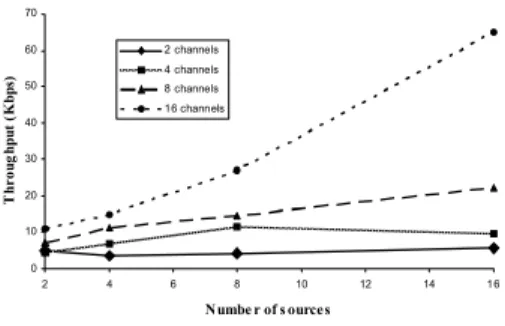
Figure 4represents throughput with changing of number of sources. When 16 channels are used with the increase of source throughput is also increased and it shows the maximum throughput.
Figure 5 shows the delivery ratio with the increase of number of sources keeping the number of channel constant. When more number of channels is used the delivery ratio increased and the delivery ratio is a constant because the network is diving in more parts, so collision and contentions are also decreased. So packet drop is also decreased. In order to compare the performance with TMCP we took another topology of 47 nodes where the maximum number of neighbors of a node was 17. We set 16 sources to send data stream simultaneously.
The sources started to send data packet at the same time. Traffic source was TCP. We applied
both TMCP and NIT algorithm for the topology and the outcome of topology is simulated using NS-2 simulator.
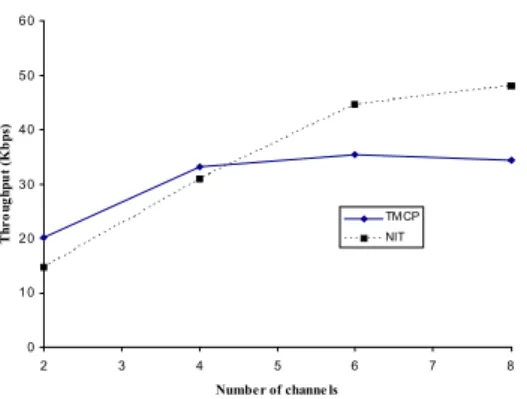
From Figure 6 it is clear that the throughput for NIT is lower than TMCP whenever small number of channel is used but for higher number of channels the throughput is more than TMCP.
Ⅴ. Conclusion
NIT algorithm is not only for making the trees for getting higher throughput but also provides the facility to overcome external interference due to IEEE 802.11b/g in tree-based multi-channel communication in sensor network. The evaluation of the network after implying our algorithm shows better result than other tree-algorithm. Even though the network is considered static,this algorithm can also be applicable for dynamic case where nodes are added or dying. In our approach all 16 channels can be used efficiently. And the most important contribution of algorithm is that the trees can overcome the external interference individually without interrupting the whole network.
References
[1] G. Zhou, C. Huang, T.Yan, T. He, and J. A.
Stankovic, MMSN: Multi-Frequency Media Access Control for Wireless Sensor Networks,”
IEEE INFOCOM, 2006.
[2] J. Zhang, G. Zhou, C. Huang, S. Son, and J.
A. Stankovic, TMMAC: An Energy Efficient Multi-Channel MAC protocol for Ad Hoc Networks,” IEEE ICC, 2007.
[3] X. Chen, P. Han, Q. He, S. Tu, and Z. Chen,
“A Multi-Channel MAC Protocol for Wireless Sensor Networks,” IEEE CIT, 2006.
[4] J. So and N. Vaidya, “Multi-Channel MAC for Ad Hoc Networks: Handling Multi-Channel Hidden Terminals Using A Single Transceiver,”
ACM MobiHoc, 2004.
[5] J. Li, Z. J. Haas, M. Sheng, and Y. Chen,
“Performance Evaluation of Modified IEEE
802.11 MAC for Multi-Channel Multi-Hop Ad Hoc Network,” IEEE AINA,2003.
[6] A. Tzamaloukas and J. J. Garcia-Luna-Aceves,
“A Receiver-Initiated Collision-Avoidance Protocol for Multi Channel Networks,” IEEE
INFOCOM, 2001.[7] P. Bahl, R. Chandra, and J. Dunagan, “SSCH:
Slotted Seeded Channel Hopping for Capacity Improvement in IEEE 802.11 Ad-Hoc Wireless Networks,” ACM MobiCom, 2004.
[8] R. Vedantham, S. Kakumanu, S. Lakshmanan, and R.Sivakumar, “Component based channel assignment in single radio, multi-channel ad hoc networks,” ACM MobiCom, 2006.
[9] H. K. Le, D. Henriksson, and T. F. Abdelzaher,
“A control theory approach to throughput optimization in multi-channel collection sensor networks,” ACM/IEEE IPSN, 2007.
[10] Yafeng Wu, John Stankovic, Tian He, and Shan Lin, “Realistic and Efficient Multi-Channel communications in Wireless Sensor Networks,”
IEEE INFOCOM, April 2008.