LED광원에 따른 감초 지상부의 생리활성 및 성분 평가
방극수1, 장영남1, 진종식1, 박상아1, 임재수2, 박정섭3, 김종성4, 이정호4*
1전북대학교 한약자원학과, 2원광대학교 한약학과, 3대두식품, 4군장대학교 호텔외식조리과
A Comparative Study of Physiological Activity and Ingredient Analysis of Glycyrrhiza uralensis Fischer Stems and Leaves Cultivated with
Different Wavelength of LED Lights
Keuk Soo Bang
1, Young Nam Chang
1, Jong Sik Jin
1, Sang A Park
1, Jae Soo Lim
2, Jeong Sub Park
3, Jong Sung Kim
4and Jeong Ho Lee
4*
1Department of Herbal Medicine Resources, Chonbuk National University, Iksan 570-752, Korea
2Department of Oriental Pharmacy, Wonkwang University, Iksan 570-749, Korea
3Daedoo Food Co., LTD, Kunsan 573-941, Korea
4Department of Culinary Art, Kunjang University, Kunsan 573-709, Korea
Abstract - Glycyrrhiza uralensis Fischer is one of the most commonly used herbs. Recently, the stem and leave of the plant have been interested in physiological activities because the aerial parts have been thrown away. Finding out cultivation method of Glycyrrhiza uralensis Fischer to improve chemical ingredients and biological activities has been tried these days.
In this study, different wavelengths of light emitting diode (LED) were used for a cultivation of Glycyrrhiza uralensis Fischer. Antioxidant activities and inhibitory effect on mutagenecity of samples were evaluated. The stem and leave cultivated under blue light (BL-0) showed the strongest antioxidant activities of 3.02 ± 0.13 ㎍/㎖ (EC50) and 2.18 ± 0.18 ㎍/㎖ (EC50) in DPPH and ABTS radical scavenging test, respectively. Total phenolic content of BL-0 was 2.93 ± 0.11 g/100 g, the highest value between cultivation conditions. However, antioxidant activities of the stem and leave cultivated under red light were the weakest between samples. All of the stem and leave used in this study showed inhibitory effect on mutagenecity of 1-nitropyrene. BL-0 showed stronger inhibitory effects on mutagenicity of Trp-P-1, Trp-P-2, and AFB1 than samples cultivated under other conditions. Only on mutagenecity of 2-aminoanthracene, the stem and leave cultivated at 1 m apart from red light (RL-1) showed the strongest inhibitory effect. These results indicate that blue LED might be the most effective condition for improvement of physiological activities for the aerial parts of Glycyrrhiza uralensis Fischer in cultivation. The components were identified with GC/MS. Cytidine was detected only in RL-1 at 25 min of retention time and 2-bromotrimethylene glycol was detected only in BL-0 at 37 min.
Key words - Glycyrrhiza uralensis Fischer, LED, Antimutagenicity, Antioxidant, Aminopyrazine
*교신저자(E-mail) :[email protected]
서 언
감초 (Glycyrrhiza uralensis Fischer)는 콩과 (Leguminosae) 의 다년생 초본으로 키는 30~80 ㎝이고 기부는 목질화하며 가 지가 많고 어린 줄기에는 털이 있다. 뿌리는 직근으로 아프가니 스탄, 파키스탄, 중국(감숙성, 신강성), 몽골 등에서 총 8종이 알려져 있으며, 근래에 들어 우리나라에서 다량 재배되고 있다
(Lee et al., 2010; Park et al., 2013). 이러한 감초는 해독(解毒) 작용, 진경작용, 진해(鎭咳)작용, 거담(祛痰)작용, 이뇨(利尿) 작용, 항염작용, 항궤양작용, 항알레르기작용, 항바이러스작 용, 항산화작용, 부신피질호르몬작용, 중추억제작용, 근육이 완, 간염, 두드러기, 피부염, 습진 등이 보고되었다(Lee et al., 2010; Lee et al., 2009; Park et al., 2013). 이러한 효능을 나타 내는 주요 성분으로는 glycyrrhizin, glycycoumarin, liquiritin, isoliquiritin, liquirtigenin, isoliquirtigenin, licoricidin, apioside,
Original Research Article
apioliquiritin, glycyrrhetinic acid, glucose, saponin 등이 보 고(Lee et al., 2010; Park et al., 2008) 되었다. 그러나 한의학 적으로 감초와 유사한 효능을 갖고 있는 것으로 알려진 감초의 지 상부는 민간에서 소량 식재료로 사용되고 있을 뿐 대부분 버려 지고 있다. 한편 이러한 감초 잎은 항산화성 및 항염증성, 항유 전독성이 있음이 보고되었으며(Siracusa et al., 2011), 기능성 성 분으로 genistein, pinocembrin, prunetin, 6-prenylnaringenin, licoflavanone, wighteone 등이 분리되었다(Hayashi et al., 2011;
Fukui et al., 1995). 또한 최근연구에서 glabranin isomer, astragalin, isoquercitrin, vicenin II, inositol, pinitol 등 다양 한 성분이 분리되면서 연구소재 및 식품으로의 활용성이 모색 되고 있다(Biondi et al., 2005).
LED (light emitting diode)는 수은을 사용하지 않아 친환경 적이고, 경량이면서 수명이 길고, 전력이 적게 소모된다(Cho et al., 2005). LED광은 전자가 흐르면서 빛이 발생하는 원리를 이 용한 반도체 소자로서 접합하는 화합물을 다르게 하면 다양한 광원을 만들 수 있으며, 사용자가 요구하는 광질을 선택할 수 있 어 활용도가 높다. 현재 식물재배에 LED광을 이용한 연구는 브 로콜리, 수박, 고추, 인삼, 파프리카 등의 작물의 형태 형성과 착색 등에 관한 연구가 대부분이며(Cho et al., 2005; Kim et al., 2012), 현재 LED를 이용하여 감초를 재배한 후 이에 대한 생리활성에 대한 연구는 거의 없는 실정이다.
따라서 본 연구에 있어서는 LED광원이 감초 지상부의 생장 에 미치는 영향을 알아보기 위하여 생리활성 및 활성성분을 분 석하여 새로운 감초 재배법을 개발하기 위한 자료를 조사하고 자 청색광 LED (650 ㎚)와 적색광 LED (450 ㎚)를 이용하여 재 배하였다. 그리고 재배되어진 감초 지상부를 채취하여 음건한 후 항산화활성(DPPH 및 ABTS 라디칼소거활성, 총폴리페놀함 량, 환원력측정)과 항돌연변이원성(Ames test)을 비교·평가하 였으며, GC/MS를 이용하여 함유성분의 차이를 측정하였다.
재료 및 방법
재료 및 시약
본 실험에 사용한 감초는 전북대학교 환경생명과학대학 실 험포장에 청색광 LED (650 ㎚)와 적색광 LED (450 ㎚)를 조사 시키면서 재배한 1년생 감초 지상부를 채취하여 실험에 사용하 였다. 사용된 검체는 청색광 밑에서 재배한 감초 지상부(BL-0), 청색광에서 1 m 떨어진 지점에서 재배한 감초 지상부(BL-1), 청 색광과 적색광에서 2 m 떨어진 지점에서 재배한 감초 지상부
(BR-2), 적색광에서 1 m 떨어진 지점에서 재배한 감초 지상부 (RL-1), 적색광 밑에서 재배(RL-0) 감초 지상부이다.
흡광도는 흡광도계(UV-1601, Shimacuz, Japan)를 이용하 였으며, 항산화 평가는 2,2-diphenyl-1-picrylhygrazyl (DPPH) 및 2,2’-azobis (2-aminopropane) dihydrochloride (AAPH), 2,2`-azino-bis (3-ethylbenzthiazoline-6-sulfonic acid) (ABTS)와 potassium ferricyanide, Iron chloride, ferrozine, Folin-Ciocalteu’s phenol regent, sodium carbonate는 Sigma- Aldrich (St. Louis, MO, USA) 제품을 사용하였고, 돌연변이원 인 3-amino-1,4-dimethyl-5H-pyrido[4,3-b]indole acetate (Trp-P-1), 3-amino-1-methyl-5H-pyrido[4,3-b]indole acetate (Trp-P-2) 등은 Wako사, aflatoxinB1 (AFB1), 1- nitropyrene (1-NP), 2-amino anthracene (2-AA)은 Aldrich Chem. Co.의 제품을 구입하여 사용하였다.
시료 추출
전북대학교 환경생명과학대학 실험포장에서 청색광 LED (650 ㎚)와 적색광 LED (450 ㎚)를 24시간 조사시키면서 재배한 1년생 감초 지상부를 채취한 후 음건하고 시료의 5배의 메탄올 을 가하여 상온에서 168 시간 동안 침지시켜 추출하였다. 이와 같 은 방법으로 3회 반복 추출한 후 얻은 메탄올 추출물을 0.4 ㎛ 필 터로 여과시킨 후 여과액을 감압 농축하여 실험에 사용하였다.
DPPH 라디칼 소거활성
전자공여능(electro donating ability)은 Okawa et al. (2001) 의 방법에 준하여 실시하였다. 즉 0.15 mM 2,2-diphenyl-1- picr-ylhygrazyl (DPPH) 1 ㎖에 시료용액을 농도별로 0.1 ㎖를 혼합하여 37℃에서 30분 동안 반응 시킨 후, 분광광도계(UV-1601, Shimadzu, Japan)를 이용하여 517 ㎚에서 흡광도를 측정하였 다. 각 시료의 농도에 따른 DPPH 라디칼을 소거하여 잔존하는 DPPH 라디칼을 50% 줄일 수 있는 농도(EC50)로 계산하였다.
ABTS 라디칼 소거활성
ABTS (2,2’-azino-bis[3-ethylbenzthiazoline-6-sulphonic acid]) 라디칼 소거활성은 Halvorsen et al. (2002)의 방법에 준 하여 실시하였다. 0.15 M NaCl을 0.1 M potassium phosphate buffer (pH 7.4)를 용해시킨 후 이에 1 mM의 AAPH와 2.5 mM의 ABTS를 넣는다. AAPH와 ABTS가 섞인 시약을 water bath (68℃) 에서 20분 이상 반응시켜(녹색) 흡광도(ABS)를 734 ㎚에서 0.650이 되도록 0.15 M NaCl을 0.1 M potassium phosphate
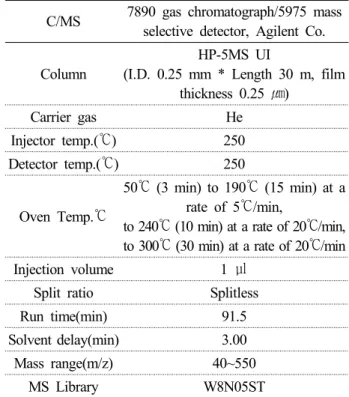
Table 1. Analytical condition of GC/MSD
C/MS 7890 gas chromatograph/5975 mass selective detector, Agilent Co.
Column
HP-5MS UI
(I.D. 0.25 mm * Length 30 m, film thickness 0.25 ㎛)
Carrier gas He
Injector temp.(℃) 250 Detector temp.(℃) 250
Oven Temp.℃
50℃ (3 min) to 190℃ (15 min) at a rate of 5℃/min,
to 240℃ (10 min) at a rate of 20℃/min, to 300℃ (30 min) at a rate of 20℃/min Injection volume 1 ㎕
Split ratio Splitless Run time(min) 91.5 Solvent delay(min) 3.00 Mass range(m/z) 40~550
MS Library W8N05ST
buffer (pH 7.4)로 조정하였다. 시료 20 ㎕와 ABTS 용액 980 ㎕ 를 혼합한 후 이를 암실에서 37℃, 10분간 반응시켰으며, 734 ㎚ 에서 흡광도를 측정하였다. 각 시료의 농도에 따른 ABTS 라디 칼을 소거하여 잔존하는 ABTS 라디칼을 50% 줄일 수 있는 농도 (EC50)로 계산하였다.
환원력 측정
환원력 측정은 Pulido et al. (2000)의 방법을 일부 변형하여 측정하였다. 즉 재배조건을 달리한 감초 지상부 메탄올 추출을 0.5 ㎎/10 ㎖ (DMSO) 농도 용해시킨 시료추출액 25∼200 ㎕에 0.2 M potassium phosphate buffer (pH 6.6) 1 ㎖을 혼합 한 다음 50℃
에서 20분 동안 반응하였다. 반응액에 10% TCA (trichloroacetic acid) 1 ㎖를 혼합한 다음 원심분리하여 상층액 1 ㎖를 취한 다 음, 이에 1 ㎖ 증류수와 0.1% FeCl3 0.2 ㎖를 혼합하여 700 ㎚에 서 흡광도를 측정하였다.
폴리페놀 함량 측정
폴리페놀 함량 측정은 Slinkard et al. (1977)의 방법을 일부 변형하여 측정하였다. 즉 재배조건을 달리한 감초 지상부 메탄 올 추출을 0.5 ㎎/10 ㎖ (DMSO) 농도 용해시킨 시료추출액 0.2
㎖와 증류수 1.8 ㎖, Folin-Ciocalteu`s phenol regent 0.2 ㎖를 혼합하여 5분간 반응 시킨다. 이에 7% Na2CO3 2 ㎖와 증류수 0.8 ㎖를 혼합한 다음 실온에서 90분 동안 반응시킨 후 750 ㎚에 서 흡광도를 측정하였다. 검량선은 gallic acid를 증류수에 용해 시켜 위와 같은 방법으로 측정하였다.
항돌연변이원성 평가
재배조건을 달리한 감초 지상부 메탄올 추출물의 항돌연변 이원성 실험은 Ames test를 개량한 preincubation 방법(Ames et al., 1983)의 방법으로 실시하였다. 미리 멸균시킨 시험관에 각 농도의 변이원 50 ㎕, 0.1 M sodium phosphate buffer 0.5 ㎖ (0.5% S9 mix 0.5 ㎖), 시료 50 ㎕와 Oxoid nutrient broth No.2 에 하룻밤 배양시킨 균 배양액(1~2 × 10⁹ CFU/㎖, OD 0.4)을 혼합하고, 37℃에서 210 rpm으로 20분간 진탕 배양하였다. 배 양액에 미리 준비해 둔 0.5 mM histidine과 biotin을 함유한 top agar 2 ㎖를 혼합한 후 minimal glucose agar plate [agar 15 g, 멸균수 930 ㎖, 50 × VB salt 20 ㎖, 40% glucose 50 ㎖]를 평판 배지 상에 도포하여 37℃에서 48시간 배양하여 발생한 복귀 돌 연변이주(his+ revertant colony)의 수를 계수하여 돌연변이 억 제 효과를 평가하였다. 돌연변이 억제효과는 다음과 같이 계산
하였으며, 각각의 실험은 2 plate씩 2반복 실시하였다.
돌연변이 억제효과
×
M: The number of revertants only in presence of mutagen S0: The number of spontaneous revertants
S1: The number of revertants in presence of mutagen and sample
GC/MS 분석
청색광 LED (650 ㎚)와 적색광 LED (450 ㎚)를 이용하여 재 배한 감초 지상부 메탄올 추출물 1 ㎎을 메탄올 5 ㎖에 희석한 후 sonication (10 min)을 거쳐 0.45 ㎛ filter를 통해 여과시킨 후에 GC/MS 분석을 진행하였다. MS조건은 Scan mode로 진행 하였으며, 분석 조건은 Table 1과 같다(Pederson et al., 1981).
통계분석
통계분석은 SPSS 통계프로그램(Statistical Package for the Social Science, Ver. 12.0, SPSS Inc., Chicago, IL, USA) 을 이용하여 각 측정군의 평균과 표준편차를 산출하고 처리간 의 차이 유무를 one-way ANOVA (analysis of variation)로 분
Table 2. Antioxidant activity of methanol extracts from Glycyrrhiza uralensis Fischer DPPH radical scavenging activity
(EC50, ㎍/㎖)z
ABTS radical scavenging activity
(EC50, ㎍/㎖)z Total phenolic content (g/100 g)z
BL-0 3.02 ± 0.13ay 2.18 ± 0.18ay 2.93 ± 0.11ay
BL-1 3.13 ± 0.28b 2.31 ± 0.21b 2.55 ± 0.09b
BR-2 3.27 ± 0.18c 2.35 ± 0.22c 2.73 ± 0.11b
RL-1 3.29 ± 0.22cd 2.42 ± 0.19c 2.56 ± 0.12c
RL-0 3.28 ± 0.16ce 2.39 ± 0.14d 2.49 ± 0.16b
zEach value expressed as the mean±standard deviation (n = 3).
yMeans in the same column with the different are significantly different (p < 0.05) by Douncan’s multiple range test.
*The conditioning of cultivation of Glycyrrhiza uralensis Fischer;
BL-0; cultivated under blue light
BL-1; cultivated at 1 m apart from blue light BR-2; cultivated at 2 m apart from blue and red light RL-1; cultivated at 1 m apart from red light
RL-0; cultivated under red light.
석한 후 Duncan’s multiple range test를 이용하여 p < 0.05 수 준에서 유의성을 검정하였다.
결과 및 고찰
항산화 평가
LED 광원을 달리하여 재배한 감초 지상부의 DPPH 라디칼 소 거활성 및 ABTS 라디칼 소거활성, 총폴리페놀함량을 측정하였 다(Table 2). DPPH를 이용한 라디칼 소거활성은 BL-0에서 EC50이 3.02 ± 0.13 ㎍/㎖로 가장 높은 라디칼 소거활성이 나타 났다. BL-1에서 EC50이 3.13 ± 0.28 ㎍/㎖로 나타났고, BR-2 에서 EC50이 3.27 ± 0.18 ㎍/㎖, RL-0에서 EC50이 3.28 ± 0.16
㎍/㎖, RL-1에서 EC50이 3.29 ± 0.22 ㎍/㎖로 라디칼 소거활성 을 보였다. ABTS 라디칼 소거활성은 BL-0에서 EC50이 2.18 ± 0.18 ㎍/㎖로 가장 높은 라디칼 소거활성이 나타냈으며, BL-1 에서 EC50이 2.31 ± 0.21 ㎍/㎖, BR-2에서 EC50이 2.35 ± 0.22
㎍/㎖, RL-0에서 EC50이 2.39 ± 0.14 ㎍/㎖, RL-1에서 EC50이 2.39 ± 0.17 ㎍/㎖의 순으로 ABTS 라디칼 소거활성을 보였다.
또한 총 폴리페놀 함량을 측정한 결과 BL-0에서 2.93 ± 0.11 g/100 g으로 가장 높은 폴리페놀 함량을 나타냈으며, BR-2에 서 2.73 ± 0.11 g/100 g, RL-1에서 2.56 ± 0.12 g/100 g, BL-1 에서 2.55 ± 0.09 g/100 g, RL-0에서 2.49 ± 0.16 g/100 g으로 가장 낮은 폴리페놀 함량을 나타냈다.
LED 광원을 달리하여 재배한 감초 지상부의 DPPH 라디칼 소 거활성은 BL-0에서 가장 높은 활성을 나타냈으며, RL-1에서
가장 낮은 활성을 나타났으나 개체간의 라디칼 소거활성의 차 이는 크지 않았다. Park et al. (2011)의 연구에서는 감초 지상부 를 포제하는 과정에서 성분의 변화 및 농축으로 인하여 DPPH 라디칼 소거활성이 차이가 나타났다고 보고한 결과와 비교하면 감초 지상부에서 DPPH 라디칼 소거활성을 나타내는 물질이 열 에 매우 안정한 물질임을 알 수 있다. Siracusa et al. (2011)의 연구에서 감초 잎 메탄올 추출물의 DPPH 라디칼 소거활성은 35.01 ㎍/㎖ (EC50)로 본 연구 보다 다소 약하게 나타났다. 이러 한 결과는 감초의 사용부위와 재배환경에 따른 차이로 보인다.
ABTS 라디칼 소거활성에 있어서 BL-0에서 가장 높은 소거활 성을 나타냈으며, RL-1에서 가장 낮은 소거활성을 나타냈다.
이러한 결과는 DPPH 라디칼 소거활성과 유사하였다. DPPH 라 디칼 소거활성보다 ABTS 라디칼 소거활성이 다소 높게 나타난 경향은 Park et al. (2013)의 감초 지상부의 포제방법에 따른 생 리활성 비교 연구 결과와 유사하였다. 이와 같이 DPPH 라디칼 소거활성과 ABTS 라디칼 소거활성을 측정한 결과 각 개체간의 활성이 크게 차이가 나타나지 않았다. 총폴리페놀함량도 개체 간의 차이가 크지 않은 것으로 보아 감초를 재배하는 과정에서 각 광원들로 인하여 생성되는 특정 성분이나 성분의 함량의 변 화가 거의 없어 생리활성의 차이도 적은 것으로 예상되나, 확인 을 위해 개별 성분들에 대한 정성 및 정량 연구가 더 필요할 것으 로 판단된다.
LED 광원을 달리하여 재배한 감초 지상부 메탄올 추출물을 25, 50, 100 ㎍/㎖을 처리한 후 환원력(reducing power)을 측정 한 결과는 Fig. 1과 같다. BL-0 에서 환원력이 가장 높게 나타났
Fig. 1. Reducing power of methanol extracts from Glycyrrhiza
uralensis Fischer.
*Mean ± standard deviation of triplicate.
*The conditioning of cultivation of Glycyrrhiza uralensis Fischer;
BL-0; cultivated under blue light
BL-1; cultivated at 1 m apart from blue light BR-2; cultivated at 2 m apart from blue and red light RL-1; cultivated at 1 m apart from red light
RL-0; cultivated under red light.
Fig. 2. Inhibitory effect of methanol extracts from Glycyrrhiza
uralensis Fischer on the mutagenicity of 1-NP.
*Mean ± standard deviation of triplicate.
*The conditioning of cultivation of Glycyrrhiza uralensis Fischer;
BL-0; cultivated under blue light
BL-1; cultivated at 1 m apart from blue light BR-2; cultivated at 2 m apart from blue and red light RL-1; cultivated at 1 m apart from red light
RL-0; cultivated under red light.
Fig. 3. Inhibitory effect of methanol extracts from Glycyrrhiza
uralensis Fischer on the mutagenicity of Trip-P-1.
*Mean ± standard deviation of triplicate.
*The conditioning of cultivation of Glycyrrhiza uralensis Fischer;
BL-0; cultivated under blue light
BL-1; cultivated at 1 m apart from blue light BR-2; cultivated at 2 m apart from blue and red light RL-1; cultivated at 1 m apart from red light
RL-0; cultivated under red light.
으며, BL-1과 BR-2, RL-1, RL-0 순으로 환원력이 낮았다. 이 러한 결과는 DPPH 라디칼 소거 활성과 ABTS 라디칼 소거활성, 환원력과 일치하는 것으로 재배환경에 따라 항산화 활성도 차 이가 나타나는 것으로 나타났으나, 개체간 활성의 차이는 크지 않았다(Kim et al., 1995). Park et al. (2013)의 감초 지상부의 포제방법에 따른 생리활성 비교 연구에서 감초 지상부의 포제 방법에 따라 항산화활성이 증가하는 것은 열처리 온도가 증가 함에 폴리페놀 함량도 증가하여 활성이 증가하였다고 보고한 결과와 유사한 활성으로 나타났다.
항돌연변이원성 측정
LED 광원을 달리하여 재배한 감초지상부 메탄올추출물의 1-nitropyrene (1-NP)에 대한 돌연변이 억제효과를 측정한 결 과는 Fig. 2와 같다. S. typhimurium TA98에 있어서 BL-0, BL-1, BR-2, RL-1, RL-0 메탄올 추출물을 각 50, 100, 250, 500 ㎍/㎖의 농도로 처리하였을 때 24~81%, 21~73%, 20~63%, 21~66%, 17~58%의 돌연변이 억제효과를 나타냈다. LED 광원 을 달리하여 재배한 감초지상부의 1–NP에 대한 돌연변이 억제 효과는 BL-0에서 가장 높게 나타났으며, RL-0에서 가장 낮았 다. 1-nitropyrene (1-NP)은 호흡기를 통하여 인체에 흡수되어 산소와 결합하여 ring를 형성한 후 DNA와 결합하여 돌연변이
를 일으키는 물질이다. 디젤엔진이나 화석연료의 불완전산화 에 의해 많이 발생되는 니트로화합물인 1-nitropyrene (1-NP)
Fig. 4. Inhibitory effect of methanol extracts from Glycyrrhiza
uralensis Fischer on the mutagenicity of Trip-P-2.
*Mean ± standard deviation of triplicate.
*The conditioning of cultivation of Glycyrrhiza uralensis Fischer;
BL-0; cultivated under blue light
BL-1; cultivated at 1 m apart from blue light BR-2; cultivated at 2 m apart from blue and red light RL-1; cultivated at 1 m apart from red light
RL-0; cultivated under red light.
Fig. 5. Inhibitory effect of methanol extracts from Glycyrrhiza
uralensis Fischer on the mutagenicity of AFB
1.*The conditioning of cultivation of Glycyrrhiza uralensis Fischer;
BL-0; cultivated under blue light
BL-1; cultivated at 1 m apart from blue light BR-2; cultivated at 2 m apart from blue and red light RL-1; cultivated at 1 m apart from red light
RL-0; cultivated under red light.
은 대도시의 대기 중에 약 57 pg/m3 존재하는 것으로 알려져 있 고, 호흡을 통해서만 인체에 흡입된다(Pederson et al., 1981).
3-amino-1,4-dimethyl-5H-pyrido[4,3-b]indole (Trip-P-1)에 대한 돌연변이 억제효과는 Fig. 3과 같다. S.
typhimurium TA98에 있어서 BL-0, BL-1, BR-2, RL-1, RL-0 를 각 50, 100, 250, 500 ㎍/㎖의 농도로 처리하였을 때 4~42%, 3~39%, 3~33%, 3~35%, 3~29%의 돌연변이 억제효과를 나타 냈다. 즉 BL-0에서 가장 높은 돌연변이 억제가 나타났으며, RL-0에서 가장 낮았다. Trp-P-1은 요리된 생선이나 물고기 등 에서 다량 발견되며, 일반적으로 대부분의 패스푸드에서 발견 되어진다. 특히 Trp-P-1은 단백질 및 지방을 다량 함유하고 있 는 식품을 굽거나 튀길 때 많이 발생된다(Weng et al., 2007).
3-amino-1-methyl-5H-pyrido[4,3-b]indole (Trip-P-2) 에 대한 돌연변이 억제효과를 측정하였다(Fig. 4). 그 결과 S.
typhimurium TA98에 있어서 BL-0, BL-1, BR-2, RL-1, RL-0를 각 50, 100, 250, 500 ㎍/㎖의 농도로 처리하였을 때 12~52%, 12~54%, 9~47%, 9~49%, 11~52%의 돌연변이 억제 효과를 나타냈다. 즉 BL-0에서 가장 높은 돌연변이 억제효과 를, BR-2에서 가장 낮았다. 3-amino-1-methyl-5H-pyrido [4,3-bindole (Trip-P-2)은 신장에서 암을 일으키는 물질로 요 리된 생선에서 발생되며 heterocyclic amine류 돌연변이원이 다(Weisburger, 1993).
Aflatoxin B1에 대한 돌연변이 억제효과를 측정한 결과는 Fig. 5와 같다. S. typhimurium TA98에 있어서 BL-0, BL-1, BR-2, RL-1, RL-0를 각 50, 100, 250, 500 ㎍/㎖의 농도로 처 리하였을 때 각 14~68%, 14~68%, 12~56%, 8~65%, 11~52%의 돌연변이 억제효과를 나타냈다. 즉 BL-1에서 가장 높은 돌연변 이 억제효과를 나타냈고, RL-0에서 가장 낮은 돌연변이 효과를 나타났다. AFB1에 의한 암 유발 원인은 생체내 간의 microsomal enzyme system 가운데 mixed function oxidase에 의해 대사활 성되어 친전자성인 핵산이나 단백질과 함께 첨가 생성물들은 형성함으로써 이들 물질을 불활성 또는 돌연변이를 일으키기 때문이라고 한다(Singer et al., 1983). 이러한 aflatoxin는 인체 에 노출될 경우 강한 발암원으로 간암 발생율을 60배나 증가시 킨다(Eaton and Gallagher, 1994).
2-aminoanthracene (2-AA)에 대한 돌연변이 억제효과를 측 정한 결과는 Fig. 6과 같다. S. typhimurium TA98에 있어서 BL-0, BL-1, BR-2, RL-1, RL-0를 각 50, 100, 250, 500 ㎍/㎖의 농도로 처리하였을 때 각 7~56%, 8~64%, 8~67%, 6~69%, 6~61%
의 돌연변이 억제효과를 나타냈다. 즉 RL-1에서 가장 높은 돌연 변이 억제효과를, BL-0에서 가장 낮았다. 2-aminoanthracene (2-AA)는 aromatic amine류로 염색약, 잉크, 플라스틱, 농약
Fig. 6. Inhibitory effect of methanol extracts from Glycyrrhiza
uralensis Fischer on the mutagenicity of 2-AA.
*Mean ± standard deviation of triplicate.
*The conditioning of cultivation of Glycyrrhiza uralensis Fischer;
BL-0; cultivated under blue light
BL-1; cultivated at 1 m apart from blue light BR-2; cultivated at 2 m apart from blue and red light RL-1; cultivated at 1 m apart from red light
RL-0; cultivated under red light.
Fig. 7. GC/MSD chromatogram of Glycyrrhiza uralensis Fischer.
*The conditioning of cultivation of Glycyrrhiza uralensis Fischer;
BL-0; cultivated under blue light
BL-1; cultivated at 1 m apart from blue light BR-2; cultivated at 2 m apart from blue and red light RL-1; cultivated at 1 m apart from red light
RL-0; cultivated under red light.
등에서 쉽게 발견된다. 또한 에폭시수지나, 폴리우레탄, 화석 연료, 담배, 음식조리 과정 등에서도 쉽게 발견되어 우리와 밀 접하다(Carriere et al., 1992). 이러한 결과는 Siracusa et al.
(2011)의 연구에서 E. coli PQ 37을 이용한 SOS chromotest에 서 감초잎 메탄올 추출물의 4-NQO에 대한 높은 항돌연변이원 성 활성과 유사하였다. 그리고 감초지상부의 항돌연변이원성 의 요인중에 하나는 chlorophyll에 기인하기도 하는데, Kim et al. (1982)은 채소 중의 chlorophyll이 직․ 간접 돌연변이원에 대 해 항돌연변이원성을 나타냄을 보고하였고, Dashwood et al.
(1998)은 chlorophyll의 수용성 유도체인 chlorophyllin은 세균 시험계에 있어서 heterocyclic amines, polycyclicc aromatin hydrocarbons, aflatoxin 등의 많은 돌연변이원에 대해 돌연변 이 억제효과를 나타냄을 보고하였다. 또한 식물 중의 polyphenol 은 항산화뿐만 아니라 항돌연변이원성과도 관련성을 나타내고 있으며, 식물중의 식이섬유, 갈변 물질과 관련성을 보이고 있다 (Yen et al., 1992).
감초는 한방에서 약재들 간에 약성을 조화시키는 등 다양한 효능을 가지고 있어 널리 사용하고 있다. 감초의 주성분은 glycyrrhizin liquiritin, liquirtigenin, licoricidin, apioside, apioliquiritin, glycyrrhetinic acid 등으로 대한약전외한약(생 약)규격집에서 감초는 건조한 후 glycyrrhizin의 함량이 2.5%
이상 함유되어야 한약으로 사용될 수 있다고 규정하고 있다. 그 동안 감초는 우리나라의 기후와 토양 등 재배 조건이 맞지 않아 재배되지 않았으나 최근 감초의 재배법을 개발하여 일부 농가 에서 재배하고 있다. 이에 따라 감초의 재배방법을 개량하여 대 한약전외한약(생약)규격집에서 요구하는 기준치인 glycyrrhizin 의 함량을 2.5% 이상 함유시키는 등 약성이 우수한 감초를 재배 하게 되면 우리나라의 한방산업 및 식품산업의 발전에 많은 도 움이 될 것으로 판단된다. 또한 감초와 유사한 효능을 갖고 있는 지상부는 대부분 버려지고 있어 감초 지상부를 식품 및 약재로 서 이용률을 높이기 위하여 청색광 LED와 적색광 LED를 이용 하여 재배한 후 항산화, 항돌연변이원성을 평가하였다. 그 결과 청색광 LED와 적색광 LED의 재배 환경에 따라 항산화, 항돌연 변이원성의 활성의 변화가 측정되었다. 항산화능력평가 중 DPPH 및 ABTS 라디칼소거활성, 환원력측정, 총폴리페놀함량 에 있어서 BL-0이 가장 높은 활성을 나타났고, RL-0에서 낮은 활성을 나타냈다. 또한 항돌연변이원성 평가에 있어서 직접변 이원인 1-NP에 대하여 모든 실험군에서 돌연변이 억제효과가 나타났으며, 간접변이원인인 Trp-P-1, Trp-P-2, AFB1, 2-AA 에 대해서는 BL-0에서 높은 돌연변이 억제효과를 나타났지만 개체간의 활성의 차이는 크지 않았다. 이러한 결과로부터 청색 광LED에서 재배한 감초지상부에서 항산화활성과 항돌연변이 억제효과가 우수하게 나타나 향 후 청색광 LED를 이용하여 감 초를 재배한 후 함유성분의 변화 및 생리활성연구에 대한 심도
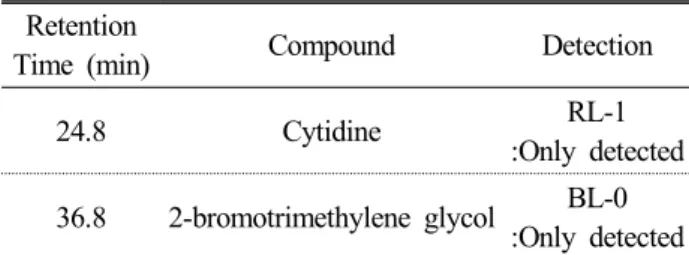
Table 3. GC/MSD analysis of the compounds contained in
Glycyrrhiza uralensis Fischer
Retention
Time (min) Compound Detection
24.8 Cytidine RL-1
:Only detected 36.8 2-bromotrimethylene glycol BL-0
:Only detected
*The conditioning of cultivation of Glycyrrhiza uralensis Fischer;
BL-0; cultivated under blue light
BL-1; cultivated at 1 m apart from blue light BR-2; cultivated at 2 m apart from blue and red light RL-1; cultivated at 1 m apart from red light
RL-0; cultivated under red light.
있는 연구를 진행할 예정이다.
GC/MS 분석
청색광 LED (650 ㎚)와 적색광 LED (450 ㎚)를 이용하여 재 배한 감초지상부의 성분변화를 관찰하기 위해 GC/MS를 이용 해 분석한 결과 모든 추출물에서 비슷한 결과를 보였으나 약 25 분, 37분에서 성분의 차이가 있는 것으로 나타났다(Fig. 7). 25 분에서 RL-1에서만 cytidine이 검출되었고, 37분에서 BL-0에 서만 2-bromotrimethylene glycol이 특정적으로 검출되었다.
이와 같이 화학성분이 특정적으로 검출된 것은 재배환경의 차 이 즉, 청색광과 적색광에 의한 재배환경의 차이에 의한 것으로 판단된다(Table 3).
적 요
LED 광원을 달리하여 재배한 감초지상부의 항산화, 항돌연 변이원성을 평가하였다. BL-0에서 DPPH 라디칼 소거활성에 서 EC50이 3.02 ± 0.13 ㎍/㎖와 ABTS 라디칼 소거활성은 EC50
이 2.18 ± 0.18 ㎍/㎖와 환원력이 가장 높게 나타났다. 폴리페놀 함량은 2.93 ± 0.11 g/100 g으로 가장 높게 나타났으며, RL-0 에서는 항산화 활성이 가장 낮게 나타났다. 항돌연변이원성 평 가에서 직접변이원인 1-NP에 대해 모든 실험군에서 돌연변이 억제효과를 나타냈으며, 간접변이원인인 Trp-P-1, Trp-P-2, AFB1에 대해서는 BL-0에서 가장 높은 돌연변이 억제효과를 나 타냈고, 2-AA에서는 RL-1에서 돌연변이 억제가 높게 나타났 다. 청색광 LED (650 ㎚)와 적색광 LED (450 ㎚)를 이용하여 재 배한 감초지상부의 성분변화를 관찰하기 위해 GC/MS를 이용
해 분석한 결과 25분에서 RL-1에서만 cytidine이 검출되었고, 37분에서 BL-0에서만 2-bromotrimethylene glycol이 특정적 으로 검출되었다. 이는 LED광원 조건에 따라 감초 경엽의 성분 이 차이가 있음을 보여준다. 이 성분들이 생리활성에 어떤 영향 을 주는지는 더 검토해야할 부분이다.
사 사
본 연구는 산업통상자원부와 한국산업기술진흥원의 산업기 술 연구기반 구축사업(N0000004)으로 수행된 연구결과입니다.
References
Ames, B.N. and D.M. Maron. 1983. Revised methods for the S.
typhimurium mutagenicity test. Mut. Res. 113:173-215.
Andriati, N. and S. Matthias. 2014. Carotenoid-cleavage activities of crude enzymes from Pandanous amryllifolius. Chem. Biod.
11:1871-1881.
Biondi, D.M., C. Rocco and G. Ruberto. 2005. Dihydrostilbene derivatives from Glycyrrhira glabra leaves. J. Nat. Prod.
68:1099-102.
Carriere, V., I. Waziers, Y.A. Courtois, J.P. Leroux and P.H.
Beaune. 1992. Cytochrome P450 induction and mutagenicity of 2-aminoanthracene (2-AA) in rat liver and gut. Mut. Res.
268:11–20.
Cho, J.Y., D.M. Son., J.M. Kim., B.S. Seo., S.Y. Yang, J.H. Bae and B.G. Heo. 2008. Effect of LED light quality on the germination, growth and physiological activities of broccoli sprouts. J. Bio-Environment Con. 17:116-123.
Dashwood, R., T. Negishi, H. Hayatsu, V. Breinholt, J. Hendricks and G. Bailey. 1998. Chemopreventive properties of chloro- phylls towards aflatoxin B1: a review of the antimutagenicity and anticarcinogenicity data in rainbow trout. Mutat. Res.
399:245-253.
Eaton, D.L. and E.P. Gallagher. 1994. Mechanism of aflatoxin carcinogenesis. Annu. Rev. Pharmacol. Toxicol. 34:135-112.
Fukui, H., K. Goto and Tabata M. 1998. Two antimicrobial flavanones from the leaves of Glycyrrhiza glabra. Chem.
Pharmacol. Bull. 36:4174-4176.
Halvorsen, B.L., K. Holte, M.C.W. Myhrsted, I. Barikmo, E.
Hvattum and S.F. Remberg. 2002. A systematic screening of total antioxidants in dietary plants. J. Nutr. 132:461-471.
Hayashi H, M. Yasuma, N. Hiraoka, Y. Ikeshiro, H. Yamamoto, E. Yesilada, E. Sezik, G. Honda and M. Tabata. 1996.
Flavonoid variation in the leaves of Glycyrrhiza glabra.
Phytochemistry 42:701-704.
Kim, N.J., Y.H. Jin and N.D. Hong. 1995. Studies on the processing of Crude durge(Ⅳ)-Physico-chemical transforma- tion of glycyrrhizin in Glycyrrhizae radix by processing.
Kor. J. Pharmacogn. 26:31-39.
Kim, S.W., B.S. Tchai, S.C. Park and S.J. Kang. 1982.
Antimutagenic activity of chlorophyll to direct- and indirect- acting mutagens and its contents on the vegetables. Korean J.
Biochem. 14:1-7.
Lee, J.H., K.R. Ze, D.H. Kim, J.Y. Park, Y.H. Shim, J.H. Kim, S. Lim, J.S. Shin, I.S. Kim, J.Y. Kim, S.H. Seong, S.Y. Jang, D.S. Kim and R.S. Seong. 2009. Analysis of liquiritigenin, an aglycone of liquiritin in licorice by high performance liquid chromatography. Kor. J. Pharmacogn. 40:309-314.
Lee, J.R., M.J. Jo, S.M. Park, S.C. Kim and S.J. Park. 2010.
Establishment of UPLC method for analysis of liquiritigenin and studies on the processing of licorice for enhancement of liquiritigenin content. Korean J. Oriental Medical Prescription 18:145-154.
Lee, J.R., S.J. Park, Y.W. Kim, I.J. Choi, S.H. Byun. and S.C.
Kim. 2011. Comparison of antimicrobial effects of corydalis tuber and processed corydalis tuber against propionibacterium acnes. J. Korean Oriental Medical Ophthalmology &
Otolaryngology & Dermatology 24:17-26.
Okawa, M., J. Kinjo, T. Nohara and M. Ono. 2001. DPPH (1,1-diphenyl-2-picrylhydrazyl) radical scavenging activity of flavonoids obtained from some medicinal plants. Biol.
Pharm. Bull. 24:1202-1205.
Park, C.S., D.H. Kim and M.L. Kim. 2008. Biological activities of extracts from corni fructus, astragalus membranaceus and Glycyrrhiza uralensis. Kor. J. Herbology 23:93-101.
Park, J.S., S.H. Park., I.S. Oh., Y.N. Chung., K,S. Bang., E.J.
Byeon and J.H. Lee. 2013. A comparative study of physiological
activity of Glycyrrhiza uralensis Fischer stems and leaves by processing methods. Korean J. Plant Res. 26:539-547.
Pederson, T.C. and J.S. Siak. 1981. The role of nitroaromatic compounds in the direct-acting mutagenicity of diesel particle extracts. J. Appl Toxicol. 1:54-60.
Pulido, R., L. Bravo and F. Saura-Calixto. 2000. Antioxidative activity of dietary polyphenols as determined by a modified ferric reducing/antioxidant power assay. J. Agric. Food Chem.
38:3396-3402.
Rhim, T.J. and M.Y. Choi. 2011. The antioxidative effects of rhododendron brachycarpum extracts. Korean J. Plant Res.
24:456-460.
Singer, B. and D. Grunberger. 1983. Molecular Biology of Mutagens and Carcinogens. Plenum Press, New York (USA).
Slinkard, K. and V.L. Singleton. 1977. Total phenol analysis:
automation and comparison with manual methods. Am. J.
Enol. Vitic. 28:49-55.
Siracusa, L., A. Saija, M. Cristani, F. Cimino, M. D'Arrigo, D.
Trombetta, F. Rao and G. Ruberto. 2011. Phytocomplexes from liquorice (Glycyrrhiza glabra L.) leaves — Chemical characterization and evaluation of their antioxidant, anti- genotoxic and anti-inflammatory activity. Fitoterapia 82:546- 556.
Weng, Y., C. Fang, R.J. Turesky, M. Behr, L.S. Kaminsky and X. Ding. 2007. Determination of the role of target tissue metabolism in lung carcinogenesis using conditional cytochrome P450 reductase-null mice. Cancer Res. 67:7825- 7832.
Weisburger, J.H. 1993. Heterocyclic amines in cooked foods:
possible human carcinogens. Cancer Res. 53:2422-2424.
Yen, G.C., L.C. Tsai and J.D. Lii. 1992. Antimutagenic effect of Maillard browning products obtained from amino acids and sugars. Chem. Toxicol. 30:127-132.
(Received 9 February 2015 ; Revised 13 February 2015 ; Accepted 16 February 2015)