• 검색 결과가 없습니다.

A Study on Trend Monitoring of a Long Endurance UAV s Gas Turbine to be Operated at Medium High Altitude

N/A
N/A
Protected

Academic year: 2021

Share "A Study on Trend Monitoring of a Long Endurance UAV s Gas Turbine to be Operated at Medium High Altitude"

Copied!
5
0
0

로드 중.... (전체 텍스트 보기)

전체 글

(1)

A Study on Trend Monitoring of a Long Endurance UAV’s Gas Turbine to be Operated at Medium High Altitude

Seonghee Kho**, †Jayoung Ki*, Changduk Kong**, Seonghwan Oh***, Jihyun Kim***

** Dept. of Aerospace Eng., Chosun Univ.

375, Seosuk-dong, Dong-gu, Kwangju, Republic of Korea

†* Easy Gas Turbines R&D Co., Ltd.

1412, Dunsan-dong, Seo-gu, Daejeon, Republic of Korea

[email protected]

*** Agency for Defense Development Yuseong P.O. Box 35, Daejeon, Republic of Korea

Abstract

The UAV propulsion system that will be operated for long time at more than 40,000ft altitude should have not only fuel flow minimization but also high reliability and durability. If this UAV propulsion system may have faults, it is not easy to recover the system from the abnormal, and hence an accurate diagnostic technology must be needed to keep the operational reliability. For this purpose, the development of the health monitoring system which can monitor remotely the engine condition should be required.

In this study, a fuzzy trend monitoring method for detecting the engine faults including mechanical faults was proposed through analyzing performance trends of measurement data. The trend monitoring is an engine conditioning method which can find engine faults by monitoring important measuring parameters such as fuel flow, exhaust gas temperatures, rotational speeds, vibration and etc.

Using engine condition database as an input to be generated by linear regression analysis of real engine instrument data, an application of the fuzzy logic in diagnostics estimated the cause of fault in each component.

According to study results, it was confirmed that the proposed trend monitoring method can improve reliability and durability of the propulsion system for a long endurance UAV to be operated at medium altitude.

Introduction

Engine performance diagnostics is performed to predict symptoms which can give rise to severe performance degradations such as compressor blade failures due to contamination, erosion and corrosion by FOD, turbine blade failures due to thermal stress and creep by long time use, corrosion and erosion by corrosive hot gas, rotating shaft and bearing failures due to bearing ware and vibration in operation stage.

The engine condition monitoring method is classified into the model-based condition monitoring that can detect quantitatively faults through comparison between the performance model and measured

performance data, and the traditional trend monitoring method that can identify qualitatively faults including mechanical faults through investigation of performance trend. The model-based condition monitoring can be mostly used for monitoring major gas path component conditions, but it is limited to monitor the mechanical failures. Moreover this method needs more measuring parameters to obtain more accurate diagnostic result, hence it is limited to the aircraft engine health monitoring due to increase of number of sensors and weight penalty. Therefore in order to monitor the engine condition more accurately, additional diagnostic method must be needed [1].

The trend monitoring method that can diagnose the engine condition through investigation of measurement parameter changing trend along with time can be widely applied to not only condition monitoring of major gas path components but mechanical fault detection through analysis of measured vibration data based on experience and knowledge about engine faults [2].

Therefore this work showed an engine condition trend monitoring technique using measured parameters of a turbofan engine. Because the measurement data had nonlinear characteristics, the fuzzy logic was used to analyze effectively this nonlinearity as well as to demonstrate the diagnosed results on engine condition.

Measurement Data of Study Engine

The study engine was the JT8D turbofan of Pratt &

Whitney company with bypass ratio of 0.96~1.74, overall compression ratio of 15.4~21, and total thrust of 14,000~21,000 lbs. The major measurement parameters of this engine were the rotational speeds of low and high pressure rotor shafts, the exhaust gas temperature, the fuel flow rate, and the vibrations at front and rear engine case.

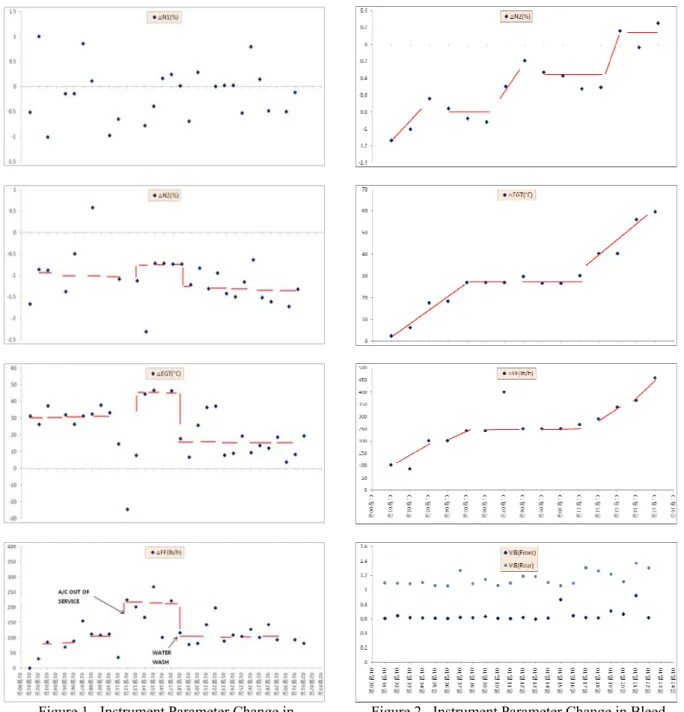
The measuring data when the compressor

contamination occurs have changes along with time as

shown in Fig. 1. In this case the fuel flow rate is

increased along with time, and then decreased after

compressor washing. However the changing

magnitude of the rotor speeds and the vibrations are

small [2].

(2)

Figure 1. Instrument Parameter Change in Compressor Contamination Case

Figure 2 shows monitoring results of measurement parameters when the crack occurred at the bleed duct.

Figure 2. Instrument Parameter Change in Bleed Duct Crack Case

According to performance monitoring results, the bleed duct crack failure induced rapid increase of the low pressure rotor speed, the exhaust gas temperature and the fuel flow rate.

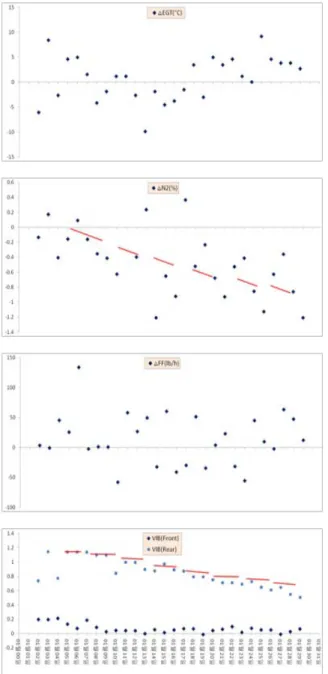
The bearing failure has different performance trend

as shown in Fig. 3.

(3)

Figure 3. Instrument Parameter Variation with Bearing Failure

The bearing failure induced the rapid decrease of the low pressure rotor speed and the front engine case vibration. Therefore, if the changing trend of measurement parameters is investigated as the above, various types of faults such as the compressor contamination, the combustor flame tube failure, the bearing failure, sensor fault, etc can be identified.

Trend Monitoring Algorithms using Fuzzy The fuzzy logic is conceptually easy to understand and tolerant of imprecise data. Also the fuzzy logic can model nonlinear functions with arbitrary complexity and it is based on natural language.

Furthermore, it allows much greater flexibility in formulating system descriptions at the appropriate level of details. In fuzzy systems, the reverse situation prevails. The input and output variables are encoded

in “fuzzy” representation, while their inter- relationships take the form of well-defined if/then rules [5].

In order to identify the faults using the measured parameters, firstly the measurement parameter database which is obtained from various engine conditions must be built, and then the trend of the monitored parameter changes is analyzed by the linear regression [3]. With the slopes obtained by the linear regression the fuzzy rule for fault identification can be generated using the fuzzy logic. The fuzzy rule can explain the physical change magnitude. Therefore it can express values with the range between 0 and 1 depending on the engine condition, and the most possible fault cause has a value nearby 1.

Table 1 shows the results of the slopes on the trend of the monitored parameter changes due to 7 types of engine faults including Fig. 1 and Fig. 2 which were obtained by the linear regression analysis.

If the slopes are analyzed, the order of magnitude of increase or decrease of measured parameter changes can be quantitatively compared. Figure 4 shows the flow of the fuzzy trend monitoring algorithms.

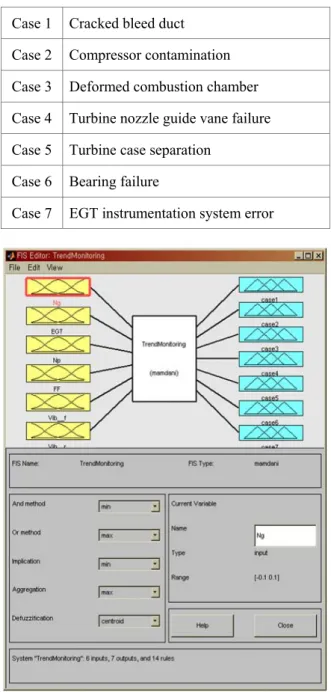
Figure 4. Fuzzy Trend Monitoring Algorithms Using the MATLAB, a fuzzy inference system was developed as shown in Fig. 5 [4].

For this fuzzy inference system the 'MAMDANI' theory was applied, and for difuzzyfication the ' Centroid ' technique was used.

The input parameters of the fuzzy logic are the following 6 measurement parameters.

- High pressure rotor shaft speed (Ng) - Exhaust gas temperature (EGT) - Low pressure rotor shaft speed (Np) - Fuel flow rate (FF)

- Front engine case vibration (Vib_f) - Rear engine case vibration (Vib_r)

The output parameters are the following 7 cases of

faults.

(4)

Table 2. Various Cases of Engine Faults Case 1 Cracked bleed duct

Case 2 Compressor contamination Case 3 Deformed combustion chamber Case 4 Turbine nozzle guide vane failure Case 5 Turbine case separation

Case 6 Bearing failure

Case 7 EGT instrumentation system error

Figure 5. Fuzzy Inference System for Turbofan Engine Trend Monitoring

Result of Fuzzy Trend Monitoring for Turbofan Engine

Table 3 shows the slopes of the trend obtained from 6 scattered measured parameters by the linear regression, and Table 4 shows the magnitude of possibility for fault identification by the fuzzy rule.

Form Table 3, it was found that the ‘A’ slope case which was obtained from the measured parameters using the linear regression has the trend with the decrease of the high pressure rotor shaft speed and the large increase of the fuel flow rate. And from Table 4 obtained by the fuzzy rule, because the case 1of the slope case ‘A’ has the largest magnitude close to 1, the most possibility for fault may be caused by the

bleed duct failure and the 2

nd

possibility would be caused by the compressor contamination.

Table 3. Slopes of Trend Obtained from Measured Data by Linear Regression

Instrument Data Slope (α)

A B Ng -0.02 0.05 EGT 3.02 0.1

Np 0.08 -0.03 FF 16.03 -1.03 Vib_f 0.02 -0.005 Vib_r 0.02 -0.01 Table 4. Magnitude of Possibility for Fault

Identification by Fuzzy Rule

A B

Case 1 0.905 0.250

Case 2 0.750 0.108

Case 3 0.500 0.108

Case 4 0.095 0.75

Case 5 0.095 0.500

Case 6 0.095 0.893

Case 7 0.500 0.107

The ‘B’ slope case shows the trend with the decrease of the low pressure rotor shaft speed, the decrease of the fuel flow rate and the decrease of the front and rear engine case vibration. And because the case 6 of the slope case ‘B’ has the largest magnitude close to 1, the most possibility for fault may be caused by the bearing failure and the 2

nd

possibility would be caused by the turbine nozzle guide vane failure.

Conclusion

In this study, an engine condition trend monitoring

method was newly proposed for fault detection of the

MUAV propulsion system. According to the proposed

trend monitoring method, firstly the measurement

parameter database which was obtained from various

engine conditions was built, and then the trend of the

monitored parameter changes was analyzed using the

slopes obtained by the linear regression. Finally the

most possibility of the engine fault cause was found

using the values obtained by the fuzzy logic. In order

(5)

to adapt this scheme, a fuzzy inference system was developed using MATLAB program.

From the study results, it was confirmed that the proposed engine condition trend monitoring method could find quantitatively and effectively the most possible engine fault causes.

Acknowledgement

This work was supported by research funds from the MUAV conceptual study project of Agency for Defense Development

References

1) Urban, L.A., "Gas Path Analysis Applied to turbine Engine Condition Monitoring", J. of Aircraft, Vol. 10, No. 7, pp. 400~406, 1972 2) Treager, I.E., "GLENCOE Aviation Technology

Series - Aircraft Gas Turbine Engine Technology", McGraw-Hill

3) Lim, J.S., “Matlab's Power“, Ajin, 2002

4) “MATLAB - Fuzzy Logic Toolbox", Mathworks 5) Tsoukalas, L.H. and Uhrig, R.E., 1997, “Fuzzy

and Neural Approaches in Engineering”, John

Wiley & Sons, Inc.

수치

Figure 1.  Instrument Parameter Change in  Compressor Contamination Case
Figure 3.  Instrument Parameter Variation with  Bearing Failure
Table 2.   Various Cases of Engine Faults  Case 1  Cracked bleed duct

참조

관련 문서