Journal of Korean Socieity for Internet Information 2012. Aug: 13(4): 53-62 53
거리정규화 레벨셋을 이용한 칼라객체분할
Color Object Segmentation using Distance Regularized Level Set
란 안 * 이 귀 상 **
Nguyen Tran Lan Anh Guee-Sang Lee 요 약
객체분할은 영상처리와 컴퓨터비전분야의 상당히 어려운 연구대상이다
.
그레이스케일 영상에 대한 영상분할은 매우 많은 방법이 발표되었으며 다양한 영상특징과 처리방법이 제시되었다.
이러한 방법들은 대개 자연상태의 칼라 영상에 적용되기 어렵다.
본 논문 에서는 기하학적인Active Contour
모델의 수정된 형태,
즉 거리정규화레벨셋(distance regularized level set evolution: DRLSE)
을 이용한 방법을 제시하여 스피드 함수가 이러한 칼라요소를 반영하도록 하였으며 실험결과 정확성과 시간효율성에 있어서 우수한 결과를 보 여주었다.
ABSTRACT
Object segmentation is a demanding research area and not a trivial problem of image processing and computer vision. Tremendous segmentation algorithms were addressed on gray-scale (or biomedical) images that rely on numerous image features as well as their strategies. These works in practice cannot apply to natural color images because of their negative effects to color values due to the use of gray-scale gradient information. In this paper, we proposed a new approach for color object segmentation by modifying a geometric active contour model named distance regularized level set evolution (DRLSE). Its speed function will be designed to exploit as much as possible color gradient information of images. Finally, we provide experiments to show performance of our method with respect to its accuracy and time efficiency using various color images.
☞
keyword : Object segmentation(
객체 분할), level set(
레벨셋), active contour model(
능동곡선모델)
1. INTRODUCTION
In recent years, object segmentation has played an important role in researches of image analysis. It is also the first step applied widely to any of applications to extract the content of images for higher processes such as image compression, object recognition, object tracking, and so on.
Actually, the goal of segmentation algorithms is very simple to help a machine understand images as human from thousands of pixels to few regions. These labeled regions must have same particular characteristics and be meaningful.
In literatures, a huge number of segmentation models
* 준 회 원: 전남대학교 전자컴퓨터공학과 석사과정 [email protected]
** 정 회 원: 전남대학교 전자컴퓨터공학과 교수 [email protected](교신저자)
[2012/04/25 투고 – 2012/05/08 심사 – 2012/07/26 심사완료]
☆ A preliminary version of this paper appeared in ICONI 2011, Dec 15-19, Sepang, Malaysia. This version is improved considerably from the previous version by including new results and features.
have been proposed for gray-scale images. However, segmenting dynamic objects in color images cannot be done with satisfactory results until now because of its complexity and diversity. Strategies which most of them rely on are statistics, graph theory, heuristic, differential geometry, and algebra. For examples, they are watershed, k-mean clustering, normalized cuts, region-growing method, mean shift, etc. To obtain acceptable results, these popular methods should be given hints such as markers, seeds, or number of desirable regions with high confidence. Thus, many challenging issues still remain.
Among these techniques, active contour models (or snakes) were represented and improved over time since it seems suitable for this problem in some senses. Although it also needs an initial contour to start evolving, it doesn’t require so high accuracy as others. Besides, there are expected strong points of this model needed in the level set framework. One of them is to be suitable for handling complex and changeable topology, such as splitting and merging a curve. Another is its ability of performing
ISSN 2287-1136 (Online)http://www.jksii.or.kr
numerical computations on Cartesian grid without the parameterization of points on the curve. Due to these advantages, our work here exploits a geometric active contour model called distance regularized level set evolution (DRLSE) developed in [1,2].
The original DRLSE method was only proposed to segment objects in gray-scale images. To apply this approach into color images, there will be some effects on both slowing down processing time if the size of images is large and decreasing computing accuracy if the color value of pixels is converted to its intensity as well as the way to calculate gradient image is chosen. In this paper, we suggest an adjustment in the speed function of this model to enhance performance of segmenting results on natural color images.
This function in its gradient flow equation is altered to use color gradient information rather than traditional gray-valued gradient. To speed up the program, images can be subsampled and also the narrow band algorithm is referred to the implementation progress.
Hence the paper is organized as follows. In section II, we review previous works in object segmentation using active contour models. Section III describes briefly background of the original model in the level set framework together with an idea of speeding up its computational time through the narrow band algorithm. DRLSE method as well as our improvements of using edge information based on color values is discussed in section IV. Given our new model, section V provides experimental results by applying to numerous color images taken from a public database.
Finally, section VI is conclusions to remark our contribution in this paper.
2. RELATED WORK
To segment a particular shape of objects in gray-scale images, active contour models introduced by Kass, Witkins, and Terzopoulos [3] in 1987 has become one of extensive segmentation approaches in image processing. It was also called snakes or deformable models. Its definition is to formulate closed curves or surfaces under an energy minimization framework. It aims at deforming an initial contour to object boundaries under various external forces as constraints determined by users. In spite of few difficulties,
it was used for many applications. Later, the level set method was introduced by Osher and Sethian [4] in 1988 to solve weakness of the beginning active contour models. Its idea is basically to describe a contour as the zero level set of a level set function to control its evolution driven by different forces extracted from a given image and embedded in a speed function [5-10]. It then rapidly became a general framework of most active contour models.
Deformable models can be categorized by the way how their energy functional is formed. They are parametric and geometric active contour models. A parametric model is represented as explicitly parameterized curve in Lagrange formulation. Otherwise, a geometric model has implicit representation and deforms according to Euler formulation based on the theory of evolution and geometric flows [11].
Dependent upon its structure, this level set based model is better and used more and more.
On the other hand, active contour models can be roughly classified by their provided information as well. They are edge- and region-based models. And different criteria to give a measurement of these types are driven from a lot of information as edges, color values, textures in images, or even motion in videos. Hence, numerous edge- and region-based methods have been employed. Among them, distance regularized level set evolution can be considered like a new edge-driven active contour model. In this model, an edge descriptor is computed by using image gradient information to attract the curve toward boundaries of the object where strong edge response appears. Its main target is to solve one of disadvantages of the segmentation problem.
That is it helps eliminate a costly re-initialization procedure of a front depicted in a signed distance function. The experimental results then gave expectative performance in the scope of gray-scale images.
To apply the goodness of DRLSE model to general
images, inheritance by modifying its energy functional
directly or combining its characteristics with other
approaches should be considered to develop new suitable
deformable models for segmenting color objects in a
superior way.
3. BACKGROUND
3.1 GEOMETRIC ACTIVE CONTOUR MODELS A basic active contour model deforms a given closed curve by a speed function F, subject to constraints, in order to detect objects in an image. The speed function here always propagates the curve in normal direction on each its point.
Let Ω be a bounded open subset of
2, with
its boundary, and I
: be a gray-scale image. Early active contours are modeled like a parametric active contour
, : 0,1
0, 2
C s t
with a spatial parameter describing points in the contour and a temporal parameter . However, this definition cannot make the curve be deformed when topological changes occur. And the level set method becomes an effective solution to overcome these situations.
(Figure 1) EVOLUTION OF A CURVE IN THE LEVEL SET FRAMEWORK
The level set method formulates an active contour C(s, t) on a plane as the zero level set of a higher dimensional function x t
,where x
x y
,, called a level set function (LSF), in the space of
3 . Its evolution equation can be written as below
0
0
, , 0 ,
t F
x y t x y
(1)
where the set x y , |
0x y , 0 defines the initial contour. The function
is called a speed function and controls movement of the curve. For image segmentation, the second component in the left-hand side of equation (1) is generally separated into two kinds ofterms, external terms which force the contour toward the desired object boundaries based on image data and internal terms which smoothen out the contour in areas of high curvature.
(Figure 2) THE EVOLVING C OBTAINED BY EXTRACTING THE ZERO LEVEL SET
To improve some problems of the traditional level set methods related to its highly inaccurate computation taking place during the evolution [7,8], the function is initialized as a signed distance function
inside
, 0 on
outside
d x C
x t C
d x C
(2)
where d x min x x
i for all x
i
on the contour
as shown in Figure 2. Although this scheme gives good results owing to the main property
1, it also producesweak points such as the periodically complicated re-initialization progress as well as an undesirable side effect of moving the zero level set away from its original location [8,12].
3.2 THE NARROW BAND ALGORITHM
As normal, results of the level set method belong to
computing the evolution of all level contours of , not just the zero-level one. That requires high complexity, and it is more complicated because there is one more dimension in the level set framework than its origin.
To improve its computing speed, this method needs an effective traversal technique which calculates only in a particular neighborhood of the zero-level contour. This technique is called the narrow band algorithm. It has been a meaningful work to limit the computation on the entire image domain and only concentrate on the zero level set of the level set function. As a result, its complexity of computing N 3 points in three-dimensional space is decreased from O(N 3 ) to O(kN 2 ) where k is the number of windows.
By applying this technique, its cost is reduced significantly.
The basic idea of this method is to mark points on the grid in one of three labels: alive, far away, or land mines.
This labeling belongs to their relative position to the band (i.e. inside, outside, or on the band, respectively). At each step of evolution, one land mines point will become an alive point, and the band is updated by the neighbors of this land mines point.
(Figure 3) LABELING TECHNIQUE IN THE NARROW BAND ALGORITHM
4. DISTANCE REGULARIZED LEVEL SET EVOLUTION APPLIED TO COLOR IMAGES
4.1 COLOR GRADIENT
A color space is the way in which colors are expressed.
In digital images, RGB color space is widely used the most.
However, converting RGB color images into gray-scale images would commonly lead to negative effects. Using only gray-valued gradient information can cause the distortion in color images. Some information to distinguish different colors can also be lost if they have the same gray
value. In this case, sometimes the boundary between objects and background is blurred. Moreover, the conversion from RGB color space to others (such HSV, L*a*b*, etc.) is regularly time-consuming due to its complex computation if the image has large size. In order to enforce the original DRLSE method upon color images, we use the color gradient information itself for gray-valued gradient information to control the movement of the contour because of the richness of information in RGB color space.
Before extracting color gradient information, color image
is convolved with a Gaussian kernel
with a specific standard deviation as
I G I (3)
After that, color gradient components in X and Y direction are computed by choosing the maximum gradient value among three color channels of convolved image
in each direction, respectively. So that the edge indicator function is defined by
2
1 1 max
i g
I
(4)
for all color channels i
1,3.
(a) Original image(b) Edge indicator function (Figure 4) COLOR GRADIENT FOR EDGE DETECTION
4.2 DRLSE
The proposed distance regularized level set evolution (DRLSE) by Li et al. in [1] introduced the following energy functional
R p ext
(5)
where
is the distance regularization term to characterize how close the level set function is to a signed distance function, is a constant controlling this deviation, and
ext is a certain external term depending on user-defined image features.
The regularization term in the image domain can be seen as an internal energy term and is stated that
R
p p
d x
(6)
where p is a double-well potential function [1] provided by the below construction
2
2
1 1 cos 2 if 1 2
1 1 if 1
2
s s
p s
s s
(7)
The external energy term in equation (5) is designed as
ext g d x gH d x
(8)
where is the edge indicator function described by equation (4),
0and
.
is the Heaviside function, and is the univariate Dirac function clarified by
H
.
In this term, the first component computes the length of the zero-level contour of . This energy is minimized when the zero-level contour is located at the boundary of objects. And the second component computes the weighted area of the region inside the zero-level contour of as well as is able to speed up its movement.
By taking the derivative of the level set function with respect to , the energy functional is minimized whilesolving the following gradient flow
div div g g
t
(9)
To implement the above equation in numerical scheme, the univariate Dirac function is usually approximated by a
smooth function
21 1 cos ,
0 ,
x x
x
x
(10)
where is a constant chosen by experiments. The narrow band algorithm [10] is then chosen to reduce the cost of complexity of implementation since it only computes pixels around the zero level set of a curve, not whole an image.
(a) Initial contour (b) Final zero level set
(c) Extracted object (d) Groundtruth mask
(Figure 5) OWL SEGMENTATION BY DRLSE FOR
THE COLOR IMAGE
5. EXPERIMENTS AND ANALYSIS
The initial contour can be a signed distance function or a binary step function defined by
otherwise
if 0
0 0 0
c
R x x c
(11)
where R 0 is a region in image domain, and c 0 0 is constant. Then, the discretization of evolution equation (9) is followed by the following difference equation
i k j k j
k i j
i , 1 , L ,
(12)
where , k
L
i j is the approximation of the right-hand side in (9) by the spatial difference scheme approximated by the central difference for partial derivatives and the forward difference for temporal derivative.
To express segmentation performance of our modification in this paper, the implementation of DRLSE method in color images has been carried out by using various natural images on Berkeley database provided at [13]. A PC of Core(TM)2 6700 2.67GHz and 2GB RAM is used to run the author’s source code [14] in the environment of Matlab 2011a. In numerical implementation, all experiments are tested based on two different approaches, both full domain and narrow band algorithm [1]. For all experiments here we let some parameters be constant as μ = 0.02, λ=5, ν=3, =1.5 and the time step τ=10.
(a) Original image
(b) Initial contour (c) Extracted object
(d) Contour movement at 20
th
iteration
(e) Contour movement at 40
th
iteration
(f) Contour movement at 66
th
iteration
(Figure 6) EVOLUTION PROGRESS OF OUR
PROPOSED MODEL IN A COLOR IMAGE
First, we apply the proposed algorithm to a 321×481 image in 74 iterations. Its result is shown in figure 6. Figure 6(a) is the original image. Its initial zero-level contour is represented by a yellow rectangle in figure 6(b). White
regions in figure 6(c) are objects segmented from the image background. Figure 6(d), (e), and (f) are in turn results got at 25 th , 50 th , and 74 th steps of evolution and take approximately 17.4, 36.1, and 54.3 seconds respectively.
When applying the narrow band algorithm to this image, the segmentation results the same but its computing cost is only 38.9 seconds for whole 66 iterations. It means that this algorithm helps our improved method do faster than its original calculation approach.
(a) Original image (b) Groundtruth mask Case 1: Color image
(c) Initial contour (d) Extracted object Case 2: Converted gray-scale image
(e) Initial contour (f) Extracted object
(Figure 7) COMPARISON OF SEGMENTATION
OF DRLSE METHOD IN TWO CASES
In figure 7, we compare results of segmenting an object in two cases: color image and its gray-scale conversion.
Both of their evolution have the same initial contours and
are stopped after 100 iterations. For the color case, DRLSE
method can extract main objects as accurately but not so
smooth as given ground truth image when using our
adjustment in its edge indicator function. Compared with the
gray-scale case, we see that the active contour in case 2
cannot finish evolving to the boundary of objects in the
same number of iterations when converting the image to
gray-scale value. Furthermore, segmenting objects in gray-scale images is slower. In this figure, it spends around 135 seconds in computing for the color case. But for the gray-scale case, the algorithm needs more than 200 seconds.
The difference between two periods of time is fabulous.
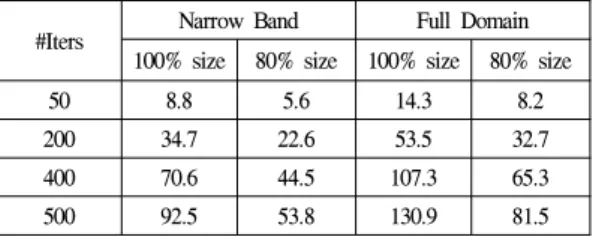
Table 1 is given to compare the computation time (in seconds) between the full domain implementation and the narrow band algorithm with or without a subsampling step.
In this table, it remarks that the narrow band based implementation runs faster than the full domain approach.
Additionally, using more and more image subsampling can speed up the deformation of contours. But it may cause errors in identifying the boundary location if the size of original images is decreased too much. There should be a tradeoff between subsampling step and accuracy of the segmentation.
(Table 1) COMPARISON OF COMPUTATION TIME OF IMPLEMENTATION IN TWO DIFFERENT WAYS
#Iters Narrow Band Full Domain 100% size 80% size 100% size 80% size
50 8.8 5.6 14.3 8.2
200 34.7 22.6 53.5 32.7
400 70.6 44.5 107.3 65.3
500 92.5 53.8 130.9 81.5
Next, figure 8 demonstrates segmentation results by trying our improvement on DRLSE in numerous color images. The zero level set of contour is presented by a yellow front enclosing the main object. The first column gives original images together with their initial contour. In the second column, segmentation results are given. And their binarized results are shown in next column. The fourth column is groundtruth masks provided by the database for visual comparison. Based on this figure, weak points of our algorithm are shown and analyzed. First, all color images should be assumed that color value of the background is at least nearly homogeneous. For example, in figure 8(a), (d), and (f), if their background is almost uniform, contours can evolve to desirable objects easily. Final results are also acceptable when comparing to given groundtruth masks. On
the contrary, segmentations in figure 8(b) and (e) are failed since their background is inhomogeneous caused by the grass and small flowers. Due to them, the gradient value is not strong enough to shrink contours toward the boundary.
In addition, the difference of color values between segmented object and others in images should also be large enough to be able to distinguish mutually. In figure 8(g), even though its background is homogeneous, its segmentation is still failed. The reason is that color values of the focused object and background are quite same. Thus there appears a weak boundary problem between them. One more disadvantages is that the model can only segment all mixed objects in an image as one group. It means that we cannot separate them into different ones from each other since they are very close or stuck together as in figure 8(a) and (c). Especially, in figure 8(a), it will be more meaningful if the grasshopper and the leaf are split as two distinct objects. Finally, in the scope of this paper, the active contour has to be initialized to be completely inside or enclose whole the desirable objects.
6. CONCLUSIONS
In this paper, we modified the edge indicator function
used in DRLSE method based on the color gradient aiming
to color information. The experimental results show that the
active contour here can fit mostly the boundary of
expectative objects more than in converted gray-scale
images. Besides, this method integrated with the narrow
band algorithm and subsampling step helps decrease the
computation time a lot. In some senses, our changes in this
paper have got acceptable performance in terms of accuracy
and time efficiency. Simultaneously, section V mentions
disadvantages of our approach which should be improved in
the future. Hence, our coming research is to keep
concentrating on segmenting dynamic-shaped objects in
natural color images. Not only the final zero level set of
contour is able to fit the boundary more exactly even if
there exists the presence of weak boundaries, but also the
contour is initialized more flexibly.
Original image with its initial contour
Segmented result Extracted object Groundtruth mask
(a)
(b)
(c)
(d)
(e)
(f)
(g)
(Figure 8) SEGMENTATION RESULTS WITH VARIOUS COLOR IMAGES
7. ACKNOWLEDGEMENT
This research was supported by Basic Science Research Program through the National Research of Korea (NRF) funded by the Ministry of Education, Science and Technology (2011-0029429) and (2012-0004742)
References
[1] Chunming Li, Chenyang Xu, Changfeng Gui, and Martin D. Fox, “Level set evolution without re-initialization: A new variational formulation,”
Proceedings of the 2005 IEEE Computer Society Conference on Conputer Vision and Pattern Recognition, CVPR, Vol. 1, 2005, pp. 430-436.
[2] Chunming Li, Chenyang Xu, Changfeng Gui, and Martin D. Fox, “Distance regularized level set evolution,” IEEE Transactions on Image Processing, Vol. 19, No. 12, Dec. 2010, pp. 3242-3254.
[3] M. Kass, A. Witkin, and D. Terzopoulos, “Snakes:
active contour models,” International Journal of Computer Vision, Vol. 1, 1987, pp. 321-331.
[4] S. Osher and J. Sethian, “Fronts propagating with curvature-dependent speed: Algorithms based on Hamilton-Jacobi formulations,” Journal of Computational Physics, Vol. 79, No. 1, Nov. 1988, pp. 12-49.
[5] V. Caselles, R. Kimmel, and G. Sapiro, “Geodesic active contours,” in International Journal of Computer Vision, 1997, pp. 61-79.
[6] Chenyang Xu and Jerry L. Prince, “Gradient vector flow: A new external force for snakes,” in IEEEProc. Conference on Computer Vision and Pattern Recognition, CVPR, 1997, pp. 66-71.
[7] S. Osher and R. Fedkiw, “Level set methods and dynamic implicit surfaces,” in Springer, New York, 2003.
[8] J. A. Sethian, “Level set methods and Fast marching methods,” in Cambridge University Press, Cambridge, 1999.
[9] Tony F. Chan and Luminita A. Vese, “Active contours without edges,” in IEEE Transactions on Image Processing, Vol. 10, No. 2, Feb. 2001, pp. 266-277.
[10] Chunming Li, Chenyang Xu, Kishori M. Konwar, and Martin D. Fox, “Fast distance preserving level set evolution for Medical image segmentation,”
IEEE International Conference on Control, Automation, Robotics and Vision, ICARCV, 2006, pp. 1-7.
[11] H.J. Wang, M. Liu, and W.L. Ma, “Color Image Segmentation Based on a New Geometric Active Contour Model,” IEEE International Conference on Machine Vision and Human-machine Interface, Apr.
2010, pp. 6-9.
[12] T. Brox, A. Bruhn, and J. Weickert, “Variational motion segmentation with level sets,” in Computer Vision, ECCV 2006, pp. 471-483, Springer.
[13] http://www.eecs.berkeley.edu/Research/Projects/
CS/vision/grouping/resources.html
[14] http://www.engr.uconn.edu/~cmli/DRLSE/
◐ 저 자 소 개 ◑
란 안 (Nguyen Tran Lan Anh)2009 University of Science Ho Chi Minh City, Bachelor of Math and Computer Science, 2012~present Chonnam National University, Master of Electronics and Computer Engineering Interests: multimedia and image processing, computer vision
E-mail: [email protected]
이 귀 상 (Guee-Sang Lee)