Inhibition Effect of Phenolic Compounds from Ultra-fine Ground Chrysanthemum indicum L. on Xanthine Oxidase
Young-Je Cho1, Byung-Oh Kim1, Hye-Jin Park1, Eun-Ho Lee1, Jae-Bum Jo1, Jae-Eun Lee1, Su-Bin Lim1, Ye-Jin Kim1, Ki-Tae Park2 and Moo-Young Choi3*
1School of Food science & Biotechnology / Food & Bio-Industry Research Institute, Kyungpook National University, 80 University Street, Bukgu, Daegu 41566, Korea
2School of Culinary Art and Baking technology, Dongju College University, 16 Sari-ro 55 street, Saha-gu, Busan 49318, Korea
3Department of Food and Nutrition, College of Health Science, Sangji University, Wonju 26338, Korea Received April 4, 2017 /Revised June 8, 2017 /Accepted June 19, 2017
In this study, the extracted phenolic compounds from 98 species of oriental herbal medicine were ex- amined for biological activities to be used as functional resources. In particular, the anti-gout effect by xanthine oxidase (XOase) inhibition was determined using water and ethanol as extraction solvents because of their non-toxicity in the human body. The extracts of Chrysanthemum indicum L. (83.45%), Cuscuta chinensis (60.22%), Asiasarum sieboldi F. Maekawa (51.66%), Acorus gramineus (67.8%), Aconitum pseudo-laeve var. erectum (75.23%), Thuja orientalis (47.27%), Polygonum aviculare (53.98%), Carthami semen (63.99%), and Syzygium aromaticum (40.22%) showed relatively high XOase inhibitory activity.
Chrysanthemum indicum L. was selected for its high XOase inhibitory activity. The biological compounds in Chrysanthemum indicum L. were identified to contain phenolics included in extracts of solids. Ultra- fine grind technology showed a higher extraction yield than normal grind and fine grind technology.
Ethanol extracts showed relatively higher XOase inhibitory activity than water extracts. XOase in- hibitory activity increased in a dependent manner as phenolic concentration increased. Therefore, ul- tra-fine grind technology was confirmed for use in increasing the extraction yield of XOase inhibitory compounds from Chrysanthemum indicum L.. Extracts from Chrysanthemum indicum L. are expected to be a useful functional resource for the prevention or treatment of gout.
Key words : Chrysanthemum indicum L., extracts, phenolics, ultra-fine grinding, xanthine oxidase inhibition
*Corresponding author
*Tel : +82-33-738-0497, Fax : +82-33-738-7652
*E-mail : [email protected]
This is an Open-Access article distributed under the terms of the Creative Commons Attribution Non-Commercial License (http://creativecommons.org/licenses/by-nc/3.0) which permits unrestricted non-commercial use, distribution, and reproduction in any medium, provided the original work is properly cited.
Journal of Life Science 2017 Vol. 27. No. 8. 902~908 DOI : https://doi.org/10.5352/JLS.2017.27.8.902
서 론
현대 인류가 직면한 환경오염이나 다양한 스트레스로 의한 질병이 심각한 사회 문제로 부각됨에 따라 건강한 먹거리를 통한 건강지향적인 식생활을 영위하며, 기능성식품의 가치가 증가되게 되었다. 이들 기능성 식품에 대한 관심과 더불어 천 연 생리활성물질에 대한 관심도 높아지게 되었는데, 주로 식 물체에 존재하는 생리활성물질에 대한 연구 및 이들의 가공방 법 등에 대한 연구가 주목 받고 있다[13].
감국(Chrysanthemum incidicum L.)은 국화과(Compositae) 국화속(Chrysanthenum)에 다년생 초본으로, 노란 꽃이 피며 이 꽃을 건조시킨 것을 감국으로 부르고 있다[19, 25]. 주요 성분으로는 플라보노이드 화합물과 sesquiterpene lactone 화
합물이 보고되어 있다[24]. 감국에 대한 약리적 효과는 항염증 및 면역조절활성[2, 27] 등이 있는 것으로 보고되어 있다. 또한 감국은 미용적인 측면에서도 여드름과 해독, 보습효과가 있다 고 알려져 있다[17]. 민간에서 약용이나 전통식품 등에 널리 이용되어 온 감국은 해열 작용이 있어 폐렴이나 기관지염 치 료에 이용되어 왔으며, 두통과 현기증 완화, 피부질환 완화, 동맥경화나 고혈압 및 위염에 좋은 효능을 가지는 것으로 알 려져 있다[8, 10].
통풍은 핵산계 물질인 purine 대사의 이상으로 혈청내에 요산의 농도가 높아지고, 높아진 요산 농도에 의해 침상 모양 의 요산염 결정이 관절 및 신장 등에 침착되어 급성염증을 일으키며, 통증과 발열 및 관절부종을 일으키는 급성관절 질 병으로 재발율이 매우 높다[14]. 통풍이 유발되게 되면 염증 반응이 동반되게 되고, 염증반응으로 인해 NO (iNOS에 의해 생산)와 PGE2 (COX-2에 의해 생산) 및 염증반응의 전사인자 인 NF-kB, TNF-α 등의 cytokine이 만들어지게 된다[23]. 최근 서구화된 식문화로 인해 야기되는 비만 등의 다양한 원인으로 발병율이 높아지게 되고[18], 통풍증상의 완화 또는 치료를 위 하여 주로 우수한 xanthine oxidase (XOase)의 저해능을 가지 는 천연물을 대상으로 많은 연구가 수행되어 왔다[9, 15, 21].
통풍의 치료는 의학분야에서 긴 전통을 가지고 있으나, 최근 식이요법의 새로운 방향이 제시되고 기존에 쓰던 약물에 저항 을 보이는 환자에게 사용될 수 있는 새로운 요산 강하제가 개 발되어 기능성 식품 분야에 적용되는 등 변화를 보이고 있다.
초미세 분쇄는 최근 식품분야의 첨단 기술로 식품재료의 표면적을 극대화시켜 생리활성물질의 용해도를 높이는데 활 용되고 있으며, 유용물질인 phenolic 화합물들의 추출 수율을 높이는 등 기존의 식품가공의 문제들을 해결할 수 있는 핵심 기술이다[16]. 이러한 초미세 분쇄기술은 단순 1차 가공처리 기술을 넘어서 한약재 등에 함유된 생리활성 물질의 용해도를 증진시켜 체내 흡수율을 높이는 고부가 가치 소재의 가공 기 법으로 활용될 수 있다[11, 12].
본 연구에서는 초미세 분쇄 가공을 이용하여 phenolic 화합 물의 추출 수율과 통풍억제 작용을 하는 XOase 저해활성을 탐색하여 약용작물의 부가가치를 높이고자 하였다.
재료 및 방법
시료의 선정
본 실험에 사용된 시료는 대구 약령시장 및 한의원에서 한 약재로 사용되는 98종을 구입하여 40 mesh의 체눈을 통과하 는 분말로 만들어 시료로 사용하였다(Table 1).
추출물의 제조
물 추출물의 경우 시료 1 g에 증류수 200 ml을 넣고 액이 100 ml가 될 때까지 가열한 후 냉각하고 ethanol 추출물은 시료 에 100 ml의 70% ethanol을 가하고 homogenizer로 20,000 rpm에서 1분간 균질화 시킨 후 24시간 동안 교반 추출하였으 며, 추출액은 Whatman No. 1 filter paper (Whatman inc, Piscataway, New Jersey, USA)로 여과한 후 필요에 따라 ro- tary vacuum evaporator (Rotavapor R-200, Buchi Labortech- ninik AG, Flawil, Switzerland)에서 농축하여 시료로 사용하 였다.
미쇄 분쇄와 초미세 분쇄 시료의 제조
본 실험에서 사용된 시료는 45℃ 건조기에서 열풍 건조시킨 감국을 10 l 용량의 초미세 분쇄장치(MKFS10-1, Koen 21 Co, Ansan, Korea)를 이용하여 시간당 20 kg의 grinding 속도로 fine grinding (125 μm ISO mesh size, ASTM 140 mesh : 초과 사이즈)과 ultra-fine grinding (125 μm ISO mesh size, ASTM 140 mesh : 미만 사이즈)으로 나누어 분쇄 사용하였다.
Phenol성 화합물의 정량
Phenol성 화합물의 정량은 Folin과 Denis 방법[6]에 준하여 측정하였다. 추출물 2 ml에 5% Na2CO3 용액 240 μl를 가하고 발색 시약으로 1 N-folin ciocalteu reagent 120 μl를 넣고 잘
섞어준 뒤, 10분간 방치하여 발색시키고, 흡광도 725 nm에서 1시간 이내에 흡광도를 측정하여 gallic acid를 이용한 표준곡 선으로 양을 환산하였다.
추출물의 용매분획
추출물 건조분말에 H2O, n-butanol, ethylacetate를 1:100으 로 가하여 용매 분획 하였으며, 용매 분획물은 Whatman No.
1 filter paper (Whatman inc, Piscataway, New Jersey, USA) 로 여과한 후 필요에 따라 rotary vacuum evaporator (Rotava- por R-200, Buchi Labortechninik AG, Flawil, Switzerland)에 서 농축하여 시료로 사용하였다.
추출물의 통풍억제(XOase 저해)효과 측정
XOase 활성 저해 측정법은 Stirpe와 Corte의 방법[22]에 준 하여 측정하였다. 즉, 반응구는 0.1 M potassium phosphate buffer (pH 7.5)에 xanthine 2 mM (Sigma-Aldrich Co, St.
Louis, MO, USA)을 녹인 기질액 3 ml에 효소액 0.1 ml와 추출 용액 0.3 ml를 넣고 대조구에는 추출용액 대신 증류수를 0.3 ml 첨가하여 37℃에서 30분간 반응시키고 20% trichloroacetic acid (TCA) 1 ml를 가하여 반응을 종료시킨 다음 원심분리하 여 단백질을 제거한 후 반응액 중에 생성된 uric acid를 흡광도 292 nm에서 측정하여 저해율(%)은 1 - 시료첨가군의 uric acid 생성량/대조구의 uric acid 생성량×100으로 환산하였다.
통계분석
본 실험의 결과는 6회 반복하여 측정한 평균값을 나타내었 으며, 평균±표준편차로 나타내었다. 통계처리는 SPSS 7.5 for windows 프로그램(Statistical Package for Social Science, Chicago, IL, USA)을 이용하여 통계처리 하였고 분산분석 (analysis of variance) 및 Duncan의 다중범위검정법(Dun- can's multiple range test)으로 95% 수준에서 유의성을 검정하 였다.
결과 및 고찰
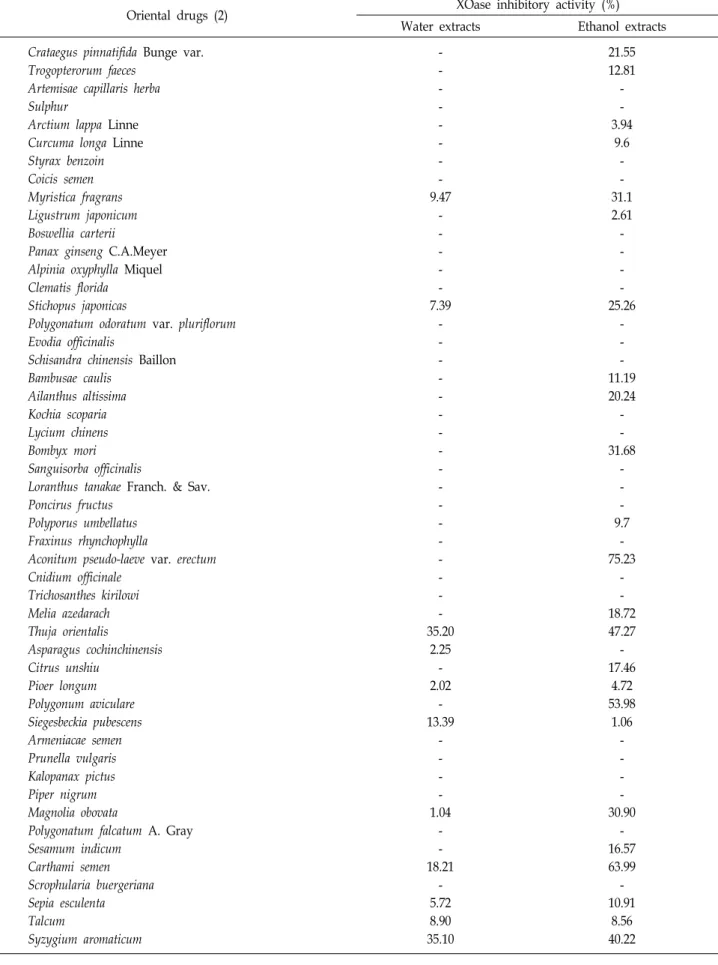
약용작물 추출물의 페놀함량 및 XOase 저해 활성 측정 천연자원 중 식물체에 존재하는 phytochemical인 폴리페놀 화합물이나 플라보노이드 화합물은 강한 항산화 기능을 가지 는 등 생리활성 물질로 작용할 수 있다는 여러 연구들이 행해 져 왔다[1]. 생체 내 purine 대사에 관여하는 XOase는 대사생 성물인 침상의 urate를 형성하며, 생성된 urate는 혈장 내 ur- ate 농도를 증가시켜 관절 등에 축적되어 통증이 동반되는 통 풍을 일으키는 효소이다. 이러한 XOase를 저해하는 천연 물질 을 찾기 위해 본 연구에서는 98종의 한약재로부터 물과 60%
ethanol을 용매로 하여 생리활성물질을 추출하여 XOase의 저 해 효과를 측정하였다. 그 결과 Table 1에서와 같이 80% 이상
Table 1. XOase inhibitory activity of extracts from oriental drugs
Oriental drugs (1) XOase inhibitory activity (%)
Water extracts Ethanol extracts
Control
Curcuma aromatic Lycium chinensis Mill Euryale ferox Salisb Fruits
Sophora flavescens Solander ex Aiton Glycyrrhiza uralensis
Lonicera japonica Thunberg Flower Platycodon grandiflorum A. De Candolle Angelica koreana L.
Teucrium veronicoides Cinnamomum zeylanicum Zingiber officinale Roscoe Deer antler
Raphanus sativus L.
Phragmites communis Trinius Angelica gigas Nakai Zizyphus jujuba Mill. var.
Vitex rotundifolia F.
Equiseti herba
Chrysanthemum indicum L.
Commiphora molmol Engl.
Liriope platyphylla Ephedra sinica
Aucklandia lappa Decne Rubus coreanus Miquel Angelicae dahuricae Radix Tribulus terrestris L. Fruits Silkworm
Mentha arvensis var. piperascens Alumen
Tortoise·shell
Polygonum multiflorum Astragalus membranaceus Cuscuta chinensis Poria cocos Wolf Curcuma zedoaria
Saposhnikovia divaricata Schiskin Ginkgo biloba
Areca catechu L.
Magnolia kobus Saururus chinensis
Cryptotympana pustulata Fabricus Bupleury radix aqueous
Asiasarum sieboldi F. Maekawa Dioscorea japonica Thunberg R. radix Preparata
Morus alba L.
Acorus gramineus Cornus officinalis
- - - 8.86
- - 5.67
- - - 6.78
- 10.68
- 13.25
- - - - 67.53
- - - - - - - - - - - 3.08
- - 3.05
- - - 27.84 35.07 6.63
- - - 23.68
- - - 4.96
- - - 37.33 25.80 - 10.33
- - - - - - - - - - - - 83.45
- - - - - - - - - - - 34.07 20.79 60.22 7.36 - - 10.50 30.28 6.34 30.75 4.21 - 51.66
- 19.51 21.38 67.84 3.81
Table 1. Continued
Oriental drugs (2) XOase inhibitory activity (%)
Water extracts Ethanol extracts
Crataegus pinnatifida Bunge var.
Trogopterorum faeces Artemisae capillaris herba Sulphur
Arctium lappa Linne Curcuma longa Linne Styrax benzoin Coicis semen Myristica fragrans Ligustrum japonicum Boswellia carterii
Panax ginseng C.A.Meyer Alpinia oxyphylla Miquel Clematis florida
Stichopus japonicas
Polygonatum odoratum var. pluriflorum Evodia officinalis
Schisandra chinensis Baillon Bambusae caulis
Ailanthus altissima Kochia scoparia Lycium chinens Bombyx mori Sanguisorba officinalis
Loranthus tanakae Franch. & Sav.
Poncirus fructus Polyporus umbellatus Fraxinus rhynchophylla
Aconitum pseudo-laeve var. erectum Cnidium officinale
Trichosanthes kirilowi Melia azedarach Thuja orientalis
Asparagus cochinchinensis Citrus unshiu
Pioer longum Polygonum aviculare Siegesbeckia pubescens Armeniacae semen Prunella vulgaris Kalopanax pictus Piper nigrum Magnolia obovata
Polygonatum falcatum A. Gray Sesamum indicum
Carthami semen Scrophularia buergeriana Sepia esculenta Talcum
Syzygium aromaticum
- - - - - - - - 9.47
- - - - - 7.39
- - - - - - - - - - - - - - - - - 35.20
2.25 - 2.02
- 13.39
- - - - 1.04
- - 18.21
- 5.72 8.90 35.10
21.55 12.81 - - 3.94
9.6 - - 31.1 2.61 - - - - 25.26
- - - 11.19 20.24 - - 31.68
- - - 9.7
- 75.23
- - 18.72 47.27 - 17.46
4.72 53.98
1.06 - - - - 30.90
- 16.57 63.99 - 10.91
8.56 40.22
Fig. 1. The phenolic content in extracted solid from Chrysanthe- mum indicum. The data were expressed as the mean ± SD (n=6), p<0.05.
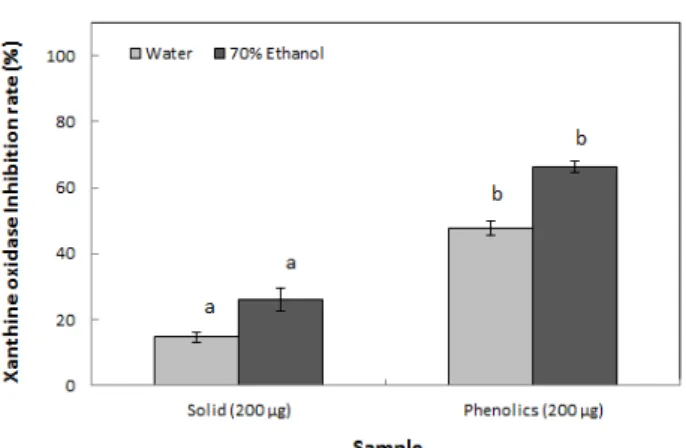
Fig. 2. The XOase inhibitory activity of extracted solid and phe- nolic at 200 μg concentration from Chrysanthemum indicum.
The data were expressed as the mean ± SD (n=6), p<0.05.
Table 2. Content of solid extracts from Chrysanthemum indicum L. by grinding technique
Grinding technique Solid content (mg/sample g) Water extracts Ethanol extracts Normal grinding
Fine grinding Ultra-fine grinding
252.1±4.8 256.3±7.6 305.6±3.8*
330.6±10.5 336.8±12.4 410.1±6.7* The data were expressed as the mean ± standard deviation (n=6), p<0.05.
의 XOase 저해율을 나타낸 한약재는 감국 ethanol 추출물이 83.45%로 가장 높은 저해 활성을 나타내었으며, Cuscuta chi- nensis (토사자)(60.22%), Asiasarum sieboldi F. Maekawa (세 신)(51.66%), Acorus gramineus (석창포)(67.8%), Aconitum pseudo-laeve var. erectum (진범)(75.23%), Thuja orientalis (측백 엽)(47.27%), Polygonum aviculare (편축)(53.98%), Carthami se- men (홍화자)(63.99%), Syzygium aromaticum (정향)(40.22%) 등 이 비교적 높은 XOase 저해율을 나타내었다. 또한 같은 종류 의 한약재에서는 물 추출물보다 ethanol 추출물에서 상대적으 로 높은 XOase에 대한 저해 효과가 높게 나타났다. 따라서 98종의 한약재 중에서 감국이 물 추출물과 ethanol 추출물 모 두에서 높은 XOase 저해 활성을 나타내어 통풍억제를 위한 시료로 선발되었다.
감국으로부터 생리활성물질의 용출에 미치는 초미세 분쇄의 영향
감국으로부터 유용물질의 추출을 위하여 인체에 유해하지 않으며, 식품에 사용할 수 있는 용매로 물과 ethanol을 선별적 으로 이용하여 고형분의 추출 수율을 비교하였다. 그 결과 Table 2에서 나타난 것과 같이 물 추출물에서 252.2 mg/sam- ple g과 ethanol 추출물에서 330.6 mg/sample g의 고형분 추 출 수율을 나타내어 물 추출물 보다 ethanol 추출물에서 상대 적으로 높은 고형분의 추출 수율을 나타내었다.
초미세 분쇄 기술은 생리활성물질을 함유한 시료의 표면적 을 극대화 시키므로 용출이 어려운 물질들의 용해도를 높여주 는 수단으로서의 활용이 가능할 것으로 추측된다. 또한 상대 적으로 유용화합물의 추출 수율을 높여 상대적인 생리활성의 증대효과를 가져오기도 한다[20]. 이러한 초미세 분쇄 기술은 원료를 분쇄하는 1차 가공처리 수준을 넘어서 한약재로부터 생리활성물질의 용해도를 증진시킴으로써 기능성 식품소재 나 식의약 소재로의 활용 등 고부가 가치소재로 전환을 기대 할 수 있다[26].
본 연구에서는 초미세 분쇄 가공 기술을 이용하여 고형분의 추출 수율을 높여 선별된 시료의 부가가치를 높이고자 하였 다. 초미세 분쇄가 감국의 고형분 추출 수율에 미치는 영향을 살펴보기 위하여 감국 건조물을 일반 분쇄, 미세 분쇄와 초미 세 분쇄로 구분하여 분쇄하고 물과 ethanol을 추출용매로 사
용하여 추출한 후 각각의 고형분의 추출 수율을 비교하였다.
그 결과 Table 2에서와 같이 물보다 ethanol을 이용하는 것이 효과적이었으며, 미세 분쇄와 초미세 분쇄를 하였을 때 고형 분의 추출 수율이 더욱 증가하는 것을 알 수 있었다[3, 4, 7].
식물계에 널리 분포되어 있는 phenolics는 식물체의 2차 대 사산물의 한 종류로 분자구조에 hydroxyl기를 가지고 있기 때문에 단백질과 효소 등의 거대 분자들과 결합함으로써 여러 생리 기능을 가진다고 보고되어 있다[5]. 추출물의 고형분에 포함된 phenolic 화합물의 함량은 Fig. 1에서와 같이 물 추출물 에서 고형분 1 g당 60.12 mg의 phenolic이 함유되어 있었으며, ethanol 추출물에는 고형분 1 g당 80.36 mg의 phenolic 함량을 나타내어 물 추출 고형분 보다 ethanol 추출물 고형분에 더 높은 농도로 phenolic이 함유되어 있음을 알 수 있었다. 감국 추출물의 고형분과 phenolic 화합물을 동일한 농도인 200 μg 으로 조절하고 각각의 XOase에 대한 저해 효과를 측정한 결과 Fig. 2에서와 같이 phenolic 화합물 함량이 낮은 고형분의 생리 활성이 phenolic에 비해 매우 낮은 수준으로 나타났으며,
Table 3. Phenolic content and inhibition effect of solvent fraction from Chrysanthemum indicum L. on XOase
Chrysanthemum indicum L.
XOase inhibitory activity
Uric acid (μg/ml) Inhibitory activity (%) Control
H2O EtOAc BuOH
79.67±2.19 68.22±3.32 49.74±2.66* 42.86±1.39*
0 14.37±0.40 37.56±1.45* 46.20±0.83* The data were expressed as the mean ± standard deviation (n=6), p<0.05.
Fig. 3. The XOase inhibitory activity by extracted phenolic con- centration from Chrysanthemum indicum. The data were expressed as the mean ± SD (n=6), p<0.05.
ethanol 추출물에 비해 상대적으로 낮은 phenolic 함량을 나타 낸 물 추출물에서 XOase의 저해 효과도 낮게 측정되었다. 따 라서 XOase 저해 생리활성은 감국 추출물에 함유되어 있는 phenolic 화합물에 의해 효과가 좌우 될 것으로 판단되었다.
감국 추출물로부터 용매분획물의 XOase 저해 효과 발현 식물에 존재하는 많은 phytochemical 중 폴리페놀 화합물 이나 플라보노이드류는 여러 가지 식물에 널리 분포되어 있으 며 천연 생리활성물질로써 작용할 수 있다는 여러 연구들이 행해져 왔다. 이에 본 연구에서 감국 추출물로부터 용매분획 물의 XOase의 저해 효과를 측정한 결과 Table 3에서와 같이 H2O layer는 14.37%, EtOAc layer는 37.56% 및 n-BuOH layer 는 46.20%의 저해 효과를 나타내었다. 감국 추출물로부터 XOase 저해 물질을 정제하기 위한 용매 분획은 BuOH layer에 서 가장 높은 저해 활성을 나타내어 의료용으로 사용할 수 있는 단계로의 감국 추출물의 정제를 위해서는 butanol을 용 매로 사용하는 것이 활성의 유지를 위하여 가장 바람직한 것 으로 나타났다.
감국 추출물의 phenolic 첨가농도에 따른 XOase 저해 효 과 발현
감국 추출물의 phenolic 첨가농도에 따른 XOase 저해 활성 은 Fig. 3에서와 같이 50~200 μg/ml phenolics 농도로 첨가했 을 때 물 추출물에서 18.23~38.89%의 XOase 저해 활성을 나타 내었으며, ethanol 추출물에서 23.32~49.39%의 XOase 저해 활 성을 나타내었다. 각 추출물의 효소저해 활성은 ethanol 추출 물이 물 추출물에 비해 상대적으로 높은 저해 활성을 나타내 었으며, phenolics의 첨가 농도가 높아지면서 XOase에 대한 저해 활성은 농도 의존적으로 증가하는 것으로 확인되었다.
또한 ethanol 추출물 50 μg phenolics 농도에서는 대조군으로 사용된 allopurinol보다 높은 저해 활성을 나타내어 저 농도에 서의 사용이 오히려 비교 우위에 있음을 알 수 있었다.
위의 결과에 따라 약용식물 중에서 감국 추출물의 XOase 저해 효과가 우수하였으며, XOase 활성과 연관된 통풍억제 효과도 우수하리라 추측되었으며, 초미세 분쇄 기술을 감국에 적용하였을 때 XOase 저해 물질에 대한 추출 수율의 증가 효 과를 기대할 수 있었다.
References
1. Bell, L. N. 2001. Stability testing of nutraceuticals and func- tional foods. In : Handbook of nutraceuticals and functional foods. Wildman REC (Editor), p. 501-516, CRC press, New York, USA.
2. Cheng, W., Li, J., Yuo, T. and Hu, C. 2005. Anti-in- flammatory and immunomodulatory activities of the ex- tracts from the inflorescence of Chrysanthemum indicum Linne. J. Ethnopharmacol. 101, 334-337.
3. Cho, C. W., Kim, S. W., Rho, J. H., Rhee, Y. K. and Kim, K. T. 2008. Extraction characteristics of saponin and acidic polysaccharide based on the red ginseng particle size. J.
Ginseng Res. 32, 179-186.
4. Cho, Y. J. 2014. Antioxidant, angiotensin converting enzyme and xanthin oxidase inhibitory activity of extracts from Saururus chinensis leaves by ultrafine grinding. Kor. J. Food Preserv. 21, 75-81.
5. Choi, H. S., Kim, M. G., Shin, J. J., Pack, J. M. and Lee, J. S. 2003. The antioxidant activities of the some commercial teas. J. Kor. Soc. Food Sci. Nutr. 32, 723-727.
6. Folin, O. and Denis, W. 1912. On phosphotungstic-phospho- molybdic compounds as color reagents. J. Biol. Chem. 12, 239- 243.
7. Heo, J. C., Lee, K. Y., Lee, B. G., Choi, S. Y., Lee, S. H.
and Lee, S. H. 2010. Anti-allergic activities of ultra-fine pow- der from persimmon. Kor. J. Food Preserv. 17, 145-150.
8. Hong, U. C. 2002. Essential oil compositions Chrysanthemum boreale and Chrysanthemum indicum. J. Kor. Soc. Agric. Chem.
Biotechnol. 45, 108-113.
9. Jee, S. O. 2009. Antioxidant activities and whitening effect of the mulberry (Morus alba L.) root bark extracts. Kor. J.
Plant Res. 22, 145-151.
10. Jung, B. S. and Shin, M. G. 1989. Hyangyak comprehensive dictionary. Younglimsa, p. 1038-1039, Seoul, Korea.
초록:초미세 분쇄한 감국으로부터 추출된 phenolic 화합물의 xanthine oxidase 저해 효과
조영제1․김병오1․박혜진1․이은호1․조재범1․이재은1․임수빈1․김예진1․박기태2․최무영3*
(1경북대학교 식품공학부/식품생물산업연구소, 2동주대학교 외식조리제과계열, 3상지대학교 식품영양학과)
본 연구에서 98종의 한약재로부터 인체에 무해한 물과 ethanol을 용매로 이용한 추출물에 대하여 xanthine oxi- dase (XOase)의 저해에 의한 통풍억제 효과를 측정한 결과 Chrysanthemum indicum L. (83.45%), Cuscuta chinensis (60.22%), Asiasarum sieboldi F. Maekawa (51.66%), Acorus gramineus (67.8%), Aconitum pseudo-laeve var. erectum (75.23%), Thuja orientalis (47.27%), Polygonum aviculare (53.98%), Carthami semen (63.99%), Syzygium aromaticum (40.22%) 등이 비교적 높은 XOase 저해율을 나타내었다. 감국의 경우 물과 ethanol 추출물 모두에서 XOase 저해 활성이 가장 높게 측정되어 시료로 선발되었다. 감국의 유효성분을 확인한 결과 단순 고형분보다 고형분에 포함 된 phenolic 성분이 XOase 저해 효과에 관여함이 입증되었다. 효율적인 추출을 위한 분쇄조건은 일반분쇄보다는 초미세 분쇄한 시료에서 추출 수율이 높아짐이 확인되었다. 추출된 감국 추출물의 XOase 저해 활성은 ethanol 추출물이 물 추출물에 비해 상대적으로 높은 저해 활성을 나타내었으며, phenolics의 첨가농도가 높아지면서 XOase에 대한 저해 활성은 농도 의존적으로 증가하는 것으로 확인되었다. 따라서 초미세 분쇄 기술은 감국으로부 터 XOase 저해 물질의 추출 수율 증가를 목적으로 적용할 수 있는 기술로 개발이 가능할 것으로 판단되었다.
11. Kim, C. S., Kim, C. S. and Kim, H. I. 2009. Physicochemical properties of non-waxy rice flour affected by grinding meth- ods and steeping times. J. Kor. Soc. Food Sci. Nutr. 38, 1076-1083.
12. Kim, K. H., Lee, I. H., Lee, H. S. and Park, J. K. 2003. R&D trend and information analysis of nanoparticles. Prosp. Ind.
Chem. 6, 46-61.
13. Ko, S. H. 2008. Nanodispension and nanoparticle using foodgrade materials. J. Food Sci. Ind. 41, 25-31.
14. Lee, Y. H. 2002. Diagnosis and management of gout. J. Kor.
Acad. Fam. Med. 23, 261-266.
15. Lee, Y. S., Kim, K. K. and Kim, N. W. 2011. The physio- logical activities of bark extract of Albizia julibrissin. Kor. J.
Food Preserv. 18, 79-86.
16. Lopez-Rubino, A., Gavara, R. and Lagaron, J. M. 2006.
Bioactive packaging: turning foods into healthier foods through biomaterials. Trends Food Sci. Technol. 17, 567-575.
17. Matsuda, H., Morikawa, T., Toguchida, I., Harima, S. and Yoshikawa, M. 2002. Medicinal flowers. VI. Absolute stereo- structures of two new flavanone glycosides and a phenyl- butanoid glycoside from the flowers of Chrysanthemum in- dicum L.: their inhibitory activities for rat lens aldose reductase. Chem. Pharm. Bull. 50, 972-975.
18. National Health Insurance Statical Yearbook. 2011. Health Insurance Review & Assessment Service, p. 559-578, Wonju, Korea.
19. Park, J. H. and Lee, J. K. 2000. The encyclopedia of medicinal plants. Shinilbooks Pub., p. 8, Seoul, Korea.
20. Park, K. T., Oh, S. L. and Cho, Y. J. 2016. Hyaluronidase inhibitory activity of extracted phenolic compounds from
ultrafine grind Saururus chinensis. Kor. J. Food Preserv. 23, 20-26.
21. Seo, S. J. and Kim, N. W. 2010. Physiological activities of leaf and root extracts from Liriope platyphylla. Kor. J. Food Preserv. 17, 123-130.
22. Stripe, F. and Corte, E. D. 1969. The regulation of rat liver xanthin oxidase activity. J. Biol. Chem. 244, 3855-3862.
23. Sutaria, S., Katbamna, R. and Underwood, M. 2006.
Effectiveness of interventions for the treatment of acute and prevention of recurrent gout: a systematic review.
Rheumatology 45, 1422-1431.
24. Woo, K. S., Yu, J. S., Hwang, I. H., Lee, Y. R., Yoon, H.
S., Lee, J. and Jeong, H. S. 2008. Antioxidative activity of volatile compounds in flower of Chrysantheum indicum, C.
morifolium, and C. zawadskii. J. Kor. Soc. Food Sci. Nur. 37, 805-809.
25. Yoon, O. H. and Cho, J. S. 2007. Optimization of extraction conditions for hat water extracts from Chrysanthemum in- dicum L. by response surface methodology. Kor. J. Food Cook.
Sci. 23, 1-8.
26. Yoon, W. B. 2011. Effects of particle size and high pressure process on the extraction yield of oil compounds from soy- bean powder using hexane and supercritical fluid. Food Eng.
Progr. 15, 203-208.
27. Yoshikawa, M., Morikawa, T., Murakami, T., Toguchida, I., Harima, S. and Matsuda, H. 1999. Medicinal flowers. I.
Aldose reductase inhibitors and three new eudesmane-type sesquiterpenes, kikkanols A, B, and C, from the flowers of Chrysanthemum indicum L. Chem. Pharm. Bull. 47, 340-345.