유비쿼터스 홈 네트워크 시스템을 위한 동기화 기법
김윤현*, 이성훈**, 황유민***, 신동수***, 노정규****, 김진영***
Novel Synchronization Scheme for Ubiquitous Home Network Systems
Yoon Hyun Kim*, Sung Hun Lee**, Yu Min Hwang***, Dong Soo Shin***, Jung Kyu Rho****, and Jin Young Kim***
요 약
본 논문에서 우리는 최근 신속하게 발전되고있는 유비쿼터스 홈 네트워크 시스템 구현에 있어서 적용 가능한 새로운 신호 검출 기법 및 동기화 기법을 제안하고 그 성능을 분석하였다. 개인용 전자기기 및 건물에 설치되는 Access point 등 무선 통신 인프라가 다양하 게 공존하는 유비쿼터스 홈 네트워크 시스템에서는 본 논문의 핵심 기술인 무선 간섭환경에서의 동기화 장치와 신호 검출 장치에 대한 연구가 필수적이며 구현에 있어서 매우 중요한 부분을 차지하고 있다. 그래서 우리는 디지털 워터마킹 시퀀스를 이용하여 시스 템에 오버헤드 없이 멀티페스 페이딩을 비롯한 다양한 간섭환경에서 성공적으로 신호를 검출할 수 있는 제안한 시스템에 대한 성능 을 모의실험을 통해 나타내었다. 본 논문 결과를 이용하여 다양한 전자기기간 서로의 신호들이 독립성을 보장받아 공존하는 유비쿼 터스 홈 네트워크 시스템의 구현을 기대한다.
Key Words : Ubiquitous Home Network Systems, synchronization, signal detection, interference management, correlation performance.
ABSTRACT
In this paper, we propose and analyze a novel synchronization scheme for ubiquitous home network system. In ubiquitous home network system, synchronization method is very important because many consumer electronic devices send the data simultaneously to each other through infrastructure such as access point. We employ digital watermarking sequence to improve synchronization performance without system overhead. The performance of proposed scheme is analyzed in terms of correlation performance. The results of the paper can be applied to design of various applications for ubiquitous home network systems.
"본 연구는 광운대학교 2014년 교내연구비 지원에 의해 수행된 결과임."
*한국인터넷진흥원([email protected]), **대구테크노파크 모바일융합센터([email protected]), ***광운대학교 유비쿼터스 통신 연구실 ([email protected], [email protected], [email protected]), ****서경대학교 컴퓨터과학과([email protected])
접수일자 : 2014년 8월 22일, 수정완료일자 : 2014년 8월 28일, 최종게재확정일자 : 2014년 9월 3일
I. Introduction
A general method for frame synchronization is to use correlation technique. In this method, a synchronization sequence is inserted in data sequence to enable a receiver to detect the presence of a signal and to determine the position of data packets in the received signal [1]. Frame synchronization can be achieved by searching the peak of the correlation magnitudes. However, the conventional technique requires redundant information such synchronization sequence while decreasing system
throughput and increasing system complexity.
To solve these problems and improve synchronization performance, in this paper, we propose a novel synchronization scheme for ubiquitous home network systems employing OFDM (orthogonal frequency division multiplexing) technique. One of advantage of the spread spectrum watermarking is convenient detection algorithm with low system complexity. It is stem from unique characteristics of the PN-sequences, used at the watermarking modulator, so that simple detector structure is possible by the correlators. To prevent decrease of data
throughput by redundant information, we employ digital watermarking scheme. This scheme has some advantages as follows: 1) the proposed algorithm can achieve high auto-correlation, especially at low SNR (signal-to-noise-ratio), 2) the digital watermarking sequence level can be controlled according to its target applications and 3) the proposed algorithm can simultaneously transmit simple additional information through spreading and de-spreading property. In this paper we use the Kasami sequence as digital watermarking sequence because it has better correlation characteristics than other orthogonal sequences.
Correlation results and detection probabilities are derived for various system parameters in ubiquitous home network applications. Moreover, as the wireless signal interference management scheme like proposed system is a very important issue in satellite communication systems too, we need an in-depth research.
The rest of this paper is organized as follows: In Section II, digital watermarking system is described and its system model is suggested. In Section III, simulation results are presented for various system parameters.
Finally, in Section IV, some conclusions and applications are drawn.
Ⅱ. Digital Watermarking Systems
Digital watermarking is information hiding method by which prevents unauthorized usage and illegal replication of digital multimedia contents such as video, music, text, and image. The basic idea of the digital watermarking process is as follow. The information is mapped into bit stream and then into watermark which is same type and dimension of the cover work. The watermark is then embedded into the digital content directly. It is important to maintain the watermark level to be robust enough for prevent signal distortions caused by common digital source processing or intentional attack [3].
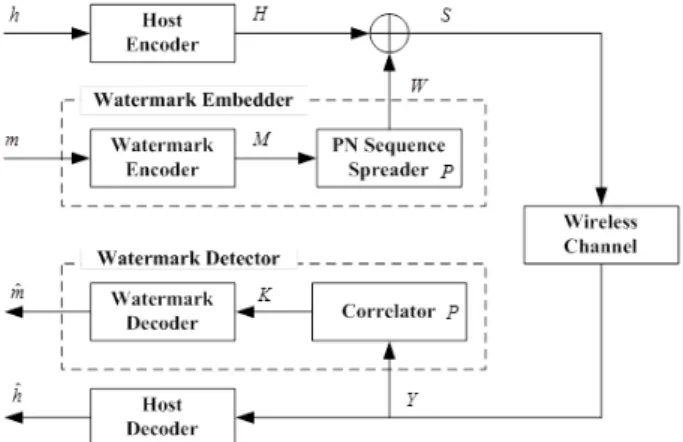
Fig. 1. Block Diagram of Digital Watermarking System.
In addition to prevent illegal reproduction of digital sources, the digital watermarking techniques can be applied to many digital systems with various objectives.
There are various applications according to watermark purpose. The first class of applications uses the watermarks for protection of intellectual property rights and this is one of the primitive objectives of the watermarking technique. The second class of applications uses watermarks for content verification thereby ensuring original multimedia contents would be possible. The third class of applications uses watermarks to provide additional information without additive system resources[4].
It is expected that these applications will be extended to various industrial fields because the most of the contents of the multimedia are digital source.
Generally, a digital watermarking system includes two main parts that is watermark embedder and detector.
Figure 1 shows the general block diagram of the digital watermarking system. The input payload, P, is fed into encoder and modulated according to proper modulation scheme. Thereafter, modulated watermark is added to the original host signal, and transmitted through channel.
At the receiver, signal corrupted by frequency selective channel noise, , is received and processed by detection algorithms.
It is well known that the spread spectrum method is the most promising scheme among the above watermarking methods. One of advantage of the spread spectrum watermarking is convenient detection algorithm with low system complexity. It is stem from unique characteristics of the PN-sequences, used at the watermarking modulator, so that simple detector structure is possible by the correlators. Furthermore, this regime makes the watermarked signal robust to the distortions from the signal processing such as compression, filtering, ADC/DAC, etc.
Ⅲ. Proposed System model
Spread spectrum schemes as a means of communication have been developed since the 1950s in an attempt to provide robust reliable communication in jamming environments. The performance of this scheme has been proved in various commercial systems as well as military applications. Moreover, spread spectrum techniques provide several advantages such as high robustness
against signal distortion, easy frequency planning, and high flexibility in system design, etc. In information hiding technology, watermarking method, using by spread spectrum modulation, also provides robust performance [5]. At the receiver, the received signal, , is passes through correlators in order to find exact P used at the transmitter. In this process, the correlation characteristic of the PN-sequence determines the performance of the watermarking system. The output of the correlators can be expressed as
, (1)
where
,
and N is the period of the PN-sequence. It can be easily expected that will remains small as compare to
from the correlation property of the PN sequence.
The block diagram of the proposed system model with digital watermarking scheme is illustrated in Figure 3.
The OFDM modulator block contains serial-to-parallel converter, inverse fast Fourier transform (IFFT), parallel-
Fig. 2. Block Diagram of Spread Spectrum Watermarking System.
Fig. 3. Block diagram of proposed system model.
to-serial converter and cyclic prefix (CP) insertion. The serial input data stream of the consumer device in home network is mapped onto data symbols with a symbol rate of 1/, employing the signal constellation scheme of binary phase shift keying (BPSK). And the resulting symbol stream is demultiplexed into a vector of data symbols. The parallel data symbol rate is 1/(×) . The parallel symbol duration is times longer than the serial symbol duration . The inverse fast Fourier transform (IFFT) of the data symbol vector is computed.
After the OFDM modulation, digital watermarking sequence is added up to the OFDM modulated data. At this block, generally digital watermarking sequence has the power level about -5dB ~ -20dB compared with power level of transmitted data so that the watermarking sequence level does not affect system performance.
Because the digital watermarking sequence seems to be additive white Gaussian noise (AWGN), it can be controlled by target applications and channel condition. At the receiver, in block of correlation with digital watermarking sequence, a log-likelihood function of received signal is given by
, (2)
where is received signal and denotes probability density function (PDF) of .
From (2), we obtain maximum likelihood (ML) estimation of given by
(3) where is watermarking sequence. The ML estimation finds the maximum output value of the correlator from correlation between the received signal and the watermarking sequence.The receiver has no idea about the synchronization position. What the receiver knows is that what kind of digital watermarking sequence is added on each consumer device in home network. Therefore, by correlating the received signal with the known digital watermarking sequence, the ML estimation of the synchronization position of the signal can be obtained. The ML estimation of finds the maximum value of the correlator outputs.
From (3), detection probability is derived by
, (4)
where is detection threshold.
Ⅳ. Simulation Results
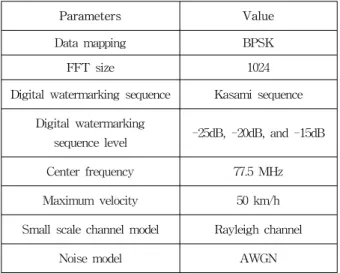
In this section, synchronization performance with digital watermarking sequence for CR based ad-hoc network is evaluated. Synchronization performance is performed by simulation parameters as Table 2. As the OFDM signals of each ad-hoc device are considered, FFT size is 1024 and CP length is 256 (a quarter of FFT size). And binary phase shift keying (BPSK) modulation is employed. As mentioned before, digital watermarking sequence is the Kasami sequence and its power levels are –20dB and -10dB We setup the center frequency as 77.5MHz due to that frequency can be applicable to practical tactical environment. According to [6], among the 37.8, 57.0, and 77.5MHz center frequency, 77.5MHz has the lowest average power delay profile for a downtown measurement at a range of 1km. So, in this dissertation, we consider the worst case. In practice, tactical radio set such as PRC-999K and PRC-950K operates very high frequency (VHF) band in 00MHz~00MHz. And we setup the maximum velocity of tactical ad-hoc device as 50km/h.
Because of velocity of tactical ad-hoc device, we consider the Doppler shift corresponding to velocity.
Table 1. Simulation parameters for synchronization.
Parameters Value
Data mapping BPSK
FFT size 1024
Digital watermarking sequence Kasami sequence Digital watermarking
sequence level -25dB, -20dB, and -15dB Center frequency 77.5 MHz
Maximum velocity 50 km/h
Small scale channel model Rayleigh channel
Noise model AWGN
Figure 4 shows the BER performance with various digital watermarking sequence levels. As shown in Figure 4, BER performance of without watermarking is almost same as the BER with -20dB and -10dB digital watermarking levels. From the results of this paper, it is confirmed that there is a trade-off relationship between detection probabilities and BER performance. So, it should be paid special attention to choice of digital watermarking sequence levels according to [6].
Fig. 4. BER performance with various digital watermarking sequence level (-5dB ~ -20dB, and without watermarking)
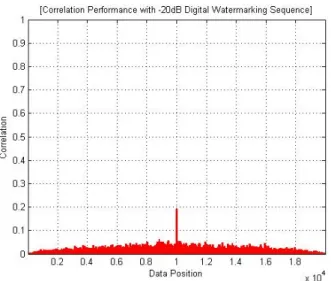
Figure 5 shows the correlation performance over Rayleigh channel model with -20dB digital watermarking sequence level at 0dB SNR. In order to perform frame synchronization, we need to find a maximum peak point.
So, to find peak point, threshold is determined adaptively by various digital watermarking sequence levels. In case of Figure 5, due to a maximum auto-correlation peak point is great higher than other cross-correlation peaks, if threshold is determined around auto-correlation peak, and then synchronization performance has superiority over other synchronization techniques without any redundant data.
Figure 6 shows the correlation performance over Rayleigh channel model with -10dB digital watermarking sequence levels at 0dB SNR. As shown in these Figures, when system has -10dB digital watermarking sequence levels, maximum peak points are higher than 0.5. In order to perform frame synchronization, we need to find the points in which the autocorrelation level is peak or exceeds predetermined threshold. But in a multi-user environment such as wireless ad-hoc networks, there exist not only the autocorrelation values but also the cross-correlation ones. Thus, difference between auto-correlation peak and cross-correlation peak is very important to increase synchronization performance. From the simulation results, it is confirmed that cross-correlation peaks are very small as always compared with maximum peak of auto-correlation.
Fig. 5. Correlation performances over Rayleigh channel with -20dB digital watermarking sequence level (SNR=0dB)
Fig 6. Correlation performances over Rayleigh channel with -10dB digital watermarking sequence level (SNR=0dB)
From the simulation results, it is confirmed that a proposed novel synchronization scheme with digital watermarking sequence has several advantages. First, due to difference between maximum peak point and other side-lobes is very large evidently, regardless of digital watermarking sequence level, system has excellent synchronization performance. Second, in comparison with other synchronization schemes, a proposed novel synchronization scheme does not require redundant data, so it does not affect data throughput performance and complexity.
Ⅴ. Conclusions
In this paper, we analyzed and simulated a novel synchronization scheme with digital watermarking sequence for ubiquitous home network system. From the simulation results, it is confirmed that a proposed synchronization is very efficient in terms of many technical points. Regardless of digital watermarking sequence level, it can achieve improved synchronization performance. Moreover, the proposed synchronization scheme does not need redundant data or information. The results of this paper can be applicable to design of various applications to many consumer devices for ubiquitous home network.
참 고 문 헌
[1] S. M. Ryan and M. Frater, Tactical Communications for the Digitized Battlefield, Artech house Publishers, 2002 [2] C. Busch, W. Funk, and S. Wolthusen, “Digital watermarking:
from concepts to real-time video applications,” IEEE J.
Computer Graphics and Applications, vol. 19, no. 1, pp.
25-35, Jan. 1999.
[3] B. Furht, E. Muharemagic, and D. Socek, Multimedia Encryption and Watermarking, Springer, 2005.
[4] A. Z. Tirkel, G. A. Rankin, and R. van Schyndel, “Electronic Watermark,” in Digital Image Computing, Technology and Applications –DICTA 93, Macquarie University, pp.
666-673, 1993.
[5] FCC, “Spectrum Policy Task Force,” Rep. ET Docket no.
02-135, Nov. 2002.
[6] J. G. Proakis, Digital Communications, 4th ed., New York:
McGraw-Hill, 2001.
저자
김 윤 현(Yoon Hyun Kim) 정회원
․2008년 2월:광운대학교 전파공학과 석사
․2013년 2월:광운대학교 전파공학과 박사
․2013년 3월 : 한국인터넷진흥원 주임 연구원
<관심분야> : 군 통신, 협력통신, 인지무선통신, 5G
이 성 훈(Sung Hun Lee)
․2010년 8월:광운대학교 컴퓨터공학 과 공학박사
․2010년 10월 : 제주테크노파크 선임연 구원
․2012년 5월 ~ 현재 : 대구테크노파크 모바일융합센터 선임연구원
<관심분야> : 연구기획(이동통신), WPAN, WLAN, LTE
황 유 민(Yu Min Hwang) 준회원
․2012년 2월:광운대학교 전파공학과 학사
․2012년 3월 ~ 현재:광운대학교 전파 공학과 석박통합과정
<관심분야> : 5G, 재난 통신, WPAN, 협력통신
신 동 수(Dong Soo Shin)
․2005년 2월:충북대학교 공학 석사
․2007년 국무총리 표창(국가안전보장 기여)
․2009년 광운대학교 방위사업학과 박사 수료
․2006년 ~ 현재 : 방위사업청 육군 중령 <관심분야> : 재해재난 및 군 이동통신, 디지털통신
노 정 규(Jung Kyu Rho)
․1991년 : 서울대학교 계산통계학과 이 학사
․1993년 : 서울대학교 전산과학과 이학 석사
․1999년 : 서울대학교 전산과학과 이학 박사
․1999년 ~ 2002년 : 삼성전자 통신연구소 책임연구원
․2002년 ~ 2005년 : 서경대학교 컴퓨터과학과 전임강사
․2006년 ~ 현재 : 서경대학교 컴퓨터과학과 조교수 <관심분야> : 분산시스템, 방송/통신 데이터처리, 시뮬레이션
김 진 영(Jin Young Kim) 종신회원
․1998년 2월:서울대학교 전자공학과 공학박사
․2001년 2월:SK텔레콤 네트웍 연구소 책임연구원
․2001년 3월~현재:광운대학교 전자 융합공학과 교수
<관심분야> : 다지털통신, WPAN, UWB, 부호화, 인지무선 통신, 5G 이동통신