
IEG 환경지질연구정보센터
13
0
0
전체 글
(2) 422. Hyo Min Lee, Jong Ik Lee, Mi Jung Lee, Jeongmin Kim, and Seok Won Choi. Fig. 1. (a) Geological map of the Ellsworth-Whitmore Mountains (EWM) crustal block (after Storey et al., 1988b). (b) and (c) Location maps of study area within West Antarctica, illustrating major crustal blocks. Abbreviations: Antarctic Peninsula (AP), Ellsworth-Whitmore Mountains (EWM), Haag Nunataks (HN), Marie Byrd Land (MBL) and Thurston Island (TI).. arctica. It is known as one of the Jurassic granite suites in the EWM (Miller and Pankhurst, 1987), but the geochemical characteristics of the Pirrit Hills granite are still poorly understood. The systematic sampling was carried out during the 1st Korea Expedition for Antarctic Meteorites (KOREAMET, January 2007) as a joint geological survey with meteorite searching. In this paper, we present new petrological, geochemical data and SHRIMP zircon ages of the Pirrit Hills granite which shows typical features of A-type granites, and discuss the geological meaning of magmatism associated with the Gondwana break-up process during the Mesozoic. 2. GEOLOGICAL SETTING As mentioned above, West Antarctica consists of five discrete crustal blocks which are divided by deep crustal rift zones (Storey et al., 1988b). The Pirrit Hills (81°08'S, 85°25'W) is located in the EWM. From north to south there are several scattered hills and mountains in the EWM; the Ellsworth Mountains, the Pirrit, Nash, and Martin Hills, the Whitmore Mountains, the Pagano Nunatak, the Hart Hills, and the Thiel. Mountains (Fig. 1a). The Ellsworth Mountains are the largest outcrop and form a NNE–SSW-trending mountain range approximately 415 km in length. About 13 km of thick sedimentary rocks are exposed within the mountains, representing a continuous Middle Cambrian to Permian succession (Webers et al., 1992). Locally, thick volcanic and subvolcanic rocks intrude the Middle Cambrian sedimentary rocks (Curtis et al., 1999), and rarely coarse- and fine-grained granites occur at small scale (Vennum and Storey, 1987b; Storey et al., 1988b). The granitic suite exposed at the Pirrit Hills, Nash Hills, Martin Hills, Pagano Nunatak, and Whitmore Mountains are post-tectonic, and intrude deformed sedimentary rocks (Storey and Dalziel, 1987; Vennum and Storey, 1987a). The Pirrit and Nash Hills are composed largely of felsic plutonic rocks. The Pirrit Hills mainly consist of coarse- or very coarse-grained pink to pinkish-white leucocratic granite that locally contains K-feldspar megacrysts (Vennum and Storey, 1987a). The Pirrit Hills granite is surrounded by thermally altered metasedimentary roof pendants (Storey and Macdonald, 1987). The nature of the metamorphic basement beneath the.
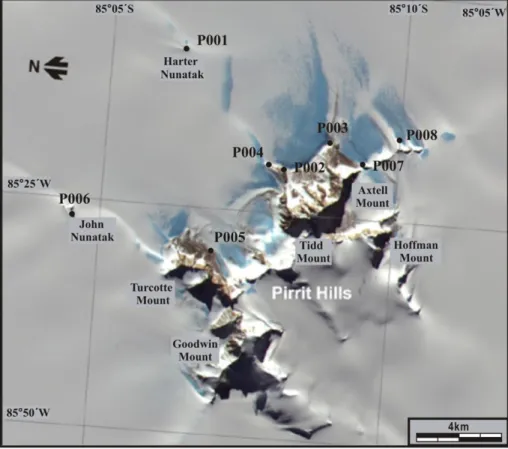
(3) The A-type Pirrit Hills Granite, West Antarctica. EWM is uncertain. Miller and Pankhurst (1987) reported RbSr whole-rock isochron ages of 173 ± 3, 175 ± 8, and 175 ± 8 Ma for the plutons of the Pirrit Hills, Nash Hills, and Pagano Nunatak, respectively. 3. ANALYTICAL METHODS Thirteen samples were collected from the Pirrit Hills (Fig. 2) and made into thin sections. A polarizing microscope was used to observe the texture, modal composition, and mineralogical paragenesis. Samples were crushed and ground into fine powder by an automatic agate ball mill. Powdered samples were then analyzed for major, trace, and rare earth elements. Major elements were analyzed using an X-ray fluorescence spectrometer (XRF) at ActLabs, Canada. Trace and rare earth elements (REE) were measured using an inductively-coupled plasma mass spectrometer (ICP-MS, Perkin-Elmer Elan 6100) at the Korea Polar Research Institute (KOPRI), Incheon, Korea, following the methods reported by Hur et al. (2003). Zircons were separated using conventional mineral separation techniques of crushing, sieving, panning, and hand picking under a microscope. Zircon grains were mounted with standard FC-5z in epoxy and polished to expose the cores of the grains for microscopic observation and U-Pb age dating. All grains were photographed by transmitted and reflected optical microscope. Cathodoluminescence (CL) and back-scattered electron (BSE) images of these zircons. 423. were used to examine texture and compositional zoning using a scanning electron microscope (JEOL 6610LV) at KBSI, and to identify internal structures and choose potential target sites for U-Pb isotopic analysis. In-situ U-Pb isotopic analysis of zircon was performed using a sensitive high-mass resolution ion microprobe (SHRIMP IIe/MC) at KBSI. Analytical spot size was ~25 µm. U-ThPb ratios were calibrated using the standard zircon FC-5z. Measured compositions were corrected for common Pb using the 204Pb method. Uncertainties in isotopic ratios are reported at 1σ level. Data reductions were carried out using the SQUID program and plots were generated using the Isoplot/Ex program (Ludwig, 2003). The errors for weighted mean 206Pb/238U age are reported at 95% (1σ) confidence level. 4. PETROGRAPHY The Pirrit Hills granite is mostly medium- to coarse-grained and contains locally fine-grained leucocratic alkali feldspar granite. It mainly consists of quartz, alkali feldspar, and plagioclase with minor amounts of biotite, muscovite, and opaque minerals. Sericite and chlorite occur as secondary minerals in some samples (Fig. 3). Coarse-grained alkali feldspar is mainly perthite with Carlsbad twins ranging from 3 to 10 mm (Fig. 3a) and forms micrographic intergrowths with quartz in several samples (Fig. 3d). Plagioclase usually occurs as euhedral to subhedral crystals and sometimes contains inclusions of quartz,. Fig. 2. Satellite image of the Pirrit Hills and sampling locations..
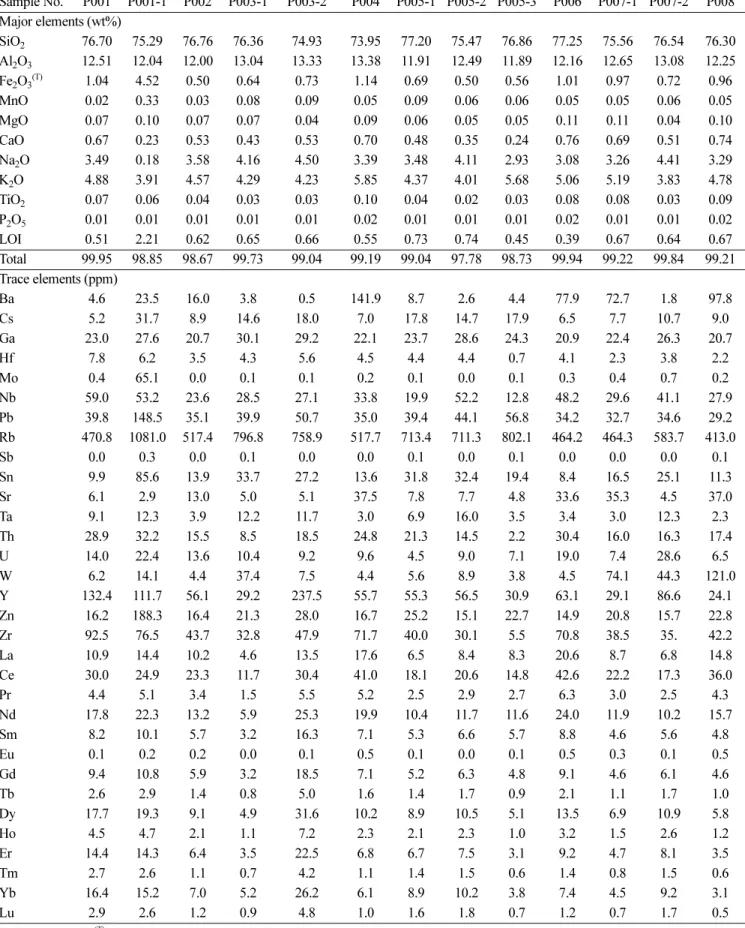
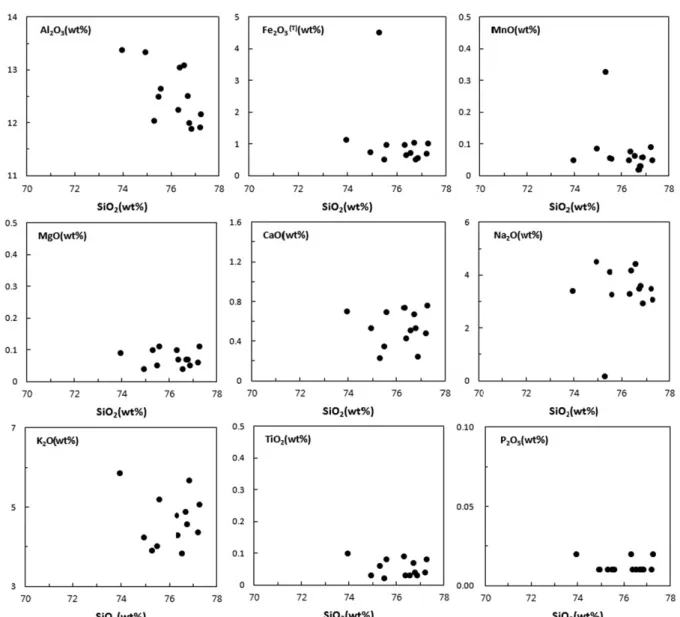
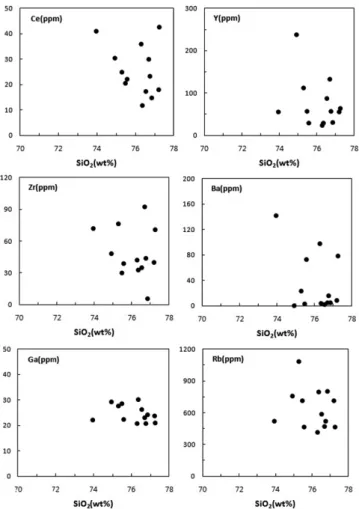
(4) 424. Hyo Min Lee, Jong Ik Lee, Mi Jung Lee, Jeongmin Kim, and Seok Won Choi. Fig. 3. Representative photomicrographs (crossed polars) of the Pirrit Hills granite. (a) Coarse-grained perthitic alkali feldspar. (b) Plagioclase containing inclusions of quartz, muscovite, and opaque minerals. (c) Interstitial muscovite between quartz and feldspar. (d) Micrographic intergrowth between quartz and alkali feldspar.. muscovite, biotite, and opaque minerals (Fig. 3b). It usually shows albite twins and locally albite-Carlsbad twins and is partly sericitized. Quartz mostly occurs as anhedral crystals and frequently shows undulatory extinction. Biotite is partly altered to chlorite along grain boundaries and cleavages, and sometimes contains opaque minerals. Both biotite and muscovite are observed as late-stage, interstitial minerals (Fig. 3c). 5. RESULTS 5.1. Major and Trace Elements The Pirrit Hills granite has high SiO2 (74−77 wt%) and K2O + Na2O (7.8−9.2 wt%) contents, and low Al2O3, MnO, MgO, CaO, TiO2, and P2O5 contents (Table 1). One exception is P001-1 which shows extraordinarily high Fe2O3(T), MnO, and LOI, and low Na2O contents, probably due to Na-leaching and Fe-enrichment by alteration. These geochemical characteristics indicate that the Pirrit Hills granite is a highly homogeneous, strongly fractionated, and felsic granite. In Harker diagrams, major elements show no obvious trends except Al2O3 which decreases with increasing SiO2,. indicating some feldspar fractionation (Fig. 4). On a molar A/NK versus A/CNK diagram, all samples are mildly peraluminous with A/CNK values between 1.08 and 1.15 except P001-1 which has a very high A/CNK value (2.65), in contrast to S-type granites that are strongly peraluminous (Clemens, 2003) (Fig. 5). The Pirrit Hills granite contains high Rb (>400 ppm) and low Sr (<40 ppm) concentrations, supporting its highly fractionated nature. Because of the narrow range of SiO2 contents, the selected trace elements (Ce, Y, Zr, Ba, Ga, and Rb) do not show obvious trends (Fig. 6). The Ga/Al ratio is commonly high in A-type granites, hence it is the most useful elemental ratio to distinguish Atype granites from I-, S- and M-type granites (Whalen et al., 1987). The high Ga/Al ratio results from preferential retention of plagioclase in the source region during partial melting because Ga is preferentially excluded from the plagioclase structure relative to Al (Goodman, 1972). The 10000*Ga/ Al diagrams show that the Pirrit Hills granite entirely belongs to the A-type granite field (Fig. 7). In the primitive-mantle normalized spider diagram (Fig. 8), the Pirrit Hills granite shows prominent Ba, Sr, P, Eu, Ti and moderate Nb, K, Zr depletion, and does not show any regular patterns according.
(5) The A-type Pirrit Hills Granite, West Antarctica. 425. Table 1. Major and trace element compositions of the Pirrit Hills granite Sample No. P001 P001-1 Major elements (wt%) 76.70 75.29 SiO2 Al2O3 12.51 12.04 Fe2O3(T) 1.04 4.52 MnO 0.02 0.33 MgO 0.07 0.10 CaO 0.67 0.23 Na2O 3.49 0.18 K2O 4.88 3.91 0.07 0.06 TiO2 P2O5 0.01 0.01 LOI 0.51 2.21 Total 99.95 98.85 Trace elements (ppm) Ba 4.6 23.5 Cs 5.2 31.7 Ga 23.0 27.6 Hf 7.8 6.2 Mo 0.4 65.1 Nb 59.0 53.2 Pb 39.8 148.5 Rb 470.8 1081.0 Sb 0.0 0.3 Sn 9.9 85.6 Sr 6.1 2.9 Ta 9.1 12.3 Th 28.9 32.2 U 14.0 22.4 W 6.2 14.1 Y 132.4 111.7 Zn 16.2 188.3 Zr 92.5 76.5 La 10.9 14.4 Ce 30.0 24.9 Pr 4.4 5.1 Nd 17.8 22.3 Sm 8.2 10.1 Eu 0.1 0.2 Gd 9.4 10.8 Tb 2.6 2.9 Dy 17.7 19.3 Ho 4.5 4.7 Er 14.4 14.3 Tm 2.7 2.6 Yb 16.4 15.2 Lu 2.9 2.6 (T) Total Fe as Fe2O3 . LOI means loss on ignition.. P002. P003-1. P003-2. P004. P005-1 P005-2 P005-3. 76.76 12.00 0.50 0.03 0.07 0.53 3.58 4.57 0.04 0.01 0.62 98.67. 76.36 13.04 0.64 0.08 0.07 0.43 4.16 4.29 0.03 0.01 0.65 99.73. 74.93 13.33 0.73 0.09 0.04 0.53 4.50 4.23 0.03 0.01 0.66 99.04. 73.95 13.38 1.14 0.05 0.09 0.70 3.39 5.85 0.10 0.02 0.55 99.19. 77.20 11.91 0.69 0.09 0.06 0.48 3.48 4.37 0.04 0.01 0.73 99.04. 75.47 12.49 0.50 0.06 0.05 0.35 4.11 4.01 0.02 0.01 0.74 97.78. 16.0 8.9 20.7 3.5 0.0 23.6 35.1 517.4 0.0 13.9 13.0 3.9 15.5 13.6 4.4 56.1 16.4 43.7 10.2 23.3 3.4 13.2 5.7 0.2 5.9 1.4 9.1 2.1 6.4 1.1 7.0 1.2. 3.8 14.6 30.1 4.3 0.1 28.5 39.9 796.8 0.1 33.7 5.0 12.2 8.5 10.4 37.4 29.2 21.3 32.8 4.6 11.7 1.5 5.9 3.2 0.0 3.2 0.8 4.9 1.1 3.5 0.7 5.2 0.9. 0.5 18.0 29.2 5.6 0.1 27.1 50.7 758.9 0.0 27.2 5.1 11.7 18.5 9.2 7.5 237.5 28.0 47.9 13.5 30.4 5.5 25.3 16.3 0.1 18.5 5.0 31.6 7.2 22.5 4.2 26.2 4.8. 141.9 7.0 22.1 4.5 0.2 33.8 35.0 517.7 0.0 13.6 37.5 3.0 24.8 9.6 4.4 55.7 16.7 71.7 17.6 41.0 5.2 19.9 7.1 0.5 7.1 1.6 10.2 2.3 6.8 1.1 6.1 1.0. 8.7 17.8 23.7 4.4 0.1 19.9 39.4 713.4 0.1 31.8 7.8 6.9 21.3 4.5 5.6 55.3 25.2 40.0 6.5 18.1 2.5 10.4 5.3 0.1 5.2 1.4 8.9 2.1 6.7 1.4 8.9 1.6. 2.6 14.7 28.6 4.4 0.0 52.2 44.1 711.3 0.0 32.4 7.7 16.0 14.5 9.0 8.9 56.5 15.1 30.1 8.4 20.6 2.9 11.7 6.6 0.0 6.3 1.7 10.5 2.3 7.5 1.5 10.2 1.8. P006. P007-1 P007-2. P008. 76.86 11.89 0.56 0.06 0.05 0.24 2.93 5.68 0.03 0.01 0.45 98.73. 77.25 12.16 1.01 0.05 0.11 0.76 3.08 5.06 0.08 0.02 0.39 99.94. 75.56 12.65 0.97 0.05 0.11 0.69 3.26 5.19 0.08 0.01 0.67 99.22. 76.54 13.08 0.72 0.06 0.04 0.51 4.41 3.83 0.03 0.01 0.64 99.84. 76.30 12.25 0.96 0.05 0.10 0.74 3.29 4.78 0.09 0.02 0.67 99.21. 4.4 17.9 24.3 0.7 0.1 12.8 56.8 802.1 0.1 19.4 4.8 3.5 2.2 7.1 3.8 30.9 22.7 5.5 8.3 14.8 2.7 11.6 5.7 0.1 4.8 0.9 5.1 1.0 3.1 0.6 3.8 0.7. 77.9 6.5 20.9 4.1 0.3 48.2 34.2 464.2 0.0 8.4 33.6 3.4 30.4 19.0 4.5 63.1 14.9 70.8 20.6 42.6 6.3 24.0 8.8 0.5 9.1 2.1 13.5 3.2 9.2 1.4 7.4 1.2. 72.7 7.7 22.4 2.3 0.4 29.6 32.7 464.3 0.0 16.5 35.3 3.0 16.0 7.4 74.1 29.1 20.8 38.5 8.7 22.2 3.0 11.9 4.6 0.3 4.6 1.1 6.9 1.5 4.7 0.8 4.5 0.7. 1.8 10.7 26.3 3.8 0.7 41.1 34.6 583.7 0.0 25.1 4.5 12.3 16.3 28.6 44.3 86.6 15.7 35. 6.8 17.3 2.5 10.2 5.6 0.1 6.1 1.7 10.9 2.6 8.1 1.5 9.2 1.7. 97.8 9.0 20.7 2.2 0.2 27.9 29.2 413.0 0.1 11.3 37.0 2.3 17.4 6.5 121.0 24.1 22.8 42.2 14.8 36.0 4.3 15.7 4.8 0.5 4.6 1.0 5.8 1.2 3.5 0.6 3.1 0.5.
(6) 426. Hyo Min Lee, Jong Ik Lee, Mi Jung Lee, Jeongmin Kim, and Seok Won Choi. Fig. 4. Harker variation diagrams for major elements of the Pirrit Hills granite.. Fig. 5. Molar Al2O3/(Na2O + K2O) vs. Al2O3/(CaO + Na2O + K2O) diagram.. to the order of incompatability of trace elements. This feature seems to be related with source characteristics rather than degree of partial melting and corresponds to the typical characteristics of A-type granites (Collins et al., 1982; Whalen et al., 1987; Wu et al., 2002). The chondrite-normalized REE patterns of the Pirrit Hills granite are very flat with significant negative Eu anomalies (Fig. 9). The REE pattern contrasts the general REE patterns of LREE-enriched and HREE-depleted signatures of I- and S-type granites, indicating different source materials or fractional crystallization schemes in the genesis of the Pirrit Hills granite. The LREE depletion might result from fractionation of monazite or apatite which is extremely enriched in the LREE (Mariano, 1989). The extreme enrichment of heavy relative to light REE could be the result of accumulation of zircon or garnet (Nagasawa, 1970; Watson, 1980; Watson and Harrison, 1983 and 1984; Mariano, 1989), but the Pirrit Hill granite has relatively low Zr contents. Thus,.
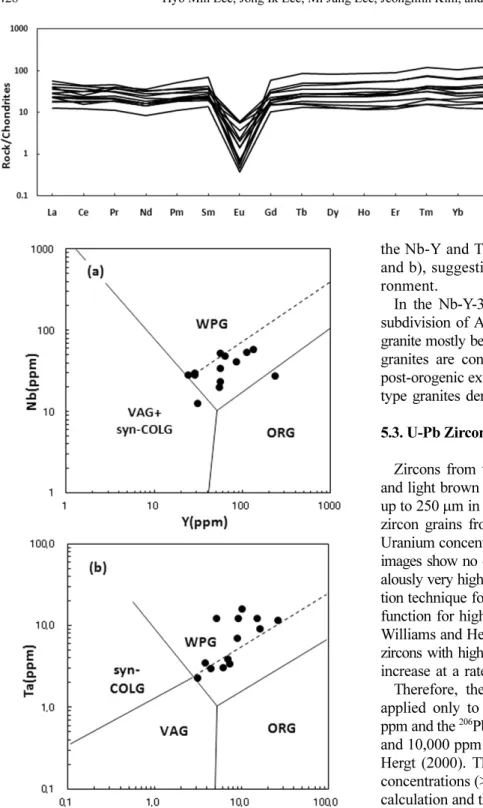
(7) The A-type Pirrit Hills Granite, West Antarctica. 427. Fig. 7. Diagrams of (K2O + Na2O)/CaO, K2O/MgO, Zr, and Nb vs. 10000*Ga/Al to distinguish A-type granites from other types of granites (after Whalen et al., 1987).. Fig. 6. Harker variation diagrams for selected trace elements of the Pirrit Hills granite.. the strong enrichment of HREE is considered to be a characteristic of the source material, and probably indicates the presence of garnet in the source. The significant negative Eu anomalies indicate plagioclase as a residual phase during partial melting because a significant proportion of Eu could be retained in the plagioclase residue, producing a melt with a negative Eu anomaly (Mariano, 1989). Therefore,. garnet granulites (clinopyroxene + plagioclase + alkali feldspar + quartz + garnet rocks) in the lower crust might be the most probable source material for the the Pirrit Hills granite. Considering the mildly peraluminous nature of the Pirrit Hills granite, a gabbroic source material containing amphibole, which seems to be widely distributed in the lower crust, is not a suitable source candidate, because it generally produces hydrous, metaluminous, and I-type magma (Chappell and Stephens, 1988). 5.2. Tectonic Discrimination Pearce et al. (1984) proposed tectonic discrimination diagrams for granites based on Rb-Y-Nb and Rb-Yb-Ta relationships. The elements were selected as the most efficient discriminants among most types of ocean ridge granites. Fig. 8. Primitive mantle-normalized spider diagram of the Pirrit Hills granite. The normalization values for primitive mantle are from Sun and McDonough (1989)..
(8) 428. Hyo Min Lee, Jong Ik Lee, Mi Jung Lee, Jeongmin Kim, and Seok Won Choi. Fig. 9. Chondrite-normalized REE patterns of the Pirrit Hills granite. The normalization values are from Taylor and McLennan (1985).. the Nb-Y and Ta-Yb discrimination diagrams (Figs. 10a and b), suggesting its generation in an anorogenic environment. In the Nb-Y-3Ga and Nb-Y-Ce triangular diagrams for subdivision of A-type granites (Eby, 1992), the Pirrit Hills granite mostly belongs to the A2-type (Fig. 11). The A2-type granites are considered as forming in a post-collision or post-orogenic extensional environment, and differ from A1type granites derived from hotspots or plumes. 5.3. U-Pb Zircon Age. Fig. 10. Tectonic discrimination diagrams of the Pirrit Hills granite based on (a) Nb vs. Y and (b) Ta vs. Yb (after Pearce et al., 1984). Abbreviations: oceanic ridge granite (ORG), syn-collisional granite (syn-COLG), volcanic arc granite (VAG), and within-plate granite (WPG).. (ORG), within-plate granites (WPG), volcanic arc granites (VAG), and syn-collisional granites (syn-COLG). In these tectonic discrimination schemes, the Pirrit Hills granite plots in the field of within-plate granites on. Zircons from the Pirrit Hills granite are colorless, pink, and light brown and mostly euhedral or subhedral, ranging up to 250 µm in length. A total of 51 analytical spots on 46 zircon grains from three samples was analyzed (Fig. 12). Uranium concentrations range from 300 to 19,917 ppm. CL images show no obvious internal structures because of anomalously very high U contents. The conventional U-Pb calibration technique for in-situ SHRIMP zircon analysis does not function for high U zircon (>2,500 ppm U) as reported by Williams and Hergt (2000). The 206Pb/238U apparent ages of zircons with high U contents between 2,500 and 10,000 ppm increase at a rate of about 2% per thousand ppm U. Therefore, the conventional calibration technique was applied only to zircons with U contents less than 2,500 ppm and the 206Pb/238U data of zircons with U between 2,500 and 10,000 ppm were corrected according to Williams and Hergt (2000). The 206Pb/238U data of zircons with high U concentrations (>10,000 ppm) were not included in the age calculation and the 206Pb/238U data of zircons with cracks or inclusions were excluded in the calculation (Table 2). For these reasons, a total of 28 data among 51 analyses was used for age calculation. The analyses yielded a weighted mean 206Pb/238U age of 164.5 ± 2.3 Ma (MSWD = 1.3), which is interpreted as the emplacement age of the Pirrit Hills granite (Fig. 13). This 206 Pb/238U zircon age is 8 to 9 Mys younger than a Rb-Sr whole rock age (173 ± 3 Ma) reported by Miller and Pankhurst (1987), and corresponds to the first rifting stage of the break-up of Gondwana (at 165 Ma, Hawkesworth et al., 1999). The Pirrit Hills granite is thus concluded to have been emplaced.
(9) The A-type Pirrit Hills Granite, West Antarctica. 429. Fig. 11. Triangular diagrams of the Pirrit Hills granite to subdivide A-type granites (after Eby, 1992). A1: Within-plate granites from a mantle plume, A2: Granites formed in a post-collision or post-orogenic extensional environment.. Fig. 12. Back-scattered electron (BSE) images of zircon grains from the Pirrit Hills granite. White ellipses indicate SHRIMP analytical spots with diameters of about 25 µm.. in the Middle Jurassic when the Gondwana supercontinent began to break-up. 6. DISCUSSION: A-TYPE GRANITE ASSOCIATED WITH CONTINENTAL BREAK-UP A-type granite is indicative of unusual compositions and tectonic settings, with environment that is anorogenic (e.g., Collins et al., 1982; Whalen et al., 1987) or within-plate extensional (e.g., Eby, 1992; Bonin, 2007). A-type granite can thus provide significant constraints on their origin and tectonic setting. Though the origin of A-type granite is still controversial, many workers have suggested that A-type granites are produced by anhydrous partial melting of depleted residual. materials from the source with slightly different composition compared to that for I-type granites (e.g., Collins et al., 1982; Anderson, 1983; Clemens et al., 1986; Whalen et al., 1987; Wormald and Price, 1988; Creaser et al., 1991; Landenberger and Collins, 1996). Lower crust has been favored as the most plausible source material for A-type granite. We already noted that the petrology and geochemistry of the Pirrit Hills granite are very similar to typical characteristics of A-type granites. However, the Pirrit Hills granite shows a mildly peraluminous nature, even though A-type stands for alkaline. A peraluminous nature is one of the defining characteristics of S-type granites. Peraluminous A-type granite contains a variety of micas with high Li and F, and has very low P2O5 contents (<0.05 wt%), whereas S-type gran-.
(10) 430. Hyo Min Lee, Jong Ik Lee, Mi Jung Lee, Jeongmin Kim, and Seok Won Choi. Table 2. SHRIMP U-Th-Pb isotopic data of zircon separated from the Pirrit Hills granite common U Th Pb (%) (ppm) (ppm) P1-1.1 0.74 3571 1713 P1-2.1 0.15 7312 3546 P1-3.1 3.30 2833 1728 P1-8.1 2.42 4003 1497 P2-1.1 0.38 7443 869 P2-6.1 0.12 8762 1021 P2-7.1 2.91 8679 7211 P2-7.2 3.11 8124 7150 P2-8.2 0.64 1464 443 P2-9.1 5.86 300 242 P2-10.1 0.02 7540 1132 P2-12.1 1.03 361 228 P2-13.1 2.11 5077 1176 P2-15.1 0.32 8386 674 P2-18.1 1.30 976 719 P2-19.1 0.18 2208 423 P6-1.1 8.45 2725 652 P6-2.1 4.67 3361 441 P6-3.1 0.69 3223 1226 P6-5.1 0.91 6663 942 P6-6.1 0.15 4337 1127 P6-10.1 6.40 1223 863 P6-13.1 0.21 2106 822 P6-15.1 0.80 3307 1500 P6-17.2 6.41 1825 886 P6-18.1 7.30 1361 797 P6-20.1 0.02 8074 1034 P6-22.1 1.61 3173 1178 Pb*: corrected for common Pb using 204Pb.. Spot No.. 206. 207. Th/U 0.48 0.48 0.61 0.37 0.12 0.12 0.83 0.88 0.30 0.81 0.15 0.63 0.23 0.08 0.74 0.19 0.24 0.13 0.38 0.14 0.26 0.71 0.39 0.45 0.49 0.59 0.13 0.37. Pb*/ Pb* 0.0482 0.0481 0.0459 0.0494 0.0493 0.0488 0.0504 0.0523 0.0445 0.0499 0.0490 0.0462 0.0502 0.0487 0.0489 0.0468 0.0495 0.0514 0.0476 0.0480 0.0500 0.0518 0.0493 0.0492 0.0517 0.0354 0.0488 0.0504 206. ±% (1σ) 2.36 1.10 9.86 3.31 1.29 0.99 2.88 7.42 5.26 20.91 0.95 13.43 2.74 1.18 5.58 2.81 7.94 6.49 2.95 2.03 1.53 10.37 2.42 3.33 10.23 19.14 0.89 3.15. ite has rather high P2O5 contents (0.4−1.6 wt%) (Bonin, 2007). The P2O5 abundance and phosphate mineralogy can be a key factor to distinguish A-type granite from S-type leucogranite (London, 1992; Taylor, 1992; Morgan and London, 2005). The Pirrit Hills granite has very low P2O5 contents (0.01−0.02 wt%, Table 1). The high Ga/Al ratios and HREEenriched characteristics also strongly support that the Pirrit Hills granite is A-type, and that plagioclase and garnet should have been in the source (Nagasawa, 1970; Watson, 1980; Watson and Harrison, 1983 and 1984; Mariano, 1989). Considering its peraluminous nature, the source material might be recycled lower crust. The highly fractionated characteristics (74–77 wt% SiO2, 7.8–9.2 wt% Na2O + K2O) indicate that its source might not be mafic, and that the degree of partial melting was small under anhydrous conditions. The garnet granulites in the lower crust are likely to have been the most probable source materials for the genesis of the Pirrit Hills granite. The timing of magmatic events associated with the break-. 207. Pb*/ U 0.1822 0.1899 0.1683 0.1971 0.2001 0.1982 0.1987 0.2042 0.1613 0.1748 0.1946 0.1655 0.1849 0.1901 0.1660 0.1707 0.1822 0.1986 0.1707 0.1811 0.1858 0.1913 0.1785 0.1779 0.1886 0.1230 0.1783 0.1736 235. ±% (1σ) 3.75 3.10 10.29 4.41 3.18 3.07 4.10 7.97 6.03 21.18 3.06 13.80 4.00 3.14 6.33 4.07 8.59 7.24 4.35 3.77 3.53 10.88 4.01 4.61 10.74 19.43 3.29 4.48. 206. Pb*/238U. 0.0274 0.0287 0.0266 0.0289 0.0295 0.0295 0.0286 0.0283 0.0263 0.0254 0.0288 0.0260 0.0267 0.0283 0.0246 0.0264 0.0267 0.0280 0.0260 0.0274 0.0269 0.0268 0.0263 0.0262 0.0265 0.0252 0.0265 0.0250. ±% Apparent age ±Ma (1σ) (Ma) 206Pb/238U (1σ) 2.91 170.6 5.0 2.90 164.8 5.2 2.96 168.2 4.9 2.92 178.5 5.3 2.91 168.9 5.4 2.90 164.0 5.4 2.92 159.6 5.2 2.91 159.9 5.2 2.95 167.2 4.9 3.36 161.8 5.4 2.91 164.9 5.2 3.17 165.5 5.2 2.92 161.4 4.9 2.90 158.9 5.1 2.98 156.9 4.6 2.93 168.2 4.9 3.26 169.8 5.5 3.21 175.3 5.6 3.19 163.1 5.2 3.18 159.8 5.5 3.18 165.1 5.4 3.29 170.6 5.5 3.20 167.1 5.3 3.19 164.3 5.3 3.28 168.6 5.5 3.33 160.7 5.3 3.17 150.1 5.3 3.19 156.9 5.0. up of the Gondwana supercontinent was reviewed by Storey et al. (1995). There were three main episodes of magmatism within the initial rifting stage starting about 180 Ma. The first stage was in the Middle Jurassic and the second stage was in the Early Cretaceous. The final magmatic event occurred in the Late Cretaceous. Hawkesworth et al. (1999) also summarized the main episodes of magmatism and rifting linked to the break-up of Gondwana. The first rifting episode was in the Middle Jurassic (~165 Ma) and the next rifting events were in the Early Cretaceous (~130 Ma, ~115 Ma, and ~107 Ma) and the Late Cretaceous (~88 Ma). Finally, the break-up of Gondwana was completed in the Cenozoic (~65 Ma). However, the causes of break-up are still uncertain though Dlaziel et al. (2000) suggested a plume origin. To solve this problem, we need to obtain more precise ages (e.g., U-Pb zircon ages) on both intrusive and extrusive rocks to elucidate the temporal and spatial relationships with the break-up process. The previously reported Rb-Sr whole-rock isochron ages.
(11) The A-type Pirrit Hills Granite, West Antarctica. 431. appears to have been produced by almost adiabatic decompressional melting of anomalously hot lower crust. Considering its highly fractionated nature, the melting degree seems to have been very small (less than 5%). Therefore, we conclude that the Pirrit Hills granite was emplaced at 164.5 ± 2.3 Ma during the first episode of magmatism and rifting associated with the break-up and dispersal of the Gondwana supercontinent. At that time, the lower crust should have been hotter than normal and anhydrous. The five crustal blocks of West Antarctica have split off each other after about 164 Ma. The precise age dating and geochemical characterization of the A-type Pirrit Hills granite may be a good example for understanding magmatism associated with the Gondwana break-up process in time and space. 7. CONCLUSIONS. Fig. 13. (a) Weighted mean 206Pb/238U age for zircons of the Pirrit Hills granite. (b) U-Pb concordia diagram showing the SHRIMP spot analyses of zircons from the Pirrit Hills granite.. of the EWM granitic suite are 173 ± 3, 175 ± 8, and 175 ± 8 Ma for the plutons of the Pirrit Hills, Nash Hills, and Pagano Nunatak, respectively (Miller and Pankhurst, 1987). These ages are not easily linked to the main episodes of the breakup of Gondwana. Especially, the Rb-Sr age of the typical Atype Pirrit Hills granite is 8 to 9 Mys older than the first rifting stage. We carefully observed and separated the most suitable magmatic zircons (Fig. 12), and performed more precise UPb age dating using SHRIMP-IIe/MC. The most convincing U-Pb zircon age of the Pirrit Hills granite is 164.5 ± 2.3 Ma, which is believed to represent the emplacement age. The age is identical to the timing of magmatic events associated with the first rifting of Gondwana (~165 Ma). An extensional environment in response to the Middle Jurassic thermal event could have led to melting of the lower crust, due to crustal thinning and underplating of hot mantle at the base of the lower crust. The Pirrit Hills granite. (1) The Pirrit Hills granite occurs as an isolated plutonic body in the Ellsworth-Whitmore Mountains crustal block, West Antarctica. It is highly fractionated, mostly mediumto coarse-grained and contains locally fine-grained leucocratic alkali feldspar granite. It mainly consists of quartz, alkali feldspar, and plagioclase with minor amounts of biotite, muscovite, and opaque minerals. Both biotite and muscovite occur as late-stage, interstitial fillings. (2) The Pirrit Hills granite has high SiO2 (74−77 wt%) and K2O + Na2O (mostly 7.8−9.2 wt%) contents and is highly homogeneous, strongly fractionated, and mildly peraluminous. (3) According to tectonic discrimination schemes, the Pirrit Hills granite belongs to A-type granites and is mostly A2-type, suggesting its generation in an extensional, anorogenic environment. (4) The strong enrichment of HREE can be explained by the presence of garnet in the source. The significant negative Eu anomalies indicate plagioclase as a residual phase during partial melting. These REE characteristics combined with other geochemical features suggest that garnet granulite in the lower crust was the most probable source material for the Pirrit Hills granitic magma. (5) The U-Pb zircon age is 164.5 ± 2.3 Ma (1ó), which is interpreted as the emplacement age of the Pirrit Hills granite, and is indistinguishable from the age of the first rifting stage of Gondwana break-up (at 165 Ma). The Pirrit Hills granite is thus concluded to have been emplaced in the Middle Jurassic when the Gondwana supercontinent started to break-up. ACKNOWLEDGMENTS: We are grateful to Prof. D.B. Shin of Kongju National University for constructive comments which improved our manuscript. We thank Prof. Min, Prof. Whattam, and an anonymous reviewer for their helpful and constructive reviews of the manuscript. We thank Mr. H.K. Kim of KBSI for U-Pb zircon SHRIMP dating and Ms. M.K. Choo of KOPRI for analytical support on the ICP-MS. JI Lee thanks the members of the 1st Korea Expedition for Antarctic.
(12) 432. Hyo Min Lee, Jong Ik Lee, Mi Jung Lee, Jeongmin Kim, and Seok Won Choi. Meteorites (KOREAMET) for sampling and field assistance. This study was financially supported by KOPRI project (PE12060; Korea Curation of Antarctic Meteorites and Evolution of Planetary Materials).. REFERENCES Anderson, J.L., 1983, Proterozoic anorogenic granite plutonism of North America. Geological Society of America Memoir, 161, 133–154. Bonin, B., 2007, A-type granites and related rocks: evolution of a concept, problems and prospects. Lithos, 97, 1–29. Chappell, B.W. and Stephens, W.E., 1988, Origin of infracrustal (Itype) granite magmas. Transactions of the Royal Society of Edinburgh, 79, 71–86. Clemens, J.D., Holloway, J.R., and White, A.J.R., 1986, Origin of an A-type granite: experimental constrains. American Mineralogist, 71, 317–324. Clemens, J.D., 2003, S-type granitic magmas - petrogenetic issues, models and evidence. Earth-Science Reviews, 61, 1–18. Collins, W.J., Beams, S.D., White, A.J.R., and Chappell, B.W., 1982, Nature and origin of A-type granites with particular reference to southeastern Australia. Contributions to Mineralogy and Petrology, 80, 189–200. Creaser, R.A., Price, R.C., and Wormald, R.J., 1991, A-type granites revisited: assessment of a residual-source model. Geology, 19, 163–166. Curtis, M.L., Leat, P.T., Riley, T.R., Storey, B.C., Millar, I.L., and Randall, D.E., 1999, Middle Cambrian rift-related volcanism in the Ellsworth Mountains, Antarctica: tectonic implications for the palaeo-Pacific margin of Gondwana. Tectonophysics, 304, 275–299. Dalziel, I.W.D., Lawver, L.A., and Murphy, J.B., 2000, Plumes, orogenesis, and supercontinental fragmentation. Earth and Planetary Science Letters, 178, 1–11. Eby, G.N., 1992, Chemical subdivision of the A-type granitoids: petrogenetic and tectonic implications. Geology, 20, 641–644. Goodman, R.J., 1972, The distribution of Ga and Rb in coexisting groundmass and phenocryst phase of some basic volcanic rocks. Geochimica et cosmochimica Acta, 36, 303–317. Grunow, A.M., Kent, D.V., and Dalziel, I.W.D., 1987, Mesozoic evolution of the West Antarctica and the Weddell Sea Basin: new palaeomagnetic constraints. Earth and Planetary Science Letters, 86, 16–26. Hawkesworth, C.J., Kelley, S., Turner, S.P., Roex, A.L., and Storey, B.C., 1999, Mantle processes during Gondwana break-up and dispersal. Journal of African Earth Sciences, 28, 239–261. Hur, S.D., Lee, J.I., Lee, M.J., and Kim, Y., 2003, Determination of rare earth elements abundance in alkaline rocks by inductively coupled plasma mass spectrometry (ICP-MS). Ocean and Polar Research, 25, 53–62 (in Korean with English abstract). Landenberger, B. and Collins, W.J., 1996, Derivation of A-type granites from a dehydrated charnockitic lower crust: evidence from the Chaelundi Complex, Eastern Australia. Journal of Petrology, 37, 145–170. Loiselle, M.C. and Wones, D.R., 1979, Characteristics and origin of anorogenic granites. Geological Society of America Abstract with Programs, 11, 468. London, D., 1992, Phosphorus in S-type magmas: the P2O5 content of feldspars from peraluminous granites, pegmatites, and rhyolites. American Mineralogist, 77, 126–145. Ludwig, K.R., 2003, User's manual for Isoplot 3.00: a geochronological toolkit for Microsoft Excel. Berkeley Geochronology Center Special Publication No 4.. Mariano, A.N., 1989, Geochemistry and mineralogy of rare earth elements. Reviews in Mineralogy, 21, 45–77 and 309–337. Millar, I.L. and Pankhurst, R.J., 1987, Rb-Sr geochronology of the region between the Antarctic Peninsula and the Transantarctic Mountains: Haag Nunataks and Mesozoic granitoids. In: Mackenzie, G.D. (ed.), Gondwana Six: Structure, Tectonics and Geophysics, Geophysical Monograph 40, American Geophysical Union, Washington, D.C., 151–160. Morgan, G.B. and London, D., 2005, Phosphorus distribution between potassic alkali feldspar and metaluminous haplogranitic liquid at 200 Mpa (H2O): the effect of undercooling on crystal-liquid systematics. Contributions to Mineralogy and Petrology, 150, 456–471. Nagasawa, H., 1970, Rare earth concentrations in zircons and apatites and their host dacites and granites. Earth and Planetary Science Letters, 9, 359–364. Pearce, J.A., Harris, N.B.W., and Tindle, A.G., 1984, Trace element discrimination diagrams for the tectonic interpretation of granitic rocks. Journal of Petrology, 25, 956–983. Storey, B.C. and Dalziel, I.W.D., 1987, Outline of the structural and tectonic history of the Ellsworth Mountains-Thiel Mountains ridge. In: Mackenzie, G.D. (ed.), Gondwana Six: Structure, Tectonics and Geophysics, Geophysical Monograph 40, American Geophysical Union, Washington, D.C., 117–128. Storey, B.C. and Macdonald, D.I.M., 1987, Sedimentary rocks of the Ellsworth-Thiel mountains ridge and their regional equivalents. British Antarctic Survey Bulletin, 76, 21–50. Storey, B.C., Dalziel, I.W.D., Garrett, S.W., Grunow, A.M., Pankhurst, R.J., and Vennum, W.R., 1988a, West Antarctica in Gondwanaland: crustal blocks, reconstruction and breakup processes. Tectonophysics, 155, 381–390. Storey, B.C., Hole, M.J., Pankhurst, R.J., Millar, I.L., and Vennum, W., 1988b, Middle Jurassic within-plate granites in West Antarctica and their bearing on the break-up of Gondwanaland. Journal of the Geological Society, London, 145, 999–1007. Storey, M., Mahoney, J.J., Saunders, A.D., Duncan, R.A., Kelley, S.P., and Coffin, M.F., 1995, Timing of hot spot-related volcanism and the breakup of Madagascar and India. Science, 267, 852–855. Sun, S.S. and McDonough, W.F., 1989, Chemical and isotopic systematic of oceanic basalt: implication for mantle composition and processes. In: Saunders, A.D. and Norry, M.J. (eds.), Magmatism in the Oceanic Basins. Geological Society of London, Special Publication, 42, 313–346. Taylor, R.P., 1992, Petrological and geochemical characteristics of the Pleasant Ridge zinnwaldite-topaz granite, southern New Brunswick, and comparisons with other topaz-bearing felsic rocks. Canadian Mineralogist, 30, 895–921. Taylor, S.R. and McLennan, S.M., 1985, The Continental Crust: its composition and evolution. Blackwell, Oxford, 312 p. Vennum, W.R. and Storey, B.C., 1987a, Petrology, geochemistry and tectonic setting of granitic rocks from the Ellsworth-Whitmore Mountains crustal block and Thiel Mountains, West Antarctica. In: Mackenzie, G.D. (ed.), Gondwana Six: Structure, Tectonics and Geophysics, Geophysical Monograph 40, American Geophysical Union, Washington, D.C., 139–150. Vennum, W.R. and Storey, B.C., 1987b, Correlation of gabbroic and diabasic rocks from the Ellsworth Mountains, Hart Hills and Thiel Mountains, West Antarctica. In: Mackenzie, G.D. (ed.), Gondwana Six: Structure, Tectonics and Geophysics, Geophysical Monograph 40, American Geophysical Union, Washington, D.C., 129– 130. Watson, E.B., 1980, Some experimentally determined zircon/liquid.
(13) The A-type Pirrit Hills Granite, West Antarctica. partition coefficients for the rare earth elements. Geochimica et cosmochimica Acta, 44, 895–897. Watson, E.B. and Harrison, T.M., 1983, Zircon saturation revisited: temperature and composition effects in a variety of crustal magma types. Earth and Planetary Science Letters, 64, 295–304. Watson, E.B. and Harrison, T.M., 1984, Accessory minerals and the geochemical evolution of crustal magmatic systems: a summary and prospectus of experimental approaches. Physics of the Earth and Planetary Interiors, 35, 19–30. Webers, G.F., Craddock, C., and Splettstoesser, J.F., 1992, Geological history of the Ellsworth Mountains, West Antarctica. In: Webers G.F., Craddock, C., and Splettstoesser, J.F. (eds.), Geology and Paleontology of the Ellsworth Mountains, West Antarctica. Geological Society of America Memoir 170, 1–8. Whalen, J.B., Currie, K.L., and Chappell B.W., 1987, A-type granites: geochemical characteristics, discrimination and petrogenesis. Con-. 433. tributions to Mineralogy and Petrology, 95, 407–419. Williams, I.S. and Hergt, J.M., 2000, U-Pb dating of Tasmanian dolerite: a cautionary tale of SHRIMP analysis of high-U zircon. In: Woodhead, J.D., Hergt, J.M., and Noble, W.P. (eds.), Beyond 2000: New frontiers in Isotope Geoscience, Lorne, 2000 Abstracts and Proceedings, 185–188. Wormald, R.J. and Price, R.C., 1988, Peralkaline granites near Temora, southern New South Wales: tectonic and petrological implications. Australian Journal of Earth Sciences, 35, 209–221. Wu, F., Sun, D., Li, H., Jahn, B., and Wilde, S., 2002, A-type granites in northeastern China: age and geochemical constraints on their petrogenesis. Chemical Geology, 187, 143–173. Manuscript received February 8, 2012 Manuscript accepted October 17, 2012.
(14)
수치
+3

관련 문서
