www.earticle.net
환경 온도와 등지방두께가 포유모돈의 번식성적, 혈액 특성, 호르몬 성상 및 유 성상에 미치는 영향
이석희1· 김광열2· Hosseindoust Abdolreza4· 최요한5· 김태균6· 문준영6· Joseph Moturi6· 김진수7· 채병조3*
강원대학교 동물생명과학대학 대학원생1, 연구원2, 교수3; 강원대학교 동물자원공동연구소 연구원4; 국립축산과학원 연구원5; 강원대학교 바이오헬스융합학과 대학원생6, 교수7
Effects of Environmental Temperature and Backfat Thickness on the Reproductive Performance, Blood Characteristics, Hormone Profiles, and
Milk Composition in Lactating Sows
SeokHee Lee1, KwangYeol Kim2, Hosseindoust Abdolreza4, YoHan Choi5, TaeGyun Kim6, JunYoung Mun6, Joseph Moturi6, JinSoo Kim7 and ByungJo Chae3*
1Graduate Students, 2Researcher, 3Professor, College of Animal Life Sciences, Kangwon National University, Chuncheon 2431, Korea. 4Researcher, Institue of Animal Resources, Kangwon National University,
Chuncheon 2431, Korea. 5Researcher, Swine Science Division, National Institute of Animal Science, RDA, Cheonan 31000, Korea
6Graduate Students, 7Professor, Department of Bio-Health Convergence, Kangwon National University, Chuncheon 2431, Korea
ABSTRACT1)
The present study was conducted to investigate the effect of environmental temperature and backfat thickness (BT) on the reproductive performance of lactating sows. Sixty crossbred sows were allotted to four groups in a 2×2 factorial arrangement by environmental temperature (high temperature [HT], 27.5±1.76℃; low temperature [LT], 23.3±0.89℃) and BT (<20 mm, average 17.70 mm; ≥20 mm, average 23.20 mm) from July to August 2019. Sows in the HT group experienced a greater change in BT and a lower feed intake. Losses in body weight and BT were lower in sows with <20 mm BT than in those with ≥20 mm BT. Sows with low BT had a lower weaning-to-estrus interval than sows with high BT (5.20, 4.93 d vs. 5.87, 5.60 d, respectively). Piglet survivability was lower in the HT group (90.31%) than in the LT group (94.87%). Piglet weaning weight and average daily weight gain were greater in sows with <20 mm BT (5.75 kg and 201.46 g, respectively) than in those with ≥20 mm BT (5.49 kg and 188.41 g, respectively). Sows in the HT group had higher cortisol concentrations than those in the LT group (post-farrowing: HT 7.86 µg/mL vs. LT 6.04 µg/mL; weanling: HT 5.48 µg/mL vs. LT 4.40 µg/mL). In conclusion, environmental temperature adversely influenced sow performance and cortisol levels. Moreover, sows with low BT had a greater weaning-to-estrus interval when subjected to heat stress.
(Key words: Environmental temperature, Backfat thickness, Feed intake, Reproductive performance, Lactating sows)
* Corresponding author: Byung Jo Chae, Department of Animal Life Science, College of Animal Life Sciences, Kangwon National University, Chuncheon 24341, Korea. Tel: +82-33-250-8616, E-mail: [email protected]
This is an Open Access article distributed under the terms of the Creative Commons Attribution Non-Commercial License (http://creativecommons.org/licenses/by-nc-nd/3.0/deed.ko), which permits unrestricted non-commercial use, distribution, and reproduction in any medium, provided the original work is properly cited. The moral rights of the named author(s) have been asserted.
[Provider:earticle] Download by IP 118.70.52.165 at Monday, December 20, 2021 7:45 PM
www.earticle.net
Ⅰ. 서론
현대 유전자 계통의 모돈은 자발적인 사료 섭취량이 낮기 때문에 유지, 신체 성장 및 유 생산에 대한 영양소 요구량을 충족시키기 어려움이 있을 수 있다(Clowes et al., 2003, Vinsky et al., 2006). 포유 중인 모돈의 자발적 사료섭취량은 모돈의 생산성과 관계되어 있으며, 환경 온 도 및 임신기 등지방두께 등이 영향을 미친다. 포유기 사 료섭취량의 증가는 모돈의 체손실을 감소시키고 번식능 력에 긍정적인 영향을 미치는 반면에, 사료섭취량의 감소 는 체손실 증가, 번식능력 저하 등의 부정적인 영향을 미 치는 것으로 알려져 있다(Rosero et al., 2012; Choi et al., 2017).
포유 중인 모돈의 임계온도는 22℃이며(Bragança et al., 1998), 이보다 높으면 일일사료섭취량이 감소하여 체 손실 증가, 번식능력 저하가 발생된다(Quiniou and Noblet, 1999; Choi et al., 2017). 고온 환경 내 모돈은 호 르몬 내분비 균형 붕괴, 산화 증가로 인한 배아 사망률이 증가하고, 산자수가 감소된다(Renaudeau and Noblet, 2001, Silva et al., 2009). 또한, 유선세포 혈류량과 유선 내 영양소 수송의 감소로 인해 돈유 합성이 저하되어 비 유량과 자돈 증체량이 감소된다(Renaudeau et al., 2012).
특히, 감소한 사료섭취량에 의해 체손실이 증가(Choi et al., 2019)하고, 재귀발정, 산자수와 같은 차기산차의 번식 능력이 감소한다(Rosero et al., 2012).
모돈의 등지방두께는 모돈의 비만 정도를 나타내는 중 요한 생체 지표로서, 모돈의 생산 능력을 향상시키기 위 해 적정 등지방두께를 유지하는 것이 매우 중요하다 (Houde et al., 2010). 임신후기의 과도한 등지방은 태반 내 지방독성(lipotoxic)을 유발하고, 사산수, 자궁 내 성장 제한(IUGR, intrauterine growth restriction), 생시 체중 감소 및 이유 체중 감소의 발생률을 증가시킨다(Silva et al., 2009; Kim et al., 2015). 또한, 포유기간 중 사료섭취 량을 저하시켜 체손실 증가, 포유자돈 생산성 저하 (Clowes et al., 2003) 외에도 재귀발정일 지연(Serenius et al., 2006) 등의 문제가 발생한다.
그러나 포유기 환경 온도와 모돈의 등지방두께에 의한 모돈 생산성 변화에 대한 연구는 수행된 바가 없다. 따라 서 본 연구는 포유모돈의 환경 온도와 등지방두께가 번 식성적, 혈액 특성, 호르몬 성상 및 유 성상에 미치는 영 향을 구명하기 위해 실시하였다.
Ⅱ. 재료 및 방법
본 동물실험은 강원대학교 동물실험윤리위원회의 승인을 얻은 후 진행하였다(승인번호: KW-150630-1).
1. 공시동물 및 시험설계
사양시험을 위해 1~6산차의 이원 교잡종(Yorkshire×
Landrace; 평균 체중, 212±24.2kg) 포유모돈 60두를 공시 하였다. 모든 시험동물은 산차와 체중을 고려하여 2×2 요인설계에 따라 4개의 처리구 중 1개로 완전임의 배치하 였다. 처리 내용은 환경 온도 2수준[high temperature(HT), 일일 평균 온도 27.5℃; low temperature(LT), 일일 평균 온도 23.3℃]과 등지방두께 2수준(<20mm, 평균 등지방두 께 17.70mm; ≥20mm, 평균 등지방두께 23.20mm)이었다.
시험기간은 분만 후부터 이유 시점(평균 21일)까지 실시 하였다.
2. 시험사료와 사양관리
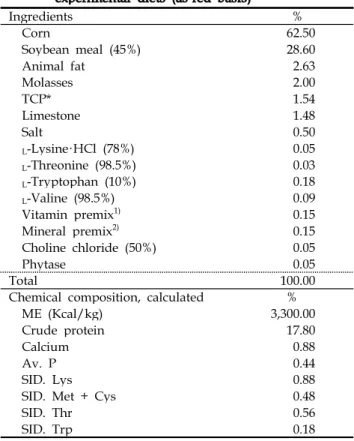
본 시험에 사용한 기초사료는 옥수수와 대두박 위주의 가루 배합사료로써 영양소 함량은 NRC(2012)에서 제시 된 영양소 요구량을 충족하거나 초과하도록 하였다(Table 1). 시험기간 동안 사료와 물은 자유채식 시켰으며, 강원 도에 위치한 연구 농장에서 2019년 7월부터 8월까지 수 행하였다. 환경 온도 LT 처리구의 온도를 조절하기 위해 냉방기(CS-1810AD, Airsystem, Korea)를 사용하였다. 본 시험기간 동안 측정된 실제 환경 온도는 LT 처리구가 23.3±0.89℃이었으며, HT 처리구는 27.5±1.76℃이었다. 이 유는 평균 21일령에 하였으며, 모돈은 임신사로 이동 후 재귀발정 확인 시점까지 관리하였다.
3. 조사항목
(1) 모돈과 번식 성적
모돈의 체중과 등지방두께 측정은 분만 당일과 이유 시점(평균 21일)에 측정하였으며, 등지방두께는 초음파 측정기(Agroscan A16, Angouleme, France)로 제 10번 늑 골 기준으로 왼쪽 6.5cm 지점에서 3회 측정하여 평균값 을 사용하였다. 모돈의 총 사료섭취량을 조사하여, 일일 사료섭취량으로 산출하였다. 모돈 개체별 개시 포유두수, 이유두수 및 자돈의 체중을 측정하여, 복당증체량, 일당
[Provider:earticle] Download by IP 118.70.52.165 at Monday, December 20, 2021 7:45 PM
www.earticle.net
Table 1. Formula and chemical composition of experimental diets (as-fed basis)
Ingredients %
Corn 62.50
Soybean meal (45%) 28.60
Animal fat 2.63
Molasses 2.00
TCP* 1.54
Limestone 1.48
Salt 0.50
L-Lysine·HCl (78%) 0.05
L-Threonine (98.5%) 0.03
L-Tryptophan (10%) 0.18
L-Valine (98.5%) 0.09
Vitamin premix1) 0.15
Mineral premix2) 0.15
Choline chloride (50%) 0.05
Phytase 0.05
Total 100.00
Chemical composition, calculated %
ME (Kcal/kg) 3,300.00
Crude protein 17.80
Calcium 0.88
Av. P 0.44
SID. Lys 0.88
SID. Met + Cys 0.48
SID. Thr 0.56
SID. Trp 0.18
1)Supplied per kilogram of vitamin premix: 12,000,000 IU vitamin A, 2,400,000 IU vitamin D3, 132,000 IU vitamin E, 1,500 mg vitamin K3, 3,000 mg vitamin B1, 11,250 mg vitamin B2, 3,000 mg vitamin B6, 45 mg vitamin B12, 36,000 mg pantothenic acid, 30,000 mg niacin, 600 mg biotin, 4,000 mg folic acid.
2)Supplied per kilogram of mineral premix: 80,000 mg Fe, 170 mg Co, 8,500 mg Cu, 25,000 mg Mn, 95,000 mg Zn, 140 mg I, 150 mg Se.
*TCP : tri calcium phosphate.
증체량 및 포유기 생존율을 산출하였다. 재귀발정일은 이 유 후 일 2회(06:30시, 18:30시) 관찰하여 발정이 확인되 는 시점으로 계산하였다.
(2) 혈액 특성
분만 당일과 이유 시점에 처리구별 모돈 10두를 무작 위로 선발한 후 모돈의 경정맥으로부터 혈액 10ml를 채 취하였다. 채취한 혈액은 항응고제 처리가 되지 않은 vacutainer plastic serum tube(Becton Dickinson, Franklin, NJ)에 담은 후 원심분리기를 이용하여 3,000rpm, 4℃ 조 건에서 15분간 혈청을 분리하였다. 분리된 혈청 시료는 분석 전까지 –20℃에서 보관하였다.
혈 중 blood urea nitrogen, glucose, triglyceride 및
creatinine의 농도는 생화학분석기(Fuji Dri-chem 3500i;
Fujifilm Corp.)를 사용하여 분석하였으며, 혈 중 cortisol 의 농도는 porcine cortisol kit(Fujifilm Corp., Saitama, Japan)를 사용하여 분석하였다. 혈 중 LH, FSH 및 insulin 의 농도는 swine ELISA kit(Endocrine Technologies Inc., USA)를 이용하여 해당 protocol에 따라 분석하였다.
(3) 유 성상
처리구별 10두씩 무작위로 선발하여 분만 후 12시간 내 및 분만 후 10일차에 초유와 상유를 각각 25ml씩 채 취하였다. 상유 채취를 위해 1ml의 옥시토신(10IU/ml)을 근내 주사하였고, 알코올로 소독한 후 유방 마사지법을 통해 채취하였다. 채취한 시료는 –20℃에서 분석 전까지 냉동 보관하였으며, 적외선 유성분 분석기(Milko Scan 133B. Analyser; Foss Electric, Hillerød, Denmark)를 이 용하여 돈유 내 total solid, protein, fat 및 lactose 함량 을 분석하였다.
(4) 통계분석
본 2×2 요인 시험설계에 의하여 얻어진 모든 데이터는 SAS(Statistical Analysis System, SAS Institute Inc., USA) 프로그램의 general linear model procedure를 이 용하여, 포유모돈의 환경 온도와 등지방두께의 효과 및 이들 간의 상호작용 효과를 분석하였다. 번식성적은 개체 별 측정단위로 하였고, 혈액 특성, 혈 중 호르몬 성상 및 유 성상은 처리구별 선발된 10두를 측정단위로 하였다.
Ⅲ. 결과 및 고찰
1. 모돈 성적
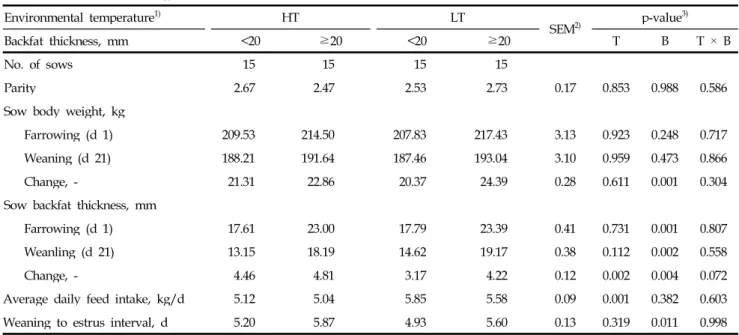
포유모돈의 환경 온도와 등지방두께에 따른 모돈 성적 은 Table 2와 같다. 환경 온도에 의해 등지방두께 변화, 일일사료섭취량에서 유의적인 차이가 있었으며, 등지방두 께에 의해서는 포유모돈의 체중변화, 이유 시 등지방두 께, 등지방두께 변화 및 재귀발정일이 유의적인 차이를 보였다. 환경 온도와 등지방두께에 따른 상호작용 효과는 나타나지 않았다. 고온 환경하의 모돈은 체내 대사열 발 생을 조절하기 위해 자발적 사료섭취량이 감소하며, 이와 관련된 연구결과가 보고되었다. Schinckel 등(2010)의 연 구결과에 의하면, 포유모돈의 환경 온도가 22℃에서 1℃
[Provider:earticle] Download by IP 118.70.52.165 at Monday, December 20, 2021 7:45 PM
www.earticle.net
Table 2. Effects of environmental temperature and backfat thickness on body condition, feed intake and weaning to estrus interval in lactating sows
Environmental temperature1) HT LT
SEM2) p-value3)
Backfat thickness, mm <20 ≥20 <20 ≥20 T B T × B
No. of sows 15 15 15 15
Parity 2.67 2.47 2.53 2.73 0.17 0.853 0.988 0.586
Sow body weight, kg
Farrowing (d 1) 209.53 214.50 207.83 217.43 3.13 0.923 0.248 0.717
Weaning (d 21) 188.21 191.64 187.46 193.04 3.10 0.959 0.473 0.866
Change, - 21.31 22.86 20.37 24.39 0.28 0.611 0.001 0.304
Sow backfat thickness, mm
Farrowing (d 1) 17.61 23.00 17.79 23.39 0.41 0.731 0.001 0.807
Weanling (d 21) 13.15 18.19 14.62 19.17 0.38 0.112 0.002 0.558
Change, - 4.46 4.81 3.17 4.22 0.12 0.002 0.004 0.072
Average daily feed intake, kg/d 5.12 5.04 5.85 5.58 0.09 0.001 0.382 0.603
Weaning to estrus interval, d 5.20 5.87 4.93 5.60 0.13 0.319 0.011 0.998
1)HT (high temperature), 27.5℃; LT (low temperature), 23.3℃.
2)Standard error of means.
3)T, environmental temperature; B, backfat thickness; T × B, temperature × backfat thickness.
증가 시 일일 ME 섭취량이 1.6% 감소하였으며, 25℃ 이 상 온도에서는 1℃가 증가함에 따라 3.67% 감소하였다.
본 연구결과에서도 27.5℃에 노출된 모돈의 일일사료섭취 량이 11.25% 감소하여 이와 유사하였다. Choi 등(2018)의 연구에서는 고온 환경 온도 내 모돈의 등지방두께가 22mm 이상일 경우 사료섭취량이 감소하였고 체손실은 22mm 이하에 비해 증가하였다. 한편, 지방 세포로부터 방출되는 렙틴은 사료섭취량과 음의 상관관계를 나타내 기 때문에 분만 시 등지방두께는 번식성적에 영향을 미 칠 수 있다(Cervantes et al., 2016). 분만 시 등지방두께 23mm 이상의 모돈은 포유기 사료섭취량이 감소하여 체 손실이 증가하였다는 연구결과들(Dourmad et al., 2001;
Goodband et al., 2006)이 보고되었으나, 본 연구결과에 서는 등지방두께에 의한 사료섭취량 변화는 없었다. 그러 나 포유기 체중 및 등지방두께 변화에서 등지방두께에 따른 차이를 나타내어 포유기 영양소 요구량에 비해 적 은 섭취량에 기인한 것으로 사료된다. 체손실의 크기는 영양소 요구량과 섭취량 간의 음의 관계가 클수록 더 크 게 발생하며(Strathe et al., 2017), 고온에 의한 자발적 사 료섭취량 감소에 의해 체손실이 크게 증가할 수 있다 (Silva et al., 2009). 또한, 낮은 사료섭취량과 포유기간 중 높은 체손실에 의해 재귀발정이 지연될 수 있으며 (Strathe et al., 2017), 본 연구결과에서도 높은 등지방두
께 처리구의 재귀발정일이 증가하였다. 2. 번식 성적
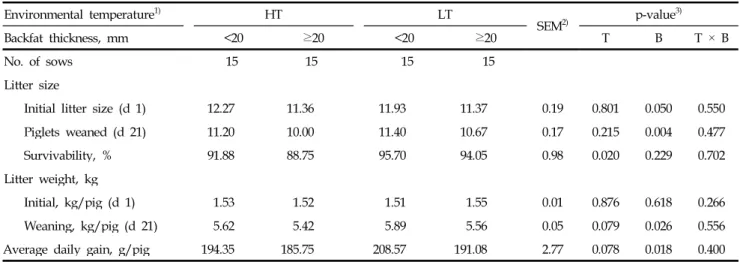
포유모돈의 환경 온도와 등지방두께에 따른 번식 성적 은 Table 3과 같다. 포유자돈의 생존율은 환경 온도에 의 한 유의적인 차이가 있었으며, 이유자돈 수, 이유 시 체 중 및 일당증체량은 등지방두께에 따른 유의적인 차이를 나타냈다. 환경 온도와 등지방두께에 따른 상호작용 효과 는 없었다. 포유기 고온 환경은 포유자돈의 돈유 섭취량 과 생존율에 부정적인 영향을 미치며(Silva et al.,2009), 이는 고온에 의한 사료섭취량 감소(Strathe et al., 2017) 와 유선 혈류량의 감소(Renaudeau and Noblet, 2001)가 주요 원인이다. 본 연구결과에서도 27.5℃에 노출된 처리 구의 자돈 생존율이 23.3℃에 노출된 처리구보다 낮았으 며, 이는 유 생산량 감소에 의한 것으로 사료된다. 한편, 임신말기 등지방두께는 포유기 사료섭취량 및 번식성적 간의 상관관계가 있다(Kim et al., 2015). 등지방두께가 너무 낮거나 높으면 유선 발달이 저하되며(Farmer, 2018), 임신 중기 이후 낮은 사료섭취량은 산화스트레스 유발을 촉진하여 유선 발달을 감소시키는 원인이다(Berchieri- Ronchi et al., 2011). 따라서 포유기 유생산량을 감소시키 고 자돈의 성장을 저하시키는 요인이 될 수 있다. 본 연
[Provider:earticle] Download by IP 118.70.52.165 at Monday, December 20, 2021 7:45 PM
www.earticle.net
Table 3. Effects of environmental temperature and backfat thickness on litter size and piglet performance in lactating sows
Environmental temperature1) HT LT
SEM2) p-value3)
Backfat thickness, mm <20 ≥20 <20 ≥20 T B T × B
No. of sows 15 15 15 15
Litter size
Initial litter size (d 1) 12.27 11.36 11.93 11.37 0.19 0.801 0.050 0.550
Piglets weaned (d 21) 11.20 10.00 11.40 10.67 0.17 0.215 0.004 0.477
Survivability, % 91.88 88.75 95.70 94.05 0.98 0.020 0.229 0.702
Litter weight, kg
Initial, kg/pig (d 1) 1.53 1.52 1.51 1.55 0.01 0.876 0.618 0.266
Weaning, kg/pig (d 21) 5.62 5.42 5.89 5.56 0.05 0.079 0.026 0.556
Average daily gain, g/pig 194.35 185.75 208.57 191.08 2.77 0.078 0.018 0.400
1)HT (high temperature), 27.5℃; LT (low temperature), 23.3℃.
2)Standard error of means.
3)T, environmental temperature; B, backfat thickness; T × B, temperature × backfat thickness.
구결과에서도 등지방두께 ≥20mm 처리구의 이유 시 체 중 및 일당증체량이 <20mm 처리구보다 감소하였으며, 이는 유선발달 저하 또는 유생산량 감소에 의한 것으로 사료된다. Kim 등(2015)의 연구결과, 등지방두께 25mm 이상인 모돈의 이유 시 자돈 체중과 두수가 감소하였고 이와는 반대로, Choi 등(2018)의 연구결과에서 포유기에 높은 등지방두께는 체 내 축적된 지방을 전환시켜 사용 함으로써 자돈의 성장에 영향을 미치지 않았으나, 과도한 체손실로 인해 재귀발정일이 감소하였다.
3. 혈액 특성
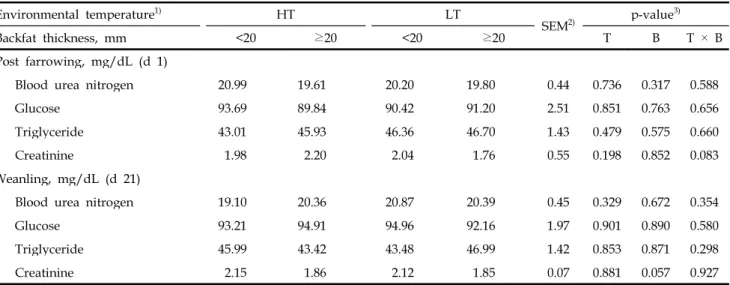
포유기에 환경 온도와 등지방두께가 포유모돈의 혈액 특성에 미치는 영향을 Table 4에 나타냈다. 분만 후 및 이유 시 혈중 blood urea nitrogen, glucose, triglyceride 및 creatinine 농도는 포유모돈의 환경온도, 등지방두께 및 이들 간의 상호작용에 의한 유의적인 차이가 나타나 지 않았다. 혈액 성상의 변화는 사료섭취량 감소에 대한 판단 지표로 사용될 수 있다. 감소된 사료섭취량은 혈 중 포도당을 감소시키고(Pearce et al., 2013), 높은 등지방두 께를 갖는 모돈의 혈 중 triglyceride 농도는 등지방두께 가 낮은 모돈보다 높은 것으로 보고되었다(Eissen et al., 2000). 그러나 본 연구결과에서는 차이가 발견되지 않았 으며, 환경 온도 및 등지방두께가 포유기 모돈의 혈액 대 사에 어떠한 영향을 미치는지 추가적인 연구가 필요할 것으로 사료된다.
4. 호르몬 성상
환경 온도와 등지방두께에 따른 포유모돈의 호르몬 성 상 변화는 Table 5와 같다. 분만 후 및 이유 시 혈 중 cortisol 농도가 포유모돈의 환경 온도에 따른 유의적인 차이가 있었으며, 이외에 FSH, LH 및 insulin 농도는 환 경온도, 등지방두께 및 이들 간의 상호작용에 따른 차이 가 없었다. 고온 환경에서 증가된 혈 중 cortisol은 체내 발생된 발열을 위해 혈관 확장제 역할을 하며, 고온 조건 에서 크게 증가되는 것으로 알려져 있다(Muns et al., 2016). Malmkvist 등(2009)은 고온과 적온 환경에서 분만 전후 5시간 동안의 모돈 혈 중 cortisol 농도 변화를 분석 한 결과, 고온 환경이 적온 환경에 비해 혈 중 cortisol 농도가 29% 증가하였다. 본 연구에서도 환경 온도 27.5℃
의 모돈 혈 중 cortisol 농도가 적온 대비 23% 높게 나타 났다. 이와는 반대로, Cabezón 등(2017)의 연구에서는 지 속적인 고온에 대한 내분비 작용으로 cortisol의 상승이 완화되었으며, 3주간 고온 노출 시 혈 중 cortisol 농도의 차이가 발견되지 않았다.
5. 유 성상
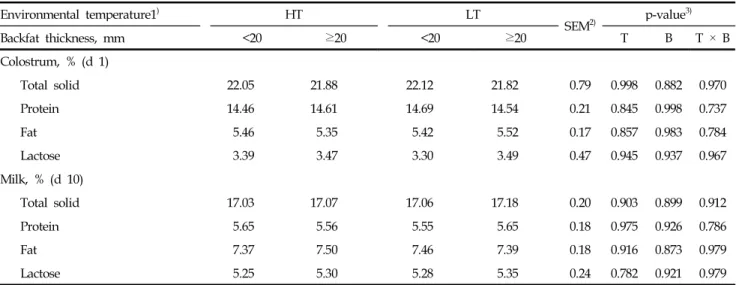
포유모돈의 환경 온도 및 등지방두께가 유 성상에 미 치는 영향은 Table 6과 같다. 초유와 상유 내 total solid, protein, fat 및 lactose 함량은 포유기 모돈의 환경 온도 및 등지방두께에 따른 유의적인 차이가 없었다. 포유기 환경 온도 및 등지방두께에 대한 연구결과들이 보고되고
[Provider:earticle] Download by IP 118.70.52.165 at Monday, December 20, 2021 7:45 PM
www.earticle.net
Table 4. Effects of environmental temperature and backfat thickness on blood metabolites in lactating sows
Environmental temperature1) HT LT
SEM2) p-value3)
Backfat thickness, mm <20 ≥20 <20 ≥20 T B T × B
Post farrowing, mg/dL (d 1)
Blood urea nitrogen 20.99 19.61 20.20 19.80 0.44 0.736 0.317 0.588
Glucose 93.69 89.84 90.42 91.20 2.51 0.851 0.763 0.656
Triglyceride 43.01 45.93 46.36 46.70 1.43 0.479 0.575 0.660
Creatinine 1.98 2.20 2.04 1.76 0.55 0.198 0.852 0.083
Weanling, mg/dL (d 21)
Blood urea nitrogen 19.10 20.36 20.87 20.39 0.45 0.329 0.672 0.354
Glucose 93.21 94.91 94.96 92.16 1.97 0.901 0.890 0.580
Triglyceride 45.99 43.42 43.48 46.99 1.42 0.853 0.871 0.298
Creatinine 2.15 1.86 2.12 1.85 0.07 0.881 0.057 0.927
1)HT (high temperature), 27.5℃; LT (low temperature), 23.3℃.
2)Standard error of means.
3)T, environmental temperature; B, backfat thickness; T × B, temperature × backfat thickness.
Table 5. Effects of environmental temperature and backfat thickness on hormone profiles in lactating sows
Environmental temperature1) HT LT
SEM2) p-value3)
Backfat thickness, mm <20 ≥20 <20 ≥20 T B T × B
Post farrowing (d 1)
FSH, ng/mL 2.40 2.47 2.50 2.36 0.11 0.978 0.864 0.664
LH, ng/mL 0.33 0.35 0.33 0.34 0.01 0.936 0.560 0.813
Insulin, µIU/mL 2.56 2.33 2.52 2.59 0.14 0.713 0.780 0.600
Cortisol, ug/mL 7.82 7.91 6.11 5.98 0.17 0.002 0.794 0.689
Weanling (d 21)
FSH, ng/mL 3.09 3.11 2.96 2.91 0.08 0.365 0.932 0.841
LH, ng/mL 0.61 0.64 0.64 0.66 0.01 0.713 0.383 0.766
Insulin, µIU/mL 1.89 1.84 1.78 1.77 0.06 0.524 0.832 0.855
Cortisol, ug/mL 5.62 5.34 4.48 4.33 0.12 0.001 0.921 0.759
1)HT (high temperature), 27.5℃; LT (low temperature), 23.3℃.
2)Standard error of means.
3)T, environmental temperature; B, backfat thickness; T × B, temperature × backfat thickness.
있다. Chen 등(2019)은 포유기 환경 온도에 따른 초유 성 상 변화는 없었으나 15일차 상유 성상에서 차이가 있으 며, 고온에서 일반 조성분들이 감소한 것으로 보고하였 다. 반대로 Renaudeau와 Noblet(2001)의 연구결과에서는 초유 성분에 차이는 없었으나, 14일차 상유 성상에는 차 이가 있는 것으로 보고하였으며, 고온 환경 모돈의 유성 분 중 건물, 조회분 및 에너지 함량이 증가하였다. 한편, 모돈의 등지방두께에 따른 초유와 상유의 일반 조성분에 대한 차이는 없다는 결과도 보고된 바 있다(Choi et al.,
2018). 본 연구결과에서도 환경 온도와 등지방두께에 따 른 유 성상 차이가 없었으며, 유 합성 대사 과정에 관한 연구가 필요할 것으로 사료된다.
Ⅳ. 요약
본 연구는 환경 온도와 등지방 두께(BT)가 모돈의 번식능력에 미치는 영향을 조사하기 위해서 수행되었
[Provider:earticle] Download by IP 118.70.52.165 at Monday, December 20, 2021 7:45 PM
www.earticle.net
Table 6. Effects of environmental temperature and backfat thickness on colostrum and milk composition of lactating sows
Environmental temperature1) HT LT
SEM2) p-value3)
Backfat thickness, mm <20 ≥20 <20 ≥20 T B T × B
Colostrum, % (d 1)
Total solid 22.05 21.88 22.12 21.82 0.79 0.998 0.882 0.970
Protein 14.46 14.61 14.69 14.54 0.21 0.845 0.998 0.737
Fat 5.46 5.35 5.42 5.52 0.17 0.857 0.983 0.784
Lactose 3.39 3.47 3.30 3.49 0.47 0.945 0.937 0.967
Milk, % (d 10)
Total solid 17.03 17.07 17.06 17.18 0.20 0.903 0.899 0.912
Protein 5.65 5.56 5.55 5.65 0.18 0.975 0.926 0.786
Fat 7.37 7.50 7.46 7.39 0.18 0.916 0.873 0.979
Lactose 5.25 5.30 5.28 5.35 0.24 0.782 0.921 0.979
1)HT (high temperature), 27.5℃; LT (low temperature), 23.3℃.
2)Standard error of means.
3)T, environmental temperature; B, backfat thickness; T × B, temperature × backfat thickness.
다. 실험은 포유모돈 60두를 공시하였고, 2×2 factorial arrangement에 따라 각 처리구는 두 수준의 사육 온 도(high temperature [HT], 27.5±1.76℃; low temperature [LT], 23.3±0.89℃) 및 BT(<20mm, 평균 17.70mm; ≥20mm, 평균 23.20mm)로 나누어 2019년 7월부터 8월까지 2개월 동안 실시하였다. 실험 결과 HT 처리구에서 등지방두께 변이폭이 크고, 사료 섭취 량은 적은 것으로 나타났다. <20mm BT 처리구가 ≥ 20mm BT 처리구에 비하여 체중 손실과 등지방 손실 이 적은 것으로 나타났다. <20mm BT 처리구의 재귀 발정일(<20mm 5.20, 4.93d vs. ≥20mm 5.87, 5.60d)이
≥20mm BT 처리구보다 짧은 것으로 나타났다. 포유 자돈 생존률은 LT 처리구(94.87%) 보다 HT 처리구 (90.31%)에서 더 낮은 것으로 나타났다. 자돈의 이유 체중과 일일증체량은 BT가 ≥20mm 이상인 모돈(각각 5.49kg 및 188.41g)보다 BT가 <20mm미만인 모돈(각 각 5.75kg 및 201.46g)에서 더 큰 것으로 나타났다.
HT 처리구의 모돈은 LT 처리구의 모돈 보다 코티솔 농도가 더 높았다(post farrowing: HT 7.86ug/mL vs.
LT 6.04ug/mL; weanling: HT 5.48ug/mL vs. LT 4.40ug/mL). 결론적으로 환경 온도는 모돈의 번식과 코티솔 수치에 부정적인 영향을 미치는 것으로 나타 났다. 또한, BT가 높은 모돈은 열 스트레스를 받을 때 이유에서 발정까지의 간격이 더 길었다. 본 실험 결과 는 실제 농가에서 고온기에 모돈관리하는데 활용될
것으로 보여진다.
사사
본 논문은 농촌진흥청 연구사업(세부과제번호: PJ01160302) 의 지원 및 2020년도 농촌진흥청 국립축산과학원 전문연 구원 과정 지원사업에 의해 이루어진 것임.
Ⅴ. 참고문헌
1. Berchieri-Ronchi C. B., Kim, S. W., Zhao, Y., Correa, C. R., Yeum, K. J. and Ferreira, A. L. 2011. Oxidative stress status of highly prolific sows during gestation and lactation. Animal. 5(11):1774-1779.
2. Cabezón, F. A., Schinckel, A. P., Marchant-Forde, J.
N., Johnson, J. S. and Stwalley, R. M. 2017. Effect of floor cooling on late lactation sows under acute heat stress. Livest. Sci. 206:113-120.
3. Cervantes, M., Cota, M., Arce, N., Castillo, G., Avelar, E., Espinoza, S. and Morales, A. 2016. Effect of heat stress on performance and expression of selected amino acid and glucose transporters, HSP90, leptin and ghrelin in growing pigs. J. Therm. Biol.
[Provider:earticle] Download by IP 118.70.52.165 at Monday, December 20, 2021 7:45 PM
www.earticle.net
59:69-76.
4. Chen, J., Zhang, F., Guan, W., Song, H., Tian, M., Cheng, L., Shi, K., Song, J., Chen, F., Zhang, S., Yang, F., Ren, C. and Yang, F. 2019. Increasing selenium supply for heat-stressed or actively cooled sows improves piglet preweaning survival, colostrum and milk composition, as well as maternal selenium, antioxidant status and immunoglobulin transfer. J.
Trace Elem. Med. Bio. 52:89-99.
5. Choi, Y., Hosseindoust, A., Shim, Y., Kim, M., Kumar, A., Oh, S., Kim Y. and Chae, B. J. 2017.
Evaluation of high nutrient diets on litter performance of heat-stressed lactating sows.
Asian-Australas. J. Anim. Sci. 30(11):1598.
6. Choi, Y. H., Hosseindoust, A., Kim, J. S., Lee, S. H., Kim, M. J., Kumar, A. and Chae. B. J. 2018. An overview of hourly rhythm of demand-feeding pattern by a controlled feeding system on productive performance of lactating sows during summer. Ital. J.
Anim. 17(4):1001-1009.
7. Choi, Y. H., Moturi, J., Hosseindoust. A., Kim, M. J., Kim, K. Y., Lee, J. H., Song, C. H., Kim, Y. H. and Chae, B. J. 2019. Night feeding in lactating sows is an essential management approach to decrease the detrimental impacts of heat stress. J. Anim. Sci.
Technol. 61(6):333-339.
8. Clowes, E. J., Aherne, F. X., Foxcroft, G. R. and Baracos, V. E. 2003. Selective protein loss in lactating sows is associated with reduced litter growth and ovarian function. J. Anim. Sci. 81(3):753-764.
9. Dourmad, J. Y., Etienne, M. and Noblet, J. 2001.
Measuring backfat depth in sows to optimize feeding strategy. INRA Prod. Anim. (France). 14(1):41-50.
10. Eissen, J. J., Kanis, E. and Kemp, B. 2000. Sow factors affecting voluntary feed intake during lactation. Livest. Prod. Sci. 64:147-165.
11. Farmer, C. 2018. Nutritional impact on mammary development in pigs: a review. J. Anim. Sci.
94(9):3748-3756.
12. Goodband, B., Rouchey, J. D., Tokach, M., Dritz, S.
and Nelssen, J. 2006. Strategies for feeding weaned pigs. In Proc London Swine Conference, London,
ON, Canada, pp. 75-85.
13. Houde, A. A., Méthot, S., Murphy, B. D., Bordignon, V. and Palin, M. F. 2010. Relationships between backfat thickness and reproductive efficiency of sows: A two-year trial involving two commercial herds fixing backfat thickness at breeding. Can. J.
Anim. Sci. 90(3):429-436.
14. Kim, J. S., Yang, X., Pangeni, D. and Baidoo, S. K.
2015. Relationship between backfat thickness of sows during late gestation and reproductive efficiency at different parities. Acta Agriculturae Scandinavica B.
65(1):1-8.
15. Malmkvist, J., Damgaard, B. M., Pedersen, L. J., Jørgensen, E., Thodberg, K., Chaloupková, H. and Bruckmaier, R. M. 2009. Effects of thermal environment on hypothalamic-pituitary-adrenal axis hormones, oxytocin, and behavioral activity in periparturient sows. J. Anim. Sci. 87(9):2796-2805.
16. Messias de Bragança, M., Mounier, A. M. and Prunier. A. 1998. Does feed restriction mimic the effects of increased ambient temperature in lactating sows. J. Anim. Sci. 76(8):2017-2024.
17. Muns, R., Nuntapaitoon, M. and Tummaruk, P.
2016. Non-infectious causes of pre-weaning mortality in piglets. Livest. Sci. 184:46-57.
18. NRC, Nutrient requirements of swine. 2012. 11th Ed.
National Academy Press; Washington, D.C. U.S.A., pp. 208-238.
19. Pearce, S. C., Gabler, N. K., Ross, J. W., Escobar, J., Patience, J. F., Rhoads, R. P. and Baumgard, L. H.
2013. The effects of heat stress and plane of nutrition on metabolism in growing pigs. J. Anim.
Sci. 91(5):2108-2118.
20. Quiniou, N. and Noblet, J. 1999. Influence of high ambient temperatures on performance of multiparous lactating sows. J. Anim. Sci. 77(8):2124-2134.
21. Renaudeau, D. and Noblet, J. 2001. Effects of exposure to high ambient temperature and dietary protein level on sow milk production and performance of piglets. J. Anim. Sci. 79(6):1540-1548.
22. Renaudeau, D., Collin, A., Yahav, S., De Basilio, V., Gourdine, J. L. and Collier, R. J. 2012. Adaptation to
[Provider:earticle] Download by IP 118.70.52.165 at Monday, December 20, 2021 7:45 PM
www.earticle.net
hot climate and strategies to alleviate heat stress in livestock production. Animal. 6(5):707-728.
23. Rosero, D. S., Van Heugten, E., Odle, J., Cabrera, R., Arellano, C. and Boyd, R. D. 2012. Sow and litter response to supplemental dietary fat in lactation diets during high ambient temperatures. J. Anim.
Sci. 90(2):550-559.
24. Schinckel, A. P., Schwab, C. R., Duttlinger, V. M.
and Einstein, M. E. 2010. Analyses of feed and energy intakes during lactation for three breeds of sows. Prof. Anim. Sci. 26(1):35-50.
25. Serenius, T., Stalder, K. J., Baas, T. J., Mabry, J. W., Goodwin, R. N., Johnson, R. K. and Miller, R. K.
2006. National pork producers council maternal line national genetic evaluation program: A comparison of sow longevity and trait associations with sow longevity. J. Anim. Sci. 84(9):2590-2595.
26. Silva, B. A. N., Noblet, J., Donzele, J. L., Oliveira, R.
F. M., Primot, Y., Gourdine, J. L. and Renaudeau, D.
2009. Effects of dietary protein level and amino acid supplementation on performance of mixed-parity lactating sows in a tropical humid climate. J. Anim.
Sci. 87(12):4003-4012.
27. Strathe, A. V., Bruun, T. S. and Hansen. C. F. 2017.
Sows with high milk production had both a high feed intake and high body mobilization. Animal.
11(11):1913-1921.
28. Vinsky, M. D., Novak, S. W., Dixon, T., Dyck, M. K.
and Foxcroft, G. R. 2006. Nutritional restriction in lactating primiparous sows selectively affects female embryo survival and overall litter development.
Reprod. Fertil. Dev. 18(3):347-355.
(Received 23 November 2020, Revised 16 December 2020, Accepted 22 December 2020)
[Provider:earticle] Download by IP 118.70.52.165 at Monday, December 20, 2021 7:45 PM