1. Introduction
1)Algae strains that are robust and highly productive are selected for the conversion of biomass into energy (Spolaore et al., 2006), and strains with relatively high lipid contents are very attractive for biodiesel fuel production (Choi, 2015b;
Rudolfi et al., 2009). Microalgae have received considerable interest as a source of renewable energy; however, further optimization of the mass culture conditions is necessary to make microalgal biofuel production economically viable and sustainable (Choi, 2014; Pittman et al., 2011).
Many algal organisms can use either autotrophic, hetero- trophic or mixotrophic metabolic processes for growth. The growth rate and biomass production for some algae in mixo- or heterotrophic conditions can be several times higher than in photoautotrophic-only conditions (Qiao et al., 2009; Yang et al., 2000; Zhang et al., 2011). Moreover, the synthesis of
†To whom correspondence should be addressed.
This is an Open-Access article distributed under the terms of the Creative Commons Attribution Non-Commercial License (http://creativecommons.org/
licenses/by-nc/3.0) which permits unrestricted non-commercial use, distribution, and reproduction in any medium, provided the original work is properly cited.
metabolic products, such as lipids and pigments, is influ- enced by the quality and quantity of organic carbon. The use of organic carbon in mixotrophic cultures reduces the need for carbon dioxide in the culture and facilitates the growth of algal species that are sensitive to agitation (Andrade and Costa, 2007; Chojnacka and Noworyta, 2004). Bouarab et al.
(2004) reported that Micractinium pusillum grew in the presence of organic substrates, such as glucose and acetate, under both mixotrophic and heterotrophic conditions. It can be concluded from the above that mixotrophism is an ideal nutritional mode for high density cultivation of microalgae for the production of biofuels and functional components.
However, even though the biomass and lipid productivities are significantly higher compared with those from autotro- phic growth, the cost of organic carbon sources (usually in the form of glucose or acetate) is high when compared to all other added nutrients. To overcome this high carbon cost, a cheap resource must be found.
Acorns are capable of providing such a supply. Acorns are much cheaper than other organic carbon sources and are found everywhere in the world. The acorn is the nut from oaks and their close relatives (genera Quercus and Litho-
Application of Saccharified Acorn-starch for Biomass and Lipid Accumulation of Microalgae
Hee-Jeong Choi*,† Jung-Min Lee**
*Department of Energy and Environment Convergence, Catholic Kwandong University
**Department of Global Language and Cultures, Catholic Kwandong University
당화된 도토리의 전분이 미세조류 바이오매스 증식과 바이오오일 함량에 미치는 영향
최희정*,†․이정민**
*가톨릭관동대학교 에너지환경융합학과
**가톨릭관동대학교 글로벌 어문학부
(Received 4 January 2016, Revised 9 March 2016, Accepted 10 March 2016)
Abstract
The growth of the algae strain Chlorella vulgaris under mixotrophic conditions in the presence of saccharified acorn-starch (acorn-glucose) was evaluated with the objective of increasing biomass growth and triacylglycerols (TAGs) content. The results indicated that 81.3% of starch was converted to glucose in acorns. C.vulgaris algal strains grown with acorn-glucose produced higher biomass and TAGs content than with autotrophic growth. The highest biomass production and TAGs content with 3 g/L acorn-glucose were 12.44 g/L and 32.9%, respectively. Biomass production with 3 g/L acorn-glucose was 16.4 fold higher than under autotrophic growth condition. These findings suggested that 3 g/L acorn-glucose is economic and efficient for biomass production/productivity and TAGs content of microalgae. This study provides a feasible way to reduce the cost of bioenergy production from microalgae.
Key words : Acorn-starch, Biomass, Glucose, Microalgae, Mixotrophic, Oil content
carpus, in the family Fagaceae). It usually contains a single seed (rarely two seeds), enclosed in a tough, leathery shell and borne in a cup-shaped cupule. Acorns vary from 1-6 cm in length and 0.8-4 cm in width. Acorns are also rich in nutrients. Percentages vary from species to species, but all acorns contain large amounts of water (10.6%), protein (0.8%), carbohydrates (87.3%) and fats (1.2%), as well as various minerals (e.g., calcium, phosphorus, magnesium, potassium and the vitamin niacin) and sugar (e.g., rhamnose, galactose, arainose, mannose, fucose and xylose) (Choi, 2015a). Glucose is especially rich in the acorn, representing 97.9% of the sugar composition. Glucose is an important carbohydrate in biology, indicated by the fact that cells use it as a secondary source of energy and a metabolic inter- mediate. Glucose is one of the main products of photosyn- thesis and fuels for cellular respiration (Pyle et al., 2008). In mixotrophic growth, there are two distinctive processes:
photosynthesis and aerobic respiration. The former is influ- enced by light intensity, and the latter is related to the organic substrate (glucose) concentration (Andruleviciute et al., 2014; Heredia-Arroyo et al., 2011). The high cell density in mixotrophic cultures has demonstrated that the growth stimulating effects of light and CO2 in mixotrophic cultures are as strong as the effects of glucose (Kong et al., 2013).
The above findings suggest that acorn-glucose is a poten- tial substrate for the mixotrophic cultivation of microalgae that may reduce the production cost of microalgal biodiesel.
However, there are few reports on the use of acorn-glucose in biomass production and algal cell components under mixotrophic conditions. Therefore, the effects of various concentrations of saccharified acorn-starch (acorn-glucose) on the biomass growth and triacylglycerols (TAGs) content of Chlorella vulgaris (C. vulgaris) were evaluated under mixo- trophic conditions in this study.
2. Materials and Methods
2.1. Microalgae Cultures and Medium
The investigated microalgae were isolated from KMMCC (Korea Marine Microalgae Culture Center). The C. vulgaris (FC-16, KMMCC-135) cells were round in shape and 3-8 μm in diameter. C. vulgaris cells were cultivated in Jaworski’s medium (JM), which was prepared using deionised water under LED lamps at ambient temperature. Jaworski’s medium is comprised of 4.0 g Ca(NO3)2H2O, 2.48 g KH2PO4, 10.0 g MgSO4 7H2O, 3.18 g NaHCO3, 0.45 g EDTAFeNa, 0.45 g EDTANa2, 0.496 g H3BO3, 0.278 g MnCl2 4H2O, 0.20 g (NH4)6Mo7O24 4H2O, 0.008 g cyanocobalamin, 0.008 g thia- mine HCl, 0.008 g biotin, 16.0 g NaNO3 and 7.2 g Na2HPO4
12H2O in 200 ml of deionised water. The initial concen-
tration of C. vulgaris was 0.357 g/L, and the pH was adjusted to 7.3±0.3. Each culture was grown at room temperature (23±2°C) under 200~250 µmol photons/m 2s illumination using white LEDs (light emitting diodes) for dark and light cycles of 12 h each. Light intensity was measured with a data logger (model LI-1400) using an LI-190SA quantum sensor. For batch cultivation in laboratory conditions, Erlen- meyer glass flasks with a working volume of 5 L were used, and a 15-day cultivation period was chosen. The cultivation period of 15 days was not chosen randomly; the highest biomass concentration is reached during the stationary growth phase, and the lipid content increases with increasing culti- vation time.
Mixotrophic conditions for microalgae cultivation were achieved with acorn-glucose. This acorn contained consi- derable amounts of starch and glucose. The corresponding amount of acorn-glucose was added to the JM growth medium to achieve the desired mixotrophic medium. The cultures were shaken by hand several times a day to avoid sticking.
2.2. Pretreatment of Acorn
Acorns were collected in Ganuneung City in Korea. To remove adherent and interference materials, such as organics and salts, the acorns were rinsed several times with deio- nised water. After cleaning, the hard shell of the acorn was removed, and the nuts were dried in an oven at 105°C for 24 h then crushed into a fine powder using a mortar and pestle. Tannins were removed by soaking chopped acorns in several changes of water until the water no longer turned brown. The acorn powder was extracted using ultrasonic cycle extraction equipment (JYD-US01, Shenzhen Jiayuanda Technol. Co., Ltd, Guangdong, China) with 20-kHz ultra- sonic frequency in an 80% ethanol solution for 120 min with a liquid-to-solid ratio of 15:1 (Pan et al., 2014).
2.3. Saccharification of Acorn-starch
Acorn powder was added to deionized water at a ratio of 1:5 and mixed with calcium chloride and α-amylase (30 U/g dry acorn) for 2h at 90°C. The liquefied mixture was saccharified with glucoamylase (150 U/g dry acorn) for 4h at pH 4.0 and 60°C (Tang et al., 2011). Acorn powder was treated as above for the liquefaction step; however, the saccharification step was allowed to continue for 12 h to completely convert all the starch to glucose. The glucose was measured to determine the total starch in the powder.
2.4. Analytical Methods
The experiment was carried out five times, and the mean values and standard deviations were calculated. Saccharifica-
tion of starch represents a normal glucose equivalent (Dext- rose Equivalent, DE).
DE = (Glucose form saccharified starch/ total solid) × 100 2.4.1. Proximate Compositions
The moisture content of the acorns was determined by drying the various parts in an oven at 105°C until a constant weight was obtained. The crude protein content was calcu- lated by converting the nitrogen content, which was deter- mined using the method proposed by Kjeldahl (6.25 × N).
The fat content was determined with the acid saccharifica- tion Soxhlet system using the method described by the AOAC (2005). The ash content was determined by dry ashing in a furnace oven at 600°C for 10 h. The carbohy- drate content was estimated by subtracting the sum of the weights of the protein, fibre and ash from the total dry matter. All determinations were performed in triplicate.
2.4.2. Measurement of Minerals
The samples used for mineral determination were first digested in HNO3/HCl. The elements K, Ca, Fe, Na and Mg were measured with atomic absorption spectrophotometry (AAS) using a Varian Spectra atomic absorption spectropho- tometer, Buck Scientific 210 GVP model. All determinations were performed in triplicate, and we also added spike samples to verify the accuracy of the procedure. P was analysed accord- ing to the Mo-blue method using a UV/Vis Spectrophoto- meter DU800 (Beckman Coulter, USA).
2.4.3. Determination of Monosaccharides for Acorn
The monosaccharide content was determined by a method of separation described by Blakeney et al. (1983). The 10-mg sample was placed into a Teflon-lined screw cap tube and mixed with 125 µL of 73% (w/w) H2SO4. After 45 minutes, the solution was saccharified with 1.35 mL of distilled water at 100°C for 3 hour, and then it was neutra- lised by adding 320 µL of 15M NH4OH. After neutrali- zation, 1 mL of 2% NaBH4 in DMSO was added to the mixture to react for 90 minutes at 40°C. Next, 100 µL of 18 M glacial acetic acid, 200 µL of 1-methylimidazole and 2.0 mL of acetic anhydride were added to the reaction mixture and allowed to stand at room temperature for 10 minutes.
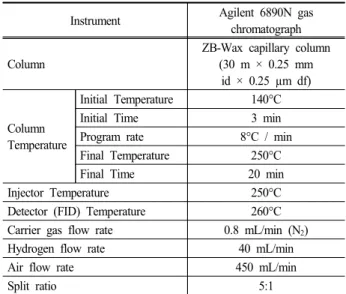
After decomposing, the excess acetic anhydride was sepa- rated into a microcentrifuge tube for analysis by GLC. The GLC analysis conditions are shown in Table 1.
2.4.4. Measurement of Cell Weight and Specific Growth Rate Acorn-glucose at various concentrations (0, 1, 2, 3 and 5 g/L) was added during the initial growth phase and the growth of the algae biomass as well as the lipid accumu- lation was evaluated. To determine the biomass concentration,
Table 1. Instrument and operation conditions for monosaccharide analysis by GLC
Instrument Agilent 6890N gas
chromatograph Column
ZB-Wax capillary column (30 m × 0.25 mm
id × 0.25 µm df)
Column Temperature
Initial Temperature 140°C
Initial Time 3 min
Program rate 8°C / min
Final Temperature 250°C
Final Time 20 min
Injector Temperature 250°C
Detector (FID) Temperature 260°C
Carrier gas flow rate 0.8 mL/min (N2)
Hydrogen flow rate 40 mL/min
Air flow rate 450 mL/min
Split ratio 5:1
a sample of microalgae in growth medium was centrifuged for 10 min at 628 g, washed with distilled water and dried in an oven at 105ºC for 24 h to constant weight. The biomass productivity P (g/(L day)) was calculated from the variation in biomass concentration X (g/L) within a cultiva- tion time t (in days), according to the following equation:
P = (X1-X0) / (t1-t0) (1)
The specific growth rate µ (in days) was calculated using equation (2):
µ = ln (X1/X0) / (t1-t0) (2)
where X1 and X0 are the biomass concentration (g/L) on days t1 and t0, respectively.
2.4.5. Extraction of Lipids
The algal biomass for lipid extraction was prepared by centrifugation and drying. After oven drying, the algae were pulverised and subjected to Soxhlet extraction. All Soxhlet extractions were performed for 72 h using 500 mL of solvent for 1 g of pulverised dry algae with a cycle time of 10-15 min. The Soxhlet extraction with hexane was selected because the Bligh and Dyer (1959) extraction method is suit- able for the extraction of all lipids, including triglycerides, phospholipids and other pigments (Sobczuk and Chisti 2010).
The lipid content does not reflect the exact amount of tri- acylglycerols (TAGs) because only triglycerides are used in the synthesis of biodiesel, and other components are unde- sirable. The excess hexane was evaporated by rotary evapo- ration until the total volume reached 30-40 mL. The solutions were diluted to 50 mL and used to determine the TAG
content. The amount of TAGs was determined using a Fourier transform infrared (FTIR) spectrometer Spectrum RX 1 (Perkin Elmer) according to the carbonyl stretching absorp- tion at 1740/cm (Stehfest et al., 2005). The amount of TAGs in the extract solutions was determined using a standard graph, and the amount of TAGs was calculated in the dry algae (%, w/w). The experiments were performed five times, and the mean values and standard deviations were calculated.
3. Results and Discussion
3.1. Saccharification of Acorn Powder
The composition of raw acorn and saccharified acorn is represented in Table 2. The proximate compositions such as moisture, crude ash, crude protein, crude fat and carbohy- drate decreased from 70.2-78.8% to 14.7-20.5%. In contrast, sugar composition (Glucose, Rhamnose, Galactose, Arabinose, Mannose, Fructose and Xylose) increased after sacchrifica- tion of the acorns, from 23.2-28.6% to 75.3-91.4%. These results indicated that most of the starch in the acorns was converted to glucose through saccahrification. Mineral con- tents (K, P, Ca, Na, Mg and Fe etc.) and fatty acid com- position decreased slightly from 4.3-5.2% to 3.8-4.9% and 5.6-6.2% to 5.1-5.4%, respectively, with saccharification.
Fig. 1 illustrates glucose release during the saccharification of acorn starch from the pretreated materials. Starch con- centration decreased to 14.50 g/L from 123.50 g/L. While starch concentration decreased by 88.3%, glucose increased 9.8 fold in 5 hours after saccharification. The saccharifica- tion rate reached 81.3% within 5 hours but the starch could not be converted completely. After 5 hours of saccharifica- tion, the glucose and starch concentrations did not change further. α-amylase and glucoamylase, saccharified enzymes, convert the α-1,4- bond polymer in starch to form low mole- cular weight dextrins such as glucose, maltose, oligosaccha- rides. The activities of α-amylase and glucoamylase are inhibited by tannins (Pan et al., 2014), which comprise about 6.2% of acorns. After the saccharification enzymes saccha- rified amylose to dextrins (6 to 8 form glucose), the dextrin is decomposed into oligosaccharides such as maltoteratose, maltopentaose and maltotriose by the enzyme. Thereafter, oligosaccharides are slowly broken down to glucose and maltose by the enzyme and the concentration becomes
Table 2. The acorn composition
Composition [%] Acorn powder Saccharified acorns Proximate compositions 70.2-78.8 14.7-20.5
Mineral contents 4.3-5.2 3.8-4.9
Sugar composition 23.2-28.6 75.2-81.1 Fatty acid composition 5.6-6.2 5.1-5.4
Fig. 1. Process of glucose and starch concentration during saccharification of acorn starch.
diluted (Charef et al., 2008). However, if the concentration of oligosaccharides is high, isomaltose and panose can be regenerated using saccharified energy from maltose and glucose. In particular, since the concentration of glucose and maltose increase rapidly in accordance with the progress of sacchrification, the regeneration of isomaltose and panose also occurs rapidly (Tang et al., 2011). Thus, obtaining a large amount of glucose from starch saccharification is difficult. Glucose is a very important carbon source for the growth of microalgae under mixotrophic conditions and was the main sugar composition in the acorns evaluated. Chaud- hary et al. (2012) reported that glucose is a very important factor for microalgae growth and that E. coli growth with glucose is 3 times faster than with glycerol. The results of the current study indicated that the acorns contained a con- siderable amount of carbonate and glucose, which positively affected the growth of microalgae.
3.2. Effect of Acorn-glucose Dosage on the Growth of Algal Species
Figure 2 shows the effect of different acorn-glucose con- centrations on the growth of C. vulgaris compared to growth in the autotrophic condition. On the first day, the microalgae grew at the same rate in all concentrations of acorn-glucose.
After 2 days, microalgae growth in 5 g/L acorn-glucose was significantly higher than the other samples. The biomass increased for the first 6 days in the sample containing 5 g/L acorn-glucose. Thereafter, the rate of biomass production was similar to the 3 g/L acorn-glucose sample, indicating that high glucose concentrations inhibit the growth of microalgae.
Maximum biomass productions were 0.76±0.03, 3.49±0.05, 8.06±0.35, 12.44±1.34 and 10.62±0.75 g/L in the media con- taining 0, 1, 2, 3 and 5 g/L acorn-glucose, respectively. This was 4.6, 10.6, 16.4 and 14.0 fold higher than the concen- tration achieved with C. vulgaris in autotrophic medium, respectively. The highest biomass production in the mixotro- phic condition was obtained with 3 g/L acorn-glucose. All media with acorn-glucose yielded a higher biomass than the autotrophic condition.
Fig. 2. Growth of C. vulgaris in various acorn-glucose concentrations.
The oxidation of glucose in microalgae contributes to a series of complex biochemical reactions that provide the energy needed by cells (Choi and Yu, 2015; Liang et al., 2009). The first step in the breakdown of glucose in all cells is glycolysis to produce pyruvate, which is the starting point for all other processes in cellular respiration. In cells where oxygen is present (aerobic respiration), these processes are modelled in the tricarboxylic acid cycle (TCA) or the Krebs cycle. The majority of the energy generated from glucose oxidation is used in the conversion of adenosine diphosphate (ADP) to adenosine triphosphate (ATP), with the energy-rich molecule ATP used subsequently as the energy currency of the cell (Mitra et al., 2012; Perez-Garcia et al., 2010).
Bouarab et al. (2004) reported that Micractinium pusillum grew in the presence of organic substrates, i.e., glucose and acetate, under mixotrophic conditions, as well as they did under heterotrophic conditions. The growth of M. pusillum was much more eugenic in the light than in the dark and was higher in the presence of glucose than acetate. It can be concluded from the above that mixotrophism is an ideal nutritional model for the production of biofuels and func- tional components. In the present study, the acorn-glucose concentration influenced the biomass production of C. vulgaris.
The results of this study suggest that the investigated algae species may be excellent biofuel producers because organic materials stimulate the growth rate of these strains.
Growth of C. vulgaris in various acorn-glucose concen- trations depicted in Figure 3. C. vulgaris achieved a maxi- mum biomass productivity of 0.342±0.015 g/L day and a maximum specific grow rate of 0.367±0.021 g/L day with 3 g/L acorn-glucose. The maximum biomass productivity and maximum specific growth rate in samples with acorn-glucose were higher than the authotrophic condition.
An early report indicated that mixotrophic growth had the potential to greatly increase the microalgal cell concentration and volumetric productivity in a batch system (Yamane et al., 2001). The report established that the adenosine tri- phosphate formed in photochemical reactions accelerated
Fig. 3. Pmax and µmax with various acorn-glucose concentrations.
glucose anabolism in the mixotrophic culture of Euglena gracilis and was the reason why growth in the mixotrophic culture increased. The results of our study suggest that C.
vulgaris has the potential to be an excellent biofuel producer because the growth rate of the strains can be stimulated by organic materials.
3.3. Total TAGs (triacylglycerols) Content in Algae Species The total TAGs content with different acorn-glucose concentrations are represented in Table 3. The highest TAGs content was 32.9% for C. vulgaris with 3 g/L acorn-glucose.
Furthermore, 3 g/L acorn-glucose resulted in 29.2% more TAGs content in C. vulgaris compared with the autotrophic condition. The TAGs content increased approximately 2 fold with each 1 g/L acorn-glycerol increment, up to 3 g/L acorn- glucose. However, slight inhibition was observed during the initial cultivation when the acorn-glucose concentration reached 5 g/L. Therefore, to obtain high TAGs content, the recom- mended mixotrophic condition for the microalgae species is 3 g/L acorn-glucose.
Liang et al. (2010) observed an increase in lipid content with increasing concentrations of glucose. The lipid content increased from 22% with 1 g/L glucose to 32% with 2 g/L glucose; however, the highest amount (10 g/L) of glucose had an inhibitory effect on the growth of algae and on TAGs content. Another study demonstrated that Chlorella protothecoides was slightly inhibited by glucose and could still grow even when the salinity of the culture medium Table 3. Total TAGs content in dry biomass for different
acorn-glucose concentrations Acorn-glucose
concentration [g/L]
Total TAGs content in dry biomass* (%)
0 3.71 ± 0.51
1 8.73 ± 1.12
2 18.21 ± 1.83
3 32.91 ± 2.82
5 18.35 ± 2.27
*The data from the 15-day cell growth was used for the determination.
TAGs: Triacylglycerols
reached 35 g/L (Chaudhary et al., 2012). Chlorella vulgaris, however, had a much lower tolerance of glucose and its growth was inhibited when the glucose concentration reached 15 g/L. In this study, slight inhibition was observed during the initial cultivation when the acorn-glucose concentration reached 5 g/L. The TAGs content and biomass production with acorn-glucose increased with increasing acorn-glucose concentration. The results showed that using acorn-glucose as a carbon source for the mixotrophic cultivation of C.
vulgaris is a feasible way to solve the problem of low algal cell density when the acorn-glucose is the sole carbon source, which stimulates additional utilization of the acorn- glucose. Furthermore, this study demonstrated the feasibility of acorn-glucose as an alternative carbon substrate to glucose for microalgae cultivation, and cost reduction of the carbon substrate feed for microalgal lipid production is expected.
The TAGs content and efficiency of microalgae growth are important for biodiesel production (Ramos et al., 2009).
Improved lipid accumulation with slower microalgae growth may result in lower oil yields compared to faster growing microalgae with less lipid accumulation.
Various carbon sources, such as sodium acetate (Qiao et al., 2009), fructose (Gao et al., 2009), glucose (Yeh and Chang, 2012), glycerol (Heredia-Arroyo et al., 2010), sucrose (Gao et al., 2009), and acetate (Heredia-Arroyo et al., 2010), have been successfully applied to increase the rate of growth and lipid content of microalgae. However, these methods are cost-intensive (Borowitzka and Moheimani, 2013; Lin and Wu, 2015; Vidotti et al., 2014). The carbon source used in this study is simple and cost effective. The prices of glucose (obtained from starch produced from plants that are culti- vated under phototrophic conditions, e.g. corn), glycerol and acetate are in the range of 0.5-0.8, 0.6-0.7 and 0.9-0.94 US dollars per kg, respectively. While the use of carbon dioxide from flue gases has an additional bonus due to the reduction of emissions to the atmosphere (Gouveia and Oliveira, 2009), additional cleanup steps are likely to be required for the flue gas. In contrast, acorns are inexpensive, costing approximately $0.15-0.3 USD per kilogram (Leon-Camacho et al., 2004; Shim et al., 2005). Acorn-glucose does not conta- minate the growth medium, which can be recycled to reduce not only the cost and the demand for water but also the extra operational costs for reusing growth medium. This cost effective carbon source will help reduce the production cost of using algae for biodiesel.
4. Conclusions
The growth of the algae strain C. vulgaris under mixo- trophic conditions in the presence of saccharified acorn-starch
(acorn-glucose) was investigated with the objective of increasing the biomass growth and TAGs content. Acorn-starch concentration decreased by 88.26% and glucose increased 9.8 fold within 5 hours after saccharification. The sacchari- fication reached 81.3% in 5 hours. Biomass production from 0.357 g/L of C. vulgaris was determined to be 0.76, 3.49, 8.06, 12.44 and 10.62 g/L with 0, 1, 2, 3 and 5 g/L acorn-glucose, respectively. Biomass production with 3 g/L acorn-glucose was 16.4 fold higher than that of the auto- trophic growth condition. In addition, the amount of TAGs in the algal strains was 3.7, 8.7, 18.2, 32.9 and 18.4% for 0, 1, 2, 3 and 5 g/L acorn-glucose, respectively. The 3 g/L acorn-glucose concentration under the mixotrophic conditions was most effective for maximum increases in biomass pro- duction/productivity and TAGs content. The acorn-glucose enhanced the investigated microalgae growth, biomass pro- ductivity and TAGs content.
국문요약
본 연구는 당화된 도토리의 전분이 미세조류(Chlorella
vulgaris) 바이오매스 증식과 바이오오일 함량에 미치는 영
향을 알아보고자 하였다. 실험결과 도토리의 전분은 당화 후에 81.3%가 글루코스로 전환되었다. 도토리-글루코스를 이용한 복합영양 상태에서 미세조류는 독립영양 상태보다 높은 바이오매스 증식률과 TAGs (Triacyglycerols)의 함유량 을 나타내었는데, 최대 바이오매스 생산량과 TAGs의 함유 량은 3 g/L의 도토리-글루코스의 농도에서 각각 12.44 g/L와
32.9%를 나타내었다. 이는 3 g/L의 도토리-글루코스 농도
에서 독립영양 상태의 바이오매스 생산량과 비교하면 16.4 배의 많은 양의 바이오매스를 생산하였음을 알 수 있었다.
따라서 경제성과 바이오매스의 생산량/생산률 그리고 TAGs 의 함유량을 고려한다면 3 g/L의 도토리-글루코스 농도가 미세조류의 증식에 가장 효과적이였다. 본 연구의 결과는 미세조류 유래 바이오에너지의 생산 비용을 절감하는 데 도움이 될 수 있을 것으로 생각된다.
Acknowledgments
This study was supported by the Basic Science Research Program through the National Research Foundation of Korea (NRF) funded by the Ministry of Education, Science and Technology (2013006899).
References
Andrade, M. R. and Costa, J. A. V. (2007). Mixotrophic Culti- vation of Microalga Spirulina platensis using Molasses as Organic Substrate, Aquaculture, 264, pp. 130-134.
Andruleviciute, V., Makareviciene, V., Skorupskaite, V., and
Gumbyte, M. (2014). Biomass and Oil Content of Chlorella sp., Haematococcus sp., Nannochloris sp. and Scenedesmus sp. under Mixotrophic Growth Conditions in the Presence of Technical Glycerol, Journal of Applied Phycology, 26, pp.
83-90.
Association of Official Analytical Chemist (AOAC). (1980).
Official Methods of Analysis, 14th ed, Association of official analytical chemist, Washington DC, pp. 129-133.
Blakeney, A. B., Harris, P. J., Henry, R. J., and Stone, B. A.
(1983). A Simple and Rapid Preparation of Alditol Acetate for Monosaccharide Analysis, Carbohydrate Research, 113(2), pp. 291-299.
Bligh, E. G. and Dyer, W. J. (1959). A Rapid Method of Total Lipid Extraction and Purification, Canadian Journal of Biochemistry and Physiology, 37, pp. 911-917.
Bouarab, L., Dauta, A., and Loudiki, M. (2004). Heterotrophic and Mixotrophic Growth of Micractinium pusillum fresenius in the Presence of Acetate and Glucose: Effect of Light and Acetate Gradient Concentration, Water Research, 38, pp. 2706- 2712.
Borowitzka, M. A. and Moheimani, N. R. (2013). Sustainable Biofuels from Algae, Mitigation and Adaptation Strategies for Global Change, 18, pp. 13-25.
Charef, M., Yousfi, M., Saidi, M., and Stocker, P. (2008).
Determineation of the Fatty Acid Composition of Acorn (Quercus), Pistacia Lentiscus Seeds Growing in Algeria, Journal of the American Oil Chemists' Society, 85, pp. 921-924.
Chaudhary, N., Ngadi, M. O., and Simpson, B. (2012). Com- parison of Glucose, Glycerol and Crude Glycerol Fermen- tation by Echerichia Coli K12, Journal of Bioprocessing and Biotechniques, S1:001 doi:10.4172/2155-9821
Choi, H. J. (2014). Efficiency of Nutrient Removal and Biomass Productivity in the Wastewater by Microalgae Membrane Bioreactor Process, Journal of Korean Society on Water Envi- ronment, 30(4), pp. 386-393. [Korean Literature]
Choi, H. J. (2015a). Effect of Acorn Powder on the Biomass Productivity of Microalgae, Journal of Korean Society on Water Environment, 31(2), pp. 134-141. [Korean Literature]
Choi, H. J. (2015b). A Comparative Study on Microalgae Recovery Rates in Response to Different Low Cost Bio- flocculant Applications, Journal of Korean Society on Water Environment, 31(6), pp. 625-631. [Korean Literature]
Choi, H. J. and Yu, S. W. (2015). Influence of Crude Glycerol on the Biomass and Lipid Content of Microalgae, Biotech- nology and Biotechnological Equipment, 29(3), pp. 506-513.
Chojnacka, K. and Noworyta, A. (2004). Evaluation of Spirulina sp. Growth in Photoautotrophic, Heterotrophic and Mixotro- phic Cultures, Enzyme and Microbial Technology, 34, pp. 461- 465.
Gao, C., Zhai, Y., Ding, Y., and Wu, Q. (2009). Application of Sweet Sorghum for Biodiesel Production by Heterotrophic Microalga Chlorella protothecoides, Applied Energy, 87, pp.
756-761.
Gouvela, L. and Oliveira, C. (2009). Microalgae as a Raw Material for Biofuels Production, Journal of Industrial Micro- biology and Biotechnology, 36, pp. 269-274.
Heredia-Arroyo, T., Wei, W., Ruan, R., and Hu, B. (2011).
Mixotrophic Cultivation of Chlorella vulgaris and its Poten-
tial Application for the Oil Accumulation from non-sugar Materials, Biomass Bioenergy, 5, pp. 2-10.
Kong, W. B., Yang, H., Cao, Y. T., Song, H., Hua, S. F., and Xia, C. G. (2013). Effects of Glycerol and Glucose on the Enhancement of Biomass, Lipid and Soluble Carbohydrate Production by Chlorella vulgaris in Mixotrophic Cultures, Food Technology and Biotechnology, 51, pp. 62-69.
Leon-Camacho, M., Viera-Alcaide, I., and Vicario, I. M. (2004).
Acorn (Quercus Spp) Fruit Lipids: Saponifiable and Unsapo- nifiable Fractions: A detailed Study, Journal of the American Oil Chemists' Society, 81, pp. 447-453.
Liang, Y., Sarkany, N., and Cui, Y. (2009). Biomass and Lipid Productivities of Chlorella vulgaris under Autotrophic, Hetero- trophic and Mixotrophic Growth Conditions, Biotechnology Letters, 3, pp. 1043-1049.
Liang, Y., Sarkany, N., Cui, Y., and Blackburn, J. M. (2010).
Batch Stage Study of Lipid Production from Crude Glycerol derived from Yellow Grease or Animal Fats through Micro- algal Fermentation, Bioresource Technology, 101, pp. 6745- 6750.
Lin, T. S. and Wu, J. Y. (2015). Effect of Carbon Source on Growth and Lipid Accumulation of newly isolated Microalga cultured under Mixtrophic Condition, Bioresource Technology, 184, pp. 100-107.
Mitra, D., van Leenwen, J., and Lamsal, B. (2012). Heterotrophic/
Mixotrophic Cultivation of Oleaginous Chlorella vulgaris on Industrial Co-products, Algal Research, 1, pp. 40-48.
Pan, P., Tang, Y., Sun, D., Jiang, J., and Song, X. (2014).
Effect of Ultrasonic-assisted Pretreatment on Hydrolysis and Fermentation of Acorn Starch, Bioresources, 9(2), pp. 2705-2716.
Perez-Garcia, O., de-Bashan, L. E., Hernandez, J. P., and Bashan, Y. (2010). Efficiency of Growth and Nutrient Up- take from Wastewater by Heterotrophic, Autotrophic, and Mixotrophic Cultivation of Chlorella vulgaris immobilized with Azospirillum brasilense, Journal of Phycology, 46, pp.
800-812.
Pittman, J. K., Dean, A. P., and Osundeko, O. (2011). The Potential of Sustainable Algal Biofuel Production using Waste- water Resources, Bioresource Technology, 102(1), pp. 17-25.
Pyle, D. J., Garcia, R. A., and Wen, Z. (2008). Docosahexaenoic Acid (DHA)-rich Algae from Biodiesel-derived Crude Glycerol:
Effects of Impurities on DHA Production and Algal Biomass Composition, Journal of Agricultural and Food Chemistry, 56, pp. 3933-3939.
Qiao, H., Wang, G., and Zhang, X. (2009). Isolation and Cha- racterization of Chlorella sorokiniana GXNN01(Chlorophyta) with the Properties of Heterotrophic and Microaerobic Growth, Journal of Phycology, 45, pp. 1153-1162.
Ramos, M. J., Fernández, C. M., Casas, A., Rodríguez, L., and Pérez, A. (2009). Influence of Fatty Acid Composition of Raw Materials on Biodiesel Properties, Bioresource Techno- logy, 100, pp. 261-268.
Rudolfi, L., Zittelli, G. C., Bassin, N., Padovani, G., Biondi, N., Bonini, G., and Tredicil, M. R. (2009). Microalgae for Oil:
Strain Selection, Induction of Lipid Synthesis and Outdoor Mass Cultivation in a Low-cost Photobioreactor, Biotechno- logy and Bioengineering, 102, pp. 100-112.
Shim, T. H., Jin, Y. S., Sa, J. H., Shin, I. C., Heo, S. I., Lee,
T. W., Kim, T. W., Park, K. Y., Jeong, K. J., Han, K. S., Oh, H. S., and Wang, M. H. (2005). Studies on the Compo- nents and Evaluation of Antioxidation Activity in Acorn Powder, Report, Institute of Health and Environment, 16, pp.
46-52.
Sobczuk, T. M., and Chisti, Y. (2010). Potential Fuel Oils from the Microalga Choricystis minor, Journal of Chemical Techno- logy and Biotechnology, 85, pp. 100-108.
Spolaore, P., Joannis-Cassan, C., Duran, E., and Isambert, A.
(2006). Commercial Applications of Microalgae, Journal of Bioscience and Bioengineering, 10, pp. 87-96.
Stehfest, K., Toepel, J., and Wilhelm, C. (2005). The Appli- cation of Micro-FTIR Spectroscopy to analyze Nutrient Stress- related Changes in Biomass Composition of Phytoplankton algae, Plant Physiology and Biochemistry, 43, pp. 717-726.
Tang, Y., Zhao, D. Q., Cristhian, C., and Jiang, J. X. (2011).
Simultaneous Saccharification and Cofermentation of Ligno- cellulosic Residues from Commercial Furfural Production and Corn Kernels using Different Nutrient Media, Biotechnology for Biofuels, 4(22), doi: 10.1186/1754-6834-4-22.
Vidotti, A. D. S., Coelho, R. S., Franco, L. M., and Franco, T.
T. (2014). Miniaturized Culture for Hetrotrophic Microalgae using Low Cost Carbon Sources as a Tool to isolate fast and economical Strains, Chemical engineering transactions, 38, pp. 325-330.
Yamane, Y., Utsunomiya, T., Watanabe, M., and Sasaki, K. (2001).
Biomass Production in Mixotrophic Culture of Euglena gra- cilis under Acidic Conditions and its Growth Energetic, Bio- technology Letters, 23, pp. 1223-1228.
Yang, C., Hua, Q., and Shimizu, K. (2000). Energetics and Carbon Metabolism during Growth of Microalgal Cells under Photoautotrophic, Mixotrophic and Cyclic Light-autotrophic/
Dark-heterotrophic Conditions, Biochemical Engineering Journal, 6, pp. 87-102.
Yeh, K. L. and Chang, J. S. (2012). Effects of Cultivation Con- ditions and Media Composition on Cell Growth and Lipid Productivity of Indigenous Microalga Chlorella vulgaris ESP-31, Bioresource Technology, 105, pp. 120-127.
Zhang, H., Weiliang, L. Y., Yang, W., and Shen, G. (2011).
Mixotrophic Cultivation of Botryococcus braunii, Biomass Bioenergy, 35, pp. 1710-1715.