• 검색 결과가 없습니다.

A Case Study of Operating the Computer Programming Subject based on the Flipped Learning Model

N/A
N/A
Protected

Academic year: 2021

Share "A Case Study of Operating the Computer Programming Subject based on the Flipped Learning Model"

Copied!
8
0
0

로드 중.... (전체 텍스트 보기)

전체 글

(1)

A Case Study of Operating the Computer Programming Subject based on the Flipped Learning Model

1)

Young-Sang Kim*

Abstract

This paper shows what kind of influence the learning motivation factors have on the effectiveness of Flipped Learning Model through the case of operating a JAVA programming subject. The Flipped Learning Approach consisting of Before Class, Before or At Start of Class, and In Class provides the students with learning motivation as well as satisfies Keller’s ARCS(Attention, Relevance, Confidence, Satisfaction) to keep them studying steadily. This research conducts the operation of Flipped Learning and gets Exploratory Factor Analysis and Reliability Analysis from the result of the course experience questionnaire at the end of the class. Given this survey result, Flipped Learning approach improves the learners' satisfaction in class and the effectiveness in the fields of understanding learning context more than does the previous lecture-based learning approach by pacing learning procedure and conducting self-directed learning.

▸Keyword : Flipped Learning, Attention, Relevance, Confidence, Satisfaction, Effectiveness, Operation

I. Introduction

Recently the government has been pushing ahead with a variety of policies to improve the qualities of the college education through which instructors foster not the talented with many kind of qualifications but those with the core competency of their own job. The education centered on the competency such as NCS(National Competency Standards) suggests that the colleges in the country should change the traditional teaching method which focus knowledge delivery education into the new one which encourage the students for themselves to recognize and practice what to do. Specifically, the creative economy society provides the chance that everyone acquires whatever he or she wants to know.

Therefore, the society has emphasized the importance of the abilities to put the attained knowledge into practice, to cooperate each other, to solve problems, and to communicate with the counterpart[1, 2].

The United States has already carried out an innovative education method called 'Course Redesign' that satisfies both the improvement of the training properties for the students and the reduction of educational expenditure for the colleges as well as the relief of teaching burden for the faculty members for more than ten years(Twigg 2003)[3]. Nowadays 'Flipped Learning Model' has been paid attention to as an alternative in the future education, leading to Digital instruction along with the development of digital media.

Flipped Learning is a teaching learning process which avoids indoctrination, the conventional process of inculcating ideas, attitudes, cognitive strategies or a professional methodology in the students, rather, inspires them to acquire the knowledge voluntarily in advance and focuses on possessing the capability to applicate their knowledge already recognized during their independent study, by making them discuss what they study and answer the questions in order to confirm if they learn

∙First Author: Young-Sang Kim, Corresponding Author: Young-Sang Kim

*Young-Sang Kim([email protected]), Dept. of Digital Contents, Cheju Halla University

∙Received: 2016. 05. 26, Revised: 2016. 05. 29, Accepted: 2016. 07. 12.

(2)

what they need. Previous instructor-led learning model presents the knowledge to the students in class and then gives the assignment including quiz or its application after school. 'Flipped Learning Model' encourages the students to acquire knowledge through a learning material such as video clips during Before Class, and then makes them pay attention to the application of learning over the discussion during In Class.

In Korea, this model is used at Seoul National University, KAIST, UNIST, and so on, which shows effective results, so that it is increasingly likely to be adopted by both the elementary and the secondary education fields. 'Flipped Learning Model' of UNIST is taking an expanded operation containing 66 subjects in 2014, beginning with 3 subjects in 2009, and 32 in 2013.

In addition, as a trial to apply 'Flipped Learning Model' in reality, KBS broadcast 'Class in Reverse', a documentary where the model is adapted to suit classroom on the spot.

As shown by the positivistic case studies such as Bon-hyuk K.(2015)[4], Hee-suk et. al(2015)[5], Chang-suk K.(2014)[6], Jeong-bin et. al(2015)[7], and Dong-yub L.(2013)[8], the main aim of Flipped Learning is to improve learning experiences. In an engineering class, however, it is difficult to bring Flipped Learning Model into class so as to develop the core competency of the job due to the college mandatory attribute, taking a field training(hands-on experience). This study consisting of five chapters aims to clarify how many influences the elements of inducing learning motivation have on the students' satisfaction with classes from effectiveness of educational method, Flipped Learning, in the engineering classes accompanied by a field training.

With the demonstrations in actual JAVA programming classes that practice Flipped Learning Model and then diagnose the elements of inducing Keller's learning motivation and the effectiveness of it, this study also shows the vision that Flipped Learning Method can stimulate the students to study and to be satisfied with the subject in more depth than the previous instructor-led learning method can.

In chapter 2, there are the models triggering learning motivation and the precedent study about Flipped Learning. Chapter 3 puts forward the model cases of JAVA programming class redesign based on Flipped Learning. Chapter 4 explains what its effectiveness results in, and finally chapter 5 as a conclusion suggests comprehensive proposals in considering the way ahead

with Flipped Learning.

II. Theoretical Background

1. The Elements of Learning Motivation and Its Effectiveness

According to John M. Keller, a founder of ARCS(Attention, Relevance, Confidence, Satisfaction) Model, it is the motivation that is the most significant component while learning something. Without the motivation, it is less likely to get an expected result of learning as well. Keller's ARCS Model which evokes learners' motivation and keeps them studying steadily insists that Attention should be the basic premise in order to lead to successful learning. Instructors devote themselves to developing the teaching-learning method to encourage their learners to feel curiosity about the subject and keep concentrating on their tasks. There are Sensible Attention, Cognitive Attention and Variety as sub-strategies of Attention.

Relevance judges what the learners are attracted to and why they are in connection with the subject. If they don’t have distinctive purpose awareness of learning and cannot find the reason why they take lessons, learning will be considered boring and useless. In its sub-strategies are Goal Orientation, Motive Agreement, and Closeness Formation. Confidence is a kind of measure to estimate the expectation which learners get from learning. That is, the confidence of a learner depends on how confident he or she is with his or her own success. Its sub-factors has Learning Requirements, Provision for the Opportunity of Success, and Self-control. Satisfaction is a factor which makes a learner keep his or her motive about learning.

Furthermore, the satisfaction attained from former

learning becomes a basis of the expectation and the

motive of the following learning. The strategies for

satisfaction are immanent consolidation, extrinsic

reinforcement, and fairness maintenance. This study

tries to make learners continually pay attention and

concentration to their subject through the activities like a

review test, team presentation, making sure to watch

learning video clip and be aware of relevance between

the lecture and these activities in the development of

learning procedure. In addition, students who have a team

presentation get the credit for their strong points that

(3)

they have confidence in their work. Evaluating performance assessment such as class activities, participation rate, attitudes, and so forth helps the students build their own satisfaction with learning. The reliability and validity of the elements of learning motivation are analyzed which show satisfaction rate with 4 elements of learning motivation complemented by the effectiveness of Flipped Learning.

In pedagogy, Effectiveness is referred to as the rate that learners actually achieve among the expected purposes of organization. The concept of Effectiveness does not contain that of investment of expense unlike the term of efficiency. The effectiveness of recent education can judge the adaptability to change, students’

performance, faculties’ occupational satisfaction, interest in the main life sections, etc., which includes a wide variety of the educational organization’s goal achievement and elements connected with learner’s individual mental satisfaction.

2. Flipped Learning

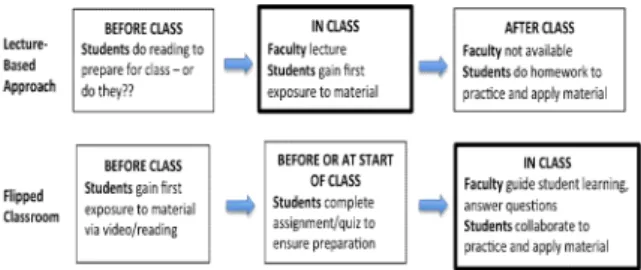
As shown at Fig. 1.(CRLT), Flipped Learning is composed of Before Class Activity that learners watch lecture video clip in advance, In Class Activity that they have presentation and a Q & A Session as a form of cooperative learner’s voluntary activity[9].

Fig. 1. Comparison Lecture-Based Approach with Flipped Classroom

This teaching-learning method is called such various names as Inverted classroom, Inverted Learning, Flipped Learning, Class in Reverse, Reversed Learning, etc, but this study adopts Flipped Learning as a systematic term.

Flipped Learning need to redesign the former lecture-based subject now that an instructor should reduce the amount of lecture or get rid of the lecture. In other words, the instructor should classify the tasks by student’s activity during Before Class, and instructor’s activity during In Class and establish the target context structure as well as a learning plan satisfying Flipped Learning.

Soo-gyun B. et. al(2012), Jin-hyouk I.(2014) redesigned Microsoft Office Software for freshmen and experimented the effectiveness of Flipped Learning. The course has characteristics that most attendees consist of freshmen and there’s a big difference of preliminary knowledge among the students. As a primary subject, this course aims for student’s mastery learning up to certain level of academic ability. The primary idea of Flipped Learning has learners assimilate knowledge for themselves during Before class, concentrate on Q and A session and discussion during In Class along with interaction between teacher and classmates[10, 11].

Hee-suk et. al(2015) researched the distinction of motivation between Flipped Learning class and Lecture–

Based class in social studies of Elementary School 5th graders. The result of Matching to Sample t-Verification showed meaningful difference in confidence and satisfaction of 4 learning motives, proposing that Flipped Learning improved learning motives on the whole[12].

Hae-Ja H. & Min-Ryeol C.(2014) used Flipped Learning method for 7th grade math class. They provided the students with public education videos before class and then in class, they gave the students through mini-lectures, quizzes, group discussions, and individual activities. Their method contributed to good academic achievement of their learners[13].

Strayer(2012) put Flipped Learning method into an inverted introductory statistics class, which is a specific type of mixed learning design. The researcher had learners read the content of the lecture before class and take part in learning activities in class with other learners. The study showed the learners were satisfied with cooperative learning and innovative teaching methods[14].

Ginns, P. Ellis, R.(2007) stressed the on-line environment as a complementary method. On-line learning makes the students preview any where and improves the face-to-face class and the quality of student learning[15].

Bon-hyuk K.(2015) attempted to promote an educational effect in Flipped Learning class which instructed K university seniors with MOOC(Massive Open Online Course) and investigated learning satisfaction[4].

He continually and swiftly supplied superior MOOC

concerned with learning contents to lead the seniors to

active participation and then evaluated the learning result

that showed productive accomplishment. He proposed that

(4)

there should be feedback in class and reinforcement of students’ debate activity encouraging them to study repeatedly and in depth.

Herreid, C. F., & Schiller, N. A.(2013) proposed a new model for case study which consists of teaching, combining the learner's activities, and student-centered learning. The model helps the students solve the real-world problems[16].

Enfield, J.(2013) proved that Flipped Learning led the students not only to learn the content effectively but also to increase self-confidence in their ability when they study for themselves[17].

Srivastava K.(2014) provided the students with the learning material before class. In class the students undertook the activities relevant to the material collaboratively and interactively, which gave the students a learning condition of freedom[18].

Jacob L. B., & Matthew A. V.(2013) suggested the study made up of several dimensions such as in-class and out-of-class activities, the measures to evaluate each study, and methodological characteristics for each study.

The study showed that the students tended to prefer interactive learning to the traditional lecture[19].

Zhao, Y., & Ho, A. D.(2014) presented the students preferred joining the discussion and the cross-talk through Flipped Learning. In addition they proved that the students who attended Flipped Learning were engaged in the class enthusiastically[20].

Chang-suk, K.(2014) practiced Flipped Learning for sophomores majoring in physical therapy for 15 weeks after inventing 3-stage teaching procedure: Motivation, Enrichment, and Team with intent to get the students to join the class actively and to obtain improved learning achievement in the course of absorbing knowledge[6]. As a result, she insisted that introduction of cooperation and presentation class helped the students to avoid mechanical memorization, to expand the scope of their thinking and to cultivate basic hands-on capacity through broad learning activities. She stressed feedback and reflection based on learners level that make the educational standard and learning efficiency improved.

Kil-hong J.(2015) suggested e-PBL on the basis of e-learning which upgraded previous PBL method. He applied e-PBL to information knowledge learning of computer lecture in elementary school, emphasizing many kinds of interactions between instructors and learners[21].

Hyeong-jong H.(2015) offered a strategy method that

could intimately connect online with face-to-face learning to solve the problem in Flipped Learning that there is low connectivity between online and face-to-face learning activities[22]. His result means that it is important to provide feedback, visualizing activities, and visual materials offer from an instructor to learners and to associate online contents learning with offline activities centered on the state and level of learners. He forecasts hereafter teachers should conduct comparison research in terms of learning effectiveness and confirm the advantage of connectivity.

This paper conducts the operation of Flipped Learning and gets Exploratory Factor Analysis and Reliability Analysis from the result of the course experience questionnaire at the end of the class[23].

III. Research Methods and Empirical Validation

1. Research Hypothesis

This chapter proves the effectiveness of Flipped Learning in engineering curricula and learning satisfaction shown as research hypothesis according to 3-level procedure and achieves the purpose of the study using analysis of actual proof.

At first step of preparation, 55 incumbents of industry responded the survey about 10 core competencies for two weeks from October 15 to October 31, 2014. On the basis of the research, professional core competencies are analyzed in order of importance.

At operation step, Flipped Learning was applied to 39 students in the JAVA Programming Subject of the first semester in 2015 and then Flipped Learning Experience Questionnaire was conducted.

At Synthesis phase this study focused on the following questions:

1) Do 4 elements of learner’s motivation have a positive influence on the index of Flipped Learning Effectiveness?

2) Do Flipped Learning Model have more learning satisfaction than traditional teaching-learning model?

To get the answers to them, the inquiry, as shown at

Fig. 2., is made up of 15 questions divided into three

questions in each section of Keller’s Learning Motivation,

adding three questions to survey the Effectiveness Index.

(5)

Questionnaire

The purpose of this survey is to reflect your feedback of Flipped Learning in order to improve the next teaching and learning method.

After reading the items of the questionnaire carefully, mark ◯ on the scale you think. This result is only for the development of the teaching and learning method.

Session Subject Department Gender

First Semester,2015 Java Programming Digital Contents M , F

Section Item SA A N D SD

Attention

1. I was interested in Java Programming. 5 4 3 2 1 2. I enjoyed watching Java Programming

Video lectures on the website of the university.

5 4 3 2 1

3. I could improve the attention to the lecture because it was formed into a preview Before Class and a complementary explanation In Class.

5 4 3 2 1

Relevance

1. I needed a team to do the task and to

discuss the lecture. 5 4 3 2 1

2. It was helpful to prepare for lessons

in advance at home. 5 4 3 2 1

3. In Class, presenting and discussing the subject of the lecture and then getting complementary explanation helped me understand the lecture.

5 4 3 2 1

Confidence

1. The level of Java Programming

Flipped Learning fitted me. 5 4 3 2 1 2. The pace of Java Programming

Flipped Learning fitted me. 5 4 3 2 1 3. I was engaged in the lecture by

asking many questions In Class. 5 4 3 2 1

Satisfaction

1. I was engaged in the lecture thanks to watching a video lecture Before Class as a part of performance assessment.

5 4 3 2 1

2. Watching a video lecture Before Class

improved the academic achievement. 5 4 3 2 1 3. I was satisfied with Java Programming

Flipped Learning. 5 4 3 2 1

Effectiveness

1. Flipped Learning made Java Programming

understood effectively. 5 4 3 2 1

2. Flipped Learning controlled the pace

of learning to a learner's level. 5 4 3 2 1 3. Flipped Learning was effective in the

self-directed learning. 5 4 3 2 1

● We need many other opinions to improve the lectures. Describe what you think freely.

SA:Strongly Agree, A:Agree, N:Neutral, D:Disagree, SD:Strongly Disagree Fig. 2. Questionnaire about Flipped Learning The research hypothesis of Effectiveness is that Flipped Learning gives positive impacts on understanding study contents, pacing learning procedure, and self -directed learning in engineering subjects :

[Hypothesis 1] Flipped Learning has a positive effect on comprehending the contents of JAVA Programming.

[Hypothesis 2] Flipped Learning has a positive effect on pacing learning procedure.

[Hypothesis 3] Flipped Learning has a more positive effect on self directed learning than does lecture-based learning.

2. Performance of Flipped Learning

JAVA Programming class during 1st semester in 2015 used Flipped Learning that requires learners to comprehend learning contents before class and to continue self directed learning for themselves, breaking away from existing lecture-based programming class.

The applied teaching materials are e-learning video clips of JAVA Programming Subject made by this instructor’s own effort, posted on the lecture website of the relevant college in the early March. There are mainly 4 steps in JAVA Programming Subject class: 1) An instructor posts learning materials in the form of video clips and notices that let a learner know the class procedure and how to access to the materials with his or her ID on the cyber lecture platform of the relevant college.

2) Students watch weekly video clip before class and then join the main class with their own questions and answers about already obtained knowledge for themselves by team or individual, discussing them in actual class.

3) In the development of main class, the instructor complements weekly learning contents and students’

previous knowledge by using PPT.

4) A student takes a Formative Evaluation to know how much he or she understands the subject, inputting a code presented in class by using ‘Eclipse’ development environment for oneself, and identifying the result of the implement.

3. Exploratory Factor Analysis and Reliability Analysis

Designating 5 variables made up of Effectiveness index suggested in this study as well as 4 factors of Keller’s learning motivation, the correlation with one another factor is analysed, on the basis of which Exploratory Factor Analysis figured out properly the interrelationship and the structure among the questions and variables.

If an extracted factor has voluntariness, it may be difficult to interpret the effect of the factors, therefore, this study accompanies reliability analysis at the same time.

The question investigation is implemented that consists of 3 questions about each variable like Attention, Relevance, Confidence, Satisfaction, and Effectiveness.

At this point, Keller’s 4 factors are defined as intrinsic,

homogeneous variables and Flipped Learning

Effectiveness as extrinsic heterogeneous one. There are

(6)

5 interval scales from ‘Strongly Disagree’ to ‘Disagree’,

‘Neutral’, ‘Agree’, and ‘Strongly Agree’ as a response category.

IV. Results of this Research

In the factors of learning motivation Satisfaction gets average 3.93, Confidence average 3.91, Relevance average 3.87, and Attention average 3.57 at three-questioned sections respectively.

A positive effectiveness on comprehending the contexts of JAVA Programming subject in [Hypothesis 1]

shows average 3.87, a positive effectiveness on pacing learning procedure in [Hypothesis 2] average 3.92, and a positive effectiveness on self directed learning in [Hypothesis 3] average 3.95.

The response to the questions that Flipped learning is effective on understanding learning contents and pacing learning procedure shows the frequency of 74.3% (29 persons) choosing 'mostly agree' choice and over respectively, and the response to the question that it is effective on self direct learning suggests the frequency of 79.5% (31 persons) toward 'mostly agree' choice and over.

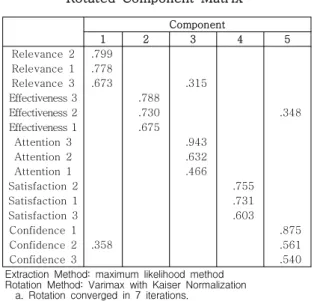
The result of exploratory factor analysis explains that 5 sampling factors in total variance described above the passage account for 64.273% of all input variables. Fig.

3. results from the factor convergency obtained by using Varimax Rotation in rotated component factor biplot.

Component

1 2 3 4 5

Relevance 2 .799 Relevance 1 .778

Relevance 3 .673 .315

Effectiveness 3 .788

Effectiveness 2 .730 .348

Effectiveness 1 .675

Attention 3 .943

Attention 2 .632

Attention 1 .466

Satisfaction 2 .755

Satisfaction 1 .731

Satisfaction 3 .603

Confidence 1 .875

Confidence 2 .358 .561

Confidence 3 .540

Extraction Method: maximum likelihood method Rotation Method: Varimax with Kaiser Normalization

a. Rotation converged in 7 iterations.

Rotated Component Matrix a

Fig. 3. Factor Analysis of Learning Motivation and Its Effectiveness

Reliability Analysis vindicates how much credible the result of exploratory factor analysis is, when 5 factors are analysed by the designated ones in this study model.

Reliability Analysis is done with each question standing for each factor in Factor Analysis. Cronbach Alpha conducted with each element shows 0.868 for Factor 1 (Relevance 2, 1, 3), 0.847 for Factor 2 (Effectiveness 3, 2, 1), 0.772 for Factor 3 (Attention 3, 2, 1), 0.774 for Factor 4 (Satisfaction 2, 1, 3), and 0.800 for Factor 5(Confidence 1, 2, 3), ensuring there must be credibility among factors and questions one another as shown over 0.7. When Factor Analysis proves the validity of the questionnaire and Reliability Analysis gives this questionnaire research credibility, this study executes Multiple Regression Analysis about Effectiveness of Flipped Learning.

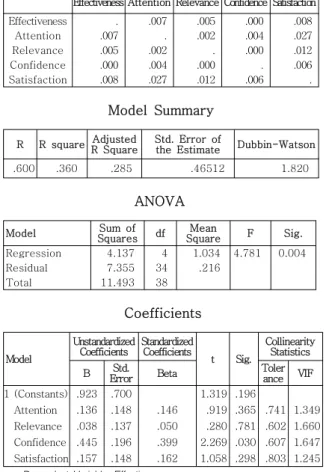
Attention, Relevance, Confidence, and Satisfaction in Independent Variables are operated by Linear Regression Analysis, putting the Effectiveness into the Dependent Variable. The analysis turns out Significant Probability between Confidence and the Effectiveness is about p <

0.001, and those between other factors and the Effectiveness are about p < 0.01 respectively. 'Model Summary' explains that the Effectiveness is 36.0% by showing 0.600 in R and 0.360 in R2.

The Numerical Value of Durbin-Watson is 1.820 coming close to 2, which enables this analysis to be called independent. One-way ANOVA Table which can judge whether the Regression Analysis is significant or not proves that this survey is statistically meaningful based on significant probability of 0.004(F=4.781) in the Regression Model.

The results of VIF(Variance inflation factor) are 1.349, 1.660, 1.647, 1.245 about the Independent Variables such as Attention(A), Relevance(R), Confidence(C), and Satisfaction(S) respectively.

There is no problem with Multicollinearity as all results show below 10. As a result, Regression Equation is as the following linear equation: E=y+aA+bR+cC+dS. (in this case, y is constant and A, R, C, S are independent variables and a,b,c,d are each value of B)

Effectiveness = Constant(0.923)+ Attention

Coefficient(0.136) + Relevance Coefficient(0.038) +

Confidence Coefficient(0.445) + Satisfaction

Coefficient(0.157) = 1.699

(7)

Therefore, Fig. 4. represents the normality and the homoscedasticity of the residual.

Effectiveness Attention Relevance Confidence Satisfaction

Effectiveness . .007 .005 .000 .008

Attention .007 . .002 .004 .027

Relevance .005 .002 . .000 .012

Confidence .000 .004 .000 . .006

Satisfaction .008 .027 .012 .006 .

Coefficient of Correlation

R R square Adjusted

R Square Std. Error of

the Estimate Dubbin-Watson

.600 .360 .285 .46512 1.820

Model Summary

Model Sum of

Squares df Mean

Square F Sig.

Regression 4.137 4 1.034 4.781 0.004

Residual 7.355 34 .216

Total 11.493 38

ANOVA

Model

Unstandardized

Coefficients Standardized Coefficients

t Sig.

Collinearity Statistics

B Std.

Error Beta Toler

ance VIF

1 (Constants) .923 .700 1.319 .196

Attention .136 .148 .146 .919 .365 .741 1.349

Relevance .038 .137 .050 .280 .781 .602 1.660

Confidence .445 .196 .399 2.269 .030 .607 1.647 Satisfaction .157 .148 .162 1.058 .298 .803 1.245 a. Dependent Variable: Effectiveness

Coefficients

Fig. 4. Multiple Regression Analysis of ARCS and Its Effectiveness

Ⅴ. Conclusions

The aim of the study is to make sure what kind of influence the learning motivation factors cause on the effectiveness of Flipped Learning. The Exploratory Factor analysis shows the validity of Flipped Learning Experience Questionnaire, furthermore, the Reliability Analysis give the survey credibility, which demonstrates the learning motivation factors affect the effectiveness of Flipped Learning and that Judging from the whole conditions, Flipped Learning approach improves more learning satisfaction than the previous lecture-based learning approach does, showing more effectiveness in the fields of understanding learning context, pacing learning procedure, and conducting self directed learning.

In the descriptive question, some of the students say

“Before class, I need to study cyber lecture context better than what I did. It helps me to understand what to learn in class.” It is the proof that Flipped Learning can boost the student’s learning motivation and their achievement motive.

In the beginning of the class, there is a burden like organizing and managing learning teams. However, as the team learning keeps on working, communicative ability among one another emerges from the team work which encourages the students to take part in the class more eagerly compared to the previous lecture-based class.

Specifically, the students majoring in Computer Engineering tend to be afraid of answering the professor’s questions. Discussion and Presentation are contributed to enhancing their ability to solve the problems. The previous programming class has a problem that it provides a one way coding method from an instructor and makes the learners bored with the lecture.

Fortunately, Flipped Learning can solve the problem by itself, giving the students much time to do self direct study.

Presumably, there is a problem that an excluded student might appear because one has difficulty in discussing the topic of the lesson amongst other students and feels embarrassed with the class unless he or she study learning context during Before Class.

The instructor should pay closer attention to solving this problem, and conduct a feedback through the further study with an attitude as a learning facilitator not a leader.

REFERENCES

[1] jhlee, “Implementation and Evaluation of Blended PBL Systems for Information Communication Ethics Education,” Journal of The Korea Society of Computer and Information, Vol. 16, No 4., pp. 83-91, Apr. 2011.

[2] srjeonㆍtwlee, “A Strategy using Writing based on STEAM Instruction for Information Gifted Students’ Creative Problem-Solving,” Journal of The Korea Society of Computer and Information, Vol. 17, No 8., pp. 181-188, Aug. 2012.

[3] Twigg, C. A., “Improving Learning and Reducing Costs:

New Modela for Online Learning,” EDUCAUSE, pp.

28-38, 2003.

(8)

[4] bhkoo, “ An Effectiveness Analysis of the Flipped Learning utilizing MOOC, ” A Thesis for th Degree of Master, Kongju National University, 2015.

[5] hsleeㆍcskim, “The Effect of Flipped Learning on Learning Motivation,” The Korean Association of Computer Education, Proceeding of Winter Annual Conference, 19(1), Jan. 2015.

[6] cskim, “Development and Adaptation of MET Flipped Learning,” Korean Council for College Education, the Contest for Teaching and Learning, Dec. 2014.

[7] jbchoiㆍegkim, “Developing a Teaching-Learning Model for Flipped Learning for Institutes of Technology and a Case of Operation of a Subject,” Journal of Engineering Education Research, Vol. 18, No 2., pp. 77-88, Mar.

2015.

[8] dylee, “Research on Developing Instructional Design Models for Flipped Learning,” The Journal of Digital Policy & Management, 11(12), pp. 83-92, Dec. 2013.

[9] CRLT, http://www.crlt.umich.edu/node/58368

[10] sgbeumㆍjhim, “The Case Study of UNIST e-Education:

Inverted(Flipped) Learning Model,” The Society of e-Learning, Proceeding of Spring Annual Conference, pp. 1-6, Apr. 2012.

[11] jhim, “WHY the Flipped Learning?,”

http://webzine.serii.re.kr , Nov. 2014.

[12] hsleeㆍsckangㆍcskim, “A Study on the Effect of Flipped Learning on Learning Motivation and Academic Achievement,” The Journal of Computer Education, Vol 18(2), pp. 47-57, Mar. 2015.

[13] Hae Ja H., Min Ryeol C., “Flipped Learning in the Middle School Math Class,” Advanced Science and Technology Letters, Vol. 71, pp. 94-97, 2014.

[14] Strayer, J. F. “How Learning in an Inverted Classroom Influences Cooperation, Innovation and Task Orientation,” Learning Environment Research, 15(2), p.171, 2012.

[15] Ginns, P. Ellis, R. “Quality in Blended Learning : Exploring the Relationships between On-line and Face-to-face Teaching and Learning,” The Internet and Higher Education, 10(1), pp. 53-64, 2007.

[16] Herreid, C. F., Schiller, N. A., “Case Studies and the Flipped Classroom,” Journal of College Science Teaching, 42(5), pp. 62-66, May/June 2013.

[17] Enfield, J. “Looking at the Impact of the Flipped Classroom Model of Instruction on Undergraduate Multimedia students CSUN,” Tech Trends: Linking Research & Practice to Improve Learning, 2013.

[18] Srivastava K., “Role of Flipped Classroom in Education,”

Research Paper, Vol 3., pp. 81-83, Apr. 2014.

[19] Jacob L. B., Matthew A. V., “A Survey of the Research,”

American Society for Engineering Education, 120th ASEE Annual Conference & Exposition, 2013.

[20] Zhao, Y., Ho, A. D., “ Evaluating the Flipped Classroom in An Undergraduate History Course, ” Harvard Graduate School of Education, Jun. 2014.

[21] jhjoo, “Study of e-PBL Teaching and Learning Model for Efficient Flipped Learning,” The Journal of the Society of Computer Knowledge, 3(1), pp. 47-53, Jan.

2015.

[22] hjhan, “ Instructional Strategies for Integrating Online and Offline Modes of flipped Learning in a College Course, ” A Thesis for the Degree of Master, Seoul National University, 2015.

[23] yskimㆍcskim, “A Study of Class Satisfaction for Flipped Learning in the JAVA Programming Course,”

International Conference Program, The Korea Academic Society of Digital Business Administration, pp. 251-260, Nov. 2015.

Authors

Young-Sang Kim received B.S. degree in Computer Science from Ulsan University, Korea, in 1990, and M.S. and Ph.D. degrees in Computer Engineering from Kyungpook National University, Korea, in 1993 and 2001, respectively.

Dr. Kim joined the faculty of the Department of

Computer Information at Cheju Halla University, Jeju,

Korea, in 1993. He is currently a Associate Professor in

the Department of Digital Contents, Cheju Halla

University. He was a research staff of SK Hynix

Inc.(Hyundai Electronics Corporation) from 1990 to

1991. He is interested in machine learning, virtual

reality, smart media, and software engineering.

수치

Fig.  1.  Comparison  Lecture-Based  Approach  with  Flipped  Classroom
Fig.  3.  Factor  Analysis  of  Learning  Motivation  and  Its  Effectiveness
Fig.  4.  Multiple  Regression  Analysis  of  ARCS  and    Its  Effectiveness

참조

관련 문서

Using questionnaire survey and exploratory factor analysis, this paper constructs a model to analyze the impact of consumer ethnocentrism on

To verify the reliability and accuracy of the questionnaire results, reliability analysis and investigative factor analysis were performed, and the results are shown in Table 3.

This study dealt with a case study on the application of flipped learning to solid mechanics in college of engineering and analyzed the results of Pre-class