학 술 논 문
http://dx.doi.org/10.9718/JBER.2019.40.6.260
260
User experience of MV2000-MT (SU:M2)
®as a Mechanical Ventilator: A Comparative Clinical Study on Usability, Safety,
and Medical Staff Satisfaction
Soeun Jeon, Hae Kyu Kim*, Dowon Lee, Hyae Jin Kim and Eun Ji Park
Department of Anesthesia and Pain Medicine, Pusan National University Hospital, Busan, Republic of Korea (Manuscript received 22 October 2019 ; revised 28 November 2019 ; accepted 17 December 2019)
Abstract: In the present study, we aimed to demonstrate that MV2000-MT(SU:M2)® (MV, MEK-ICS, Paju, Korea), a domestic ventilator, is not inferior in terms of usability, safety, and medical staff satisfaction as compared to Hamilton G5 (G5, Hamilton Medical AG, Rhäzüns, Switzerland). A total of 39 patients who applied MV (group M) or G5 (group H) were included in the study sample. Usability was evaluated by the following factors: the number of alarm errors, replacement requirement of breathing circuit, replacement requirement of a right-angle connector, and ease of ventilator weaning. For safety evaluation, the number of ventilator replacements due to malfunction of the ventilator was evaluated. Items for medical staff satisfaction survey were as follows: the number of MV and G5 uses, hardware, and software assessment. In the usability evaluation, the replacement requirement of the right-angle connector was lower in Group M than in Group H (mean
± standard deviation, Group M: 7.39 ± 6.72, Group H: 14.19 ± 10.24, p = 0.021); however, the evaluations of other parts were not significantly different between the two groups. The number of ventilator replace- ments due to a malfunction of the ventilator did not differ between two groups. The number of MV and G5 uses was 3.0 [3.0-4.0] and 10.0 [5.0-10.0] (median [interquartile range], p < 0.001). Overall, the mean medical staff satisfaction score of Hamilton G5 was higher than that of MV2000-MT(SU:M2)®. The usabil- ity of MV is comparable to that of G5. However, medical staff satisfaction with Hamilton G5 was higher than that with MV2000-MT(SU:M2)®, and this difference could be due to the difference in the number of uses.
In order to improve the penetration rate of the domestic mechanical ventilator, it is necessary to find ways to increase familiarity of medical staff with domestic mechanical ventilators.
Key words: Mechanical ventilation, Mechanical ventilator, Ventilators, Pulmonary ventilator
I. Introduction
Mechanical ventilation support is widely used in the management of patients with respiratory failure. Over the past 60 years, the mechanical ventilator has made a remarkable development and has played a central role in the treatment of respiratory diseases, beyond simple breath-supporting functions [1]. The MV2000- MT (SU:M2)® (MEK-ICS, Paju, Korea; Figure 1A) ventilator
is a domestic ventilator, that provides the high-frequency ventilation (HFV) mode, which supplies very low tidal volumes with very high respiratory rates (> 60 breaths per minute), without any additional hardware apparatus [2]. HFV is a ventilation mode used only in very limited situations, such as refractory acute respiratory distress syndrome or bronchopleural fistula [2]. The MV2000- MT (SU:M2)® has advantages in terms of user convenience and economics in that it does not require the provision and storage of additional hardware apparatus for the use of the HFV mode.
It is also designed to provide the respiratory assistance function to cardiac arrest patients, as it provides the cardiopulmonary resuscitation (CPR) mode. Since chest compression alone or continuous positive airway pressure alone does not guarantee adequate ventilation during Corresponding Author : Hae Kyu Kim
Department of Anesthesia and Pain Medicine, School of Medicine, Pusan National University, 179 Gudeok-ro, Seo-gu, Busan, 49241, Republic of Korea
Tel : +82-51-240-7399
E-mail : [email protected]
This study was supported by the Korea Health Industry Development Institute (KHIDI) and MEC-ICS.
261 cardiac arrest, alternative ventilation strategies have
been extensively discussed [3,4]. However, the optimal ventilation strategy during CPR is still lacking [4].
The CPR mode provided by MV2000-MT (SU:M2)® is available in both manual and automated mechanical CPR situations. CPR mode has the advantage of delivering accurate tidal volume to cardiac arrest patients, as mandatory breathing is performed regardless of lung compliance in the patients with cardiac arrest. It is also designed to measure the pressure delivered to the patient during chest compression, because the lung pressure can be monitored during CPR. Despite these advantages, most ventilators used in domestic hospitals are imported products, thereby increasing the cost of medical care and impeding the development of the domestic medical device industry.
In the present study, we aimed to demonstrate that MV2000-MT (SU:M2)® is not inferior in terms of usability, safety, and medical staff satisfaction as compared to Hamilton G5 (Hamilton Medical AG, Rhäzüns, Switzerland;
Figure 1B), a most widely used ventilator in domestic hospitals.
II. Methods
1. Assessment of usability and safety
This non-randomized, prospective, open-label registry study was approved by the Institutional Review Board
of Pusan National University Hospital (ID 1706-016- 056). The study was conducted from July 2017 to November 2017. After obtaining written informed consent, a total of 54 patients were enrolled. They were aged 19 years or older, were applied MV2000-MT (SU:M2)® (group M) or Hamilton G5 (group H), and were required ventilator support more than 2 days. Prior to obtaining informed consent, the Modified Ramsay Sedation Scale (MRSS) [5] was used to assess the level of consciousness of the subjects. Informed consent was obtained from a patient when the patient’s MRSS score was 1 (awake). Otherwise, the informed consent was obtained from the guardian of the patient. Those patients who did not agree to participate in the study and who were expected to receive mechanical ventilation less than 2 days were excluded from the study. The drop-out indications were as follows:
(1) patient or guardian ceased to participate; (2) the ventilator support was stopped within a day due to death, ventilator weaning, or other reasons.
After subject enrollment, the following basic characteristics were measured: (1) demographics of the patients: height, weight, sex, age, and MRSS (2) room and body temperature (RT and BT); (3) arterial blood gas analysis (ABGA) values: pH, partial pressure of arterial carbon dioxide (PaCO2), partial pressure of arterial oxygen (PaO2), base excess (BE), and Hemoglobin; (4) ventilator settings: the period of mechanical ventilator application during the experimental period, ventilator mode (volume-controlled
Fig. 1. The mechanical ventilators. (A) MV2000-MT (SU:M2)® and (B) Hamilton G5
262
ventilation, pressure-controlled ventilation, or other mode), fraction of inspired oxygen (FiO2), positive end expiratory pressure (PEEP) level, respiratory rate (RR), tidal volume (TV), and peak inspiratory pressure (PIP); and (5) usage of sedatives, analgesics, and muscle relaxants. The parameters except patient demographics were measured daily for three days: first day; D1, second day; D2, and third day; D3.
Usability was evaluated by the following factors: (1) the number of alarm errors: alarm for high minute volume, low minute volume, high pressure, low pressure, low oxygen, oxygen supply failed, high tidal volume, low tidal volume, and high frequency ventilation; (2) replacement requirement of breathing circuit, replacement requirement of a right-angle connector; (3) frequency of fighting the ventilator; (4) ease of ventilator weaning. The ease of ventilator weaning was evaluated in the patients who were attempted to wean from mechanical ventilator during the observation period. The elapsed time of the ventilator weaning was measured by the time from W1 (when the doctor-in-charge decides to attempt ventilator weaning) to W2 (when the patient’s ventilator weaning is finally completed); the infusion rates of muscle relaxant, as well as sedatives use at W1 were evaluated.
The need for replacement of the breathing circuit, the
need for replacement the right-angle connector, and the occurrence of fighting the ventilator were assessed at the judgment of the patient’s medical staff.
For safety evaluation, the number of ventilator replacements due to malfunction of the ventilator was evaluated. The experimental diagram is shown in Figure 2A.
2. Medical staff satisfaction survey
After evaluating the usability and safety of the ventilator, we conducted a user satisfaction survey for the medical staff who have experienced both the MV2000-MT (SU:M2)® and the Hamilton G5 ventilators.
This survey study was also approved by the Institutional Review Board of Pusan National University Hospital (ID D-1709-026-059) and was conducted anonymously.
The survey items were as follows (Figure 2B): (1) the number of Hamilton G5 and MV2000-MT (SU:M2)® uses during the study period (from July 2017 to November 2017); (2) hardware satisfaction assessment; size of the device, arm’s convenience, humidifier’s convenience, screen layout (comfort of viewing), touch screen sensitivity, user movement (screen manipulation), convenience of nebulizer operation, convenience of line setting, ease of cleaning after use, ease of movement (comfort of
Fig. 2. Experimental diagram. (A) Assessment of usability and safety and (B) Medical staff satisfaction. Group M: Patients who used MV2000-MT (SU:M2)®; Group H: Patients who used Hamilton G5.
263 using to a different location), stability (not moving or
swinging beyond the defined position), convenience of O2 cell replacement; (3) software satisfaction assessment;
convenience of power-up, of setting change, of differentiating the alarm type, and of the alarm volume adjustment.
The degree of hardware and software satisfaction with each item was rated on a 5-point Likert scale (1 = very poor, 5 = very good). For the items (1) - (3), the satisfaction scores of MV2000-MT (SU:M2)® and Hamilton G5 evaluated by the same responders were compared.
3. Statistical analyses
All analyses were performed using IBM SPSS Statistics (version 22; IBM Corporation, Armonk, NY). After the normality test for continuous variables, normally distributed variables were expressed as means ± standard deviation (SD), and independent t-test was performed. Non-parametric variables were expressed as median and interquartile range (IQR), and Wilcoxon rank sum test or the Wilcoxon signed rank test was performed. Categorical values were expressed as absolute numbers and percentages, and Fisher’s exact test was performed. Two-sided p- values < 0.05 were considered to indicate statistical significance.
III. Results
1. Usability and safety
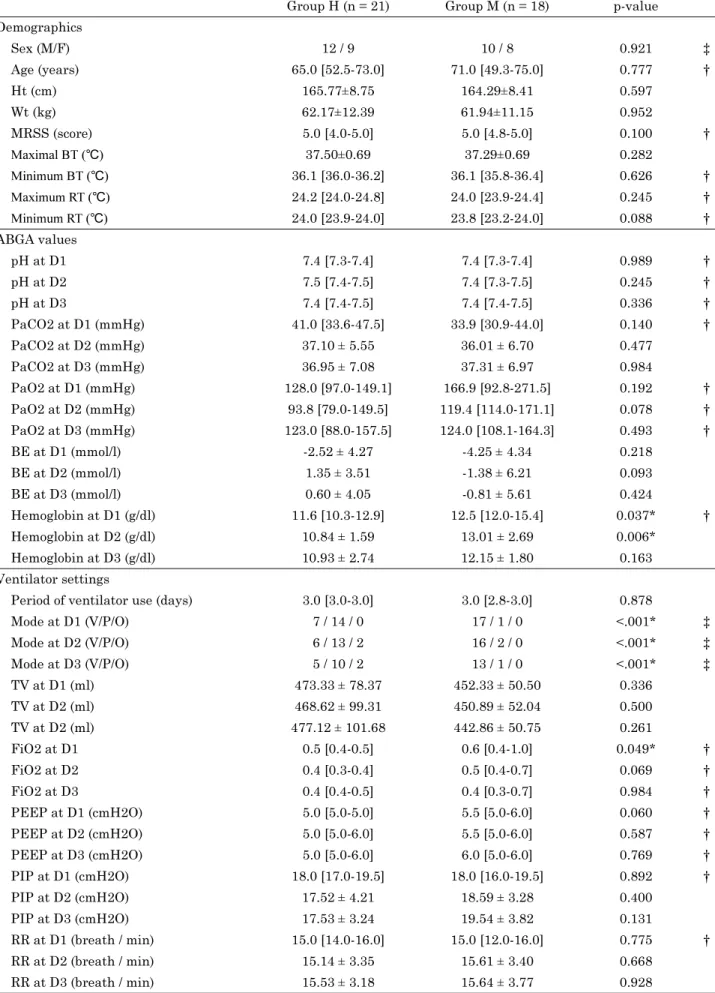
Of the 54 patients enrolled, 39 were included; however, 15 patients were excluded due to ventilator support less than 2 days (Figure 2A). Table 1 shows the basic characteristics of the two groups. Patient demographics, RT, and BT did not differ between the two groups.
Hemoglobin levels on D1 and D2 of group M were higher than those of group H (median [IQR] or mean±SD, Group H: D1—11.6 [10.3-12.9], D2—10.84±1.59, Group M: D1—
12.5 [12.0-15.4], D2—13.01±2.69 g/dl, p = 0.037 [Wilcoxon rank sum test] and p = 0.006 [independent t-test] at D1 and D2); however, no difference between the two groups in other ABGA values was observed. Volume controlled mode was predominantly used in group M, while pressure controlled mode was predominantly used in group H (absolute numbers [volume controlled mode/pressure controlled mode/other mode], Group H: D1—7/14/0, D2—6/
13/2, D3—5/10/2, Group M: D1—17/1/0, D2—16/2/0,
D3—13/1/0 p < 0.001 in all cases, Fisher’s exact test).
FiO2 level on D1 of group M was higher than those of group H (median [IQR], Group H: 0.5 [0.4-0.5], Group M: 0.6 [0.4-1.0], p = 0.049, Wilcoxon rank sum test). However, there was no difference between the two groups in other ventilator setting values. In most patients, cisatracurium was used for muscle relaxation, remifentanil for pain control, and dexmedetomidine for sedation. Other types of medication for muscle relaxation, analgesia, and sedation were not used in the present study. Remifentanil use in group M was lower than that in group H in D2 (mean ± SD, Group H: 13.43 ± 9.58, Group M: 6.91 ± 6.51 mg/day, p = 0.020, independent t-test); yet, there were no differences in other parts of muscle relaxant, analgesics, and sedatives.
The usability evaluation results are shown in Figure 3.
There were no differences in the number of alarm errors, replacement requirement of breathing circuit, and frequency of fighting the ventilator between the two groups. The replacement requirement of the right- angle connector in group M was less than in group H (mean ± SD, Group M: 7.39 ± 6.72, Group H: 14.19 ± 10.24, p = 0.021, independent t-test). The number of the patients who attempted to wean from ventilator was 5 out of 18 in group M and 5 out of 21 in group H. The infusion rates of cisatracurium and dexmedetomidine at W1 were comparable between the two groups (median [IQR], cisatracurium: group M; 0.0 [0.0-5.0] mg/hr, group H; 0.0 [0.0-7.0] mg/hr, p = 1.000, dexmedetomidine: group M; 0.0 [0.0-0.1] mcg/kg/hr, group H; 0.0 [0.0-0.9] mcg/kg/
hr, p = 0.548, Wilcoxon rank sum test). There was no difference in the elapsed time of the ventilator weaning (W1 to W2) between the two groups (median [IQR], group M: 3.0 [1.5-13.3] hr and group H: 3.0 [2.0-18.5] hr, p = 0.697, Wilcoxon rank sum test). In terms of safety, the number of ventilator replacements due to a malfunction of the ventilator was not differ between two groups (absolute numbers [percentages], group M: 3 [16.67] and group H: 0 [0.00], p = 0.089, Fisher’s exact test).
2. Medical staff satisfaction
A total of 33 medical staff responded to the survey.
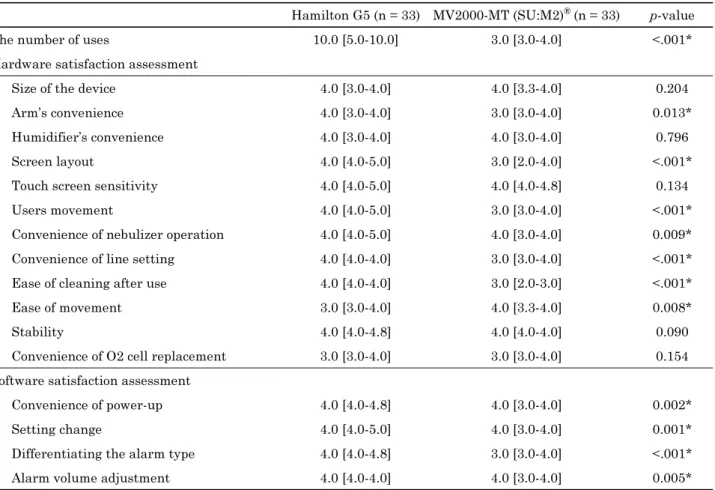
The number of MV2000-MT (SU:M2)® and Hamilton G5 uses was 3.0 [3.0-4.0] and 10.0 [5.0-10.0] (median [IQR]), respectively, and the number of MV2000-MT (SU:M2)® uses was smaller than that of Hamilton G5
264
Table 1. Patient characteristics, ventilator setting, sedative and muscle relaxant usage
Group H (n = 21) Group M (n = 18) p-value
Demographics
Sex (M/F) 12 / 9 10 / 8 0.921 ‡
Age (years) 65.0 [52.5-73.0] 71.0 [49.3-75.0] 0.777 †
Ht (cm) 165.77±8.75 164.29±8.41 0.597
Wt (kg) 62.17±12.39 61.94±11.15 0.952
MRSS (score) 5.0 [4.0-5.0] 5.0 [4.8-5.0] 0.100 †
Maximal BT (℃) 37.50±0.69 37.29±0.69 0.282
Minimum BT (℃) 36.1 [36.0-36.2] 36.1 [35.8-36.4] 0.626 †
Maximum RT (℃) 24.2 [24.0-24.8] 24.0 [23.9-24.4] 0.245 †
Minimum RT (℃) 24.0 [23.9-24.0] 23.8 [23.2-24.0] 0.088 †
ABGA values
pH at D1 7.4 [7.3-7.4] 7.4 [7.3-7.4] 0.989 †
pH at D2 7.5 [7.4-7.5] 7.4 [7.3-7.5] 0.245 †
pH at D3 7.4 [7.4-7.5] 7.4 [7.4-7.5] 0.336 †
PaCO2 at D1 (mmHg) 41.0 [33.6-47.5] 33.9 [30.9-44.0] 0.140 †
PaCO2 at D2 (mmHg) 37.10 ± 5.55 36.01 ± 6.70 0.477
PaCO2 at D3 (mmHg) 36.95 ± 7.08 37.31 ± 6.97 0.984
PaO2 at D1 (mmHg) 128.0 [97.0-149.1] 166.9 [92.8-271.5] 0.192 †
PaO2 at D2 (mmHg) 93.8 [79.0-149.5] 119.4 [114.0-171.1] 0.078 †
PaO2 at D3 (mmHg) 123.0 [88.0-157.5] 124.0 [108.1-164.3] 0.493 †
BE at D1 (mmol/l) -2.52 ± 4.27 -4.25 ± 4.34 0.218
BE at D2 (mmol/l) 1.35 ± 3.51 -1.38 ± 6.21 0.093
BE at D3 (mmol/l) 0.60 ± 4.05 -0.81 ± 5.61 0.424
Hemoglobin at D1 (g/dl) 11.6 [10.3-12.9] 12.5 [12.0-15.4] 0.037* †
Hemoglobin at D2 (g/dl) 10.84 ± 1.59 13.01 ± 2.69 0.006*
Hemoglobin at D3 (g/dl) 10.93 ± 2.74 12.15 ± 1.80 0.163
Ventilator settings
Period of ventilator use (days) 3.0 [3.0-3.0] 3.0 [2.8-3.0] 0.878
Mode at D1 (V/P/O) 7 / 14 / 0 17 / 1 / 0 <.001* ‡
Mode at D2 (V/P/O) 6 / 13 / 2 16 / 2 / 0 <.001* ‡
Mode at D3 (V/P/O) 5 / 10 / 2 13 / 1 / 0 <.001* ‡
TV at D1 (ml) 473.33 ± 78.37 452.33 ± 50.50 0.336
TV at D2 (ml) 468.62 ± 99.31 450.89 ± 52.04 0.500
TV at D2 (ml) 477.12 ± 101.68 442.86 ± 50.75 0.261
FiO2 at D1 0.5 [0.4-0.5] 0.6 [0.4-1.0] 0.049* †
FiO2 at D2 0.4 [0.3-0.4] 0.5 [0.4-0.7] 0.069 †
FiO2 at D3 0.4 [0.4-0.5] 0.4 [0.3-0.7] 0.984 †
PEEP at D1 (cmH2O) 5.0 [5.0-5.0] 5.5 [5.0-6.0] 0.060 †
PEEP at D2 (cmH2O) 5.0 [5.0-6.0] 5.5 [5.0-6.0] 0.587 †
PEEP at D3 (cmH2O) 5.0 [5.0-6.0] 6.0 [5.0-6.0] 0.769 †
PIP at D1 (cmH2O) 18.0 [17.0-19.5] 18.0 [16.0-19.5] 0.892 †
PIP at D2 (cmH2O) 17.52 ± 4.21 18.59 ± 3.28 0.400
PIP at D3 (cmH2O) 17.53 ± 3.24 19.54 ± 3.82 0.131
RR at D1 (breath / min) 15.0 [14.0-16.0] 15.0 [12.0-16.0] 0.775 †
RR at D2 (breath / min) 15.14 ± 3.35 15.61 ± 3.40 0.668
RR at D3 (breath / min) 15.53 ± 3.18 15.64 ± 3.77 0.928
265
(p < 0.001, Wilcoxon signed rank test). Medical staff satisfaction survey results are shown in Table 2. In each questionnaire, the scores of MV2000-MT (SU:M2)® and Hamilton G5 of the same respondents were compared and Wilcoxon signed-rank test was performed.
Hamilton G5 scored higher than MV2000-MT (SU:M2)® in the following items: arm’s convenience, screen layout, users movement, convenience of nebulizer operation, convenience of line setting, ease of cleaning after use, convenience of power-up, convenience of setting change, Table 1. Continued
Group H (n = 21) Group M (n = 18) p-value
Sedative and muscle relaxant usage
Dexmedetomidine at D1 (mcg/day) 192.0 [0.0-576.0] 0.0 [0.0-409.0] 0.245 †
Dexmedetomidine at D2 (mcg/day) 192.0 [0.0-1,032.0] 0.0 [0.0-282.0] 0.192 †
Dexmedetomidine at D3 (mcg/day) 98.0 [0.0-1,040.0] 0.0 [0.0-587.0] 0.464 †
Remifentanil at D1 (mg/day) 11.24 ± 5.98 8.22 ± 5.40 0.108
Remifentanil at D2 (mg/day) 13.43 ± 9.58 6.91 ± 6.51 0.02*
Remifentanil at D3 (mg/day) 14.16 ± 9.62 9.58 ± 8.91 0.183
Cisatracurium at D1 (mg/day) 0.0 [0.0-117.0] 0.0 [0.0-139.0] 0.426 †
Cisatracurium at D2 (mg/day) 0.0 [0.0-61.0] 0.0 [0.0-135.0] 0.686 †
Cisatracurium at D3 (mg/day) 0.0 [0.0-100.0] 0.0 [0.0-106.0] 0.823 †
Normally distributed variables were expressed as means ± standard deviation (SD), and independent t-tests were performed.
Non-parametric variables were expressed as median and interquartile range (IQR), and Wilcoxon rank sum test was performed. Categorical values were expressed as absolute numbers and Fisher’s exact tests were performed. Group M:
MV2000-MT (SU:M2)® applied patients, Group H: Hamilton G5 applied patients, M: male, F: female, Ht: height, Wt: weight, BT: body temperature, RT: room temperature, D1: first day, D2: second day, D3: third day, PaCO2: partial pressure of arterial carbon dioxide, PaO2: partial pressure of arterial oxygen, BE: base excess, V: volume-controlled ventilation, P: pressure- controlled ventilation, O: other mode, TV: tidal volume, FiO2: fraction of inspired oxygen, PEEP: positive end expiratory pressure, PIP: peak inspiratory pressure, RR: respiratory rate. (‡ Fisher’s exact test, † Wilcoxon rank sum test, *p value < 0.05)
Fig. 3. Assessment of usability. The values are expressed as median and interquartile range (horizontal lines represent respective group medians; boxes, 25th–75th percentile; and whiskers, 10th–90th percentile). Usability was evaluated by the following factors: (A) the number of alarm errors—alarm for high minute volume: A-1, low minute volume: A-2, high pressure: A-3, low pressure: A-4, low oxygen: A-5, oxygen supply failed: A-6, high tidal volume: A-7, low tidal volume: A-8, and high frequency ventilation: A-9; (B) replacement requirement of breathing circuit: B-1, replacement requirement of a right-angle connector: B-2; (C) frequency of fighting the ventilator: C; (D) ease of ventilator weaning—The elapsed time of the ventilator weaning: D (p < 0.05: *).
266
convenience of differentiating the alarm type, and convenience of alarm volume adjustment. In terms of ease of movement, MV2000-MT (SU:M2)® was rated higher than Hamilton G5. Satisfaction of the HFV mode and the CPR mode were not evaluated due to the lack of experience during the test period.
IV. Discussion
In the present study, a comparative evaluation of Hamilton G5 and MV2000-MT (SU:M2)® was conducted to investigate the user experience. Two mechanical ventilators were found to be comparable in usability and safety; however, Hamilton G5 was found to be superior to MV2000-MT (SU:M2)® in terms of medical staff satisfaction.
In the replacement requirement of the right-angle connector, the MV2000-MT (SU:M2)® showed better results
as compared to Hamilton G5, although group M had more patients with otolaryngology surgery than group H. In the hospital chart review, the number of patients participating in the study after otolaryngology surgery was 5 (absolute numbers [percentages], group M: 5 [27.78] and group H: 0 [0.00], p = 0.015, Fisher’s exact test). All these patients underwent the following major operations: total laryngopharyngectomy and reconstruction—3 cases, total glossectomy and reconstruction—1 case, and incision and drainage for deep neck infection—1 case.
In the present study, the replacement requirement of the right-angle connector was higher in the patients with otolaryngology surgery than in other patients (mean ± SD, the patients with otolaryngology surgery: 19.60 ± 10.78, other patients: 9.21 ± 8.78, p = 0.021, independent t-test).
In these otolaryngology patients, surgical wound drainage may have augmented the replacement requirement of the right-angle connector.
Table 2. Medical staff satisfaction survey
Hamilton G5 (n = 33) MV2000-MT (SU:M2)® (n = 33) p-value
The number of uses 10.0 [5.0-10.0] 3.0 [3.0-4.0] <.001*
Hardware satisfaction assessment
Size of the device 4.0 [3.0-4.0] 4.0 [3.3-4.0] 0.204
Arm’s convenience 4.0 [3.0-4.0] 3.0 [3.0-4.0] 0.013*
Humidifier’s convenience 4.0 [3.0-4.0] 4.0 [3.0-4.0] 0.796
Screen layout 4.0 [4.0-5.0] 3.0 [2.0-4.0] <.001*
Touch screen sensitivity 4.0 [4.0-5.0] 4.0 [4.0-4.8] 0.134
Users movement 4.0 [4.0-5.0] 3.0 [3.0-4.0] <.001*
Convenience of nebulizer operation 4.0 [4.0-5.0] 4.0 [3.0-4.0] 0.009*
Convenience of line setting 4.0 [4.0-4.0] 3.0 [3.0-4.0] <.001*
Ease of cleaning after use 4.0 [4.0-4.0] 3.0 [2.0-3.0] <.001*
Ease of movement 3.0 [3.0-4.0] 4.0 [3.3-4.0] 0.008*
Stability 4.0 [4.0-4.8] 4.0 [4.0-4.0] 0.090
Convenience of O2 cell replacement 3.0 [3.0-4.0] 3.0 [3.0-4.0] 0.154
Software satisfaction assessment
Convenience of power-up 4.0 [4.0-4.8] 4.0 [3.0-4.0] 0.002*
Setting change 4.0 [4.0-5.0] 4.0 [3.0-4.0] 0.001*
Differentiating the alarm type 4.0 [4.0-4.8] 3.0 [3.0-4.0] <.001*
Alarm volume adjustment 4.0 [4.0-4.0] 4.0 [3.0-4.0] 0.005*
Variables were expressed as median and interquartile range (IQR). The number of uses refers to the total number of uses of Hamilton G5 and MV2000-MT (SU:M2)® during the study period (from July 2017 to November 2017). The degree of hardware and software satisfaction with each item was rated on a 5-point Likert scale (1 = very poor, 5 = very good). Each items of MV2000- MT (SU:M2)® and Hamilton G5 evaluated by the same responders were compared using Wilcoxon rank sum test (p < 0.05: *).
267 Although no statistically significant difference between
the two groups was observed, there were 3 cases of ventilator replacements due to malfunction of the ventilator in group M only. The specific ventilator malfunctions were as follows: trigger flow sensor error—1 case, tidal volume measurement error—1 case, and the combination of these two errors—1 case. However, there was no serious adverse event due to these ventilator malfunctions. The results of the inspection demonstrated that all of these malfunctions occurred when the nebulizer was used with the mechanical ventilator, and the drug was deposited on the flow sensor, resulting in auto- triggering or tidal volume sensing error. Currently, the manufacturer has completed the replacement of the mesh type flow sensor with the flapper type flow sensor; thereafter, a follow-up on the safety of MV2000- MT (SU:M2)® is required.
The medical staff satisfaction score of MV2000-MT (SU:M2)® was lower than that of Hamilton G5, although the difference between the two groups in usability and safety evaluation did not reach statistical significance.
As the introduction of Hamilton G5 occurred earlier in our hospital and the number of Hamilton G5 in our hospital is larger than MV2000-MT (SU:M2)®, the medical staff had more experience with Hamilton G5 than with MV2000-MT (SU:M2)®. Accordingly, the medical staff felt more familiar with the operation of Hamilton G5, and this familiarity is presumed to be reflected in the evaluation of medical staff satisfaction. In addition, major contributing factors of the human error regarding mechanical ventilator is considered to be lack of experience, the operator’s competency and familiarity with the mechanical ventilator are very important because it is directly related to patient safety [1,6]. Vignaux et al.
conducted a prospective task-performing study and asked physicians with experience of mechanical ventilation but unfamiliar with new-generation mechanical ventilators, tested machines, to perform specific tasks using the tested machines [6]. All physicians spent more time to perform tasks than the reference (trained physiotherapist familiar with the tested machine), and their task failure rate was 16%. Also, no ventilator was clearly better than the others on all points tested. Based on these results, the author pointed out the ergonomic shortcomings of newly developed mechanical ventilators, and suggested
that it takes time for physicians to train for manipulation of an unfamiliar mechanical ventilator. Considering these points, it may be desirable to re-evaluate the medical staff satisfaction when the medical staff accumulates more experience with MV2000-MT (SU:M2)® for a more accurate assessment.
The second limitation of the present study was that, due to the lack of experience during the test period, we could not evaluate the medical staff satisfaction of the HFV mode and the CPR mode provided by MV2000- MT (SU:M2)®. These two functions are expected to be of practical help in managing the patients with cardiopulmonary dysfunction, so an evaluation of the user experience of these functions will be needed in the future.
In conclusion, the usability of MV2000-MT(SU:M2)® is comparable to that of Hamilton G5. However, it is necessary to compensate for the drawbacks of MV2000- MT(SU:M2)® safety. Medical staff satisfaction score was higher for Hamilton G5 than for MV2000-MT (SU:M2)®. However, this difference can be due to the difference in the number of uses. In order to improve the penetration rate of the domestic mechanical ventilator, it is necessary to find ways to increase familiarity of medical staff with domestic mechanical ventilators.
References
[1] Richard JCM, Kacmarek RM. ICU mechanical ventilators, technological advances vs. user friendliness: the right picture is worth a thousand numbers. Intensive Care Med. 2009;
35(10):1662-3.
[2] https://www.uptodate.com/contents/high-frequency-venti- lation-in-adults. Accessed on 26 Nov 2019.
[3] Soar J, Maconochie I, Wyckoff MH, Olasveengen TM, Sin- gletary EM, Greif R et al. 2019 International Consensus on Cardiopulmonary Resuscitation and Emergency Cardiovas- cular Care Science With Treatment Recommendations: Sum- mary From the Basic Life Support; Advanced Life Support;
Pediatric Life Support; Neonatal Life Support; Education, Implementation, and Teams; and First Aid Task Forces. Cir- culation. 2019; 140(24): e826-e880.
[4] Ventzke MM, Kemming GI. Cardiopulmonary resuscitation:
when guidelines provide no answers. Anaesthesist. 2019;68(4):
239-44.
[5] Ramsay MA, Savege TM, Simpson BR, Goodwin R. Con- trolled sedation with alphaxalone-alphadolone. Br Med J. 1974;
2(5920):656-9.
[6] Vignaux L, Tassaux D, Jolliet P. Evaluation of the user-friendli- ness of seven new generation intensive care ventilators. Intensive Care Med. 2009;35(10):1687-91.