An integrated framework of security tool selection using fuzzy regression and physical programming
1)
Hoai-Vu Nguyen * , Pauline Kongsuwan ** , Sangmun Shin *** , Yongsun Choi *** , Sangkyun Kim ****
퍼지회귀분석과 physical programming을 활용한 정보보호 도구 선정 통합 프레임워크
Hoai-Vu Nguyen * , Pauline Kongsuwan ** , 신 상 문 *** , 최 용 선 *** , 김 상 균 ****
Abstract
Faced with an increase of malicious threats from the Internet as well as local area networks, many companies are considering deploying a security system. To help a decision maker select a suitable security tool, this paper proposed a three-step integrated framework using linear fuzzy regression (LFR) and physical programming (PP). First, based on the experts’ estimations on security criteria, analytic hierarchy process (AHP) and quality function deployment (QFD) are employed to specify an intermediate score for each criterion and the relationship among these criteria. Next, evaluation value of each criterion is computed by using LFR. Finally, a goal programming (GP) method is customized to obtain the most appropriate security tool for an organization, considering a tradeoff among the multi-objectives associated with quality, credibility and costs, utilizing the relative weights calculated by the physical programming weights (PPW) algorithm. A numerical example provided illustrates the advantages and contributions of this approach. Proposed approach is anticipated to help a decision maker select a suitable security tool by taking advantage of experts’ experience, with noises eliminated, as well as the accuracy of mathematical optimization methods.
요 약
근거리통신망과 인터넷으로부터 유입되는 정보보호 위협이 증가하는 상황에 대처하기 위하여, 많은 기업들이 정 보보호 시스템 구축을 고려하고 있다. 기업 내 의사결정자의 정보보호 도구 선택을 지원하기 위하여, 본 논문은 선 형퍼지회귀분석 및 physical programming을 이용하는 세 가지 단계로 구성된 통합 프레임워크를 제안하였다. 첫
∙제1저자 : Hoai-Vu Nguyen 교신저자 : 최용선
∙투고일 : 2010. 07. 29, 심사일 : 2010. 08. 04, 게재확정일 : 2010. 08. 11.
* 베트남 FPT대, Computer기초학과 강사 ** 인제대학교 정보통신시스템학과 박사과정
***
인제대학교 시스템경영공학과 교수 **** 강원대학교산업공학과 교수
째, 정보보호도구 선정 기준 및 평가 기준에 대한 전문가들의 상대평가 의견을 바탕으로, 각 정보보호 기준들 간의 관계를 정량화시키기 위하여 analytic hierarchy process 및 quality function deployment 방법을 적용하였 다. 그리고, 선형퍼지회귀분석법을 활용하여 각 기준별 평가값을 산출하였다. 마지막으로, 정보보호 시스템의 품질, 정보보호 수준, 비용 등의 다수 목적함수를 효과적으로 고려하기 위하여, physical programming weights 알고 리즘을 통하여 도출된 가중치에 기반한 목표계획법을 활용하여 가장 적절한 정보보호 도구를 선정하였다. 이와 같 은 과정은 구체적인 예제를 통해 단계별로 설명하고 그 장점을 가시적으로 제시하였다. 본 연구에서 제안한 방법은 전문가 제공 정보에서 발생 가능한 노이즈를 효과적으로 제거함으로써, 전문가의 경험을 통한 표준 정보보호 기준 의 확보와 수학적 최적화 방법을 통한 정확성 확보의 장점을 의사결정자에게 제공할 것으로 기대된다.
▸Keyword : security tool selection, analytical hierarchy process, quality function deployment, linear fuzzy regression, physical programming, goal programming.
Ⅰ. Introduction
Today, information is one of the most important assets of any organization. The development of information technology has enabled the storage of vast amounts of information on computer systems and has ensured internal as well as external communication of organization networks. More specifically, information technology facilitates organizations in performing business transactions with customers, suppliers and other business partners. In addition, it supports organizations to provide their services to customer, and allows staff members to do their daily activities with accuracy, efficiency and effectiveness level using software, tools, and programs deployed in the organization’s computer system. Some companies have become entirely dependent on computer and information systems for maintaining their day-to-day operations.
Thus, information security is of vital importance for any organization and business. The Internet and local area networks, which are growing rapidly, have witnessed an increase in malicious attacks.
Moreover, the importance of information systems and the increasing dependence of companies on such systems have made them vulnerable targets for attackers. All these factors have increased the necessity for deploying information security systems to protect organizations from external attacks, prevent information losses, and ensure secure
communication. Security managers must consider a wide range of security tools in order to select the most suitable one that can performs well at the right cost.
A large number of studies have discussed software
quality and methods for the efficient development,
evaluation, and selection of software as well as
system projects ([1], [2], [3], [4]). Regarding
security-related issues, there are also a number of
methodologies available ([5], [6], [7], [8], [9],
[10], [11]). Some provide general guidelines and
evaluation of security products’ functionality and
effectiveness ([12], [13], [14]), but these comprehensive
standards are time-consuming and expensive to
evaluate. Moreover, the objective of these evaluation
schemes is often to produce an official certification
for each specific security tool, making it difficult to
evaluate and select among those which have similar
levels of certification [7]. Others based on two
aspects which are annual loss expected (ALE) and
return on security investment (ROSI) to evaluate
information security system ([11], [15]). Recently,
there is a new approach which uses security criteria
and experts’ estimations as the input data. Then
estimation and optimization methods are employed
to find out the relationship among these criteria and
determine the most appropriate solution ([6], [7],
[8], [10]). However this approach can still not
eliminate the noise from experts’ information nor
address the issue that the optimization method uses
a utility function which will not reflect exactly the
physical meaning of the problems. To overcome these
drawbacks, this paper proposes a three-step integrated framework by using fuzzy regression (FR) and physical programming (PP) to help a decision maker (DM) on selecting a suitable security tool.
First, based on the security criteria and expert’s estimations analytic hierarchy process (AHP) and quality function deployment (QFD) are employed to specify an intermediate score for each criterion and the relationship among these criteria. Next, the dependent function of each evaluation criterion is computed using linear fuzzy regression (LFR). By using LFR to specify the estimation function, the vagueness and noise from experts’ data can be reduced. Then, in order to integrate balance the multi-objectives of quality, credibility and costs, PP is utilized to find the optimal solution. Finally, setting the optimal solution as the target solution and using weights calculated by the physical programming weights (PPW) algorithm from the previous step, we apply a goal programming (GP) method to obtain the most appropriate security tool for an organization. The PP method which is used
here can involve not only the condition information and multiple design measures of engineering problems, but can also eliminate the weighting process when using the weighted-sum related optimization method. The case study example clearly illustrates the advantage and contribution of our approach.
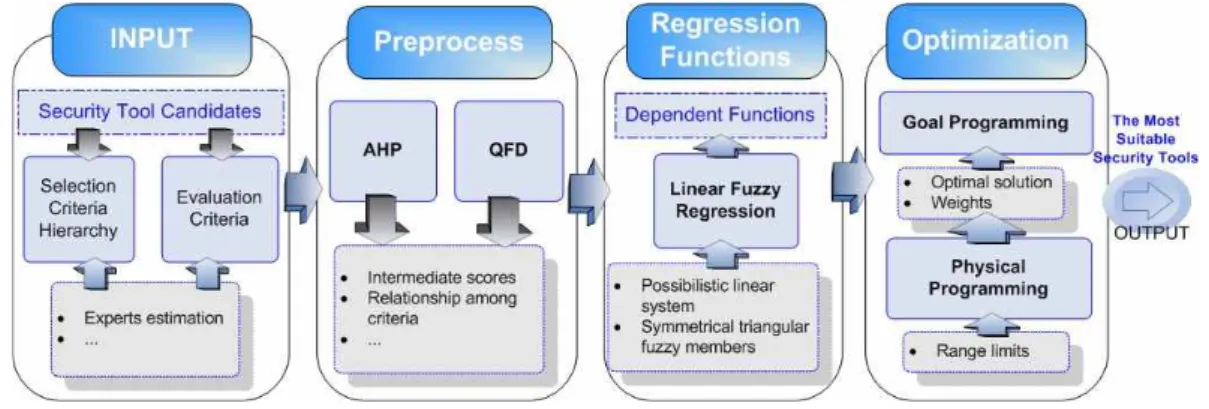
An overview of the proposed procedure for selecting the most suitable security tool can be shown in Fig. 1. Section 2 provides the studies related to our applied domain – the selection of security tools for the organization. In Section 3, we explain the proposed integration approach including the security criteria and selection procedure, preprocess step, fuzzy regression for obtaining the dependent function of each criterion, and applied PP method and GP for finding the appropriate solution.
Section 4 provides details on our approach and its application by means of a numerical example.
Finally, Section 5 presents the conclusions and suggestions for future study.
Fig. 1. Proposed approach for security tool selection
II. Literature review
Research on the selection/evaluation of security tools and related issues are considerably few ([5], [11], [15], [16]). Polk and Bassham [17] introduced a guide with criteria for judging the functionality,
practicality, and convenience of anti-virus tools. The
strengths and limitations of various classes of
anti-virus tools are discussed, as well as suggestions
of appropriate applications for these tools. However,
some classes of tools and most products are only
available for personal computers. In addition, this
study limits the functionality factors and does not
concern about the providers, costs or other factors
which affect the decision in selecting antivirus tools.
Firth et al. [18] proposed a lexicon of security functionalities to establish a common vocabulary between security objectives and the specification of tools selected to meet those objectives. These functionalities represent primitive actions that support information survivability and characterize an approach to analyze networked systems environments.
Application of this analysis approach can help organizations in establishing criteria for selecting tools, and identifying requirements for new tool development to accommodate needs not currently met by available tools. There are some well-known security methodologies that have been introduced to evaluate and obtain high-quality information security systems such as ISO/IEC, ITSEC, TCSEC and etc.
([12], [13], [14]). These are the outcome of a series of efforts to develop criteria for the evaluation of information technology security and are broadly used within the international community. These standards focus on functionality or effectiveness of product itself. They cannot show the advantages or disadvantages between a large number of security tool candidates with various quality levels.
Recently, Kim and Lee [7] presented a methodology that consists of a Process Model (that consolidates strategic and operational viewpoints in a process model) and Criteria (that provides evaluation and selection criteria to support decisions on vendors and products) for supporting the selection of security control for information security management systems. The case study conducted by using AHP proves the potential value of this methodology in helping DM in supporting their selection of security controls. Choi and Shin [6] proposed a method for measuring the relative weights among the quality factors for a system on a development life cycle and simultaneously optimizing the balance between the level of quality and development costs. The paper suggests that the relative weights among the quality factors influence the operations of the system, and provides an optimal solution for the quality costs by
employing the desirability function (DF) approach.
For optimization purposes, the study employs AHP as a multiple criteria decision making (MCDM) technique along with the DF approach. Nguyen et al. [10] proposed an integrated approach using AHP, mixed integer goal programming (MIGP) and the security criteria hierarchy to selection the most appropriate solution for an organization. The result of a case study showed the advantage of this approach. Kongsuwan et al. [8] proposed a 3-step approach to manage quality level for developing information security system adopting QFD. First, it showed how to find the importance of quality factors in the product by using QFD. Second, it presented an optimal cost or resource for quality factors under a limited budget. Lastly, it demonstrated how to find an overall quality level. Project leaders can consider this value as the quality of the final product itself. Applying this procedure the project team can gain the desired quality level by adjusting some requirements in the QFD step and recalculating a whole procedure. All the above- mentioned approaches based on the selection criteria to get the experts’
estimation. Then, the problem is remodeled and solved by using some optimization methods. These approaches can employ the advantages from the criteria, the experience in the estimations of experts, and the correctness and flexibility of mathematics in the integrated optimization method to find out the most appropriate solution. From these studies, the security criteria hierarchy is well developed. However, there are still some limitations. When remodeling the problem and integrating experts’ estimation, these methods still could not eliminate noise from the estimation data. In addition, the optimization methods use utility functions which can not exactly reflect the meaning of the problems. To overcome this, we propose an integrated approach to select the most appropriate solution based on LFR, PP and GP.
Details of this approach are discussed in Section 3.
Criteria Sub-Criteria
Product architecture
hardware requirements, OS supported, source language, source code available, NOS supported, protocols supported, and component model
supported
Product function prevention, detection, recovery, and corrective
Provider's speciality security expertise, solution lineup, best practice, and offers turnkey IT security
Produce performance functionality, reliability, usability, efficiency, maintainability, and portability
Product service warranty, maintenance, and support services Provider's track record or
ability market share, certification, geographical coverage, and financial stability
III. The proposed integration framework
In the following, the detailed integration framework for security tool selection is presented.
First, we briefly introduce security tool selection criteria and procedures. Next, based on the AHP method, the intermediate score of these criteria is calculated. The QFD is then employed to describe the relationship for mapping between selection criteria and evaluation criteria. Using these intermediate scores, and the relationship mapping of two criteria types as the input of a LFR procedure we compute the dependent function of each evaluation criterion.
Finally, PP is used to find the optimal solution;
based on this solution we apply an adjusted GP to get the most appropriate security tool.
1. Security tool selection criteria and procedure
In order to more easily understand security tool criteria, we can think of the security tool as a product. Therefore, its capability criteria are the product’s characteristics and the evaluation criteria can be defined as the customer requirements. These criteria are derived from ([7], [10], [19]) and slightly modified to suitable to our problem and method in this paper. The security tool selection criteria which are defined here include two kinds:
capability criteria and evaluation criteria.
l Capability criteria: (1) product architecture, (2) product function, (3) provider's speciality, (4) product performance, (5) product service, and (6) provider's track record or ability;
l Evaluation criteria: (1) quality, (2) credibility of providers, and (3) costs.
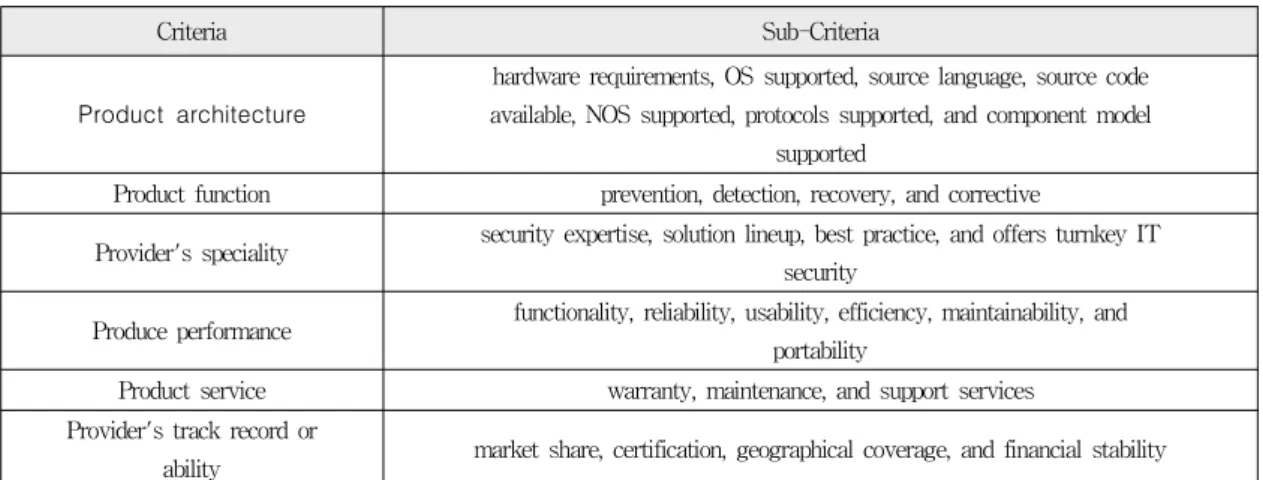
More specifically, each capability criteria have their sub-criteria. Detail about them is shown in the Table 1 below [16].
Table 1. Capability criteria of security tool provider
Based on these criteria, the estimations of experts are obtained. Detailed scores of each security tool candidate for each criterion will be summarized by using AHP and the relation among these criteria is shown in the house of quality (HOQ) model. These will be discussed in Section 3.2.
In addition, one important item we need to
specify is a selection procedure. There are many
procedures proposed for software, project, system,
security control selection ([1], [2], [7], [19]). Each
has advantages as well as disadvantages. Based on
the advantages of previous models and the characteristics
of the security domain, a procedure for security tool
selection is proposed. Steps of the section procedure
are as follows:
1. Organize an introduction team 2. Identify evaluation and selection criteria 3. Extract detailed attributes of security tools 4. Collect all security tool alternatives
5. Reduce alternative list and send an invitation to vendors
6. evaluate the Request for Proposal (RFP) responses of vendors
7. Apply optimal selection framework 8. Obtain the most suitable security system.
Based on the security tool selection criteria and procedure which is introduced above, we applied three phases framework for Step 7. This framework helps the DM to select the most suitable security tool for an organization. Further details about these three phases are provided below.
2. Selection preprocess
The AHP, introduced by Saaty [20], addresses the methods for determining the relative importance of a set of factors. The AHP is widely used for tackling MCDM problems in real situations. In this paper, data collected from security experts using a questionnaire is utilized as the input of the AHP procedure to compute the intermediate scores of each selection criterion, as well as evaluation criterion.
After applying the AHP we can eliminate the sub-criteria and consider only about the selection criteria. Then, QFD is employed to describe the relationship of the selection criteria and evaluation criteria. In fact, employing QFD here is only for the purpose of easily understanding the relationship among selection criteria, and between the selection criteria and evaluation criteria.
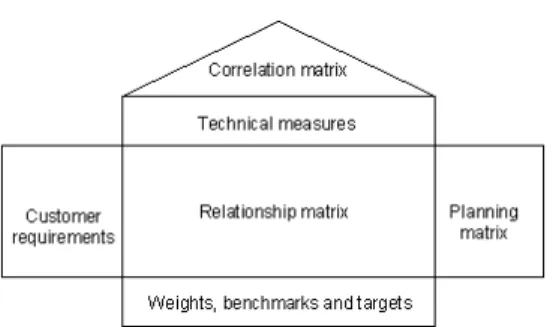
The general format of the HOQ matrix includes six major components: customer requirements, technical measures, relationship matrix, correlation matrix, planning matrix and weight, benchmarks and targets ([21], [22]). From the relationship matrix and correlation matrix we can derive the relationship information, as discussed above, for the next step – fuzzy regression.
Fig. 2. The house of quality matrix
Fig. 2 helps us to more easily see the relationship among these selection criteria, as well as between the selection criteria and evaluation criteria. In addition, all summarized scores of each alternative are shown, such as the planning matrix and weight, and the benchmarks and targets matrix. These data are used as the input of the fuzzy regression method to compute the regression function of each evaluation criteria.
3. Fuzzy regression
In this section we briefly introduce a LFR and show how to apply this method to our problem. More specifically, we compute the dependent function of each evaluation criterion using the intermediate scores and the relationship mapping of two criteria types from the previous step as the input of a LFR procedure. Because information which is obtained from experts cannot be guaranteed to be exactly correct, we use a fuzzy regression. This method overcomes the problem of noise effect in the input data quite well and has been successfully applied in many engineering domains ([1], [2]).
The linear fuzzy regression model is defined by Tanaka [23] as follow:
··· (1)
where is the fuzzy parameter, defined as
the symmetrical triangular fuzzy numbers which center
and spreads , respectively. The membership function is
written as:
≤ ≤
··· (2)
Tanaka [24] proposed an optimization model to obtain the fuzzy parameters. Solving this optimization problem, we obtained the regression function of each evaluation criterion, which is defined as a function of independent variables – selection criteria. These resultant dependent functions can be described as follows:
and
··· (3)
At the end of this step we have the above dependent functions. Based on these function, PP is employed to get the most suitable solution for an organization.
Details are discussed in the next section.
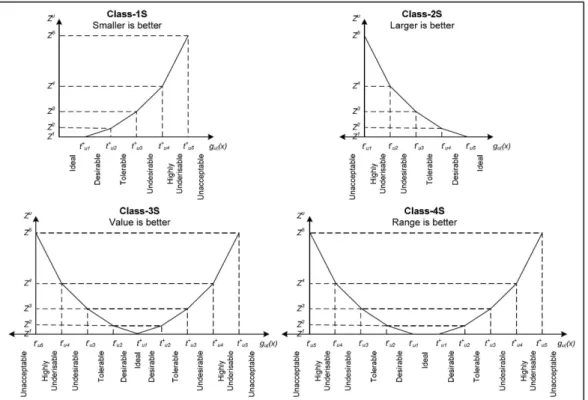
Fig. 3. PP class functions
4. Physical programming for optimization
PP is a new approach to computational design optimization which was recently developed by Messac [25]. PP provides greatly enhances an engineer’s ability to obtain an optimal design by employing a flexible and more natural problem formulation framework. One of PP’s advantages is the elimination of the need to specify optimization weights by DMs or experts. In this method, they only specify ranges of different degrees of desirability for each design measure. PP is also ideally suited to address the inherent multi-objective nature of decision problem, where multiple conflicting objectives govern the search of the best solution. For these reasons, it has been used primarily and widely in engineering design optimization ([26], [27], [28], [29]).
Within the PP procedure, the DM expresses his
preferences with respect to each criterion using four
different classes. Fig. 3 above depicts the qualitative
meaning of each class. For each class, there are two
cases: soft and hard, referring to the details of the
Subject to
≥
≥
≥
i in classes: 2S , 3S , 4S ( s = 2, 3, 4, 5; i = 1, 2, ..., n sc )
≤
≥
≤
i in classes: 1S , 3S , 4S ( s = 2, 3, 4, 5; i = 1, 2, ..., n sc )
∈ DM's preference. Here, the decision variable vector
is denoted as x, and the uth generic criterion as gu(x). The value of the criterion under consideration gu is on the horizontal axis, and the function that will be minimized or maximized for that criterion, zu hereby called the class function, is on the vertical axis. the desired behavior of generic criterion is described by one of four soft and four hard sub-classes. These classes illustrated in Fig. 3 are soft classes which can be characterized by:
Class-1S: Smaller-is-better i.e. minimization Class-2S: Larger-is-better i.e. maximization Class-3S: Value-is-better
Class -4S: Range-is-better
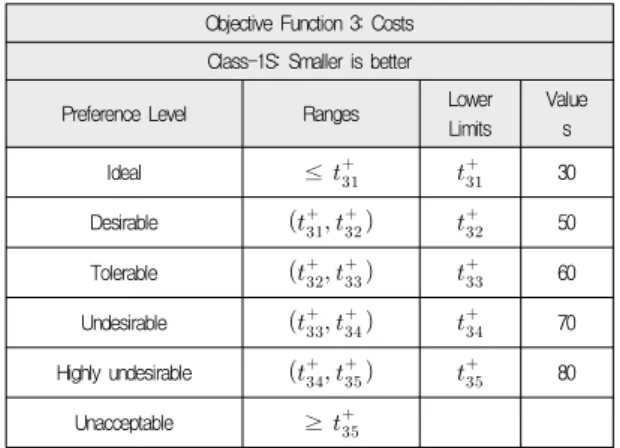
The PP lexicon comprises terms that characterize the degree of desirability of six ranges for each generic criterion for classes 1S and 2S, ten ranges for classes 3S, and eleven classes for class 4S. To illustrate the PP lexicon, consider the case of class 1S, shown in Fig. 3. In order of decreasing preference, the ranges are defined as follows:
Ideal range ( ≤ ; Range-1): A range over which every value of the criterion is ideal (the most desirable possible). Any two points of this range are of equal value to the DM;
• Desirable range ( ≤ ≤ ; Range-2): An acceptable range that is desirable;
• Tolerable range ( ≤ ≤ ; Range-3): An acceptable, tolerable range;
• Undesirable range ( ≤ ≤ ; Range-4): A range that, while acceptable, is undesirable;
• Highly undesirable range ( ≤ ≤ ; Range-5): A range that, while still acceptable, is highly undesirable; and
• Unacceptable range ( ≥ ; Range-6): The range of values that the generic metric may not take.
To evaluate the weights of each generic criterion, a PPW algorithm is applied [25]. After that, the PP problem model can be mathematically expressed as follows:
min
··· (4)
where are deviational variables. In our problem, we have three objectives which are quality, credibility and costs. By employing PP, the best solution is found. Then, based on the weights and the optimal solution which is obtained from PP step, weighted goal programming is utilized to specify the most suitable solution for an organization ([25], [30]).
IV. Case study
In this case study, the XYZ Company wants to implement an information security system. There are many candidate products in market for the company to choose from. We consider five candidates which are A1, A2, A3, A4 and A5. Among the many sub-criteria, three most important evaluation criteria are quality, credibility and cost, which must be strictly considered within the selection process. The objective of the project is to determine the most suitable security tool among these candidates which will satisfy the quality, credibility and cost requirements.
1. Preprocess and fuzzy regression phases In this particular example, there are five security tools are considered to be selected for XYZ Company.
As discussed in Section 3, our approach first applies
AHP and QFD to obtain the intermediate scores of
security tool criteria and the relationship between
selection criteria and evaluation criteria, and among
selection criteria. The result of these two phases is
shown in Fig. 4. In this figure, we can see the
relationship between selection criteria and evaluation criteria in the center matrix. In addition, the relationship among the selection criteria is shown in the angle on the top of Fig. 4. All scores for each selection criteria were normalized to the range between 0 and 100, which means the percentage of perfect
characteristics. But, for fuzzy regression computing purpose, these values are normalized again to fit into the range between 0 and 1. On the right side of Fig. 4 above, the score of each evaluation criteria is set as an integer from 0 to 10, in which “0” is the worst case and “10” is the best of this criterion.
Fig. 4. House of quality mapping selection criteria to evaluation criteria
In order to compute the dependent function of
each evaluation criteria, as well as the dependent function among selection criteria, we employ the LFR, which is discussed in Section 3. After applying LFR we obtain the following dependent functions
≤ ≤
≤ ≤
···(5) where y1, y2, y3, x1, x2, x3, x4, x5, and x6 denote quality, credibility of supplier or vendor, costs, architecture, function, speciality, performance, track record or ability and product service, respectively.
In order to obtain the fuzzy parameters for dependent quality function (y1), the following optimization model [25] needs to be solved.
min
··· (6) Subject to
≤
≥
Solving the above optimization problem by
MATLAB, the fuzzy regression function of quality
aspect is obtained as follows:
By applying the same procedure for the other criteria, all parameter estimations are obtained and we summarize all dependent functions of criteria below
··· (7)
In the next phase, using the information above we apply PP to find the most suitable security tool for XYZ Company.
2. Physical programming phase
Our objectives are to maximize the quality and the credibility of a security tool and minimize its cost. This problem can be defined as multi-objective problem below
Maximize { Quality of product = y 1 } (8) Maximize { Credibility of product = y 2 }
Minimize { Cost = y 3 }
Subject to: f x (x , y) = 0; y i ∈ S y ; x j ∈ S x
In this paper, PP is employed to solve the above problem. We first apply PP to find out the optimal solution ( ). Then, we combine the advantage of PP and GP to find the most suitable security tool among these candidate products. More specifically, optimal solution ( ) is set as the target solution for GP and the PPW procedure is used to obtain the weight of each goal.
First, the review team or DMs decide the range for each goal based on the views and requirements of the company for the selected security tool. The value of each goal is between 0 and 100, where “100” is the highest value and “0” is the lowest value. In sum, the range limits for each goal are shown in Tables 2, 3, and 4.
Objective Function 1: Quality Class-2S: Larger is better
Preference Level Ranges Lower
Limits Values
Ideal ≥ 95
Desirable 75
Tolerable 65
Undesirable 60 Highly undesirable 50
Unacceptable ≤
Table 2. Range limits for quality goal
Objective Function 2: Credibility of Provider Class-2S: Larger is better
Preference Level Ranges Lower
Limits Values
Ideal ≥ 90
Desirable 80
Tolerable 70
Undesirable 60 Highly undesirable 50
Unacceptable ≤
Table 3. Range limits for credibility goal
Objective Function 3: Costs Class-1S: Smaller is better
Preference Level Ranges Lower
Limits Value
s
Ideal ≤ 30
Desirable 50 Tolerable 60 Undesirable 70 Highly undesirable 80
Unacceptable ≥
Table 4. Range limits for costs goal
Then, applying the PPW algorithm, all weights
will be obtained as shown in Table 5.
and
Target i Normalized Weights
Quality 1 0.049 0.168 0.737 0.095
Credibility 2 0.104 0.124 0.255 0.602
Costs 3 0.052 0.176 0.255 0.602
Table 5. Normalized weights calculated by using PPW procedure
Applying PP, our problem can be rewritten as follows:
min
Subject to
≥ ≥ ≥ ·· (9)
≥ ≥ ≥
≤ ≥ ≤
≤ ≤
≤ ≤
We used the MATLAB system to solve the above problem. The results obtained are as follows:
Next, to avoid the ambiguous and incorrect computation of each objective weight, in this step we use the weights which are obtained from PPW algorithm. The optimal solution ( ) is set as the target solution. In this, we overcome two weak points of weighted GP, which are determination of weight and suitable target value for each goal. Now our problem is described as follows
min ··· (10)
Subject to
∈
and
Using the MATLAB software package, the result obtained is: . The result means that the security tool A1 is the most suitable for the XYZ Company. This result is reasonable and appropriate with the real result and is the evidence of the correctness of our approach. Detailed discussion of this result is presented in the following sub- section.
3. Result discussions
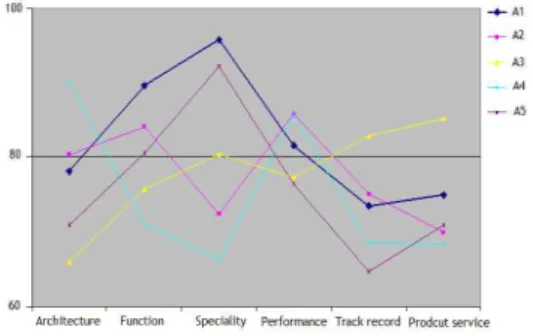
After collecting information from experts’ estimations and applying AHP to gain the intermediate scores for six main selection criteria of each security tool, we can have an overview of these tools by looking at the Fig. 5 below. We can see that A1 security tool is slightly higher compared to the others. However, it is still very hard to determine exactly which tool is the most appropriate for an organization. If each expert focuses on different factors, the result will be different. From that observation, we recommend a three-step integrated framework for helping the DM select a security tool is proposed.
Fig. 5. Synthesis intermediate score at each main selection criterion of five security tools