1. 서론
이러닝에 대한 정의는 다양하나 이를 포괄하여 ‘인터 넷을 통한 원격 교육’이라 정의할 수 있다[1]. 이러닝 산 업은 ICT와 교육의 결합으로 탄생하여 교육혁신과 인적
자원 개발 수단으로 각광받고 있으며 디지털 콘텐츠 산 업의 핵심으로 떠오르게 되었다[2].
이러닝은 시간 활용에 따라 보조학습형, 사이버형, 그 리고 오프라인/온라인 교육이 결합된 블렌디드형으로 나 눌 수 있다[3]. 본 연구에서는 사이버형 이러닝 소프트웨
ISO 품질평가 체계를 적용한
이러닝 소프트웨어의 사용성 품질평가 기준
이하용
서울벤처대학원대학교 융합산업학과
Usability Quality Evaluation Criteria of e-Learning Software Applying the ISO Quality Evaluation System
Ha-Yong Lee
Dept. of Fusion Industry, Seoul Venture University
요 약 지금까지 이러닝 소프트웨어 평가에 관한 다양한 연구가 진행되었으나 관련 표준에 따라 체계화된 형태가 아닌 연구자의 시각에서 제시된 분류에 따라 주관적인 평가 기준을 구성하고 있다. 또한 소프트웨어 평가 관련 표준도 실질적인 활용을 위해 지속적으로 보완되고 있으므로 이에 부합하는 평가 기준의 마련을 통해 평가 근거의 확보 및 체계화가 절실하다.
따라서 본 연구에서는 이러닝 소프트웨어의 품질평가 기준을 구축하기 위해 소프트웨어 제품평가 표준인 ISO/IEC 25000 시리즈의 품질특성 중 사용성에 관한 체계를 근간으로 하고 이러닝 소프트웨어의 품질 요구사항을 분석하고 체계화하여 사 용성의 부특성에 따른 평가 기준을 구축하였다. 본 평가 기준은 지속적으로 변화하는 관련 최신 표준화 동향을 반영한 이러 닝 소프트웨어 평가기준을 구축하여 실질적인 활용도를 제고했다는 점에서 차별화된다. 향후 이러닝 소프트웨어의 품질평가 및 인증에 효과적인 활용이 가능할 것으로 사료된다.
주제어 : 이러닝 소프트웨어, 품질평가 체계, 품질평가 기준, 사용성, 품질 요구사항
Abstract So far, various researches have been conducted on evaluation of e-learning software, but subjective evaluation criteria are formed according to the classification presented from the viewpoint of the researcher rather than systematized form according to related standards. In addition, standards for software evaluation are continuously being supplemented for practical use, so it is urgent to establish evaluation bases by establishing evaluation criteria.
Therefore, in order to establish the quality evaluation standard of e-learning software, this study analyzes the quality requirements of e-learning software based on the usability system among the quality characteristics of ISO/IEC 25000 series. This evaluation standard is distinguished by the fact that the evaluation standard of e-learning software that reflects the latest trend of related standardization has been established and practical utilization has been improved. It can be used effectively for quality evaluation and certification of e-learning software in the future.
Key Words : e-Learning Software, Quality Evaluation System, Quality Evaluation Criteria, Usability, Quality Requirements
*Corresponding Author : Ha-Yong Lee([email protected]) Received April 6, 2018
Accepted May 20, 2018
Revised April 30, 2018 Published May 28, 2018
어를 대상으로 품질평가 기준을 구축하고자 한다. 지금 까지의 이러닝 소프트웨어 평가기준 관련 연구들은 이러 닝 소프트웨어 평가에 대한 표준의 부재로 연구자 개인 의 주관에 따른 연구가 될 수밖에 없었다. 소프트웨어 품 질평가 관련 국제표준이 확립되고 국내에서도 이를 적용 한 인증을 수행하고 있는 만큼 국제표준의 체계를 수용 한 이러닝 소프트웨어 평가 기준이 마련될 필요가 있다.
본 논문에서는 소프트웨어 품질인증 활동의 기반이 되는 ISO/IEC 25010[4] 소프트웨어 제품평가 관련 국제 표준 품질체계의 사용성 특성을 기준으로 본 연구자의 연구와 다수의 선행 연구 결과를 접목하여 이러닝 소프 트웨어의 전반적인 품질평가 기준을 구축하였다.
2장에서는 이러닝 소프트웨어의 품질평가 관련 연구 동향을 살펴보고 3장에서는 이러닝 소프트웨어의 품질평 가 관련 특성 및 품질 요구사항을 분석하며 4장에서는 이 러닝 소프트웨어의 사용성 품질평가 기준을 구축하고 5 장에 결론과 향후 연구과제를 기술하였다.
2. 이러닝 소프트웨어 품질평가 관련 연구
2.1. 국내 이러닝 소프트웨어 평가 연구 동향 2.1.1 이러닝 콘텐츠 기술성 평가기준 연구 한태인[5]은 이러닝 콘텐츠 품질인증 기술성 평가기준 에 관한 연구를 통해 이러닝 콘텐츠의 품질인증 기술성 을 평가하기 위한 기준을 제시하였다.
기술성 평가기준의 평가 항목으로 전략 및 방법론, 사 용성 및 품질, 기술 및 기능을 포함한 총 6가지 평가부문 과 하위 평가항목이 있다. 이 연구는 평가항목별 척도의 도입으로 정량화된 등급평가가 가능하고 평가항목별 자 가점검표 제공과 평가항목별 평가의견서 작성을 통해 신 뢰성을 제고한다는 점이다.
2.1.2 이러닝 소프트웨어 무결성 시험
한국정보통신기술협회(TTA) 소프트웨어시험인증연 구소에서는 한국교육학술정보원(KERIS)과 정보통신산 업진흥원(NIPA)에서 의뢰한 교육용ㆍ산업용 이러닝 소 프트웨어에 대해 무결성 시험기준에 따라 시험하고 있다.
2.2 국외 이러닝 품질인증 동향
세계 여러 나라에서 이러닝 관련 가이드라인을 개발 하고 있으며 국가 경쟁력을 강화하고자 하는 차원에서 핵심전략으로서 인적자원개발을 위해 노력하고 있으며 이러닝 품질인증을 위한 프레임워크를 개발하고 활용하 기 위한 다양한 정책을 펴고 있다[6].
3. 이러닝 소프트웨어의 품질 요구사항
이러닝 소프트웨어의 특성에 따라 갖추어야 할 요구 사항을 먼저 분석해 본다.
3.1 기술적 특성 영역의 요구사항
한국교육학술정보원에서는 교육용 소프트웨어의 기 술적 특성 영역에 대한 평가 기준을 사용 편리성이나 제 시된 정보에 대한 수용 용이성 등을 포함하여 정의[7]하 고 있으며 이를 Table 1에 요약 정리하였다.
Rating factor Evaluation Criteria
Ease of use
Providing information about current learning status Ease of movement of learning location Relevance of learner response area Clarity of Icon Meaning
Ease of information acceptance
Effective use of multimedia technology
Appropriateness of the form that expresses contents such as letters, graphics, sound, video
Program stability
Appropriateness of reaction rate
Whether an error occurred during program operation Consider transmission speed and server stability (for online-based programs)
Management
system Follow-up maintenance plan (online-based program)
Functionality
Security of the program Openness of the program
Program Scalability (Cooperative Learning Program) Table 1. Requirements for technical characteristics
교육용 소프트웨어의 기술적 측면에 관해 한국교육학 술정보원의 기준과 다른 연구들을 바탕으로 컴퓨터라는 매체의 적합성, 학습활동에 대한 적절한 기술적 지원 정 도, 성능, 호환성, 보안성, 신뢰성 등을 보완한 연구도 있 다[8]. Table 2에 그 결과를 요약 정리하였다.
Rating factor Evaluation Criteria Ease of
information acceptance
Effective use of multimedia technology
Appropriateness of the form that expresses contents such as letters, graphics, sound, video
Program stability
Appropriateness of reaction rate
Whether an error occurred during program operation Considering the transmission speed and stability of the server
Technical support
The extent to which the quality of the skills used in the program effectively supports learning
Functionality
Whether it provides the required functionality The level of functionality provided Whether the function to select is provided
Performance
Processing speed Memory usage Hard Disk Usage
Compatibility Compatibility of software in use Compatibility of used hardware Security Preventing unauthorized access
Reliability Possibility of error avoidance due to program flaw Table 2. Evaluation Criteria for Technical Aspects
of Educational Software
3.2 운영에 관한 품질 요구사항
이러닝 소프트웨어는 학습자와 운영자 측면으로 역할 을 구분하며 이러한 분류로 평가 기준 연구가 이루어진 바 있다[8]. Table 3에 연구 결과를 정리하였다.
division Rating factor Evaluation Criteria
Learner
Learning controllability
The extent to which the learner has control over the learning content, amount of learning, learning speed
Interactivity Possibility of proper interaction with operator, speed of interaction
Feedback Whether immediate feedback is provided when needed
Efficiency of providing information
The degree of efficiency of the way in which new information is provided to learners
User interface
The appropriateness of the user interface configuration, the familiarity of the user interface elements, the location of the user interface elements, function, expression, etc.
Ease of use
The extent of providing information about current learning status, ease of movement of learning locations, ease of use of the program without special expertise in hardware or software
Guideability Whether the learner is adequately provided with user instructions or help
Operator
Maintainability Whether you can easily update your learning content
Convenience of management
Convenience of operator program operation, convenience of backup, ease of installation
Guideability Appropriate provision of guidance or help for operators
Table 3. Evaluation Criteria for the Operation of Educational Software
3.3 공통적 품질 요구사항
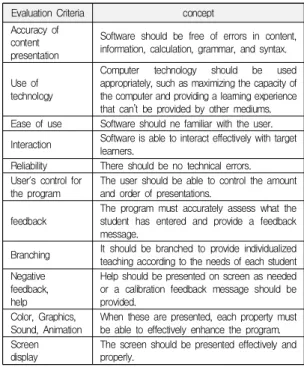
교육용 소프트웨어 전반에 공통적으로 나타나는 특성 에 대한 일반적인 평가기준을 규정하기 위해 교육용 소 프트웨어 평가 컨소시움에서 회원들을 대상으로 조사를 실시한 연구가 있다[9]. Table 4에서는 연구 결과에 따른 주요 평가 기준과 개념을 정리하였다.
Evaluation Criteria concept
Accuracy of content presentation
Software should be free of errors in content, information, calculation, grammar, and syntax.
Use of technology
Computer technology should be used appropriately, such as maximizing the capacity of the computer and providing a learning experience that can’t be provided by other mediums.
Ease of use Software should ne familiar with the user.
Interaction Software is able to interact effectively with target learners.
Reliability There should be no technical errors.
User's control for the program
The user should be able to control the amount and order of presentations.
feedback
The program must accurately assess what the student has entered and provide a feedback message.
Branching It should be branched to provide individualized teaching according to the needs of each student Negative
feedback, help
Help should be presented on screen as needed or a calibration feedback message should be provided.
Color, Graphics, Sound, Animation
When these are presented, each property must be able to effectively enhance the program.
Screen display
The screen should be presented effectively and properly.
Table 4. Common evaluation criteria for educational software
지금까지 연구된 평가 기준들은 분류 기준에 대한 공 통점을 찾기 어렵고 연구자의 주관적 판단에 따른 분류 결과이므로 분류 기준에 대한 객관적인 근거를 확보하고 체계화를 위한 연구가 요구된다고 하겠다.
4. 이러닝 소프트웨어의 사용성 품질평가 기준
이러닝은 최종 학습자가 접하는 화면 설계에 그 체제 의 특성이 잘 반영되어야 학습동기와 지속력이 유지될 수 있다[10]. 이러닝 소프트웨어와 관련된 선행연구들을 살펴 보면 학습 관련 소프트웨어라는 측면에서 학습자와 운영자 관점의 사용성 측면이 매우 부각되고 있다는 것
을 알 수 있다. 따라서 본 논문에서는 소프트웨어 제품의 평가를 위한 표준인 ISO/IEC 25010에서 소프트웨어 사 용성 측면에서 이러닝 소프트웨어의 품질평가 기준을 체 계화하고자 한다.
ISO/IEC 25010은 소프트웨어의 사용성을 타당성 식 별력, 학습성, 운영성, 사용자 오류 보호, 사용자 인터페 이스 미학, 접근성의 부특성으로 세분하고 있다.
4.1 이러닝 소프트웨어 사용성 품질평가 기준 4.1.1 타당성 식별력의 품질평가 기준
이러닝 소프트웨어의 타당성 식별력은 학습자가 학습 시스템이 자신의 요구에 적합한지를 인식할 수 있는 정 도를 의미하며, 학습 시스템의 첫인상(initial impression) 으로 시스템의 적합성을 알 수 있는 능력과 관련된다. 이 개념에 따라 도출한 이러닝 소프트웨어의 요건은 Table 5와 같다.
subcharact
eristics item Related review items
appropriate ness recognizabi lity
Screen Layout
- Effectively present the right amount of content
- Screen configuration is standard form Simplicity - A concise user interface
- Used terms: easy and universal terms
Consistency (UI)
- User interface consistency - Appropriateness of location, function,
and presentation of user interface elements
… …
Table 5. Assessment requirements for appropriateness recognizability
4.1.2 학습성의 품질평가 기준
이러닝 소프트웨어의 학습성은 학습자가 소프트웨어 가 학습을 위해 제공하는 기능을 적절하게 학습할 수 있 도록 하는 것을 말하며 이 개념에 따라 도출한 이러닝 소 프트웨어의 요건은 Table 6과 같다.
subcharact
eristics item Related review items
learnability
Ease of memory - Remember how to use it after time - Effective use of multimedia technology Ease of function
learning
- Usage learning
- Perform actions related to learned contents
Help accessibility - Provide user manuals or help appropriately
… …
Table 6. Evaluation requirements for Learnability
4.1.3 운영성의 품질평가 기준
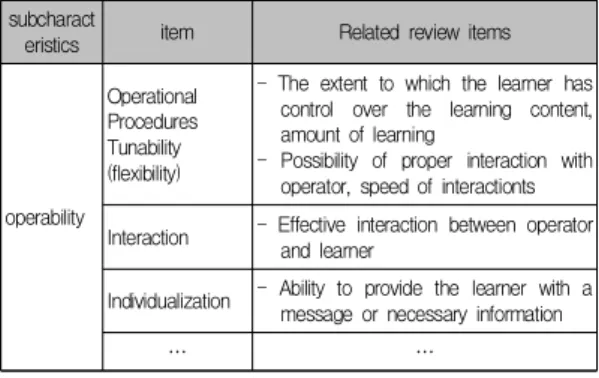
이러닝 소프트웨어의 운영성은 학습자가 소프트웨어 를 운영 및 제어할 수 있게 하는 것을 말하며 이 개념에 따라 도출한 이러닝 소프트웨어의 요건은 Table 7과 같 다.
subcharact
eristics item Related review items
operability
Operational Procedures Tunability (flexibility)
- The extent to which the learner has control over the learning content, amount of learning
- Possibility of proper interaction with operator, speed of interactionts Interaction - Effective interaction between operator
and learner
Individualization - Ability to provide the learner with a message or necessary information
… …
Table 7. Evaluation requirements for operability
4.1.4 사용자 오류 보호
이러닝 소프트웨어의 사용자 오류 보호는 학습 시스 템이 사용자가 오류를 발생시키지 않도록 보호하는 것으 로 이 개념에 따라 도출한 이러닝 소프트웨어의 요건은 Table 8과 같다.
subcharact
eristics item Related review items
User error protection
User Guide
- UI configuration type - Provide relevant information - Function Processing Order Exact content - No errors in content, information,
calculation, grammar, and syntax
Prevent errors
- Whether an error occurred - Possible error occurrence
conditions
… …
Table 8. Evaluation requirements on User Error Protection
4.1.5 사용자 인터페이스 미학의 품질평가 기준 이러닝 소프트웨어의 사용자 인터페이스 미학은 학습 자에게 사용자 인터페이스가 즐겁고 만족스런 상호작용 을 할 수 있게 하는 것으로 이 개념에 따라 도출한 이러 닝 소프트웨어의 요건은 Table 9와 같다.
subcharact
eristics item Related review items
User interface aesthetics
Interface adjustable - Relocation of toolbox - Relocation of primary elements
Interface preferred - The familiarity of UI elements - Layout of UI components
… …
Table 9. Evaluation Requirements on User Interface Aesthetics
4.1.6 접근성의 품질평가 기준
이러닝 소프트웨어의 접근성은 학습 시스템이 광범위 한 범위의 특성과 능력을 가진 학습자들이 특정한 사용 맥락에서 특정한 목표를 달성할 수 있도록 사용될 수 있 는 것으로 예를 들면, 장애인의 특성을 반영하여 독립적 인 사용이 가능한지, 장애인을 대상으로 한 소프트웨어 인 경우 장애특성이 고려되었는지, 필요시 대체입력이 가능한지, 잦은 실수로 인한 오작동으로 인해 문제가 발 생하지는 않는지 등과 같은 것이다[11]. 이 개념에 따라 도출한 이러닝 소프트웨어의 요건은 Table 10과 같다.
subcharacte
ristics item Related review items
accessibility
Independent use - Whether learners can use it independently
Consider fault characteristics
- Whether the UI is considered faulty
Auxiliary tool - Alternative input tool available if needed
… …
Table 10. Evaluation Requirements on Accessability
4.2 사용성의 품질평가 기준
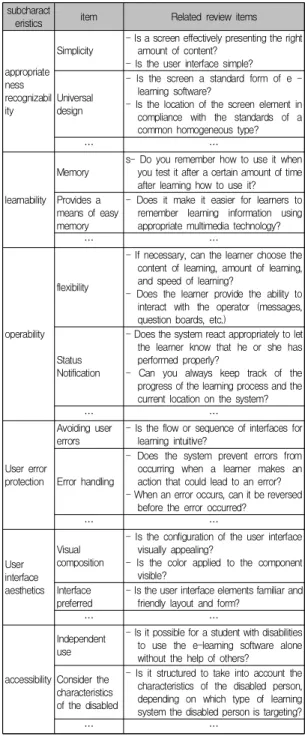
이러닝 소프트웨어의 사용성의 부특성에 대한 이러닝 소프트웨어의 요건에 대해 유사항목을 묶어 재구성하고 평가 기준을 제시하였다. Table 11에는 이러닝 소프트웨 어의 사용성에 관한 부특성인 타당성 식별력, 학습성, 운 영성, 사용자 오류 보호, 사용자 인터페이스 미학, 접근성 에 관한 품질평가 기준을 나타내었다.
subcharact
eristics item Related review items
appropriate ness recognizabil ity
Simplicity
- Is a screen effectively presenting the right amount of content?
- Is the user interface simple?
Universal design
- Is the screen a standard form of e - learning software?
- Is the location of the screen element in compliance with the standards of a common homogeneous type?
… …
learnability Memory
s- Do you remember how to use it when you test it after a certain amount of time after learning how to use it?
Provides a means of easy memory
- Does it make it easier for learners to remember learning information using appropriate multimedia technology?
… …
operability flexibility
- If necessary, can the learner choose the content of learning, amount of learning, and speed of learning?
- Does the learner provide the ability to interact with the operator (messages, question boards, etc.)
Status Notification
- Does the system react appropriately to let the learner know that he or she has performed properly?
- Can you always keep track of the progress of the learning process and the current location on the system?
… …
User error protection
Avoiding user errors
- Is the flow or sequence of interfaces for learning intuitive?
Error handling
- Does the system prevent errors from occurring when a learner makes an action that could lead to an error?
- When an error occurs, can it be reversed before the error occurred?
… …
User interface aesthetics
Visual composition
- Is the configuration of the user interface visually appealing?
- Is the color applied to the component visible?
Interface preferred
- Is the user interface elements familiar and friendly layout and form?
… …
accessibility
Independent use
- Is it possible for a student with disabilities to use the e-learning software alone without the help of others?
Consider the characteristics of the disabled
- Is it structured to take into account the characteristics of the disabled person, depending on which type of learning system the disabled person is targeting?
… …
Table 11. Evaluation Criteria of Usability of e-Learning S/W
4.3 평가 기준의 유용성 및 차별성
본 논문에서는 정보통신기술협회 같은 국내 소프트웨 어 시험ㆍ인증 기관에서도 근간으로 하고 있는 소프트웨 어 제품 평가에 관한 표준인 ISO/IEC 9126[12, 13]과
ISO/IEC 25000 시리즈[14, 15]를 구성하는 사용성 특성 의 부특성을 기반으로 기존의 연구들을 통합하여 체계화 하고 평가 기준을 구축하였다.
사용성과 그 부특성을 도출한 근간인 ISO/IEC 25000 표준은 소프트웨어 품질특성 체계와 평가 프로세스, 소 프트웨어 패키지 시험표준을 통합한 체계이며 국제표준 으로서 국내 소프트웨어 품질인증 기관에서도 활용하고 있다는 점에서 이러닝 소프트웨어의 평가 기준을 구축하 는데 있어 그 기준으로 채택하였으므로 이를 통해 이러 닝 소프트웨어 평가 기준에 대한 의미 있는 근거를 확보 하고 실질적인 활용에 접근할 수 있을 것으로 본다.
5. 결론
그 동안 국내외적으로 소프트웨어 품질평가 관련 기 준의 표준화 노력이 수행되어 왔다. 국내에서도 국제표 준에 기반을 둔 국내 표준 제정 및 그에 따른 소프트웨어 품질인증 제도 제정 및 수행을 통해 국내 소프트웨어 품 질수준 향상에 많은 기여를 해 왔다.
하지만 이러닝 소프트웨어와 관련해서 수행된 평가 기준 관련 연구들은 품질평가 표준에 입각한 체계화된 기준은 미흡한 실정이다. 이러닝 소프트웨어의 평가 기 준과 관련된 연구들을 조사해 보면 분류 기준이 명확하 지 않고 연구마다 서로 다른 분류 체계로 통일된 체계가 없어 실질적으로 적용하기에 어려움이 따른다. 선행 연 구들의 평가 기준을 보면 다수의 기준들이 학습과 관련 된 사용성과 밀접하게 연관되어 있음을 알 수 있으며 본 논문에서는 사용성에 대한 품질부특성의 관점에서 이러 닝 소프트웨어의 평가 기준을 분류하고 체계화하고자 했다.
본 연구에서는 ISO/IEC 25000 시리즈의 소프트웨어 사용성에 관한 부특성 체계를 따라 기존의 연구들에서 도출된 평가 기준들을 체계화하는데 적용하여 이러닝 소 프트웨어의 학습자와 운영자의 관점을 포함하여 사용성 의 부특성에 따른 평가 기준을 구축하였다.
이를 통해 이러닝 소프트웨어의 사용성 품질특성에 관해 ISO 국제표준에 입각한 품질특성과 부특성에 근거 한 평가 방법의 적용 가능성을 확인할 수 있었고 향후 지 속적인 연구로 여러 유형의 이러닝 소프트웨어를 대상으 로 한 실질적인 활용을 통해 이러닝 소프트웨어의 품질 향상에 기여할 수 있기를 기대한다.
REFERENCES
[1] Y. K. Kim, S. T. Park & S. J. Lee. (2008). A Study on e-Learning contents Quality, Journal of Digital Convergence, 6(2), 136.
[2] D. H. Kim & M. H. Kim. (2015). Design of Mixed Reality based Convergence Edutainment system using Cloud Service, Journal of the Korea Convergence Society, 6(3), 103.
[3] S. H. Song & H. M. Chung. (2006). An Exploratory Research on Implementation Models of Instruction for Cyber Home Study System in Korea, The Journal of Educational Information and Media, 12(3), 279-280.
[4] ISO/IEC 25010. (2011). Systems and software engineering –- Systems and software Quality Requirements and Evaluation(SQuaRE) -- system and software quality models.
[5] T. I. Han. (2015). A Study on the Technical Evaluation of the Quality Certification for e-Learning Contents, Journal of Digital Convergence, 13(1), 49-66.
[6] T. I. Han. (2017). A Study on Generic Quality Model form Comparison between Korean and French Evaluation Criteria for e-Learning Quality Assurance of Media Convergence, Journal of Digital Convergence, 15(3), 57.
[7] Korea Education and Research Information Service.
(1998). Educational Software Quality Certification Review Guideline.
[8] T. S. Lee, I. H. Yoo & P. W. Park. (2001). Development of Evaluation Standards about Educational Software, Journal of the Korean Association of Information Education, 5(2), 9-11.
[9] G. G. Bitter & D. Wighton. (1987). The most important criteria used by the educational software evaluation consortium, The Computing Teacher, 14(6), 7-9.
[10] Y. M. Son & B. S. Jung. (2015). Convergence Development of Video and E-learning System for Education Disabled students, Journal of the Korea Convergence Society, 6(4), 114
[11] Y. W. Kim, J. H. Woo & J. E. Jin. (2008). A Study on the Evaluation Guide of Educational software for Students with Disabilities, The Journal of Special Education : Theory and Practice, 9(3), 103-105.
[12] ISO/IEC 9126-1. (2001). Software engineering -- Product quality -- Part 1:Quality Model.
[13] ISO/IEC 9126-2. (2003). Software engineering -- Product quality -- Part 2:External Metrics.
[14] ISO/IEC 25020. (2007). Software product Quality
Requirements and Evaluation(SQuaRE) -- Measurement reference model and guide.
[15] ISO/IEC 25040. (2011). Systems and software engineering -— Systems and software Quality Requirements and Evaluation(SQuaRE) -- Evaluation process.
이 하 용(Lee, Ha Yong) [정회원]
▪1993년 2월 : 강원대학교 전자계산 학과(이학사)
▪1995년 2월 : 강원대학교 대학원 전자계산학과(이학석사)
▪2005년 2월 : 호서대학교 벤처전문 대학원 컴퓨터응용기술학과(공학 박사)
▪1996년 3월 ∼ 2005년 8월 : 경희대, 경원대, 선문대, 호 서대 컴퓨터공학부강사
▪1995년 5월 ∼ 2002년 12월 : 한국SW품질연구소 선임 연구원
▪2005년 9월 ∼ 현재 : 서울벤처대학원대학교 교수
▪관심분야 : S/W 품질보증과 품질평가, 품질감리, 객체 지향 프로그래밍, 인공지능 프로그래밍
▪E-Mail : [email protected]