• 검색 결과가 없습니다.

The Impact of Financial Technology on Facilitating E-Government Services in Egypt

N/A
N/A
Protected

Academic year: 2021

Share "The Impact of Financial Technology on Facilitating E-Government Services in Egypt"

Copied!
9
0
0

로드 중.... (전체 텍스트 보기)

전체 글

(1)

1. Introduction

The technological evolutions that world has witnessed in the recent century, have led to significant and important changes in the economic, social and political sectors, especially due to the technological means and innovations that the field of information technology provides in order to simplify processes and improve communication means, as well as collect, store, process, send and retrieve data and information, and so on. All of these create a fierce competition in different sectors to achieve competitive advantage through these technologies.

Due to the enormous advantages of information technology, the financial sector tends to utilize from this technology in conducting the financial transaction, thus, financial technology or fintech emerged as a phenomenon in

* First Author & Corresponding Author, Planning and Industrial Development, 38 Ali Mubarkst, Egypt. Tel: +20-0100-944-3333.

E-mail: [email protected]

© Copyright: Korean Distribution Science Association (KODISA)

This is an Open Access article distributed under the terms of the Creative Commons Attribution Non-Commercial License (https://creativecommons.org/licenses/by-nc/4.0/) which permits unrestricted non-commercial use, distribution, and reproduction in any medium, provided the original work is properly cited.

the Information Systems area, which involves design and delivery of financial services and products through technology. It affects financial and non-financial institutions, customers, merchants and regulators across a wide range of industries and leads to the emergence of peer-to-peer money exchange and systems of non-traditional payment (Leong, Tan, Xiao, Tan, & Sun, 2017).

So, most of governments turn to utilize the advantages of information systems and provide their services in a digital way by launching e-government portals, which represent modern services channels that allow citizens to interact online with government entities (Ebbers, Jansen, & Van Deursen, 2016), as well as, improve and leverage the government services delivered to citizens (Alderete, 2018).

Thus, governments have to implement financial technology to facilitate citizens’ obtaining services.

This study is important because with globalization, technological evolution and the emergence of e-commerce, the fintech field plays an important role in facilitating financial transactions and makes them easier in all fields.

However, there are studies in fintech and others in e-government but there are no studies in implementing Print ISSN: 1738-3110 / Online ISSN 2093-7717

http://dx.doi.org/10.15722/jds.17.05.201905.51

The Impact of Financial Technology on Facilitating E-Government Services in Egypt

Esam El GOHARY *

Received: March 24, 2019. Revised: April 09, 2019. Accepted: May 05, 2019.

Abstract

Purpose – Nowadays financial technology is crucial for each organization to facilitate business transactions and make them easier. This paper was conducted with the purpose of determining the effect of fintech including services e-payment, bills e-payment, ways of payment and bank accounts with e-government on facilitating e-government services in terms of availability, accessibility, efficiency and responsiveness.

Research design, data, and methodology – The problem of this paper is summarized in the lack of studies in this subject.

So, a survey was applied on 400 respondents in Egypt to investigate the impact of fintech on facilitating e-government services, in order to determine which fintech item can affect any of facilitating services dimensions.

Results – The results revealed that bank accounts with e-government doesn’t affect any of facilitating services dimension, while each of the remain items has an effect on some dimensions and does not has effect on others.

Conclusions – Data analysis revealed that the most obstacles that face respondents resulted in the weakness of internet networks, lack of efficient employees in e-government portal and lack of system effectiveness. In general, it clears that fintech implementation affect the dimensions of facilitating e-government services, however not all fintech implementation components have the same effect on the dimensions.

Keywords: Financial technology, Egyptian e-government, ICT in e-government, Fintech in e-government.

JEL Classification: G23.

(2)

fintech in e-government. Hence, this study aims to examine the impact of implementing fintech on facilitating Egyptian e-government services through examine the citizens’

perception of fintech implementation and how it facilitates e-government services in Egypt.

2. Literature Review

E-government concept is about how government organizes itself; namely; set out its administration, regulations, rules and frameworks to communicate, co-ordinate and integrate processes within itself, as well as carry out service delivery.

According to Almarabeh and AbuAli (2010) most of researchers and specialists defined E-government as

“government uses of information and communication technologies to offer for citizens and businesses the opportunity to interact and conduct business with government by using different electronic media such as telephone touch pad, fax, smart cards, self-service kiosks, e-mail / Internet, and (EDI)”.

In addition, United Nation’s defined it as “The use of information and communication technologies (ICT) - such as Wide Area Networks, the Internet, and mobile computing - by government agencies”.

From the prior definitions it clears that government uses and keeps up with the modern technologies to deliver a better government service to its citizens. As, it can achieve accountability, transparency, and citizens participation in the development of government performance (Mohammad, Almarabeh, & Abu Ali, 2009), as well as, raises the ease, efficient and accurate of services’ performance provided to citizens. It also reduces costs, improves performance, speeds delivery and increases the effectiveness of implementation (Almarabeh & AbuAli, 2010).

One of these technologies is fintech, which is used to facilitate the service obtaining process.

Fintech is defined as "any innovative ideas that improve financial service processes by proposing technology solutions according to different business situations, while the ideas could also lead to new business models or even new businesses" (Leong & Sung, 2018).

As well as it aims to: (Lukonga, 2018)

1. Achieve and promote the financial inclusion and subsequently the inclusive growth.

2. Improve the speed, convenience and efficiency of financial services.

3. Provide affordable financial services for underserved small and medium enterprises (SMEs) and unbanked populations.

4. Reducing delays and costs in cross-border remittances 5. Enhancing efficiency and transparency of government

operations, which lead to facilitate social and humanitarian transfers, in addition to reduce corruption.

6. Providing solutions for many challenges such as;

endemic corruption, informal transfers and large remittance markets, unbanked people, undiversified economies, large income disparities, vulnerabilities to terrorism and large displaced populations.

7. Enabling non-financial corporations such as;

e-commerce firms (Amazon, Alibaba, Apple), mobile transfer companies (MTOs), mobile network operators (MNOs) and large retail networks to offer financial services, such as payment and online lending solutions

8. Enabling existing banks to develop new business models.

So, in order to achieve the fintech aims it provides several Financial innovations and solutions including: (Abdel- kader, 2013; Burtch, Ghose, & Wattal, 2013, 2014; Foster &

Heeks, 2013; Lim, Kim, Hur, & Park, 2018; Lukonga, 2018) 1. Funding services, represented in:

• Crowdfunding:

• peer-to-peer lending • capital raising

2. Electronic payments, represented in:

• Mobile transactions, such as (payments and banking.

• Money transfers.

• Digital wallets

• Peer-to-peer payment technology • Cryptocurrencies

• Blockchain • Digital cheques

• Bank cards; (credit cards and debit cards) 3. Financial transactions applications:

• Asset management • Internet of things (IoT)

• Near field communication (NFC)

• Artificial Intelligence (AI) in financial services, • Wealth management

• Insurance

These services can be provided in four groups as follows:

1. Customer service Fintech: includes; services and processes that deal with the customer at the user interface level and the backend database level. For instance: electronic trading and banking, electronic billing, mobile payment technology and customer relationship management

2. Financial services: refer to processes and applications for exchanges, assess management, portfolio management and risk management.

3. Business processes: refer to the linked activities those aim to deliver a specific results, including, system integration, document management, knowledge management, etc.

4. Compliance: refers to the methods that business

organizations use in order to comply with internal and

external regulations. (e.g. financial statement reporting

and analysis)

(3)

Hence, the importance of implementing fintech in e-government to make transactions easier is cleared.

Therefore, this study interested in studying the fintech implementation in Egyptian e-government.

The Egyptian e-government portal(www.egypt.gov.eg) was launched in January 2004, with the aim of "introducing better governance, in order to reduce government expenses and increase the government efficiency". As, the shared electronic services increase the effectiveness of governments, simplify access to information, and achieve greater transparency to stimulate the business environment, accountability and collaboration, as well as foster a culture of trust, knowledge, and open government. In addition, e-government seeks to provide better public service delivery, better governance and participation, better public resources management and increase citizens’ trust and confidence in the government (Heeks, 2002; Bertot, Jaeger, & Grimes, 2010), so, it comprises three main doctrines: (Azab, Ali, &

Dafoulas, 2006)

1. Public-centric service delivery: the government developed a one stop-shop e-services approach that focuses on citizens' expectations and needs.

2. Community participation: the private/public sector organizations are active participants in e-government implementation and management as well as citizens' needs must be analyzed and considered continuously.

3. Optimal utilization of government resources: i.e. efficient allocation of resources, cost reduction, and increasing productivity.

Moreover, Egyptian e-government portal provides about 20 government services such as telephone e-billing payment, electricity e-billing payment, birth certificate, issuing, etc.

(Azab et al., 2006). As well as, its financial transactions occurs in two groups each group include two forms as follows:

1. Government payments: divided into, government to person payment and government to business payment:

• Government to person payment (G2P): refers to the disbursement of government benefits and salary payments.

• Government to business payment (G2B): refers to payments include tax refunds, subsidies and purchases of goods and services.

2. Government revenues: divided into, person to government payment and business to government payment

• Person to government payment (P2G): payments include paying taxes and fees.

• Business to government payment (B2G): payments include paying taxes and fees.

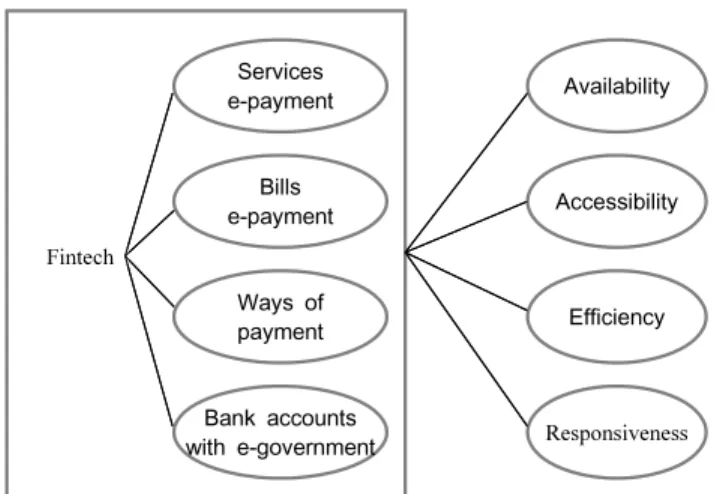
Based on the previous and because of the importance of fintech in facilitating transactions, the author proposed that Egyptian e-government portal implements fintech including (service e-payment, bills e-payment, ways of payment, and

bank accounts with e-government) in order to facilitate its services in forms of availability, accessibility, efficiency, and responsiveness. Each variable is as follows:

Concerning to Fintech model:

Services e-payment: refers to the possibility of paying services fees through electronic payment methods.

Bills e-payment: refers to the possibility of paying government bills whether telephone or electricity bills through electronic payment methods.

Ways of payment: refers to the availability of several e-payment ways whether bank card, fawry, and other e-payment methods

Bank accounts with e-government: indicates if bank accounts are connected with e-government portal.

With regard to the dimensions of e-government service facilitation:

Availability: refers to “provide government services to citizens, government agencies, businesses and travelers irrespective of location or time” (Gebba & Zakaria, 2015)

Accessibility: refers to “the good communication environment that creating easy access to e-government services and information” (Gebba & Zakaria, 2015)

Efficiency: refers to “using fewer inputs to produce particular outputs, with lower costs and thus, the optimal utilization of government resources”

Responsiveness: refers to “the providers' willingness to help customers and provide prompt service” (Parolini, Patterson, & Winston, 2009).

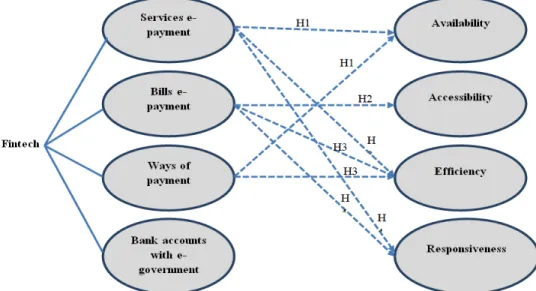
Accordingly the researcher hypothesizes that:

H1: There is a significant effect of Fintech on services availability

H2: There is a significant effect of Fintech on services accessibility

H3: There is a significant effect of Fintech on services efficiency

H4: There is a significant effect of Fintech on services responsiveness

Services e-payment

Bills e-payment

Ways of payment

Bank accounts with e-government

Availability

Accessibility

Efficiency

Responsiveness Fintech

Figure 1: The proposed research model

(4)

3. Methodology

An empirical research was developed to investigate the aim of the study and proof the hypotheses validation.

3.1. Data Collection

Both primary and secondary sources were used in collecting the research data. The questionnaire form was used to collect the primary data for empirical investigation, whereas the literature reviews were used to collect secondary data for model construction.

The survey instrument of self – administrated questionnaire was used for data collection. The questionnaire has been developed in Arabic language to suit the study population culture in order to measure the impact of implementing fintech including; services e-payment, bills e-payment, ways of payment and bank accounts with e-government, as an independent variables on facilitating e-government services in terms of (availability, accessibility, efficiency and responsiveness) as dependent variables. The research instrument is based on five parts containing 30 statements:

The first part consists of one question as a filter question to distinct between respondents transacted with e-government and those didn’t transact. The second part describes descriptive information and consists of five questions four of them are multiple choice questions and ask about respondents possession of accounts whether in banks or Fintech companies like Fawry or PayPal, bank cards, services that respondents have from the portal, as well as one open ended question asks about obstacles that respondents face in using Egyptian e-government portal.

The third and fourth parts consist of 19 questions were designed in a five point Likert-scale to show the study variables. The third part demonstrates the dimensions of services facilitation represented in (availability, accessibility, efficiency and responsiveness), and consists of 15 questions discuss the extent of availability of all services 24/7 a week and the potential to getting e-government services on mobile, the quick and ease of access to e-government services, the efficiency of e-government system in terms of ease of browsing, time and effort saving, decrease bureaucracy and corruption, and the preference of getting salary by bank cards rather in traditional way, and finally it measure the speed of delivery and response to complains

While the fourth part consists of 4 questions demonstrate the Fintech model represented in (services e-payment, bills e-payment, ways of payment and bank accounts with e-government), they measure the possibility and variety of e-payments.

The last part of questionnaire describes the respondents’

demographic characteristics in terms of age, gender and job.

3.2. Study Population and Sample

This study attempts to identify the influence of fintech implementation on facilitating e-government services in Egypt so the population of the study was represented in all e-government users in Egypt. According to Internet World Stats the number of internet users in Egypt are about 50,000,000 people consequently, a total of (400) questionnaire forms have been distributed randomly to the investigated sample to answer them according to their perceptions, knowing that each respondent was informed of the research objectives before been given the questionnaire form. It clears that only 285 respondents which represent 71.25% of the sample size transacted with e-government portal.

The Statistical Package for Social Science (SPSS V23.0) program was used to analyze the research data. The researcher used descriptive analysis to determine the study model reliability and the relation degree between dependent and independent variables. As well as, multi linear regression model was used to proof the hypotheses validation.

4. Results and Discussion 4.1. Respondents’ Age and Gender

The below table (Table 1) shows that 136 respondents which represent 47.72% are between 31 to 40 years old, while 29.12% which are 83 respondents ranged between 41:50 years old, followed by those whom ages ranged between 20:30 as they represent 44 respondents, namely 15.44%, and finally the respondents whome ages ranged between 51:60 and whome ages are more than 60 are closely as the first category represent 3.16% and the second 4.56% which are 9 and 13 respondents respectively.

With regard to gender it clears that most of respondents are males as they represent 61.75%, namely; 176 respondents while only 38.25% are females which represent 109 respondents

Table 1: Respondents’ Age and Gender

Age Gender

20:30 31:40 41:50 51:60 More than 60 Male Female

Frequency 44 136 83 9 13 176 109

% 15.4 47.7 29.1 3.2 4.6 61.8 38.2

4.2. Fintech Analysis

Table 2 shows the fintech fields’ frequencies, so it clears

that 257 respondents which represent 90.2% have bank

accounts and only 116 of respondents which represent

(5)

40.7% have accounts on fintech firms, while 236 respondents which are 82.8% have bank cards. As well as, regarding to payment methods the study reveals that 59.3%

of respondents pay by bank cards and 57.5% pay through fawry, while only 4.9% of respondents pay by cryptocurrencies Table 2: Fintech Analysis

Type Bank Account

Account Fintech on Firms

Possessing bank card

Pay by bank card

through Pay Fawry

Pay by cryptocurr

encies

Frequency 257 116 236 169 164 14

% 90.240.7 82 .8 59.3 57.5 4.9

4.3. Obstacles of e-government:

As shown in Figure 2 29.47% of respondents don’t face any obstacles in using e-government portal, while remain respondents identified the obstacles that they faced in using e-government in seven obstacles as follows:

22.81% of respondents return obstacles to Internet speed 15.44% of respondents return obstacles to low responsiveness

12.28% of respondents said that they found difficulties in using e-government

Remain respondents attributed obstacles that they face in using e-government respectively to shortage of services, e-government portal usually hold due to maintenance, low effectiveness and partly transactions.

Figure 2: Obstacles of e-government

4.4. E-government Services

Table 3 shows the e-government services, it clears that the most used services are telephone bills payment followed by issuing birth certificates and electric bills payment, then Airline tickets reservation, Traffic prosecution services, National ID and Train tickets reservation are moderated use.

While, Drive license, Inquiries, complains, High education council and Taxes are the lowest used services.

4.5. Descriptive Analysis

Table 4 presents the descriptive statistics, reliability coefficients and correlations between variables. The results of the descriptive statistics shows that the mean of the overall study variables are greater than 3, which reflect that respondents perceive the Fintech implementation in e-government and the facilitation of e-government services, except the factor of bank accounts with e-government is not perceived as its mean is 2.27.

The reliability coefficient is strong at 0.60 and above, while less than 0.60 is a poor coefficient. The value of reliability coefficients for the research scale range between (0.616) and (0.744), which indicate good internal consistency and reliability of all study scale.

The correlations demonstrate the relationship between the dependent and independent variables. The results reveal that regarding to dependent variables accessibility and efficiency have poor positive correlations with all Fintech model (services e-payment, bills e-payment, and ways of payment) except bank accounts with e-government has a poor positive correlation with efficiency and a poor negative correlation with accessibility, as their values are above 0.01 and less than 0.49 regardless to the sign.

Availability has moderate positive correlations with services e-payment and ways of payment as their values are .592, .511 respectively, and has poor positive correlations with bills e-payment and bank accounts with e-government as their values (.480, .014) respectively are above 0.01 and less than 0.49. as well as responsiveness has moderate positive correlations with services e-payment and bills e-payment as their values .534, .612 respectively are above 0.50 and less than 0.70, and has poor positive correlation with ways of payment and bank accounts with e-government as their values .432, .038 respectively are above 0.01 and less than 0.49.

Table 3: E-government Services Services Drive

License National ID

Issuing Birth certificate

Traffic prosecution

services

Airline tickets reservation

Train tickets reservation

Telephone

payment Electric

payment Inquiries Taxes

High education

council Complains

Frequency 16 5285 55 56 31 153 78 10 4 5 9

% 5.6 18.2 29.8 19.3 19.6 10.9 53.7 27.4 3.5 1.4 1.8 3.2

(6)

Table 4: Descriptive, Reliability Coefficients and Correlation Matrix

Table 5: The Results of the Multiple Linear Regression Model Variables Dependent

Independent

Availability Accessibility Efficiency Responsiveness

β t Sig. β t Sig. β t Sig. β t Sig.

Services e-payment .500 6.830 .000 .038 .462 .644 .163 2.028 .044 .154 2.079 .039

Bills e-payment -.097- -1.198- .232 .424 4.631 .000 .495 5.557 .000 .488 5.980 .000

Ways of payments .285 4.438 .000 .028 .390 .697 -.203- -2.875- .004 .009 .134 .894

Bank account with

e-government -.020- -.436- .664 -.039- -.736- .462 .071 1.385 .167 .008 .173 .863

R 2 =.395

F=45.715 (p≤ .05) R 2 =.225

F=20.292 (p≤ .05) R 2 =.269

F=25.699 (p≤ .05) R 2 =.376 F=43.823 (p≤ .05)

Concerning to independent variable results reveal that there is a strong positive correlation (.764) between services e-payment and bills e-payment, also services e-payment and bills e-payment have moderate positive correlations with ways of payment (.588, .681), while bank accounts with e-government has poor positive correlations with services e-payment, bills e-payment and ways of payment as their values .042, .047, .063 respectively are above 0.01 and less than 0.49.

4.6. Testing Hypotheses

Data was analyzed using the computer program:

Statistical Package for Social Science (SPSS V23.0). The Multiple Linear Regression Model was used in order to perform the (T test) to measure the significance efficiency extent of each independent variable, i.e.; service e-payment, bills e-payment, ways of payment and bank account with e-government on affecting each dependent variable (Availability, Accessibility, Efficiency and Responsiveness).

Table 5 demonstrates the results of the multiple linear regression analysis, including R 2 , ANOVA test, and the significance of each item of independent variables in affecting dependent variables.

Testing Hypothesis one:

ANOVA test results (F=45.715, p≤.05) reveal that Fintech

implementation affect services availability significantly, as well as it clears that (39.5%) of changes in services availability are affected by Fintech, while more than (60%) of changes are affected by other factors. T test results clear that services e-payment and ways of payment have a significant impact on availability as their (sig.≤p=0.05), while services e-payment has the bigger effect on availability as each one value change in services e-payment cause changes in availability by .500 as β=.500 and each one value change in ways of payment cause changes in availability by .285 as β

=.285. Bills e-payment and bank accounts with e-government don’t have don’t have any significant effect on availability as their (sig.≥p=0.05). Therefore, hypothesis one “There is a significant effect of Fintech on availability”, is accepted in terms of services e-payment and ways of payment and refused in terms of bills e-payment and bank accounts with e-government.

Testing Hypothesis two:

ANOVA test results (F=20.292, p≤.05) reveal that there is a main significant effect of Fintech on services accessibility, as well as R 2 =.225, namely (22.5%) of changes in services accessibility are affected by Fintech, while more than (77%) are affected by other factors. T test results clear that only bills e-payment has a significant effect on accessibility with (β=.424) which clears that each one value change in bills e-payment cause changes in accessibility by .424.

Variables Availability Accessibility Efficiency Responsiveness

Fintech Services

e-payment Bills

e-payment Ways of payment

Bank accounts with e-government

Means Item 3.54 3.67 4.05 3.43 3.95 3.96 3.79 2.27

Total 3.49

Reliability .744 .691 .736 .616 .648

Correlations

Services e-payment .592.379 .42 7 .534 1

Bills e-payment .480 .471 .485 .612.768 1

Ways of payment .511 .338 .235 .432 .588 .681 1

Bank accounts with

e-government .014 -.015- .088 .038 .042.047 .063 1

(7)

On the other side the results demonstrate that there is no significant effect of services e-payment, ways of payment and bank accounts with e-government on services accessibility. Therefore, hypothesis two “There is a significant effect of Fintech on accessibility”, is refused in all its terms except bills e-payment.

Testing Hypothesis three:

The result of ANOVA test (F=25.699, p≤.05) demonstrates that Fintech model has a main significant effect on efficiency, as well as R 2 =.269 indicates that about (27%) of changes in efficiency are affected by Fintech model, while (73%) of changes are affected by other factors. T test results clear that services e-payment, bills e-payment and ways of payment have significant impact on efficiency, while bills e-payment has the biggest effect on efficiency as each one value change in bills e-payment changes β=.495 of efficiency , following by ways of payment (β= -.203) then services e-payment (β=.163).

Regarding to, bank accounts with e-government results reflect that it doesn’t has any significant effect on efficiency.

Therefore, hypothesis three “There is a significant effect of Fintech on efficiency”, is accepted in all its terms except bank accounts with e-government.

Testing Hypothesis four

From ANOVA test result (F=43.823, p≤.05) it clears that Fintech model has a main significant effect on responsiveness, as well as it contributes by (37.6%) in changes in responsiveness as R 2 =.376, while (62.4%) of changes are affected by other factors. T test results reveal that services e-payment and bills e-payment have significant impact on responsiveness, while bills e-payment has the biggest effect as its (β=.488), followed by services e-payment (β=.154) .

Concerning to ways of payment and bank accounts with e-government, results reveal that they don’t have any significant effect on responsiveness. Therefore, hypothesis four “There is a significant effect of Fintech on responsiveness”, is accepted in terms of services e-payment and bills e-payment and refused in terms of ways of payment and bank accounts with e-government.

5. Conclusion:

Financial technology is a recent technology and become crucial for organizations in order to seamless and accelerates business process and transactions. This research aims at measuring the effect of Fintech implementation including, services e-payment, bills e-payment, ways of payment and bank accounts with e-government on facilitating e-government services in Egypt in terms of availability, accessibility, efficiency and responsiveness.

In conclusion, after reviewing related literatures, designing data collection method, collecting data from sample units and analyzing data to test the research hypotheses. It was found that:

The data analysis cleared that only 71.25% of respondents transacted with e-government portal and were valid for analysis 61.75% of them were male and 38.25%

female. As well as most of them; approximately the half of valid respondents range from 31 to 40 years old followed by those whom ages range from 41 to 50 years old then those whom ages range from 20 to 30 years old then whom ages are more than 60, and the lowest number of respondents range from 51 to 60 years old. The fintech analysis revealed

Figure 3: The structure model result

(8)

that most of respondents possess bank accounts and bank cards, however less than 50% of respondents possess accounts on fintech firms. The results also revealed that all respondents pay by bank cards and/or fawry, while a negligible percent pay by cryptocurrencies. With regard to obstacles it cleared that about 70% of respondents faced obstacles and the most popular obstacles represented in the internet speed followed by low responsiveness and difficulties in using the website then services’ shortage, these results demonstrate the weakness in internet networks, lack in efficient employees in e-government portal as well as lack of system effectiveness in several terms such as shortage of services and transactions. Furthermore, the results about the most used e-government services are conflicted with e-government portal as it reported that the most important services are National ID, Train Tickets reservation, Real Estate Office Service, Traffic prosecution services and Complains and Inquires.

The descriptive statistics illustrated the citizens’ perception of all study items, the degree of each item come above 60%, which reflect the well perception of all items. The reliability values of studied items indicated that all studied items are consistent and valid to use in another time. The correlations demonstrated that all independent variables have a poor positive relationship with dependent variables except accessibility has a poor negative relationship with bank accounts with e-government, availability has moderate positive relationship with services e-payment and ways of payment, and responsiveness has moderate positive relationship with services e-payment and bills e-payment.

While, regarding to independent variables bank accounts with e-government has poor positive relationship with all independent items, however ways of payment has moderate positive relationship with services e-payment and bills e-payment those have a strong positive relationship with each other.

From the hypotheses testing, it can be concluded that bank accounts with e-government doesn’t has any relationship or effect on any of the facilitating e-government services dimensions. However services e-payment has a direct effect on availability, efficiency and responsiveness but doesn’t affect accessibility, similarly bills e-payment has a direct effect on efficiency, responsiveness and accessibility but doesn’t affect availability. Also ways of payment has a direct effect on availability and efficiency but doesn’t affect accessibility and responsiveness.

6. Recommendations

Based on the conclusion and findings the researcher suggests the following recommendations to government:

• Government has to conduct awareness campaigns to raise citizens’ consciousness and trust in e-government transactions as 30% of respondents didn’t use

e-government portal.

• Government has to improve internet networks through developing ICT infrastructures to eliminate the internet low speed.

• Government is recommended to enhance the efficiency of e-government portal in term of transactions completion.

• Government is recommended to provide training programs in IT skills and customer services for its employees to qualify them to be able to interact with e-government portal, which in turn improve employees responsiveness

• Government is recommended to improve its website to be more easy to use from all population segments.

• Government has to provide more services in its website.

• Government and banks have to collaborate and increase fintech implementation forms in e-government and add more facilitates for citizens to interact with e-government.

7. Limitations and Future Research Recommendation

This research is applied on e-government in Egypt, so findings can be applied only to any organization implement fintech systems. This paper used secondary data from various sources to develop the measurement scale of fintech and focused on determine the relationship between each fintech item and each dimension of services facilitation without consider any obstacles that may face using e-government portal or fintech methods.

Future studies could examine the citizens’ consciousness about e-government. Also they could study the obstacles of fintech implementation, and measure the employees’ ability to interact with this new technology, as well as studying the challenges facing e-government.

References

Abdel-kader, M. (2013). Requirements of establishing banking technology in supporting competitive intelligence in Algerian banks. Journal Academic for social and human studies, 50(2), 23-30.

Alderete, M. V. (2018). The mediating role of ICT in the development of open government. Journal of Global Information Technology Management, 21(3), 172-187.

Almarabeh, T., & AbuAli, A. (2010). A General Framework for E-Government: Definition Maturity Challenges, Opportunities, and Success. European Journal of Scientific Research, 39(1), 29-42

Azab, N., Ali, M., & Dafoulas, G. (2006). Incorporating

CRM in E-Government: Case of Egypt. Proceedings of

(9)

the IADIS International Conference e-Commerce, LADIS.

Bertot, J. C., Jaeger, P. T., & Grimes, J. M. (2010).

Using ICTs to create a culture of transparency:

E-government and social media as openness and anticorruption tools for societies. Government Information Quarterly, 27(3), 264-271.

Burtch, G., Ghose, A., & Wattal, S. (2013). An empirical examination of the antecedents and consequences of contribution patterns in crowd-funded markets.

Information Systems Research, 24(3), 499-519.

Burtch, G., Ghose, A., & Wattal, S. (2014). Cultural differences and geography as determinants of online prosocial lending. Management Information Systems Quarterly, 38(3), 773-794.

Digital Financial Services [DFS]. (2016). Basic Terminology. Alliance for Financial Inclusion [AFI], 19, 10.

Ebbers, W. E., Jansen, M. G., & Van Deursen, A. J., (2016). Impact of the digital divide on e-government:

Expanding from channel choice to channel usage.

Government information quarterly, 33(4), 685-692.

Foster, C., & Heeks, R. (2013). Innovation and scaling of ICT for the bottom-of-the-pyramid. Journal of Information Technology, 28(4), 296-315.

Gebba, T., & Zakaria, M. (2015). E-Government in Egypt:

An Analysis of Practices and Challenges. International Journal of Business Research and Development, 4(2), 11-25

Heeks, R. (2002). Information systems and developing

countries: Failure, success, and local improvisations.

Information Society, 18(2), 101-112.

Leong, C., Tan, B., Xiao, X., Tan, F. T., & Sun, Y.

(2017). Nurturing a FinTech ecosystem: The case of a youth microloan startup in China. International Journal of Information Management, 37(2), 92-97.

Leong, K., & Sung, A. (2018). FinTech (Financial Technology): What is It and How to Use Technologies to Create Business Value in Fintech Way? International Journal of Innovation, Management and Technology, 9(2), 74-78

Lim, S. H., Kim, D. J., Hur, Y., & Park K. (2018). An Empirical Study of the Impacts of Perceived Security and Knowledge on Continuous Intention to Use Mobile Fintech Payment Services. International Journal of Human–Computer Interaction, 9(2), 74-78.

Lukonga, I. (2018). Fintech, Inclusive Growth and Cyber Risks: Focus on the MENAP and CCA Regions.

International Monetary Fund.

Mohammad, H., Almarabeh, T., & Abu Ali, A. (2009).

E-government in Jordan. European Journal of Scientific Research, 35(2), 188-197.

Parolini, J., Patterson, K., & Winston, B. (2009).

Distinguishing between transformational and servant leadership. Leadership & Organization Development Journal, 30(3), 274-291.

United Nations. (2018). E-government Survey: Gearing

E-government to Support Transformation towards

Sustainable and Resilient Societies.

수치

Figure  1:  The  proposed  research  model
Table  4  presents  the  descriptive  statistics,  reliability  coefficients  and  correlations  between  variables
Table  4:  Descriptive,  Reliability  Coefficients  and  Correlation  Matrix
Figure  3:  The  structure  model  result

참조

관련 문서