1. Introduction
Development of internet environment can be considered as the most notable change in the 21st century. Internet constitutes an important part of people's daily lives. Thanks
* This study was partially extracted from 2018 phd research paper of SanMyung University
** First Author, Department of Tourism. Graduate School of Smart Convergence, Kwangwoon University, Korea.
Tel: +82-2-320-6211, E-mail: [email protected]
*** Scound Author, Department of Hotel Culinary Art, Suwon Women's University, Korea.
Tel: +82-31-290-8966, E-mail: [email protected]
**** Corresponding Author, Department of Tourism. Graduate School of Smart Convergence, Kwangwoon University, Korea.
Tel: +82-32-320-6211, E-mail: [email protected]
© Copyright: Korean Distribution Science Association (KODISA)
This is an Open Access article distributed under the terms of the Creative Commons Attribution Non-Commercial License (https://creativecommons.org/licenses/by-nc/4.0/) which permits unrestricted non-commercial use, distribution, and reproduction in any medium, provided the original work is properly cited.
to fast delivery of SNS, social network service, speed of information diffusion spreads regardless of time and distance. Social networking websites gather millions of people around the world, numerous information and services are provided through SNS, and they are focused on personal communication and collaboration in context connected to online community.
Especially, word of mouth information through SNS, with its base on website, is customers' own choice of word of mouth regardless of time, place, and distance using number of users and service extendibility. In other words, online word of mouth has greater influence on customer's information research, purchase decision, and formation of corporate image than existing word of mouth (Hwang, 2010;
Park, 2014).
With activation of personal website and blogs, customers can not only look for honest review about products, but also have greater opportunity to share information. Marketing through online word of mouth can be deemed as one of the Print ISSN: 1738-3110 / Online ISSN 2093-7717
http://dx.doi.org/10.15722/jds.17.07.201907.25
Relationship among Restaurant Owner’s SNS Marketing, Trust, Purchase Intention, and Word of Mouth Intention *
Hye-Sook KIM ** , Young-Sim CHOI *** , Choung-Seob SHIN ****
Received: June 10, 2019. Revised: June 23, 2019. Accepted: July 05, 2019.
Abstract
Purpose - This study analyzes effects of word of mouth intention of restaurant product via SNS on trust of products, purchase intention, and word of mouth intention targeting restaurant customers.
Research design, data, and methodology - Targeting restaurant customers, 500 surveys were distributed in restaurants located in Seoul (where restaurants are clustered, such as Myeongdong, Dongdaemoon Station Shopping Center, and Sadangdong) between July 1st, 2016 and July 30th, 2016. Among those, 490 were collected, and 478 were used for analysis excluding those with no answer or insincere answers.
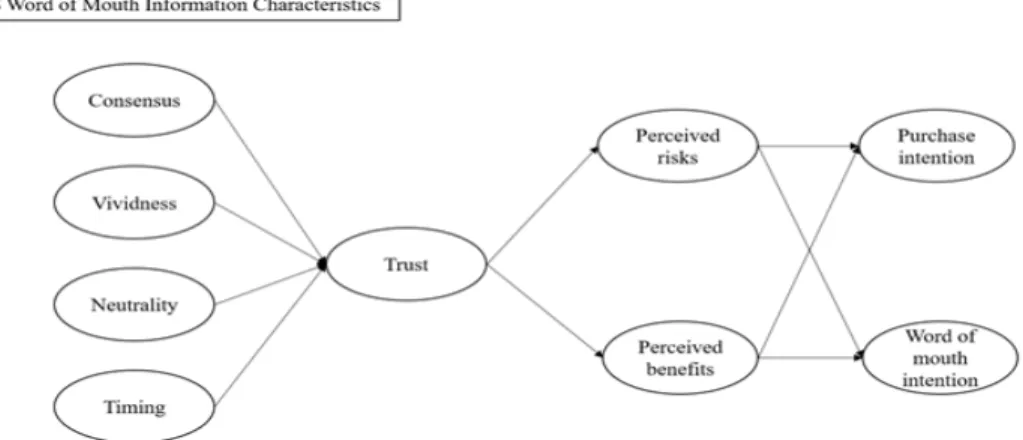
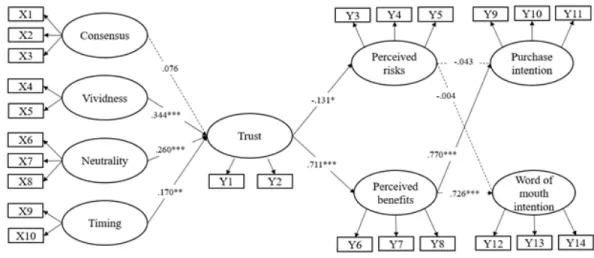
Results - SNS word of mouth information characteristics had significant effects on trust of restaurant product in the order of vividness, neutrality, and timing. Trust on restaurant product has significant effect on perceived risks (-) and perceived benefits (+) by SNS. While perceived benefits of restaurant product on SNS has effect on purchase intention, perceived risks of restaurant product on SNS does not affect purchase intention. Perceived benefits of restaurant product on SNS has significant effect on word of mouth intention, whereas perceived risks of restaurant product on SNS does not have significant effect on word of mouth intention.
Conclusions - As marketing through SNS can bring about a huge reduction effect in terms of marking cost, it can be utilized as an effective promotion by not only large restaurant corporations, but also small restaurants.
Keywords: SNS, Marketing, Trust, Purchase Intention, Word of Mouth Intention.
JEL Classifications: C80, D40, L60, M30.