Vol. 23, No. 8 (2013)
441
Synthesis of Yttria Stabilized Zirconia by Sol-gel Precipitation Using PEG and PVA as Stabilizing Agent
Bramhe Sachin N.*, Young Pil Lee*, Tuan Dung Nguyen* and Kim Taik-Nam* , ** †
*Department of Materials Science and Engineering, Graduate School of Pai Chai University, Daejeon 302-735, Korea
**Department of Information and Electronic Materials Engineering, Pai Chai University, Daejeon 302-735, Korea (Received June 27, 2013 : Received in revised form July 19, 2013 : Accepted August 8, 2013)
Abstract
There is increasing interest in zirconia as a dental material due to its aesthetics, as well as the exceptionally high fracture toughness and high strength that are on offer when it is alloyed with certain oxides like yttria. In recent years, manysolution based chemical synthesis methods have been reported for synthesis of zirconia, of which the sol-gel method is considered to be best. Here, we synthesize zirconia by a sol gel assisted precipitation method using either PEG or PVA as a stabilizing agent. Zirconia sol is first synthesized using the hydrothermal method. We used NaOH as the precipitating agent in this method because it is easy to remove from the final solution. Zirconium and yttrium salts are used as precursors and PEG or PVA are used as stabilizers to separate the metal ions. The resulting amorphous zirconia powder is calcined at 900 oC for 2 h to get crystallized zirconia. XRD analysis confirmed the partially stabilized zirconia synthesis in all the synthesized powders. SEM was taken to check the morphology of the powder synthesized using either PEG or PVA as a stabilizing agent and finally the transparency was calculated. The results confirmed that the powder synthesized with 10 % PVA as the stabilizing agent had highest percentage of transparency among all the synthesized powder.
Key words
zirconia, crystal structure, PEG, PVA, sol-gel, precipitation.1. Introduction
Zirconium is the transition element which reacts with oxygen to form zirconium dioxide(Zirconia) at 400
oC.
1)Zirconia(ZrO
2) has garnered wide scale attention due to its application in variety of fields.
2,3)This is due to the excellent electrical, optical, thermal and mechanical properties.
4-6)It has high elastic modulus, hardness, low friction coefficient, high boiling point, and is stable in chemically aggressive environment and resist detrition.
1,7,8)All these properties have helped ZrO
2gather attention as a dental material. Zirconium dioxide has three stable structures namely monoclinic, tetragonal and cubic
4)and it can also form orthorhombic structure.
6)The monoclinic structure is stable at temperature below 1170
oC, tetrago- nal structure is stable at temperature between 1170
oC- 2370
oC and cubic structure is stable at temperature above 2370
oC.
1,5)Excellent mechanical properties are shown by tetragonal phased ZrO
2.
9)When heated, ZrO
2can be transformed into tetragonal phase but when it is
brought back to room temperature, it again transforms into monoclinic form with small percentage of volume change. In a tetragonally stable zirconia block, for crack propagation energy has to be dissipated to transform ZrO
2from tetragonal to monoclinic form and to overcome the compressive stress caused due to volume change. This leads to improved mechanical strength of the material.
Because of this, ZrO
2is being studied as a dental material and there is a need of doping agents which can help in stabilization of tetragonal or cubic form at room temperature. Some examples of doping material that can be used are Y
2O
3, CaO, MgO, Ce
2O, Gd
2O
3, Sc
2O
3etc.
1,8,10,11)Studies have shown that 8 mol% yttria helps in stabili- zation of ZrO
2in cubic form, whereas 3 mol% yttria helps in stabilization of ZrO
2in tetragonal form.
2,10)There are a number of methods by which yttria stabilized ZrO
2can be synthesized like sol-gel, hydrothermal synthesis, precipitation, thermal decomposition, etc.
1,2,12)Sol-gel method is considered to be the best method for this syn-
†
Corresponding author
E-Mail : [email protected] (T.-N. Kim, Pai Chai Univ.)
© Materials Research Society of Korea, All rights reserved.
This is an Open-Access article distributed under the terms of the Creative Commons Attribution Non-Commercial License (http://creative-
commons.org/licenses/by-nc/3.0) which permits unrestricted non-commercial use, distribution, and reproduction in any medium, provided the
original work is properly cited.
thesis. Sol-gel method helps in controlling the porosity
2)thus also helping in controlling the translucency. In the present study, yttria stabilized ZrO
2is synthesized by combining sol-gel method with precipitation method. We have used polyethylene glycol and polyvinyl alcohol in the process as a stabilizing agent. The long chains of polymer make sure that the metal ions are homogenously distributed and do not aggregate or precipitate in the solution.
13)The precursor used is inorganic zirconium salt which is relatively inexpensive and insensitive to moisture.
7)2. Experimental
3 mol% yttria stabilized ZrO
2was synthesized by using zirconium chloride octahydrate(Junsei, Japan) and yttrium chloride(Aldrich, USA) as precursors. ZrO
2was synthe- sized with a combination of sol-gel and precipitation methods. The process is depicted in Fig. 1. First 12.89 g ZrOCl
2. 8H
2O and 0.36 g YCl3.6H2O are added to 40 ml D.I. water and autoclaved at 180
oC for 24h. After bring- ing the solution to room temperature, supernatant was dis- carded and mixture solution of 1 N NaOH and stabilizing agent was added to the precipitate along with mild stirring and heating at 70
oC. As shown in the figure, the experiments were performed either by using PEG or PVA as stabilizing agent. The residual Cl
−ions present in the precipitate from the precursors have to be removed from the final product. To this end the precipitate was washed four times with water and twice with absolute ethanol.
The resulting precipitation was dried in the oven at 80
oC overnight and finally calcined at 900
oC for 2 h in a box furnace.
The ZrO
2powder thus synthesized was characterized using X-ray diffraction, Scanning electron microscopy and finally transparency of each sample was determined.
Crystal structure was determined by X-ray Diffraction (XRD, CuK α1 radiation (λ = 0.15406 nm), D1w, Shimadzu, Japan) over the range of 20
oto 80
oat a scan rate of 2
o/ min. SEM images were taken using SEM Hitachi S-4800 model. For transparency evaluation samples were sent to Dentium Co. Ltd., South Korea.
3. Result and Discussion
Zirconia, at room temperature, can be in purely mono- clinic form, can be synthesized in purely tetragonal form or it can have monoclinic and tetragonal crystal structure both.
1,5,11)ZrO
2is mechanically stronger and has illustrious application when its crystal structure is a combination of tetragonal and monoclinic.
9)This type of material is called as partially stabilized zirconia(PSZ). The tetragonal to monoclinic transformation imparts mechanical strength to the material. During crack propagation in a PSZ material,
energy is required to transform tetragonal crystal structure
into monoclinic crystal structure. This transformation is
accompanied with a volume increase by approximately
4 %. Due to this volume increase, a compressive stress is
developed near the crack. During crack propagation,
Fig. 1. Schematic representation of steps followed for synthesis of
zirconia.
energy is dissipated in transformation from tetragonal to monoclinic as well as to overcome the compressive stress.
Thus it increases the strength of the material.
ZrO
2was synthesized using co-precipitation and sol-gel method. When the precursors are dissolved in D.I. water, the pH of the solution becomes highly acidic due to the Cl
−ions. When NaOH is added the pH slowly increases and in the process ZrO
2, which is insoluble in water, precipitates. We think that during this process NaCl is also formed. This NaCl can be withdrawn by washing with water. When we heat the solution again, DI water starts to evaporate. Due to this the viscosity of the solution increases and it turns into gel. This gel is then dried overnight and finally calcined at 900
oC.
The molar concentration of ZrO
2used earlier by other groups is generally very low(< 0.5 M). Here we have tried the synthesis with concentration of 1 molar. We have synthesized ZrO
2in two groups. In one group we have used PEG as a stabilizing agent for the synthesized
ZrO
2and in the other group we have used PVA as a stabilizing agent. We have studied the difference in transparency of both groups.
3.1 XRD measurement
X-ray diffraction pattern was studied to analyse the crystal structure of the synthesized ZrO
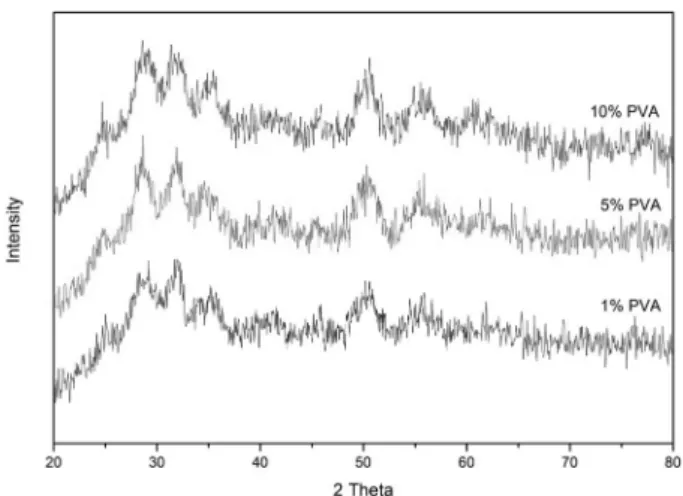
2powder. XRD analysis of both groups shows that the ZrO
2is in amor- phous form before calcination as can be seen in Fig. 2 and 3. And after calcination at 900
oC for 2 h, ZrO
2has a combination of both monoclinic and tetragonal structure.
This is true for all the synthesized samples as can be seen in Fig. 4 and 5. Thus XRD analysis confirms the synthesis of partially stabilized ZrO
2in all the samples.
The residual chloride ions present after purification step pose a problem in obtaining pure zirconia powder. These ions are difficult to remove completely which results in some excess peaks in the XRD pattern. These chloride
Fig. 2. XRD pattern of control sample without PEG or PVA and that of sample from group 1 with 0.01 M PEG and 0.1 M PEG, all showing amorphous nature before calcination.
Fig. 3. XRD pattern of sample from group 2 with 1 % , 5 % and 10
% PVA, all showing amorphous nature before calcination.
Fig. 4. XRD pattern of control sample without PEG or PVA and that of samples from group 1 with 0.01 M PEG and 0.1 M PEG, all showing monoclinic(M) and tetragonal(T) structure after calcination.
Fig. 5. XRD pattern of samples from group 2 with 1 % , 5 % and
10 % PVA, all showing monoclinic(M) and tetragonal(T) structure
after calcination.
ions are also believed to cause aggregation and thus in- crease the particle size. More extensive purification steps are needed to get completely rid of the said Cl
−ions.
3.2 Scanning Electron Microscopy
The sample morphology was studied by using SEM.
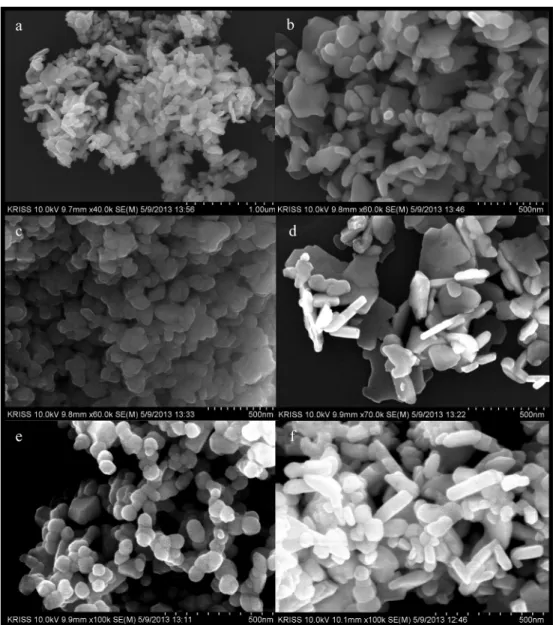
Morphology as seen for samples before calcination is shown in Fig. 6 and after calcination is shown in Fig. 7.
All the samples before calcination are amorphous in nature hence shows no effect of stabilizers, whereas the crystallized ZrO
2obtained after calcination show different morphology at different experimental conditions. The control sample containing neither PEG nor PVA as a stabilizing agent shows morphology ranging from ablated sphere to rods. This might be because no stabilizing agent is present, so the structure is free to grow in any
dimension. Sample with 0.01 M PEG also shows ablated spheres as well as rods. Also some plate like structure can be seen which shows that ZrO
2is not stabilized and aggregation takes place. Sample with 0.1 M Peg shows ablated spherical morphology with size of ~90 nm. Rod shaped morphology was seen in sample with 1 % and 10 % PVA and only spherical morphology with size
~70 nm was seen in sample stabilized with 5 % PVA. We believe, the structure of ZrO
2is stabilizing agent concen- tration dependent. More studies needs to be done to ascertain this phenomenon and this may even lead to different avenues for application of ZrO
2.
3.3 Transparency
Transparency is the property of being transparent or
allowing light to pass. If we have small sized adequately
Fig. 6. SEM image of zirconia control sample (a), zirconia synthesized with 0.01M PEG (b), 0.1M PEG (c), 1 % PVA (d), 5 % PVA (e)
and 10 % PVA (f) before calcination. All structures are amorphous in nature.
dispersed particles it would allow more light to pass through the block as opposed to aggregates which will block the incident light. Hence two conditions seems to be necessary for achieving greater transparency, first that the grain size should be low and second that the particles
should be adequately stabilized so as to oppose formation of aggregates. The transparency of each synthesized sample was as shown in Table 1. It can be seen that the sample synthesized using 10 % PVA as stabilizing agent has highest transparency(13.49 %) among the synthesized Fig. 7. SEM image of zirconia control sample (a), zirconia synthesized with 0.01 M PEG (b), 0.1 M PEG (c), 1 % PVA (d), 5 % PVA (e) and 10 % PVA (f) after calcination.
Table 1. Table showing thickness and diameter of the disks made to evaluate the transparency of zirconia along with the transparency observed.
Sample Composition Thickness(mm) Diameter(mm) Transparency(%)
Control 1 M NaOH + No PEG or PVA 1.18 ± 1.20 17.82 ± 17.81 6.10 ± 6.03
Group 1 Sample 1 1 M NaOH + 0.01M PEG 1.42 ± 1.41 18.87 ± 18.86 1.73 ± 1.96
Group 1 Sample 2 1 M NaOH + 0.1M PEG 1.37 ± 1.37 16.06 ± 16.08 8.90 ± 8.89
Group 2 Sample 1 1 M NaOH + 1 % PVA 1.28 ± 1.21 18.52 ± 18.56 3.88 ± 4.10
Group 2 Sample 2 1 M NaOH + 5 % PVA 1.15 ± 0.98 18.95 ± 18.90 7.12 ± 7.15
Group 2 Sample 3 1 M NaOH + 10 % PVA 1.21 ± 1.20 17.95 ± 18.03 13.49 ± 13.45
samples. This might be because the higher concentration of PVA helps in better stearic stabilization of synthesized ZrO
2. We believe that PEG is not able to stabilize ZrO
2as good as PVA, hence the lower transparency. Aggregates of ZrO
2blocks the light and hence allows less light to penetrate thus decreasing the transparency. A properly stabilized ZrO
2sample thus would increase the trans- parency as is observed in our results. Addition of small percentage of photocatalyst TiO
2could increase the trans- parency of ZrO
2. TiO
2has high diffraction index, shows strong light scattering and incident-light reflection capability.
Hence addition of TiO
2to the 10 % PVA sample could further increase the transparency.
4. Conclusion
We have synthesized ZrO
2with higher concentration of precursor material which was never tried before. The use of this higher concentration would save resources while synthesizing ZrO
2at larger amount. We have shown that the synthesis method applied, results in synthesis of partially stabilized ZrO
2. We then compared the trans- parency results of two groups where we have used PEG and PVA as stabilizing agent and we found that 10 % PVA gives better transparency among the other synthesized ZrO
2. There is a need to find other good stabilizing agents which would provide better stability and thus increase the transparency. Also, there is a need for extensive purification steps to obtain purified Zirconia without any excess ions. Further analysis needs to be done to ascertain the use of this synthesized zirconia as a dental material.
References
1. Antonio Díaz-Parralejo, Antonio Marias-Garcia, José
Sánchez-González, M. Ángeles Díaz-Díez and Eduardo M. Cuerda-Correa, J. Non-Crystalline Solids, 357, 1090 (2011).2. Zijun Zhang, Jiurong Liu, Fenglong Wang, Jing Kong and Xinzhen Wang, Ceram. Int., 37, 2549 (2011).
3. J. A. Wang, M. A. Valenzuela, J. Salmones, A. Vázquez, A. Garcia-Ruiz and X. Bokhimi, Catalysis Today, 68, 21 (2001).
4. Felora Heshmatpour and Reza Babadi Aghakhanpour, Powder Technol., 205, 193 (2011).
5. Javier Rivera De la Rosa, Aracely Hernandez, Fernando Rojas, Juan José Ledezma, Colloids and Surfaces A:
Physicochemical and Engineering Aspects, 315, 147 (2008).
6. Zeming Qi, Chaoshu Shi, Yaguang Wei, Zheng Wang, Tao Liu, Tiandou Hu, Zongyan Zhao and Fuli Li, J.
Phys.: Condens. Matter, 13, 11503 (2001).
7. Weimin Liu, Yunxia Chen, Chengfeng Ye, Pingyu Zhang Ceram. Int.l 28, 349 (2002)
8. X. Bokhimi, A. Morales, A. Garcia-Ruiz, T. D. Xiao, H.
Chen and P. R. Strutt, J. Solid State Chemistry, 142, 409 (1999).
9. Oleg Vasylvik and Yoshio Sakka, J. Am. Ceram. Soc., 84, 2489 (2001).
10. S. Salehi and M. H. Fathi, Ceram. Int., 36, 1659 (2010).
11. R. Ramamoorthy, D. Sundararaman and S. Ramasamy, Solid State Ionics, 123, 271 (1999).
12. Qibing Chang, Jian-er Zhou, Yongqing Wang and Guangyao Meng, Advanced Powder Technology, 21, 425 (2010).
13. Sang Jin Lee, Hyun-Kwuon Lee and Kyeong-Sik Cho J.
Ceram. Processing Research, 6, 85 (2005).