식물병연구
Res. Plant Dis. 15(3) : 217-221 (2009) Research in Plant Disease
©The Korean Society of Plant Pathology
발병 조건에 따른 fludioxonil의 상추 잿빛곰팡이병 방제효과
최경자*·장경수·최용호·김진철 한국화학연구원 산업바이오화학연구센터
Control Efficacy of a New Fungicide Fludioxonil on Lettuce Gray Mold According to Several Conditions
Gyung Ja Choi
*, Kyoung Soo Jang, Yong Ho Choi and Jin-Cheol Kim
Chemical Biotechnology Research Center, Korea Research Institute of Chemical Technology, Daejon 305-600, Korea
(Received on November 4, 2009; Accepted on November 11, 2009)
Fludioxonil is derived from the antifungal compound pyrrolnitrin produced by
Pseudomonas pyrrociniaand classified as a reduced-risk fungicide by the US EPA. The efficacy of fludioxonil for the control of lettuce gray mold caused by
Botrytis cinereawas evaluated under several conditions such as growth stages of host, inocu- lum concentrations, and amounts of potato dextrose broth (PDB) included in spore suspension of
B. cinerea. At 4-leaf stage of lettuce plants, fludioxonil applied at 2
µg/m
lwas more effective for the control of gray mold than at 5- and 6-leaf stages. However, fludioxonil at more than 10
µg/m
lprovided similar control activity in all growth stages of lettuce tested. The fungicide (10 and 50
µg/m
l) also gave excellent control of gray mold on let- tuce seedlings inoculated with spore suspensions of
B. cinerea(2.5
×10
5to 2
×10
6spores/m
l). But, control effi- cacy of fludioxonil (2
µg/m
l) was negatively correlated with inoculum concentration. Addition of PDB in spore suspension of
B. cinerearesulted in higher disease severity than non-treated control. By inoculating spore suspension including 0.5% PDB, the fungicide gave the most control activity on the disease, followed by 1% and 2% PDB. The results suggest that fludioxonil has potential to control gray mold of lettuce, but the fungicide at a concentration having moderate activity may represent low control efficacy on the disease under some conditions.
Keywords
:
Botrytis cinerea, Control activity, Fludioxonil,
In vivofungicidal activity, Inoculum concentration
Botrytis cinerea
Pers ex Fr
은거의모든작물에 잿빛곰팡이병을 일으키는 다범성 병원균으로
,
잿빛곰팡이병은노지 재배보다 비닐하우스와 같은 시설재배에서 그리고 온도가 낮고 습도가 높은 환경에서 많이 발생하여 경제 적으로 큰 피해를 주고 있다
(De Curtis
등, 1996).
이 병은 작물의 생육 중에 발생할 뿐만 아니라
4
oC
저온에서도 병이 진전하는 대표적인 저장병이다
.
잿빛곰팡이병을방제하기 위한 방법으로 습도를 낮게 하고 온도를 높이 는 등의경종적 방법이 있으나 이는비용과 밀접한 관계 가 있어 용이하지 않고
,
개발된 저항성 품종 또한 없어잿빛곰팡이병의 방제는 주로반복적인 살균제 처리에 의 존하고 있다
.
잿빛곰팡이병을방제하기위한살균제는작용기작과 화 합물 구조에 따라 크게 몇 가지 그룹으로 구분할 수 있 다
.
미세소관의 형성을 억제함으로써 세포분열을 저해하는 약제인
benomyl, carbendazim, thiophanate-methyl, thiabendazole
등의benzimidazole
계 살균제 그리고 작용메카니즘이 분명하지는 않은
iprodione, vinclozolin, procymidone
등의dicarboximide
계살균제, methionine
생합성을 저해하여 세포벽 분해효소의 분비를 억제하는
mepanipyrim
과pyrimethanil
등의anilinopyrimidine
살균제,
다작용점 약제인
sulphamide
계 살균제인dichlofluanid
와tolylfluanid
등이있다.
이들중benzimidazole
계살균제와dicarboximide
계 살균제는 작용점이 특이할 뿐만 아니라약제저항성 발현을 방지하기 위한관리노력 등이부족 하여같은계열의살균제를반복적으로살포함에따라전 세계적으로약제저항성 균이발생하게되었다
(Gullino
와*Corresponding author
Phone) +82-42-860-7434, Fax) +82-42-861-4913 Email) [email protected]
Garibaldi, 1986; Kim
등, 1993; Moorman
과Lease, 1992;
Staub
와Diriwaechter, 1986).
포장에서 저항성이 발생한살균제는 잿빛곰팡이병을 방제하기위하여 더 많은양의 살균제를살포하거나
,
다량을살포하여도만족할만한방제 효과를 얻지 못함으로 농약 오·남용의 원인이 되었 으며
,
잔류 및 인축 독성의문제를 유발하게 되었다.
오늘날
well-being
을 추구하는 시대적 조류에 따라 식물병을방제하기위하여잔류및인축독성이적은친환경 살 균제가 요구되고 있다
.
Fludioxonil
은fenpiclonil
과함께phenylpyrrole
살균제로서
,
Pseudomonas pyrrocinia가 생산하는 항균 물질인pyrrolnitrin
을리드화합물로하여합성한살균제이다(Fig.
1).
실험실 내에서Pyrrolnitrin
은다수의 곰팡이에 대하여우수한살균활성을나타내었으나
,
자연상태에서는광분해가 잘 되어 실제로 포장에서 식물병을 방제하고자 하 였을 때 낮은방제효과를 나타내었다
.
따라서 이를 모본으로하여 살균활성은유지하면서광분해에 취약한 단점 을개선함으로써경엽처리용잿빛곰팡이병살균제
fludioxonil
을개발할수있었다
.
미국Environmental Protection Agency (EPA)
에서는fludioxonil
을환경과인류에저독성인(reduced- risk)
살균제로 분류되고 있으며,
Penicillium 속,
Botrytis속
,
Monilinia속등에의한저장병 방제에사용가능한살균제로등록되었다
(EPA, 1998; Errampalli
등, 2005; Förster
등
, 2007; Zhang, 2007).
또한fludioxonil
는benzimidazole
살균제에 대하여 저항성인 Penicillium expansum에 대하
여 포자발아및 균사생장을 효과적으로억제하기도 한 다
(Errampalli, 2004; Rosslenbroich
와Stuebler, 2000).
본 실험에서는우리나라에서주로 신선채소로 이용되 고 있는 상추
(
Lactuca sativaL.)
의 잿빛곰팡이병을 방제하기 위한 살균제로
fludioxonil
을 선발하여,
상추 품종,
상추생육시기
,
전염원인 B. cinerea의포자농도그리고영양원
(potato dextrose broth)
농도 등이fludioxonil
의 상추 잿빛곰팡이병에대한 방제효과에어떠한 영향을 미치
는 지를조사하였다
.
재료 및 방법
상추의 재배. 품종실험을 제외한 모든 실험에서 상추 는권농종묘사로부터 구입한 선풍포찹적축면상추를온실 에서 재배하여 실험에사용하였다
.
원예용상토5
호(
부농사
)
가 담긴일회용 폿트(
직경4.5 cm)
에 상추 종자를 파종하고 온실
(25
±5
oC)
에서 재배하였다.
식물 생육시기에따른
fludioxonil
방제효과를 제외한 모든 실험은약3
주동안재배한
4
엽기상추유묘를실험에사용하였다.
상추품종에 따른
fludioxonil
의 방제효과는 선풍포찹적축면상추이외에도흑치마상추
(
대농종묘사)
와파워선적축면상추(
몬산토코리아사)
를 사용하여 온실에서 수행하였다.
사용약제 및처리. 상추잿빛곰팡이병방제효과를조 사하기 위하여
griseofulvin, kasugamycin, polyoxin B, polyoxorim,
그리고validamycin
등의천연물5
종과 신규살균제
fludioxonil
을 실험에 사용하였다. Griseofulvin (C
17H
17ClO
6,), kasugamycin(C
14H
25N
3O
9), polyoxin B (C
17H
25N
5O
13), polyoxorim(C
17H
23N
5O
14), validamycin (C
20H
35NO
13)
등의 천연물은95%
이상의 원제를 구입하여 실험에 사용하였다
.
그리고 살균제fludioxonil (C
12H
6F
2N
2O
2)
은20%
액상수화제인사파이어(
신젠타코리아사
)
를 시중에서구입하였다.
각 약제는 아세톤에 용해하고
Tween 20 250
µg/m
l 수용액에10%
가 되도록 첨가하였다
.
각실험을 위해준비한약제용액은상추유묘에흘러내릴 정도로 살포하여 약제처리를 하였다
.
병원균 및발병. 잿빛곰팡이병균
(
B. cinerea)
은한국화학연구원에서 분리하여 실험에 사용해온
NY76
균주를사용하였다
.
B. cinerea는potato dextrose agar
배지(PDA, Difco
®, Beckton and Dickinson
사)
중앙에 균사조각을 올려놓고
20
oC
에서5
일동안암상태로배양한 후,
광/
암 인큐베이터로이동하여 하루에
16
시간동안광을조사하면서 포자형성을 유도하였다
.
약제를처리한상추유묘는
1
일동안풍건시킨후에병원균의 포자현탁액을분무하여 접종하였다
.
멸균하여 준비한
potato dextrose broth
배지(PDB, Difco
®, Beckton and Dickinson
사)
로PDA
배지에형성된 포자를수확한 후가제로 걸러서 균사체를 제거한 후 광학현미경 하에서 포 자의수를조사하였다
.
접종원포자농도에따른fludioxonil
방제효과 실험을 제외한 모든실험에서접종원의 포자현 탁액 농도는
5
×10
5개/m
l로조정하여 실험에 사용하였다.
그리고 접종원에 첨가된 영양분
PDB
의 양에 따른fludioxonil
의 방제효과를 실험하기 위하여, PDB
의 농도Fig. 1. Chemical structures of pyrrolnitrin (A) and fludioxonil (B).
를
2 mg/m
l, 5 mg/m
l, 10 mg/m
l,
그리고20 mg/m
l로멸균하여준비한후
,
각각의용액으로 B. cinerea의포자를 수확하고 접종하였다
.
접종한 상추유묘는
20
oC
습실상에서3~4
일동안보관한 후
,
병반면적율을달관조사 하였다.
모든실험은3
반복으로
2
회 실시하였고,
결과는2
회 실험의 평균값을 나타냈으며
,
방제효과는다음과같은식에 따라계산하였다.
방제가
(%)=(1
−처리구의병반면적율/
무처리구의병반면적율
)
×100
결과 및 고찰
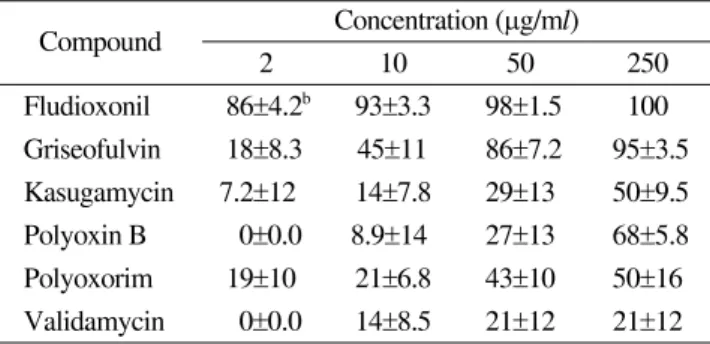
화합물의잿빛곰팡이병방제효과. 실험에사용한천연 물
5
종(griseofulvin, kasugamycin, polyoxin B, polyoxorim, validamycin)
과살균제fludioxonil
의잿빛곰팡이병방제효과를실험한 결과
, fludioxonil
과griseofulvin
은 우수한 방제효과를 나타냈으며
, kasugamycin, polyoxin B
그리고polyoxorim
은 중간 정도의 살균 활성을보였다(Table 1).
특히
fludioxonil
은2
µg/m
l 처리에 의해서도 잿빛곰팡이 병을86%
방제하였다.
그러나validamycin
은250
µg/m
l처리구에서도잿빛곰팡이병에대하여거의방제효과를나 타내지않았다
.
이들결과로부터발병조건에따른약제의상추잿빛곰팡이병방제효과를실험하기위하여
fludioxonil
을 선발하였다
.
상추 품종에 따른 fludioxonil의 방제효과. 실험에 사 용한흑치마상추
,
파워선적축면상추,
선풍포찹적축면상추각 품종의 무처리구 병반면적율은각각
48%, 55%, 54%
로 잿빛곰팡이병에 대한 품종 간의 감수성은 유의성 있 는 차이가 없었다
.
그리고 각 상추 품종에 처리한 모든fludioxonil
처리구에서잿빛곰팡이병의병반면적율에는유의성 있는 차이를 찾아 볼 수 없어 상추 품종에 따른
fludioxonil
의잿빛곰팡이병 방제효과에는 차이가 없음을알 수 있었다
(Table 2).
이는 개발된 상추 품종 중 잿빛곰팡이병 저항성 품종이 없기 때문이다
.
상추는1990
년이후에야 비로소 일부 종자회사가 품종 개발에 대한 필 요성을인식하면서품종육성이시작되었으며
, 1998
년종자산업법 제정을 통한 품종보호제도가 도입되면서 적극
적인 품종 개발이 활기를 띠게 되었다
(
박 등, 2008).
하지만잿빛곰팡이병에 대한저항성 유전자원이 없어아직 잿빛곰팡이병에대한저항성품종은 없는실정이다
.
따라서 저항성 상추 품종 개발을 위하여 잿빛곰팡이병에 대 한저항성유전자원을확보하기위한노력이요구되고있다
.
상추의생육시기에 따른fludioxonil의방제효과.
4
엽기
, 5
엽기그리고6
엽기상추에fludioxonil
을살포하여잿빛곰팡이병 방제효과를 실험하였다
. 4
엽기, 5
엽기, 6
엽기상추유묘의무처리구병반면적율은각각
58%, 60%, 58%
로 상추의 생육 시기에 따른 잿빛곰팡이병 발생은 거의 차이가 없었다
. Fludioxonil 50
µg/m
l 처리구는 상추잿빛 곰팡이병에 대한 완벽한방제효과를 그리고10
µg/m
l 처리구는
85%
이상의 방제가를 나타내어상추의 생육시기에따른잿빛곰팡이병에대한방제효과는거의차이가없 었다
(Table 3).
반면에fludioxonil 2
µg/m
l처리구에서는상 Table 1. In vivo antifungal activity of several compounds onlettuce gray molda
Compound Concentration (µg/ml)
2 10 50 250
Fludioxonil 86±4.2b 93±3.3 98±1.5 100 Griseofulvin 18±8.3 45±11 86±7.2 95±3.5 Kasugamycin 7.2±12 14±7.8 29±13 50±9.5 Polyoxin B 0±0.0 8.9±14 27±13 68±5.8 Polyoxorim 19±10 21±6.8 43±10 50±16 Validamycin 0±0.0 14±8.5 21±12 21±12
aDisease severity of untreated control was 68%.
bControl value (%).
Table 2. Efficacy of fludioxonil for control of gray mold in three lettuce cultivarsa
(µg/ml)Con.
Lettuce cultivar Hukchima Powersunjuk-
chukmyun Sunpungpochop 0.4 0.0±9.2b 2.0±3.0 3.0±6.5
2 33±8.3 25±11 36±15 10 93±5.0 99±1.0 95±3.1
50 100 100 100
aDisease severity of untreated controls was 48% for Hukchima, 55%
for Powersunjukchukmyun, and 54% for Sunpungpochop.
bControl value (%).
Table 3. Control activity of fludioxonil on gray mold of lettuce at several growth stagesa
(µg/ml)Con. Growth stage of lettuce plants 4-Leaf stage 5-Leaf stage 6-Leaf stage 0.4 3.0±9.9 0.0±0.0 6.0±0.0
2 6 0±9.9 49±0.0 41±5.4 10 87±4.3 90±6.2 88±7.6
50 100 100 100
aDisease severity of untreated controls was 58% for 4-leaf stage, 60%
for 5-leaf stage and 58% for 6-leaf stage.
bControl value (%).
추생육시기에따라방제효과의차이를 나타냈으며
, 4, 5, 6
엽기로상추가커질수록fludioxonil
의방제효과는낮아졌다. Bennet
등(1994)
은 Bremia lactucae에 대하여저항성을 보이는 상추 품종에서 과민성 반응과 관련이 있는phytoalexin
인lettucenin A
을 분리하고 보고하였다.
이phytolalexin
은 B. cinerea에대해서도상추잎에축적되는데
,
저항성반응과감수성반응을보이는잎에서lettucenin
A
함량은 뚜렷한 차이가 있었다(Bestwick
등, 1995;
Takasugi
등, 1985).
따라서 실험한 선풍포찹상추의 경우에 어린잎에
lettucerin A
와 같은 항균물질 등 병 발생억제에 기여하는 요인들이 병 발생을 억제할 정도의 양으 로존재하지는않지만이들이
fludioxonil
과협력함으로써잿빛곰팡이병의 방제효과의증진에 기여하였으리라 추정 되었다
.
접종원포자농도에따른fludioxonil의방제효과. 상추
유묘에
fludioxonil
을 살포하고 잿빛곰팡이병균을 각각2.5
×10
5개/m
l, 5.0
×10
5개/m
l, 1.0
×10
6개/m
l,
그리고2.0
×10
6개
/m
l로 접종하여fludioxonil
의 잿빛곰팡이병에 대한 방제효과를조사하였다
.
상추잿빛곰팡이병에대한fludioxonil
의 방제효과는접종원 농도가 증가함에 따라감소하였으 며
,
그차이는fludioxonil 2
µg/m
l 농도 처리구에서 가장 컸다(Table 4).
하지만fludioxonil 50
µg/m
l 처리구에서는 접종원 농도가10
배 증가하여도 잿빛곰팡이병을 완벽하게방제하였다
.
살균제를처리하지않은무처리구의병반면적율은접종원농도
2.5
×10
5개/m
l, 5.0
×10
5개/m
l, 1.0
×10
6개
/m
l그리고2.0
×10
6개/m
l에따라각각58%, 55%, 48%, 58%
의 병반면적율을보여접종3
일 후병조사에서 접종원 농도에 따른 병 발생은 큰 차이가 없었다
.
이와달리김등
(1991)
은오이탄저병균의접종농도가10
4개/m
l,10
5개/m
l, 10
6개/m
l로 증가함에 따라 살균제benomyl
의방제효과는크게감소하였으며,
특히benomyl
100
µg/m
l처리는10
4과10
5개/m
l 접종농도에서는95%
이상의높은방제효과를나타내었지만
10
6개/m
l접종구에서 는15%
의 방제가를 보일 뿐이라고 보고하였다.
따라서약제의방제효과실험에서접종원농도는아주중요한인 자라고 주장하였으나
,
우리의 상추 잿빛곰팡이병에 대한fludioxonil
의방제효과 결과에서는접종원농도가 증가함에따라방제효과가다소감소하지만결정적요인으로작 용하지는 않았다
.
영양액농도에따른 fludioxonil의방제효과. 잿빛곰팡
이병균 B. cinerea는거의 모든식물에 병을일으켜 경제
적으로 큰피해를 입히는식물병원균이나
,
부생성이강하여 직접열매를 침입하기보다시든꽃과같은 죽은조직 을 감염한후에 건전한 조직에 병을일으킨다
.
그러므로인위적으로식물에잿빛곰팡이병을발생시킬경우에는포 자현탁액에
glutamine, glucose,
아미노산, KH
2PO
4와MgSO
4 무기염류 등의 영양분을 첨가해야 한다(
손 등,
2001; Hoffland
등, 1999).
본 실험에서는 접종원의 현탁액을 준비하는데 사용하
는
PDB
의 농도에 따른fludioxonil
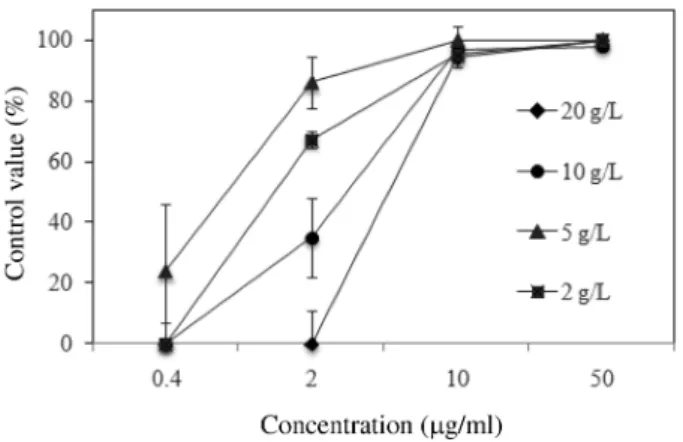
의 방제효과를 실험한결과
, PDB
양을2 mg/m
l에서20 mg/m
l로 증가함에따라무처리구의병반면적율은증가하였으며
, fludioxonil 0.4
µg/
m
l부터10
µg/m
l처리구의방제효과도감소하였다(Fig. 2).
하지만
50
µg/m
l 농도로 살포한fludioxonil
은 영양분 함량에 관계없이 모든 처리구에서
98%
이상의 우수한 방제효과를 보였다
.
이상의결과로부터 저독성살균제인
fludioxonil
은상추잿빛곰팡이병을 효과적으로 방제할 수 있는 살균제임을
알수있었으며
,
중간정도의활성을나타내는fludioxonil
처리농도에서는 발병조건에 따라방제효과가 변화할 수 있으리라 예상되었다
.
Table 4. Control of fludioxonil on the development of gray mold in lettuce plants inoculated with spore suspension of Botrytis cinerea at various concentrationsa
(µg/ml)Con. Spore concentration (×106 spores/ml) 0.25 0.50 1.0 2.0 0.4 4.0±12b 5.0±6.4 0.0±7.4 0.0±0.0
2 43±6.1 32±6.4 32±7.4 17±7.9 10 97±0.0 97±3.9 92±3.0 94±1.6 50 100 100 100 100
aDisease severity of untreated controls was 58% for 2.5×10⁵ spores/
ml, 55% for 5.0×10⁵ spores/ml, 48% for 1.0×10⁶ spores/ml and 58%
for 2.0×10⁶ spores/ml.
bControl value (%).
Fig. 2. Effect of potato dextrose broth (PDB) on efficacy of flu- dioxonil for control of lettuce gray mold disease. The nutrient was added in inoculum at several concentrations. And disease severity of untreated controls was 13% for 2 mg/ml PDB, 42% for 5 mg/
ml PDB, 38% for 10 mg/ml, and 53% for 20 mg/ml PDB.
요 약
Fludioxonil
은미국EPA
에의해저독성(reduced-risk)
살균제로분류되었으며
,
이살균제는Pseudomonas pyrrocinia가 생산하는 항균 물질인
pyrrolnitrin
을 선도 물질로 하여합성하였다
.
본연구에서는상추품종,
기주식물의생육 시기
,
Botrytis cinerea 포자농도,
접종원의 영양분 농도등의발병조건에 따른
fludioxonil
의상추잿빛곰팡이병에대한방제효과를온실에서실험하였다
.
상추의생육시기에 따른
fludioxonil
방제효과를실험한결과, 2
µg/m
l처리구는 어린유묘에서 잿빛곰팡이병방제효과가더 높 았으나
, 10
µg/m
l 이상농도에서는 생육 시기에 따른 방 제효과의 차이는 거의 없었다.
또한fludioxonil 10
µg/m
l이상 농도처리구는 B. cinerea의 포자농도
(2.5
×10
개/m
l부터
2
×10
6 개/m
l까지)
에관계없이모두우수한방제효과를나타냈다
.
반면에fludioxonil 2
µg/m
l은접종원의포자 농도가 높을수록낮은방제효과를보였다.
그리고영양분농도에 따른
fludioxonil
의잿빛곰팡이병방제효과를실험한 결과
, potato dextrose broth
의 농도가 낮을수록fludioxonil
은 상추잿빛곰팡이병에 대한높은방제효과를나타냈다
.
이상의 결과로부터 살균제fludioxonil
은 상추잿빛곰팡이병에 대한효과적인 살균제임을알 수있었으 며
,
다만 낮은 농도에서는 발병 조건에 따라 다소 낮은방제효과를 나타낼 수 있을 것이다
.
감사의 글
본 연구는 농촌진흥청 공동연구사업
(
과제번호: 200901OFT102966165
호)
의지원에의해이루어진것이다.
참고문헌
김흥태, 정영륜, 조광연. 1991. 오이탄저병에대한 bennomyl의 억제효과에영향을미치는요인. 한국식물병리학회지 7: 153- 158.
박효근등 20인. 2008. 한국채소종자산업발달사. 서울대학교출
판부. 607 pp.
손지희, 이재필, 김철승, 임은경, 송주희, 김현주, 박현철, 문병 주. 2001. 토마토쥬스와 KH2PO4가Botrytis cinerea LVF12
분생포자의토마토감염에미치는영향. 식물병연구 7: 134- Bennett, M. H., Gallagher, M. D. S., Bestwick, C. S., Rossiter, J.139.
T. and Mansfield, J. W. 1994. The phytoalexin response of lettuce to challenge by Botrytis cinerea, Bremia lactucae and Pseudomonas syringae pv. phaseolicola. Physiol. Mol. Plant Pathol. 44: 321-333.
Bestwick, L., Bennett, N. H., Mansfield, J. W. and Rossiter, J. T.
1995. Accumulation of the phytoalexin lettucenin A and changes in 3-hydroxy-3-methylglutaryl coenzyme a reductase activity in lettuce seedlings with red spot disorder.
Phytochemistry 39: 775-777.
De Curtis, F., Torriani, S., Rossi, E. and De Cicco, V. 1996.
Selection and use of Metschnikowia pulcherrima as a biological control agent for postharvest rots of peaches and table grapes. Ann. Microbiol. Enzimol. 46: 45-55.
Errampalli, D. 2004. Effect of fludioxonil on germination and growth of Penicillium expansum and decay in apple cvs.
Empire and Gala. Crop Prot. 23: 811-817.
Errampalli, D., Northover, J., Skog, L. and Brubacher, N. R. 2005.
Control of blue mold (Penicillium expansum) by fludioxonil in apples (cv Empire) under controlled atmosphere and cold storage conditions. Pest Manag. Sci. 61: 591-596.
Environmental Protection Agency (EPA). 1998. General overview: reduced-risk pesticide program. Environ, Prot.
Agency Off. Pestic. Programs, Staff Background. Paper 2-4.
Förster, H., Driever, G. F., Thompson, D. C. and Adaskaveg, J. E.
2007. Postharvest decay management for stone fruit crops in California using the “reduced-risk” fungicides fludioxonil and fenheximid. Plant Dis. 91: 209-215.
Gullino, M. L. and Garibaldi, A. 1986. Fungicide resistance monitoring as an aid to tomato grey mould management. Proc.
Br. Crop Prot. Conf. 2: 499-505.
Hoffland, E., van Beusichem, M. L. and Jeger, M. J. 1999.
Nitrogen availability and susceptibility of tomato leaves to Botrytis cinerea. Plant and Soil 210: 263-272.
Kim, B. S., Choi, G. J. and Cho, K. Y. 1993. Responses to several fungicides of Botrytis cinerea isolates resistant to benzimidazole and dicarboximide fungicides. Kor. J. Plant Pathol. 9: 104-111.
Moorman, G. W. and Lease, R. T. 1992. Benzimidazole- and dicarboximide-resistant Botrytis cinerea from Pennsylvania greenhouses. Plant Dis. 76: 477-480.
Mueller, D. S., Bradley, C. A., Grau, C. R., Gaska, J. M., Kurle, J.
E. and Pedersen, W. L. 2004. Application of thiophanate- methyl at different host growth stages for management of sclerotinia stem rot in soybean. Crop Prot. 23: 983-988.
Rosslenbroich, H.-J. and Stuebler, D. 2000. Botrytis cinerea- history of chemical control and novel fungicides for its management. Crop Prot. 19: 557-561.
Staub, T. and Diriwaechter, G. 1986. Status and handling of fungicide resistance in pathogens of grapevine. Proc. Br. Crop Prot. Conf. 2: 771-780.
Takasugi, M., Okinaka, S., Katsui, N., Masamune, T., Shirata, A.
and Ohuchi, M. 1985. Isolation and structure of lettucenin A a novel guaianolide phytoalexin from Lactuca sativa var.
capitula (Compositae). Chem. Commun. 10: 621-622.
Zhang, J. 2007. The potential of a new fungicide fludioxonil for stem-end rot and green mold control on Florida citrus fruit.
Postharvest Biol. Technol. 46: 262-270.