Received: November 3, 2020 Revised: November 30, 2020 Accepted: December 4, 2020 Trauma and InJury
Correspondence to In Ho Han, M.D., Ph.D.
Department of Neurosurgery, Pusan National University Hospital, 179 Gudeok- ro, Seo-gu, Busan 49241, Korea Tel: +82-51-240-7257 Fax: +82-51-244-0282 E-mail: [email protected]
*SY and HJC contributed equally as first authors.
associated Injuries in Spine Trauma Patients: a Single-Center Experience
Seunghan Yu, M.D.*, Hyuk Jin Choi, M.D.*, Jung Hwan Lee, M.D., Byung Chul Kim, M.D., Mahnjeong Ha, M.D., In Ho Han, M.D., Ph.D.
Department of Neurosurgery, Medical Research Institute, Pusan National University Hospital, Busan, Korea
Purpose: The purpose of this study was to determine the incidence and characteristics of associated injuries in patients with spine trauma.
methods: Data of 3,920 consecutive patients admitted to a regional trauma center during a 3-year period were analyzed retrospectively.
results: Of the 3,920 patients who were admitted to the trauma center during the 3-year study period, 389 (9.9%) had major spinal injuries. Among these 389 patients, 303 (77.9%) had associated injuries outside the spine. The most common body region of associated injuries was the extremities or pelvis (194 cases, 49.4%), followed by the chest (154 cases, 39.6%) and face (127 cases, 32.6%). Of these 303 patients, 149 (64%) had associated injuries that required surgical treatment such as laparotomy or internal fixa- tion. Associated injuries were more common in patients with lumbar injuries (93.3%) or multiple spinal injuries (100%) than in those with lower cervical injuries (67.4%). There was a significant correlation between the location of the spinal injury and the body re- gion of the associated injury. However, distant associated injuries were also common.
Conclusions: Associated injuries were very common in spinal injury patients. Based on demographic groups, the trauma mechanism, and the location of spinal injury, an asso- ciated injury should be suspected until proven otherwise. Using a multidisciplinary and integrated approach to treat trauma victims is of the paramount importance.
Keywords: Spinal injuries; Multiple trauma; Trauma centers
INTRODUCTION
Spinal cord injuries (SCI) have devastating consequences for patients and society. De- spite various efforts, the incidence and in-hospital mortality of SCI remain high, and their prevalence is increasing [1]. Considering the anatomical location of the spinal
associated Injuries in Spine Trauma Patients: a Single-Center Experience
Seunghan Yu, M.D.*, Hyuk Jin Choi, M.D.*, Jung Hwan Lee, M.D., Byung Chul Kim, M.D., Mahnjeong Ha, M.D., In Ho Han, M.D., Ph.D.
Department of Neurosurgery, Medical Research Institute, Pusan National University Hospital, Busan, Korea
Purpose: The purpose of this study was to determine the incidence and characteristics of associated injuries in patients with spine trauma.
methods: Data of 3,920 consecutive patients admitted to a regional trauma center during a 3-year period were analyzed retrospectively.
results: Of the 3,920 patients who were admitted to the trauma center during the 3-year study period, 389 (9.9%) had major spinal injuries. Among these 389 patients, 303 (77.9%) had associated injuries outside the spine. The most common body region of associated injuries was the extremities or pelvis (194 cases, 49.4%), followed by the chest (154 cases, 39.6%) and face (127 cases, 32.6%). Of these 303 patients, 149 (64%) had associated injuries that required surgical treatment such as laparotomy or internal fixa- tion. Associated injuries were more common in patients with lumbar injuries (93.3%) or multiple spinal injuries (100%) than in those with lower cervical injuries (67.4%). There was a significant correlation between the location of the spinal injury and the body re- gion of the associated injury. However, distant associated injuries were also common.
Conclusions: Associated injuries were very common in spinal injury patients. Based on demographic groups, the trauma mechanism, and the location of spinal injury, an asso- ciated injury should be suspected until proven otherwise. Using a multidisciplinary and integrated approach to treat trauma victims is of the paramount importance.
Keywords: Spinal injuries; Multiple trauma; Trauma centers
column and the nature of the usual injury mechanisms, including traffic accidents and falls, one might expect multiple accompanying injuries. Nevertheless, the litera- ture usually deals with spine trauma in isolation [2]. It is important for spine surgeons to recognize that patients could have injuries in other parts of the body in addition to the spine. Conversely, it is also important for trauma surgeons to understand that injuries concurrent with spi- nal trauma might not show typical manifestations due to pain or sensory impairment.
The purpose of this study was to determine the inci- dence and characteristics of associated injuries in patients with spine trauma. The findings could be useful for un- derstanding the nature of spine trauma, and may have implications for providing better care for spine trauma in polytrauma.
METHODS
Data collection
Data from 3,920 consecutive patients who were admitted to a regional trauma center of Pusan National University Hospital between January 1, 2017 and December 31, 2019 were reviewed retrospectively. Of these patients, 389 had major spinal injuries. Epidemiological and physiological data were obtained from the Korean Trauma Data Base registry, along with neurological and prognostic data from patients’ medical records. This study was approved by the Institutional Review Board (IRB No. H-2011-009- 096).
Definition and measures
Major spine injury was defined as a traumatic injury to the spinal column, including fracture, subluxation, dislocation, and neural damage, that required surgical treatment. Minor injuries such as soft tissue injuries and simple fractures were excluded in accordance with the purpose of this study.
Associated injuries were evaluated by the Revised Trau- ma Score (RTS) for a physiological analysis, along with the Abbreviated Injury Scale and Injury Severity Score (ISS) for an anatomical analysis. In addition to presence of associated injuries, the necessity of common surgical
procedures for associated injuries was investigated.
The spinal injury level was analyzed using the Meyer classification [3]. Minor injuries were excluded. Patients with multiple-level spinal injuries were described accord- ingly. Neurological function was assessed using the Amer- ican Spinal Injury Association (ASIA) Impairment Scale at the time of injury and at 6 months after the injury.
Statistical method
Univariate analysis was performed using logistic regres- sion to compare differences according to sex, age group, the mechanism of injury, and initial neurological status.
Odds ratios and their 95% confidence intervals were also calculated for the same purpose. The chi-square and Fish- er exact tests were employed to analyze the location of spinal injuries, neurological recovery, and the presence of associated injuries. Correlations between various outcome factors and severity parameters were examined using Spearman rank correlation analysis. All statistical analyses were conducted using R version 3.6.2 for Windows. P-val- ues of less than 0.05 were considered to indicate statistical significance.
RESULTS
Of 3,920 patients who were admitted to the trauma cen- ter during a 3-year period, 389 (9.9%) had major spinal injuries. Among these 389 patients, 303 (77.9%) had asso- ciated injuries. The most common body region of the as- sociated injuries was the extremities and pelvis (194 cases, 49.4%), followed by the chest (154 cases, 39.6%) and face (127 cases, 32.6%). Of the 303 patients with associated injuries, 149 (64%) required surgical treatment such as laparotomy or internal fixation. There was no statistically significant difference in the presence of associated injuries according to sex. However, young adults, patients who underwent high-energy falls, and neurologically intact patients showed higher probabilities of having associated injuries (Table 1).
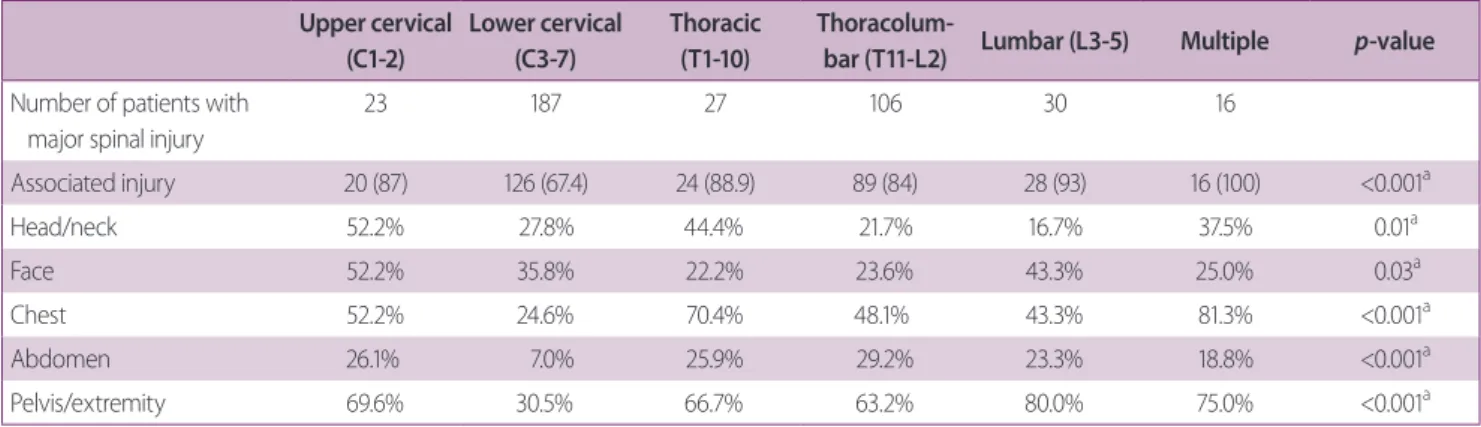
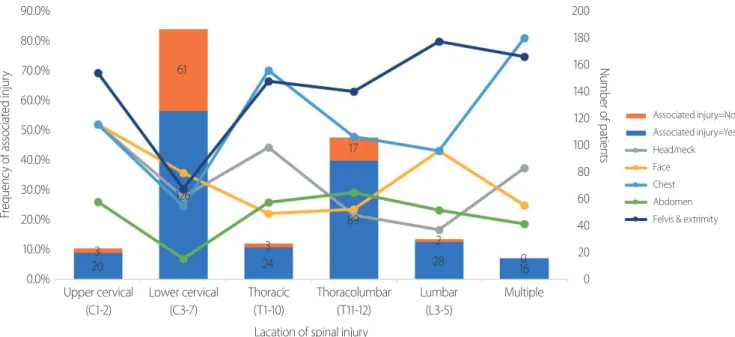
Associated injuries were more common in patients with lumbar injuries (93.3%) and multiple spinal injuries (100%) than in those with lower cervical injuries (67.4%) (Table 2). The location of the spinal injury was correlated
with the body region of the associated injury (Fig. 1).
Patients with associated injuries had a lower chance of having neurological deficits. However, there was no sig- nificant correlation between the presence of an associated
injury and neurological recovery (Table 3).
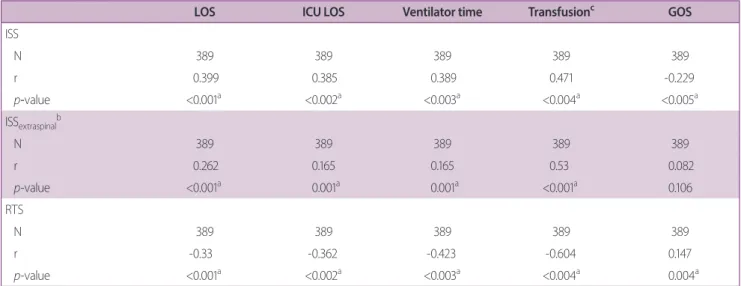
We evaluated outcome variables including length of stay (LOS), LOS in the intensive care unit (ICU LOS), du- ration of mechanical ventilation, total amount of packed
Table 1. Associated injuries according to injury characteristics Number of patients
with major spinal injury
Number of patients
with associated injury OR 95% CI p-value
Sex
Male 288 (74.0) 224 (26.1) Reference
Female 101 (26.0) 79 (73.9) 1.026 2.651–4.621 0.927
Age group
Young adult (<40) 80 (20.6) 72 (23.8) Reference
Middle age (40–65) 217 (55.8) 163 (53.8) 0.335 0.152–0.741 0.007a
Old age (>65) 92 (23.7) 68 (22.4) 0.315 0.132–0.748 0.009a
Etiology of injury
Car accident 82 (21.1) 60 (19.8) Reference
Motorcycle/bicycle 59 (15.2) 51 (16.8) 2.338 0.959–5.699 0.062
High energy fall 178 (45.8) 150 (49.5) 1.964 1.042–3.701 0.037a
Trivial fall 24 (6.2) 11 (3.6) 0.310 0.121–0.794 0.015a
Etc. 46 (11.8) 31 (10.2) 0.758 0.345–1.664 0.489
Initial neurologic status
Complete injury 56 (14.4) 43 (14.2) Reference
Incomplete injury 261 (67.1) 195 (64.4) 0.893 0.452–1.764 0.745
Intact 72 (18.5) 65 (21.5) 2.807 1.037–7.603 0.042a
Values are presented as number (%).
OR: odds ratio, CI: confidential interval.
aStatistically significant differences (p-value<0.05).
Table 2. Associated injuries according to the location of the spinal injury Upper cervical
(C1-2)
Lower cervical (C3-7)
Thoracic (T1-10)
Thoracolum-
bar (T11-L2) Lumbar (L3-5) Multiple p-value Number of patients with
major spinal injury
23 187 27 106 30 16
Associated injury 20 (87) 126 (67.4) 24 (88.9) 89 (84) 28 (93) 16 (100) <0.001a
Head/neck 52.2% 27.8% 44.4% 21.7% 16.7% 37.5% 0.01a
Face 52.2% 35.8% 22.2% 23.6% 43.3% 25.0% 0.03a
Chest 52.2% 24.6% 70.4% 48.1% 43.3% 81.3% <0.001a
Abdomen 26.1% 7.0% 25.9% 29.2% 23.3% 18.8% <0.001a
Pelvis/extremity 69.6% 30.5% 66.7% 63.2% 80.0% 75.0% <0.001a
Values are presented as number (%).
aStatistically significant differences (p-value<0.05).
cell transfusion, and Glasgow Outcome Scale (GOS) at 6 months after the injury. Both the ISS and RTS were closely correlated with most variables (Table 4). The ISS calculated without the spinal injury (ISSextraspinal) showed correlations with LOS and total amount of packed cell transfusion.
DISCUSSION
In this study, 77.9% of patients with major spinal in- juries had associated injuries. In previous studies, the prevalence of associated injuries has been reported to be
28.8–54.4% [2-5]. The large difference in the prevalence between the present study and previous studies might be due to the following factors: 1) in our study, only pa- tients with major spinal injuries were included; 2) since Pusan National University Hospital is a regional trauma center, more severely injured patients could be selected;
and 3) at our facility, computed tomography scans of the chest and abdomen are included in the routine protocol, making it possible to diagnose more associated injuries. A large portion of associated injuries (64%) needed surgical treatment, which required surgeons specializing in the corresponding body region. This finding underscores the need for a multidisciplinary approach to properly manage
Table 3. Correlation between neurological status and the presence of an associated injury
Associated injury (=YES) Associated injury (=NO) p-value
Number of patients 303 86
Patients with initial neurologic deficit 238 (78.5) 73 (21.8) 0.224
Recoverya 52 (21.8) 18 (22.8) 0.632
Full recoveryb 10 (4.2) 4 (5.1) 0.746
Values are presented as number (%).
ASIA: American Spinal Injury Association.
aAny positive change in ASIA impairment scale at 6-month after the injury.
bRecovery to ASIA impairment scale E at 6-month after the injury.
Fig. 1. Correlations between the location of the spinal injury and the body region of the associated injury.
Frequency of associated injury Number of patients
90.0%
80.0%
70.0%
60.0%
50.0%
40.0%
30.0%
20.0%
10.0%
0.0%
200 180 160 140 120 100 80 60 40 20 0
Associated injury=No Associated injury=Yes Head/neck Face Chest Abdomen Felvis & extrimity
Upper cervical (C1-2)
Lower cervical (C3-7)
Thoracic (T1-10)
Thoracolumbar (T11-12)
Lumbar (L3-5)
Multiple
Lacation of spinal injury 3
20
61
126
3 24
17
89
2
28 0
16
trauma patients, in addition to making a precise diagno- sis.
In our study, high-energy falls were the most common cause of injury, followed by car accidents and motorcycle accidents, consistent with previous epidemiological stud- ies [5-8]; this finding can be explained by the high-energy nature of these mechanisms. These causes of injury are also the most commonly associated with injuries outside the spine. Thus, special attention to the presence of asso- ciated injuries is needed when treating trauma patients with high-energy injury mechanisms.
Of the 389 patients who had major spinal injuries, 72 (18.5%) were initially neurologically intact; however, these patients were disproportionately likely to have asso- ciated injuries (Table 1). Saboe et al. [2] reported similar results. We hypothesize that in this group, damage is distributed to other systems of the body instead of being focused on the spinal column; thus, these patients are less likely to have cord injuries. However, further study is needed to support this hypothesis.
The most common site of spinal injuries was the lower cervical region (C3-7, 48.1%) and thoracolumbar junc- tion (T11-L2, 27.2%). However, associated injuries were more prevalent in patients with injuries at the thoraco-
lumbar junction (84%) than in those with injuries in the lower cervical region (67.4%). We suspect that injuries to the biomechanically more stable thoracolumbar area might reflect higher-energy mechanisms, increasing the likelihood of associated injuries. All cases with multiple locations of spinal injuries had associated injuries. Thus, physicians should pay special attention to associated in- juries when encountering patients with spinal injuries in more than one location. We also identified a significant correlation between the location of the spinal injury and the body region of the associated injury. The anatomical vicinity between spinal injuries and associated injuries has been studied before, especially for lumbar spine fractures and abdominal injuries [9-11]. However, in our study, abdominal injuries were more frequent in patients with upper cervical injuries (26.1%) than in those with lum- bar injuries (23.3%). Moreover, facial injuries were more common among patients with lumbar injuries (43.3%) than in those with lower cervical injuries (35.8%). There- fore, non-contiguous or remote injuries should also be suspected.
The ISS [12,13] and RTS [14] have been used widely to evaluate the severity of trauma victims. In our study, both parameters were closely correlated with various outcome
Table 4. Correlations between various outcome variables and injury severity parameters
LOS ICU LOS Ventilator time Transfusionc GOS
ISS
N 389 389 389 389 389
r 0.399 0.385 0.389 0.471 -0.229
p-value <0.001a <0.002a <0.003a <0.004a <0.005a
ISSextraspinalb
N 389 389 389 389 389
r 0.262 0.165 0.165 0.53 0.082
p-value <0.001a 0.001a 0.001a <0.001a 0.106
RTS
N 389 389 389 389 389
r -0.33 -0.362 -0.423 -0.604 0.147
p-value <0.001a <0.002a <0.003a <0.004a 0.004a
LOS: length of stay, GOS: Glasgow Outcome Scale, ISS: injury severity score, RTS: revised trauma scale.
aStatistically significant differences (p-value<0.05).
bISS score calculated without spinal injury.
cTotal amount of packed red blood cell transfusion.
variables. ISSextraspinal was not correlated with ICU LOS, the duration of mechanical ventilation, or GOS. Thus, the spinal injury itself might affect the abovementioned vari- ables more strongly than an associated injury.
This study has some limitations. First, our study was a retrospective single-center study with limited number of patients. Further randomized prospective studies with larger sample sizes are needed to establish more accurate prediction models for spinal injury patients. Nevertheless, these findings show the importance of an integrated ap- proach to treat trauma patients.
CONCLUSION
Spinal injuries are quite common in multiple trauma pa- tients. Conversely, associated injuries are very common in spinal injury patients. In particular, associated inju- ries should be suspected in young adults, patients with high-energy trauma, and neurologically intact patients.
Clinicians should initially consider the possibility of an associated injury in the same general body region as the spinal injury, but remote injuries should be screened as well. Above all, a multidisciplinary, integrated approach to multiple trauma victims is of the paramount impor- tance.
REFERENCES
1. Jain NB, Ayers GD, Peterson EN, Harris MB, Morse L, O’Con- nor KC, et al. Traumatic spinal cord injury in the United States, 1993-2012. JAMA 2015;313:2236-43.
2. Saboe LA, Reid DC, Davis LA, Warren SA, Grace MG. Spine trauma and associated injuries. J Trauma 1991;31:43-8.
3. Meyer PR. Surgery of spine trauma. New York:Churchill Living-
stone;1989.
4. Chu D, Lee YH, Lin CH, Chou P, Yang NP. Prevalence of as- sociated injuries of spinal trauma and their effect on medical utilization among hospitalized adult subjects--a nationwide data-based study. BMC Health Serv Res 2009;9:137.
5. Leucht P, Fischer K, Muhr G, Mueller EJ. Epidemiology of trau- matic spine fractures. Injury 2009;40:166-72.
6. Liu P, Yao Y, Liu MY, Fan WL, Chao R, Wang ZG, et al. Spinal trauma in mainland China from 2001 to 2007: an epidemiologi- cal study based on a nationwide database. Spine (Phila Pa 1976) 2012;37:1310-5.
7. Wang CM, Chen Y, DeVivo MJ, Huang CT. Epidemiology of extraspinal fractures associated with acute spinal cord injury.
Spinal Cord 2001;39:589-94.
8. Wang H, Zhang Y, Xiang Q, Wang X, Li C, Xiong H, et al. Epide- miology of traumatic spinal fractures: experience from medical university-affiliated hospitals in Chongqing, China, 2001-2010.
J Neurosurg Spine 2012;17:459-68.
9. Dai LY, Yao WF, Cui YM, Zhou Q. Thoracolumbar fractures in patients with multiple injuries: diagnosis and treatment-a re- view of 147 cases. J Trauma 2004;56:348-55.
10. Hsu JM, Joseph T, Ellis AM. Thoracolumbar fracture in blunt trauma patients: guidelines for diagnosis and imaging. Injury 2003;34:426-33.
11. Rabinovici R, Ovadia P, Mathiak G, Abdullah F. Abdominal injuries associated with lumbar spine fractures in blunt trauma.
Injury 1999;30:471-4.
12. Loftis KL, Price J, Gillich PJ. Evolution of the abbreviated injury scale: 1990-2015. Traffic Inj Prev 2018;19(Suppl 2):S109-13.
13. Park Y, Chung M, Lee GJ, Lee MA, Park JJ, Choi KK, et al. Char- acteristics of Korean trauma patients: a single-center analysis using the Korea trauma database. J Trauma Inj 2016;29:155-60.
14. Champion HR, Sacco WJ, Copes WS, Gann DS, Gennarelli TA, Flanagan ME. A revision of the trauma score. J Trauma 1989;29:623-9.