Influence of Solution pH on Pyrene Binding to Sorption-Fractionated and Kaolinite-Bound Humic Substance
Jin Hur*
Senior Researcher, Korea Institute of Water and Environment, KOWACO 462-1 Jeonmin-dong, Yuseong-gu, Daejeon, 305-730
ABSTRACT
Changes in pyrene binding by dissolved and kaolinite-associated humic substances (HS) due to HS adsorptive fractionation processes were examined using purified Aldrich humic acid (PAHA) at different pH (4, 7 and 9). Irrespective of solution pH, molecular weight (MW) fractionation occurred upon adsorption of PAHA onto kaolinite, resulting in the deviation of residual PAHA MW from the original MW prior to sorption. Variation in K
ocby bulk PAHA was observed at different pH due to relative contributions of partitioning and size exclusion effects (i.e., specific interactions). For all pH conditions investigated, carbon-normalized pyrene binding coefficients for nonadsorbed, residual fractions (K
oc(res)) were different from the original dissolved PAHA K
ocvalue (K
oc(orig)) prior to contact with the kaolinite suspensions. Positive correlations between pyrene K
oc(res) and weight-average molecular weight (MW
w) for residual PAHA fractions were observed for pH 7 and 9. However, such a positive correlation was not found at pH 4 due to the absence of the dramatic fractionation observed for high pH conditions (i.e., exclusive fractionation with respect to higher MW), suggesting that actual MW distribution pattern is more important for sorption-fractionated HS than the composite MW value. For adsorbed PAHA, conformational changes of PAHA upon adsorption seem to be important for the extent of pyrene binding.
At relatively high pH (7 and 9), lower extent of pyrene binding was observed for adsorbed PAHA versus nonadsorbed PAHA. The conformation effects were more pronounced at higher pH.
Key word:
Humic substances (HS), Hydrophobic organic contaminants (HOCs), Organic carbon normalized binding coefficient (K
oc), Adsorptive fractionation; kaolinite
요 약 문
다양한
pH
조건하에서휴믹물질흡착적분획현상에의해 변화하는용존 및kaolinite
에흡착된휴믹물질(Aldrich
휴믹산
)
과의pyrene
의 결합변화를 조사하였다.
먼저 흡착효과를배제한 흡착 전 상태에서bulk
휴믹산은, pH
에 따른분배
(partitioning)
과크기별 배제효과 영향 차이에의해 유기탄소 결합계수의변화를 보였다.
모든 용액pH
조건에서
Aldrich
휴믹산은kaolinite
에흡착하는 과정에서 분자량별분획이 일어났으며용존 휴믹산의분자량은 흡착전의분자량과는 달랐다
.
그에따라 흡착후남은 휴믹산과의pyrene
결합계수는 흡착전의 경우와달랐다. pH 7
과9
조건에서 흡착 후남은 휴믹산은 그분자량과
pyrene
결합계수 사이에양성 상관관계를보였으나 그러한 상관관계가pH 4
의조건하에서는관찰되지 않았다.
이러한차이는흡착적분획과정에서pH 4
인경우 고분자에대한독점적분 획현상이 없었고분자량에대해 다소 균일한분획이일어났다는점으로설명할수있었다.
또한 관찰되는분획현상차이는
pH
조건에 따라 달라지는 흡착포화 정도 차이 때문인 것으로 사료된다.
흡착된PAHA
의 경우,
형태변화(conformational changes)
가pyrene
결합에중요한것으로나타났다. pH 7
과9
조건하에서,
흡착전의휴믹산의경우더 낮은
pyrene
결합계수를보였고이러한형태변화효과는pH
가높을수록 더크게나타났다.
주제어 :휴믹물질
,
소수성유기오염물,
유기탄소결합계수,
흡착적분획, kaolinite
*Corresponding author : [email protected]
원고접수일
: 2005. 5. 25
게재승인일: 2005. 5. 25
질의및토의
: 2005. 7. 11
까지1. Introduction
Apparent aqueous concentrations and transport of hydrophobic organic contaminants (HOCs) are greatly affected by the presence of humic substance (HS) (Thurman, 1985). The mobility of HOCs is facilitated by dissolved HS in an aqueous phase, whereas their transport is retarded by binding with adsorbed HS on inorganic surfaces (McCarthy and Zachara, 1989; Liu and Amy, 1993). Understanding the sorption behavior of HS onto minerals is a prerequisite for evaluating the fate and distribution of HOC in many aquatic environments. Solution pH influences HS sorption behavior by changing the surface chemistry of minerals and the degree of the ionization of acidic functional groups in HS. Numerous studies have reported that HS sorption on minerals is pH-dependent. The pH dependence of HS adsorption has been reported to be the most likely due to several mechanisms: 1) increased ligand exchange between the acidic functional groups on HS and protonated surface hydroxyl groups at lower pH, 2) increased electrostatic attraction between mineral surfaces and charged HS at a pH value below the point of zero charge (PZC) of minerals, and 3) changes in macromolecular conformation of HS (Sposito, 1984; Schlautman and Morgan, 1994; Kretzschmar
et al., 1997).
Size or molecular weight (MW) fractionation of HS occurs via mineral sorption, and the fractionation pattern is dependent on solution chemistry as well as the type of mineral and HS used (Zhou
et al., 2001;
Hur and Schlautman, 2003a; Hur and Schlautman, 2004a). For example, Zhou
et al. (2001) observed preferential adsorption of high molecular weight fractions of an aquatic fulvic acid on goethite at low pH and of medium size fractions at higher pH. They explained that, at the higher pH, increasing repulsion between neighboring negatively charged molecules adsorbed on goethite could limit further adsorption of larger and highly charged HS molecules. More recently, Hur and Schlautman (2004a) observed a greater extent of preferential adsorption of higher MW fraction of Aldrich humic acid with higher pH, demonstrating that adsorption
selectivity for particular molecular weight components is influenced by solution pH.
Many prior studies suggest that HS adsorptive fractio- nation with respect to MW may influence HOC binding in mineral surfaces-abundant systems such as contaminated soil or groundwater. For example, positive relations between HS MW and the extent of HOC binding have been reported for fractionated HS as well as bulk HS (Chin
et al., 1997; Hur and Schlautman, 2003a). More recently, Hur and Schlautman (2003b) reported that a positive relationship between MW of HS and the extent of pyrene binding still remained even after HS fractionated via mineral sorption, indicating that MW of HS plays a critical role in binding HOC in aqueous phase regardless of structural loss of HS from sorption onto mineral surfaces.
There were only a few studies of solution pH effects on the ability of mineral-bound HS to bind HOC.
Schlautman and Morgan (1993a), using humic and fulvic acids, investigated perylene binding with HS- coated aluminum oxide surfaces at varying solution chemistry (pH and solution composition) and compared the results with K
ocobtained from dissolved HS. Loar
et al
. (1998) studied phenanthrene sorption to goethite coated with Aldrich humic acid at pH 5 and 7.
Schlautman and Morgan (1993a), under the condition that characteristics of adsorbed HS are principally identical to the original HS except for structural change upon adsorption, focused the magnitude of the confor- mational change at different pH for explaining the variations in the perylene K
ocwith adsorbed HS.
However, all of these studies neglected HS adsorptive fractionation effects and they never interpreted their results in terms of HS MW.
To the author's knowledge, there was no effort made
to investigate solution pH effects on HOC binding in
HOC-HS-mineral systems from a standpoint of HS
adsorptive fractionation and the relationship between
HS MW and the extent of binding. The objective of
this study was to evaluate the adsorptive fractionation
effect of HS on the extent of pyrene binding to
dissolved HS and kaolinite-bound HS at different pH
(4, 7 and 9).
2. Materials and Methods 2.1. Materials
Purified Aldrich humic acid (PAHA) was used for HS.
Pyrene was selected as the model HOC. Commercially available kaolinite (Sigma) was used for the model mineral adsorbent without further treatment. The treatment and basic characteristics of the materials have been previously reported (Hur and Schlautman, 2003a, 2003b).
2.2. Analytical Methods
A total organic carbon (TOC) analyzer equipped with an autosampler (Shimadzu model 5050) was used to quantify PAHA concentrations in the aqueous phase. A UV-vis spectrophotometer (Beckman model DU640) was used to consider inner-filter correction of pyrene samples (Gauthier
et al., 1987). Pyrene concent- rations in aqueous solutions or hexane extracts were quantified by a luminescence spectrophotometer (Perkin- Elmer, LS-5B) using external standards. The excitation/
emission wavelengths (nm/nm) for pyrene were 336/
373, and the slits were set for bandwidths of 3 nm for excitation and 5 nm (in aqueous solutions) or 20 nm (in hexane extracts) for emission. Relative precisions of 1 and 3% were routinely obtained for absorbance/
fluorescence and TOC measurements, respectively.
Size exclusion chromatography (SEC) was used to determine weight-average molecular weights (MW
w) of PAHA samples, generally following a methodology based on the work of Zhou
et al.(2000). Prior to SEC measurements, the pH values of residual PAHA samples from adsorption experiments conducted at pH 4 and 9 were adjusted to be around 6.8 using 0.01N of HCl or NaOH solution to avoid potential non-size exclusion effects derived from pH difference between PAHA sample and the mobile phase (pH 6.8) (Hur and Schlautman, 2004a). In addition, the adjustment of pH made it easier to compare HS adsorptive fractionation observed at different pH without considering the changes of structural configurations with pH. All PAHA samples were filtered through prewashed 0.45- mm PVDF membrane filters prior to sample injection
to the SEC system. The details for the SEC system and MW calculation were provided in Hur and Schlautman (2003b).
2.3. Pyrene binding to residual PAHA
Detailed experimental procedures for HS adsorption by kaolinite is described elsewhere (Hur and Schlautman, 2004a). Pyrene K
ocvalues with the residual HS, designated here as K
oc(res), were determined using the supernatant HS solutions resulting from the HS adsorption experiments. A fixed concentration (80
µg/L) of pyrene was spiked into each residual HS sample.
Due to the limited concentrations and volumes of residual HS samples, a modified fluorescence quenching technique was utilized to determine K
oc(res) instead of the more typical Stern-Volmer analysis (Hur and Schlautman, 2004b). All samples were mixed on a reciprocating shaker at low speed for 20 min to attain equilibrium before removing aliquots for fluore- scence and absorbance measurements.
For the modified fluorescence quenching technique, residual HS-associated pyrene, freely dissolved pyrene and residual HS concentrations were all quantified separately to determine K
oc(res) values with the following equation (Hur and Schlautman, 2003a):
(1) where [pyr-HS] is the HS-associated pyrene concent- ration (
µg/L), [pyr]
freeis the freely dissolved pyrene concentration (
µg/L), and [HS] is the dissolved residual HS concentration (mg/L). For this study, concentrations of freely dissolved pyrene in HS samples were determined by fluorescence using external standards, and pyrene concentrations associated with the residual dissolved HS were calculated by mass balance.
2.4. Pyrene binding to kaolinite-bound PAHA
This experiment was very similar to the HS adsorption experiments, except for the spiking of pyrene (100
µg/L) into centrifuge tubes that contained appropriate concentrations of HS and minerals. First, the same HS concentrations as used in HS adsorption
Koc(res) [pyr HS
–
]pyr
[ ]free⋅[HS]
--- 10
× –6=
experiments were added to centrifuge tube that containing a fixed mineral suspension and solution composition (i.e., 0.1 M NaCl, pH 7, 50 or 10 g/L of kaolinite or hematite, respectively). All samples were equilibrated on the shaker for 72 hours, based on preliminary rate studies. After centrifuging (3,000 rpm, 30 min) each sample to separate the solid phase, the total concentration of dissolved pyrene (i.e.,
= freely dissolved pyrene + pyrene associated with residual dissolved HS) was quantified by hexane extraction and subsequent fluorescence measurement. The pyrene concentration adsorbed to the mineral-associated HS was then determined by mass balance. Details of the procedure were illustrated in a figure included in a previous report (Hur and Schlautman, 2004b). Although Johnson and Amy (1995) reported successful quantifi- cation of pyrene in HS samples using hexane extraction and fluorescence measurement, a slight increase was observed for this study in the fluorescence of HS- equilibrated hexane control solutions. Therefore, a modified hexane extraction method was developed and utilized to quantify total dissolved pyrene concentrations (Hur and Schlautman, 2004b). Briefly, the background fluorescence of hexane solutions after equilibration with residual HS in the absence of pyrene was measured and used to make fluorescence corrections. Preliminary studies showed pyrene recovery percentages of 100.5 (±1.3) and 99.1 (±2.8) in the presence of 10 and 50 mg C/L, respectively, HS solutions.
3. Results and Discussion
3.1. PAHA adsorption by kaolinite at different pH
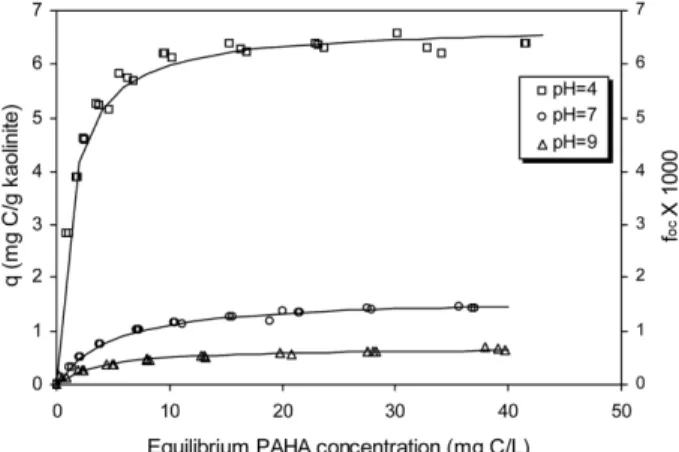
Fig. 1 shows PAHA sorption isotherms on kaolinite at different pH. All the sorption isotherms were fit well with the Langmuir isotherm model (R
2> 0.97), indicating that site-limiting mechanisms may be responsible for PAHA sorption on kaolinite regardless of the pH conditions. Greater adsorption was observed at lower pH, which is in a good agreement with prior reports (Schlautman and Morgan, 1993b; Gu et al., 1994; Hur and Schlautman, 2004a). The maximum sorption density of the isotherm obtained at pH 4 is
four-fold higher than that observed at pH 7, and ten- fold, at pH 9. It appears that the site-dependent sorption mechanisms such as ligand exchange and electrostatic attraction are more strongly involved and the contributions become greater for PAHA sorption to kaolinite at lower pH.
3.2 Pyrene Binding by Dissolved Bulk PAHA at Different pH
Pyrene K
ocbinding to bulk PAHA, K
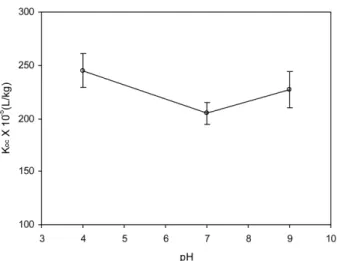
oc(bulk), at different pH was investigated (Fig. 2). A consistent trend of K
ocwas not observed with pH. Instead, relatively low K
ocwas achieved at the neutral pH (7.0) versus pH 4 and 9. The higher K
ocvalues at pH 4 versus pH 7 may be attributed to the increase in hydrophobic regions of PAHA because of neutralization of the charged acidic functional groups in PAHA at lower pH. However, a single mechanism of partitioning cannot explain the increased K
ocat pH 9. Schlautman and Morgan (1993b) found that a Flory-Huggins partitioning model failed to predict HOC binding by Suwannee River humic and fulvic acids at varying solution chemistry. They hypothesized that hydrophobic cavities might play a role in binding HOC as secondary structures of HS. Xing and Pignatello (1997) incorporated the size exclusion effect into the dual-mode model (glassy/rubbery model), and suggested that two mechanisms, partitioning and hole-filling mechanism, control HOC binding by HS. In the glassy/rubbery
Fig. 1.
Adsorption isotherms of PAHA on kaolinite at pH 4, 7
and 9 (0.1 M NaCl). The adsorption data were adopted from Hur
and Schlautman [9].
model, HS were depicted as having two domains- rubbery and glassy domain. Partitioning occurs in both domains, however, the glassy domain also has holes where specific interactions occur. If solution pH changed the hole environments of the glassy domains by contracting or expanding HS structure, the relative contributions of both partitioning and hole-filling mechanism could influence the extent of binding.
At lower pH, HS may adopt more a constricted conformation because of weak repulsive forces between negatively charged functional groups in HS and, possibly, more H-bonding. The more compact conformation of HS may restrict pyrene accessible to HS attachment sites, and there may not be a sufficient number of holes to fit pyrene and size exclusion effects may not operate in the overall binding. In this case, hydrophobicity of HS is expected to determine the extent of binding. As pH increases, however, a greater number of acidic functional groups dissociate and the hole-filling mechanism participates more effectively in the overall binding. The results shown in Fig. 2 suggest that a “threshold” pH, after which the specific mechanism becomes more important than partitioning, may be greater than 7.0 for this particular case.
Previous investigations of pH effects on HOC binding to dissolved bulk aquatic HS have shown a decrease in K
ocvalues for higher pH (Carter and
Suffet, 1982; Schlautman and Morgan, 1993b). In contrast, an increasing trend of K
ocwith pH has been reported with terrestiral HS (Clapp
et al,1997; John and Tiller, 1999; Hur and Schlautman, 2004c). For example, Clapp
et al.(1997), using a soil-derived HS, observed an increase in the extent of binding of a slightly soluble herbicide, napropamide, with pH increasing from 4 and 8. More recently, Jones and Tiller (1999) observed increasing trends of phenanthrene K
ocwith pH (4-10) by a soil-derived HS in different concentrations of NaNO
3aqueous solutions. The apparent contrasting results for aquatic vs. terrestrial HS indicate that the trend of K
ocwith pH may depend on the type of HS. Jones and Tiller (1999) suggested larger molecular sizes of a soil-derived humic acid versus aquatic HS as a possible explanation for the conflicting observation with aquatic HS.
It is noteworthy that the molecular size of either phenanthrene or napropamide is smaller than pyrene.
Due to the smaller molecular size of these solutes versus pyrene, the size exclusion effect may begin at a pH lower than the “threshold” pH of this study, which could explain the increasing trend of K
ocover the pH ranges they investigated. Moreover, the relative contribution of the size exclusion effect (by specific interactions) versus partitioning may be greater than the case of pyrene due to the higher aqueous solubilities of the solutes. In this sense, the result of this study seems to generally agree with the two previous studies. The trend of K
ocvalues with pH for this study is more consistent with a recent report of Hur (2004c), who demonstrated using the same humic acid (i.e., PAHA) that size exclusion effects play a secondary role in determining the extent of binding pyrene and naphthalene for HS.
3.3. Pyrene binding to residual PAHA at different pH
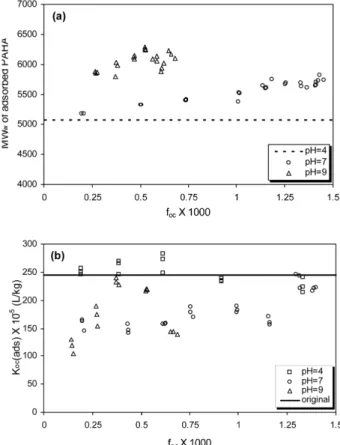
MW
wvalues of residual PAHA after sorption are plotted as a function of equilibrium PAHA concen- trations in Fig. 3a. Deviations of these values from their corresponding original MW
wvalue indicate that MW fractionation of PAHA occurred upon adsorption to kaolinite. Apparently, the extent of the fractionation
Fig. 2.
Pyrene K
ocby dissolved bulk PAHA at different pH (0.1M
NaCl solutions). The values were estimated by the modified
fluorescence technique.
at pH 7 is very similar to that observed at pH 9 at comparable equilibrium PAHA concentrations. However, it should be kept in mind that more fractionation occurred at pH 9 when the residual MW
wdata were compared as a function of percent carbon adsorption (Hur and Schlautman, 2004a). The detailed discussion and explanations for the adsorptive fractionation results shown in Fig. 3a have been provided in a previous report (Hur and Schlautman, 2004a). For example, at lower percent carbon adsorption, which corresponds to the plateau regions of the sorption isotherms, available sorption sites become limiting and competition among PAHA components for adsorption sites is highest. In this case, strongly-adsorbing PAHA components (i.e., lower MW
wfractions), which are likely governed by ligand exchange or electrostatic
attraction, are expected to be more competitive. In contrast, at high percent carbon adsorption (i.e., low surface excess concentration), competition is less important and hydrophobic interactions likely lead to nonadsorbed PAHA fractions of lower MW
wremaining in solution versus the original MW
wK
oc(res) values were compared with the original K
ocvalues obtained from bulk PAHA in Fig. 3b. All K
oc(res) values at pH 7 and 9 were lower than the original values, consistent with the lower MW
wof residual PAHA versus the original MW
w. This suggests that the extent of pyrene binding depend on the MW
wof the residual PAHA for pH 7 and 9.
However, K
oc(res) values at pH 4 do not deviate much from the original value, indicating that the adsorptive fractionation occurring at pH 4 does not change the extent of binding (Fig. 3b). Therefore, changes in pyrene binding due to adsorptive fractionation was observed at high pH (7 and 9).
The relative impacts of adsorptive fractionation on pyrene binding can be evaluated by plotting the K
oc(res) values as a function of the MW
wof the residual PAHA at different pH (Fig. 4). Positive correlations between K
ocand MW
wof residual PAHA were observed for pH 7 and 9 conditions, which is consistent with a prior study (Hur and Schlautman, 2004b). The positive relationship was more pronounced for pH 9 versus pH 7, as demonstrated by the higher R
2value of the linear regression equations (Fig. 4).
However, such a positive correlation was not found for pH 4. The lack of the positive relationship is possibly explained by a wider range of adsorption selectivity of kaolinite with respect to PAHA MW for pH 4 versus other pH conditions (Hur and Schlautman, 2004a). In other words, despite the apparent difference in the measured MW
wvalues, residual PAHA is likely to have a wide range of MW after sorption at pH 4 because hydrophobic interactions and site-limiting HS sorption mechanisms, which were responsible for preferential adsorption of higher MW and lower MW fractions, respectively, do operate simultaneously under the condition. The different fractionation pattern also explains the higher degree of the positive correlation
Fig. 3.
(a) MW
wof residual PAHA after adsorption on kaolinite
(adopted from ref 18) (b) K
oc(res) (L/g-OC), pyrene K
ocwith the
residual PAHA, as a function of equilibrium PAHA concentrations
after sorption at different pH. The horizontal lines represent the
original values before adsorption. The molecular weight data
were adopted from Hur and Schlautman [9].
observed for pH 9 versus pH 7 because hydrophobic interactions, which are responsible for preferential of higher PAHA MW fractions, are more dominant at pH 9 versus pH 7 (Hur and Schlautman, 2004a). The observation suggests that an actual MW distribution of HS may be more important in determining the extent of pyrene binding to dissolved HS than is the apparent composite MW value. Despite large scatter of pH 4 data, the relatively higher K
oc(res) values were still observed in the declining order of pH 4 >
pH 9 > pH 7 on the overlapped MW
wrange as for the case of bulk PAHA.
3.4. Pyrene binding to kaolinite-bound PAHA at different pH
Apparent MW
wvalues of the adsorbed PAHA fractions in low (< 0.002) f
ocsystems were calculated following the ideal mixture approach described in Hur and Schlautman (2003a). The approach is based on the concepts of mass balance and adherence to the Beer-Lambert law for UV absorbance, and calculates adsorbed MW
wvalues from their corresponding residual MW
wvalues, corresponding relative fractions of residual UV absorbing components, and the original bulk HS MW
wvalue. In general, MW
wof adsorbed PAHA increased with carbon fractional coverage on kaolinite surfaces (f
oc=0
−0.0015) at pH 7 and 9 (Fig. 5a). Higher
MW
wof adsorbed PAHA versus bulk PAHA reflects preferential adsorption of higher MW
wfractions. Note that MW
wof adsorbed PAHA is the same as the original MW
wat pH 4 because no residual PAHA was detected from the adsorption isotherms at the range of f
ocinvestigated.
Estimating the contribution of bare kaolinite to pyrene sorption is well described in a previous study (Hur and Schlautman, 2004b). K
oc(ads) values were calculated using the following equation.
(2) where [PYR]
aqis the free pyrene concentration dissolved in water and [PYR]
solidis the adsorbed pyrene concentration, K
ioand f
ioare the partition coefficient of pyrene with inorganic surfaces and the fraction of inorganic surface area available for pyrene sorption (0-1), respectively. In this study, f
iowas
Kd [PYR]solid PYR [ ]aq
---
fio⋅Kio+
focKoc(ads)= =
Fig. 4.
Relationship between K
ocand MW
wof nonadsorbed PAHA fractions. The dotted lines represent the regression equations for pH 7 (K
oc= 0.026
·MW
w+ 51.4; R
2= 0.743) and pH 9 (K
oc= 0.018
·MW
w+ 121.3; R
2= 0.827). Note that no apparent linear relationship was found for pH 4.
Fig. 5.
(a) MW
wof adsorbed PAHA on kaolinite after adsorption
with f
oc(b) pyrne K
oc(ads), pyrene K
oc, with adsorbed PAHA, as
a function of f
oc.
estimated under an assumption that the maximum available kaolinite surface area for PAHA is 0.272.
K
oc(ads) values obtained from kaolinite-bound PAHA under different pH conditions were plotted as a function of f
ocin Fig. 5b. Compared to the original bulk K
ocvalues, K
oc(ads) values at pH 7 and 9 were lower across most of the f
ocrange investigated, whereas the values at pH 4 are nearly constant over the f
ocrange without major deviation from the original K
oc. K
oc(ads) values were lower at pH 7 and 9 than their respective bulk K
ocvalues despite the higher apparent MW
wfor adsorbed PAHA components. This observation demonstrates that MW
wis not the sole controlling factor for pyrene binding at pH 7 and 9.
Schlautman and Morgan (1993a), in a study of perylene binding to an alumina-bound aquatic humic acid at varying solution chemistry (pH 4, 7 and 10, and different concentrations of NaCl), observed no perylene binding at neutral to high pH (pH 7 and 10) for all NaCl aqueous solutions. Perylene binding was found at only a low pH (pH = 4) through their investigation. They explained that ligand exchange became more dominant at high pH due to higher polarity of HS, whereas hydrophobic interaction significantly contributes to HS sorption at low pH as a result of increasing protonation of carboxyl groups on HS. It was also inferred therein that HS adsorption by ligand exchange at high pH severely restricts conformational changes of the adsorbed HS necessary to bind perylene because HS are bound tightly at the mineral surface by inner-sphere complexes. In contrast, weakly-adsorbed HS at low pH (e.g., through hydro- phobic interaction) were thought to be able to change their conformation at the surface if necessary to bind perylene.
Although the apparent K
oc(ads) trend with pH agrees with the result of this study, some caution must be exercised because 1) Schlautman and Morgan (1993a) used an aquatic HS and different mineral, and 2) they did not consider HS adsorptive fractionation.
Therefore, the trend they reported could be less pronounced if higher MW
wfraction of the HS were preferentially adsorbed. In addition, the explanations
they offered are not consistent with those provided for the results of this study (i.e., sorption mechanisms for different pH). For this study, ligand exchange and/or electrostatic interactions were considered as more important sorption mechanisms at a lower pH.
It was reported that apparent pK
arange of HS is rather broad and also that the value decreases at higher ionic strength of a solution (Stevenson, 1994).
Since a high ionic strength (0.1 M) was used in this study, an appreciable fraction of carboxyl groups on PAHA probably still remains dissociated and electrostatic interactions is expected to still operate at a low pH.
Therefore, different combination of orientation and arrangement of adsorbed PAHA may better explain the changes in K
ocvalues with pH rather than the degree of the tightness in binding between HS and minerals described by Schlautman and Morgan (1993a).
At lower pH, more hydrophilic regions may be attached to mineral surfaces due to electrostatic attraction formed between negatively charged acidic functional groups of HS and positively charged kaolinite surfaces.
In this case, more hydrophobic regions of HS, exposed toward to a solution, is expected to enhance pyrene binding.
4. Conclusions
Irrespective of solution pH, MW fractionation occurred upon adsorption of PAHA onto kaolinite, resulting in the deviation of residual PAHA MW from the original MW prior to sorption. The adsorptive fractionation changed the extent of pyrene binding.
Positive correlations between pyrene K
ocand MW
wvalues for PAHA were achieved for pH 7 and 9,
but not for pH 4. No positive correlation at pH 4
was explained by relatively a wide range of MW
components present in solution due to less selective
adsorptive fractionation with respect to MW for the
particular pH. Variation in K
ocby bulk disssolved
PAHA at different pH was observed, which was
explained by relative contributions of partitioning and
size exclusion effects (i.e., specific interactions). For
adsorbed PAHA, conformational changes of PAHA
upon adsorption seem to be more important for the extent of pyrene binding than does HS MW. At relatively high pH (7 and 9), lower extent of pyrene binding was observed for adsorbed PAHA versus nonadsorbed PAHA. The conformation effects were more pronounced at higher pH.
References
Carter, C.W. and Suffet, I.H., 1982, Binding of DDT to dis- solved humic materials, Environ. Sci. Technol.,
16, 735-740.
Chin, Y.P., Aiken, G.R., and Danielsen, K.M., 1997, Binding of pyrene to aquatic and commercial humic substances: The role of molecular weight and aromaticity, Environ. Sci. Technol.,
31, 1630-1635.
Clapp, C.E., Mingelgrin, U., Liu, R., Zhang, H., and Hayes, M.H.B., 1997, A quantitative estimation of the complexation of small organic molecules with soluble humic acids, J. Environ.
Qual.,
26, 1277-1281.
Gauthier, T.D., Shane, E.C., Guerin, W.F., Seitz, W.R., and Grant, C.L. 1986, Fluorescence quenching method for determin- ing equilibrium constants for polycyclic aromatic hydrocarbons binding to dissolved humic materials, Environ. Sci. Technol., 20, 1162-1166.
Gu, B., Schmitt, J., Chen, Z., Liang, L. and McCarthy, J.F., 1994, Adsorption and desorption of natural organic matter on iron oxide: Mechanisms and model, Environ. Sci. Technol.
28, 38-46.
Hur, J. and Schlautman, M.A., 2003a, Using selected opera- tional descriptors to examine the heterogeneity within a bulk humic substance, Environ. Sci. Technol.,
37, 880-887.
Hur, J. and Schlautman, M.A., 2003b, Molecular weight frac- tionation of humic substances by adsorption onto minerals, J.
Colloid Interf. Sci.
264, 313-321.
Hur, J. and Schlautman, M.A., 2004a, Effects of pH and phos- phate on the adsorptive fractionation of purified Aldrich humic acid on kaolinite and hematite, J. Colloid Interf. Sci.,
277, 264- 270.
Hur, J. and Schlautman, M.A., 2004b, Influence of humic sub- stance adsorptive fractionation on pyrene partitioning to dis- solved and mineral-associated HS, Environ. Sci. Tech.
38, 5817- 5877.
Hur, J., 2004c Polycyclic aromatic hydrocarbon (PAH) binding to dissolved humic substances (HS): Size exclusion effect, J.
KoSSGE,
9(3), 12-19.
Jones, K.D. and Tiller, C.L., 1999, Effect of solution chemistry on the extent of binding of phenanthrene by a soil humic acid: A
comparison of dissolved and clay bound humic, Environ. Sci.
Technol.,
33(4), 580-587.
Johnson, W.P. and Amy, G.L., 1995, Facilitated transport and enhanced desorption of polycyclic aromatic hydrocarbons by natural organic matter in aquifer sediments, Environ. Sci. Tech- nol.,
29, 807-817.
Kretzschmar, R., Hesterberg, D., and Sticher, H., Effects of adsorbed humic acid on surface charge and flocculation of kaolinite, Soil Sci. Soc. Am. J.,
61, 101-108.
Laor, Y., Farmer, W.J., Aochi, Y., and Strom, P.F. Phenanthrene binding and sorption to dissolved and to mineral-associated humic acid, Wat. Res.
32(6), pp1923-1931(1998).
Liu, H. and Amy, G., 1993, Modeling partitioning and transport interactions between natural organic matter and polynuclear aro- matic hydrocarbons in groundwater, Environ. Sci. Technol.,
27, 1553-1562.
McCarthy, J.F., and Zachara, J.M., 1989, Subsurface transport of contaminants, Environ. Sci. Technol.,
23, 496-502.
Schlautman, M.A. and Morgan J.J., 1993a, Binding of a fluores- cence hydrophobic organic probe by dissolved humic sub- stances and organically-coated aluminum oxide surfaces, Environ. Sci. Technol. 27, 2523-2532.
Schlautman, M.A. and Morgan, J.J., 1993b, Effect of aquatic chemistry on the binding of polycyclic aromatic hydrocarbons by dissolved humic materials, Environ. Sci. Technol.
27(5), 961- 969.
Schlautman, M.A. and Morgan, J.J., 1994, Adsorption of aquatic humic substances on colloidal-size aluminum oxide particles:
Influence of solution chemistry, Geochim. Cosmochim. Acta,
58