Received: April 20, 2020 Revised: July 20, 2020 Accepted: August 20, 2020
OPEN ACCESS
HORTICULTURAL SCIENCE and TECHNOLOGY 38(6):860-869, 2020
URL: http://www.hst-j.org pISSN : 1226-8763 eISSN : 2465-8588
This is an Open Access article distributed under the terms of the Creative Commons Attribution Non-Commercial License which permits unrestricted non-commercial use, distribution, and reproduction in any medium, provided the original work is properly cited.
Copyrightⓒ2020 Korean Society for Horticultural Science.
Gaseous Chlorine Dioxide Treatment Suppresses Decay and Microbial Growth in Cold-stored Jujube Fruit
Hyowon Park, Chul-Woo Kim, Narae Han, Minjae Jeong, and Uk Lee*
Division of Forest Special Products, National Institute of Forest Science, Suwon 16631, Korea
*Corresponding author: [email protected]
Abstract
Gaseous chlorine dioxide (ClO2) fumigation is widely used in various industries as a strong oxidizing and sanitizing agent to eliminate harmful microorganisms. Here, we investigated the effectiveness of ClO2 fumigation in suppressing decay and microbial growth in jujube fruit during cold storage.
ClO2 fumigation significantly reduced the decay incidence of jujube fruit; in particular, treatment with 30 mg·L-1 and 50 mg·L-1 ClO2 maintained the decay rate below 7.0% for up to 4 weeks of storage, whereas the decay rate of the control was approximately 20%. Moreover, the decay rate of fruit treated with 50 mg·L-1 ClO2 was maintained below 20% until the end of storage (6 weeks). In addition, 50 mg·L-1 fumigation completely prevented aerobic bacterial growth during the first 2 weeks of storage; after 6 weeks, the aerobic bacteria count in the groups treated with 30 mg·L-1 and 50 mg·L-1 ClO2 was 2.4 log colony-forming units per gram, which was 30% lower than that of the control. Total yeast and mold growth were also well controlled during storage, even with only 10 mg·L-1 of gaseous ClO2 fumigation. These data demonstrate that 30 - 50 mg·L-1 of gaseous ClO2
fumigation suppressed postharvest jujube fruit decay by controlling fungal and bacterial growth on the surface, and it is recommended as an effective method to maintain crop quality.
Additional key words: aerobic bacteria, cold storage, fruit quality, fumigation, mold, postharvest
Introduction
Jujube (Ziziphus jujuba Mill.), belonging to the family Rhamnaceae, is distributed in subtropical and tropical regions of Asia, Russia, northern Africa, southern Europe, and the Middle East (Hernández et al., 2014). In Korea, dried jujube fruit have long been used in traditional medicine since it is enriched in vitamins, minerals, flavonoids, and other organic compounds (Guo et al., 2015). It has been shown to be effective in stimulating the immune system and in treating insomnia, cancer, and inflammation (Li et al., 2011; Plastina et al., 2012; Yu et al., 2012). Recently, the popularity of fresh jujube fruit has increased owing to its sweet flavor and crisp texture. However, fresh jujube fruit is susceptible to low temperature which is responsible for chilling injury and also easily get postharvest disease caused by several fungal and bacterial pathogens, such as Alternaria alternata, Botrytis cinerea, Penicillium expansum, and Xanthomonas arboricola (Wang et al., 2009; Myung et al., 2010; Liu et al., 2018). As these pathogens
cause considerable economic loss, when infecting the jujube fruit during cold storage, synthetic chemical fungicides are usually used for pathogen control. However, public concerns have been raised regarding the potential impact of fungicides on human health and the environment (Cohen, 2008).
Chlorine dioxide (ClO2) is a strong oxidizing and sanitizing agent with an oxidation capacity approximately 2.5-times higher than chlorine and is thus widely used to control microbiological growth in several industries (Wu and Rioux, 2010; Lee et al. 2012). Toxicity of gaseous ClO2 is reported to be minimal at concentrations used for decontamination (Gordon and Rosenblatt, 2005). ClO2 is particularly effective at controlling Salmonella, Escherichia coli O157:H7, Listeria monocytogenes, yeasts, and molds growing on raw food materials (Behrsing et al., 2000; Park and Kang, 2018). Gaseous ClO2
is considered to be effective at reaching and inactivating pathogenic cells owing to its high diffusivity and penetrability (Gomez-Lopez, 2012; Sun et al., 2017). Gaseous ClO2 has been applied to various fruits for pathogen control and retention of freshness during storage, including apples, green peppers, strawberries, and tomatoes, at different concentrations, relative humidity, and time combinations (Han et al., 2000; Du et al., 2003; Mahmoud et al., 2007; Trinetta et al., 2010). Several studies have demonstrated clear reductions in the total population of bacteria, yeast, and mold (Trinetta et al., 2013; Park and Kang, 2015; Kim and Hwang, 2016). Vandekinderen et al. (2009) reported that the mean reductions of gram-negative bacteria, such as E. coli and S. enterica Typhimurium, showed 3.5 log CFU/cm2, while gram-positive bacteria, such as L.
monocytogenes and Lactobacillus sakei and yeast/mold were 2.6 and 0.9 log CFU/cm2, respectively. Generally, gaseous ClO2
is more effective against gram-negative bacteria than gram-positive bacteria, with an intermediate effect against mold and yeast. Gaseous ClO2 treatment substantially reduced Colletotrichum acutatum and E. coli populations after 10 d of cold storage in blueberries (Sun et al., 2014). In winter jujube, ClO2-treated fruit showed higher vitamin C content and lower soluble pectin content, which has a positive effect on fruit quality (Zhang and Zhang, 2006). Fu et al. (2019) found that ClO2
controls B. cinerea in jujube fruit, the causal agent of gray mold in various fruit, by disrupting the cell membrane of the fungal pathogen. However, there has been a lack of research on the effectiveness of gaseous ClO2 treatment in preventing microbiological spoilage of postharvest jujube fruit during cold storage. In this study, we investigated the effectiveness of different ClO2 gas concentrations in controlling decay and microbial growth on jujube fruit during 6 weeks of cold storage.
Materials and Methods
Fruit Material and Experimental Design
‘Bokjo’ jujube (Ziziphus jujuba Mill.) fruit were hand-harvested on October 10, 2018, at maturity (more than 70% colored fruit) from commercial orchards in Boeun, Republic of Korea. The fruit were selected for uniformity of size, color, ripeness, and lack of physical injury (fruit weight: 14.1 ± 1.5 g; soluble solids content: 25.3 ± 2.9% Brix and firmness: 29.4 ± 5.1 N).
The fruit were immediately transported to the laboratory within 3 h and randomly divided into four sets of 5-kg samples (35 fruits per sample) for each concentration treatment. The fruits were carefully put into a plastic box and then exposed to gaseous ClO2. The fruit quality assays were examined at 0, 1, 2, 4, and 6 weeks of cold storage.
Gaseous ClO2 Fumigation Treatment
The four sets of fruit were fumigated with 0 (as a control), 10, 30, or 50 mg·L-1 ClO2 gas for 30 min under a relative humidity
of 80% to suppress decay and microbial growth (Kang et al., 2015; Kim and Song, 2017). A ClO2 generator (CA-300, Purgofarm Inc., Hwaseong, Korea) was used employing the electrochemical method reported by Gates (1998), in which highly pure ClO2 gas produced by aqueous sodium chlorite was passed through a multi-porous membrane electrode assembly.
After these electrochemical reactions, the ClO2 gas was flowed through a vent into a collection chamber for the fumigation treatment. After fumigation at harvest, each treated set was sealed in plastic containers (184 ×129 × 70 mm, Easepack, Namyangju, Republic of Korea) and then stored at 2 ± 1°C under a relative humidity of 80%, which is the condition generally used in commercial jujube orchards, for up to 6 weeks.
Fruit Decay and Cracking Incidence
The effects of fumigation on the incidences of fruit decay and peel cracking were evaluated using the number of infected and/or moldy and cracked fruit. These counts were taken at the beginning of the experiment and after 1, 2, 4, and 6 weeks of cold storage. Seventy fruit were used for the measurement of the decay incidence for each treatment.
Analysis of Microbial Activity
The microbial activity on the jujube fruit surface was quantified at 0, 1, 2, 4, and 6 weeks after the application of fumigation treatment. For the assessment of total microbial growth, 3 g of jujube pericarp from 1 g per fruit was mixed with 27 mL of distilled water, and this mixture was used to prepare a 3-fold serial dilution. Each diluent (1 mL) was inoculated in triplicate on 3M Petrifilm Aerobic Count Plates and 3M Petrifilm Yeast and Mold Count Plates (3M Co., Saint Paul, MI, USA). The aerobic bacteria were then incubated at 37°C for 48 h, and the yeast and mold were incubated at 25°C for 5 d. After incubation, total microorganisms were counted visually, based on the numbers of red-, blue-, and black-colored colonies for the total bacterial, yeast, and mold count, respectively. Each microbial determination was performed in triplicate, and the results were expressed in log colony-forming units (CFU) per gram.
Determination of Fruit Firmness and Soluble Solids Content (SSC)
The firmness and SSC of the fruit were determined at 0, 1, 2, 4, and 6 weeks of cold storage. Flesh firmness was measured using a penetration test with a 5-mm-diameter probe to a depth of 5 mm using a rheometer (CR-3000EX-S; Sun Scientific Co., Tokyo, Japan), defined as the maximum penetration force (N). Fruit juice was extracted by homogenizing one fruit in a juicer, resulting in individual SSC values. The SSC (%) was then measured using a digital refractometer (RA-510; Kyoto Electronics MFG Co., Tokyo, Japan).
Weight Loss
To measure weight loss, each jujube fruit was weighed on a digital scale (AUX220; Shimadzu Co., Japan) at the beginning of the experiment and after storage. Results are expressed as the percentage loss of the initial weight.
Statistical Analysis
The experiments were set up using a completely randomized design with three replicates (10 fruit were used for each
Fig. 1. Physical appearance of ‘Bokjo’ jujube fruit treated with 0, 10, 30, or 50 mg·L-1 gaseous chlorine dioxide (ClO2) fumigation at 20°C for 30 min, followed by storage at 2 ± 1°C after 6 weeks. Scale bar = 2 cm.
replicate) and data expressed as mean ± standard error. Data were analyzed by one-way analysis of variance (ANOVA) using Statistical Package for the Social Sciences (SPSS) software version 18.0 (SPSS, Inc., Chicago, IL, USA). The MetaboAnalyst (v 4.0) online program (https://www.metaboanalyst.ca/) was used to calculate the correlation coefficients among parameters and for data visualization (Chong et al., 2019). Regression analysis was conducted using Sigma Plot 12.0 software (Systat Software, CA, USA). A difference was considered to be statistically significant at P < 0.05.
Results and Discussion
Effect of ClO2 on Jujube Fruit Quality Attributes during Cold Storage
Fumigation with ClO2 gas is known to be effective in maintaining fruit quality by suppressing microbial growth and reducing decay in various fruits and vegetables (Han et al., 2000; Lee et al., 2004; Park and Jeong, 2015). Therefore, this study aimed to evaluate the effectiveness of ClO2 gas fumigation treatment in controlling fruit decay during cold storage in jujube fruit.
As shown in Fig. 1, there was an obvious increase in quality with higher concentrations of ClO2 treatment, especially at 30 and 50 mg·L-1. Fruit firmness is one of the most representative indicator to monitoring the quality of fruit according to ripening and/or softening (Valero et al., 2007). There was no significant difference in flesh firmness of fumigated fruit based on the concentrations of gaseous ClO2 applied (Fig. 2A). However, there was a significant difference in fruit firmness depending on storage duration; the values decreased from 30.0 N to approximately 24.0 N throughout the 6 weeks of cold storage. Yan et al. (2012) also showed that firmness of jujube fruit gradually decreased as storage time increased. The SSC in
A
B
C
Fig. 2. Fruit firmness (A, n=30), soluble solids content (B, n=30), and weight loss (C, n=5) in fresh ‘Bokjo’ jujube fruit treated with 0, 10, 30, or 50 mg·L-1 gaseous chlorine dioxide (ClO2) at harvest, followed by storage at 2 ± 1°C for up to 6 weeks.
Vertical bars represent the standard errors of replicates.
jujube fruit showed a consistent value (range 25 ‑ 28%), regardless of the ClO2 concentrations applied or storage duration (Fig.
2B). The weight loss of fresh jujube fruit treated with different concentrations of ClO2 gas fumigation significantly increased with prolonged storage, while there was no significant difference according to ClO2 concentration (Fig. 2C). Though the treatment of ClO2 is known to inhibit weight loss of fruit and vegetables in general, Sun et al. (2014) reported that gaseous ClO2 did not affect weight loss in fresh blueberries, which is a similar result as ours.
Effect of ClO2 Treatment on Storage Disorder of Jujube Fruit
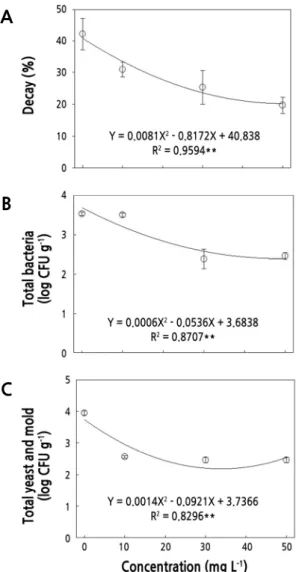
The decay incidence of jujube during the storage period after fumigation treatment is shown in Fig. 3A. The control group showed rapid decay, with the incidence increasing from 2.8% at 1 week of cold storage to 18.3% at 4 weeks, whereas decay incidence in the groups treated with 30 mg·L-1 and 50 mg·L-1 was below 7% until 4 weeks, representing a significant reduction compared to the control group. At the end of storage duration, decay incidence of the 50 mg·L-1 group was controlled at <20%, whereas more than 40% of the fruit in the control group showed symptoms of decay. Thus, 50 mg·L-1 was the most effective
A B
C D
Fig. 3. Decay incidence (A, n=30), cracking (B, n=30), total bacterial growth (C, n=3), and total yeast and mold growth (D, n=3) in fresh ‘Bokjo’ jujube fruit treated with 0, 10, 30, or 50 mg·L-1 gaseous chlorine dioxide (ClO2) at harvest, followed by storage at 2 ± 1°C for up to 6 weeks. Vertical bars represent the standard errors of replicates.
concentration to prevent the development of fruit decay and decay incidence decreased in parallel with the increase in gaseous ClO2 concentration (Fig. 4A). Similarly, Du et al. (2007) showed that the efficacy of ClO2 gas on inhibiting the decay of green bell pepper was elevated with the increase in ClO2 concentration; after 40 d of ClO2 gas treatment, the rates of decay in bell pepper stored at 10 ± 0.5°C were 50% lower than those of the control. Also, the natural incidence of decay in fig fruit, mostly due to gray mold rot, was shown to be significantly reduced after ClO2 fogging (Karabulut et al., 2009). Fruit cracking was occasionally observed during cold storage, which was reported as one of the main factors contributing to provoking fruit decay and then deteriorating fruit quality and storability (Hua et al., 2015). We first noted fruit cracking at 1 week of cold storage, with an incidence of about 2% in all the treated groups; subsequently, the cracking rates increased to approximately 15% by the end of storage duration (Fig. 3B). However, there was no influence of ClO2 concentration on the incidence of fruit cracking.
Effect of ClO2 Treatment on Microbial Growth
The total bacteria count in the control group increased from 1.3 to 3.5 log CFU·g-1 during cold storage; however, no bacterial growth was observed in the group treated with 50 mg·L-1 of gaseous ClO2 until 14 d of cold storage (Fig. 3C). After 6 weeks, the bacterial growth in the groups treated with 30 mg·L-1 and 50 mg·L-1 ClO2 was 30% lower than that of the control and the 10 mg·L-1 ClO2 groups, representing a significant difference (p < 0.01); the 30 mg·L-1 and 50 mg·L-1 ClO2 treatment groups had an average bacterial count of only 2.4 log CFU·g-1 in contrast to around 3.5 CFU·g-1 in the control and 10 mg·L-1 groups. The gaseous ClO2 fumigation treatment, especially at 50 mg·L-1, effectively prevented the growth of bacterial colonies on jujube fruit until 2 weeks. Similarly, ClO2 fumigation for 30 min at 20 ppmv was reported to be sufficient to
A
B
C
Fig. 4. Regression analyses between fruit decay (A), total bacteria (B), and total yeast and mold (C) counts according to the concentration of gaseous chlorine dioxide (ClO2) fumigation treatment in ‘Bokjo’ jujube fruit stored at 2 ± 1°C after 6 weeks of cold storage.
inhibit E. coli, S. typhimurium, and Listeria monocytogenes on tomatoes and spinach leaves (Park and Kang, 2018). Sun et al.
(2017) also found that 5 mg·L-1 of ClO2 completely suppressed the growth of E. coli and Penicillium digitatum in a chamber experiment. ClO2 is considered to decrease bacterial colonies by damaging and destabilizing the inner cellular membranes, thereby contributing to altering the cellular permeability of microorganisms, causing cell metabolism disruption (Young and Setlow, 2003; Vandekinderen et al., 2009). The total bacteria count decreased in a quadratic manner with the increase in ClO2
concentration (Fig. 4B). Similar to our result, the log reduction of S. enterica Typhimurium on grape fruit and L.
monocytogenes on strawberry increased as the ClO2 gas concentration increased (Mahmoud et al., 2007; Netramai et al., 2016).
Fumigation with gaseous ClO2 significantly reduced the yeast and mold count (p < 0.001), compared with those of the untreated control. Although there was no significant difference in efficacy based on ClO2 concentrations, fumigation with more than 10 mg·L-1 of gaseous ClO2 was clearly effective in suppressing yeast and mold growth in jujube fruit during cold storage (Fig. 3D). ClO2 gas fumigation treatments also previously showed strong antifungal activity against Alternaria
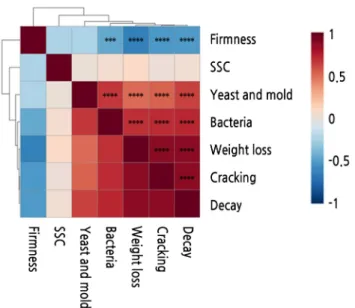
Fig. 5. Pearson’s correlation coefficient (r) matrix among fruit quality attributes of jujube fruit fumigated with 0, 10, 30, or 50 mg·L-1 gaseous chlorine dioxide (ClO2) at harvest followed by storage at 2 ± 1°C for up to 6 weeks. Red and blue indicate positive and negative correlation coefficients between variables, respectively. *p < 0.05, **p < 0.01, ***p <
0.001, and ****p < 0.0001. SSC stands for soluble solids content.
alternata on tomatoes for 3 min at 10 mg·L-1 (Trinetta et al., 2013). Similarly, Mahmoud et al. (2007) reported that treatment with 5 mg·L-1 ClO2 for 10 min significantly reduced the initial populations of yeast and mold on strawberry fruit from 4.8 log CFU·g-1 to an undetectable value. Fu et al. (2019) demonstrated that as the ClO2 concentration increased, the disease diameter caused by Botrytis cinerea was significantly reduced, indicating the effectiveness of ClO2 fumigation against B. cinerea and a positive correlation with respective concentrations. The mechanism of antifungal activity has been considered to be involved in the direct inhibition of ClO2 on mycelial growth, spore germination, and germ tube elongation of B. cinerea and Penicillium expansum, along with the induction of cellular damage to integrity of the plasma membrane, causing leakage of fungal cellular contents (Zhang et al., 2018; Fu et al., 2019). Total yeast and mold counts were lower even at 10 mg·L-1 ClO2
treatment; gaseous chlorine dioxide treatment was highly effective in controlling total yeast and mold counts even at low concentration (Fig. 4C).
Correlation of Fruit Quality Attributes and Microbial Growth
Pearson’s correlation coefficient heatmap matrix among fruit quality attributes was constructed to evaluate the overall responses to the four concentrations of ClO2 gas (Fig. 5). Firmness was negatively correlated with fruit decay, peel cracking, and weight loss (p < 0.0001). Wang et al. (2019) found similar results as fruit firmness decreased during cold storage, while aerobic plate count (APC) and yeast and mold counts increased, indicating a negative correlation between firmness, APC, and yeast and mold count. In contrast, yeast, mold, and bacterial growth; weight loss; peel cracking; and fruit decay were highly positively correlated with each other. Kong et al. (2013) also reported that the injury from side cracking and ostiole-end splitting in fig fruit accelerated development of decay and loss of marketability. The damage from fruit cracking and splitting that occurs over the storage duration usually is a starting point for infection and water loss.
Conclusion
This study demonstrated that postharvest treatment with 30 ‑ 50 mg·L-1 gaseous ClO2 fumigation for 30 min can significantly control the natural infection and inactivation of microorganisms in cold-stored jujube fruit, thereby preventing fruit decay and ensuring quality. Overall, ClO2 gas fumigation treatment could effectively extend the storability of jujube fruit by inhibiting the incidence of fruit decay and bacterial/fungal growth as well.
Literature Cited
Behrsing J, Winkler S, Franz P, Premier R (2000) Efficacy of chlorine for inactivation of Escherichia coli on vegetables. Postharvest Biol Technol 19:187-192. doi:10.1016/s0925-5214(00)00092-2
Chong J, Wishart DS, Xia J (2019) Using MetaboAnalyst 4.0 for comprehensive and integrative metabolomics data analysis. Curr Protoc Bioinform 68:e86. doi:10.1002/cpbi.86
Cohen M (2008) Environmental toxins and health: the health impact of pesticides [online]. Aust Fam Physician 36:1002-1004 Du J, Fu M, Li M, Wei X (2007) Effects of chlorine dioxide gas on postharvest physiology and storage quality of green bell pepper
(Capsicum frutescens L. var. longrum). Agric Sci China 6:214-219. doi:10.1016/s1671-2927(07)60037-6
Du J, Han Y, Linton RH (2003) Efficacy of chlorine dioxide gas in reducing Escherichia coli O157: H7 on apple surfaces. Food Microbiol 20:583-591. doi:10.1016/S0740-0020(02)00129-6
Fu M, Zhang X, Jin T, Li B, Zhang Z, Tian S (2019) Inhibitory of grey mold on green pepper and winter jujube by chlorine dioxide (ClO2) fumigation and its mechanisms. Food Sci Technol 100:335-340. doi:10.1016/j.lwt.2018.10.092
Gomez-Lopez VM (2012) Decontamination of fresh and minimally processed produce. Wiley-Blackwell, UK. doi:10.1002/97811182291 87.oth1
Gordon G, Rosenblatt AA (2005) Chlorine dioxide: The current state of the art. Ozone-Sci Engin 27:203-207. doi:10.1080/0191951059 0945741
Guo S, Duan J, Qian D, Tang Y, Wu D, Su S, Wang H, Zhao Y (2015) Content variations of triterpenic acid, nucleoside, nucleobase, and sugar in jujube (Ziziphus jujuba) fruit during ripening. Food Chem 167:468-474. doi:10.1016/j.foodchem.2014.07.013
Han Y, Sherman DM, Linton RH, Nielsen SS, Nelson PE (2000) The effects of washing and chlorine dioxide gas on survival and attachment of Escherichia coli O157:H7 to green pepper surfaces. Food Microbiol 17:521-533. doi:10.1006/fmic.2000.0343
Hernández F, Legua P, Melgarejo P, Martínez R (2014) Phenological growth stages of jujube tree (Ziziphus jujube): codification and description according to the BBCH scale. Ann Appl Biol 166:136-142. doi:10.1111/aab.12169
Hua YB, Song Y, Li J, Tian C, Zhou X-G, Li L (2015) A proposed systemic modeling software for jujube fruit cracking. Am J Plant Sci 6:565-573. doi:10.4236/ajps.2015.65061
Kang JH, Park SM, Kim HG, Son HJ, Song KJ, Cho M, Kim JR, Lee JY, Song KB (2015) Gaseous chlorine dioxide treatment to produce high quality paprika for export. J Korean Soc Food Sci Nutr 44:1072-1078. doi:10.3746/jkfn.2015.44.7.1072
Karabulut OA, Ilhan K, Arslan U, Vardar C (2009) Evaluation of the use of chlorine dioxide by fogging for decreasing postharvest decay of fig. Postharvest Biol Technol 52:313-315. doi:10.1016/j.postharvbio.2009.01.006
Kim H-G, Song KB (2017) Combined treatment with chlorine dioxide gas, fumaric acid, and ultraviolet-C light for inactivating Escherichia coli O157:H7 and Listeria monocytogenes inoculated on plums. Food Cont 71:371-375. doi:10.1016/j.foodcont.2016.07.022 Kim HM, Hwang SJ (2016) Effect of chlorine dioxide on freshness of ‘Maehyang’ strawberries during export. Korean J Hortic Sci Technol
34:626-633. doi:10.12972/kjhst.20160064
Kong M, Lampinen B, Shackel K, Crisosto CH (2013) Fruit skin cracking and ostiole-end splitting shorten postharvest life in fresh figs (Ficus carica L.), but are reduced by deficit irrigation. Postharvest Biol Technol 85:154-161. doi:10.1016/j.postharvbio.2013.06.004 Lee JH, Chun HH, Oh DH, Park J, Won M, Song KB (2012) Sensory and microbiological qualities of romaine lettuce and kale affected by
a combined treatment of aqueous chlorine dioxide and ultrabiolet-C. Hortic Environ Biotechnol 53:387-396. doi:10.1007/s13580- 012-0013-7
Lee S-Y, Costello M, Kang D-H (2004) Efficacy of chlorine dioxide gas as a sanitizer of lettuce leaves. J Food Prot 67:1371-1376.
doi:10.4315/0362-028x-67.7.1371
Li J, Shan L, Liu Y, Fan L, Ai L (2011) Screening of a functional polysaccharide from Zizyphus jujuba cv. Jinsixiaozao and its property. Int J Biol Macrol 49:255-259. doi:10.1016/j.ijbiomac.2011.04.006
Liu X, Wang T, Chen L, Li L, Wang Y, Li X, Xing Y (2018) Transcriptomic and gene expression changes in response to postharvest surface pitting in ‘Lingwu Long’ jujube fruit. Hortic Environ Biotechnol 59:59-70. doi:10.1007/s13580-018-0007-1
Mahmoud BSM, Bhagat AR, Linton RH (2007) Inactivation kinetics of inoculated Escherichia coli O157:H7, Listeria monocytogenes and Salmonella enterica on strawberries by chlorine dioxide gas. Food Microbiol 24:736-744. doi:10.1016/j.fm.2007.03.006
Myung I-S, Moon SY, Jeong IH, Lee SW, Ra D-S (2010) A new disease, bacterial fruit rot of jujube, caused by Xanthomonas arboricola in Korea. New Dis Rep 22:12. doi:10.5197/j.2044-0588.2010.022.012
Netramai S, Kijchavengkul T, Sakulchuthathip V, Rubino M (2016) Antimicrobial efficacy of gaseous chlorine dioxide against Salmonella enterica Typhimurium on grape tomato (Lycopersicon esculentum). Int J Food Sci Tech 51:2225-2232. doi:10.1111/ijfs.13209 Park DS, Jeong CS (2015) Effect of CO2 and ClO2 gas pre-treatment for maintain shelf-life of summer strawberries. Korean J Hortic Sci
Technol 33:705-711. doi:10.7235/hort.2015.15068
Park S-H, Kang D-H (2015) Antimicrobial effect of chlorine dioxide gas against foodborne pathogens under differing conditions of relative humidity. LWT-Food Sci Technol 60:186-191. doi:10.1016/j.lwt.2014.09.031
Park S-H, Kang D-H (2018) Effect of temperature on chlorine dioxide inactivation of Escherichia coli O157:H7, Salmonella typhimurium, and Listeria monocytogenes on spinach, tomatoes, stainless steel, and glass surfaces. Int J Food Microbiol 275:39-45. doi:10.1016/
j.ijfoodmicro.2018.03.015
Plastina P, Bonofiglio D, Vizza D, Fazio A, Rovito D, Giordano C, Barone I, Catalano S, Gabriele B (2012) Identification of bioactive constituents of Ziziphus jujube fruit extracts exerting antiproliferative and apoptotic effects in human breast cancer cells. J Ethnopharmacol 140:325-332. doi:10.1016/j.jep.2012.01.022
Sun X, Bai J, Ference C, Wang Z, Zhang Y, Narciso J, Zhou K (2014) Antimicrobial activity of controlled-release chlorine dioxide gas on fresh blueberries. J Food Prot 77:1127-1132. doi:10.4315/0362-028x.jfp-13-554
Sun X, Baldwin E, Ference C, Narciso J, Plotto A, Ritenour M, Harrison K, Gangemi D, Bai J (2017) The effect of controlled-release chlorine dioxide on the preservation of grapefruit. HortScience 52:122-126. doi:10.21273/hortsci11363-16
Trinetta V, Linton RH, Morgan MT (2013) Use of chlorine dioxide gas for the postharvest control of Alternaria alternata and Stemphylium vesicarium on Roma tomatoes. J Sci Food Agric 93:3330-3333. doi:10.1002/jsfa.6180
Trinetta V, Morgan MT, Linton RH (2010) Use of high-concentration-short-time chlorine dioxide gas treatments for the inactivation of Salmonella enterica spp. inoculated onto Roma tomatoes. Food Microbiol 27:1009-1015. doi:10.1016/j.fm.2010.06.009 Valero C, Crisosto CH, Slaughter D (2007) Relationship between nondestructive firmness measurements and commercially important
ripening fruit stages for peaches, nectarines and plums. Postharvest Biol Technol 44:248-253. doi:10.1016/j.postharvbio.2006.12.014 Vandekinderen I, Devlieghere F, Van Camp J, Kerkaert B, Cucu T, Ragaert P, De Bruyne J, De Meulenaer B (2009) Effects of food composition
on the inactivation of foodborne microorganisms by chlorine dioxide. Int J Food Microbiol 131:138-144. doi:10.1016/j.ijfoodmicro.2009.
02.004
Wang L, Sokorai K, Wu VCH, Fan X (2019) Gaseous chlorine dioxide maintained the sensory and nutritional quality of grape tomatoes and reduced populations of Salmonella enterica serovar Typhimurium. Food Control 96:299-309. doi:10.1016/j.foodcont.2018.09.
023
Wang Y, Yu T, Li Y, Cai D, Liu X, Lu H, Zheng XD (2009) Postharvest biocontrol of Alternaria alternata in Chinese winter jujube by Rhodosporidium paludigenum. App Microbiol 107:1492-1498. doi:10.1111/j.1365-2672.2009.04330.x
Wu VCH, Rioux A (2010) A simple instrument-free gaseous chlorine dioxide method for microbial decontamination of potatoes during storage. Food Microbiol 27:179-184. doi:10.1016/j.fm.2009.08.007
Yan J, Cao J, Jiang W, Zhao Y (2012) Effects of preharvest oligochitosan sprays on postharvest fungal diseases, storage quality, and defense responses in jujube (Zizyphus jujuba Mill. cv. Dongzao) fruit. Sci Hortic 142:196-204. doi:10.1016/j.scienta.2012.05.025 Young SB, Setlow P (2003) Mechanisms of killing of Bacillus subtilis spores by hypochlorite and chlorine dioxide. J Appl Microbiol
95:54-67. doi:10.1046/j.1365-2672.2003.01960.x
Yu L, Jiang BP, Luo D, Shen XC, Guo S, Duan JA, Tang YP (2012) Bioactive components in the fruits of Ziziphus jujuba Mill. against the inflammatory irritant action of Euphorbia plants. Phytomedicine 19:239-244. doi:10.1016/j.phymed.2011.09.071
Zhang SH, Zhang C (2006) The effects of chlorine dioxide (ClO2) on quality of winter jujube. Mod Food Sci Technol 22:84-86 Zhang X, Fu M, Chen Q (2018) Effect of chlorine dioxide (ClO2) on patulin produced by Penicillium expansum and involved mechanism.
J Sci Food Agric 99:1961-1968. doi:10.1002/jsfa.9394