일반 및 가공용 쌀 발아현미로 제조한 홍국쌀의 Monacolin K 함량과 항산화 성분 비교
⁃ 연구노트 ⁃
오현아․김민영․이윤정․송명섭․이준수․정헌상 충북대학교 식품생명공학과
Comparison of Monacolin K and Antioxidant Components of Red Yeast Rice Produced by Germinated Brown Rice
Using Normal and Processing Rice Cultivars
Hyun Ah Oh, Min Young Kim, Yoon Jeong Lee, Myeong Seob Song, Junsoo Lee, and Heon Sang Jeong
Department of Food Science and Biotechnology, Chungbuk National University
ABSTRACT In this study, red yeast rice was prepared using germinated brown rice of Samkwang and Hangaru cultivars, and the changes in pigment, monacolin K, and antioxidant components were investigated. Pigment production was increased after germination compared to that before germination, but pigment production decreased rapidly at 3 days of germination. The total monacolin K was higher in Hangaru than in Samkwang. The highest level of monacolin K was 323.45 mg/kg in Hangaru at one day of germination, but decreased significantly to 72.02 mg/kg at 3 days of germination. In addition, the total polyphenol contents were 0.22 and 0.49 mg/g and flavonoid content were 0.01 and 0.24 mg/g for Samkwang and Hangaru before germination, respectively. The total polyphenol and flavonoid contents were highest at 2.65 mg/g and 0.56 mg/g on Hangaru at one day of germination. Hangaru, which was developed for processing, was suitable for Monascus as a substrate to increase the contents of pigment and monacolin K, and one day of germination was most suitable for the cultivation of red yeast rice.
Key words: normal type rice, processing type rice, Monascus, monacolin K, antioxidant components
Received 16 November 2018; Accepted 29 November 2018 Corresponding author: Heon Sang Jeong, Department of Food Sci- ence and Biotechnology, Chungbuk National University, Cheongju, Chungbuk 28644, Korea
E-mail: [email protected], Phone: +82-43-271-4412
서 론
쌀(Oryzae sativa L.)은 한국인의 식생활에서 가장 중요 한 곡물 중 하나이며, 동남아시아를 비롯한 여러 나라의 중 요한 식량자원으로 이용되고 있다(1). 우리나라 쌀 생산량은 증가하고 있는 추세지만 대체 식품과 즉석가공식품이 다양 해지고 식생활이 간편해지면서 쌀 소비량은 지속해서 감소 하고, 수입 개방 확대로 쌀 재고량은 증가하고 있다(2). 이러 한 쌀 수급 불균형을 해결하기 위해 쌀 소비 확대 정책으로 농림수산식품부에서는 쌀가공산업 활성화 방안을 마련하고 가공용 쌀 소비를 확대하기로 구체적인 계획을 제시하기도 하였으며(3), 쌀 소비를 증가시키기 위해 가공률을 높이고 대량소비가 가능한 이용 소재 개발과 가공용 쌀 품종 개발 연구도 활발히 진행되고 있다. 최근 개발된 가공용 품종 중 쌀가루 전용 품종인 한가루는 둥근 전분 구조를 가졌으며,
뽀얀 멥쌀이면서 연질이고 쌀알의 입형이 크고 환원당이 높 아 알코올 수율이 높으며 단백질과 지방 함량이 낮아 맥주 제조에 이용되고 있다(4). 또한 발효 특성이 우수하고 쉽게 분쇄되는 특징을 가져 건식제분이 가능하다(5).
홍국은 쌀에 Monascus 속 곰팡이를 접종시킨 것으로 발 효과정에서 진분홍색 monacolin K를 생산하여 붉은색을 띠 며, 오래전부터 중국, 대만, 일본 등지에서 식품으로 사용되 어 왔다(6). 홍국에는 콜레스테롤 합성 저해제인 monacolin K(lovastatin)가 함유되어 있어서 혈액 콜레스테롤 저하 작용 이 있는 것으로 알려져 있으며(7-9), 최근에는 홍국쌀에 함 유되어 있는 azaphilone 색소(monascin, ankaflavin, ru- bropunctain, monascorburin, rubropunctamine 및 mon- ascorburamine)들의 항염증 작용, γ-aminobutyric acid의 신경전달 및 혈압 강하 효과, dimerumic acid, tannin, phe- nol 및 unsaturated fatty acids의 항산화 작용 등 홍국의 발효과정에서 생성되는 이차 대사산물들의 다양한 기능성 이 보고되면서 관심도 커지고 있다(10-14).
발아는 식물 종자의 씨눈과 배젖에 있는 비활성 상태의 DNA 유전 정보와 각종 효소 및 영양소 등이 외적 환경 여건 이 좋아지면 활성화되어 싹이 트는 것으로, 씨눈 부분이 발
아되면서 단백질과 아미노산, 지방산, 탄수화물, 비타민, 미 네랄, 식이섬유 등이 변화하며, γ-oryzanol이나 arabinox- ylan, GABA, vitamin E 등의 생리활성 성분들도 증가하고 발아 중에 효소가 활성화됨으로써 영양성분들의 체내 흡수 가 용이하게 되는 것으로 알려져 있다(15). 또한 벼의 종자 를 발아시키게 되면 발아 과정 중 활성화된 α-amylase와 glucoamylase로 인하여 전분의 연화와 당화가 일어나(16) 홍국균 배양 시 좋은 탄소원으로 작용하여 홍국색소와 mon- acolin K 생성량을 증가시킬 수 있을 것으로 보고된 바 있다 (17).
홍국쌀 제조 관련 연구들은 주로 가공용 쌀이 아닌 일반쌀 을 이용하여 진행되어 왔으며, 특히 최근에 개발된 한가루 품종을 이용한 홍국 제조 관련 연구는 전무한 실정이다. 따 라서 본 연구에서는 가공용 쌀로 개발된 한가루 품종을 이용 한 홍국쌀의 가공특성을 살펴보기 위하여 일반쌀 현미와 가 공용쌀 현미를 발아시켜 홍국쌀을 제조하고 발아 기간에 따 른 홍국 색소 함량, monacolin K 함량 및 항산화 성분에 대하여 비교하고 가공용 쌀의 활용도 증진을 위한 자료로 활용하고자 하였다.
재료 및 방법
실험재료
본 실험에 사용한 쌀 품종은 2017년 재배된 일반 벼 품종 인 삼광벼(Oryza sativa cv. Samkwang)와 한가루(Oryza sativa cv. Hangaru) 품종을 국립식량과학원(Wanju, Ko- rea)으로부터 분양받았으며, 현미기(FC2K, Kett Inc., To- kyo, Japan)로 현미를 제조하여 실험에 사용하였다. 또한, Monascus pilosus 305-9(KFCC 11410P)는 (주)에프앤피 (Jeungpyeong, Korea)로부터 제공받아 사용하였다.
발아
발아는 Lee 등(17)의 방법을 약간 변형하여 진행하였다.
즉 현미를 수돗물에 5회 수세하여 이물질을 제거하고 2배수 의 증류수에 담아 1일 1회 물갈이를 실시하며 4°C에서 3일 간 침지시켰다. 침지된 벼는 습도 85%로 조정된 발아기 (WGC 450, Daihan Scientific Co., Ltd., Seoul, Korea)를 이용하여 32°C에서 3일간 발아시켜 발아일수별로 샘플을 채취하였으며, 채취한 발아현미는 60°C의 열풍건조기(WFO- 459PD, Eyela, Tokyo, Japan)에서 24시간 건조시켜 사용 하였다.
홍국 제조
품종 및 발아기간에 따라 건조된 발아현미를 4°C에서 24 시간 수침시킨 후 건져내어 물기를 제거하고 뚜껑이 달린 250 mL 유리병에 100 g씩 담아 121°C에서 15분간 멸균한 다음 미리 준비해둔 Monascus pilosus 305-9(KFCC 11410P) 배양액 10 mL를 접종한 후 온도 30±1°C, 습도 70±5%의
배양기에서 7일간 배양하였다. 발효물을 121°C에서 15분 간 2차 살균한 후 60°C에서 수분 함량이 10% 이하가 되도 록 건조하여 분쇄기로 분쇄하여 시료로 사용하였다.
추출물 제조
품종별 발아현미로 제조한 홍국의 색소 및 항산화 성분 측정을 위한 에탄올 추출물은 홍국발아현미 분말 각 5 g에 75% 에탄올(v/v) 50 mL를 가하여 1시간 1회 초음파 추출 한 후 3,000×g로 20분간 원심분리 한 후 상등액을 50 mL 로 정용하여 제조하였다.
홍국색소 측정
품종별 발아현미로 제조한 홍국의 홍국색소(Monascus pigment)는 에탄올 추출물을 여과(Whatman No. 42, What- man, Maidstone, UK)한 후 spectrophotometer(Uvikon 933, Kontron Instruments, Neufahrn, Germany)를 이용 하여 각각 500 nm(red color group), 470 nm(orange col- or group) 및 400 nm(yellow color group)에서 흡광도를 측정하였다(18).
Monacolin K 함량 측정
품종별 발아기간에 따라 제조한 홍국쌀의 monacolin K 함량은 건강기능식품 시험법의 총 모나콜린 K 시험법 (III.3.6.6 총 모나콜린 K)에 따라 측정하였다(19). 즉 홍국발 아현미 분말 각 4 g에 75% 에탄올 40 mL를 넣은 후 1시간 초음파 추출하였다. 추출물을 3,000×g로 20분간 원심분리 한 후 상등액을 40 mL로 정용하고 0.45 μm 멤브레인 필터 로 여과한 다음 분석하였다. 표준용액으로 비활성형 mon- acolin K(Mevinolin, Sigma-Aldrich Co., St. Louis, MO, USA)는 10 mg을 정확히 칭량하여 75% 에탄올 50 mL에 녹여 제조하였으며, 활성형 monacolin K는 이 중 2 mL를 취하여 0.05 N 수산화나트륨용액 0.5 mL를 넣고 실온에서 30분 방치하여 제조하였다. Monacolin K 함량은 HPLC (Acme 9000 system, Younglin Inst., Anyang, Korea)를 이용하여 분석하였다. 칼럼은 Mightysil RP-18 GP column (250×4.6 mm, 5 μm pore size, Kanto Chemical, Tokyo, Japan)을 사용하였다. 이동상은 acetonitrile을 A로, 0.2%
phosphoric acid를 B로 하여 초기 35:65에서 20분에 75:
25, 21분에 100:0, 35분에 100:0, 36분에 35:65, 5분에 35:
65의 기울기용리로 하였고 시료 20 μL를 주입하여 1 mL/
min의 유속으로 용출시키며, UV detector를 이용하여 237 nm에서 측정하였다.
총 폴리페놀 및 플라보노이드 함량 측정
총 폴리페놀 함량은 Folin-Ciocalteu phenol reagent가 추출물의 페놀성 화합물에 의해 환원된 결과 몰리브덴 청색 으로 발색하는 것을 원리로 분석하였다(20). 추출물 100 μL 에 2% Na2CO3 용액 2 mL를 가한 후 3분 동안 방치하고
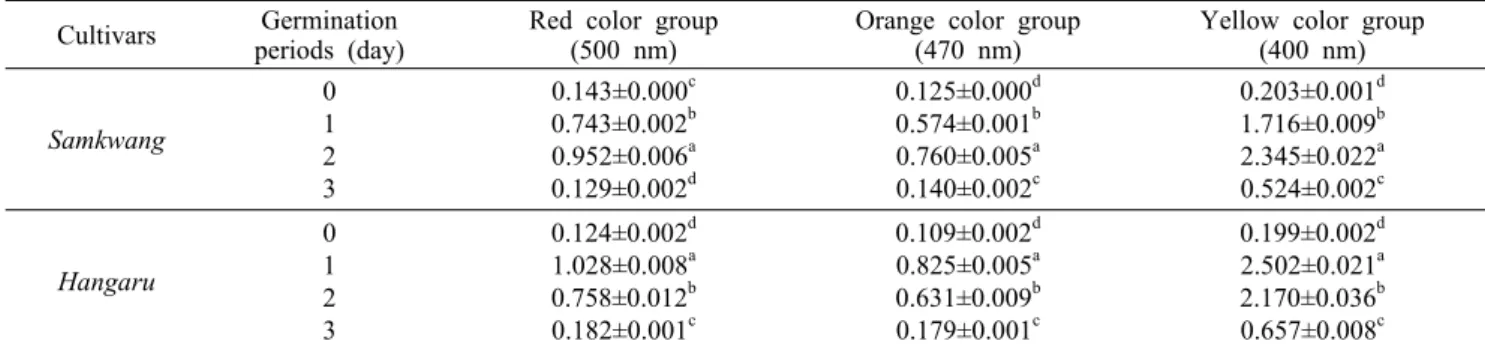
Table 1. Changes in Monascus pigments of germinated brown rice cultivated Monascus pilosus with different cultivars and germination periods
Cultivars Germination
periods (day) Red color group
(500 nm) Orange color group
(470 nm) Yellow color group (400 nm)
Samkwang
0 1 2 3
0.143±0.000c 0.743±0.002b 0.952±0.006a 0.129±0.002d
0.125±0.000d 0.574±0.001b 0.760±0.005a 0.140±0.002c
0.203±0.001d 1.716±0.009b 2.345±0.022a 0.524±0.002c
Hangaru
0 1 2 3
0.124±0.002d 1.028±0.008a 0.758±0.012b 0.182±0.001c
0.109±0.002d 0.825±0.005a 0.631±0.009b 0.179±0.001c
0.199±0.002d 2.502±0.021a 2.170±0.036b 0.657±0.008c Different letters (a-d) within the same column indicate a significant difference at P<0.05 by Duncan’s multiple range test.
50% Folin-Ciocalteu reagent 100 μL를 가하여 30분간 반응시킨다. 반응액을 Spectrophotometer(Uvikon 933, Kontron Instruments)를 이용하여 750 nm에서 측정하였 다. 표준물질인 gallic acid(Sigma-Aldrich Co.)를 사용하 여 검량선을 작성하였으며, 총 폴리페놀 함량은 시료 g 중의 mg gallic acid로 나타내었다. 총 플라보노이드 함량은 Dewanto 등(21)의 방법을 변형하여 측정하였다. 추출물 250 μL에 증류수 1 mL와 5% NaNO2 75 μL를 가한 다음, 5분 후 10% AlCl3・6H2O 150 μL를 가하여 6분 방치하고 1 N NaOH 500 μL를 가하였다. 반응 11분 후 반응액의 흡광 도 값을 spectrophotometer(Uvikon 933, Kontron Instr- uments)를 이용하여 510 nm에서 측정하였다. 표준물질인 catechin(Sigma-Aldrich Co.)을 사용하여 검량선을 작성 한 후 총 플라보노이드 함량은 시료 g 중의 mg catechin으 로 나타내었다.
통계처리
통계분석은 SPSS 통계프로그램(Statistical Package for the Social Science, Ver. 12.0, SPSS Inc., Chicago, IL, USA)을 이용하여 본 실험에서 얻어진 결과의 평균과 표준 편차를 산출하고 처리 간의 차이 유무를 one-way ANOVA (analysis of variation)로 분석한 뒤 Duncan’s multiple range test를 이용하여 유의성을 검정하였다.
결과 및 고찰
홍국색소의 변화
Monascus 속 균주의 주요 색소는 monascin과 anka- flavin(황색), rubropunctatin과 monascorubrin(오렌지색), rubropunctamine과 monascorubramine(적색) 색소가 대 표적으로 알려져 있으며, 단일 물질로 존재하는 것이 아니라 다양한 색소성분들의 복합체로 존재한다(22). 이들 색소성 분들은 특이적인 최대 흡수파장대를 가져 집단화할 수 있으 며 그 결과는 Table 1과 같다. 적색계(A500), 오렌지계(A470) 및 황색계(A400)에서 삼광은 발아 2일차에 가장 높게 측정되 었고, 한가루는 발아 1일차에 가장 높게 측정되었다. 발아하
지 않은 현미에 비해 발아현미가 높은 색도를 나타내었고 발아 3일 차에는 색소 생성이 현저하게 감소하는 것을 확인 하였다. 홍국색소 생성량 및 종류는 균주의 종류 및 생육 온도, 기질 등의 생육조건에 따라 차이가 발생한다고 알려져 있다(23,24). Lee 등(17)은 홍국균의 생육과 색소 생성이 높은 상관관계가 있다고 하였는데, 발아 3일 차에 따라 색소 생성량이 감소하는 것은 미생물의 생육이 저하되고 있는 것 으로 생각된다. 또한 발아에 따라 활성화된 α-amylase와 glucoamylase 등의 효소 작용으로 인해 전분과 단백질 같 은 고분자 물질이 단당, 올리고당 및 아미노산으로 분해되어 미생물이 이용하기 쉬운 형태가 되어 발아에 따라 홍국균의 성장이 촉진되지만(25), 발아 과정에서 연화된 전분 입자가 고온 고압의 살균과정에서 응집되어 홍국균이 이용할 수 있 는 비표면적이 작아지고 통기성이 저하되어 생육이 저하됨 으로써 색소 생성이 저하된 것으로 보인다.
Monacolin K 함량 변화
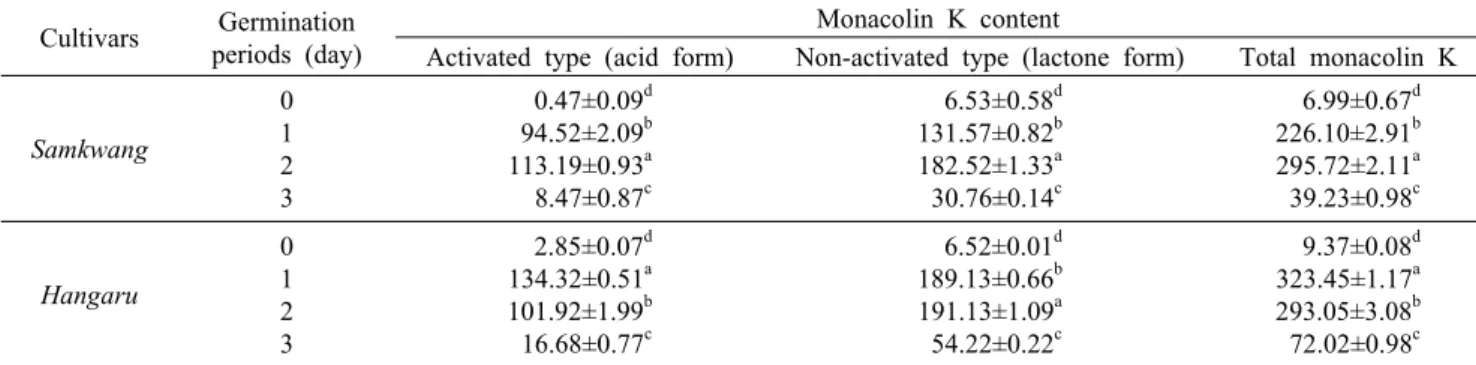
품종 및 발아 기간에 따른 홍국쌀의 monacolin K 함량 변화는 Table 2에 나타내었다. 본 연구에서 발아시키지 않은 현미의 경우 삼광과 한가루가 각각 6.66 mg/kg 및 9.37 mg/kg으로, Park 등(26)의 결과에서 두 가지 균주를 7종의 쌀품종(고아미, 고아미2, 상주찰벼, 설갱, 세계진미, 영호진 미, 칠보)을 백미로 도정하여 배양한 결과 상주찰벼가 각각 47.24 mg/kg과 117.03 mg/kg이 측정된 것과 비교하여 매 우 낮은 수준이었지만, 발아 1일 차에는 삼광과 한가루가 각각 226.10 mg/kg 및 323.45 mg/kg으로 발아 전에 비해 높은 함량을 나타내었으며, 가공용 쌀인 한가루 품종이 일반 쌀인 삼광에 비해 높게 나타났다. 이는 쌀의 발아에 의해 활성화된 효소들이 고분자 기질들이 저분자로 분해되어 홍 국균이 기질로써 사용하기 쉬운 형태가 되기 때문으로 보인 다. 그러나 발아 기간이 늘어남에 따라 총 monacolin K 함량 이 감소하는 경향을 나타내어, 발아 3일 차에는 삼광과 한가 루가 각각 39.23 mg/kg 및 72.02 mg/kg의 함량이 나타났 다. 이는 발아가 진행됨에 따라 탄소원, 질소원 및 무기성분 이 발아에 사용되어 홍국균이 기질로 사용하는 데 제한이 있는 것으로 생각된다. 삼광의 경우 발아 1일 차에 비해 2일
Table 2. Changes in activated and non-activated monacolin K content of germinated brown rice cultivated Monascus pilosus with different cultivars and germination periods (mg/kg)
Cultivars Germination periods (day)
Monacolin K content
Activated type (acid form) Non-activated type (lactone form) Total monacolin K
Samkwang
0 1 2 3
0.47±0.09d 94.52±2.09b 113.19±0.93a 8.47±0.87c
6.53±0.58d 131.57±0.82b 182.52±1.33a 30.76±0.14c
6.99±0.67d 226.10±2.91b 295.72±2.11a 39.23±0.98c
Hangaru
0 1 2 3
2.85±0.07d 134.32±0.51a 101.92±1.99b 16.68±0.77c
6.52±0.01d 189.13±0.66b 191.13±1.09a 54.22±0.22c
9.37±0.08d 323.45±1.17a 293.05±3.08b 72.02±0.98c Different letters (a-d) within the same column indicate a significant difference at P<0.05 by Duncan’s multiple range test.
Table 3. Changes in total polyphenol and flavonoid contents of germinated brown rice cultivated Monascus pilosus with dif- ferent cultivars and germination periods (mg/g)
Cultivars Germination periods (day) Total polyphenol
content Total flavonoid content
Samkwang 0 1 2 3
0.22±0.01d 1.25±0.02c 2.09±0.01b 2.23±0.01a
0.01±0.00d 0.31±0.02b 0.43±0.02a 0.23±0.01c
Hangaru
0 1 2 3
0.49±0.05c 2.65±0.01a 2.10±0.01b 2.06±0.02b
0.24±0.02c 0.56±0.01a 0.45±0.02b 0.27±0.01c Different letters (a-d)within the same column indicate a sig- nificant difference at P<0.05 by Duncan’s multiple range test.
차에 monacolin K 함량이 226.10 mg/kg에서 295.75 mg/
kg으로 높았다. 그러나 한가루 발아 1일 차의 경우 삼광 발 아 2일 차보다 높은 monacolin K 함량을 나타내 삼광에 비해 발아 기간이 짧고 monacolin K 함량이 높은 홍국쌀 제조에 적합할 것으로 판단된다.
총 폴리페놀 및 플라보노이드 함량 변화
품종 및 발아 기간에 따른 홍국쌀의 총 폴리페놀과 플라보 노이드 함량 변화는 Table 3과 같다. 발아 전 총 폴리페놀 및 플라보노이드 함량은 삼광이 각각 0.22 mg/g 및 0.01 mg/g을 나타낸 것에 비해 한가루가 각각 0.49 mg/g 및 0.24 mg/g으로 높게 측정되었다. 발아가 진행됨에 따라 총 폴리페놀 및 플라보노이드 함량이 삼광에서 1.25~2.23 mg/g 및 0.31~0.23 mg/g, 한가루가 2.65~2.06 mg/g 및 0.56~0.27 mg/g으로 급격하게 증가하였다. 또한 한가루와 삼광 발아 3일 차에 색도와 monacolin K 함량은 낮게 측정 되었으나 폴리페놀 함량은 발아 1, 2일 차와 비교하여 유사 하거나 더 높게 측정되었다. 이는 Lee 등(17)의 결과와 같이 벼의 발아가 진행됨에 따라 다양한 효소들이 활성화되어 결 합하여 있던 페놀 화합물이 유리형으로 전환되며, 한가루가 삼광에 비해 높은 함량을 보인 것은 한가루의 세포조직이 삼광에 비해 부드럽고 연하기 때문에 페놀 화합물의 추출이
증대된 것으로 판단된다. 또한 Kim 등(27)의 발아 기간이 증가함에 따라 페놀 화합물의 함량이 증가한다는 연구 결과 와 일치하였다.
요 약
일반쌀 품종인 삼광과 가공용으로 개발된 한가루 품종의 발 아현미를 이용하여 홍국쌀을 제조하고 홍국색소, monacolin K 함량 및 항산화 성분 변화를 조사하였다. 발아 전에 비하 여 발아 후의 색소 생성량이 삼광은 발아 2일 차에 높았으며, 한가루는 발아 1일 차가 높았다. 총 monacolin K 함량은 삼광에 비해 한가루가 높았으며, 발아 1일 차에 323.45 mg/
kg으로 가장 높았지만 발아 3일 차에는 72.02 mg/kg으로 급격하게 감소하였다. 또한 발아 전 삼광과 한가루에서 총 폴리페놀 함량은 0.22 및 0.49 mg/g이었으며, 플라보노이 드 함량은 0.01 및 0.24 mg/g이었지만 발아 후에 유의적으 로 증가하여 발아 1일 차에 한가루는 총 폴리페놀 및 플라보 노이드 함량이 각각 2.65 mg/g 및 0.56 mg/g으로 가장 높 았다. 이상의 결과로부터 홍국색소와 monacolin K 생성량 을 증가시키기 위한 기질로 일반미인 삼광 품종에 비해 가공 용으로 개발된 한가루 품종이 우수하였으며, 발아 1일 차가 홍국쌀 배양에 가장 적합하였다.
감사의 글
본 연구는 농림축산식품부 고부가가치식품기술개발사업(과 제번호: 118058-02)에 의해 수행되었으며, 이에 감사드립 니다.
REFERENCES
1. Oh HA, Kim MY, Lee YJ, Song MS, Lee CK, Lee YR, Lee J, Jeong HS. 2018. Quality characteristics of rice bread with different cultivars and milling methods. Korean J Food Sci Technol 50: 492-498.
2. Statistics Korea. Annual trends of food grain consumption in 2017. http://kosis.kr/statHtml/statHtml.do?orgId=101&tblId
=DT_1ED0002&conn_path=I2 (accessed Jan 2018).
3. Shin DS, Kim HY, Hong HC, Oh SG, Yoo SM. 2014. The effects on the quality of Tteokbokki tteok by different types cultivars of rice. Korean J Food Cook Sci 30: 271-277.
4. Korea seed and variety service. Grant of Plant Variety Pro- tection Right. http://www.seed.go.kr/protection/situation/seed search_01_view.jsp?appl_idty=134719&appl_knd=10 (accessed Apr 2017).
5. Kim HJ, Park JY, Lee SK, Park HY, Cho DH, Choi HS, Oh SK. 2017. Quality characteristics of rice cultivars suit- able for rice beer. Korean J Crop Sci 62: 113-117.
6. Kim SH, Park BW, Kim JH. 2015. Quality characteristics of Tarakjuk (milk porridge) prepared with red yeast-rice.
Korean J Food Nutr 2: 313-319.
7. Wang J, Lu Z, Chi J, Wang W, Su M, Kou W, Yu P, Yu L, Chen L, Zhu JS, Chang J. 1997. Multicenter clinical trial of the serum lipid-lowering effects of a Monascus purpureus (red yeast) rice preparation from traditional Chinese medi- cine. Curr Ther Res 58: 964-978.
8. Li CL, Zhu Y, Wang Y, Zhu JS, Chang J, Kritchevsky D.
1998. Monascus purpureus-fermented rice (red yeast rice):
A natural food product that lowers blood cholesterol in ani- mal models of hypercholesterolemia. Nutr Res 18: 71-81.
9. Heber D, Yip I, Ashley JM, Elashoff DA, Elashoff RM, Go VL. 1999. Cholesterol-lowering effects of a proprietary Chinese red-yeast-rice dietary supplement. Am J Clin Nutr 69: 231-236.
10. Martinkova L, Patakova-Juzlova P, Krent V, Kucerova Z, Havlicek V, Olsovsky P, Hovorka O, Rihova B, Vesely D, Vesela D, Ulrichova J, Prikrylova V. 1999. Biological activ- ities of oligoketide pigments of Monascus purpureus. Food Addit Contam 16: 15-24.
11. Akihisa T, Tokuda H, Yasukawa K, Ukiya M, Kiyota A, Sakamoto N, Suzuki T, Tanabe N, Nishino H. 2005. Azaphi- lones, furanoisophthalides, and amino acids from the extracts of Monascus pilosus-fermented rice (red-mold rice) and their chemopreventive effects. J Agric Food Chem 53: 562- 565.
12. Taira J, Miyagi C, Aniya Y. 2002. Dimerumic acid as an antioxidant from the mold, Monascus anka: the inhibition mechanisms against lipid peroxidation and hemeprotein-me- diated oxidation. Biochem Pharmacol 63: 1019-1026.
13. Lee CL, Wang JJ, Kuo SL, Pan TM. 2006. Monascus fermen- tation of dioscorea for increasing the production of choles- terol-lowering agent-monacolin K and antiinflammation agent-monascin. Appl Microbiol Biotechnol 72: 1254-1262.
14. Kwon CS. 2012. Antioxidant properties of red yeast rice (Monascus purpureus) extracts. J Korean Soc Food Sci Nutr 41: 437-442.
15. Lee YR, Kim JY, Woo KS, Hwang IG, Kim KH, Kim KJ, Kim JH, Jeong HS. 2007. Changes in the chemical and func- tional components of Korean rough rice before and after germination. Food Sci Biotechnol 16: 1006-1010.
16. Kim MJ. 1995. Analysis of the factors enhancing Monascus pigment production in mixed culture. PhD Dissertation. Yon- sei University, Seoul, Korea.
17. Lee SH, Jang GY, Kim MY, Kim S, Lee YR, Lee J, Jeong HS. 2015. Effect of Monascus fermentation on content of monacolin K and antioxidant activities of germinated brown rice. J Korean Soc Food Sci Nutr 44: 1186-1193.
18. Johns MR, Stuart DM. 1991. Production of pigments by Monascus purpureus in solid culture. J Ind Microbiol 8:
23-28.
19. KFDA. 2010. Health Functional Food Code. Korea Food and Drug Adminstration, Seoul, Korea.
20. Avula B, Cohen PA, Wang YH, Sagi S, Feng W, Wang M, Zweigenbaum J, Shuangcheng M, Khan IA. 2014. Chemical profiling and quantification of monacolins and citrinin in red yeast rice commercial raw materials and dietary supple- ments using liquid chromatography-accurate QToF mass spectrometry: Chemometrics application. J Pharm Biomed Anal 100: 243-253.
21. Dewanto V, Wu X, Liu RH. 2002. Processed sweet corn has higher antioxidant activity. J Agric Food Chem 50: 4959- 4964.
22. Patakova P. 2013. Monascus secondary metabolites: pro- duction and biological activity. J Ind Microbiol Biotechnol 40: 169-181.
23. Babitha S, Soccol CR, Pandey A. 2007. Solid-state fermen- tation for the production of Monascus pigments from jack- fruit seed. Bioresour Technol 98: 1554-1560.
24. Lee SM, Kim HS, Yu TS. 2003. The optimal condition for production of red pigment by Monascus anka on solid cul- ture. J Korean Soc Food Sci Nutr 32: 155-160.
25. Kim KY, Kim HG, Song BC, Cha CJ. 2006. Screening for fermentative microorganisms that grow on brown rice with high amylase and pretense activities. Korean J Microbiol 42: 160-163.
26. Park JY, Han SI, Seo WD, Ra JE, Sim EY, Nam MH. 2014.
Study on Monascus strains and characteristic for manu- facturing red yeast rice with high production of monacolin K. Korean J Crop Sci 59: 167-173.
27. Kim MY, Lee SH, Jang GY, Park HJ, Li M, Kim S, Lee YR, Lee J, Jeong HS. 2013. Effects of high pressure treat- ment on antioxidant compounds and activity of germinated rough rice (Oryza sativa L.). J Korean Soc Food Sci Nutr 42: 1783-1791.