Objectives : To develop and validate High-performance liquid chromatography-photodiode array methods for simultaneous determination of two constituents in Oryeong-san (ORS).
Methods : Reverse-phase chromatography using a Gemini C18 column operating at 40°C, and photodiode array(PDA) detection at 280 nm, were used for quantification of the two marker components of ORS. The mobile phase using a gradient flow consisted of two solvent systems.
Solvent A was H
2O and solvent B was acetonitrile.
Results : Calibration curves were acquired with correlation coefficient ( r
2)>0.9999, and the relative standard deviation(RSD) values(%) for intra- and inter-day precision were not exceed 1.0%. The recovery rate of each compound was in the range of 93.01-104.16%, with an RSD less than 2.0%. The contents of two compounds in ORS were 1.10-3.72 mg/g.
Conclusions : The established HPLC method will be helpful to improve quality control of ORS.
Simultaneous Determination of Cinnamaldehyde and Coumarin in Oryeong-san using HPLC with Photodiode
Array Detector
Chang-Seob Seo, Hyeun-Kyoo Shin
Herbal Medicine EBM Research Center, Korea Institute of Oriental Medicine
ABSTRACT
17)
•Correspondence to : Hyeun-Kyoo Shin
•Herbal Medicine EBM Research Center, Korea Institute of Oriental Medicine, Jeonmin-dong 461-24, Yuseong-gu, Daejeon, 305-811, Korea
•Tel : 042-868-9464 Fax : 042-864-2120 E-mail : [email protected]
•접수 : 2010/ 08/ 25 수정 : 2010/ 11/ 02 채택 : 2010/ 11/ 04
Key word : HPLC-PAD, Oryeong-san (ORS), Simultaneous determination, Herbal formula
I. Introduction
Many kinds of traditional oriental medicines have been attracting more and more attentions for their complementary therapeutic effects to western medicines with few or no side effect
1,2). However, although many traditional herbal medicines have been proven effective by modern pharmacological studies and clinical trials, their bioactive constituents and the remedial mechanism are still not well understood. Thus, traditional herbal medicines remain of considerable interest
3-5). Oryeong-san (ORS, Wuling-san in Chinese; Gorei -san in Japanese) is one of traditional herbal medicine and was first described in the Han dynasty(China, about AD168)
6). It is thirst and urine flow decrease, and it has been used widely for the treatment of headache.
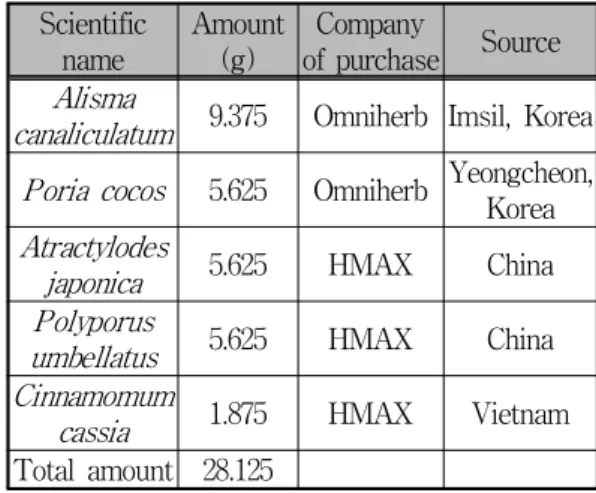
7)A composite traditional Korean medicine, ORS consist of five herbs including Alisma canaliculatum , Poria cocos , Atractylodes japonica , Polyporus umbellatus , and Cinnamomum cassia (Table 1). Recently, results from pharmacological studies indicated that ORS has therapeutic potentials against liver injury and obesity, and also enhance diuretic action
8-12). However, previous works have not been reported the simultaneous analysis about constituents of ORS by High-performance liquid chromatography (HPLC). Therefore, we needed to develop the
simultaneous determination for quality control of traditional herbal medicine.
HPLC is a convenient, widely used, and effective method to control the quality of botanical extracts and plants important in traditional Chinese medicine due to its rapid separation and quantification
13,14). Therefore, we here focused on quantitative determination of the main components of ORS, and used HPLC- PDA-coupled methods for simultaneous detection of two constituents(Fig. 1).
Fig. 1. Chemical structures of two constituents in Oryeong-san .
Ⅱ. Materials and Methods
1. Chromatographic system
We analyzed using a Shimadzu LC-20A HPLC
system(Shimadzu Co., Kyoto, Japan), consisting
of a solvent delivery unit, an on-line degasser, a
column oven, an autosampler, and a PDA
detector. The data processor employed LCsolution
software (Version 1.24). The analytical column
was used a Gemini C18(250×4.6 mm; particle
size 5 μm; Phenomenex, Torrance, CA). The mobile phases were solvent A (H
2O) and solvent B (Acetonitrile). The gradient flow was as follows:
(A)/(B)=75/25 (0 min) → (A)/(B)= 0/100 (30 min) → (A)/(B)= 75/25 (35 min; hold for 15 min). Column temperature was maintained at 40°C. The analysis was carried out at a flow rate of 1.0 mL/min with PDA detection at 280 nm.
The injection volume was 10 μL.
2. Reagents and materials
The reference standards of cinnamaldehyde and coumarin were purchased from Wako(Osaka, Japan) and Sigma-Aldrich(St. Louis, CA, USA). The purity of all reference standards was above 98.0%. The HPLC-grade reagents methanol, acetonitrile, and water were obtained from J.T. Baker(Phillipsburg, NJ, USA). The materials forming ORS were purchased from Omniherb and HMAX. All ORS components were taxonomically confirmed by Professor Je-Hyun Lee, Dongguk University, Korea.
A voucher specimen (2008-KE17-1 ∼ 2008-KE17-5) has been deposited at the Herbal Medicine EBM Research Center, Korea Institute of Oriental Medicine.
3. Preparation of standard solutions and calibration curves
A methanol standard stock solution containing compounds cinnamaldehyde(1,050 μg/mL) and coumarin(1,000 μg/mL) was prepared and stored below 4°C. Working standard solutions were prepared by serial dilution of stock solutions with methanol. All calibration curves were obtained from assessment of peak areas of standard solutions in the concentration ranges: cinnamaldehyde,
1.64-105.00 μg/mL; and coumarin, 0.78-50.00 μg/mL.
4. Preparation of sample solutions
An ORS was prepared in our laboratory from a mixture of chopped crude herbs purchased from Omniherb(Yeongcheon, Korea) and HMAX(Chungbuk, Korea). ORS was prepared as described in Table 1 and extracted in distilled water at 100°C for 2 h. The extract was evaporated to dryness and freeze-dried(yield; 22.7%). Lyophilized ORS extract was weighed(200 mg) into a 20 mL flask and distilled water added to the volumetric mark, and then the mixture was filtered a 0.2 μm syringe filter. Injection volume for HPLC analysis was 10 μ L.
Scientific
name Amount
(g) Company
of purchase Source Alisma
canaliculatum 9.375 Omniherb Imsil, Korea Poria cocos 5.625 Omniherb Yeongcheon, Korea Atractylodes
japonica 5.625 HMAX China Polyporus
umbellatus 5.625 HMAX China Cinnamomum
cassia 1.875 HMAX Vietnam
Total amount 28.125
Table 1. Composition of Oryeong-san
5. Limits of detection (LODs) and quantification (LOQs)
Stock solutions of reference compounds were
further diluted with methanol to assess LOD and
LOQ values. The LOD and LOQ data obtained
under the chromatographic conditions used in this
report were determined using signal-to-noise(S/N)
ratios of 3 and 10, respectively.
6. Precision and accuracy
Repeatability was assessed by analysis of seven independently prepared standard solutions. The relative standard deviation(RSD) of peak areas of analytes, and peak retention times for each standard, were calculated. Intra- and inter-day precision was determined using a standard addition method to prepare spiked samples, employing both standards and controls.
Recovery tests were performed by adding known amounts of reference standards to ORS samples before extraction. An average recovery was calculated using the formula: Recovery (%)
= (Amount
determined–Amount
original)/Amount
spiked× 100.
Ⅲ. Results and Discussion
1. Optimization of chromatographic conditions We obtained satisfactory separation using mobile phases consisting of (A) H
2O and (B) acetonitrile,
with a gradient flow of (A)/(B)=75/25 (0 min)
→ (A)/(B)=0/100 (30 min) → (A)/(B)=
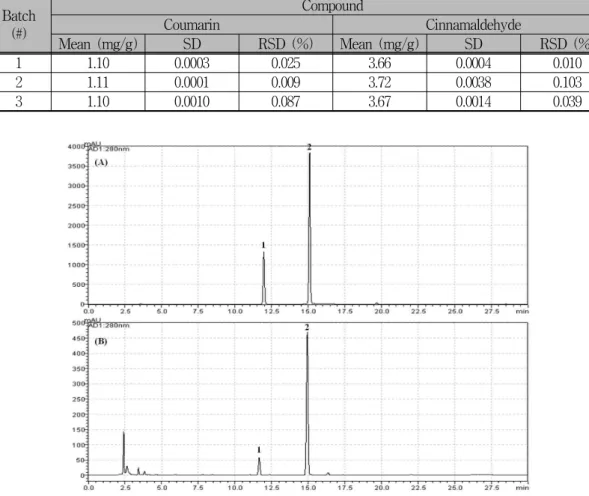
75/25 (35 min; hold for 15 min). Quantitation was achieved by PDA detection at 280 nm, based on peak area. The selectivity of the HPLC protocol is illustrated in Fig. 2, where good separation of marker compounds from other components of the extract can be noted. Using optimized chromatography conditions, all analytes were eluted before 20 min, showing a resolution better than 6.0, and good specificity in sample analysis. Representative HPLC chromatogram of standards and extract was shown in Fig. 2.
2. Recovery
A recovery test was performed by addition of known amounts of cinnamaldehyde and coumarin.
Standard compounds, at each of three different levels, were mixed with sample powder, and extracted. The recovery of each standard ranged from 93.01-104.16%, and the RSD range was 0.41-1.61%(Table 2).
Compound Original mean
(ug/mL) Spiked
(ug/mL) Detected mean
(ug/mL) Recovery mean
(%) SD RSD(%)
Coumarin 11.07 2.00 12.93 93.01 1.51 1.62
5.00 16.23 103.19 0.41 0.41
10.00 21.26 101.98 0.57 0.57
Cinnamaldehyde 37.27 8.40 45.54 98.37 1.19 1.21
21.00 57.67 97.14 0.49 0.50
42.00 81.02 104.16 0.71 0.68
Table 2. Recovery of two marker compounds (n=3)
3. Linearity, range, LOD, and LOQ
Calibration curves were obtained using standard solutions containing 1.64-105.00 μg/mL of
cinnamaldehyde and 0.78-50.00 μg/mL of coumarin
as marker compounds. Line equations representing
calibration curves and correlation coefficients
thereof are summarized in Table 3.
The LOD value of cinnamaldehyde and coumarin was 0.04 ug/mL and 0.11 μg/mL, respectively.
The LOQ value of cinnamaldehyde and coumarin was 0.15 ug/mL and 0.37 μg/mL, respectively.
These data are shown in Table 3.
Compound Linear range
(ug/mL) Slope Intercept Correlation
coefficient (R
2) LOD
(ug/mL) LOQ
(ug/mL)
Coumarin 0.78-50.00 42536.98 -4343.49 1.0000 0.11 0.37
Cinnamaldehyde 1.64-105.00 107074.16 -46100.12 0.9999 0.04 0.15 Table 3. Regression data, linear ranges, LODs and LOQs for marker compounds
4. Precision and accuracy
Repeatability or intra-assay precision was assessed by repeatedly measuring retention times and peak areas for three independently prepared samples of analytes. Measurement precision was less than RSD 1.0% for peak responses and less than RSD 0.05% for retention times, with all analytes. Thus, the HPLC assay offered good reproducibility under optimized conditions.
To test the accuracy and precision of our analytical method, intra- and inter-day variations for measurement of two marker compounds were determined, and are summarized in Table 4. The precision of the method in simultaneous determination of the two marker compounds was acceptable
because the RSD did not exceed 1.0% at any concentration. The intra-day accuracy ranged from 93.34-101.88%, and the inter-day accuracy from 93.58-101.64%.
5. Determination of the main constituents of Oryeong-san
To simultaneous determination, we analyzed two compounds, coumarin and cinnamaldehyde, in ORS. Fig. 2 show chromatogram of reference compounds and water extract of ORS, with detection of eluent at 280 nm. The analytical results for each compound identified are summarized in Table 5.
Compound Spiked Conc.
(ug/mL)
Intra-day Inter-day
Observed Conc.
(ug/mL) Precision
(RSD %) Accuracy
(%) Observed Conc.
(ug/mL) Precision
(RSD %) Accuracy (%)
Coumarin 2.00 1.87 0.14 93.34 1.87 0.77 93.58
5.00 5.09 0.46 101.88 5.08 0.31 101.64
10.00 9.98 0.11 99.80 9.98 0.08 99.85
Cinnamaldehyde 8.40 8.40 0.07 100.00 8.40 0.51 100.04
21.00 20.05 0.21 95.45 20.06 0.16 95.50
42.00 42.48 0.05 101.14 42.47 0.04 101.12
Table 4. Precision and accuracy of analytical results (n=3)
Batch (#)
Compound
Coumarin Cinnamaldehyde
Mean (mg/g) SD RSD (%) Mean (mg/g) SD RSD (%)
1 1.10 0.0003 0.025 3.66 0.0004 0.010
2 1.11 0.0001 0.009 3.72 0.0038 0.103
3 1.10 0.0010 0.087 3.67 0.0014 0.039
Table 5. Analytical results for marker compounds in Oryeong-san
Fig. 2. Representative HPLC chromatogram of the standard mixture (A) and Oryeong-san (B).
Number 1 and 2 in the chromatogram indicate coumarin and cinnamaldehyde, respectively.