접수일자 : 2009년 11월 30일 완료일자 : 2010년 2월 1일
이 논문은 대구대학교 학술연구비 일부지원에 의한 논 문임
퍼지 ARTMAP에 의한 한글 차량 번호판 인식 시스템 설계
Design of a Korean Character Vehicle License Plate Recognition System
웅성1․최병재2
Xing Xiong and Byung-Jae Choi
1대구대학교 전자공학과 E-mail: [email protected]
2대구대학교 전자공학과 E-mail: [email protected]
요 약
Recognizing a license plate of a vehicle has widely been issued. In this thesis, firstly, mean shift algorithm is used to filter and segment a color vehicle image in order to get candidate regions. These candidate regions are then analyzed and classified in order to decide whether a candidate region contains a license plate. We then present an approach to recognize a vehicle's license plate using the Fuzzy ARTMAP neural network, a relatively new architecture of the neural network family. We show that the proposed system is well to recognize the license plate and shows some compute simulations.
키워드 : License plate recognition, Image processing, Mean shift algorithm, Fuzzy ARTMAP Neural Network
1. Introduction
During the past few years, intelligent transportation systems (ITSs) have had a broad impact in people's lives as they have improved transportation safety and mobility and enhanced productivity through the use of advanced technologies. These systems are divided into intelligent infrastructure systems and intelligent vehicle systems. In this paper, a computer vision and character recognition algorithm for a license plate recognition (LPR) is presented. The system presented is suitable as a core component for use in intelligent infrastructures like electronic payment (toll payment, parking fee pay- ment) systems, and freeway and arterial management systems for traffic surveillance. Moreover, as increased security awareness has made the need for vehicle based authentication technologies extremely significant, the proposed system may be employed as an access control system for monitoring of unauthorized vehicles entering private areas.
The license plate remains as the principal vehicle identifier despite the fact that it can be deliberately al- tered in situations of fraud or replaced (e.g. with a sto-
len plate). Therefore, ITSs rely heavily on robust LPR systems. The main job is to analyze images obtained from the camera, according to an image processing technique, and then recognize some characters in the plate. Specifically, the contributions are as follows:
1) a discontinuity preserving smoothing technique named mean shift algorithm used for faster de- tection of regions of interest (RoI);
2) an algorithmic sequence called Fuzzy ARTMAP is used to recognize some characters.
There are three stages in the recognition process: li- cense plate detection, character extraction and character recognition. They will be presented in detail in the next part.
2. Design of License Plate Recognition System
The LPR sequence, which is proposed in this paper, consists of two distinct parts. The first one deals with the detection of the RoI, i.e., the license plate. The sec- ond part includes operations for the successful segmen- tation of the license plate characters along with an arti- ficial neural network, which performs the OCR task.
we first discuss a License Plate Segmentation. This part consists of preprocessing in order to detect the RoI in ambient illumination conditions. The preprocessing
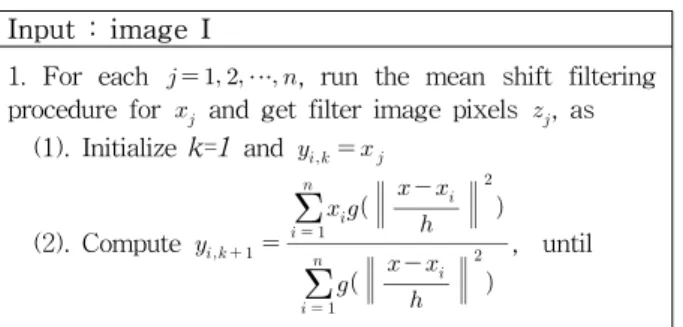
Input : image I
1. For each ⋯ , run the mean shift filtering procedure for and get filter image pixels , as (1). Initialize k=1 and
(2). Compute
∥
∥
∥
∥
, until
convergence, and . Where
′ ∥∥ .
(3). Assign .
The superscripts s and r denote the spatial and range components of a vector, respectively. The assignment specifies that the filtered data at the spatial
will have the range component of the point of convergence . 2. Delineate the clusters ⋯ in the joint domain by grouping together all which are closer than in the spatial domain and in the range domain.
3. For each ⋯ , assign ∈
4. Eliminate spatial regions that are smaller than M pixels
component consists of four tasks: implementation of the mean shift filtering method, delineation of the cluster, elimination of spatial regions smaller than M pixels, and extraction of the rectangularity and aspect ratio. The discontinuity preserving smoothing of the mean shift algorithm is indicated in Table I.
An image is typically represented as a two-dimen- sional lattice of p-dimensional vectors. The space of the lattice is known as the spatial domain, while gray level, color, or spectral information is represented in the range domain. For both domains, Euclidean metric is assumed.
When the location and range vectors are concatenated in the joint spatial-range domain of dimension d=p+2, their different nature has to be compensated by proper normalization. Thus the multi-variate kernel is defined as the product of two radially symmetric kernels and Euclidean metric allows a single bandwidth parameter for each domain
∥
∥
∥
∥
(1)where is the spatial variable, is the range vari- able of a feature vector, is the common profile used in both of the two domains, and C is the corre- sponding normalization constant.
In the joint spatial-range domain we used mean shift filtering, each data point is associated to a point of con- vergence which represents the local mode of the density in the d-dimensional space. Smoothing through replac- ing the pixel in the center of a window by the average of the pixels in the window indiscriminately blurs the image, removing not only the noise but also salient information. Discontinuity preserving smoothing techni- ques, on the other hand, adaptively reduce the amount of smoothing near abrupt change in the structure. The procedure continues until all pixels in the image are scanned.
The license plate segmentation operation is im- plemented on the mean shift filtered images. The origi- nal input image is firstly normalized with a normal ker- nel function, where the bandwidth in the spatial domain and the range domain are denoted as and , respectively. Let and , ⋯ , be the d-dimen- sional input and filtered image pixels in the joint spa- tial-range domain.
Table I. Discontinuity Preserving Smoothing
Since this process takes into account simultaneously both the spatial and range information of the image, it can achieve a high quality, discontinuity preserving spatial filtering.
After the candidate regions are obtained by applying mean shift filtering, features of each region are to be extracted in order to correctly differentiate the license plate regions from others. Various features have been utilized for this purpose. Such features include the size of the region, the width and the height of the region, the orientation of the characters, edge intensity, and po- sition of the region. Some features, however, can only deal with images captured under very specific environ- mental conditions.
The license plate has a rectangular shape with a pre- determined length to width ratio on each kind of vehicle. Due to the viewing angle and uneven or curvy road surfaces, however, license plate images taken from a vehicle image are usually no longer a standard rec- tangular shape. Under limited distortion, however, li- cense plates in vehicle images can still be viewed as approximately as rectangular shape with a certain as- pect ratio. This is the most important shape feature of license plates.
A quick and straightforward method is used to detect the edge of the object region to get its minimum en- closing rectangle (MER). With this method, an edge of RoI is a transition from background to object or vice versa. But for an image that contains a license plate may also include the dynamo and fore-baffle etc, which have very strong horizontal edges. We can see that a vertical edge detector is better than a horizontal edge detector in suppressing horizontal noise.
(2) Where f(i, j) represents the gray image of the input
image after smoothing and normalization, and
represents the horizontal edge map and vertical edge map respectively.
The aspect ratio is defined as the ratio of the width to the height of the region’s MER. Since the MER of the object region can be computed via rotating the re- gion in the previous section, the dimension of the ob- ject’s MER can be taken as the width and the height of the region. This ratio is defined by
max min
max min
(3)
where c indicates column and r indicates row. The orientation of the object is defined by
tan
(4)
Those candidate regions whose measurements fulfill the criteria orientation <35°, 2<aspect ratio<6, are con- sidered as candidate plate regions.
After applying the above three features to filter the segmented regions, many non-license plate regions can be removed. However, there are still many candidate regions left which have similar rectangularity and as- pect ratio features as the license plate regions do, such as the head lights. The edge density is measured in a region R by averaging the intensities of all edge pixels within the region as
∈
(5)
where represents the edge magnitude at loca- tion(i, j), and is the number of pixels in region R.
The next part is the consists of the preprocessing and forward step. Preprocessing isolates the characters in the license plate image. And the forward step sends those characters to the Fuzzy ARTMAP network for identification.
Following the inversion of the resulting image and object labeling, the orientations and heights of con- nected components (objects) are then calculated. The components whose measurements do not fulfill specific rules (orientation > 75◦ and height > 32 pixels) are deleted. The remaining objects are then forwarded to Fuzzy ARTMAP after a well defined preparation proc- ess, which includes character segmentation calculating the standard deviation of columns and rows, and, fi- nally, transformation of each character to the size of the input vector of the Fuzzy ARTMAP. Fig 3 presents ex- amples of license plate processing with the proposed algorithm.
After the Character Segmentation is finished, the next problem is character recognition. A combination of neural and fuzzy techniques (Fuzzy ARTMAP) is used
to guarantee a very low error rate at an acceptable rec- ognition rate. It is widely applied in practice, which will be introduced in the following paragraphs.
ARTMAP (Adaptive Resonance Theory - Mapping) is a class of neural networks that can perform in- cremental supervised learning. It also performs mul- ti-dimensional mapping in response to binary input vectors presented arbitrarily. The Fuzzy ARTMAP ex- tends the ARTMAP by integrating fuzzy logic into the system, which allows it to accept input vector values between 0 and 1.
Fuzzy ARTMAP consists of two fuzzy ART modules (ARTa and ARTb). The parameters of these networks are designated respectively by the subscripts a and b.
The two Fuzzy ARTs are interconnected by a series of connections between the F2 layers of ARTa and ARTb. These connections form what is called the map field Fab. The map field is used to form predictive associa- tions between categories and to realize the match tracking rule, whereby the vigilance parameter of ARTa increases in response to a predictive mismatch at ARTb.
The input to ARTa and ARTb are in complement code form, which is necessary for the successful oper- ation of fuzzy ARTMAP. For ARTa, if input is
⋯
, then
⋯⋯ (6) where
≤ ≤
The activity vector is denoted by
⋯
and the activity vector with number of categories is denoted by ⋯
. and are arbitrary. For ARTb, ⋯
,
. The activity vector is denoted by
⋯
and the activity vector with number of categories is denoted by ⋯
. and are also arbitrary. For the inter-ART modules, the map field output vector is denoted by
⋯
, and let ⋯
denote the weight vector from the j-th node to . Vectors
are initialized to zero between input presentations.
The inter-ART module is activated whenever any of the ARTa or ARTb categories is active. The
output vector obeys
∧
and
′
′ and
and ′
(7)
During the learning phase, the input vector Io, is pre- sented to ARTa and the desired output vector Oo, is presented to ARTb. The ARTa vigilance parameter , equals the baseline vigilance, at the beginning of ev- ery input presentation. When Fuzzy ARTMAP receives an input/output pair(), ARTa chooses the Jth node of and ARTb chooses the Kth node of . When both ARTa and ARTb are active and ≠ , then the input/output pairs are associated with the equation:
and
(8)
The ARTa and ARTb modules classify the input and desired output vector into categories, then the map field (inter-ART module) makes associations from the ARTa
category to the ARTb category.
If , then there is a mismatch. The Inter-ART module triggers a match tracking mechanism, which in- creases , by a minimum value and, hence, forces the ARTa module to search for another category suitable to be associated with the desired output vector. ρa is then set back to the baseline vigilance parameter, , for ev- ery step of learning trial.
3. Simulation Results
The characters used to test the performance of the algorithm were extracted from a wide variety of images of vehicles. They are not idealized representations. The origin of these characters means that they are very varied in their size, orientation, completeness and meth- od collection.
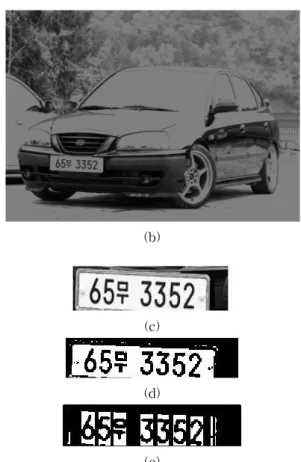
A lot of templates are needed in the proposed system which requires substantial time to make the classifier, but it is essential. Some of the obtained images from the digital camera are shown in Fig 1.
(a)
(b)
(c)
(d)
(e)
Fig. 1. Step for license plate segmentation (a) Initial image. (b) Result of mean shift algorithm and edge
detection. (c) Plate detection. (d) Binary image. (e) Successful segmentation of character
The inputs of Fuzzy ARTMAP algorithm are the im- ages of numbers and letters on vehicle license plates.
The testing set has 300 characters, around 96% of the characters have better quality, the others are all degen- erate to different degree.
4. Conclusion and Future Extensions
This paper presented an effective character recog- nition method based on mean shift algorithm and a Fuzzy ARTMAP neural network classifier which in- creased the recognition rate of the system. The pro- posed binarization method provides a good result which conforms to the final recognition rate.
We are currently undertaking research for extracting key points from the vehicle mask on the basis of li- cense plate position and creating a digital signature for every vehicle model. Moreover, for under-vehicle in- spection, it is assumed that a template under-vehicle image for each inspected vehicle has been archived into a database in advance. Based on the incoming vehicle license plate, the respective template image is retrieved from the database and then compared to the one ac-
quired during real-time under-vehicle inspection.
References
[1] Chang Seok Park, Byeong Man Kim, Byung Hoon Seo, Jun Woo Kim, and Kwang Ho Lee.,
"Real-time Recognition of Car License Plate on a Moving Car," Korea Society of Industrial Information System, vol. 9, no. 2, pp. 32-43, 2004.
[2] Kwang-Baek Kim and Jae-Hyun Cho, Korea Society of Computer Information System, vol. 12, no. 5, pp. 313-319, 2007.
[3] Kwang-Baek Kim, Young Woon Woo and Choong-Shik Park, “Recognition System of Car License Plate using Fuzzy Neural Networks,”
International Journal of Maritime Information and Communication Sciences, vol. 11, no. 5, pp.1004-1012, 2007.
[4] N. A. Khan et. al., "A License Plate Recognition System," Int. Conf. on Applications Digital Image Processing XXI, 1998
[5] J. R. Cowell, "Syntactic Pattern Recognizer for Vehicle License Plates," IEEE Trans. on Vehicular Technology, vol.4, no.4, pp. 13-19, 1995 [6] Dorin Comaniciu and Peter Meer, "Mean Shift: A Robust Approach Toward Feature Space Analysis," IEEE Transactions on Pattern Analysis and Machine Intelligence, vol. 24, no. 5, pp. 603-619, 2002.
[7] Gail A. Carpenter, Stephen Grossberg, Natalya Markuzon, John H. Reynolds, and David B. Bosen,
"Fuzzy ARTMAP: A Neural Network Architecture for Incremental Supervised Learning of Analog Multi-dimensional Maps," IEEE Transactions on Neural Networks, vol. 3, no. 5, pp. 698-713 1992.
저 자 소 개
Xing Xiong
He received his B.S. degree in automation engineering at NanJing Institute of Technology, and M.S.
degree from Daegu University. He is currently Doctor Course in the School of Electronic Engineering from Daegu University. His research interests include intelligent control and embedded systems.
Byung-Jae Choi
He received his B.S. degree in electronic engineering at Gyeongbuk National University, and M.S. degree and Ph.D. from KAIST. Since 1999 he is working at Daegu University. His research interests include intelligent control and systems.
Phone : 053-850-6633 Fax : 053-850-6619 E-mail : [email protected]