Implicit Surface Representation of
Three-Dimensional Face from Kinect Sensor
수료 아드히 워보워* ․ 김은경* ․ 김성신**
†Suryo Adhi Wibowo, Eun-Kyeong Kim, and Sungshin Kim
†*부산대학교 전자전기컴퓨터공학과, **부산대학교 전기컴퓨터공학부
*Department of Electrical and Computer Engineering, Pusan National University
**School of Electrical and Computer Engineering, Pusan National University
본 논문은 BK21플러스, IT기반 융합산업 창 의인력양성사업단에 의하여 지원되었으며, 산업통상자원부가 지원하는 산업융합ㆍ연 계형 로봇창의인재양성사업의 연구결과로 수행되었음.(N0001126)
This is an Open-Access article distributed un- der the terms of the Creative Commons Attribution Non-Commercial License ( ht t p: / / c r ea t i v ec ommon s . or g / l i- censes/by-nc/3.0) which permits unrestricted non-commercial use, distribution, and re- production in any medium, provided the orig- inal work is properly cited.
Abstract
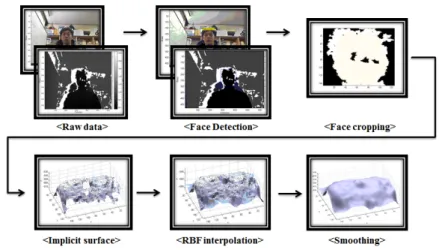
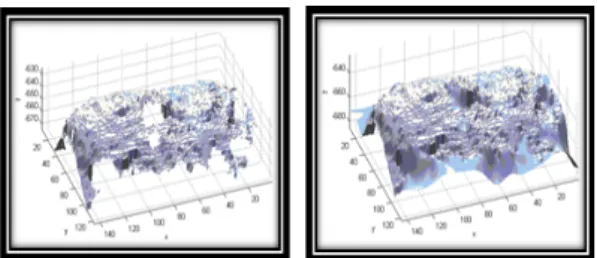
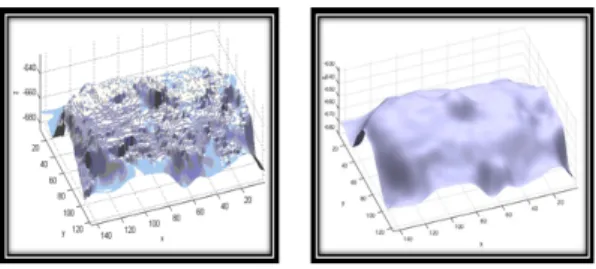
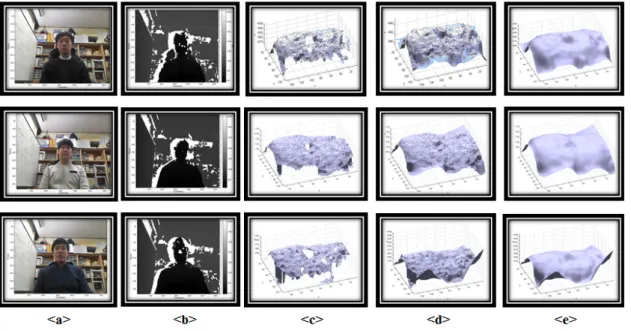
Kinect sensor has two output data which are produced from red green blue (RGB) sensor and depth sensor, it is called color image and depth map, respectively. Although this device’s prices are cheapest than the oth- er devices for three-dimensional (3D) reconstruction, we need extra work for reconstruct a smooth 3D data and also have semantic meaning. It happened because the depth map, which has been produced from depth sensor usually have a coarse and empty value. Consequently, it can be make artifact and holes on the surface, when we reconstruct it to 3D directly. In this paper, we present a method for solving this prob- lem by using implicit surface representation. The key idea for represent implicit surface is by using radial basis function (RBF) and to avoid the trivial solution that the implicit function is zero everywhere, we need to defined on-surface point and off-surface point. Based on our simulation results using captured face as an input, we can produce smooth 3D face and fill the holes on the 3D face surface, since RBF is good for in- terpolation and holes filling. Modified anisotropic diffusion is used to produced smoothed surface.
Key Words : Implicit surface, Radial basis function, Three-dimensional face, Kinect sensor.
Received: Mar. 22, 2015 Revised : Apr. 5, 2015 Accepted: May. 5, 2015
†Corresponding author [email protected]