• 검색 결과가 없습니다.

Analysis of Airtightness and Air Leakage of Wooden Houses in Korea

N/A
N/A
Protected

Academic year: 2021

Share "Analysis of Airtightness and Air Leakage of Wooden Houses in Korea"

Copied!
8
0
0

로드 중.... (전체 텍스트 보기)

전체 글

(1)

1. INTRODUCTION

Climate change and high energy cost have in- creased the demand of energy efficient buildings. Heat loss through building envelope must be reduced to achieve energy efficient building. The heat loss through building enve- lopes consists of thermal transmittance of build- ing envelope directly, and heat loss due to air leakage through cracks, gaps, or holes of build- ing envelops. That is represented by thermal transmittance and this is done by airtightness of building envelope.

After a couple of oil shocks in 1970s, the

amount of thermal insulation in building enve- lope had increased in order to improve building energy performance through low thermal trans- mittance of the building envelopes. However, it is difficult to satisfy the needs of residents on low energy consuming house only by improving thermal transmittance of building envelopes.

Not only thermal transmittance but also airtight- ness of building envelope should be improved to achieve expected energy performance be- cause of two major heat loss paths.

Normalized energy demands of a building can be measured by the evaluation of building

Original Article

Analysis of Airtightness and Air Leakage of Wooden Houses in Korea 1

Sejong Kim

2,†

⋅Yoon-Seong Chang

2

⋅Joo-Saeng Park

2

⋅Kug-Bo Shim

2

ABSTRACT

Airtightness of buildings is one of critical aspects of its energy performance. To build up references of air- tightness of wooden houses built in Korea, blower door tests have been carried out in 42 houses since 2006.

Causes of air leakage were investigated recently. The average value of air change rate was 3.7 h

-1

for light frame house and 5.5 h

-1

for post-beam construction at ACH50 (air change per hour at 50 Pa air pressure differ- ence). Foam type insulation was more advantageous in ensuring building airtightness than glass fiber batt.

Airtightness of wooden houses which were constructed after 2010 was improved to have less than 1.5 h

-1

of ACH50, threshold for application of artificial air change. The average air change rate of CLT (cross laminated timber) houses showed the lowest value, 1.1 h

-1

, among the tested structures.

Keywords : building airtightness, wooden house, air leakage, blower door

1

Date Received September 29, 2017, Date Accepted October 30, 2017

2

Division of Wood Engineering, Department of Forest Products, National Institute of Forest Science, Seoul 02455, Republic of Korea

Corresponding author: Sejong Kim (email : [email protected], ORCID: 0000-0002-0844-7726)

(2)

energy performance based on the thermal trans- mittance and airtightness of building envelopes.

The thermal transmittance is calculated based on the building envelope composition. However, the airtightness of a building should be meas- ured in situ after construction completion, be- cause it is affected by construction accuracy and technical expertise. Consequently, the data bases of building airtightness have been estab- lished in northern America (Chan et al., 2013) and Europe (Wei, 2010; Sinnott and Dyer, 2012; Vinha et al., 2015; Bramiana et al., 2016) where studies on low energy houses had implemented in advance. Building airtightness has been measured in Korea (Yoon et al., 2008; Jo, 2010). However, the airtightness measurements did not include wooden house because there were small number of wooden houses constructed annually, less than 2,000 houses permitted up to mid 2000s. Therefore, there is no available airtightness reference value of wooden houses in Korea.

Recently, the Korean government strength- ened policy of energy efficiency of existing buildings which were more than 90% of total buildings. Existing wooden houses in Korea had very poor energy performance because of many defects derived from construction and manage- ment without sufficient expertise and regional considerations. So, the current building energy performance of existing wooden houses in Korea were investigated for estimation of en- ergy saving potentials, focusing on the poor building airtightness and its causes.

In this study, evaluation of airtightness and

air leakage causes of wooden houses in Korea was implemented for reference value of build- ing energy analysis.

2. MATERIALS and METHODS 2.1. Description of the tested houses

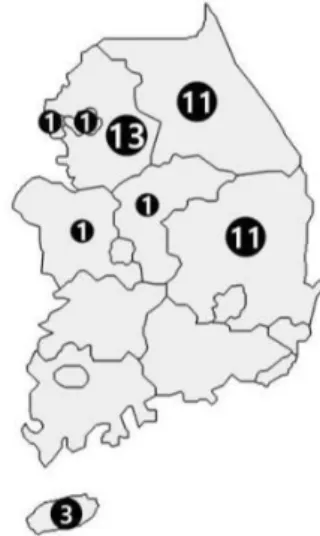
Blower door test of 42 wooden houses in 16 cities in Korea were carried out since 2006.

Ten of them were post and beam construction including Korean traditional wooden house, Han-ok. Two of them were CLT (cross lami- nated timber) construction. The rest of them were light frame houses.

The number of measurements and the loca- tion of tested houses is shown in Fig. 1.

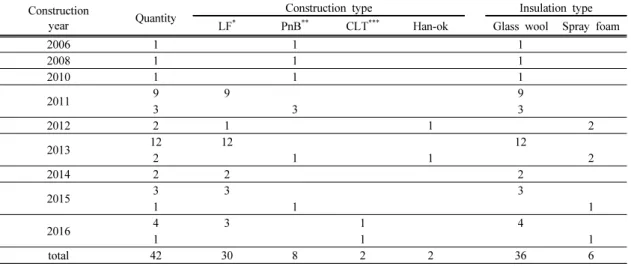
Table 1 shows the specifications of the meas- ured houses. The oldest house was constructed in 2006 and the newest one was done in 2016.

Construction types were a) light frame, b) post

Fig. 1. Location and number of tested wooden

houses.

(3)

and beam, c) CLT and d) Han-ok. Two kinds of insulation type, glass wool and spray foam, were installed. Spray foam type insulation is used for building airtightness in Korea. In some cases, air barrier with thin membrane type was added on building envelops for better building airtightness.

2.2. Blower Door Test

In order to determine the air change rate through a building envelope, tracer gas or blower door fan can be used. The blower door test using building pressure differences is more widely used than the other because of con- venience of measurement in the field. So, in this study, the blower door test was used for evaluation of building airtightness. The details of test process is described in ASTM E779-87 and ISO 9971. To compare the stability of in-

sulation, the pressurization and depressurization test mode was applied (Fig. 2).

Actual air change at natural pressure differ- ence is too small and variable to quantify. So, it is obtained by regressive method, which uses measured airflow values at higher building pres- sure differences and building leakage curve equation follow (1).

Fig. 2. Depressurization (left) and pressurization (right) mode of blower door test.

Construction

year Quantity Construction type Insulation type

LF

*

PnB

**

CLT

***

Han-ok Glass wool Spray foam

2006 1 1 1

2008 1 1 1

2010 1 1 1

2011 9 9 9

3 3 3

2012 2 1 1 2

2013 12 12 12

2 1 1 2

2014 2 2 2

2015 3 3 3

1 1 1

2016 4 3 1 4

1 1 1

total 42 30 8 2 2 36 6

* LF: light frame

** PnB: post and beam

*** CLT: cross laminated timber

Table 1. Specifications of tested houses

(4)

   ×  ··· (1) where: Q = air flow(m

3

/h),

C = flow coefficient(m

3

/(h ⋅Pa

n

)), ΔP = pressure difference(Pa), n= exponent.

Canadian general standard board (CGSB 149.10-M86), EN13829 and ASTM E779-10, common standards to determine building air- tightness, can be distinguished by the range of pressure differences and the number of data points. In this study, CGSB, with 8 data points at relatively lower pressure differences than the others, was used, because all the measured houses were detached ones with smaller air pressure difference than common tall buildings.

ACH50, common normalized criteria for build- ing airtightness, is obtained from dividing the air flow at 50 Pa pressure difference by the in- ner volume of the building.

2.3. Inspection of Air Leakage

In order to find out causes of induced poor building airtightness, infrared camera and vane anemometer were used (Fig. 3). The infrared

camera was used to inspect heat loss spot. The vane anemometer was used to confirm whether the heat loss was induced from air leakage or not.

3. RESULTS and DISCUSSION

Bramiana et al. (2016) reviewed some papers concerned with building airtightness and analyse influencing variables for that. In this study, construction year, construction type, insulation type and application of air barrier were use for influencing variables for analysis.

3.1. Effect of Construction Year on Building Airtightness

The 30 measurements of building airtightness in light frame houses are shown in Fig. 4.

Building airtightness by the construction year had improved gradually. Montoya et al. (2010) and Sinnott et al. (2012) had proved con- struction year as influencing variable. The air change rate values less than 1.5 h

-1

of ACH50 had appeared after 2012. The thermal trans- Fig. 3. Infrared camera (left) and vane anemometer

(right). Fig. 4. Building airtightness change of light frame

constructions.

(5)

mittance of building envelopes is restricted by the Korean building codes. The Korean govern- ment has a plan to strengthen the regulations on thermal transmittance to the goal of zero energy homes by 2025. For not only this reason but al- so rapid increase of wooden house demand af- ter 2005 (Fig. 5), the owners and builders of wooden houses had more interest on building energy performance. As a result, the airtightness of Korean wooden houses seems to be im- proved gradually.

The 8 measurements of building airtightness in post-beam constructions are shown in Fig. 6.

As same as light frame, building airtightness had improved gradually except only 1 measure- ment in 2011. This was obtained from an ac- commodation in public recreational forest. The highest value of ACH50 in 2011 of light frame house in Figure 4 was also obtained at the same place. Because the accommodation was in public place, it was considered that there was less attention on the air tightness during con- struction of the house than private house. As a

result, poor airtightness was obtained.

Because there were only 2 measurements of CLT and Han-ok constructions, it was difficult to analyse the time effect of building airtight- ness of them.

3.2. Effect of Construction Type on Building Airtightness

Except 2 measurements with poor airtightness from public accommodation, the average values of ACH50 in light frame, post-beam and CLT constructions are compared in Fig. 7. The light Fig. 7. Building airtightness difference by construction type.

Fig. 6. Building airtightness change of post-beam constructions.

Fig. 5. Number of annual permits of wooden build-

ings in Korea (Minister of Land, Infrastructure and

Transport).

(6)

frame houses showed higher airtightness than post-beam construction. Most of post-beam con- structions, air leakage was detected at the junc- tions of walls and post-beam members and the connections of post and beam (Fig. 8).

In the case of CLT houses, ACH50 of them were very low, 1.4 h

-1

and 0.7 h

-1

. The 0.7 h

-1

of ACH50 was the smallest value among all of the tested houses. Although building airtightness is affected by various factors, it was clear that CLT construction in Korea was advantageous to keep building airtight.

The measurements of Han-ok were not com- pared because of deviation in ACH50 values by

6.9 h

-1

and 17.5 h

-1

. In case of 17.5 h

-1

, there were many visible gaps between roof and walls.

The cause of poor airtightness was very clear.

In Korea, Han-ok is managed and constructed not by an architect but by a carpenter.

3.3. Effects of Insulation Type on Building Airtightness

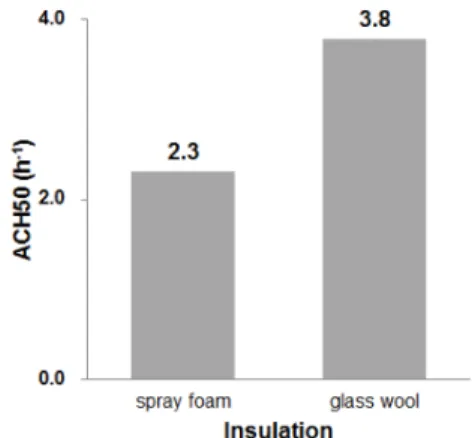
Glass wool has been used as common in- sulation material in most of wooden houses in Korea. The use of spray foam type insulations, such as polyurethane foam, is increasing not only because of installation convenience but be- cause of advantage of airtightness. Among the 42 tested houses, 37 houses used glass wool and the others did polyurethane foam as in- sulation material. As shown in Fig. 9, spray foam insulation appeared to be more favourable to improve building airtightness than glass wool. Because of unintended gaps while fitting glass wool into wall cavity and deflection of glass wool after fitting, glass wool dose not Fig. 9. Comparison of building airtightness of glass wool insulation vs foam type insulation.

Fig. 8. Air leakage in post-beam construction.

(7)

have advantage on building airtightness. But, spray foam insulation can do the role of air barrier with flexibility of spraying and rigidity after hardening.

3.4. Effects of Air Barrier on Building Airtightness

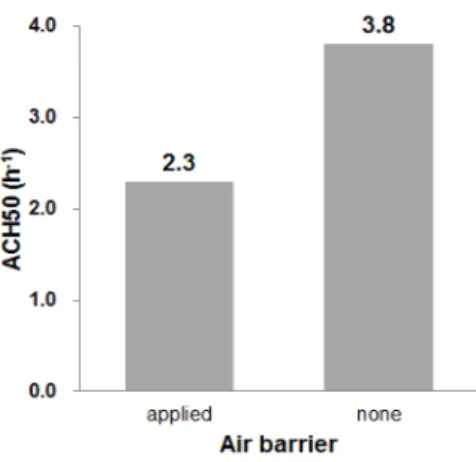
Recently, the use of air barrier has increased for building airtightness in wooden house in Korea. Use of membrane for building airtight- ness is well known to be effective (Langmans et al., 2010). 5 houses were installed air barrier at the wall assembly. As shown in Figure 10, the use of air barrier was effective on building airtightness. In case of the 3 houses with air barrier built in 2011, those building airtightness were improved than that of the other 5 houses with no air barrier, even though the houses were constructed at the same site and the same time by the same site manager. With consider- ing time and cost for application of air barrier, unless passive house-level airtight performance

(below 0.6 h

-1

of ACH50) is required, ensuring construction accuracy is more efficient than in- stall of air barrier. Because, there were 5 meas- urements of light frame houses with below 1.5 h

-1

of ACH50 without air barrier.

3.5. Defects of Air Leakage

Fig. 11 shows the infrared image of heat loss induced by air leakage. Post and beam con- nections were weak area to prevent air leakage.

Air leakage of post and beam connections can’t be avoid because of dimensional variation of large scale structural members affected by sur- rounded hygro-thermal conditions.

In many cases, air leakage was detected near the electric components such as lights, electric outlet, light switch and etc. But, there were no air leakage around electrical components when electric distribution was located in the house or when airtightness product was installed for the electrical components.

In case of detached wooden house in sub- urban region, air leakage was detected near sewer pipe. In that case, the end of sewer pipe was directly exposed to outside.

Fig. 11. Infrared image of air leakage of post-beam connection.

Fig. 10. Effect of air barrier on building airtightness.

(8)

4. CONCLUSIONS

In this study, evaluation of airtightness and air leakage causes of wooden houses in Korea was implemented for building reference value of building energy analysis.

The conclusions were as follows.

∙ Building airtightness of wooden house in Korea is gradually improved by the con- struction year.

∙ Foam type insulation was more advanta- geous than glass wool for building airtightness.

∙ Air barrier was effective to get airtight in wooden house.

∙ The order of airtight building was CLT, light frame, post-beam, Han-ok.

∙ Air leakage was mainly at the electrical components, sewer pipe and connections of structural member of post and beam construction.

REFERENCES

ASTM Standard E779. 1987. Standard test method for determining air leakage rate by fan pressurization.

Bramiana, C.N., Entrop, A.G., Halman, J.I.M. 2016.

Relationships between building characteristics and airtightness of Dutch dwellings. Energy Procedia 96: 580 ∼591.

Chan, W.R., Joh, J., Sherman, M.H. 2013. Analysis

of air leakage measurements of US houses.

Energy and Buildings 66: 616 ∼625.

ISO 9971. 2007. Determination of building airtight- ness - Fan pressurization method.

Jo, J.H. 2010. Measurements of the Dwelling Unit Airtightness in High-rise Residential Buildings.

JOURNAL OF THE ARCHITECTURAL INSTITUTE OF KOREA Planning & Design 26(10): 337 ∼344.

Langmans, J., Klein, R., Paepe, M.D., Roels, S. 2010.

Potential of wind barriers to assure airtightness of wood-frame low energy constructions. Energy and Buildings 42(12): 2376 ∼2385.

Montoya M.I, Pastor E., Carrié F.R, Guyot G., Planas E. 2010. Air leakage in catalan dwell- ings: Developing an airtightness model and leak- age airflow prediction. Building and Environment 45: 1458 ∼1469.

Pan, W. 2010. Relationships between air-tightness and its influencing factors of post-2006 new-build dwellings in the UK. Building and Environment 45(11): 2387 ∼2399.

Sinnott, D., Dyer, M. 2012. Air-tightness field data for dwellings in Irelad. Building and Environment 51: 269 ∼275.

Vinha, J., Manelius, E., Korpi, M., Salminen, K., Kurnitski, J., Kiviste, M., Laukkarinen, A. 2015.

Airtightness of residential buildings in Finland.

Building and Environment 93(2): 128 ∼140.

Yoon, J.H., Park, J.W., Lee, K.S., Baek, N.C., Shin,

U.C. 2008. A Study on the Measurement of

Airtightness Performance of Detached Houses in

Chung-cheong area. Journal of the Korean Solar

Energy Society 28(5): 65 ∼71.

수치

Table 1 shows the specifications of the meas- meas-ured houses. The oldest house was constructed  in 2006 and the newest one was done in 2016
Fig. 2. Depressurization (left) and pressurization (right)  mode of blower door test.
Fig. 5. Number of annual permits of wooden build- build-ings in Korea (Minister of Land, Infrastructure and  Transport).
Fig. 8. Air leakage in post-beam construction.
+2

참조

관련 문서