서 론
최근 융합이 핵심적인 키워드로 대두되고 있으며, 전문가들은 과학, 지식, 기술, 교육 등 사회 전반에 걸쳐 융합의 필요성을 언급 하고 있다1). 넓은 범위에서의 융합 기술은 과학기술부 등에서 정의 한 IT, BT, NT 등 첨단 신기술간 상승적 결합을 통해 미래 사회 및 국가 공통의 목표 달성을 위한 과학기술적 한계를 극복함으로써 경제와 사회, 문화의 변화를 주도하는 기술을 의미한다2).
실제로 정부에서는 IT, 과학기술의 융합을 지속적으로 추진하 고 있으며3) 교육 분야에서도 과학, 기술, 공학, 예술, 수학을 융합 한 융합인재교육(STEAM)의 개념이 도입되어 창의적 인재 양성을 위한 교육을 강화하고 있다4).
한의학 분야에서도 향후 5년간의 국정 과제 속에 양한방 융합
이 포함되어 양한방 융합 기반 기술 개발 사업이 추진 중에 있으며
5) 그 일환으로 보건복지부 한의학 정책관실 한방산업과에서 ‘양한 방 융합 기술 관련 제도 환경 구축’을 위한 정책 과제 수행을 계획 하였다. 이 과제는 양한방 융합의 개념을 정립하고 융합 치료 서비 스 개발 육성을 위한 제도 환경 구축을 목적으로 하고 있으며 본 연구는 그 세부 연구 과제로서 국내외 융합과 관련 연구 동향을 살 펴 보기 위한 기초 연구로 시행되었다.
일전에 정립된 ‘양한방 융합’에 대한 개념을 살펴보면, 한의정 책 제 2권 1호에서는 느슨한 형태의 협업으로 단순한 공동 진료를 위한 활동을 의미하는 협진(Package), 양한방 고유의 특성은 유지 하면서 직접적인 치료 효과를 높이기 위한 상호 보완적인 활동을 의미하는 복합(Hybrid)에서 더 나아가 한방과 양방의 장점을 극대 화하고 단점을 보완하여 새로운 형태의 치료 기술을 개발하는 활동
한의학 융합 연구와 관련된 국내외 연구 동향 고찰
박혜림1,3·홍미나1,3·조재현1,3·최준용1,3·김남권2,3·박재민3·박진수3·이동우3·백규환3·이 인1,3*
1 : 부산대학교한방병원 한방내과, 2 : 부산대학교한방병원 한방안이비인후피부과, 3 : 부산대학교 한의학전문대학원,
Study on the Trend of Domestic and International Research about Convergence in Korean Medicine
Hye Lim Park
1,3, Min-na Hong
1,3, Jae Hyun Cho
1,3, Jun Yong Choi
1,3, Nam Kwen Kim
2,3, Jae Min Park
3, Jin Soo Park
3, Dong Woo Lee
3, Kyu Hwan Baek
3, In Lee
1,3*
1 : Department of Internal Medicine, Pusan National University Korean Medicine Hospital,
2 : Department of Ophthalmology, Otolaryngology and Dermatology, Pusan National University Korean Medicine Hospital, 3 : Pusan National University School of Korean Medicine
The purpose of this study is to analyze differences between domestic and international research about convergence in Korean medicine (KM) and to find plans to facilitate further convergence. Articles published from 1995 to 2015 were searched on domestic database, NDSL and international database, PUBMED using the keyword concerning to five subjects (device, treatment, education, drug, effect and mechanism). Two authors checked independently searched articles to decide inclusion on the analysis and the stage of convergence, and made a conclusion through discussion. 58 and 27 articles were included in domestic and international research respectively on five subjects mentioned above. Articles in treatment and effect and mechanism were the most in domestic (62%) and international research (37%) individually. On the stage of convergence (It is divided by the degree of mixing between resource, experience, and theory of KM and other fields of study), most of articles were included in the first and second stage in domestic (62%) and international research (85%) respectively. Domestic and international research had different characteristics on the main subjects as well as the stage of convergence. It is needed that more active research and realistic application to facilitate further convergence.
keywords : Convergence, Collaboration, Korean medicine, Research
* Corresponding author
In Lee, School of Korean Medicine, Pusan National University, 49, Busandaehak-ro, Mulgeum-eup, Yangsan-si, Gyeongsangnam-do, Korea
·E-mail : [email protected] ·Tel : +82-55-360-5960
·Received : 2015/06/25 ·Revised : 2015/07/27 ·Accepted : 2015/07/31
ⓒ The Korean Society of Oriental Pathology, The Physiological Society of Korean Medicine pISSN 1738-7698 eISSN 2288-2529 http://dx.doi.org/10.15188/kjopp.2015.08.29.4.313
Available online at http://society.kisti.re.kr/sv/SV_svjscj03L.do?method=list&poid=ksomp&kojic=DRSRDH&sVnc=v28n5&menuid=1&subid=13
으로 언급하고 있다5).
그러나 융합을 치료 기술로만 국한하게 될 경우 ‘양한방 융합’
과 관련된 연구 현황을 포괄적으로 살펴 보기 어렵다는 판단 하에 본 연구진은 ‘양한방 융합’을 ‘한의학에서의 융합’으로 수정하였고, 그 영역을 서양의학과 한의학 또는 타 학문과 한의학의 협업과 같 이 한의학과 관련된 모든 분야에서 다른 학문의 기술이 함께 사용 된 모든 활동으로 결정하고 연구를 진행하였다.
본 논문에서는 국내외 데이터베이스를 이용하여 한의학에서의 융합과 관련된 국내 및 국외 연구 현황을 검색하였다. 이를 통해 현재까지 진행된 연구들의 특성을 파악하고, 국내 및 국외 연구의 차이에 대한 분석 결과를 제시하여 한의학에서 융합을 활성화할 수 있는 방안을 모색하고자 하였다.
연구대상 및 방법
한의학에서의 융합과 관련된 연구 현황 파악을 위해 국내 분야 에서는 국가과학기술정보센터 NDSL(National Digital Science Library, http://www.ndsl.kr)을 채택하였고, 국외 분야에서는 PubMed (http://www.ncbi.nlm.nih.gov/pubmed)의 두 가지 검 색 엔진을 채택하였으며 문헌은 1995년부터 2015년까지 발행된 것 을 포함하도록 검색 기간을 설정하였다.
검색어는 기존의 체계적 문헌 고찰에서 사용하는 것과 같이 ‘융 합’을 포함하는 몇 가지 단어의 조합을 통한 포괄적인 검색어를 선 정하기 위해 우선적으로 “한양방 융합”, “양한방 융합” 의 단어로 검색을 시도하였으나 관련 문헌 수가 적었고 이와 같은 방법으로는 한의학에서의 융합과 관련된 문헌들을 폭넓게 검색할 수 없었다.
그래서 “한양방”, “양한방”, “동양의학 AND 서양의학”, “통합 의학”, “한양방협진”, “동서의학협진” 의 검색어로 예비 검색을 시 행하였고 의료 기기, 협진, 교육, 한의학 치료 기전의 증명과 관련 된 문헌들을 찾을 수 있었다. 연구진들의 논의를 통해 상기 문헌들 이 융합의 사례에 적합한지를 결정하였고 추가적으로 약물 분야에 서의 융합 사례를 찾기로 하여 한약재의 제제, 제형의 변화라는 측 면에서 “천연물 신약”을 키워드로 추가하였다. 이러한 과정을 바탕 으로 연구진들의 최종적인 논의를 통해 한의학에서의 융합에 포함 되는 영역을 5가지 범주 (의료 기기, 협진, 교육, 약물, 한의학 치 료의 효과 및 기전 연구)로 선정하였으며 “양한방협진”, “한방기 기”, “한방진단기”, “한방진단기기”, “협진 OR 진단”의 키워드를 추가하여 검색한 결과 총 578건의 문헌이 선택되었다.
국외 연구에서도 “convergence”의 검색어로 접근하였으나 관 련된 자료를 찾기 어려웠으며, 융합과 관련된 연구들을 포괄할 수 있는 대표적인 키워드를 선정하기 위해 PUBMED의 MeSH 검색어 로 접근하였다. "Cooperative Behavior AND Medicine, East Asian Traditional"과 "Integrative Medicine AND Cooperative Behavior"의 키워드로 검색한 결과 총 40건의 문헌이 검색되었으 며, 융합과 무관한 내용을 제외하고 23건이 선택되었다.
보다 다양한 연구 결과들을 검색하기 위해 MeSH 검색어를 사 용하지 않고 traditional Chinese medicine 또는 kampo를 기본 으로 하여 combination, western, conventional 등의 단어를 조
합하여 검색하였으며, 그 외에 device, drug, extract 등의 단어를 결합하여 추가적인 검색을 시행하였다.
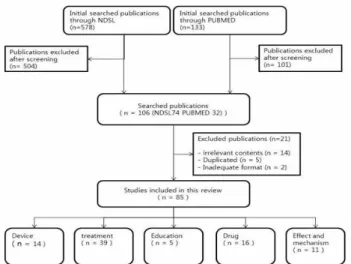
국내 연구의 경우 578건의 문헌 중 내용 분석을 통해 504건을 제외하고 74건을 선별하였으며 국외 연구에서는 133건의 문헌 중 내용 분석을 통해 101건을 제외하고 32건을 선별하였다. 선별된 국내외 문헌 106건 중에서 내용이 부적절한 문헌 14건, 중복된 문 헌 5건, 논문 또는 보고서 형식이 아닌 2건을 제외하고 최종적으로 85건의 문헌(의료 기기 14건, 협진 39건, 교육 5건, 약물 16건, 한 의학 치료의 효과 및 기전 연구 11건)이 최종 선택되었다(Fig. 1).
한편, 본 연구진은 융합과 관련한 법안 또는 제도 마련을 위한 기초 작업으로서 제도적 단계와 기술적 단계를 고려하여 융합 단계 를 설정하였고, 한의학에서의 융합 현황을 살펴 보기 위해 검색된 문헌들을 융합 단계별로 분류하였다.
최종 문헌 선택 과정 및 국내외 연구 분석, 융합 단계별 연구 분석 단계에서 2명의 저자가 독립적으로 선별된 논문을 검토한 후 포함 및 배제 여부를 판단하고 문헌의 융합 단계를 분석하는 과정 을 거쳤으며 논의를 통해 최종 결론을 도출하였고 이견이 있는 경 우 토론을 통해 합의하였다.
Fig. 1. Flow chart of selection process of searched studies
결 과
1. 국내외 연구의 주제별 동향 분석 (Table 1)
국내 연구 총 58건6-63) 중 가장 많은 수를 보인 것은 협진 부 문이었으며 총 36건의 연구6-41)가 포함되었고 이는 전체 국내 연구 의 62%를 차지하였다. 협진 분야에 포함된 연구들은 대부분 특정 질환을 양한방 협진을 통해 치료하거나6-17), 한방 치료 또는 양방 치료의 단일 치료와 협진을 통해 치료한 결과를 비교 분석한 증례 보고 위주의 문헌들이었다18-23). 그 외에 협진 EMR 개발24,25), 통합 데이터베이스 구축에 대한 연구26)가 있었으며 양한방 협진의 clinical pathway27) 또는 protocol이나 모델28-30)을 제시하는 연구 가 있었다. 또한 현재 우리나라에서 협진이 시행되고 있는 기관의 협진 현황31-33) 및 국내뿐 아니라 한의학적 의료가 사용되는 국외 몇 개국과의 협진 현황을 비교 분석하는 연구34)가 있었으며 양한방
통합의료의 갈등과 방향에 대해 분석하여 통합 의학을 위한 향후 제언을 하거나35) 의료일원화를 위한 단계적 방안 제시하는 연구들
36)이 있었다.
국내 연구 중 협진 부문 다음으로 많은 수를 보인 것은 의료 기기 부문으로 10건의 연구42-51)가 포함되었다. 의료 기기 부문에서 는 IT 기술을 포함한 타 학문과의 융합을 통해 한의학적 진단법을 보다 객관화, 가시화하려는 연구들42-44)이 있었으며 그 외에 한의학 적 진단의 보급화를 위한 재택 진단기기 개발 연구45,46), 맥진 설진 등 전통적인 진단법과 관련된 기기 이외의 새로운 진단 기기 개발 과 관련된 연구47,48), 원격 진료와 같은 새로운 진료 시스템 적용을 위한 연구49)를 찾아볼 수 있었다.
그 외 교육 분야에서는 협진 및 공동 연구를 위한 교육 과정
개발52,53) 및 한의학 교육에 대한 의사, 한의사의 인식 조사에 대한
연구54)가 있었다. 또한 약물 분야에서는 천연물 신약과 관련된 현 황 보고 및 프로세스56,57), 천연물의 활성 또는 독성 관련 실험 연
구58-60)를 찾아볼 수 있었으며 한의학 치료의 효과 및 기전에 대한
연구63)는 1건이었다.
국외 연구 총 27건 중 가장 많은 연구 수를 보인 것은 한의학 치료의 효과 및 기전 연구 부문이었으며 총 10건64-73)의 연구가 포 함되었고 이는 전체 국외 연구의 37%를 차지하였다. 그 내용은 초 음파64), f-MRI65), 전기 임피던스66,67), DNA 분석68,69) 등 현대적인 기기와 연구 방법을 이용하여 득기64), 경락과 비경락의 비교70,71), 침의 효과72) 등과 같은 한의학적인 치료법의 효과와 기전을 밝히려 는 것이었으며, 국내에서 한의학 치료의 효과 및 기전 연구가 1건
63)으로 조사된 것과 비교해 볼 때 본 분야에서 국외의 연구가 더욱 활발히 진행되고 있음을 확인할 수 있었다.
국외 연구 총 27건 중 약물 관련 연구는 9건74-82)으로 국내의 연구 대부분이 천연물의 활성 규명 또는 천연물 신약과 관련된 내 용이었던 것에 비해 국외의 연구는 한약의 효과에 대한 RCT 연구
74-78)뿐 아니라 한약의 약동학, 약력학적 연구79)나 양약과 한약의
병용 투여가 미치는 영향에 대한 연구80), tablet75,76), 주사78), patch81) 등의 형태로 한약의 제형 변화를 시도한 연구들을 찾아볼
수 있었다.
그 외에 기기 관련 연구에서는 전자 맥진기83), 염전과 같은 수 기가 가능한 레이저 침84)과 같은 진단, 치료법을 새롭게 적용한 기 기 개발과 관련된 시도들을 찾아볼 수 있었다. 교육 관련 연구는 1 건87)이었으며 그 내용은 공중보건 향상을 위해 자연주의, 카이로프 락틱, TCM, 마사지 등의 다 학제간 통합 교육이 필요하다는 것이 었다.
2. 국내외 연구의 융합 단계별 분석 (Table 2)
본 연구진은 연구 내용 분석에 앞서 한의학과 타학문의 ‘소재 및 경험/이론/사용자’의 3가지 요소가 결합된 정도를 기준으로 한 의학에서 융합의 단계를 3단계로 설정하였다.
융합 1단계는 융합 도입 단계로 협진과 같이 하나의 생산물에 한의학과 타학문의 ‘소재 및 경험/이론/사용자’가 혼합되어 결합되 지는 않으나 각각의 생산물이 함께 적용됨으로써 파급효과를 낼 수 있는 경우를 의미한다. 융합 2단계는 융합 성숙 단계로 이론간 장 벽은 있지만 서로의 장점을 활용하는 단계로 한방의 소재 및 경험 을 활용하나 양의학적 이론으로 만든 의약품인 천연물 신약을 예로 들 수 있다. 융합 3단계는 융합 완성 단계로 한의학과 타 학문의 이론이 결합되어 소재 및 경험, 이론, 사용자의 각 요소간 장벽이 완전히 사라진 단계를 의미하는 것으로 가정하여 정의하였다. 즉, 1단계는 현 수준(0단계)에서 가장 해결 가능성이 높은 단계이자 2 단계로 진입하기 위해 선행되어야 할 단계이며, 융합 단계가 높을 수록 융합 수준이 높음을 의미한다.
상기한 융합 단계별로 국내외 연구를 분석해 보면, 융합 1단계 와 융합 2단계에 포함되는 연구가 각각 40건, 44건으로 융합 1단 계 연구가 전체 연구의 47%, 융합 2단계 연구가 전체 연구의 52%
를 차지하였다. 융합 3단계와 연관 지어 생각해 볼 수 있는 연구는 전체 85건의 연구 중 1건47)에 불과하였다.
협진 분야의 대다수를 차지하였던 양한방 협진 치료의 효과에 대한 증례 보고가 대표적인 융합 1단계에 속하는 연구였으며 교육 관련 연구 또한 한의학 교육과정 및 교재 개발 관련 내용이었기에
Table 1. Analysis of Domestic and International Research according to the Subjects
Subject Domestic research (N=58) International research (N=27)
N (%) Contents N (%) Contents
Device 10 (17%)
∙ Objectification of diagnosis
∙ Development of diagnostic device for home use
∙ Development of new diagnostic device
∙ Remote medical service
4 (15%)
∙ Development of new device using scientific technology - pulse diagnosis with artificial neural network - laser acupuncture
Treatment 36 (62%)
∙ Case report for the effect of treatment (WM vs IM/ TKM vs IM / IM)
∙ Implementation of EMR for IM
∙ Development of CP
∙ Analysis of the present condition of IM (Domestic/ International)
∙ The presentation of medical unification plan
3 (11%)
∙ RCT for the effect of IM
∙ Analysis of the present condition of IM - HK
Education 4 (7%) ∙ Development of education curriculum for IM 1 (4%) ∙ The necessity of inter-professional education
Drug 7 (12%) ∙ The process and situation of natural product drug discovery
∙ The efficacy and toxicity of natural product 9 (33%)
∙ RCT for the effect of TCM drug
∙ Pharmacokinetic interaction
(TCM drug only / valproic acid and TCM drug)
∙ Change of TCM drug’s shape (tablet, injection, patch) Effect and
mechanism 1 (2%) ∙ verification for principle of acupuncture by using SPECT 10 (37%)
∙ Acupuncture sensation
∙ The comparison of acupuncture meridians and non-meridians
∙ Therapeutic effect of acupuncture
WM: Western Medicine, IM: Integrative Medicine, KM: Korean Medicine, EMR: Electronic Medical Record, CP: Clinical Pathway, RCT: Randomized Controlled Trial, HK:
Hong Kong, TCM: Traditional Chinese Medicine, SPECT: Single Photon Emission Computed Tomography
1단계에 속하는 것으로 분류하였다. 또한 천연물 신약 및 한약의 제형 변화와 관련된 연구, 약력학적 약동학적 분석 등 대부분의 약 물 관련 연구와 타 학문과의 융합을 통한 진단기기 개발, 현대적 기기를 사용한 한의학 이론의 증명과 관계된 연구들을 2단계로 분 류하였다. 융합 3단계로 분류된 연구는 ‘홀센서 집게형 맥진기와 심전도-용적맥파계를 이용한 양한방 융합용 환자감시장치 개발 연 구47)’가 있었으며 본 연구는 향후 융합 치료에의 적용 가능성을 제 시한 연구로 분석해 볼 수 있다.
국내외 연구를 융합 단계별로 분석해 본 결과 국내에서는 융합 1단계의 연구가 36건으로 전체 국내 연구의 62%를 차지하여 가장 많은 것을 확인할 수 있었으며 국외의 경우 융합 2단계의 연구가 23건으로 전체의 85%를 차지하여 가장 많은 것을 확인할 수 있었 다. 국내 및 국외 모두 융합 3단계의 연구는 거의 없었다.
고 찰
한의학에서의 융합과 관련된 5가지 영역(의료 기기, 협진, 약 물, 교육, 한의학 치료의 효과 및 기전)의 연구들에 대해 국내외 및 융합 단계별 현황 분석을 시행한 결과 국내와 국외에서 각기 활성 화되고 있는 연구 주제가 달랐고 융합 단계별로도 다른 특성을 보 여 국내외 융합 연구 현황에 차이가 있음을 확인할 수 있었다.
연구 내용에서 국내 연구는 협진, 진단 기기 관련 내용이 주를 이루었고 국외 연구는 한의학 치료의 효과 및 기전, 약물 관련 연 구가 주를 이루었다. 융합 단계에서도 국내 연구는 1단계, 국외 연 구는 2단계 위주로 진행되고 있는 것을 확인할 수 있었으며, 국내 외 연구 모두에서 융합 3단계에 속하는 연구가 적은 것은 현재 한 의학에서의 융합 수준이 낮은 단계에 머물러 있음을 시사하는 것으 로 해석할 수 있다.
향후 한의학에서의 융합을 활성화하기 위해서는 위해서는 먼저 각 분야별 융합 관련 연구가 더욱 확대되어야 하며, 융합 단계에서 는 2단계 이상의 연구가 활성화될 필요가 있다. 그리고 더 나아가 이러한 연구 결과들을 실제 교육 및 진료에 접목해 보려는 시도가 필요하다고 생각된다.
한의학에서 융합을 활성화하기 위한 방안을 각 분야별로 살펴 보면, 먼저 협진 분야에서는 현재 대부분을 차지하는 양한방 협진 의 치료 효과에 대한 증례 보고 연구 외에 단일 치료와 협진 치료
의 효과를 객관적으로 비교할 수 있는 RCT와 같은 연구가 필요하 다. 또한 서양의학적 진단 기기를 사용하여 진단한 이후 한의학적 인 치료를 하는 것과 같은 소극적인 협진 모델보다는 양한방 의료 진간의 활발한 소통을 바탕으로 보다 적극적인 협진을 위한 CP 개 발 연구나 실제 협진이 이루어지고 있는 진료 현장에서의 문제점, 갈등 등을 파악하여 보완, 개선할 수 있는 방안을 찾는 연구들이 더욱 활성화될 필요가 있다. 이러한 연구들이 활성화 된다면 향후 새로운 융합 치료 모델을 제시하기 위한 기초 자료가 될 수 있을 것으로 생각된다.
의료 기기 분야에서는 단순히 한의학적인 이론을 가시화하려는 노력에서 더 나아가 ‘홀센서 집게형 맥진기와 심전도-용적맥파계를 이용한 양한방 융합용 환자감시장치 개발 연구47)’와 같이 실제로 적용될 수 있는 융합 치료용 의료기기를 개발하여 임상에서의 활용 을 시도해 보거나, 양방 진단기기나 치료제의 한의학적 적용과 활 용 방법을 규명하는 것과 같은 새로운 연구가 필요하다.
또한 교육 분야에서는 단순히 의학과 한의학 교육의 현황을 파 악하는 것에서 더 나아가 의학뿐 아니라 공학, 인문학 등 다양한 타 학문과의 통합 교육에 대한 현황 또는 가능성을 살펴보는 연구 가 필요하며, 이러한 다 학제적인 교육을 통해 한의학에서의 융합 을 활성화 할 수 있는 방안을 고안해 낼 수 있을 것으로 생각된다.
약물 분야에서는 실제 진료 현장을 반영한 양약과 한약의 병용 투 여 관련 연구나 약물의 제형 변화와 같은 연구들이 지금보다 폭넓 게 이루어질 필요가 있으며 그 결과를 바탕으로 실제적인 활용의 근거를 마련하거나 제품화를 시도해 볼 수 있을 것으로 생각된다.
또한 한의학 치료의 효과 및 기전 분야에서는 국외 연구에서와 같 이 타 학문과의 협력을 통해 한의학적인 치료의 기전을 밝히려는 연구들이 지금보다 활성화될 필요가 있다.
한편, 연구 분야에서 더 나아가 융합 관련 수요 및 필요도 조 사, 전문가 자문을 통한 실제 융합의 현황 파악이 필요하며, 향후 다학제간의 적극적인 융합을 도모하기 위해서는 현실적인 제도적, 정책적 개선이 뒷받침되어야 할 것으로 사료된다.
본 연구에서는 NDSL과 PUBMED라는 제한된 데이터베이스를 사용하여 의료 기기, 협진, 교육, 약물, 한의학 치료의 효과 및 기 전 연구의 5가지 영역 내에서 분야별 검색을 시행하였고, 이를 통 한 연구 사례를 바탕으로 국내외 연구 현황을 비교 분석 하였기에 자료의 내용이 한의학에서의 융합과 관련된 모든 범위를 포괄하지 Table 2. Analysis of Domestic and International Research according to the Stage of Convergence
Stage Explanation Domestic research (N=58) International research (N=27)
N (%) N (%)
1 Collaboration
∙ A product that resource, experience, theory of KM and other fields of study is not mixed but applied simultaneously
∙ Having a ripple effect through simultaneous application ex) collaboration in treatment
36 (62%) 4 (15%)
2 Combination
∙ A product that resource, experience, theory of KM and other fields of study is partially mixed
∙ A stage using mutual advantage or strength
ex) new developed drug consist of not chemical compound but the chief ingredients from natural herb
21 (36%) 23 (85%)
3 Convergence
∙ A product that resource, experience, theory of KM and other fields of study is entirely mixed
∙ A stage that is no obstruction between the theory of KM and other fields of study
ex) There is no visible product till now
1 (2%) 0 (0%)
KM: Korean Medicine
못하였을 가능성이 있으며, 일본 및 중국, 타이완 등의 연구를 포 함하지 못한 한계점이 있다. 그러나 본 연구가 향후 한의학에서 융 합의 활성화를 위한 기초 연구 자료로 사용될 수 있을 것으로 기대 하는 바이다.
결 론
한의학에서의 융합과 관련된 연구 동향을 분석하기 위해 의료 기기, 협진, 약물, 교육, 한의학 치료의 효과 및 기전의 5가지를 주 제로 NDSL과 PUBMED의 연구들을 검색하였다.
선정된 연구들의 분석을 시행한 결과 국내와 국외의 연구 주제 및 융합 단계별 연구 현황의 차이점을 발견할 수 있었다.
향후 한의학에서 융합의 활성화를 위해서는 각 분야별 융합 관 련 연구가 더욱 확대되어야 하며, 융합 단계에서 2단계 이상의 연 구를 활성화하여 실제 교육 및 진료에 그 결과를 접목해 보려는 시 도가 필요하다고 생각된다.
감사의 글
본 연구는 보건복지부 한의약선도기술사업 (과제 고유번호 : HI14C1733) 및 2014년도 부산대학교병원 임상연구비 지원으로 이 루어진 것임.
참고문헌
1. Kang, M.M., Kim, S.R. Emerging Convergence Services.
The Journal of Information and Science 32(2):9-21, 2014.
2. Ministry of Science, ICT and Future Planning.
Convergence technology. 2010 [cited 2015 May 9]
Available from: URL:http://www.mest-crh.or.kr
3. Kim, K.B., Kim, G.C., Choi, S.B. The Upbringing Plan of R&D Special Enterprise in Mobile Convergence. Journal of Digital Convergence 12(4):85-92, 2014.
4. Chang, S.Y., Chung, J.H. Development of a Model of Animation Education Contents applied in STEAM.
Journal of Digital Convergence 13(2):333-341, 2015.
5. Han, G.J. New Trend and Prospect of Integrative medicine Research and Development. The Journal of Korean Medicine Policy 2(1):54-64, 2014.
6. Lee, S.H., Lee, I.S., Cho, H.S., Kim, K.K. Effect on Oriental-Western Medicine Integrative Care after Gynecology Surgery. The Journal of Oriental Obstetrics
& Gynecology 24(3):127-145, 2011.
7. Kim, D.H., Jung, D.L., Cho, C.G., Hong, S.U. Changes in Facial palsy Patient's Quality of life based upon Oriental-Western Medicine Treatment. The Journal of Korean Oriental Medical Ophthalmology &Otolaryngology
&Dermatology 23(2):174-185, 2010.
8. Lee, D.J., Hwang, B.M., Seo, H.S., Kim, S.J., Lee, J.S.
Eastern and Western Combined Medical Treatments on11 Patients with Dry Eye Syndrome.The Journal of Korean Oriental Medical Ophthalmology &Otolaryngology
& Dermatology 25(2):61-67, 2012.
9. Jang, S.Y., Yoo, H.J., Yoon, K.M., Im, E.Y., Shin, H.C.
Clinical Report on One Case of Pulmonary Tuberculosis Using Oriental Medicinewith Western Medicine. Korean J.
Orient. Int. Med 31(1):177-188, 2010.
10. Kim, S.K., Lim, C.S., Kim, M.Y., Koo, B.M., Yang, D.H.
Clinical Observation on One Case of Paraplegia by Bone Metastasis of Breast Cancer. The Journal of Korea CHUNA Manual Medicine for Spine & Nerves 3(2):9-18, 2008.
11. Min, S.J., Park, M.J., You, K.G., Yeam, S.R., Kwon, Y.D.
A Clinical Case of the Korean and Western Medical Treatment for the Patient with Herpes Zoster Opthalmicus. The J of Korean Medicine rehabilitation 22(4):199-207, 2012.
12. Kim, Y.S., Yang, D.H. A Case of Ramsay Hunt Syndrome by the Integrated Therapy of Oriental and Western Medicine. Kyung-hee medicine 14(3):317-320, 1999.
13. Oh, Y.S., Choi, B.R. A clinical study of combined Eastern and Western Treatment of 82 facial palsy. The J of Korea Institute of Oriental Medicine 5(1):317-328, 1996.
14. Yoon, H.M., An, C.B. A clinical study of Oriental and Western medicine treatment for facial semi-paralysis.
The J of Korean Acupuncture & Moxibustion Society 12(2):65-74, 1995.
15. Lee, J.W., Chang, W.S., Baek, K.M. A Case of Western-Oriental Medicine combined Treatment on the Dizziness Patient diagnosed as Olivoponto cerebellar Atropy(OPCA). The Oriental and Western medicine 35(4):73-83, 2010.
16. Park, S.C., Kim, D.H., Han, C.W., Park, S.H., Lee, I., Choi, J.Y. Integrated Medicine Therapy for an End-stage Lung Cancer Patient with Brain Metastasis. J of Korean Traditional Oncology 16(2):43-51, 2011.
17. Sung, W.S., Kim, P.K., Goo, B.H., Ryu, H.K., Suk, K.H., Lee, J.H., Kim, M.J., Park, Y.C., Seo, B.K., Park, D.S., Baek, Y.H. Study on the Validity of Electromyography(EMG) And Early-performed Electroneurography(ENoG) as Predicting Factor for Facial Palsy – basedon Collaborative Treatment between Korean and Western Medicine. The Acupuncture
30(4):115-123, 2013.
18. Kim, J.H., Sin, W.J., Jang, J.W., Kim, J.Y., Min, S.S., Hwang, W.D. A Clinical Study of Combined Eastern and Western Treatment of Acute Stage Stroke. Korean J.
Orient. Int. Med 25(4): 65-74, 2004.
19. Lee, S.M., Jeon, H.J., Kim, S.H., Kim, J.H., Lee, Y.K., Lee, B.H., Jung, T.Y., Kim, J.S., Lim, S.C., Lee, K.M.
Comparative Clinical Study between Oriental Medical Treatment and Oriental-Western Combination Treatment on Herniated Lumbar Disc. The Journal of Korean Acupuncture &Moxibustion Society 27(3):25-33, 2010.
20. Lee, C.I., Shim, K.Y., Kim, H.Y., Choi, S.Y., Bang, D.G., Cho, K.S. Clinical Study of the Efficacy of Combined Western-Oriental Medicine for Gastric Cancer and Hepatocellular Carcinoma. J. of Kor. Oriental Oncology 7(1):117-129, 2001.
21. Kwon, N.H., Shin, Y.J., Kim, C.Y., Koh, P.S., Yi, W.I., Joh, B.J., Woo, H.S., Baek, Y.H., Park, D.S. Comparative Clinical Study between Oriental Medical and Oriental-Western Medical Treatment on Bell's Palsy. The journal of Korean Acupuncture &Moxibustion Society 25(3):19-28, 2008.
22. Park, I.B., Kim, S.W., Lee, C.W., Kim, H.G., Heo, S.W., Yoon, H.M., Jang, K.J., Ahn, C.B. Comparative Clinical Study between Oriental Medicine and Oriental-Western Medicine Treatment on Bell`s palsy. The journal of Korean Acupuncture & Moxibustion Society 21(5):191-203, 2004.
23. Seo, B.M., Yun, J.S., Kim, S.W., Lee, S.Y., Lee, K.M., Bae, E.J., Seo, J.C., Lim, S.C., Jung, T.Y., Han, S.W.
Comparison of Treatment Effect between Oriental Medicine Therapy and Oriental and Western Medicine Combination Therapy on Low Back Pain Patients. The journal of Korean Acupuncture & Moxibustion Society 20(6):140-147, 2003.
24. Ahn, Y.C., Oh, S.B. An Implementation of Integrated Database for Electronic Medical Record System in East-West Medical Collaboration. J. of Information Technology Applications & Management 12(2):129-143, 2005.
25. Park, J.S., No, I.C., Kim, C.S. The development of EMR(electronic medical records) for East-West Medical Collaboration. The Korean Society of management &
Science pp 139-140, 1999.
26. Yea, S.J., Jang, H.C., Kim, C., Kim, J.H., Kim, S.K., Song, M.Y. Plan of Information System for Combined Treatment of the Oriental and the Western Medicine.
Kor. J. Oriental Preventive Medical Society 13(3):19-28,
2009.
27. Oh, K.E., Bak, W.S., Yang, H.I., Han, S.S., Yoo, M.C., Park, S.C., Lee, S.C. Development of Clinical Pathway and Analysis of Clinical Patterns for Optimizing the Integrative Medical Service. The Journal of The Korea Institute of Oriental Medical Diagnostics 16(2):23-32, 2012.
28. Lee, G.E., Yang, H.D., Jeon, W.K., Kang, H.W. A Study on the System of Collaborative Practice between Korean Traditional Medicine and Western Medicine for Dementia based on a Case Study. J of Oriental Neuropsychiatry 24(3):211-228, 2013.
29. Lee, W.C. The Efficacy of Combined Treatment with the Oriental & Western Medicine for Major Chronic Degenerative Diseases and the Development of Cooperative Model between the Oriental Medical Hospital
& the General Hospital. DongGuk University pp 1-279, 2002.
30. Jeon, W.G. Studies on Combined Treatment with the Oriental &Western medicine for Senile Mental Illness.
Korea Institute of Oriental Medicine pp 1-185, 2011.
31. Lim, S.M. An actual utilization and development plan study of interdisciplinary medical care at the National Rehabilitation Center. The Journal of the Society of Korean Medicine Diagnostics 18(1):25-31, 2014.
32. Lim, S.M. A study on the construction of a combined system of western and oriental medicine at the Korean National Rehabilitation Center. The Journal of the Society of Korean Medicine Diagnostics 17(1):45-50, 2013.
33. Shin, Y.J., Kim, C.Y., Kwon, N.H., Kwon, S.A., Lee, J.W., Koh, H.K., Woo, H.S., Park, H.S., Baek, Y.H. Clinical Study on East-West Combination Treatment in Joint Disorders. The Journal of Korean Acupuncture &
Moxibustion Society 26(6):121-132, 2009.
34. Moon, O.R., Kim, E.Y., Shin, E.Y., Kim, H.Y., Chun, H.R. A comparative Study on the Combined Oriental and Western Medicine in Four Northeast Countries.
Korean J. of Health Policy & Administration 13(2):1-22, 2003.
35. Lim, E.J., Kim, S.Y., Son, M.S., Choi, P.R., Oh, B.S. The study for conflicts between western and oriental medicine within Parallel (Dual) health care systems.
Korean journal of oriental physiology & pathology 28(2):243-250, 2014.
36. Yoon, G.J., Kim, D.S. Medical Unification Plan for shared growth with modern medicine and traditional medicine in Korea. Korea Institute for health and Social
Affairs pp 1-217, 2013.
37. Kim, J.W. The investigation on Hwabyung with fMRI and genetics. Korea Health Industry Development Institute pp 1-98, 2006.
38. Bae, S.H., Park, S.E., Kang, C.W., Hong, S.H. Safety of Korean Herbal Medicine Used with Western Medicine on Liver Function: Prospective Observational Study. Korean J. Orient. Int. Med 34(2):192-203, 2013.
39. Kang, S.H., Kim, D.I., Kang, H.C. A Study ofT he Role and Diagnostic Contents of The Diagnostic Radiology for Cooperative medical examination. The J of Oriental Gynecology 12(2):374-387, 1999.
40. Lee, S.J., C. Robert Cloninger, Kevin M. Cloninger, Chae H. The Temperament and Character Inventory for Integrative Medicine. J of Oriental Neuropsychiatry 25(3):213-224, 2014.
41. Kim, N.Y., Lee, S.U. Art Therapy of Affective Disorders through Integrating Medicine Cultures. Journal of north-east Asian cultures 31: 641-656, 2012.
42. Park, T.Y., Lee, S.S. Analysis of Magnetic Field Variation for Pulse Wave by Using Finite Element Method. Journal of the Korean Magnetics Society 24(3):90-96, 2014.
43. Lee, S.S. Development of Popular Integrated Oriental Diagnosis Apparatus Using High Reliability Pulse and Three Wave Tongue Image. Korea Health Industry Development Institute 2013.
44. Kim, K.C. Development of the three dimension facial shape analysis machine for the oriental medical image diagnosis. Korea Health Industry Development Institute pp 1-259, 2009.
45. Kim, B.H., Cho, D.U., Lee, S.H. Tongue Color Analysis Technique for Home-based Oriental Medicine Diagnosis Equipment Development. Korea Data Processing Society 10: 101-104, 2006.
46. Kim, C.H. Diagnostic traditional Korean medical Device for home use. KISTI MARKET REPORT 4(2):20-23, 2014.
47. Lee, D.H., Hong, Y.S., Lee, S.S. Development of Oriental-Western Fusion Patient Monitor by Using the Clip-type Pulsimeter Equipped with a Hall Sensor, the Electrocardiograph, and the Photoplethysmograph.
Journal of the Korean Magnetics Society 23(4):135-143, 2013.
48. Kim, K.H. Development of Technology Road Map on Korean Medical Engineering. Korea Institute of Oriental Medicine pp 1-58, 2013.
49. Hong, Y.S., Lee, S.S., Park, H.S., Kim, H.G. Oriental Medical Treatment System Based on Mobile Phone.The
journal of the institute of internet, broadcasting and communication 14(3):199-208, 2014.
50. Kim, B.H., Cho, D.W. Oriental Medicine Diagnosis Devices Trend and Proposal of Service Platform for Real Implementation of u-Healthcare. Information &
Communications Magazine 37(3):115-121, 2012.
51. Moon, I.H. The development of moxibustion using far-infrared light. Small and Medium-sized Business Technology and Information Development Institute pp 1-24, 2007.
52. Kim, H.K. For Standardization of the Integrative Medicine Curriculum. Korean journal of medical education 20(2):95-97, 2008.
53. Yun, Y.J. Development of educational program and materials for medical doctors on traditional Korean medicine to promote collaboration in medical research and practice. National Research Foundation of Korea pp 1-8, 2013.
54. Han, G.Y., Gu, H.G., Yun, Y.G. Attitudes of Western Medicine Doctors and Korean Medicine Doctors toward Korean Medicine Education for Cooperative Practices. J Korean Oriental Med 34(1):160-169, 2013.
55. Lee, M.S., Baek, T.S., Shin, H.S., Lee, W.L., Park, S.J., Park, C.W., Yeo, S.H., Lee, S.J. Integrated Medical Perspective View on Forest Healing Instructor Training Program and Curriculum Development. The Journal of Digital Policy & Management 11(8):227-234, 2013.
56. EOM, S.K., Kim, S.H., Kim, K.S., Park, S.J., Eo, W.K., Choi, W.C. A Proposal for Research Process of Botanical Drug based Clinical Traditional Korean Medicine. J. Oriental Medical Classics 23(4):63-102, 2010.
57. Lee, K.G., Bae, S.H., Shin, H.K. An Investigation about the Present States of Clinical Trial for Traditional Medicine in Korea, China, Taiwan and Japan. Korean journal of oriental medicine 12(1):13-22, 2006.
58. Kim, D.Y., Yu, H.J., Yoon, M.S., Park, J.H., Jang, S.H., Lee, H.M. Gomisin A Inhibits Tumor Growth and Metastasis through Suppression of Angiogenesis. Journal of Life Science 22(9):1224-1230, 2012.
59. Kang, D.H., Kim, H.S. Characterization and Anti-Helicobactor pyloriActivity of Xanthium strumariumL. Extracton Lactic acid Fermentation. KSBB Journal 25(3):244-250, 2010.
60. Kim, J.M., Park, J.D., Park, D.C., Kim, B.O. In vivo Antitumor Activity and Acute, Subacute Toxicity of Keumsa (Phellinuslinteus) Extracts. Journal of Life Science 23(11):1388-1396, 2013.
61. You, H.S. Developmental process of Natural Medicine.
The Plant Resources Society 2012.
62. Cho, Y.H., Lee, J.Y., Lee, J.H., Cho, J.S., Lee, G.W.
Evaluation of Stability in the Purified Wood Vinegar and Its Hair Growth Effect. Journal of life science 19(10):1389-1395, 2009.
63. An, S.G. A Study For Variety of Acupuncture Therapy on CVA (CerebroVascular Attack) Patients and New Model of Verification for Principle of Acupuncture by using SPECT. Korean Institute of Oriental Medicine 1999.
64. Park, J.J., Akazawa, M., Ahn, J., Beckman-Harned, S., Lin, F.C., Lee, K., Fine, J., Davis, R.T., Langevin, H.
Acupuncture sensation during ultrasound guided acupuncture needling. Acupunct Med 29(4):257-265, 2011.
65. Kim, J. Beyond paradigm: making transcultural connections in a scientific translation of acupuncture.
SocSci Med 62(12):2960-2972, 2006.
66. Kim, S.B., Shin, T.M., Lee, Y.H. Development and evaluation of a bio-ion measurement system on acupoints for meridian diagnosis. J Acupunct Meridian Stud 6(2):110-118, 2013.
67. Shira, R., Jiang, Z., Fen, S.Y., Monnavar, A.A., Ali, K.
Development and evaluation of a novel four-electrode device system for monitoring skin impedance. Afr J Tradit Complement Altern Med 9(4):599-606, 2012.
68. Carles, M., Lee, T., Moganti, S., Lenigk, R., Tsim, K.W., Ip, N.Y., Hsing, I.M., Sucher, N.J. Chips and Qi:
microcomponent-based analysis in traditional Chinese medicine. Fresenius J Anal Chem 371(2):190-194, 2001.
69. Lee, T.M., Hsing, I.M., Lao, A.I., Carles, M.C. A miniaturized DNA amplifier: its application in traditional Chinese medicine. Anal Chem 72(17):4242-4247, 2000.
70. Spaulding, K., Chamberlin, K. The transport of extremely low-frequency electrical signals through an acupuncture meridian compared to nonmeridian tissue.
J Altern Complement Med 17(2):127-132, 2011.
71. Wong, F.W., Lim, C.E., Smith, W. A new bio impedance research device (BIRD) for measuring the electrical impedance of acupuncture meridians. J Altern Complement Med 16(3):257-264, 2010.
72. She, Y.F., Ma, L.X., Qi, C.H., Wang, Y.X., Tang, L., Li, C.H., Yuan, H.W., Liu, Y.Q., Song, J.S., Zhu, J. Do changes in electrical skin resistance of acupuncture points reflect menstrual pain? A comparative study in healthy volunteers and primary dysmenorrhea patients.
Evid Based Complement Alternative Med 2014: 1-10, 2014.
73. Fico, T., Duchon, F., Dubravsky J.Hardware and
software realization of EDSD for acupuncture research and practice. IEEE J Biomed Health Inform 18(4):1207-1213, 2014.
74. Peng, S.L., Guo, Z.A. Effect of total saponins of Panaxnotoginseng on urinaryalbumin in patients with chronic renal failure. Zhongguo Wei Zhong Bing Ji Jiu Yi Xue 22(12):744-746, 2010.
75. Zhang, S.J., Xue, Z.Y. Effect of Western medicine therapy assisted by Ginkgo biloba tablet on vascular cognitive impairment of none dementia. Asian Pac J Trop Med 5(8):661-664, 2012.
76. Zhao, M.X., Dong, Z.H., Yu, Z.H., Xiao, S.Y., Li, Y.M.
Effects of Ginkgobiloba extract in improving episodic memory of patients with mild cognitive impairment: a randomized controlled trial. Zhong Xi Yi Jie He Xue Bao 10(6):628-634, 2012.
77. Chen, L., Huang, J., Xue, L. Effect of compound Polygonummultiflorum extract on Alzheimer's disease.
Zhong Nan Da XueXueBao Yi Xue Ban 35(6):612-615, 2010.
78. Zhu, Y.F., Luo, H.M., Deng, Z.L., Fu, D.Y., Yao, W., Dai, J. Effects of the Chinese patent medicine, Honghua Injection, on platelet glycoprotein IIb/III a receptors in patients with acute coronary syndrome: a randomized controlled trial. Zhong Xi Yi Jie He Xue Bao 10(3):318-323, 2012.
79. Yang, X.G., Peng, B., Zhang, G.H., Wei, L.L., Nie, S.F., Pan, W.S. Studies of the pharmacokinetics of paeoniflorin in two Jing-Zhi-Guan-Xin formulations after oral administration to beagle dogs. J Pharm Biomed Anal 41(1):320-324, 2006.
80. Chen, L.C., Chou, M.H., Lin, M.F., Yang, L.L. Lack of pharmacokinetic interaction between valproic acid and a traditional Chinese medicine, Paeoniae Radix, in healthy volunteers. J Clin Pharm Ther 25(6):453-459, 2000.
81. Wang, C., Ma, J., Liu, R., Han, W., Tang, X. A thermoplastic elastomer patch matrix for traditional Chinese medicine: design and evaluation. Drug Dev Ind Pharm 40(2):211-221, 2014.
82. Wang, Q.S., Cui, Y.L., Dong, T.J., Zhang, X.F., Lin, K.M.
Ethanolextract from a Chinese herbal formula,
"ZuojinPill", inhibit the expression of inflammatory mediators in lipopolysaccharide-stimulated RAW 264.7 mouse macrophages. J Ethnopharmacol 141(1):377-385, 2012.
83. Tang, A.C., Chung, J.W., Wong, T.K. Digitalizing traditional chinese medicine pulse diagnosis with
artificial neural network. Telemed J E Health 18(6):446-453, 2012.
84. Li, C., Zhen, H. Design of the laser acupuncture therapeutic instrument. Conf Proc IEEE Eng Med Biol Soc 1: 4107-4110, 2006.
85. Qu, W., Xiong, X., Hu, W., Zhang, P., Luo, Q., Zhang, S. Surface enhancement of WO3 nanowires toward the oxidation and electrochemical detection of honokiol in traditional Chinese medicine. Colloids and Surfaces B:
Biointerfaces 100: 103-106, 2012.
86. Gareus, I., Rampp, T., Tan, L., Lüdtke, R., Niggemeier, C., Lauche, R., Klose, P., Dobos, G. Introducing a computer-assisted, digital tongue-imaging device for standardization of traditional tongue diagnosis. Forsch Komplementmed 21(3):190-196, 2014.
87. Brett, J., Brimhall, J., Healey, D., Pfeifer, J., Prenguber, M. Competencies for public health and interprofessional education in accreditation standards of complementary and alternative medicine disciplines. Explore (NY) 9(5):314-320, 2013.