• 검색 결과가 없습니다.

Effect and Nutrient Content of Fermented Aloe Saponaria as Pigs Feed Additive Food

N/A
N/A
Protected

Academic year: 2021

Share "Effect and Nutrient Content of Fermented Aloe Saponaria as Pigs Feed Additive Food"

Copied!
8
0
0

로드 중.... (전체 텍스트 보기)

전체 글

(1)

Effect and Nutrient Content of Fermented Aloe Saponaria as Pigs Feed Additive Food

Choi Sun Mi, Destiani Supeno, Kwon Soon Hong, Chung Sung Won, Kwon Soon Goo, Park Jong Min, Kim Jong Soon, Choi Won Sik *

<Abstract>

Aloe gel layer is well known as raw materials of medicines and cosmetics due to their antioxidant and anti-inflammatory properties. In aloe gel extracting process, the outer part of the leaf was removed. It contains high quality of fiber and many nutrients. However, this part is thrown away and generally used as fertilizer. The purpose of this research was to examine the important nutrient of Aloe saponaria.

Moreover, the feasibility of using aloe as a dietary supplement by feeding fermentation treatment of aloe was investigated. To do this, the aloe leaf was divided into several parts including leaf skin, bottom of the leaf, tip of the leaf, middle of the leaf, and leaf flesh. Then the saponin content were analyzed from each part. The extraction method was used to clarify the saponin content. The aloe then fermented to improve it benefit. The fermented Aloe then given as dietary food to group of pig. Finally, the appropriate feed level was determined and the pork meat quality was analyzed. The extraction of saponin shows that the highest concentration of saponin located on the skin of the leaf. The feeding experiment shows that there is no significant difference in pig growth without aloe dietary food and groups with aloe as dietary food. It was conclude that fermented aloe can replace the pigs normal feeder as an alternative feeding solution.

Keywords : Fermentation, aloe saponaria, saponin, aloe product

* Corresponding Author, Professor, Dept. of Bio-Industrial Machinery Eng.,Pusan Natl. Univ

Gyeongsangnam-do Miryang-si Sangnamjin-eub Sangnamjin-ro 1268-50, 50463 REPUBLIC OF KOREA

E-mail: [email protected] Tel:+82-55-350-5425

(2)

1. Introduction

Aloe Saponaria is well known as a medicine because of their medical properties contain in aloe gel. It can be used as skin care product such as for treats sunburn, acts as moisturizer, and treat acne. It also known to reduce the pain and inflammation [1]. In medical field, it was used as inhibition on histamine synthetic enzyme [2], stimulation of immune reactions [3], blastogenesis [4], inhibition of tumor cells growth [3], antibradykinin activity [5], antioxidant [6], and inhibition of carragenin [7]. The aloe fermented products enhancing immunity and effectiveness against cancer [8].

Aloe leaf processing including filleting, homogenization, enzymatic treatment, filtration, deaeration, hot processing, flash cooling, cold processing, and addition of preservatives and stabilizer. In filleting step the skin of the leaf was removed to extract the gel inside the leaf. The skin of the aloe leaf contains high quality of fiber and many nutrients. However, this part is thrown away and generally used as fertilizer.

This study was investigate the mechanisms and characteristics involved in Aloe saponaria fermentation process and fermentation product. Another objective was to analyze the feasibility of using aloe as a dietary supplement by feeding fermentation treatment of aloe.

2. Material and methods

2.1 Sampling preparation

The materials used in this research is Aloe saponaria. It was supplied by DoYoung Aloe Company, Ulsan city Republic of Korea. The material was storage in the refrigerator until the experiment began. To prepare the samples, the Aloe washed by tap water. The Aloe divided into five part observation area and also gave them with deferent code respectively, which are tip of the leaf (H), middle of the leaf (M), bottom of the leaf (B), leaf skin (S) and leaf flesh (IS).Using a commercial blender, few samples of Aloe were chopped and mixed into homogeneous solution to analyze its saponin, initial pH and sugar (brix) content. The part of Aloe that used for this experiment can be seen in the Figure 1 and Figure 2.

Fig. 1 The surface appearance of Aloe

Saponaria ; B (bottom part of the

leaf), M (middle part of the leaf),

and H (tip part of the leaf)

(3)

2.2 Nutrient analysis method

Extraction of saponin procedures were performed by modifying the four thermal processing methods. Firstly, 0.5g of Aloe samples in Figure 3 (a) were defatted with 10mL of petroleum ether by shaking for 4h, and then the residues were extracted in Figure 3 (b) by 10mL of 80% aqueous methanol for 4h. The extracts were measured for 0.3mL as a samples. 0.3mL of freshly Aloe juice were prepared by 8% vanillin solution (in ethanol), and 3.0mL of sulfuric acid were vortexed for 5-10s. The mixture solution were incubated in a water bath at 60°C for 20min and cooled down in ice-cold water until the temperature decreased. It can be seen in the Figure 3 (c).

Absorbance at 544nm was recorded using spectral photometer in Figure 3 (d).

The results were expressed as mg of saponin equivalent per gram of sample on a dry weight (mg/g DW) basis from a standard curve of different concentrations of crude saponin. Every sample solution was injected

in triplicate, and the contents of the analyses were determined from the corresponding calibration curves. According the calibration curve equation, the amount of saponin in each sample can be calculated accurately.

The pH level measurement was done using pH-meter (SATO, Japan). The device used is pH meter type sk-620PH, this device can measure the pH with a value of 0-14. Sugar content in this research was measured using a refractometer type: Master-53M, capacity:

0.0-53%, ATAGO, Japan. The sugar content scale based on sucrose (sugar) and water solution. The water content of Aloe was observed by prepared the small piece of samples were taken from each leaf part. The sample which is taken has ± 0.5 grams of weight averagely. Each sample was evaporated the water content and measured the weight with 2h intervals. Totally 4h needed to evaporate the water from Aloe. In the final state, the dry masses of Aloe were Fig. 2 The inner appearance of Aloe

Saponaria ; IS (flesh of the leaf),

and S (skin of the leaf) Fig. 3 The instruments analysis for saponin

extraction of A loe saponaria ; (a)

0.5g aloe sample, (b) aloe residue

extraction, (c) incubated samples, and

(d) spectral photometer instrument

(4)

checked with precision scale weighing.

Comparing the mass of evaporated water with initial weight and multiplied with 100%

to gain the moisture content of Aloe. A force convection dryer was used to evaporate the water content.

2.3 Fermentation method

Aloe fermentation was conducted based on the Table 1. The experimental temperature was 35°C and was done for 114 hours of fermentation period. The initial pH and brix contains in this fruits are 5.22 pH and 2.4 %.

Samples Aloe (g)

Sugar (g)

Salt (g)

Bacillus powder

(g)

A 500 500 1 -

B 500 250 1 -

C 500 125 1 -

D 500 500 1 1

E 500 250 1 1

F 500 125 1 1

Table 1. The experimental composition of aloe saponaria fermentation

The aloe fermentation procedure was carried out according to Figure 4. Samples were placed in the fermentation room at 35°C. The pH value measured every 12h per day until 144h of fermentation period.

2.4 Food dietary method

The feasibility of using aloe as a dietary supplement was done by selected 120 piglets from the farm and the piglets were divided into two groups. One group was fed by diets food containing general food and the other group fed by diets food containing fermented aloe. The diet food was fed once every 10 days up to 70 days, and then once every 20 days up to 152 day. The results were checked and the grades were determined by livestock product quality assurance center.

After picking the grade, the fresh fillet muscle were stored immediately at the refrigeration temperature (4±1°C), and shipped to animal husbandry laboratory at Pusan National University. Then storage weight loss at 4±1°C, pH, water retention,

Fig. 4 The fermentation procedure of A loe

saponaria ; (a) sterilizing, (b) fresh aloe

leafs, (c) cutting the samples, (d)

samples measurement, (e) sugar

measurement, (f) salt measurement, (g)

water measurement and (h) blending all

ingredient using electric blender

(5)

flesh color, TBARS, VBN, and crude fat were measured.

3. Result and Discussion

3.1 Nutrient content

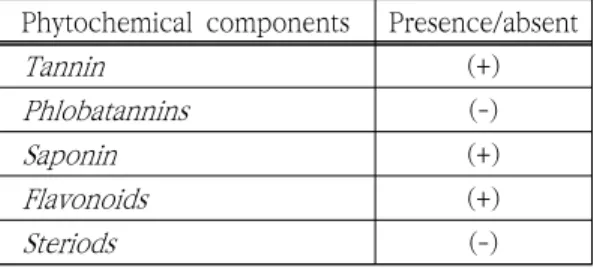
The phytochemical active compounds of Aloe saponaria were qualitatively analyzed and the results are presented in Table 2. In analysis of tannin compounds brownish green color developed to indicate the presence of tannin. Similarly based on the presence or absence of color change indicates positive and negative results are indicate. In this screening process tannin, saponin, flavonoids and terpenoids gave positive results and phlobactanins and steriods gave negative results.

Phytochemical components Presence/absent

Tannin (+)

Phlobatannins (-)

Saponin (+)

Flavonoids (+)

Steriods (-)

+ = presence, - = absent

Table 2. Qualitative analysis of Photochemical A1 components

The value of R square (

) for standard saponin content in Aloe saponaria was 0.999 (Figure 5). The

indicating the fitness of

regression line. While the value reaches 1, the line fits perfectly and 0 indicates that the line does not fit the data at all. In the general form

can be seen to be related to the unexplained variance, since the second term compares the unexplained variance (variance of the model’s errors) with the total variance (of the data). According the statistic regression, the absorbance equation was equal with Y=3.0817X+0.0063. It has 0.000712 of residual error.

Fig. 5 Standard calibration curve for total saponin content

The minimum saponin content is obtained

from (I.S) which are the biggest part of the

leaf. The (M) does not significant different

with leaf flesh in the saponin content. (B)

and (H) of leaf have almost similar amount of

saponin content. The highest saponin content

can be obtained from the (S). Comparison

between total saponin content contain in

Aloe saponaria and Aloe vera leaf in whole

parts also can be shown in Table 3 as a

follow.

(6)

Aloe Parts Aloe saponaria (mg/g)

B 1.132±0.026

M 0.876±0.007

H 1.083±0.020

S 1.519±0.048

I.S 0.638±0.064

Table 3. Total saponin content/g in each part of aloe leaf

3.2 Aloe fermentation

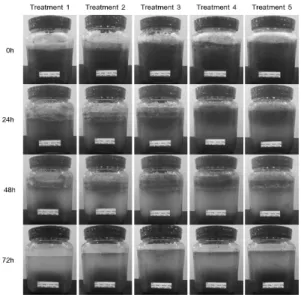
The aloe fermentation visual condition shows in Figure 6. The color change from green to dark yellow and the solid are concentrating on the bottom of the jars. The comparion of pH value and sugar content can be seen on the Figure 7. The average of pH level of all fermentation treatments are decreased from 5 to 3.7 level of pH. The sugar content of treatment 5 (initial sugar content is 35%) has the biggest decrement compare to other treatments.

3.3 Animal dietary food

In treatment C, the pork fed with normal feeder (without aloe), in treatment T the pork were feed with feeder contain with fermented aloe. Table 4 shows the results of pH measurement of sirloin from pigs fed with and without aloe. The pH of the control did not show any significant change over the storage period. The pH of the experimental group tended to gradually increase with the storage period. There was

Fig. 6 Fermentation visual condition during fermentation period

(a)

(b)

Fig. 7 The comparison of (a) pH value and

(b) sugar content (%) before and after

fermentation

(7)

a significant difference (p <0.05) between the experimental value of 1 day and the measurement value of 6 and 15 days (p

<0.05). But there was no significant difference on the other days.

Storage Period

(days) Treatment C Treatment T

1 5.45±0.04 5.33±1.73b

3 5.56±0.08 5.48±0.08ab

6 5.47±0.33 5.76±0.28a

9 5.58±0.08 5.55±0.05ab

12 5.57±0.07 5.54±0.12ab

15 5.55±0.22 5.63±0.13a

Table 4. Changes in pH of longissimus dorsi from pork during storage period at 4±1°C

a∼b means with different superscript in the same row are significantly different (p<0.05)

Table 5 shows the results of daily gain per day of pigs fed with or without aloe. In the control group, high weight gain was shown at 0∼10 days, 40∼60 days and 130∼152 days, and high weight gain was observed at 0∼10 days, 40∼60 days and 110∼130 days in experimental group.

Table 6 shows the changes in body weight of pigs fed with and without aloe. In the control and experimental groups, there was a tendency to increase gradually with the lengthening period, while the control group increased in all the periods and the experimental group showed a significant increase with the lengthening of the rearing period (p <0.05).

Fattening Period

(days) Treatment C Treatment T

0 - -

10 7.63±1.26J 8.17±1.13K

20 12.31±2.09IJ 12.42±2.00J 30 15.44±3.27I 16.34±2.55I 40 21.94±4.72H 22.81±3.04H 50 30.28±6.88G 32.08±4.17G 60 40.84±8.22F 42.78±1.07F 70 47.84±5.52E 50.20±4.88E 90 59.25±11.33D 64.46±8.36D 110 73.97±12.61C 78.57±9.22C 130 88.56±13.31B 95.60±9.59B 150 107.69±12.10A 113.78±10.57A Table 6. Changes in pig’s body weights (kg)

during fattening period

4. Conclusion

From this experimental result we can conclude that :

Fattening Period

(days) Treatment C Treatment T

0 - -

10 0.76±0.13BCD 0.82±0.11BC 20 0.47±0.14EFG 0.43±0.15F

30 0.31±0.15G 0.39±0.15F

40 0.63±0.21CDE 0.65±0.19D 50 0.83±0.28BC 0.93±0.30AB

60 1.06±0.25A 1.07±0.44A

70 0.41±0.40FG 0.46±0.46EF 90 0.57±0.24DEF 0.72±0.32CD 110 0.74±0.33CD 0.71±0.35CD 130 0.73±0.32CD 0.88±0.37B 150 0.95±0.23AB 0.61±0.32DE Table 5. Changes in gained weights /day during

fattening period (kg)

(8)

1) The skin of the Aloe leaf contains highest concentration of saponin compare to the other part of Aloe leaf. In other hand, up to 98.823±0.035% of leaf flesh contain with water. This part has the highest water content in the Aloe leaf part.

2) During the fermentation process, the color change from green to dark yellow and the solid are concentrating on the bottom of the jars. The average of pH level of all fermentation treatments are decreased from 5 to 3.7 level of pH. The sugar content of treatment 5 (initial sugar content 35%) has the biggest decrement compare to other treatments.

3) pH showed a tendency to increase in both the control and experimental groups, but there was no significant difference between the storage period and the control and experimental groups. Juice loss rate tended to increase in both control and experimental groups. Conservativity showed no significant difference in both control and experimental groups and showed a tendency to decrease. Shear thinning showed no significant difference between the control and experimental groups, and showed a tendency to decrease. It was conclude that fermented aloe can replace the pigs normal feeder as an alternative feeding solution.

Reference

[1] Vogler, B. & E, E., “Aloe vera a systematic”.

British Journal of General Practice. Vol.49(447), pp. 823-828, 1999.

[2] Yamamoto, I, “A new subtance, Aloe ulcin, its chemical properties and inhibition on histamine synthetic”. Journal of the Medical Society of Toho University. Vol. 17, pp. 361-364, 1970.

[3] Winters, W., Benavides, R. & Clouse, W.,

“Effects of Aloe extracts on human normal and tumor cells in vitro”. Economic Botany. Vol.71, pp 89-95, 1981.

[4] Winters, W., “Lymphocyte stimulation by newly identified Aloe lectin-mitogens”. Advances in New Drug Development. pp.pp. 391-137, 1991.

[5] Yagi, A. et al., “Antibradykinin active material in Aloe Saponaria”. Journal of Pharmaceutical Sciences. Vol.71 pp. 1172-1174, 1982.

[6] Jia, Q. and Farrow, T., “7-Hydroxychromones as potent antioxidants” U.S. Pat. Appl. Publ., 2003.

[7] Yagi, A. et al., “Structure determination of polysaccharides in Aloe saponaria (Hill).

(Liliaceae)”. Journal of Pharmaceutical Sciences.

Vol.73 pp. 62-65, 1984.

[8] Soon, O. B., Bong, G. K. & Ju, H. C.,

“Fermentation product of aloe, method of manufacturing the same and functional foods using the same” Durham, New York, US:

United States Patent Application Publication.

2010.

(Manuscript received November 30, 2017; revised January

2, 2018; accepted January 8, 2018.)

수치

Fig.  4  The  fermentation  procedure  of  A loe  saponaria ;  (a)  sterilizing,  (b)  fresh  aloe  leafs,  (c)  cutting  the  samples,  (d)  samples  measurement,  (e)  sugar  measurement,  (f)  salt  measurement,  (g)  water  measurement  and  (h)  blend
Fig.  5  Standard  calibration  curve  for  total  saponin content
Table  3.  Total  saponin   content/g  in  each  part  of  aloe  leaf
Table  4.  Changes  in  pH  of  longissimus  dorsi  from  pork  during  storage  period  at  4±1°C

참조

관련 문서

As a result of performing a compound exercise of spinning and Zumba for 8 weeks, the change in α-amylase showed a significant difference in the exercise group (p&lt;.01), and

Second, there was no significant difference in the effect of participants' motivation according to age, final educational attainment, motivation to

Second, analyzing students' level of interest in the unit of Clothes and Life Style revealed that there was significant difference between genders and students in the two

There was no significant difference between the groups in problems of eating habits, but the obesity group considered overeating as a problem while the normal

Third, there was no significant difference in the frequency of second hospital evacuation after moving to the medical room due to experience and

Difference of microhardness values(M±SD) between control and experimental side in various groups ···

The change in active oxygen was decreased after exercise in the exercise group than in the control group, and there was a statistically significant

In the control group, lifestyle-related factors were significantly different only in blood glucose (p &lt;.01) and there was no significant difference in