Submitted: 4 August 2021, Revised: 30 August 2021, Accepted: 6 September 2021
Corresponding author: Yoon Jin Lee, Human Research Protection Center, Keimyung University Dongsan Hospital, 1035, Dalgubeol-daero, Dalseo-gu, Daegu, 42601, Korea
Tel: +82-53-258-6694, Email: [email protected], https://orcid.org/0000-0003-1487-2646
의약품 임상시험 종사자 교육 이수자의 지식 수준, 태도, 교육 선택 요인 분석
1계명대학교 동산병원 임상연구보호센터, 2경북대학교 의과대학 예방의학교실 이윤진1, 장혜윤1, 이유미2
An Analysis on the Knowledge Levels, Attitudes, and Factors Affecting the Choices of Those Who Completed the Education of Persons Conducting Clinical Trial Workers
Yoon Jin Lee
1, Hye Yun Jang
1, Yu-Mi Lee
21
Human Research Protection Center, Keimyung University Dongsan Hospital, Daegu, Korea
2
Department of Preventive Medicine, Kyungpook University College of Medicine, Daegu, Korea
Purpose: This study aimed to analyze the knowledge levels, attitudes, and factors affecting the choices on the education of the participants who completed their education of persons conducting clinical trial workers, and to assess the problems of the current education system for clinical trial workers, leading to improvements.
Methods: Clinical trial workers (including principal investigators/subinvestigators, members of the Institutional Review Board [IRB], clinical research coordinators) who were affiliated to one of the 4 university hospitals running their own clinical trial center and IRB in Daegu and completed their education of persons conducting clinical trial workers were the subjects of this study.
One hundred seven online questionnaires were answered from 2021-04-02 to 2021-04-17. Descriptive statistics and Pearson correlation analysis were used to analyze the acquired data. Independent t-test and 1-way analysis of variance were used to analyze the differences in the knowledge levels and attitudes following the characteristics of the education participants.
Results: The baseline characteristics of the 107 participants were as follows: the majority of the participants were female (72.0%), were in their 30s (36.4%), had a nursing major (29.0%), were clinical research coordinators (63.6%), had never experienced a principal investigator (79.4%), had participated 3 or more educations (58.9%), had completed their maintenance course (55.1%), had 5 or more years of clinical trial experiences (34.6%). The fields on which participants had low levels of objective knowledge were "types and preparations on audits of clinical trials," "regulations on clinical trials (Pharmaceutical Affairs Act, Korea Good Clinical Practice)." The difficulties that the participants faced were on "annual educations" and "lack of information regarding the educations." Factors that showed significant differences in objective knowledge were sex (p=0.02), number of educations (p=0.004), the curriculum of 2020 (p=0.001). Age (p=0.004), having experienced a principal investigator (p=0.006), number of educations (p<0.001), the curriculum of 2020 (p<0.001), clinical trial career (p=0.001) were factors that significantly affected subjective knowledge. Attitudes toward the education were positively correlated with objective knowledge (r=0.20, p=0.04) and subjective knowledge (r=0.32, p=0.001). Major sources through which information on educations was acquired were "institutional notices," and major factors affecting the choices on the education were "when the education took place"
and "where the education took place." "Within the affiliated institution," "Online classes (recorded)" and "IRB and review processes" were each the most preferred place, mode, and content of the education.
Conclusion: Knowledge levels varied largely among participants who completed their education of persons conducting clinical trial workers, depending on their characteristics such as the number of educations. Participants also complained about their lack of information on educations. The quality of education may be improved if clinical trial organizations are designated as education facilities. Education programs must be developed considering the knowledge level and demand of the participants. Furthermore, as offline classes may be impossible due to pandemics such as the coronavirus disease 2019, the development of diverse and sophisticated online classes is looked forward to.
Key Words: Education of persons conducting clinical trial workers, Knowledge levels, Attitudes, Factors affecting the choices on
the education of the participants
서론
식품의약품안전처와 국가임상시험지원재단에서 발표한 2020년 임상시험계획 승인 건수는 799건으로 코로나19 감염 병 위기 상황임에도 전년대비 11.9% 증가
1함을 보았을 때, 국내 임상시험 역량이 향상되고 있음을 알 수 있다. 하지만 임상시험 은 안전성과 유효성이 충분히 입증되지 않은 상태에서 사람을 대상으로 연구를 수행하는 것이므로 시험대상자 보호가 전제되 어야 한다. 또한, 임상시험의 과학적 타당성이 결여되거나 임상 시험을 통해 얻어진 결과가 질적으로 떨어지는 것이라면 수행 된 임상시험은 무의미하다. 따라서 임상시험은 과학성, 윤리성 모두 갖추어야 하며, 이를 위해서는 연구자의 교육과 훈련이 선 행되어야 한다.
2임상시험이 질적으로 성장하기 위해 교육은 중요하며, 이는 대상자 보호와 임상시험 성패와도 연결되는 중요한 부분이다.
하지만 현장에서는 임상시험 종사자에 비해 관련 프로그램이 다양하지 않아 질 높고 다양한 교육 콘텐츠의 필요성을 요구하 고 있다.
3따라서 이 연구를 통해 의약품 임상시험 종사자 교육 을 이수한 연구자들의 지식 수준, 태도, 교육 선택에 영향을 주 는 요인을 파악한다면, 현행 임상시험 종사자 교육의 문제점을 파악하고 개선된 교육프로그램을 마련하기 위한 기초자료로 활 용될 수 있을 것이다.
본론
이 연구는 대구지역의 대학병원 중 임상시험실시기관으로 지 정받고 기관 내 임상시험센터, 기관윤리심의위원회를 독립적으 로 운영하고 있는 병원(경북대학교병원, 영남대학교병원, 대구 가톨릭대학교병원, 계명대학교 동산병원)의 ‘시험책임자/시험 담당자’, ‘심사위원회 위원(의사등, 그 밖의 위원)’, ‘임상시험 코 디네이터’ 직군의 연구자 중 의약품 임상시험 종사자 교육 이수 자로 선정하였다. 연구자의 소속기관 내 교육 이수자는 명단을 파악한 후 개인별로 이메일을 보냈고, 타기관은 임상시험 교육 담당자에게 이메일을 보내어 협조요청을 하였다. 응답한 설문 지의 회수 기간은 2021년 4월 2일부터 4월 17일까지이었으며, 107부의 온라인 설문(Google 설문지) 응답을 받았다.
1. 설문조사 내용
설문 문항은 선행연구 결과
4,5와 ‘의약품 임상시험 종사자 교 육 및 교육실시기관 지정에 관한 규정’
6을 참고하여 연구자가 개발하였고, 교육 이수자에 관한 일반적 특성에 관한 9개 문항, 교육 선택 요인에 관한 5개 문항, 교육 이수자의 객관적 지식에 관한 17개 문항, 주관적 지식에 관한 7개의 5점 척도 문항, 교육 에 대한 태도에 관한 12개의 5점 척도 문항으로 구성되어 있다.
점수가 높을수록 지식 수준과 교육에 대한 태도가 긍정적인 것 을 의미한다.
2. 설문조사의 결과 분석
수집된 데이터의 통계적 요약은 일반적으로 기술적 통계로
Table 1. General characteristics of the participants (N=107)
Characteristic No. (%)
Sex
Male 30 (28.0)
Female 77 (72.0)
Age (yr)
20s 26 (24.3)
30s 39 (36.4)
40s 26 (24.3)
50 or more 16 (15.0)
Major
Medicine 26 (24.3)
Nursing 31 (29.0)
Clinical pathology 22 (20.6)
Pharmaceutics 4 (3.7)
Others 16 (22.4)
Occupation*
Principal investigator/subinvestigator 26 (23.4) Member of the IRB (doctor, etc.) 16 (15.0)
Member of the IRB (others) 13 (12.1)
Clinical research coordinator 68 (63.6) Department
Clinical Medicine 94 (87.9)
Pharmacy 4 (3.7)
Others 9 (8.4)
Principal investigator experience
Yes 22 (20.6)
No 85 (79.4)
No. of educations
3 or more 63 (58.9)
2 14 (13.1)
1 30 (28.0)
Curriculum of 2020
New recruit course 29 (27.1)
Advanced course 15 (14.0)
Maintenance course 59 (55.1)
None 4 (3.7)
Clinical trial experience
5 Years or more 37 (34.6)
2–5 Years 22 (20.6)
1–2 Years 19 (17.8)
Less than 1 year 15 (14.0)
None 14 (13.1)
*Participants were allowed to return more than 1 answers.
기술하였다(범주형 데이터에 대해서는 빈도수와 백분율로 요약 하고, 연속형 데이터에 대해서는 평균, 표준표차로 요약). 교육 이수자의 특성에 따른 지식(객관적, 주관적)과 태도는 각 변수 의 특성에 따라 독립표본 T-검정, 일원배치 분산분석을 이용하 여 분석하였다. 교육 이수자의 지식(객관적, 주관적)과 태도 간
상관관계는 Pearson 상관분석을 이용하여 분석하였다. 교육 에 대한 태도 중 역으로 질의된 역문항에 대해서는 역변환하였 다. 통계분석은 SPSS Statistics ver. 25.0 (IBM Co., Armonk, NY, USA)를 이용하였으며, 통계적 유의수준(α-level)은 0.05 로 하였다.
Table 2. Participants' objective knowledge (N=107)
Class No. of
questions Mean ±SD Correct answer rate (%)
1. History of clinical trial, subject protection 1 0.80±0.40 80.4
Q5. Consents should be considered unobtainable from persons contained in facilities, since they are
in a vulnerable situation. 〃
2. Regulations on clinical trials (Pharmaceutical Affairs Act, KGCP) 5 3.62±0.83 73.8
Q1. The education of persons conducting clinical trial workers is offered depending on the occupation of the clinical trial worker, and includes "new recruit course," "advanced course", and
"maintenance course."
95.3
Q2. "New recruit course" is mandated for those who are new to clinical trial, but "Advanced course"
and " Maintenance courses" may be taken regardless of their orders. 73.8
Q3. Participants may take up to 50% of their mandated education by online courses, and may take all
of their priority education by online courses. 47.7
Q4. A "responsible clinical trial worker" means a person who is responsible for clinical trials (excluding subinvestigators, clinical trial pharmacists, and clinical research coordinators), under the supervision and guidance of the principal investigator. It often includes clinical pathologists and radiologic technicians.
46.7
Q6. The collective benefit of science and society must be considered before the rights, safety, and
welfare of the participants. 99.1
3. Considerations in recruiting subjects and acquiring consent 3 2.81±0.42 93.8
Q7. A subject must write the date and his or her authorized signature with his or her own handwriting
when a written consent is acquired. 99.1
Q8. Once a written consent is acquired, the original copy is kept by the researcher, while the subject
is given a duplicate. 90.7
Q9. Contents may be highlighted using certain fonts and red underlines. 91.6
4. IRB and review processes 3 2.43±0.69 81.0
Q10. A review by the IRB must be conducted once data collection and result analysis is completed. 86.9 Q11. All decisions by the IRB must be made while meeting a quorum. But in an urgent situation, under
the request of the principal investigator, a decision may be made without meeting the quorum. 65.4 Q12. A "Suspected Unexpected Serious Adverse Reaction" which occurs within the hospital, severe in
its nature or in the harm it has caused, must be reported to the IRB without delay. 90.7
5. Types and preparations on audits of clinical trials 1 0.71±0.46 71.0
Q13. An "audit" is a monitoring activity done to review and confirm that the principal investigator supervises the stages of the clinical trial, and that the clinical trial is executed and archived according to the plan and the standard operating procedures while meeting regulations.
〃
6. Stages of the clinical trial (managing drugs and research grants) 1 0.99±0.10 99.1
Q14. A PI/Sub-I must have detailed knowledge on the protocol, the IB, and the drug manual provided
by the trial client. 〃
7. Archiving of the clinical trial (source documents, case reports) 3 2.30±0.85 76.6
Q15. It is desirable for the principal investigator to set the term of retainment and retain the related
documents, and dispose of the documents himself or herself once the period is met. 79.4 Q16. The principal investigator must provide his or her best cooperation if a monitoring agent,
an audit officer, the IRB, or the MFDS requests to view documents (including electronic documents) related to the clinical trial.
90.7
Q17. The principal investigator is disallowed from directly handling the investigational drug. 59.8
Total 17 13.60±3.75 80.4
SD, standard deviation; KGCP, Korea Good Clinical Practice; MFDS, Ministry of Food and Drug Safety; IRB, Institutional Review Board; PI/
Sub-I, Principal investigator/subinvestigator; IB, Investigator Brochure.
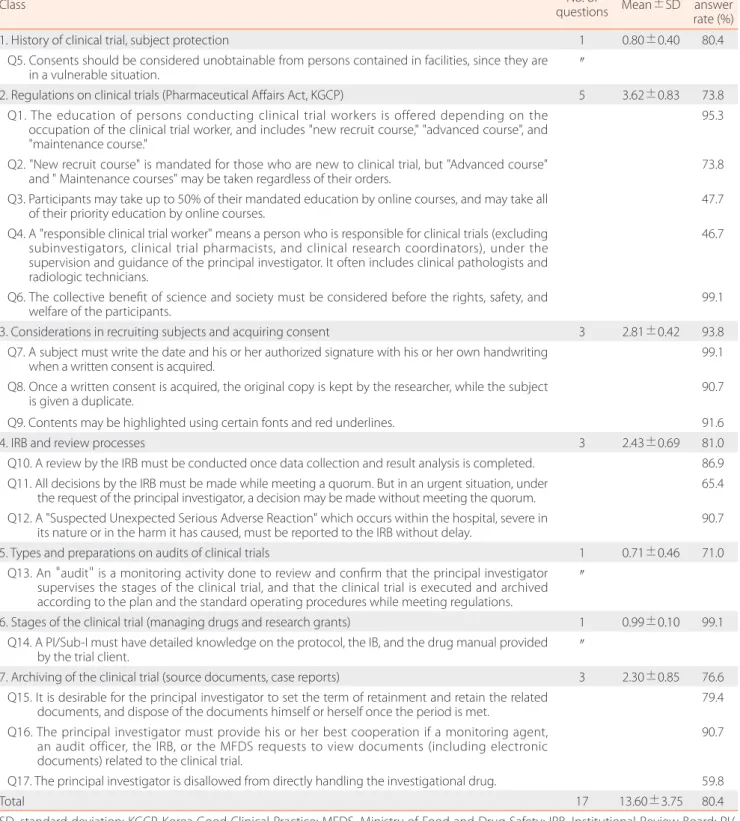
험 실태조사 종류 및 준비’에 대한 정답률이 71.0%로 가장 낮았 다. 그 외 ‘임상시험 관련 규정(73.8%)’, ‘임상시험 자료(근거문 서, 증례기록서)의 작성 및 보관(76.6%)’ 영역에서도 전체 평균 보다 낮은 정답률(80.4%)을 보였다.
3. 교육 이수자의 교육에 대한 주관적 지식
교육에 대한 주관적 지식은 Table 3과 같다. 주관적 지식의 문항별 전체 평균 점수는 5점 만점에 3.38±0.94점으로 나타났 으며, 영역 중 ‘임상시험 관련 규정(3.11±0.85점)’이 가장 낮았 다.
4. 교육 이수자의 교육에 대한 태도
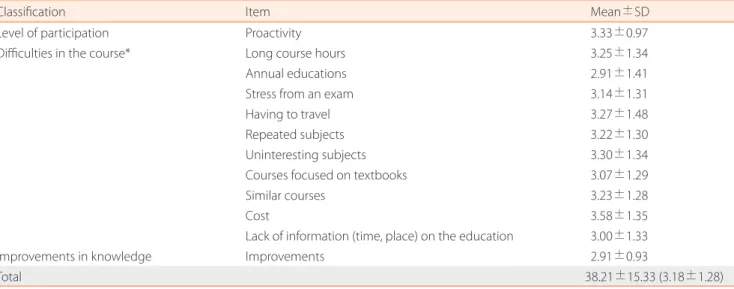
교육에 대한 태도는 교육의 참여 정도, 교육 이수 어려움, 지 식 수준 향상으로 구분하였으며, 분석 결과는 Table 4와 같다.
교육 이수의 어려움은 점수가 높아질수록 어려움에 대한 태도 가 긍정적인 것으로 어려움 정도가 낮은 것이다(역변환 문항).
매년 교육 이수는 2.91±1.41점, 교육 정보 부족(장소, 일정 등) 은 3.00±1.33점 순으로 부정적으로 나타났다.
연구 결과
1. 교육 이수자의 기본 정보
교육 이수자의 일반적 특성은 Table 1과 같다. 성별은 여성이 72.0%로 남성보다 많았으며, 연령은 30대가 36.4%로 가장 많 았다. 전공은 간호학 29.0%, 의학 24.3% 순으로, 다중응답 분석 한 담당직군은 임상시험 코디네이터 63.6%, 시험자 23.4% 순 으로 나타났다. 근무 부서는 임상의학 87.9%로 가장 많았고, 연 구책임자 경험은 없음이 79.4%로 있음보다 많았다. 교육 횟수 는 3회 이상이 58.9%, 2020년 교육 이수 과정은 보수 교육과정 이 55.1%, 임상시험경력은 5년 이상이 34.6%로 가장 많았다.
2. 교육 이수자의 교육에 대한 객관적 지식
식품의약품안전처에서 발표한 ‘의약품 임상시험 종사자 교육 및 교육실시기관 지정에 관한 규정’에서 교육대상자별 교육과 정 중 예시로 제공된 교육 과목을 바탕으로 17개 문항을 물어보 았다.
교육에 대한 객관적 지식은 Table 2와 같다. 영역 중 ‘임상시
Table 3. Participants' subjective knowledge on the education (N=107)
Class Mean±SD
1. History of clinical trials, subject protection 3.26±0.94
2. Regulations on clinical trials (Pharmaceutical Affairs Act, KGCP) 3.11±0.85
3. Considerations in recruiting subjects and acquiring consent 3.80±0.86
4. IRB and review processes 3.48±0.94
5. Types and preparations on audits of clinical trials 3.22±0.97
6. Stages of the clinical trial (managing drugs and research grants) 3.24±1.03
7. Archiving of the clinical trial (source documents, case reports) 3.54±1.00
Total 23.65±6.59 (3.38±0.94)
SD, standard deviation; KGCP, Korea Good Clinical Practice; IRB, Institutional Review Board.
Table 4. Participants' attitude toward the education (N=107)
Classification Item Mean±SD
Level of participation Proactivity 3.33±0.97
Difficulties in the course* Long course hours 3.25±1.34
Annual educations 2.91±1.41
Stress from an exam 3.14±1.31
Having to travel 3.27±1.48
Repeated subjects 3.22±1.30
Uninteresting subjects 3.30±1.34
Courses focused on textbooks 3.07±1.29
Similar courses 3.23±1.28
Cost 3.58±1.35
Lack of information (time, place) on the education 3.00±1.33
Improvements in knowledge Improvements 2.91±0.93
Total 38.21±15.33 (3.18±1.28)
SD, standard deviation.
*Participants were allowed to return more than 1 answers.
Table 5. Differences in the knowledge and attitudes following the characteristics of the education participants (N=107)
Characteristic Objective knowledge Subjective knowledge Attitude
Mean±SD t or F (p) Scheffe Mean±SD t or F (p) Scheffe Mean±SD t or F (p) Scheffe Sex
Male 14.17±1.09 2.34
(0.02) 23.93±4.85 0.35
(0.73) 39.00±8.44 0.60
(0.55)
Female 13.48±1.90 23.56±5.39 37.90±8.86
Age (yr)
20s
a13.19±2.98 2.28
(0.08) 21.46±4.05 4.65
(0.004) a<c 37.81±7.68 2.69 (0.05)
30s
b13.54±1.57 22.92±5.91 35.90±8.70
40s
c13.38±1.24 26.27±4.46 39.19±8.30
50 or more
d13.63±1.54 24.81±4.56 42.88±9.66
Major
Medicine 14.04±1.08 0.46
(0.77) 22.88±5.23 0.31
(0.87) 36.58±7.80 2.00
(0.10)
Nursing 13.68±1.14 22.94±4.64 37.00±8.24
Clinical pathology 13.45±2.40 23.55±4.78 37.27±8.47
Pharmaceutics 13.75±0.96 23.50±5.80 46.25±9.71
Others 13.46±2.30 24.50±6.57 41.04±9.62
Occupation*
Principal investigator/subinvestigator 14.08±1.08 -1.78
(0.08) 24.00±5.31 -0.36
(0.72) 37.00±7.65 0.86
(0.39)
Occupations other than investigators 13.55±1.10 38.57±9.03
Member of the IRB (doctor, etc.) 13.81±1.11 -0.49
(0.63) 24.63±4.90 -0.84
(0.41) 36.56±7.12 0.96
(0.35)
Member of the IRB (except doctors) 13.65±1.83 38.49±8.97
Member of the IRB (others) 13.92±1.89 -0.51
(0.62) 24.77±5.54 -0.77
(0.45) 46.54±6.29 -4.87
(<0.001) Clinical research coordinator 13.49±1.90 1.62
(0.11) 23.37±5.21 0.77
(0.44) 37.23±8.66 1.53
(0.13) Department
Clinical Medicine
a13.64±1.72 0.18
(0.84) 23.51±5.19 0.50
(0.61) 37.05±8.40 7.60
(0.001) -
Pharmacy
b13.75±0.96 23.50±5.80 46.25±9.71
Others
c13.75±2.24 25.33±5.68 46.67±4.90
Principal investigator experience
No 13.58±1.85 -1.49
(0.14) 22.99±5.20 -2.94
(0.006) 37.87±8.91 -0.83
(0.41)
Yes 14.05±1.13 26.27±4.53 39.50±8.00
No. of educations
1
a12.80±2.28 5.76
(0.004) a,b<c 20.63±5.38 13.35
(<0.001) a,b<c 37.37±8.39 0.27 (0.77)
2
b13.93±1.44 21.36±4.33 37.71±8.82
3 or more
c14.03±1.33 25.62±4.43 38.71±8.95
Curriculum of 2020
New recruit course
a12.62±2.35 5.61
(0.001) - 20.83±5.37 7.09
(<0.001) - 36.97±8.38 0.59 (0.63)
Advanced course
b13.93±1.39 21.67±4.34 37.53±8.53
Maintenance course
c14.12±1.26 25.49±4.41 39.17±9.01
None
d13.75±0.50 24.75±8.18 35.50±8.85
Clinical trial experience
None
a13.50±2.53 0.64
(0.64) 21.43±6.58 5.15
(0.001) d,e>b 42.29±9.20 1.87 (0.12)
Less than 1 year
b13.53±1.13 19.53±2.72 36.40±7.99
1–2 Years
c13.21±2.53 23.47±6.20 37.16±8.39
2–5 Years
d13.86±1.25 25.22±4.30 40.68±7.98
5 Years or more
e13.92±1.32 25.35±4.28 36.46±8.99
SD, standard deviation; IRB, Institutional Review Board;
*Participants were allowed to return more than 1 answers.
5. 교육 이수자 특성에 따른 교육에 대한 지식과 태도의 차이
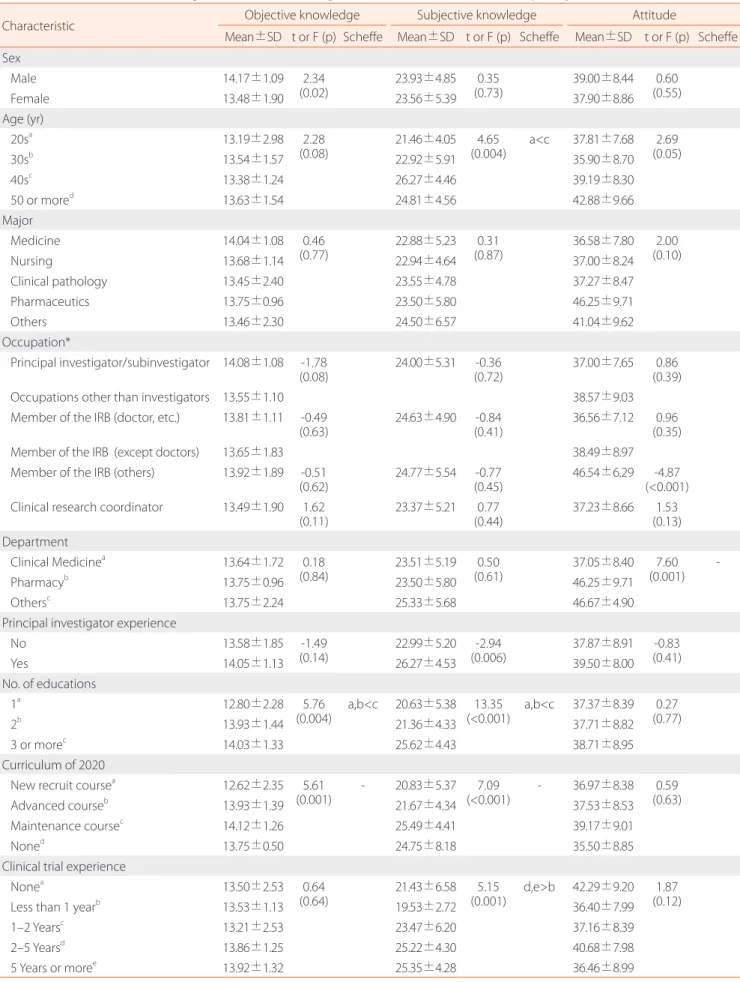
교육 이수자 특성에 따른 교육에 대한 지식과 태도의 차이를 분석한 결과는 Table 5와 같다.
객관적 지식에 유의한 차이가 있는 항목은 성별, 교육 횟 수, 2020년 교육 이수 과정으로 확인되었다. 남성이 여성보다 14.17±1.09점으로 객관적 지식이 높았으며(t=2.34, p=0.02), 교육 횟수에서는 3회 이상 교육을 들은 교육 이수자 14.03±
1.33점으로 가장 주관적 지식이 높게 나타났으며, 사후검정 결 과 교육을 1회, 2회 들은 교육 이수자보다 객관적 지식이 높은 것으로 명확히 구분지어졌다(F=5.76, p=0.004). 2020년 교육 이수 과정 중 보수교육 이수한 교육 이수자 14.12±1.26점으로 객관적 지식이 가장 높게 나타났으나, 사후검정 결과 명확하게 구분되지 않았다(F=5.61, p=0.001).
주관적 지식에 유의한 차이가 있는 항목은 연령, 연구책임자 경험, 교육 횟수, 2020년 교육 이수 과정, 임상시험경력이 통계 적으로 유의미한 차이를 보였다. 연령에서는 40대 교육 이수자 26.27±4.46점으로 가장 주관적 지식이 높게 나타났으며, 사 후검정 결과 주관적 지식이 가장 낮은 20대 교육 이수자 21.46
±4.05점보다 40대 교육 이수자가 높은 것으로 명확히 구분 지 어졌다(F=4.65, p=0.004). 연구책임자 경험 있음이 없음보다 26.27±4.53점으로 주관적 지식이 높았다(t=-2.94, p=0.006).
교육 횟수에서는 3회 이상 교육을 들은 교육 이수자 25.62±
4.43점으로 가장 주관적 지식이 높게 나타났으며, 사후검정 결 과 교육을 1회, 2회 들은 교육 이수자보다 주관적 지식이 높은 것으로 명확히 구분 지어졌다(F=13.35, p<0.001). 2020년 교 육 이수 과정 중 보수교육 이수한 교육 이수자 25.49±4.41점 으로 주관적 지식이 가장 높게 나타났으나, 사후검정 결과 명 확하게 구분되지 않았다(F=7.09, p<0.001). 5년 이상의 임상 시험경력이 25.35±4.28점으로 가장 주관적 지식이 높게 나 타났으며, 사후검정 결과 2년 이상–5년 미만, 5년 이상의 경력 을 가진 교육 이수자의 주관적 지식이 1년 미만의 경력을 가진 교육 이수자보다 높은 것으로 명확히 구분 지어졌다(F=5.15, p=0.001).
태도에 유의한 차이가 있는 항목은 담당직군 중 Institutional Review Board (IRB) 위원(그 밖의 위원), 근무 부서에서 유의 한 차이를 보였다. 담당직군 중 IRB 위원(그 밖의 위원) 46.54
±6.29점으로 유의미하게 높게 나타났다(t=-4.87, p<0.001).
근무 부서에선 임상의학에서 37.05±8.40점으로 가장 긍정적 인 태도를 보였으나, 사후검정 결과 명확하게 구분되지 않았다 (F=7.60, p=0.001).
6. 교육 이수자의 교육에 대한 지식, 태도 간 상관관계
교육에 대한 객관적 지식과 주관적 지식, 태도 간의 상관관계 를 분석한 결과는 Table 6과 같다. 교육에 대한 태도는 객관적 지식(r=0.20, p=0.04) 및 주관적 지식(r=0.32, p=0.001)과 양 의 상관관계를 보였다.
7. 교육 선택에 영향을 주는 요인