Probabilistic Neural Network
Chang, Seongkyu* Kim, Dookie†
···
Abstract
Recently, structures are becoming longer and higher because of the developments of new materials and construction techniques.
However, such modern structures are more susceptible to excessive structural vibrations which cause deterioration in serviceability and structural safety. A modified probabilistic neural network(MPNN) approach is proposed to reduce the structural vibration. In this study, the global probability density function(PDF) of MPNN is reflected by summing the heterogeneous local PDFs automatically determined in the individual standard deviation of each variable. The proposed algorithm is applied for the vibration control of a three-story shear building model under Northridge earthquake. When the control results of the MPNN are compared with those of conventional PNN to verify the control performance, the MPNN controller proves to be more effective than PNN methods in decreasing the structural responses.
Keywords : neural network(NN), modified probabilistic neural network(MPNN), training pattern, active control, earthquake
···
†책임저자, 종신회원․군산대학교 토목환경공학부 부교수 Tel: 063-469-4770 ; Fax: 063-469-4791 E-mail: [email protected]
* 정회원․군산대학교 토목환경공학부 박사후연구원
∙이 논문에 대한 토론을 2011년 2월 28일까지 본 학회에 보내주시 면 2011년 4월호에 그 결과를 게재하겠습니다.
1. Introduction
Civil structures such as high-rise buildings, towers, long span bridges, etc. should be designed and constructed safely and reliably under various external loads such as earthquake, wind, traffic, etc. Recently, as structures become longer and higher, aesthetic designs also become more affordable with the innovation of materials and construction methods. However, such modern structures are susceptible to excessive structural vibrations, which may cause structural damage not limited to the degradation of serviceability.
During the last three decades, various vibration control methods have been developed and applied to suppress structural vibration in numerous areas. One of them, active control of structures using the neural network (NN), had been studied by Ghaboussi et al.
(1991), Chen et al. (1995), Ghaboussi and Joghataie (1995), Bani-Hani and Ghaboussi (1988), and Kim et al. (2004) in civil engineering applications in the last
decade.
In their papers, they introduced the learning capability of NN in the design of a controller for structural vibrations during earthquake. Recently, Kim et al. (2002) applied cerebellar model articulation controller (CMAC) for suppression of structural vibration, and compared results of the CMAC with those of NN.
The NN, however, takes a long time to be trained (Madan, 2005). To overcome this weakness, the probabilistic neural network (PNN) was proposed for structure control by Kim et al. (2007a), as the PNN requires lesser time for the determination of the network architecture and for training. Although the PNN control algorithm has many advantages in a comparison with the NN one, the smoothing para- meter (σ) in the PNN is obtained by trial and error.
In order to improve the PNN algorithm, Kim et al.
(2007b) proposed the modified probabilistic neural network (MPNN) and applied it to estimate the stability number of breakwaters. Unlike the homogenous
probability density function of PNN, the global probability density function (PDF) of MPNN is reflected by summing the heterogeneous local PDFs automatically determined in the individual standard deviation of each variable. Chang et al. (2009) attempted to reduce a response of an offshore structure under wave loads using the MPNN.
In this study, MPNN is applied for the vibration control of a three-story shear building model under Northridge earthquake. The control results of the MPNN are compared with those of PNN (Kim et al., 2007a) to verify the validity of the former. Results prove that the vibrations of a three-story shear building model under Northridge earthquake are more effectively controlled by MPNN than PNN.
2. Active Control Method using PNN and MPNN
2.1 Equation of motion
The equation of motion of a structural system with n degrees of freedom subjected to an earthquake and the control force can be expressed as
} ]{
[ } ]{
[ } ]{
[ } ]{
[ } ]{
[M u&& + C u& + K u = Lc fc + Le fe (1)
where [M], [C] and [K] are the n× mass, damping, n and stiffness matrices, respectively; { tu()} is the n -dimensional displacement vector; {fc(t)}is the control force vector; {fe(t)} is the excitation load vector proportional to the ground acceleration {u&&g}; and [Lc] and [Le] are the location matrices of the control force and the excitation, respectively.
} ]{
[ }
{fe =−M u&&g (2)
Multiplying both sides of Eq. (1) by [M]−1, the equation of motion becomes
} ]{
[ ] [ } ]{
[ ] [ } ]{
[ ] [ } ]{
[ ] [ }
{u&& + M −1C u& + M−1K u = M −1Lc fc + M−1Le fe (3)
The corresponding state-space equation can be
derived as
} ]{
[ } ]{
[ } ]{
[ }
{z& = A z + Lc fc + Le fe (4) t T
u t u t
z()}=< () ()>
{ & (5)
⎥⎦
⎢ ⎤
⎣
⎡
−
= − − −
C M K M
I 0
1
] 1
[A (6)
⎥⎦
⎢ ⎤
⎣
=⎡ −
c
Lc
L M
0 ] 1
[ , ⎥
⎦
⎢ ⎤
⎣
=⎡ −
e
Le
L M
0 ] 1
[ (7)
where { tz()}is the state vector; [A is the system ] matrix; and [L and c] [L are location matrices e] indicating the locations of controllers and external excitations in the state space form, respectively (Kim, 2005).
2.2 Modified probabilistic neural network
PNN is essentially a pattern classifier that combines the well-known Bayes decision strategy with the Parzen non-parametric estimator of the probability density functions of different classes (Specht, 1990).
PNN has gained considerable attention because it offers a way to interpret the network’s structure in the form of a probability density function and is easy to implement. An accepted norm for decisive rules or strategies used to classify patterns is done in such a way that minimizes the ‘average risk’ defined by Van Trees (1968). Such strategies are termed “Bayes strategies” and can be applied to problems containing any number of classes.
For a two-category situation in which the state of nature θ is known to be either θA or θB, and to decide whether θ =θA or θ =θB based on a set of measurements represented by the P -dimensional vector X=[X1...Xj...Xp]T, the Bayes decision rule becomes
d(X)=θA if hAlAfA(X)>hBlBfB(X) (8a) d(X)=θB if hAlAfA(X)<hBlBfB(X) (8b) where fA(X) and fB(X) are the PDFs for categories A and B, respectively; l is the loss function A
associated with the decision d(X)=θB when θ =θA;
-15 -10 -5 0 5 10 15 0
1 2 3 4 5
position
density function
The PDFs of variables The global PDF
Fig. 1 Parzen’s density estimation of conventional PNN
Fig. 2 Structure of PNN
Fig. 3 Pattern layer of conventional PNN l is the loss associated with the decision B d(X)=θA
when θ=θB (the losses associated with correct decisions are taken to be equal to zero); h is the a A
priori probability of occurrence of patterns from category A; and hB = 1−hA is the a priori probability that θ =θB. In a simplified case that assumes both loss function and a priori probability are equal to each other, the Bayes rule classifies an input pattern to the class that has the greater PDF; therefore, the accuracy of the decision boundaries depends on the accuracy with which the underlying PDFs are estimated. Parzen (1962) showed how one may construct a family of estimates of f(X), and Cacoullos (1966) extended Parzen’s results to estimate in the special case that the multivariate kernel is a product of univariate kernels. In the particular case of the Gaussian kernel, the multivariate estimates can be expressed as
∑
= ⎥⎦
⎢ ⎤
⎣
⎡− − −
= m
i
T Ai Ai p
A p m
f
1 2
2 2
) ( ) exp (
1 ) 2 ( ) 1
( π σ σ
X X X
X X (9)
Here, X is the test vector to be classified; fA(X) is the value of the PDF of category A at point X ; m is the number of training vectors; p is the dimensionality of the training vectors; T is the transpose of matrix; X is the Ai i training vector for th category A; and σ is the smoothing parameter. It is interesting to note that fA(X) is the simple sum of the small multivariate Gaussian distributions centered at each training variable (see Fig. 1).
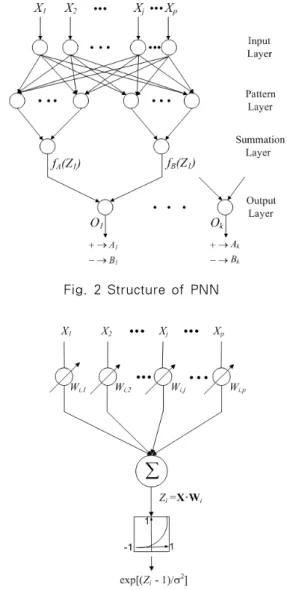
Fig. 2 shows the PNN organization for the classification of input patterns X into two categories.
Here, the input layer is merely the distribution units that supply the same input values to all of the pattern units. The second layer consists of a number of pattern units. Each pattern unit (shown in more detail in Fig. 3) forms a dot product of the input pattern vector X with a weight vector W , i Zi=X⋅Wi, and then performs a nonlinear operation on Z before i
outputting its activation level to the summation unit.
Instead of the sigmoid activation function commonly used for PNN, the nonlinear operation used here is
] ) 1 (
exp[ Zi− σ2 . Assuming that both X and W are i
normalized to unit length, this is the equivalent of using
-15 -10 -5 0 5 10 15 0
1 2 3 4 5
position
density function
The PDFs of variables The global PDF
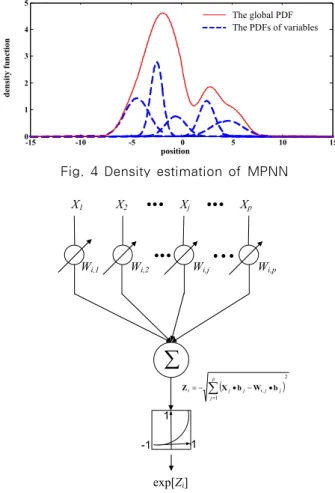
Fig. 4 Density estimation of MPNN
∑
1
-1 1
X1 X2 Xj Xp
Wi,1 Wi,2 Wi,j Wi,p
exp[Zi]
( )2
1
∑ ,
=
•
−
•
−
= p j
j j i j j
i X b W b
Z
Fig. 5 Pattern layer of MPNN
Northridge Earthquake
Structure
Displacement
Velocity MPNN Control force
Response
El Centro Hachinohe California KS artificial LQR control
State vector Control force Previous work Fig. 6 Control flowchart 2 ]
) ( )
exp[ ( 2
σ i
i T X W
W
X− −
− (10)
which is identical to Eq. (9) in form.
To compensate for the flaw of the conventional PNN using one global smoothing parameter, Berthold and Diamond (1998) suggested a constructive proba- bilistic neural network (CPNN) by taking different smoothing parameters for different patterns. Jin et al. (2002) applied the CPNN to classify the freeway traffic patterns for incident detection. However, the CPNN needed to consider a different probabilistic property for each variable.
The variables of training patterns, such as displa- cement (u ) and velocity (u& ), have individual standard deviations and different probabilistic properties.
However, the PDF did not consider the individual probabilistic property of variables in the PNN because only one smoothing parameter was used (Fig.
1). Therefore, in this paper, the MPNN is proposed to reflect the global probability density function. This
is done by summing the heterogeneous local PDFs automatically determined in the individual standard deviation of the variables (Fig. 4). The basic idea is to individually use the heterogeneous local PDF in a variable, as the probabilistic property of variables is not homogenous but heterogeneous. The individual PDF is derived from the standard deviation of the variables. The PDF for the i sample is determined to th sum different standard deviations of the training vector with j variable (Fig. 5). Therefore, the nonlinear th operation of the MPNN can be expressed as
( )
⎪⎭
⎪⎬
⎫
⎪⎩
⎪⎨
⎧
•
−
•
−
=
∑
=
2
1 ,
exp ) (
p
j j j ij j
f X X b W b (11)
where
j
j σ
b = −log(0.5) (12)
where i and j are indices for the i training pattern th and j variable; p is the number of variables; th X j
is the j variable of input data; th Wi,j is the j th variable of the i training vector; th bjis the bias of the j variable; and th σj is the standard deviation of the j variable.th
2.3 Active control using MPNN
The rule base of the MPNN needs to be formulated for applying the method for vibration control of a structure. The state vector and the control force are considered as input and output respectively for developing the rule base in the present study. A linear quadratic regulator (Sage and White, 1977)
t, Northridge + +
+ MATLAB
Function
MPNN
Lc*u Control force
State
A*u Z=Int[Az+LcFc+LeFe]
A Lc
1
s
Response Earthquake
K*u Le
state vector
Fig. 7 Block diagram of MPNN controller
Fig. 8 Three story shear building
0 2 4 6 8
-0.015 -0.01 -0.005 0 0.005 0.01 0.015
time(sec)
Displacement(m)
The first floor uncontrolled PNN control
0 2 4 6 8
-0.015 -0.01 -0.005 0 0.005 0.01 0.015
time(sec)
Displacement(m)
The first floor uncontrolled MPNN control
(a) First floor
0 2 4 6 8
-0.015 -0.01 -0.005 0 0.005 0.01 0.015
time(sec)
Displacement(m)
The second floor uncontrolled PNN control
0 2 4 6 8
-0.015 -0.01 -0.005 0 0.005 0.01 0.015
time(sec)
Displacement(m)
The second floor uncontrolled MPNN control
(b) Second floor
0 2 4 6 8
-0.015 -0.01 -0.005 0 0.005 0.01 0.015
time(sec)
Displacement(m)
The third floor uncontrolled PNN control
0 2 4 6 8
-0.015 -0.01 -0.005 0 0.005 0.01 0.015
time(sec)
Displacement(m)
The third floor uncontrolled MPNN control
(c) Third floor
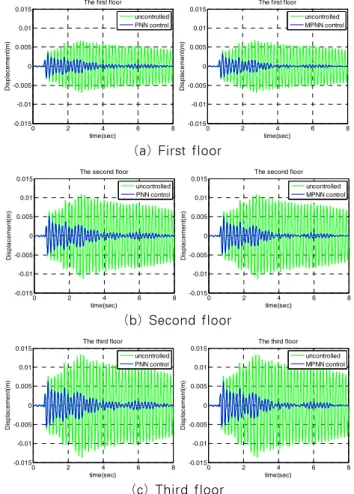
Fig. 9 Displacement time history of structure subjected to Northbridge earthquake (0.344g)
control algorithm is adopted for deriving the state vector and control force for arbitrary earthquakes.
The proposed MPNN control algorithm is then applied to new earthquakes. Probabilistically, the most suitable control force measuring the Euclidian distance between the training pattern and the state vector about new earthquakes is produced by MPNN. The application of MPNN, therefore, reduces the structural vibration by means of suitable control force. The basic control flow chart and the block diagram of the corresponding MPNN controller are depicted in Figs. 6~7.
3. Numerical Application
To illustrate the proposed method, a model of a three-story shear building with the active tendon control system is considered as shown in Fig. 8. The state vector of the structure and the control force that are derived by LQR algorithm under El Centro, Hachinohe, California and KS artificial earthquakes
are used as training patterns of the MPNN. Then, Northridge earthquake is used to verify the proposed MPNN control algorithm.
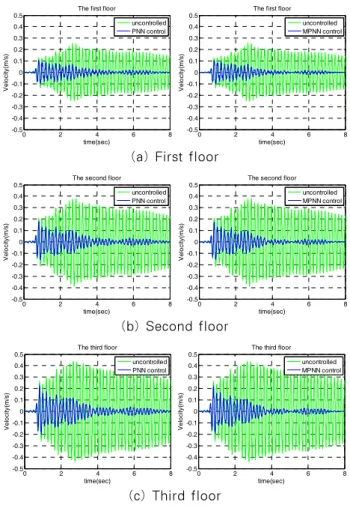
In this section, the control capability of the MPNN is compared with that of the PNN. Controlled and uncontrolled responses under Northridge earthquake are shown in Figs. 9~10. From the figures, the structural displacement and velocity responses have been suppressed effectively by both control algorithms.
0 2 4 6 8 -0.5
-0.4 -0.3 -0.2 -0.1 0 0.1 0.2 0.3 0.4 0.5
time(sec)
Velocity(m/s)
The first floor
uncontrolled PNN control
0 2 4 6 8
-0.5 -0.4 -0.3 -0.2 -0.1 0 0.1 0.2 0.3 0.4 0.5
time(sec)
Velocity(m/s)
The first floor uncontrolled MPNN control
(a) First floor
0 2 4 6 8
-0.5 -0.4 -0.3 -0.2 -0.1 0 0.1 0.2 0.3 0.4 0.5
time(sec)
Velocity(m/s)
The second floor uncontrolled PNN control
0 2 4 6 8
-0.5 -0.4 -0.3 -0.2 -0.1 0 0.1 0.2 0.3 0.4 0.5
time(sec)
Velocity(m/s)
The second floor uncontrolled MPNN control
(b) Second floor
0 2 4 6 8
-0.5 -0.4 -0.3 -0.2 -0.1 0 0.1 0.2 0.3 0.4 0.5
time(sec)
Velocity(m/s)
The third floor uncontrolled PNN control
0 2 4 6 8
-0.5 -0.4 -0.3 -0.2 -0.1 0 0.1 0.2 0.3 0.4 0.5
time(sec)
Velocity(m/s)
The third floor uncontrolled MPNN control
(c) Third floor
Fig. 10 Velocity time history of structure subjected to Northbridge earthquake (0.344g)
Probabilistic Neural network
Modified Probabilistic Neural network
1 story 54.4968 54.8488
2 story 54.0989 54.6452
3 story 51.9469 53.0763
Table 1 The decreasing rates of the maximum displacement of PNN and MPNN
Probabilistic Neural network
Modified Probabilistic Neural network
1 story 49.2187 50.4752
2 story 54.0199 54.4921
3 story 57.7344 58.0238
Table 2 The decreasing rates of the maximum velocity of MPNN and PNN
Tables 1~2 show the decreasing rates of the maximum displacement and velocity of MPNN and PNN. These results prove that the vibrations of a three-story shear building model under Northridge earthquake are more effectively controlled by MPNN than PNN.
4. Conclusions
In this study, a simple and robust method using the MPNN is proposed for vibration control of structures subjected to earthquakes. MPNN using a heterogeneous local PDF for training patterns is applied instead of the conventional PNN that uses homogenous local PDF. While the PNN calculates the global PDF by using one smoothing parameter defined by the user, MPNN automatically calculates the global PDF by using the standard deviation of a respective variable. The proposed algorithm is applied and verified for the vibration control of a three-story shear building model under earthquakes. When the control results of the MPNN are compared with those of conventional PNN to verify the control performance, the MPNN controller shows better performance than PNN methods in decreasing the structural responses.
Acknowledgements
This research was supported by Basic Science Research Program through the National Research Foundation of Korea (NRF) funded by the Ministry of Education, Science and Technology (No. 2010- 0013642).
References
Bani-Hani, K., Ghaboussi, J. (1998) Nonlinear Structural Control using Neural Networks, ASCE Journal of Engineering Mechanics, 124(3), pp.319
~328.
Berthold, M.R., Diamond, J. (1998) Constructive Training of Probabilistic Neural Networks, Neuro- computing, 19, pp.167~183.
Cacoullos, T. (1966) Estimation of a Multivariate Density, Tokyo, Annals of the Institute of Sta- tistical Mathematics, 8(2), pp.179~189.
Chang, S., Kim, D., Chang, S., Cho, S.G. (2009) Active Response Control of an Offshore Structure under Wave Loads using a Modified Probabilistic Neural Network, Journal of Marine Science and Technology, 14(2), pp.240~247.
Chen, H.M., Tsai, K.H., Qi, G.Z., Yang, J.C.S., Amini, F. (1995) Neural Network for Structural Control, ASCE Journal of Computation in Civil Engineering, 9(2), pp.168~176.
Ghaboussi, J., Joghataie, A. (1995) Active Control of Structure using Neural Networks, ASCE Journal of Engineering Mechanics, 121(4), pp.555~567.
Ghaboussi, J., Garrett, J.H., Wu, X. (1991) Knowledge-based Modeling of Material Behavior with Neural Network, ASCE Journal of Engi- neering of Mechanics, 117(1), pp.132~153.
Jin, X., Cheu, R.L., Srinivasan, D. (2002) Deve- lopment and Adaptation of Constructive Proba- bilistic Neural Network in Freeway Incident Detec- tion, Transportation Research Part C, 10, pp.121
~147.
Kim, D.K., Kim, D.H., Chang, S.K., Chang, S.K.
(2007b) Modified Probabilistic Neural Network Considering Heterogeneous Probabilistic Density Functions in the Design of Breakwater, Coastal and Harbor Engineering, KSCE Journal of Civil Engineering, 11(2), pp.65~71.
Kim, D.K., Lee, J.J., Chang, S.K., Choi, I.J.
(2007a) Active Control for Seismic Response Reduction Using Probabilistic Neural Network, Journal of the Korea Institute for Structural Main- tenance Inspection, 11(1), pp.103~112.
Kim, D.H., Oh, J.W., Lee, I.W. (2002) Cerebellar Model Articulation Controller(CMAC) for Suppre-
ssion of Structural Vibration, Journal of Computing in Civil Engineering, ASCE, 16(4), pp.291~298.
Kim, D.H., Seo, S.N., Lee, I.W. (2004) Optimal Neurocontroller for Nonlinear Benchmark Structure, ASCE Journal of Engineering Mechanics, 130, pp.424~429.
Kim, D.K. (2005), Dynamics of Structures, Goomibook Inc., Seoul, pp.437~438.
Madan, A. (2005) Vibration Control of Building Structures using Self-Organizing and Self-Learning Neural Networks, Journal of Sound and Vibration, 287(4/5), pp.759~784.
Parzen, E. (1962) On Estimation of a Probability Density Function and Mode, Annals of Mathematical Statistics, 33(3), pp.1065~1076.
Sage, A.P., White, C.C. (1977) Optimum System Control, 2nd edition Prentice Hall.
Specht, D.F. (1990) Probabilistic Neural Networks, Neural Networks, 3(1), pp.109~118.
Van Trees, H.L. (1968) Detection, Estimation, and Modulation Theory. Part I, New York, Wiley.
논문접수일 2010년 10월 30일
논문심사일 2010년 11월 4일
게재확정일 2010년 12월 6일